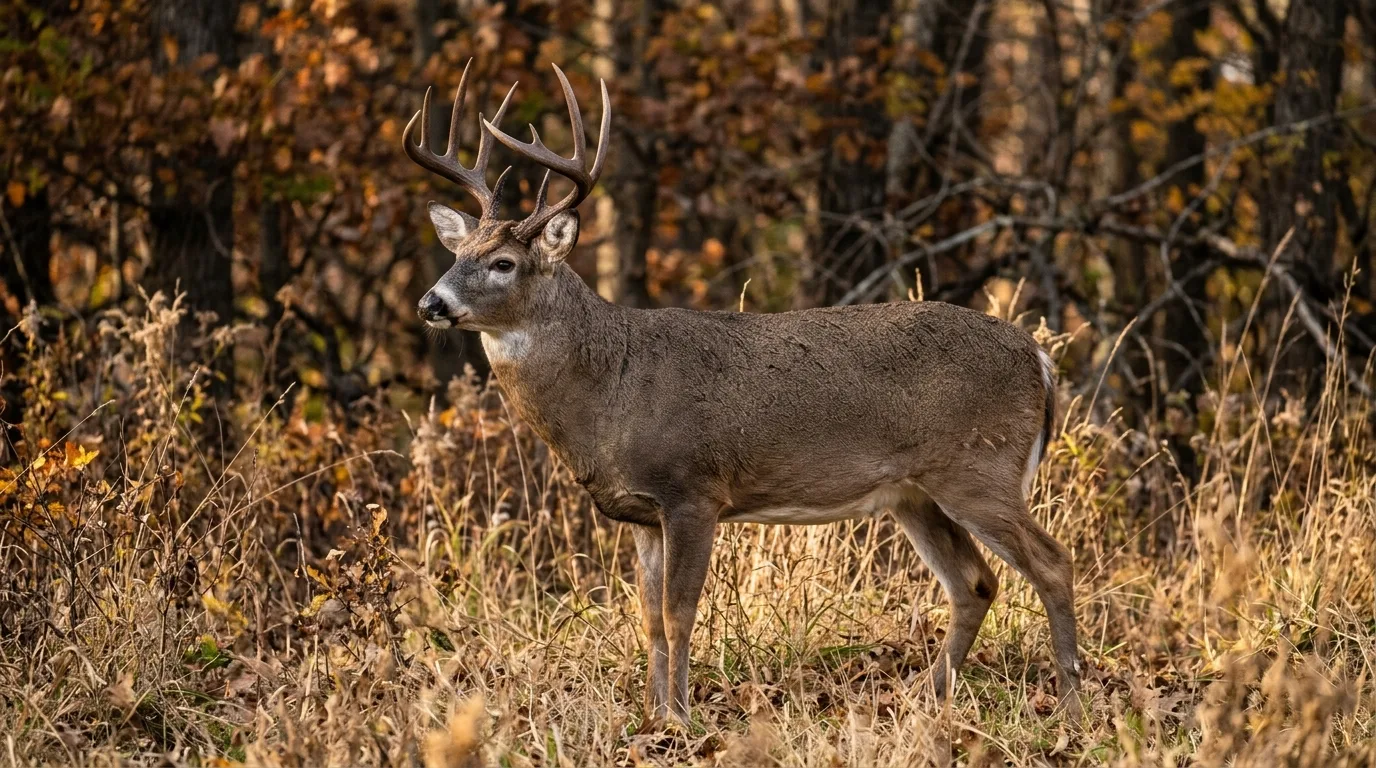
The first thing you look at when a buck steps into the frame is the antlers. Of course it is. Even the biologists admit it. "I'm no different than anyone," says Kip Adams of the National Deer Association — the first thing he looks at is the rack. The problem is that the rack is also the thing most likely to lie to you about the animal's age. Put a 2.5-year-old's antlers on a small-bodied southern deer and he looks like a giant; put that same rack on a big-bodied Canadian buck and it looks tiny. The antlers tell you what's on his head this year. They don't tell you how many years he's had.
So if you actually want to know whether the buck on your trail camera is a yearling you should leave alone or a mature deer worth a tag, you have to learn to read his body — the legs, the chest, the belly, the neck — and treat the antlers as, at most, a tie-breaker. That's how to age a buck on the hoof, and it's a skill most hunters considered impossible a decade ago.
Here's the honest short version, the part you can use before you finish scrolling. You can reliably sort bucks into young and mature from a good broadside photo, and that's genuinely useful — it's all you need to pass young deer and target old ones. What you cannot do, no matter how good you get, is reliably call a buck's exact age once he's past about three and a half. Even the pros can't. So aim for the right bucket, not the right candle count, and let the camera do what your eyes in a five-second field encounter can't.
The antlers tell you what's on his head this year. They don't tell you how many years he's had.
Why the antlers lie to you
It's worth sitting with this, because it's the hardest habit to break. Antler size is driven by a "complex interaction of age, nutrition, and genetics," with the first two doing most of the work. A buck on rich farmland soil grows a bigger rack at every age than the same buck would on poor ground. So a rack tells you about his groceries and his genes as much as his birthdays.
The research is blunt about it. In South Texas, antler size at 1.5 years does not predict antler size at maturity — a yearling spike can carry eight or more points years later. The Texas Parks and Wildlife known-age facility at Kerr WMA makes the same point with a single photo that should be taped inside every deer-camp door: a 1.5-year-old buck that weighed 136 pounds and grew 12 points with a 20¼-inch spread, scoring 133⅝ gross Boone and Crockett. A yearling. Their guide hammers it home in the kind of all-caps that tells you a frustrated biologist wrote it: "The size of the antlers is not always a good indicator of age!!!!!".
And it cuts both ways. Penn State's Deer-Forest Study likes to show off "Buck 12786" — a confirmed mature buck nobody would have guessed was at least 4.5, because his antlers were unremarkable. Big antlers on a young deer, small antlers on an old one: both push your estimate in the wrong direction. That's why the people who do this for a living read the body and then, in Adams's words, only factor in antlers "as a tie-breaker, when I'm on the fence".
The five body tells
There are really five things to look at. None of them is absolute on its own — you're weighing them together, and you're weighing them relative to other deer in your area, because a "big-bodied" buck in one region is a normal one in another. Take them as a set.
1. Leg length, relative to the body. This is the easiest one to see and a great place to start. Young bucks (1.5 to 2.5) have legs that look too long for them — gangly, like the chest hasn't filled in to match. At 3.5 the legs look about right for the body. By 4.5 and older, the legs start to look too short — and here's the trick: the legs aren't actually shorter, the deer's chest and body have just grown to take up more of the picture, so it's partly an optical illusion.
2. Rump versus chest. Look at the depth of the chest against the depth of the hindquarters. On a 1.5- or 2.5-year-old, the rump looks heavier than the chest. By 3.5 the chest is catching up and starting to look deeper than the rump. On a mature buck the chest clearly out-masses the hindquarters — the whole front end is the big end.
3. Belly and waistline. Young bucks are tight and lean in the gut. The tell for a mature buck is that the belly sags and the waist — the area just in front of the hind legs — drops down until it's even with, or below, the line of the chest. Adams describes the fully mature gut as "barrel-like". The oldest bucks carry an outright pot belly and a sagging back.
4. Neck, and where it joins the chest. This is Adams's personal favorite, and the one he finds most consistent with age. A yearling's neck is thin and connects high on the chest, with a clear line of separation between neck and shoulder. Each year the neck thickens and connects lower, until at 5.5 to 6.5 it seems to flow seamlessly into the chest with no junction at all. During the rut the neck swells dramatically — which is exactly why the rut is the best time to judge one.
5. Tarsal staining — but only during the rut. The dark stain on the inside of the hind legs, from rub-urinating, deepens with age and breeding activity. A yearling shows little to none; a 2.5 shows some, but not dark; by 3.5 it's heavy; and on a 4.5-plus buck the stain can extend well below the gland itself. It's a strong supporting signal in November and useless in July.
Read the body relative to other deer where you hunt — a "big" buck in one place is an ordinary one a state away.
A field guide by age class
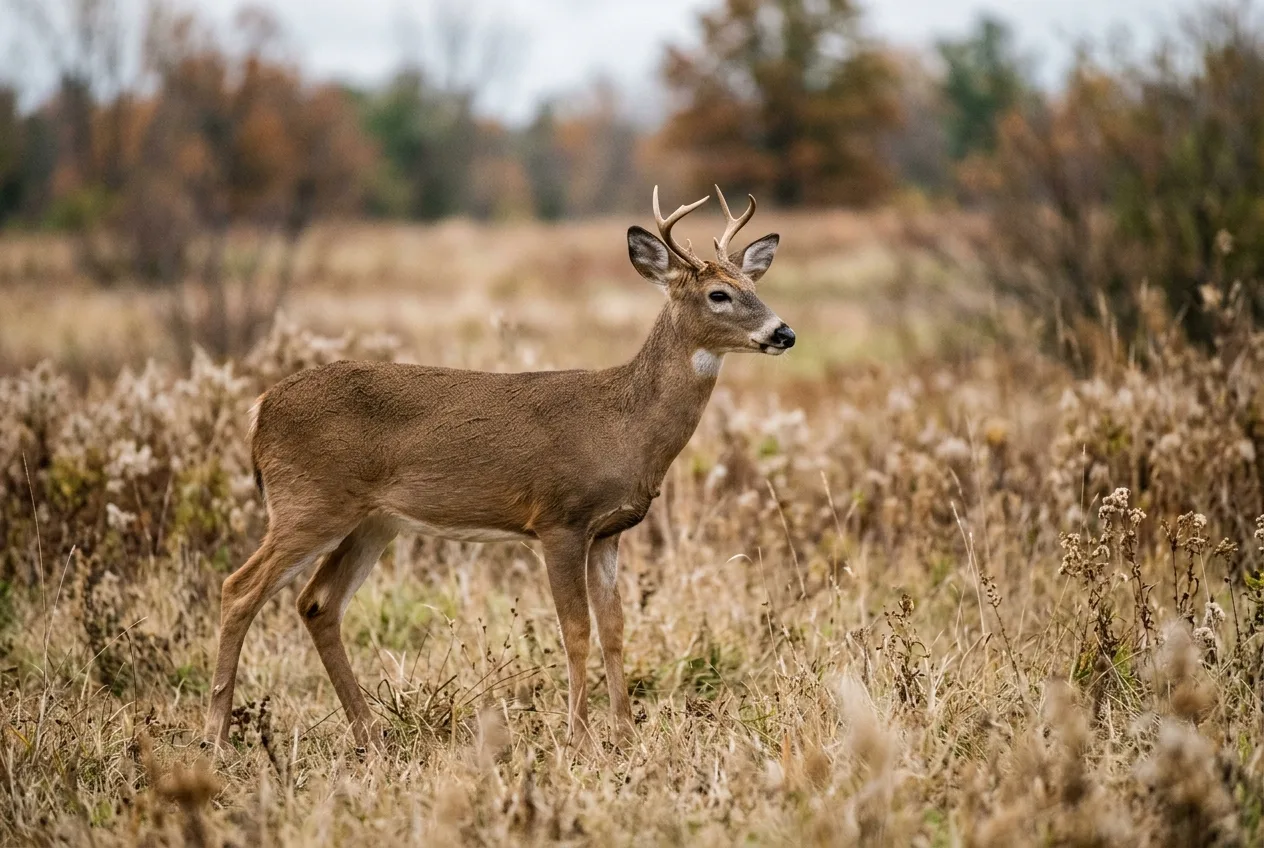
Put the five tells together and each age class has a recognizable look. These descriptions come straight from the extension and biologist guides, several of them built on known-age research deer, so they're as close to a standard as this inexact art has.
| Age class | Body shape and the key tells | Antlers (rough, region-dependent) |
|---|---|---|
| 1.5 (yearling) | A "doe with antlers." Thin neck, thin hindquarters, long thin legs, lanky — a teenage boy who hasn't filled in. Spread almost always inside the ear tips. | ~25% of lifetime size; antlers roughly double from 1.5 to 2.5. |
| 2.5 | Still looks long-legged and sleek; some shoulder muscle; neck swells only slightly in the rut; waist still thin. Easily mistaken for a yearling. | ~60% of lifetime size. |
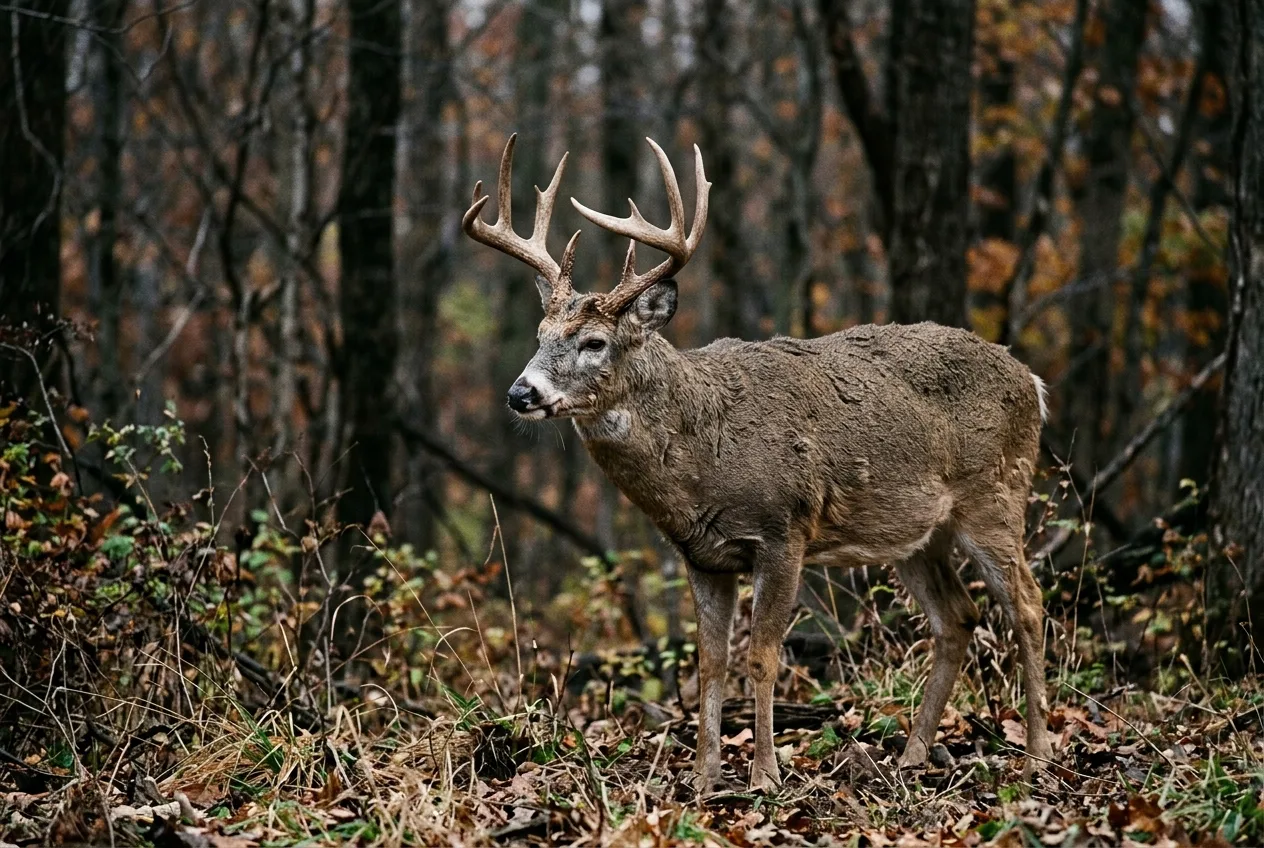
| 3.5 | The "racehorse" or "linebacker" — muscled shoulders, thickly swollen neck in the rut, deep chest, but still a lean waist. Often mistaken for mature. | ~75% of size; some sources say most have hit 50–75% of potential by now. |
| 4.5 | Physiologically mature. Lost the racehorse look; neck blends into the shoulders; waistline dropped to even with the chest; legs look too short; back still straight, belly only a slight sag. | ~90% of size. |
| 5.5–6.5 (prime) | Front half is "one large mass," neck flows into the shoulders, sagging belly, squinty eyes, often battle scars; can look "like a small cow". | Peaks around 5.5–6.5, then may decline. |
| 7.5+ (post-mature) | Reverts and can fool you into guessing younger: muscle lost from the neck, swayed back, pot belly, loose skin and a "chin flap," pointed hip/shoulder bones. | Declines with age. |
Two cautions worth pulling out of the table. First, the 3.5-year-old is the great impostor — muscled and big-necked enough that hunters routinely shoot him thinking he's older. The waist is your giveaway: at 3.5 it's still lean, while a 4.5 has that dropped, chest-level gut. Second, the 7.5-plus buck runs the trick in reverse, losing condition until he reads like a younger deer — which is one more reason exact aging gets harder, not easier, at the top end.
If all of that feels like a lot to weigh in the moment, it is — and that's the honest case for not trying to split 4.5 from 5.5 in the field at all. For most management, sorting every buck into yearling, 2.5, or "3.5 and older" is enough to make good decisions. Nail those three and you can run a program.
Don't forget the does (and the button bucks)
Aging on the hoof isn't only about trophy decisions. If you're shooting does to balance a herd, the costliest mistake is dropping a button buck you thought was a doe. A few quick checks: an adult doe has a long, slender snout and a rectangular body; a fawn has a short, stocky snout and a squarish body. A buck fawn's head is flattened on top by the developing antler pedicles, where a doe's head is more rounded between the ears. And don't shoot the loner — adult does travel in family groups, and the curious deer that steps into the opening first is often the button buck. When in doubt, wait for a better look.
Why the rut is the right window
The same buck looks like different animals across the year, so when you judge him matters almost as much as how. His best condition is the pre-rut, after a spring and summer of feeding in bachelor groups. Then the rut runs him down: a mature buck can lose up to a quarter of his body weight chasing does. By the post-rut he's gaunt and worn.
The catch is that the two clearest age signals — neck swelling and tarsal staining — only show up during the rut. So there's a sweet spot. As Adams puts it, "in the summer bucks are skinny, with small necks," and "in the post-rut, they've lost a bunch of weight," but "during the late pre-rut and for several weeks after, bucks are at their physical peak and the body characteristics of different age classes are most visible". Aging a deer in November is much easier than in May or January.
How accurate is any of this, really?
Here's where a lot of "age your buck" articles go quiet, and where you deserve the straight story. Aging on the hoof is, in the phrase nearly every biologist reaches for, "more art than science".
Put a number on it. In the most-cited test of this skill, researchers (Gee et al., Wildlife Society Bulletin, 2014) showed photographs of 70 known-age wild whitetails to about 100 wildlife biologists and enthusiasts. The average score was 36% correct, with individuals ranging from 16% to 56%. These are people who age deer for a living, and they got two out of three wrong on exact age. And the accuracy isn't spread evenly — it collapses with age. Reproduced from that work, the share scored correctly by age class runs like this:
| Known age | Correctly identified (from photos) |
|---|---|
| 1.5 | 62% |
| 2.5 | 43% |
| 3.5 | 25% |
| 4.5 | 30% |
| 5.5 | 25% |
| 6.5 | 15% |
| 7.5 | 7% |
| 10.5 | 2% |
Notice the shape: you're better than a coin flip on yearlings, and barely better than noise by middle age. That pattern shows up again when scientists build statistical models from precise body measurements off photos — not eyeballs, actual morphometric ratios. One such model (Flinn et al.) correctly assigned 75% of 1.5-year-olds and 86% of 2.5-year-olds before the breeding season, but only 40% of 3.5-year-olds and — this is the line that sticks — 0% of the 4.5-year-olds. "0% (NONE!)," as the Penn State biologist wrote, using a model with real measurements. After the rut the same model did a bit better on the older classes (53% at 3.5, but still only 14% at 4.5). The takeaway isn't that the method is junk — it's that the honest unit of measurement is the age bracket, especially "young vs. mature," not the exact year.
Even the professionals get the exact age wrong about two times out of three — so aim for the right bracket, not the right number.
None of that makes the skill pointless. Quite the opposite: every one of those guides says practicing it sharpens your eye and improves your harvest decisions in the majority of cases. It just means you should hold your estimate loosely, and lean on it for young-or-mature calls where it's strong, not for bragging about a buck's exact age where it isn't.
Where trail-camera photos help — and where they fool you
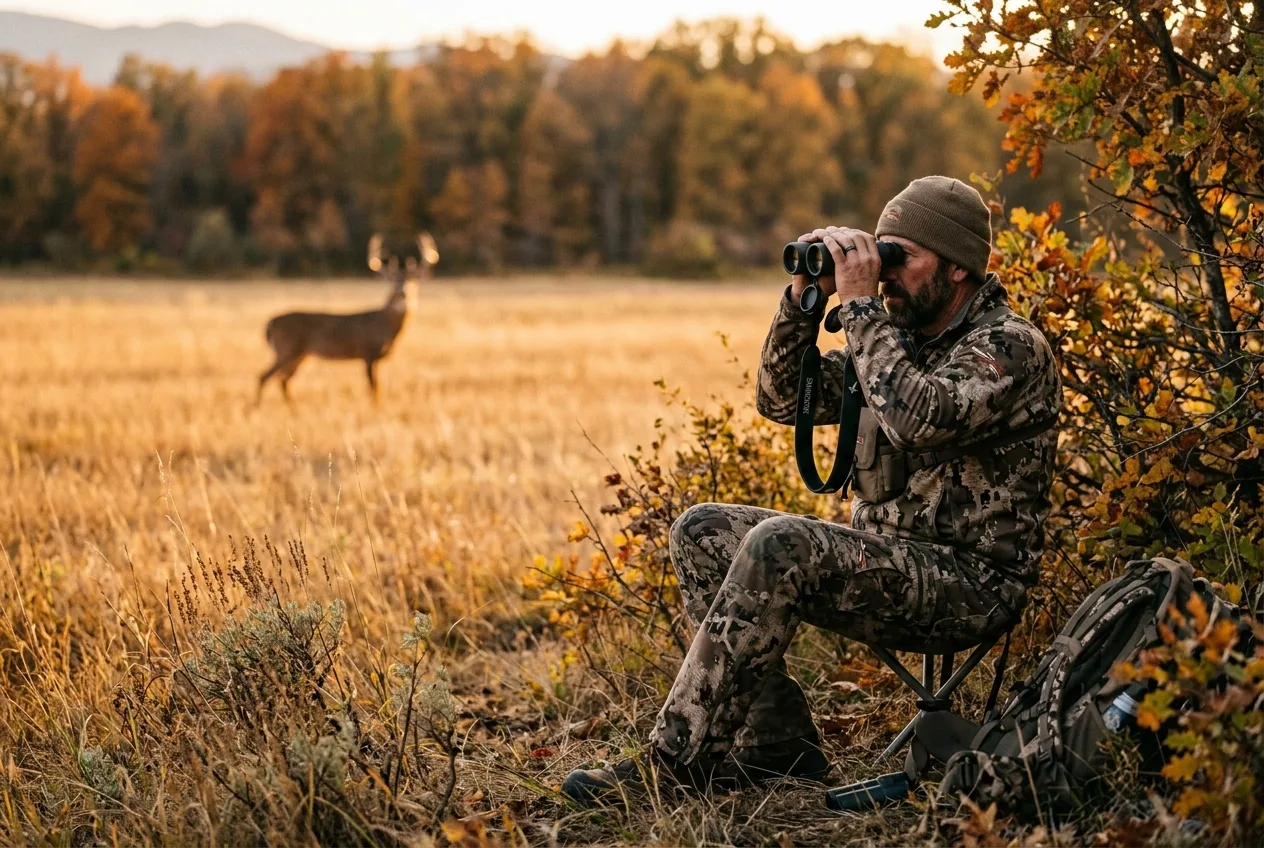
A live buck in the timber gives you a few seconds, often at a bad angle that hides the neck or the hindquarters you most need to see. A trail camera gives you something better: many frames, over days and weeks, of the same deer standing broadside in a food plot. That's why the extension guides increasingly frame body-aging around cameras at all — "trail camera photos allow hunters to estimate age of bucks before hunting", and the same physical criteria can be judged "from photos taken by infrared-triggered trail cameras" as in the field. The science backs the approach: paired with predictive models, remotely-triggered cameras can collect age and antler data "non-lethally" and with "less bias" than hunter-harvested samples, because the camera doesn't selectively skip the small-racked deer the way hunters do.
But cameras have one pitfall you have to respect, and it's the single most important habit in this whole article: never age a buck from one photo. Posture and angle deceive. Adams tells on himself with a perfect example — a buck whose stomach looked huge and round in one frame, which would read as a mature, barrel-bellied deer. Then a second photo of the same buck, taken literally five minutes later, shows a tight waist and a younger-looking animal. The "belly" was just the deer turning as the shutter fired. So gather the set. Look at several frames, ideally from different days and different stances, before you commit to an age.
This is exactly where a camera platform earns its keep. The bottleneck isn't taking the photos; it's pulling every shot of one particular buck out of thousands of frames across a season so you can study his body over time.
The ground truth: teeth, after the shot
Here's the reframe that keeps an honest hunter humble. Everything above is an estimate. The actual answer lives in the deer's teeth, and you can only read it once he's down — which makes the harvest the perfect moment to grade your own guess.
There are two tooth methods. The field-usable one is tooth replacement and wear (TRW), the "Severinghaus technique" developed on known-age New York deer in 1949. It works in two phases: an eruption phase (up to about 2.5 years), where you age by which teeth have come in, and a wear phase (3.5+), where you read how far the enamel has worn to expose the darker dentine. The eruption phase is rock-solid — it ages fawns, yearlings, and "2.5-or-older" reliably, by counting teeth, not judging wear. The wear phase is where it gets soft: tooth wear varies with grit, soil, and diet, so "aging a wild white-tailed deer older than 2.5 years old is only an approximation". Trained biologists hit roughly 80%-plus accuracy through about 4.5 years and then fade. And it's biased: across studies, wear-and-replacement tends to underestimate females and the younger classes while overestimating old bucks, which leaves managers with an impression of a younger herd than they actually have. In one known-age Texas test, biologists got 66.7% of ages right by TRW, and three-quarters of their misses ran older than the true age.
The more accurate method is cementum annuli (CA) — counting the seasonal growth rings laid down in the tooth root, light bands in summer and dark rings in winter, read under a microscope like the rings of a tree. You pull the two middle incisors, mail them to a lab, wait, and pay a fee — so it's a post-harvest tool, not a field one. It's the closest thing to ground truth: one known-age Wisconsin sample was aged 100% correctly by CA, and an Iowa study found two independent reads of the same deer agreed within one year 99% of the time. Field & Stream's write-up puts the practical numbers on it — Matson's Lab advertises up to 90% accuracy, at $75 for five teeth.
CA isn't magic either. Its accuracy is best in places with hard winters and falls off in the South, where the seasons that lay down the rings are muted; documented error rates run 15–28% in northern latitudes and worse below them. A small Texas known-age sample once had a lab age only 16% of incisors correctly, almost all of the misses younger than the truth — a reminder that no method is flawless and that southern deer are genuinely harder. The consensus that emerges across the studies is a sensible division of labor: TRW for separating yearlings from "2.5-and-older," and CA when you need the older deer aged more precisely.
If you want to actually get better at aging on the hoof, this is the feedback loop: estimate the buck's age from his body before the shot, then send a jawbone to a lab and find out how close you were. Do that for a few seasons in your own country, against your own soils and genetics, and your eye calibrates to the deer you actually hunt.
Frequently asked questions
Can you really tell a buck's age from a trail-camera photo?
You can reliably tell young from mature, which is what matters for passing yearlings and targeting old bucks — but not the exact year. Even experts get the exact age right only about a third of the time from photos, and accuracy drops sharply after 3.5 years.
What's the single best indicator of a buck's age?
The body, weighed as a set — but if you press a biologist, the neck wins: it thickens with age and connects lower on the chest each year, flowing seamlessly into the shoulders by 5.5–6.5. It's the trait most consistently tied to age. Antlers are the least reliable indicator and should only break a tie.
How do you tell a 3.5-year-old from a 4.5-year-old buck?
The waistline. A 3.5 is muscled and big-necked but still has a lean, tucked waist (the "racehorse" look); by 4.5 the waist has dropped to become even with the chest, the legs look too short, and the racehorse look is gone. It's a genuinely hard call, so get multiple photos and don't force it.
When is the best time of year to age a buck?
The late pre-rut and the few weeks of the rut. Neck swelling and tarsal staining — two of your clearest age signals — only appear then, and bucks are at peak condition. Summer (skinny, small-necked) and post-rut (run down, having lost up to a quarter of their body weight) are both poor windows.
Why shouldn't I use antler size to judge age?
Because antler size is driven by nutrition and genetics as much as age. A yearling can carry a big rack and a yearling spike can become an eight-pointer at maturity, so big antlers on a young deer and small antlers on an old one will both throw your estimate off.
How do I find out a buck's actual age after I shoot him?
Send the jawbone to a lab. Cementum annuli analysis counts the tooth's annual rings for up to about 90% accuracy (around $75 for five teeth); tooth wear-and-replacement is the simpler method but only an approximation past 2.5 years. Doing this is also the best way to check and sharpen your on-the-hoof estimates over time.