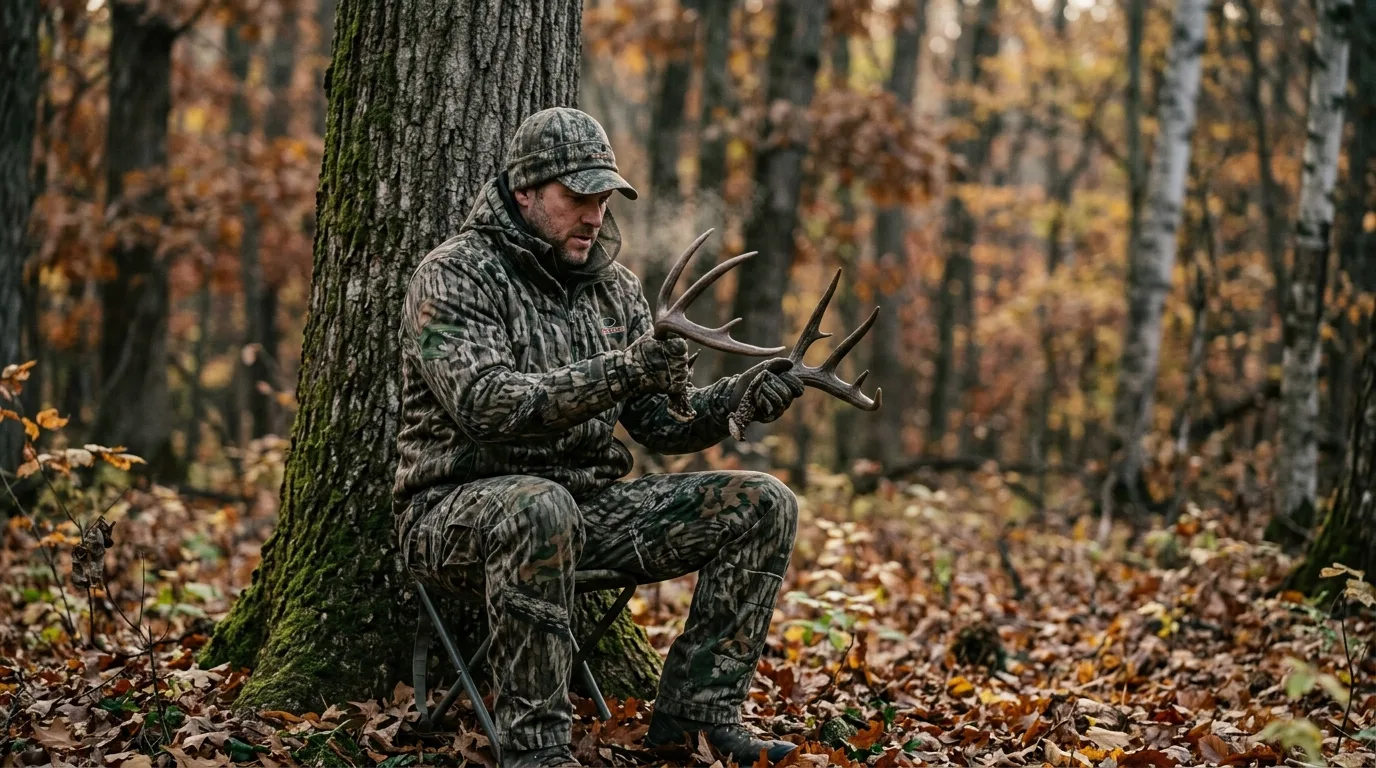
Bang a pair of antlers together in the woods and one of two things happens. A buck materializes out of the brush like you summoned him — or nothing comes, all day, and you start to wonder whether the whole thing is a campfire story hunters tell each other. Both are real. The trick is knowing which one you're set up for.
So let's answer the question straight, because most of what gets written about rattling is opinion dressed up as fact. Does rattling work for deer? Yes — and we can put a number on it. In a controlled three-year experiment on white-tailed deer in South Texas, researchers rattled 171 times and pulled in 111 bucks, an overall response rate of about 65 percent. Call it two responses for every three sequences. That's not folklore; that's a wildlife biologist with a video camera in an observation tower counting bucks.
But "65 percent" hides the part that actually matters to you in a treestand, which is that the response rate swung from nearly zero to better than one buck per attempt depending on when, how, and how loud the researchers rattled. Rattling isn't a coin you flip. It's a tool with a right time, a right volume, and a long list of conditions that quietly turn it off. This piece walks through what the research actually shows — and, just as honestly, when calling is a waste of breath.
What you're actually imitating when you rattle and call
Start with what the noise means to a deer, because that's the whole game. You're not making a random sound; you're impersonating a specific event the buck recognizes.
Rattling imitates two bucks meeting antlers. The thing most hunters get wrong is assuming that's always a fight. It usually isn't. Among male white-tailed deer, only about 2 to 10 percent of confrontations are classified as genuine aggressive fights. The rest is sparring — a lower-stakes shoving match that helps bucks sort out who ranks where, with no real aggression behind it. The two sound different, and that difference is the most useful lever you have. In the Texas study, the researchers deliberately built it into their method: during quiet sequences they "kept elbows against the body to avoid loud antler clashes to simulate two males sparring," and during loud ones they "increased volume by clashing antlers as hard as possible to simulate fights," even breaking branches and raking the ground beforehand to mimic a real brawl. So when you rattle softly you're saying two bucks are pushing each other around; when you rattle hard you're saying two big deer are trying to kill each other over a doe. Bucks respond to those two messages differently, and we'll get to which one wins.
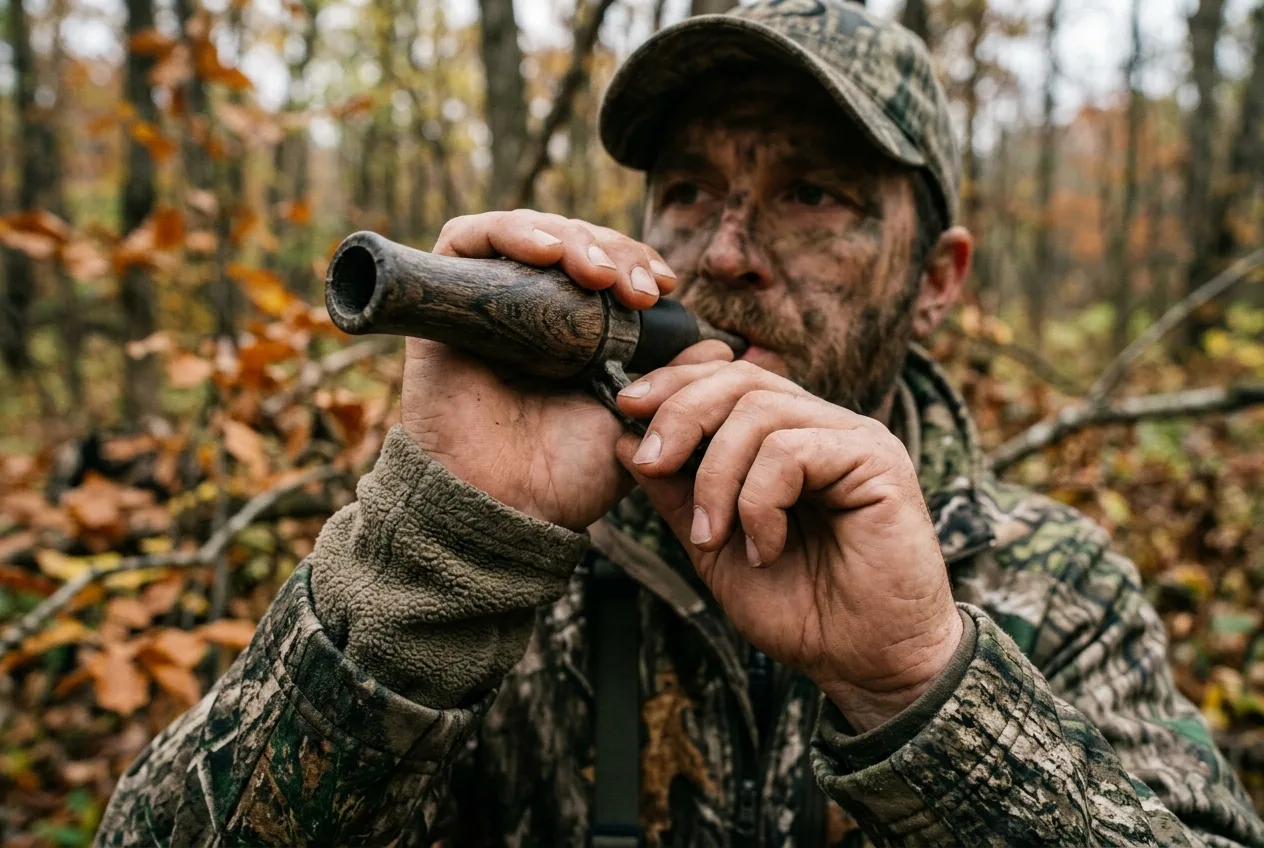
Calling is the same idea with your voice instead of antlers. Each call imitates a different deer in a different mood:
- The contact or social grunt is the everyday "I'm here" of the deer world — soft, passive, nothing aggressive about it, used by does and bucks to keep tabs on each other. It relaxes deer and works all season.
- The bleat is mostly a doe's call, a social sound she uses to stay in touch with other deer and especially her fawns; a buck that hears it often comes to check whether there's a doe worth investigating.
- The trailing grunt is a quick burst of short grunts a buck makes with almost every step as he follows a hot doe's scent trail, nose to the ground — classic pre-rut cruising behavior.
- The tending grunt is the deep, rhythmic, almost ticking sound a buck makes when he's actually with an estrous doe; one research buck was recorded tending for nearly six minutes straight. It signals dominance and a doe worth fighting over, which is exactly why it pulls in rivals.
- The snort-wheeze is the trump card — an aggressive challenge, often a short snort rolled straight into a drawn-out wheeze, a buck telling another buck to back off.
One caution that runs through all of this: a deeper grunt isn't just "louder," it reads as a bigger, older buck. Use a deep, guttural dominant grunt on a yearling and you'll likely watch him leave, because young bucks spend their lives getting bullied by mature ones and have learned to avoid that voice. The call has to fit the deer you're hoping to fool.
You're not making noise. You're telling a story a buck already knows the ending to — and he decides in seconds whether to come find out who's lying.
The controlled study: what the numbers really say
Almost everything trustworthy we know about rattling response traces back to one place — the Hellickson team's experiment on the Welder Wildlife Refuge in South Texas, run from 1992 to 1995 and published in the SEAFWA proceedings. It's worth understanding why this study carries so much weight. The refuge was chosen specifically for its high deer density and balanced sex and age ratios, and it had 17 ten-meter observation towers giving clear views. Two people ran every sequence the same way for consistency: one rattled from the brush, the other watched from the tower and filmed. That setup is the reason the numbers mean something — and it also produced the study's most humbling finding, which we'll come back to.
Here's the shape of it, pulled straight from the data tables.
| Factor | Best condition | What the data showed |
|---|---|---|
| Volume | Loud | Loud sequences drew nearly 3× the bucks of quiet ones; 73% of all responses came to a loud sequence |
| Rut phase | Peak rut | Prerut 0.30, rut 1.07, postrut 0.57 bucks per session — more than one buck per attempt at peak |
| Time of day | Morning | Morning sessions averaged 0.92 bucks vs 0.38 midday and 0.56 afternoon |
| Within a sequence | First 10 minutes | Most responses came in the opening segment (0.44), tapering to 0.34 then 0.22 |
| Duration | Didn't matter | Long and short rattling performed the same — volume mattered, length didn't |
Volume is the headline. "Loud rattling attracted nearly three times as many males as quiet rattling, but duration of rattling did not differ," the authors wrote. Bucks also responded faster to the loud sequences and came in looking more aggressive. Part of that is simple physics — a hard antler clash carries farther, so more deer hear it — but the researchers also suspect bucks tune out quiet rattling because soft sparring is just background noise during the pre-rut and post-rut, when it happens constantly. A real fight, by contrast, means a doe is near estrus, and that's worth investigating.
Rut phase is the close second, and it's where folklore actually gets something right. Response was lowest during the pre-rut and peaked hard during the rut — at peak, the researchers averaged more than one responding buck per session. The reason is competition: at the rut's height, bachelor groups have broken up, bucks are roaming alone, and a fight signals a breeding opportunity worth crashing.
Mornings beat the rest of the day. Most responses clustered into the morning window. The National Deer Association's summary of the same study puts it in plain percentages: 54 percent of responding bucks came between 7:30 and 10:30 a.m., versus 16 percent midday and 30 percent in the afternoon.
And weather nudges the odds. The study found responses generally increased when winds were light and fell as wind speed rose — calm air both carries the sound and, perhaps, makes a cautious buck more willing to commit. The plain-language summaries add that response climbed on cooler days and when cloud cover topped 75 percent. Nobody's entirely sure why cloud cover matters; one honest write-up shrugs that "we don't have to understand the why — just the how".
Now the humbling part. Remember the two-person method? The ground-level observer — the guy in the position you'd actually be hunting from — failed to see 57 percent of the bucks that responded. Better than half the deer that came to the antlers were never spotted by the person at ground level; only the elevated tower observer caught them. When the team rattled to radio-collared bucks they couldn't see at all, the true response rate jumped to 73 percent. The lesson isn't subtle: rattle from height where you can, keep your eyes moving, and assume more deer are responding than you'll ever lay eyes on.
More than half the bucks that answered the antlers were never seen by the man on the ground. Rattle blind and you'll swear it didn't work — when really, you just didn't look up in time.
Which bucks come — and why the biggest ones often don't
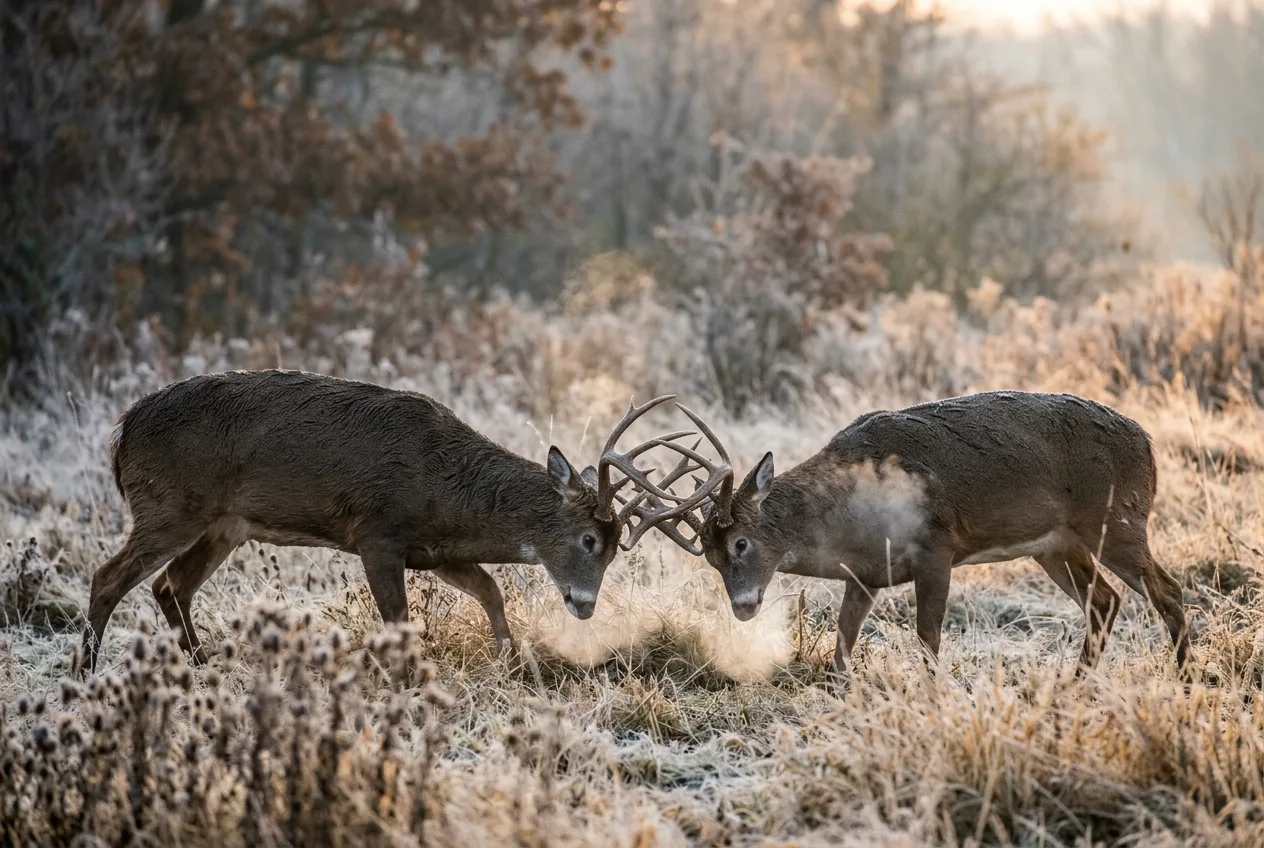
Here's the wrinkle that catches a lot of hunters off guard. The peak of the rut pulls the most bucks, but not necessarily the oldest ones.
In the Texas data, young bucks (1.5 to 2.5 years) responded at their highest rates during the pre-rut, middle-aged bucks (3.5 to 4.5) during the rut, and mature bucks (5.5 and older) at their best during the post-rut. Look at peak rut specifically and the mature class actually responded least. That sounds backwards until you read the authors' explanation: "Lower response rates of mature males during rut were likely because they were engaged in courtship of females". The oldest bucks weren't uninterested in a fight — they were already busy with does and couldn't be bothered to leave one for a scrap that might be nothing.
The NRA's American Hunter, quoting the study's lead author directly, frames the takeaway you can act on: rattling during the rut brings the most bucks, but "most of the bucks that responded during the rut were not considered among the most mature deer." If your goal is specifically an old buck, the pre-rut and post-rut are better windows — "though you shouldn't expect deer to come charging in" the way they do at peak. The NDA's summary of the post-rut numbers makes the same point with figures: as the rut winds down, the overall response rate drops to about 55 percent, but 69 percent of the bucks that do respond are 3.5 years or older — mature deer still prowling for the last unbred does.
So there's a genuine trade-off baked into the timing, and you get to choose which side of it you want:
- Want action and numbers? Rattle the peak. You'll likely pull a buck, but skewed young.
- Want a specific mature buck? Work the pre-rut and post-rut, rattle a little softer, and accept fewer, more cautious responses.
When rattling and calling backfire
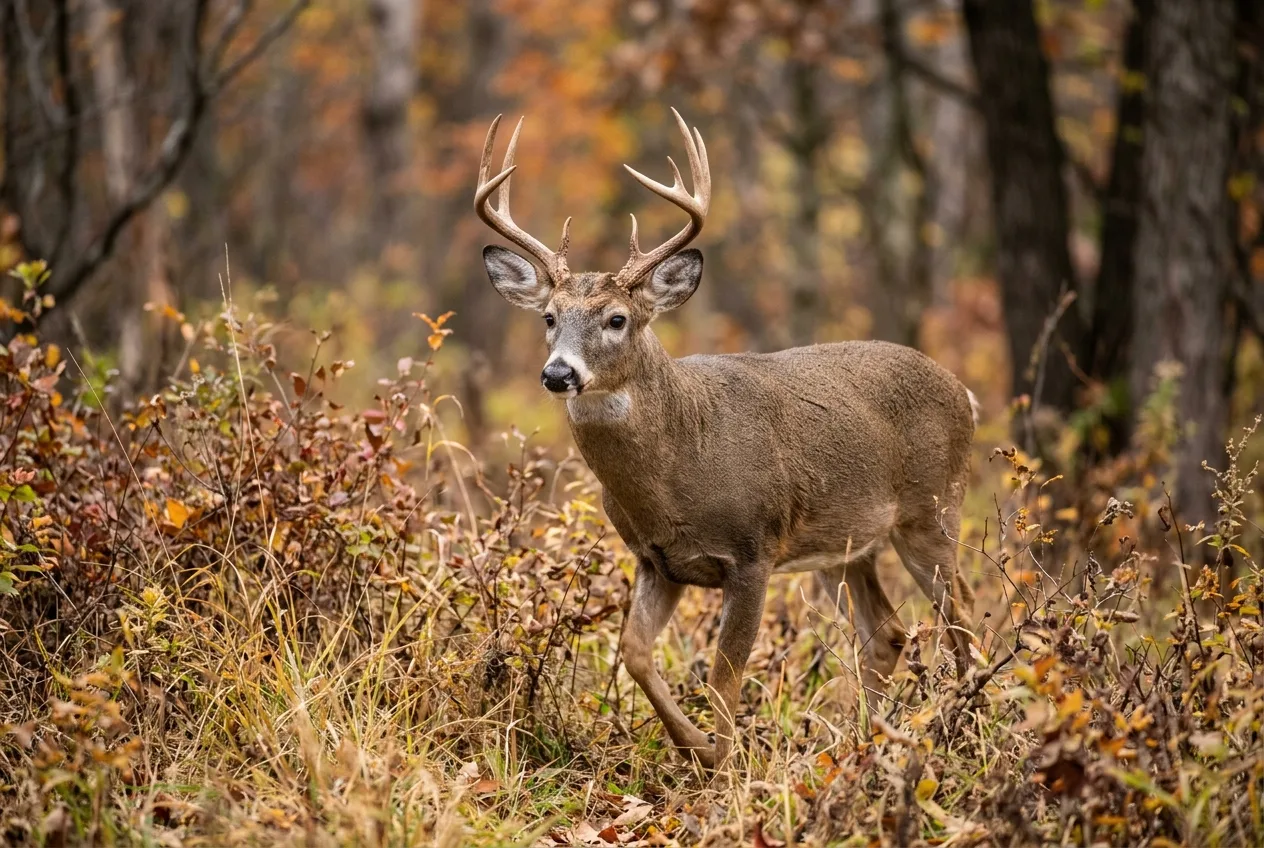
This is the section nobody writes, so it's the one worth reading twice. Rattling has a real failure mode, and it isn't random bad luck — it's predictable, and most of it comes down to the herd you're hunting and the moment you pick.
The buck is already locked on a doe. This is the single most common reason calling falls flat during the rut's best days. "If a whitetail buck is with a doe, especially an estrus doe, he will be very hard (if not impossible) to call within range," one veteran caller puts it bluntly. It's the same mechanism behind the study's low mature-buck response at peak: a buck who's found what everyone's fighting over has no reason to go looking for a fight. About the only thing that sometimes pulls him off is an aggressive snort-wheeze, which threatens to take the doe rather than just inviting a tussle. The deer biology backs this up — once peak rut arrives, hunters typically see fewer bucks because they're "courting and breeding receptive does, rather than searching" for them.
The herd is out of balance. A balanced buck-to-doe ratio with a real spread of ages produces a tight, intense, competitive rut — exactly the conditions that make bucks respond. Skew it, and the whole thing slackens. When mature bucks are too few, does don't all get bred on their first cycle, so they recycle weeks later and the rut smears out into a long, low-energy affair with little of the competition that drives a buck to your antlers. Wildlife managers have documented peak-breeding dates shifting by up to 30 days purely from changes in buck-to-doe ratio and age structure. Remember that the landmark study got its strong numbers on a refuge specifically chosen for balanced ratios and good age structure — your back forty may not behave the same way, and that's not your calling technique's fault.
The deer are young and few. The honest practitioner consensus, and it lines up with the biology, is that rattling works best where deer are dense enough to create competition and old enough to fight over does. One hunter who's rattled across the continent says plainly that if you think rattling only brings small bucks, "you hunt in an area with few mature bucks". Thin, young herds simply have fewer deer motivated to answer.
A note on the "you'll educate every deer in the woods" worry — the data is reassuring here. In the study's second experiment, researchers rattled repeatedly to known radio-collared bucks. In 13 of 14 cases a buck that had been rattled to before responded again on a later session, and one buck came to the antlers all four times they tried him. The authors' conclusion was flat: "Males apparently did not learn to avoid rattling". A hunter who rattled the same old Texas buck in twice in one week tells the same story from the stand. You can rattle a buck more than once. What you can't do is overcome a buck who's already with a doe, or a herd that doesn't have the deer to begin with.
Most "rattling doesn't work" stories aren't about technique. They're about a buck who already had a doe, or a herd that never had the competition to make him care.
How to rattle and call by rut phase
The reason this article talks in phases — pre-rut, peak, post-rut — instead of calendar dates is that the rut is a moving target, and where you hunt decides when it lands. The Texas breeding study found peak-rut dates ranging from late September in one region to late December in another, all within a single state. And lest anyone think the rut is a Northern-Hemisphere thing on a fixed schedule, free-ranging red deer studied in Patagonia rut in the Southern autumn, peaking in the last two weeks of March. "The rut" is whenever the does in your ground come into estrus — so read the phase, not the month.
Across the practitioner sources and the agency guidance, the phase-by-phase approach is remarkably consistent:
| Rut phase | What's happening | What to throw | How aggressive |
|---|---|---|---|
| Early / pre-season | Bucks still in bachelor groups, feeding patterns | Soft contact grunts, doe bleats, light antler tickling | Gentle — soft, non-aggressive sounds only |
| Pre-rut | Bucks cruising for the first hot does, getting territorial | Trailing grunts, doe bleats, moderate rattling | Building — moderate force |
| Peak rut | Bucks fighting and chasing; competition high | Tending grunts, estrous bleats, hard rattling, the occasional snort-wheeze | Loud and aggressive — turn it up |
| Post-rut | Deer shifting back to food; mature bucks seek last does | Softer grunts, doe bleats, lighter rattling | Toned down |
A few field mechanics that the sources agree on, regardless of phase:
Open soft, then commit. Whatever the phase, start a new setup quietly — a few grunts and a light tickle of the tines — in case a buck is already close, because leading with a loud crash can blow him out of the area. If nothing shows in a couple of minutes, escalate into a real, louder sequence.
Make it a scene, not just a clash. Real fighting bucks break brush, rake trees, and grind the dirt. Add that — rake the leaves with your boot, smack a sapling, keep a grunt tube in your mouth and hit it as you rattle. One inventive hunter even works an empty plastic bottle against the ground with his foot for extra crunch.
Then wait, and watch downwind. In the study, 60 percent of bucks were first spotted downwind of the rattler, circling to scent-check the fight before showing themselves. Set up with an open lane on your downwind side so you see them coming, and stay put through the quiet stretches — most responses come in the first ten minutes, but collared bucks kept drifting in on later sequences too.
It's worth saying the field experience isn't perfectly tidy. One hunter rattled in a dozen bucks before 9 a.m. one morning and not a single deer the next day from the same stand. Another reports bucks coming "from all directions," not just downwind. Rattling is a way to tilt the table, not to control it.
The study gives you the odds. The woods still get a vote.
Does any of this apply to deer that aren't whitetails?
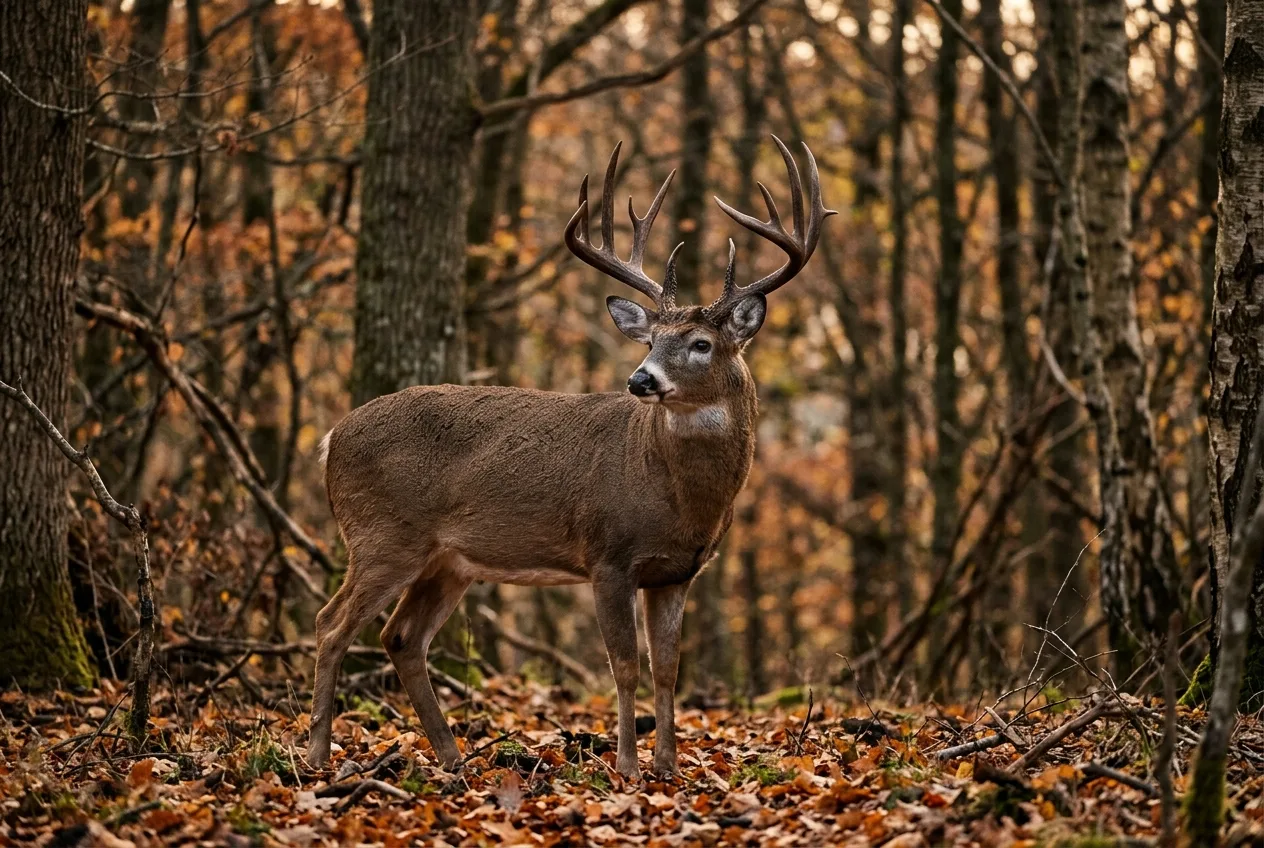
Mostly no — and this is where a lot of internet advice quietly oversteps, so it's worth being precise. Every response percentage in this article comes from white-tailed deer. Whitetails fight with their antlers and respond to the sound of other whitetails fighting, which is exactly why rattling works on them. Do not assume those numbers transfer to red deer, roe deer, fallow, sika, elk, or moose. They communicate differently, and in some cases the entire premise changes.
The clearest way to see it is in the voice. Across cervids, the frequency of the rutting call varies enormously: red deer roars run a low fundamental of about 107 Hz, fallow deer groans are lower still at around 28 Hz, while sika deer moans climb astonishingly high — into the hundreds and even past a thousand Hz. Elk go the other way from their red deer cousins entirely, replacing the roar with a high, whistling bugle that can reach roughly 1,000–1,200 Hz. A red deer roar and an elk bugle are produced by nearly identical anatomy and yet sound nothing alike. These are not whitetails with an accent; they're different signals doing different jobs.
The receiver differs too. In red deer, a stag sizing up a rival isn't listening to pitch at all — he's reading the formants, the resonance that honestly encodes body size, because a bigger stag can stretch his vocal tract longer and sound bigger. Playback experiments confirm stags essentially ignore a roar's fundamental frequency when judging an opponent. Hinds, interestingly, do attend to pitch and tend to prefer higher-pitched roars — a reminder that what a male call signals depends entirely on who's listening and why. The point for a caller is that imitating the wrong feature of the wrong species' call is just noise.
That said, the principle generalizes even when the numbers don't: calling other cervids works when you match the sound to the rut phase, exactly as with whitetails. Alaska's wildlife agency lays out moose calling as a phase-by-phase progression — soft, non-threatening "glucks" and antler-scraping on brush early; a deep, powerful bull challenge once mature bulls are sparring at mid-rut; and cow calls late, to pull lonely bulls when the breeding is winding down. Bull moose even thrash trees with their antlers as a dominance display, a rough analog to rattling. So the strategy — read the phase, simulate the right social event, escalate as competition peaks — is broadly a cervid principle. The specific recipe, and especially the response rates, are whitetail property. Treat them that way.
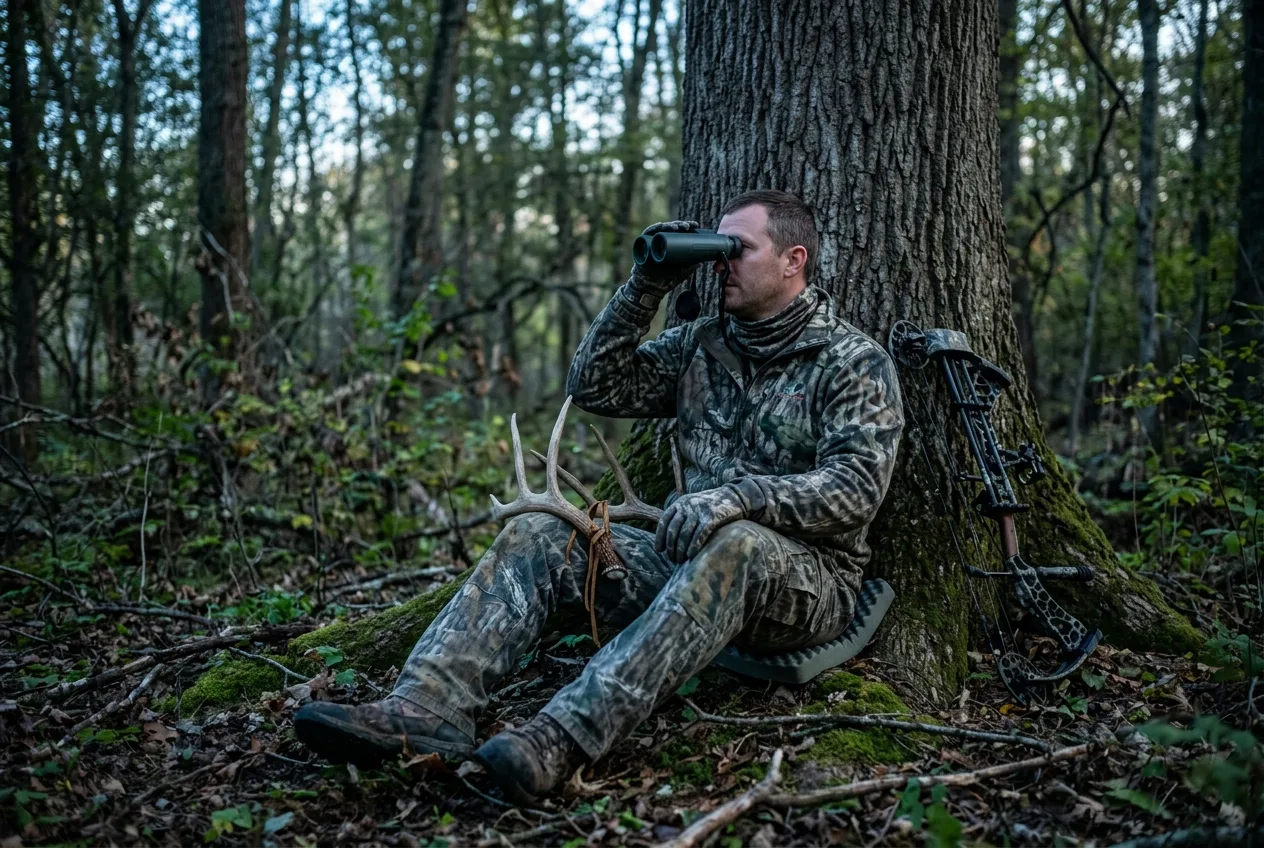
Where a trail camera fits
Rattling's biggest variable is the one thing you can't see: whether a buck worth calling is even in the area. The study is blunt that responses depend on "herd demographics" and visibility, and the failure modes above are mostly herd problems — not enough mature bucks, a buck already on a doe, deer moving only after dark. A camera network answers exactly those questions before you ever pick up the antlers. If your photos show mature bucks present and starting to move in daylight as the phase shifts, a calling sequence is a smart bet; if they show only young deer or strictly nocturnal movement, you've saved yourself a morning of rattling to an empty woods.
Frequently asked questions
Does rattling actually work for deer?
Yes. A controlled three-year study of white-tailed deer recorded about a 65 percent response rate over 171 rattling sequences — and 73 percent when tracking radio-collared bucks the observer often couldn't see. It's not guaranteed on any given attempt, but it's a real, repeatable tactic, not a myth.
When is the best time to rattle for deer?
By rut phase, the peak rut pulls the most bucks — the study averaged more than one responding buck per attempt then. By time of day, mornings dominate: over half of responses came between roughly 7:30 and 10:30 a.m.. Calm, cool, overcast conditions help. If you specifically want a mature buck, the pre-rut and post-rut tend to favor older deer.
Should I rattle loud or softly?
Loud, mostly. Aggressive rattling drew nearly three times as many bucks as quiet sparring in the study, and 73 percent of all responses came to a loud sequence. The common move is to open a new setup softly in case a buck is close, then build into a loud, aggressive sequence.
Can you rattle in the same buck more than once, or do they get educated?
You can. When researchers rattled repeatedly to known collared bucks, a buck responded again in 13 of 14 repeat cases, and the authors concluded the deer "did not learn to avoid rattling". The bigger obstacle isn't education — it's a buck that's already with a doe, which is very hard to call off.
Why didn't any bucks come when I rattled?
Usually one of three things: a buck nearby was already locked on a doe and wouldn't leave her; your herd has a skewed buck-to-doe ratio or too few mature bucks, which flattens the competition that drives responses; or you simply couldn't see the bucks that did respond — the ground observer in the study missed 57 percent of them.
Does rattling work on red deer, elk, or other deer?
Not the way it works on whitetails, and the response numbers here don't transfer — they're whitetail-specific. Other cervids call and fight differently (red deer roar near 107 Hz, elk bugle near 1,000 Hz, fallow groan near 28 Hz). The general principle of matching calls to the rut phase does carry across species, as agency moose-calling guidance shows, but treat the specific tactics and rates as whitetail knowledge.