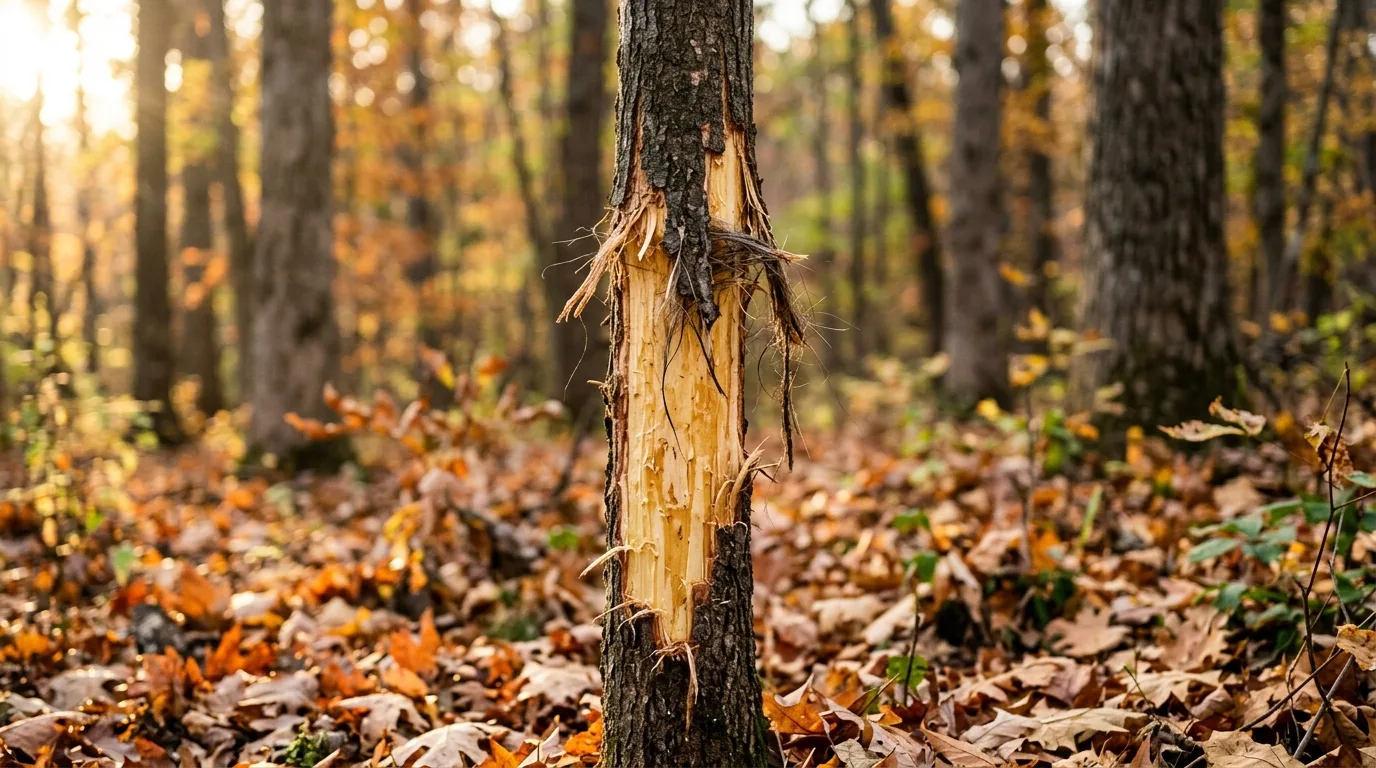
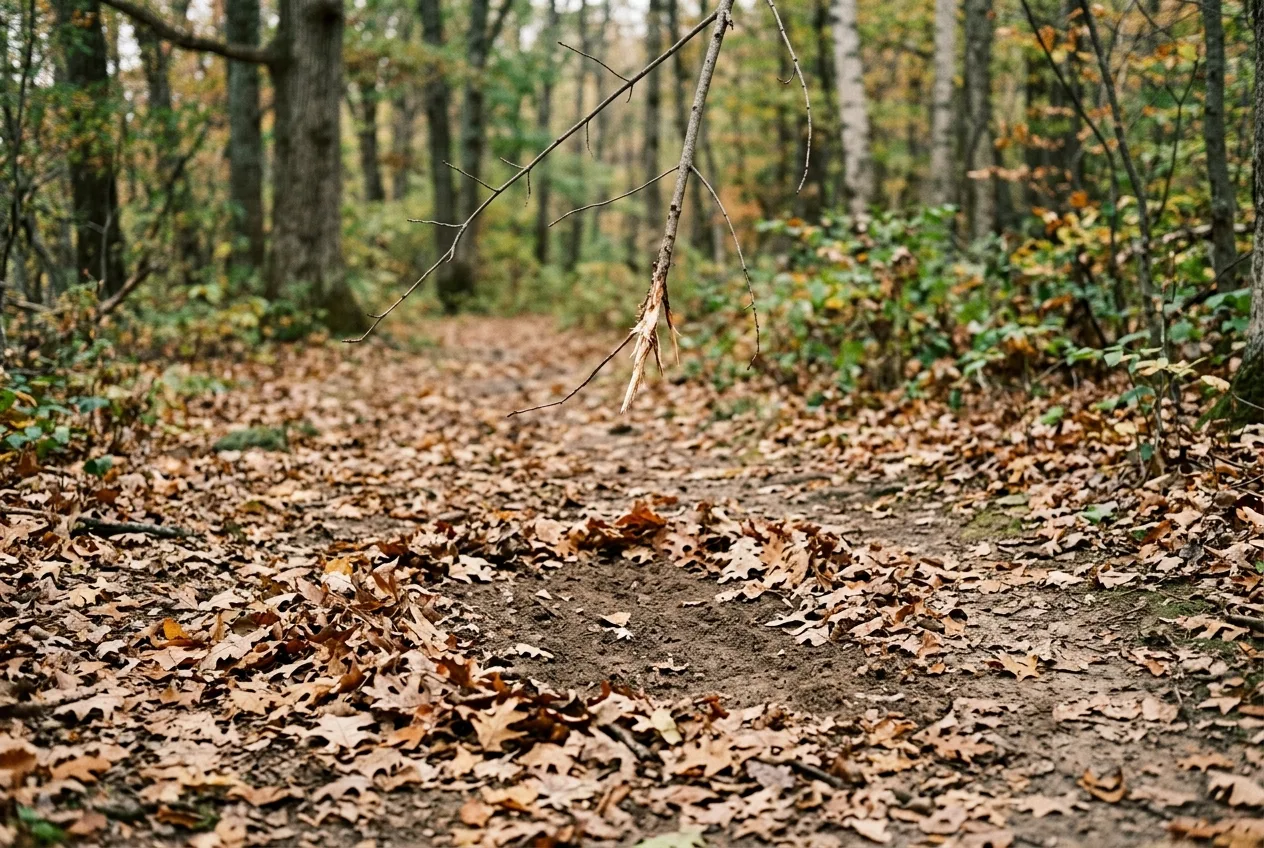
You walk a fall ridge and find two very different things. One is a sapling stripped down one side, the bright wood showing, a few hairs caught in the bark. The other is a patch of bare, pawed dirt under a low branch, the leaves kicked away in a circle. Both got made by a buck. Both are him talking. But they are not saying the same thing, and if you read them the same way you'll waste good hunts.
Here's the short version, the part you came for. A rub is a buck's signature — he rakes a tree with his antlers and forehead and leaves his scent and a bright visual mark behind, mostly to advertise that he exists and outrank whoever's reading it. A scrape is more like a community message board — a pawed circle of dirt under an overhanging "licking branch," where a buck (and plenty of does and other bucks) chew the branch, work it with their glands, and urinate in the dirt, leaving a scent every passerby can read for days. The rub is mostly about him. The scrape is about the whole neighborhood. Get that distinction and most of the confusion about buck sign falls away.
And here's the contrarian part most rut articles bury, so I'll put it up high: the scrape — the sign everybody romanticizes and hangs a stand over — is one of the worst places to actually catch a mature buck in daylight during the peak of the rut. The research is consistent that the vast majority of scrape activity happens after dark. Rubs and rub lines, read right, often tell you more about where to sit. We'll get to why.
What a rub actually is
Start with the simplest sign in the woods. A buck's antlers harden and the velvet dries up in late summer; by September the velvet is shed and rubbing begins. That first round of rubbing — during and just after velvet loss — is genuinely violent, the buck thrashing brush to clean the last skin off his rack. People assume that's the whole story, that a rub is just a buck scratching velvet. It isn't. Most rubs have nothing to do with velvet at all.
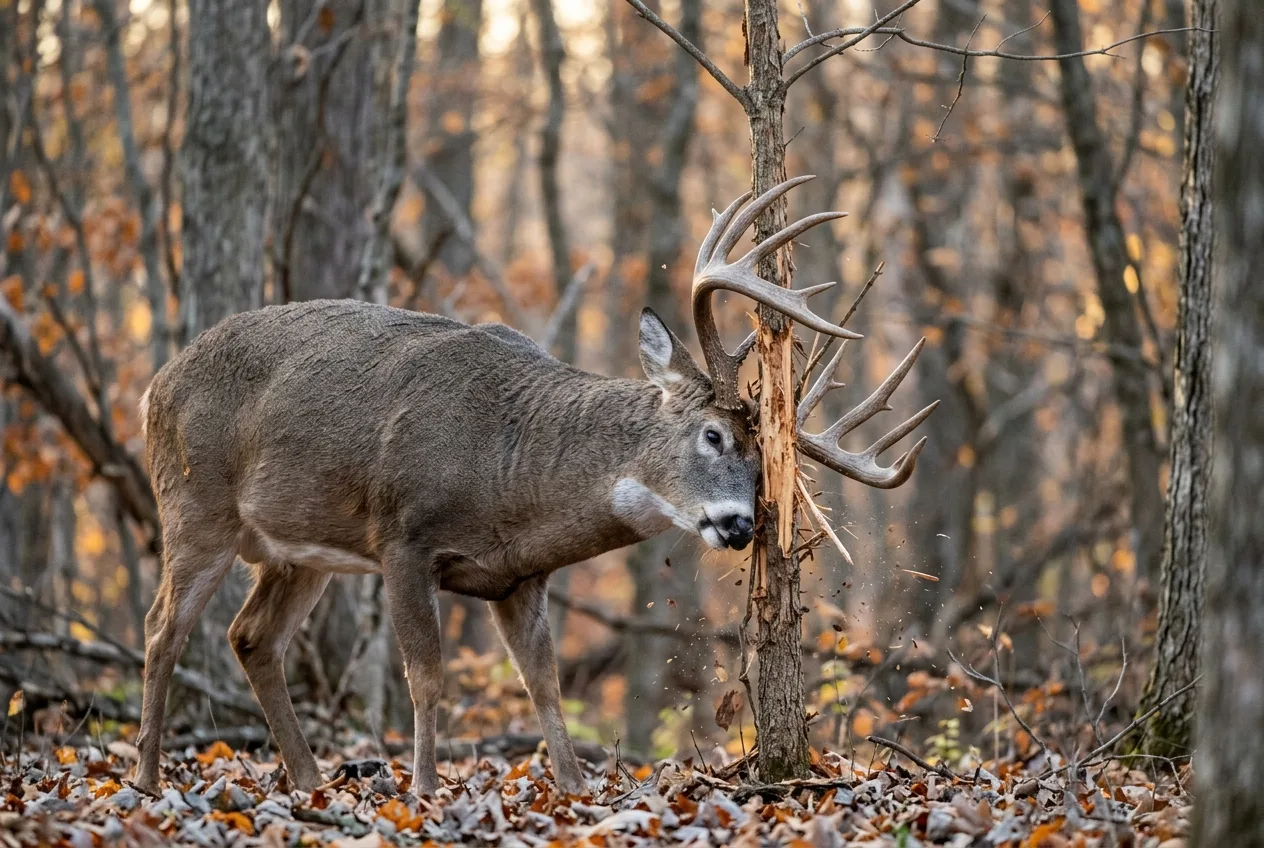
A rub is a scent station and a billboard rolled into one. When a buck rakes a tree, he isn't only stripping bark — he's pressing the forehead gland between his antler bases against the wood and leaving a chemical calling card. University of Georgia chemists who analyzed those forehead-gland secretions found 57 volatile compounds, several of them unique to the forehead region. Other deer read that signature: it identifies the maker and broadcasts his status. Strip the bark and you also get the visual half — the exposed pale wood jumps out against dark bark, especially along a field edge where deer can see it from a distance. As John Ozoga, a retired Michigan deer-research biologist who spent decades on this, put it after years of experiments: "mature bucks make most signposts to advertise their presence. Young males and females are the primary 'readers'".
Two practical truths follow from that. First, size says something about the maker. Yearling bucks tend to rub skinny stuff — saplings two to three inches across — while a mature buck will tear up a pole tree six inches or thicker. Maine's wildlife agency tells its rut-watch volunteers the same rule of thumb: a rub on a tree four or more inches in diameter "means a big buck is in the area". It isn't a guarantee — a young buck can rub a big tree — but a wrist-thick rubbed pole is a real clue, not wishful thinking. Second, some rubs come back every year. A buck only re-rubs maybe 5 to 10 percent of his own rubs in a given season — except for traditional "signpost" rubs on larger, often aromatic trees, which get worked annually, sometimes by multiple bucks. Ozoga noted the most heavily used traditional rub in his Michigan enclosure wasn't even a tree; it was a tarred utility pole at a busy deer crossing. Bucks lean toward fragrant species when they can get them — pine, cedar, sassafras, bay — but location and visibility matter at least as much as the species.
If you want to know how strongly the visual drives this, Ozoga's pole study is the best evidence I've seen. He cut 25 aspen saplings, trimmed them into bare eight-foot poles, and stuck them along forest openings. Twelve were rubbed in the first week; 23 within two weeks; all 25 multiple times within five. These were dead, scentless poles — no buck had marked them — and bucks couldn't resist them, simply because a pale aspen pole at an opening edge is exactly what a rub is supposed to look like. He even caught three bucks marking one fresh pole inside nine minutes, in increasing order of rank: a yearling first, then a 2½-year-old, then the area's most dominant buck, a 9½-year-old. That's the whole social function of a rub on camera in one frame.
There's a newer wrinkle worth knowing, because it explains when rubs do their job. A 2025 University of Georgia study took UV lights into the woods at night and discovered that fresh rubs literally glow to a deer's eyes. Deer see well into the blue and near-ultraviolet — far better than we do — and a rubbed tree gives off a faint blue-green light that lines up almost perfectly with a deer's peak visual sensitivity. The glow comes from compounds in the exposed sapwood and from the buck's forehead-gland secretions, and — this is the key finding — it got brighter on rubs made later in the season, as testosterone climbed toward the rut. The lead researcher's line for hunters is perfect: "Rubs look like highway reflectors to deer". As one of his colleagues framed it: "If you're a one-and-a-half-year-old buck and you see a torn up tree glowing bright, you know there's a big gentleman in the area so be cautious". All of which lands on the same point — a rub is communication, and it shouts loudest at dawn and dusk when deer are moving and that glow stands out.
That's the whole social function of a rub on camera in one frame.
Rub lines vs. random rubs
Not every rub is worth your time. A single rub tells you a buck passed through. A rub line — a string of rubs running in a consistent direction — tells you something far more useful: a travel route, and often which way he was walking. Bucks tend to rub on the side of the tree facing the direction they came from, so a line of rubs can point back toward bedding or on toward food.
The catch is that rub concentrations shift. Ozoga found that even within one area, where the rubs pile up can change a lot from autumn to autumn depending on the food, the cover, and how many mature bucks are around. A clustered line of fresh rubs from this week is gold; a faded line from two seasons ago is history. Which is exactly why the freshness read matters: a fresh rub shows bright, almost wet-looking inner bark contrasting with the dull outer bark, often with shredded bark, hair, or velvet still hanging, and a rough torn texture. An old rub is uniformly gray and smoothed over. Learn that at a glance and a rub line stops being a curiosity and becomes a map.
What a scrape actually is
A scrape is where hunters overthink things, so let's keep it concrete. A full scrape is a three-part sequence, and the parts can happen together or separately.
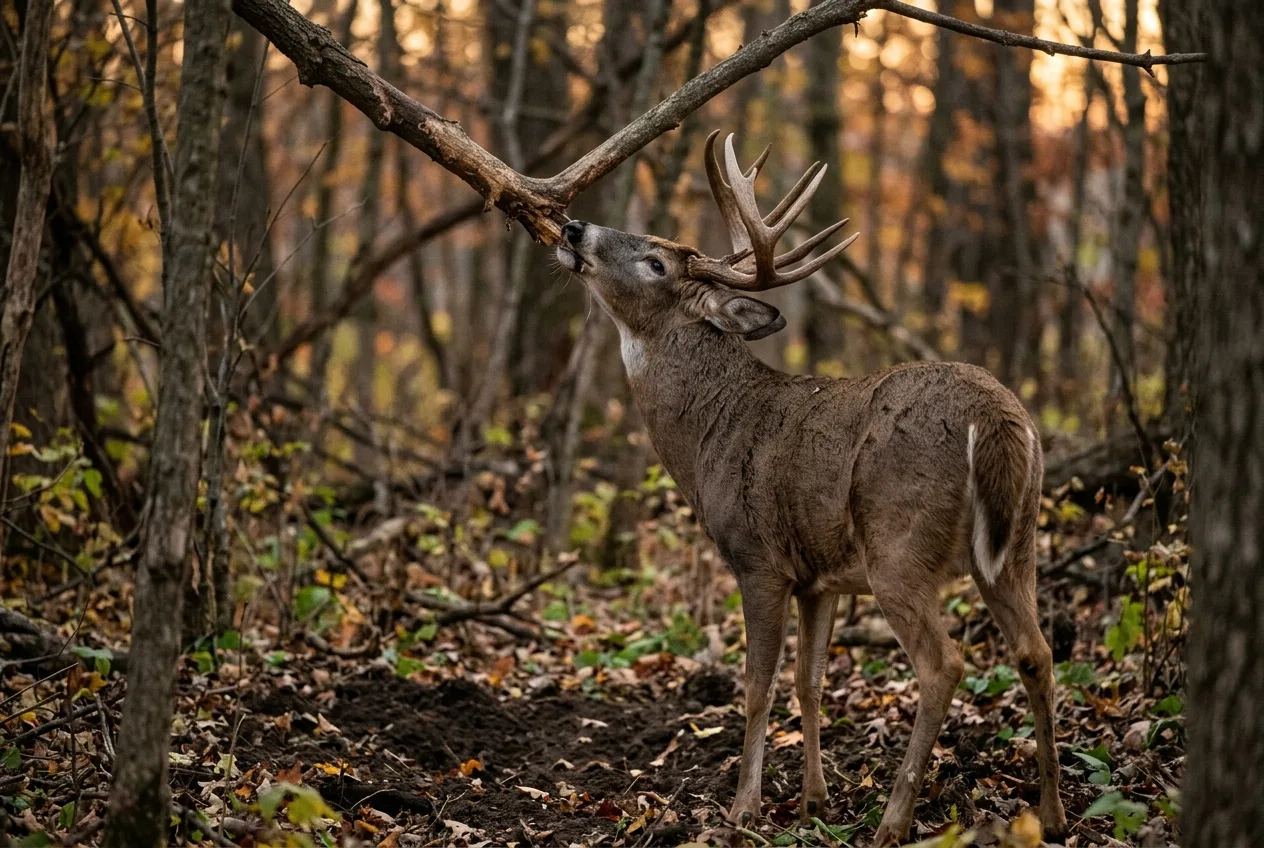
- The licking branch. The buck works an overhanging limb — usually around head height, roughly three to five feet over a trail — rubbing his forehead and preorbital glands on it, sometimes raking it with his antlers, then taking the twig in his mouth to chew and moisten it. This is him leaving scent and reading everyone else's.
- The pawing. He clears the leaf litter below the branch with his front hooves, opening a bare circle of dirt — Pennsylvania's biologists put it at roughly three to six feet across.
- The urination. He steps into the cleared dirt and urinates, often rubbing his tarsal glands together as he does — the move called rub-urination — depositing a scent loaded with identity and status into the soil. That tarsal scent is the closest thing a deer has to an ID card: a unique mix of urine, gland oils, and bacteria that carries his dominance status, sex, and health to anyone who reads it.
Now the single most important thing to understand about scrapes, the thing that fixes ninety percent of the confusion: the licking branch is the scrape. The dirt is almost secondary. Ozoga proved this with another set of experiments — he nailed bare sugar-maple limbs over deer trails in spots that lacked overhead branches, and bucks converted 60 percent of those artificial sites into scrapes. He didn't even need to expose the soil; bucks pawed under a well-placed limb whether or not he'd cleared dirt first. As one mock-scrape guide puts it bluntly: "If you put an obvious licking branch in an area with deer, you will have deer use it. That's a promise". Flip it around — remove the overhead limb and an active scrape dies. The bare dirt you get excited about is downstream of the branch.
That also tells you why some scrapes reappear in the same spot year after year and others don't. A scrape needs a marking branch at the right height, and as the forest grows and changes, the right branches move — so scrape locations can wander. A rub only needs a tree, and if nobody cuts it down, that tree stands there next fall, which is why traditional rubs are more reliably "historic" than traditional scrapes.
One more thing the ground will lie to you about: not every pawed patch is a buck scrape. Maine's agency warns that turkey scratching can fool you — but a real scrape is a defined circle of exposed dirt a few feet across under a chewed or broken overhanging branch, often with a musky whiff if a buck has urinated recently, while turkey work is a broader, messier scatter of overturned leaves. A fresh scrape is clean — bare earth free of leaves and debris.
The licking branch is a community sign-in sheet
Here's where the rub-versus-scrape distinction gets real. A rub is mostly one buck's statement. A scrape is used by everybody, and the camera data on this is striking.
Kip Adams of the National Deer Association once ran a camera on a single fresh scrape in northern Pennsylvania: over 13 days it took 88 photos and captured 20 different bucks. That's not one buck's scrape — that's a community bulletin board. A large camera study in Mississippi drove the point home with numbers: across 33 monitored scrapes and more than 118,000 images, researchers catalogued 96 unique bucks, with an average of around seven different bucks visiting each scrape. The most popular ones — what biologists call community scrapes — pull in many individuals and become genuine social hubs.
And it isn't just bucks. Does and fawns visit scrapes constantly, mostly to read what's there rather than to mark. Ozoga's photo work teased apart who does what: of the deer he caught working the overhead limb, 86 percent were bucks, 6 percent does, 8 percent fawns — but of the deer inspecting the ground in the scrape, only 26 percent were bucks, while 61 percent were fawns. In other words, bucks are the ones marking the branch; does and especially fawns are down sniffing the dirt to find out who's been around. As Adams puts it, "does visit scrapes regularly to see who is in the neighborhood". That's the function — a scent-based social network, written in urine and gland secretions, that the whole local herd checks in on.
It's worth knowing that this same community function is why scrapes have become a focus of disease research. A scrape is a spot where dozens of deer press their noses and mouths to the same branch and the same dirt — an efficient way to swap whatever they're carrying. Studies sampling scrapes in Tennessee found chronic wasting disease prions at more than 100 scrape sites, on licking branches and in the soil, and researchers now talk about scrapes as potential "early warning sentinel sites" for CWD surveillance. You don't need the epidemiology to hunt, but it's a vivid confirmation of what the sign means: a scrape is a place a lot of different deer physically touch.
A scrape is a place a lot of different deer physically touch.
Who actually makes scrapes — and when
A common mistake is thinking every buck scrapes like every other. He doesn't. Serious scraping is a mature-buck behavior. Yearlings rub plenty, but when it comes to full scraping they're clumsy and sparse — in the absence of mature bucks, yearlings make only about 15 percent as many scrapes. Pennsylvania's agency says it plainly: "usually only mature, dominant bucks produce any significant number of scrapes". So a property suddenly lighting up with fresh, well-worked scrapes in late October is itself a sign — it suggests mature bucks are present and feeling the season.
That mature-buck framing comes with one honest complication worth flagging. That Mississippi camera study found that on its most heavily hunted, most predator-pressured site, young bucks actually out-scraped the mature ones — likely because pressure suppressed the mature bucks' daylight presence. And the disease-network angle adds a twist: young, dispersing bucks turned out to be the biggest potential "super-spreaders" at scrapes, because they roam widely and contact the most other deer. So "mostly mature bucks scrape" is the rule, but pressure and young-buck dispersal bend it. Read your own sign; don't assume.
Timing is where rubs and scrapes diverge most usefully:
- Rubbing starts at velvet shed in September, peaks during the pre-rut, and then holds at that elevated level right through the breeding season. So rubs show up first and stay relevant a long time.
- Scraping can technically happen across much of the year — limb-marking has been observed May through November, and pawing from July into March — but full-fledged scraping intensifies sharply just before peak breeding and then largely shuts off once does start coming into estrus. Ozoga's controlled data nailed the window: 50 to 80 percent of full scrapes appeared annually in September and October, before the first doe was bred, with peak scraping in the last week of October and the first week of November.
That last fact is the one that should change how you hunt. Scraping peaks before the rut, not during it. Once does are actually in heat, bucks abandon the scrapes and go chase live does instead. Which brings us to the timing of the rut itself.
How the rut's clock works (and why scrapes go cold)
The rut isn't set by weather or the moon — it's set by photoperiod, the shortening day length of autumn, which trips the hormonal switch that brings does into estrus. The Mississippi State Deer Lab frames it crisply: "the timing of the rut is controlled by the presence of females willing and able to breed" — not by the bucks. A buck is physically ready to breed for months; if he ran the show, the rut would last half the year. He doesn't. The does' calendar runs it, and that calendar is remarkably fixed year to year. As Virginia's deer project leader writes, when hunters ask when the rut will be: "The short answer is: it's the same time every year".
How fixed? Pennsylvania measured conception dates from over 6,000 does and found 9 of 10 bred between mid-October and mid-December, with the peak in mid-November and a median conception date of November 11–17. Virginia back-dates a June 3 fawn-drop peak by a 200-day gestation to a November 16 breeding peak. The moon doesn't move it: GPS-collar studies from Mississippi to Pennsylvania show moon phase has "no meaningful impact" on the timing, and Pennsylvania's verdict on the "rutting moon" is blunt — "for deer, it's serious business and they aren't about to change their schedule for the moon or latest marketing ploy".
The big asterisk is geography. Peak breeding shifts dramatically by region. Texas studied 2,436 does across its ecological zones and found peaks ranging from late September on the Gulf Prairies to December 24 in the South Texas brush. Mississippi alone runs from late November in the northwest to mid-February in the southeast. So "mid-November" is a Northern number — find your area's historical breeding peak, because that's the date your scrape sign is counting down to. An individual doe is only in estrus for about 24 to 48 hours, and if she's missed she recycles roughly every three to four weeks, which is what fuels the "second rut" and the late stragglers people misread as a shifted rut.
Tie it together: scrape activity climbs through the pre-rut as bucks anticipate the does, peaks in the days before breeding starts, then collapses when the does actually come into heat and the bucks switch to chasing. That's why the scrape that was smoking on November 1 looks dead on November 12. The buck didn't leave the country — he's just done leaving messages and started knocking on doors.
The buck didn't leave the country — he's just done leaving messages and started knocking on doors.
The honest take: how to hunt this sign
So what's genuinely useful for patterning a buck, and what's overrated? Here's where I'll plant a flag.
Hunting directly over a scrape during the peak rut is the most overrated move in this whole topic. The reason is simple and well documented: most scrape work happens in the dark. Research cited by the NDA shows "over 80% of scrape use occurs at night," and a separate figure puts it around 85 percent — outside legal shooting hours. Bucks tend to hit scrapes just before daylight or just after dark, swing through on their schedule, not yours. Sit a stand right on a hot scrape during the rut and you're mostly photographing a spot a buck visits at 2 a.m. The better play, by the biologists' own recommendation, is to set up between the scrape and the bedding cover — catch him on his feet in the last of the light as he heads toward the scrape, before he gets there in the dark.
Where scrapes and the licking branch genuinely shine is intelligence, not ambush — and that's mostly a camera job. Because the licking branch reliably draws deer, it's one of the best camera locations going, especially as the pre-rut builds toward the breeding peak. A camera on a good scrape inventories the bucks in your area better than almost anything else short of bait — that single Pennsylvania scrape gave up 20 bucks in under two weeks. The NDA's pre-rut camera guidance is explicit that scrape utility increases as the pre-rut progresses, so the later in October you get, the more a camera on a scrape earns its place — while clusters of fresh rubs make good camera sites from early in the pre-rut on.
You can also make the sign where you want it. Mock scrapes work, and they work because of that one principle: it's the branch, not the dirt. Hang an obvious licking branch over a high-traffic spot — a logging-road intersection, a field corner, a place deer can see from a distance — scratch a roughly two-foot circle of bare dirt under it after about mid-September, and bucks will adopt it. Appearance beats scent; you don't need fancy lures. One mock scrape made with no added scent at 3:12 p.m. had a buck adding his own six hours later, and deer will reuse a good mock scrape year after year as long as the branch stays put. That makes a mock scrape the perfect place to pin a camera and pull an inventory without much intrusion. Ozoga's experiments add a useful caution, though: doctoring scrapes with doe-in-heat lure didn't measurably increase buck visits in his controlled tests, and dumping a strange buck's rut urine into mock scrapes once triggered enough social upheaval that several of his enclosure bucks died fighting. The branch and the location do the work; the bottled scent is mostly for you.
For rubs, hunt the line, not the lone rub. A single rub is a "he was here." A fresh, clustered rub line is a travel route you can actually set up on, ideally between bedding and food. And read freshness ruthlessly — bright torn wood and hanging hair means now; gray and smooth means last year.
Put simply: let the scrapes and licking branches build your intel (run cameras, take inventory, time the pre-rut), and let the rub lines and terrain pick your ambush (sit travel routes between bed and food, not the scrape itself). The sign that's best for learning who's around isn't the sign that's best for killing him in daylight. Confusing the two is the classic rut mistake.
Frequently asked questions
What's the difference between a buck rub and a scrape?
A rub is a tree (or sapling) with bark raked off by a buck's antlers and forehead — a visual-and-scent mark advertising the individual buck, made any time he's in hard antler and peaking in the pre-rut. A scrape is a pawed circle of bare dirt under an overhanging "licking branch," where many deer of both sexes deposit and read scent, peaking in the days just before breeding. The rub is mostly one buck's signature; the scrape is a community message board.
Does a rub on a big tree mean a big buck?
Often, but not always. Mature bucks rub larger trees — pole trees six inches or more across — while yearlings usually rub saplings two to three inches thick, so a rub on a tree four-plus inches in diameter is a strong hint a big buck is around. A young buck can rub a big tree, so treat it as a clue, not proof.
Should I hunt over a scrape during the rut?
Usually not directly. Over 80 percent of scrape activity happens at night, outside legal hours, with bucks hitting scrapes just before daylight or after dark. The better strategy is to set up between the scrape and bedding cover to catch him moving in shooting light, and to use the scrape itself mainly as a camera/inventory site.
When do bucks make scrapes — and why do they stop?
Full scraping intensifies through the pre-rut and peaks in the days before the first does are bred — 50 to 80 percent of scrapes appear in September and October, peaking the last week of October into early November in the North. Once does enter estrus, bucks abandon scrapes to chase live does, which is why a hot scrape can look dead a week into the rut.
Do does use scrapes too, or is it just bucks?
Does and fawns use them constantly — mostly to read scent rather than make it. Bucks do most of the work on the overhead licking branch, while does and especially fawns are the ones down sniffing the dirt to find out who's been around. Does "visit scrapes regularly to see who is in the neighborhood".
Do mock scrapes actually work?
Yes, and the key is the licking branch, not the dirt. Hang an obvious overhanging branch in a visible, high-traffic spot and scratch a roughly two-foot circle of bare ground under it; bucks will adopt it, often reusing it for years. Appearance and location matter far more than added scent — doe-in-heat lure doesn't reliably increase buck visits.