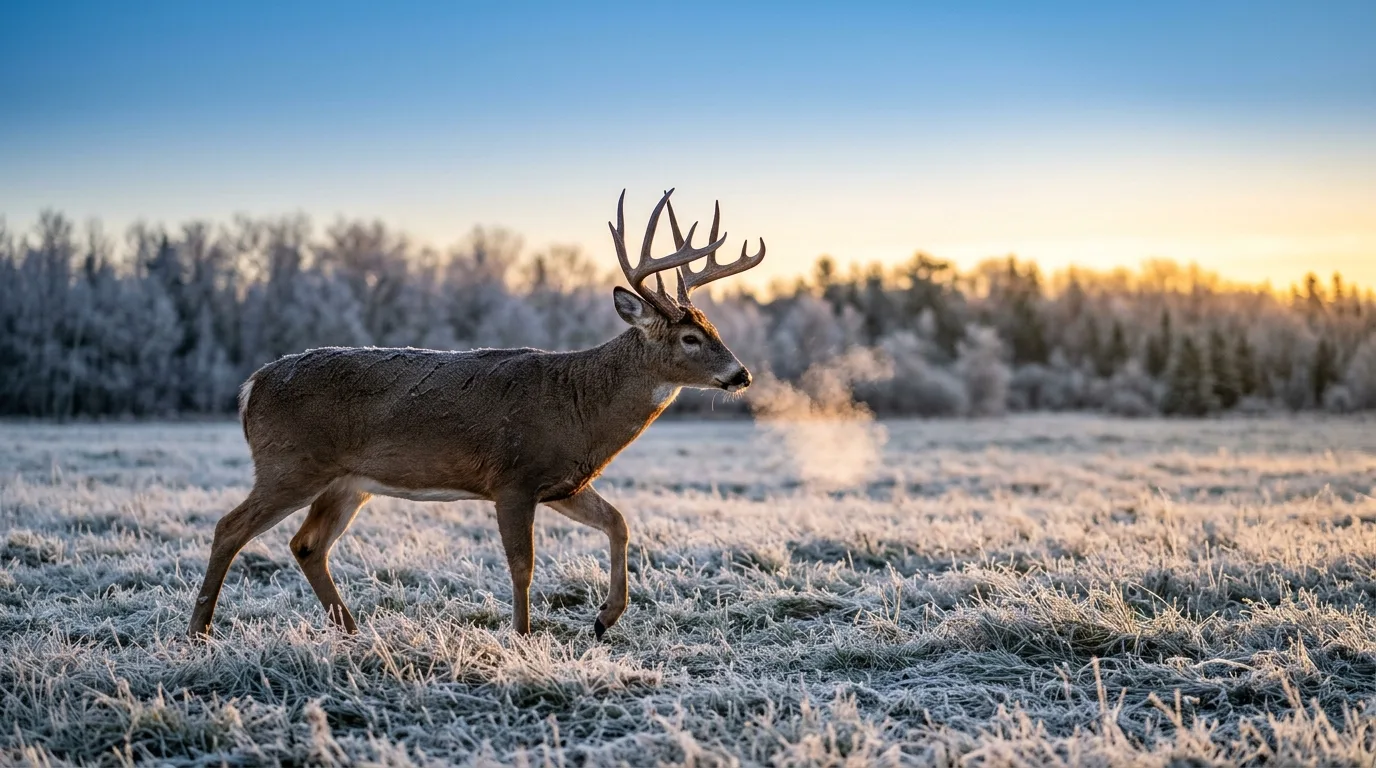
Every deer season has the same moment. You're watching the ten-day forecast, and there it is: a big cold front, a 25-degree drop, the temperature line falling off a cliff on a Thursday. You feel it before you think it — that's the day, the day the woods come alive, the day to burn a vacation morning. Half the hunting world has felt the same thing. The phrase practically writes itself: a cold front gets deer on their feet.
So here's the honest answer up front, because you came for the straight story. When researchers strap GPS collars on deer and watch them around the clock, the cold front mostly doesn't show up. The most careful studies on cold front deer movement found no overall difference in how fast deer moved or how far they traveled before, during, or after a front passed. Temperature is the single most influential weather variable anyone has measured, but even that effect is modest and inconsistent, and it barely touches the dawn-and-dusk rhythm that runs deer movement no matter what the sky is doing.
But "the science doesn't back the cold-front belief" is not the same as "weather does nothing," and that's the part the hot takes on both sides get wrong. There's a real, repeatable thread buried in this — about whether you see deer versus whether they're actually moving more, and about a much bigger force that happens to share the calendar with autumn cold fronts. The folklore isn't crazy. It's aimed slightly off-target. Let's walk through what hunters believe, what the data actually shows, and how you should think about the forecast.
Where the cold-front belief comes from
This one runs deep, and unlike a lot of hunting lore it isn't traceable to a single book or guru. It comes straight from the woods. Hunters have noticed, for as long as anyone has hunted whitetails, that the morning after the season's first hard cold snap is often electric — more deer, more daylight movement, more action. Penn State's research team put the belief in plain words when they launched a study specifically to test it: "A cold front is coming, which is why the deer are out feeding". They listed it right alongside the old full-moon axioms as a piece of "common wisdom" worth checking against data.
The intuition has a tidy mechanism behind it, too. A whitetail wears a heavy coat geared for November. When it's 70 degrees in October, the thinking goes, a mature buck is miserable and stays bedded; when the bottom drops out and it's suddenly 35, his cooling system works again and he gets up and walks. The hunting media states it about that plainly. In one widely read book, the argument runs that "cool weather changes the psyche of mature bucks... but—BAM!—a cold front hits, and suddenly their internal cooling systems work again. Big deer get up and walk". It's vivid, it's physiological, and it lines up with what a lot of people have seen with their own eyes.
The problem isn't the observation. The observation is real. The problem is the explanation we hang on it.
What the GPS data actually shows
Here's what changed the conversation: before GPS collars, you studied deer by watching them, and you can only watch what you can see. A collar doesn't care about that. It logs a deer's position every 15 minutes to every three hours, day and night, for months — bedded or moving, in your line of sight or a mile away in cover you'll never glass. When that kind of data went up against the cold-front belief, the belief didn't hold up the way hunters expected.
The clearest test comes from the Penn State Deer-Forest Study, a long-running project run with the Pennsylvania Game Commission and Bureau of Forestry. When a notable October cold front swept across the state, the team pulled the movement data for their collared bucks and looked at the days before, the day of (it rained), and the days after. Their read was blunt: "the average movement isn't really any different" on the day of the front. Some deer moved more afterward, some barely moved at all, and the variation between individual animals swamped any tidy front-driven signal. As the National Deer Association summarized the same dataset, monitoring deer through that big October front showed "no overall difference in speed of movement or total distance traveled before, during or after the front passed".
"The average movement isn't really any different" on the day of the front — and from one deer to the next, the variation is huge.
The man who heads that study, Duane Diefenbach, has been careful not to overclaim in either direction. He won't say cold fronts have zero effect, and he won't say they have one — for the seven deer his team watched through that front, he simply saw no overall pattern. That's the honest scientist's position, and it's worth sitting with: the data doesn't prove a cold front does nothing; it shows that whatever a front does is small enough, and variable enough, that it disappears into the noise of how differently individual deer behave.
Zoom out from that one front and the picture holds. The most-cited GPS study on whitetail weather response — Webb and colleagues in Oklahoma, who collected location fixes every 15 minutes from 32 deer over seven years — reached a conclusion hunters love to ignore: "In general, we found minimal evidence that weather was having an influence on deer movements. Relationships were weak and parameter estimates were small". Their summary of the whole question is the cleanest line in the literature: "hourly and daily variation in weather events have minimal impact on movements of white-tailed deer in southern latitudes." What drives the movement instead, they found, is the thing that drives it every single day — the routine crepuscular push at dawn and dusk, presumed to balance feeding against the risk of being caught in the open.
That's the heart of it. Deer are crepuscular animals. They move most at first and last light, cold front or warm spell, and that pattern is so dominant it buries almost anything the weather is doing.
Temperature: the one variable that does a little
If any weather factor earns a hunter's attention, it's temperature — but keep the bar where the data puts it. Across the studies, temperature is consistently the most influential single weather variable. It's just that "most influential" here means "the least weak," not "strong."
A Mississippi State analysis put it precisely: "a general pattern in how weather influenced deer movements was not observed, except that temperature influenced deer movements more than any other weather variable". A Texas study on free-ranging bucks found something even more deflating — "no correlation was found between hourly means in male activity and temperature" at all. And a North Carolina State project landed in the middle, calling air temperature "a consistent predictor of buck movement across all seasons" while admitting that activity "varied by season and period of day, making it difficult to attribute responses solely to climatic factors". Read those three together and you get the real shape of it: temperature is the variable that keeps showing up, but it shows up faintly, and not the same way everywhere.
There's a useful nuance hidden in when temperature matters. An Auburn study on a South Carolina property found that weather effects were weakest at dawn and dusk and strongest in the middle of the day and the dead of night — exactly the off-peak hours. In other words, temperature doesn't move the crepuscular peaks much; it nudges what deer do between them. The same study found something genuinely counterintuitive: rather than one simple "colder is better" line, there appeared to be two temperatures where the probability of movement peaked — one cooler, one warmer — with a lull in between. That's a long way from the clean "cold front equals movement" rule on a forecast app.
So where does the hunter's "10-degree drop" rule fit? It's worth being honest that this number is folklore, not a study finding. The common sentiment in the deer-hunting world, as one outlet distilled it, is that "a drop of 10 or more degrees in daytime high temperatures tends to elicit a positive increase in deer movement". The wildlife biologist Grant Woods uses a version of it — he gets interested in a roughly 10% temperature drop when it's been warmer than normal (say, 80 down to 72), and in late season he'll hunt a small warming trend, like 30 up to 33. Treat that as a reasonable rule of thumb for stacking the odds, not as a law the deer have agreed to follow.
Barometric pressure: the weakest claim of all
If you want the part of deer-weather lore that the science treats most harshly, it's barometric pressure. A lot of hunters hold it as gospel — pressure rises behind a front, and the deer pour out. The data does not cooperate.
Penn State actually built a study around exactly this idea, and the framing is a gift. The folklore says deer have a kind of "Spidey sense" for an oncoming storm — that they feel the pressure change and feed hard before it hits. A poll of the study's own readers found 48% believed deer are more active in the 24 hours before a front, with another 34% saying before and after. So the team tested it directly: 30 winter-storm events, more than 52,000 GPS fixes from collared does, with each storm front defined the way the folklore would want it — "wind shifting from S-SW to W-NW, increasing wind speeds, temperature drops, and a sudden rise in barometric pressure after a drop".
The numbers came back flat. In 2016, deer averaged about 105 yards per hour overall — 102 before a storm, 113 during, 111 after, and 102 when no storm was present. In 2017 it was 102 on average, with the "before" figure (105) barely separable from the "no storm" figure (111). The verdict was unambiguous: "Data show no statistical or biological significance of oncoming winter storms on behavior or movement of our collared deer". Or, as the team put it: deer don't have a Spidey sense.
Researchers ran "a half a dozen projects" on barometric pressure, cold fronts, and rain "without finding correlations."
That lines up with everyone else who has looked. The Texas study found "no correlation... between hourly means in male activity and temperature or barometric pressure". And a conservation-group researcher summed up the broader field bluntly: there are "a half a dozen projects out there that have tied all those data points to weather events—barometric pressure, cold fronts, rain, and haven't found anything". There's a reason for some of the pressure folklore, too: low pressure tends to come with rain, and rain does have a small effect, so people may be reading a faint precipitation signal as a pressure signal. But as an independent trigger you can hunt by, barometric pressure is the shakiest claim in the whole discussion. Honest hunters who track it say as much — one well-known writer's bottom line is that he can't say with certainty pressure helps, and "I'm certainly not hanging my hat on any one factor like pressure".
The thing the cold-front believers are actually seeing
So if the GPS data is this lukewarm, why does the cold-front morning so often feel electric? Because something real is happening — it's just not "deer moving farther." It's deer being more visible.
Heat suppresses daytime activity, and a cold snap releases it. A clever Mississippi State experiment showed the mechanism cleanly: researchers put shade structures over some feeders and left others in the sun, making the unshaded feeders about 1.4°C warmer. Deer ate 17–23% less at the hot feeders — but the key finding was when they made it up. Restricted to the unshaded feeders, deer "fed less during the day but compensated by increasing feeding during times when temperature was lower". They didn't eat less overall; they shifted the timing. Push that onto a fall landscape and the picture clicks: on a hot day, deer feed at the edges of darkness; cool it off, and that feeding slides into legal shooting light, where you can see it.
The wildlife biologist Grant Woods names this directly, and it might be the single most useful idea in this whole article. After a front that took his area from the high 70s to under 30 in 24 hours, his trail cameras lit up. But he's careful about what that means: "there's some miscommunication going on," he says — cold raises visibility, not rutting intensity. Hunters see more deer and conclude the deer are moving more. Researchers measure the same deer and find they're moving about the same; they're just doing it where eyes can find them. Both groups are right. They're answering different questions.
The Mississippi State Deer Lab folds the same idea into its rut research: "Weather does affect deer activity patterns, and major changes in weather may affect how hunters perceive the population's rutting behavior. For example, a cold snap after normally warmer weather may increase visibility of deer, making it appear that the rut is just starting". That's the whole trick in one sentence. The front didn't change the deer. It changed what you could see.
The real driver shares the calendar with cold fronts
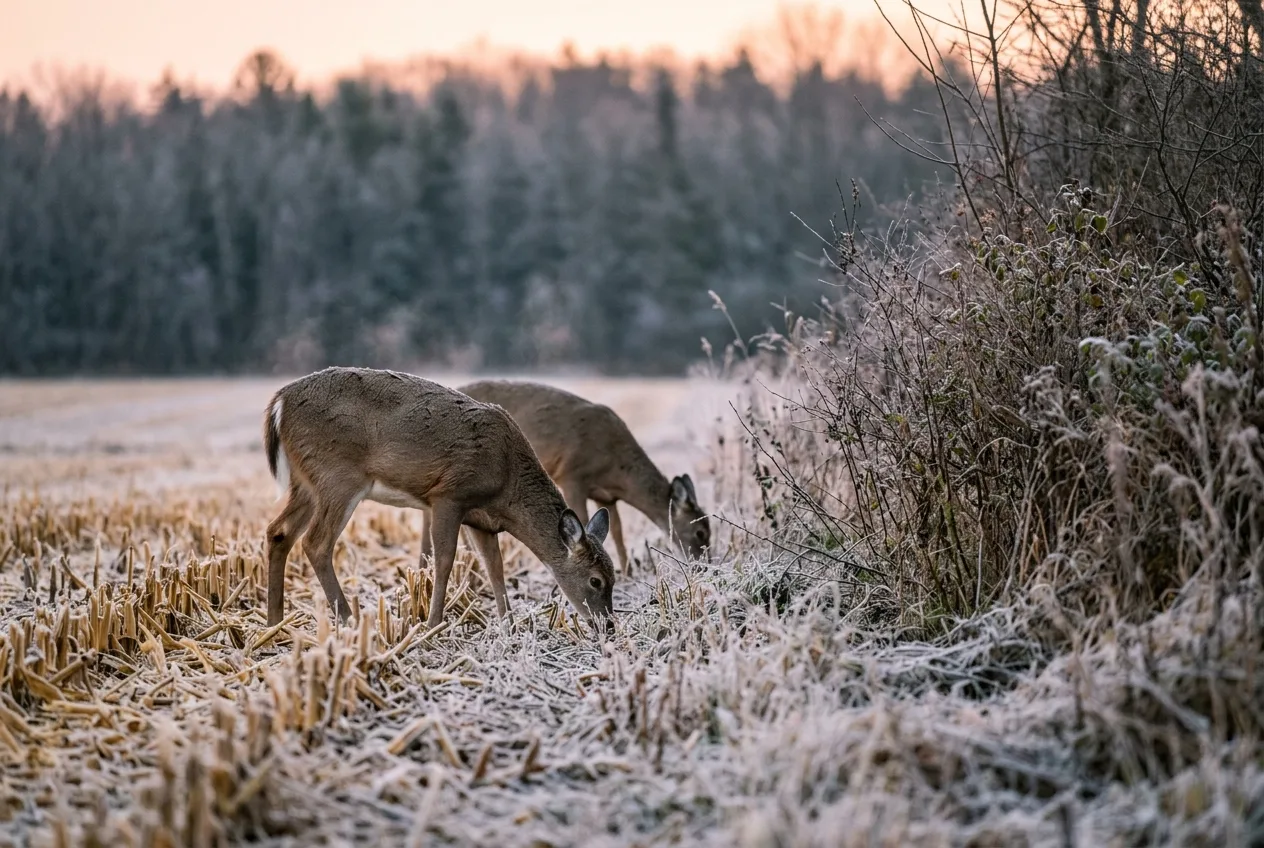
Here's the part that quietly explains most of why the cold-front belief survives: the biggest spike in deer movement all year — the rut — lands in late October and November, which is also prime cold-front season. The two things happen at the same time, so it's easy to credit the weather for what the rut is doing.
But the rut isn't triggered by weather. It's triggered by photoperiod — the shortening of daylight. The Mississippi State Deer Lab is categorical: "In contrast to many hunters' perceptions, weather has absolutely no influence on the timing of breeding behavior," and "the outside temperature isn't going to affect when she is in estrus". The National Deer Association says the same: rut timing "is not influenced by moon phase, weather changes or planetary alignments... Photoperiod (length of daylight) is what triggers does to come into estrus". The Noble Research Institute echoes it: "A common belief is that cooler weather is responsible for the increased rutting activity at this time; however, photoperiod is the primary contributor". Three independent sources, one answer.
And the rut's effect on movement is enormous — the kind of effect a real driver produces. Penn State's data has peak-rut bucks averaging about 30 km a week, roughly 18 miles, with daytime travel running "not much less than half" of that 24-hour total. Even in an unusually warm fall, the team found "no evidence of any change in the timing of the rut," and their statistical model confirmed that "temperature provided no help in explaining any of the variability in movements over the 3 years". Their long-term graph shows bucks resting up in early October, then climbing into "an exponential increase in activity" by the third week of the month — right on the photoperiod schedule, with half of does bred by about November 13 every year. That's the spike you're hunting. The cold front just happens to be standing next to it.
The cold front didn't change the deer. It changed what you could see — and it showed up at the same time as the rut.
Grant Woods puts the practical version of this as well as anyone: even a big front doesn't send pre-rut bucks "running far outside their home range," though they may walk around more within it. The rut will roll on its photoperiod schedule whether it's 30 degrees or 80. "Even if it's 80 degrees... it's still going to happen".
Wind and rain: small, situational, and tangled together
Two more variables round out the forecast, and both are minor — but they're worth a quick, honest accounting because the conventional wisdom on them is also a little off.
Rain has a small, real effect, and it's mostly on bucks. Penn State's data shows bucks "reduced their movement by as much as half on rainy days" — but with a sharp caveat: "a little rain has no effect on buck activity if there is a strong wind blowing". Does are largely unaffected either way. Grant Woods has seen the same split: bucks tend to move less in steady rain, possibly because blowing leaves and noise make it harder to detect predators, while does, for reasons no one's sure of, move a little more. So the "deer don't move in the rain" rule is half right — it's really a buck thing, and wind can cancel it.
Wind is genuinely debated, and the studies disagree, which is itself the honest finding. The Auburn work saw little difference in movement across wind conditions before and during the rut, with post-rut buck activity declining as wind rose. Penn State found close to the opposite — "the least amount of deer movement during calm conditions, and activity steadily increased as wind speeds increased" — while noting that genuinely gale-force days are too rare that time of year to draw a firm conclusion. When two good datasets point in opposite directions, the right takeaway isn't to pick one; it's that wind's effect on how much deer move is small and inconsistent enough that you shouldn't let it decide your day. (How wind affects your scent and your ability to hunt is a different, much more important question — but that's about you, not the deer.)
So what should a hunter actually do with the forecast?
Strip away the folklore and the practical advice is freeing: don't let the weather talk you out of a good day. As the rut approaches, survival and breeding drives trump weather every time, so an "off" forecast is a bad reason to stay home. The single best predictor of when deer move hard is the calendar, not the thermometer — build your time off around your area's historical breeding peak (your state wildlife agency publishes it) and around the dawn and dusk windows that hold in every kind of weather.
That said, a cold front is still a fine day to hunt — just for the right reason. It won't make deer travel farther, but by pulling feeding into daylight it makes them more visible, which is exactly what you need from a stand. And cool, high-pressure, low-humidity conditions favor you: your scent behaves better and you're less likely to get busted. Hunt the front. Just hunt it because it's a good day to be a predator, not because the deer have suddenly decided to move more.
The deepest truth in all of this is that the only weather pattern that truly matters is the one on your ground. National studies tell you what deer do on average across Oklahoma or Pennsylvania; they can't tell you what the buck behind your house does when it drops 20 degrees. That's where your own records earn their keep — a season of trail-camera captures, sorted by when each photo was taken and matched against what the temperature was doing, will show you your deer's real pattern instead of the one you remember from the good morning you got lucky.
Frequently asked questions
Does a cold front really get deer on their feet?
Not the way the saying implies. GPS-collar studies of deer tracked through a real October front found no overall difference in speed of movement or total distance traveled before, during, or after it passed. A front can pull deer feeding into daylight so you see more of them, but they aren't reliably moving farther overall.
What is the best weather to hunt deer, then?
The most useful answer isn't a weather pattern — it's the rut, which is set by daylight, not temperature, and roughly doubles buck movement. Among weather factors, a cool front is a solid choice because it increases daytime visibility and high-pressure, low-humidity air helps keep deer from smelling you. But don't skip an otherwise good day over the forecast.
Does barometric pressure affect deer movement?
There's little evidence it does. Tracking collared deer against oncoming winter storms — defined partly by a rising barometer — turns up no statistical or biological significance, and studies that have looked find no correlation between barometric pressure and movement. It's the weakest of all the weather claims.
Do cold fronts make the rut happen earlier?
No. The rut is triggered by photoperiod (shortening daylight), so "weather has absolutely no influence on the timing of breeding behavior". A cold snap can make the rut look like it's starting by making deer more visible, but it doesn't move the breeding peak, which lands at about the same time every year.
Why do so many great hunters swear cold fronts work?
Because they're seeing something real — just misreading it. Cooler temperatures shift feeding into daylight, so hunters see more deer and conclude the deer are moving more. As biologist Grant Woods puts it, "there's some miscommunication going on": cold raises visibility, not rutting intensity.
Does temperature affect deer movement at all?
A little. Temperature is consistently the most influential single weather variable in the studies, but the effect is modest — GPS tracking turns up only minimal, "weak" evidence that weather drives movement at all. It nudges activity most in the off-peak midday and overnight hours, not at the dawn and dusk peaks.