
A wildlife camera will happily hand you ten thousand photos of nothing. Wind in the grass, a warm rock at dusk, a branch swinging through the frame at 2 a.m. — every one of them triggers the shutter, and every one of them lands in the same folder as the actual animals. In one forest-canopy study, 98% of the camera triggers — nearly 69,000 of them — turned out to be moving vegetation, not wildlife. The flagship Snapshot Serengeti survey collected 1.2 million image sets; only about 323,000 of them contained an animal at all. The rest were misfires.
That is the problem AI species recognition exists to solve. The promise is simple to state: point a model at the pile, and it tells you which frames have animals, what those animals are, and how sure it is. The reality is more interesting — and more honest about its own limits — than the marketing usually lets on. So let's actually open the box. How does a computer go from raw pixels to "that's a red fox, 0.91 confidence," what do the accuracy numbers really mean, and — the part that matters most if you're going to trust it — where does it reliably get things wrong?
The core idea: detect first, identify second
Almost every serious camera-trap AI is built the same way — a two-step pipeline. It's worth understanding why, because the split explains most of what follows.
The first step is a detector. Its only job is to look at an image and answer a deliberately dumb question: is there an animal here, and if so, where? It draws a box around anything that looks like an animal (and usually people and vehicles too), and it throws out the empty frames. The most widely used research detector states its own scope bluntly: it finds "animals, people, and vehicles" and "does not identify animals to the species level, it just finds them". That's not a limitation someone forgot to fix — it's the design. When researchers tested a two-stage setup — a detector that finds the animals, then a separate classifier that names them — against a single model trying to do everything at once, the two-stage version won.
The second step is a classifier. It takes each box the detector found, crops the animal out, and asks the harder question: which species is this? That's the model that produces "white-tailed deer" or "coyote" with a confidence score. One current open research ensemble pairs a detector that decides "which images — and which pixels within those images — contain animals" with a classifier that "produces a species name and confidence level for each animal it identifies".
The detector finds the needle; the classifier decides what kind of needle it is. They fail for completely different reasons.
Why bother splitting them? Two reasons. First, the empty-frame problem is enormous — remember the 98% of canopy triggers that were just vegetation — and you don't need to know what species an empty frame contains. Roughly 75% of Snapshot Serengeti images were empty, so automating just the "is anything here?" step "saves 75% of human labor" before you've identified a single animal. Second, the two questions have wildly different difficulty. Telling "animal" from "not animal" is robust; telling a reedbuck from an oribi is not. Splitting the job lets you lean on the reliable half and put your scrutiny on the fragile one.
For boxing the animal, the field landed on standard object detectors — the same family of models used to find faces or cars. One head-to-head comparison on camera-trap data put Faster R-CNN against an early version of YOLO and found 93.0% versus 76.7% accuracy at localizing animals. Different architectures, different trade-offs of speed against precision, but the same idea: localize first, classify the crop second.
What's actually happening inside: how the classifier "sees"
The classifier is almost always a convolutional neural network, or CNN. You don't need the math, but you do need the right mental picture, because it explains the failures later.
A CNN processes an image in layers, and each layer abstracts a little further from the raw pixels. As Norouzzadeh and colleagues describe it, the input pixels are "first processed to detect edges," then "corners and textures," then "object parts," and so on until the final layer makes a prediction. Crucially, nobody programs in "look for antlers" or "check the tail." The features "emerge automatically as the network learns how to solve a given task". The network invents its own visual vocabulary from the examples it's shown.
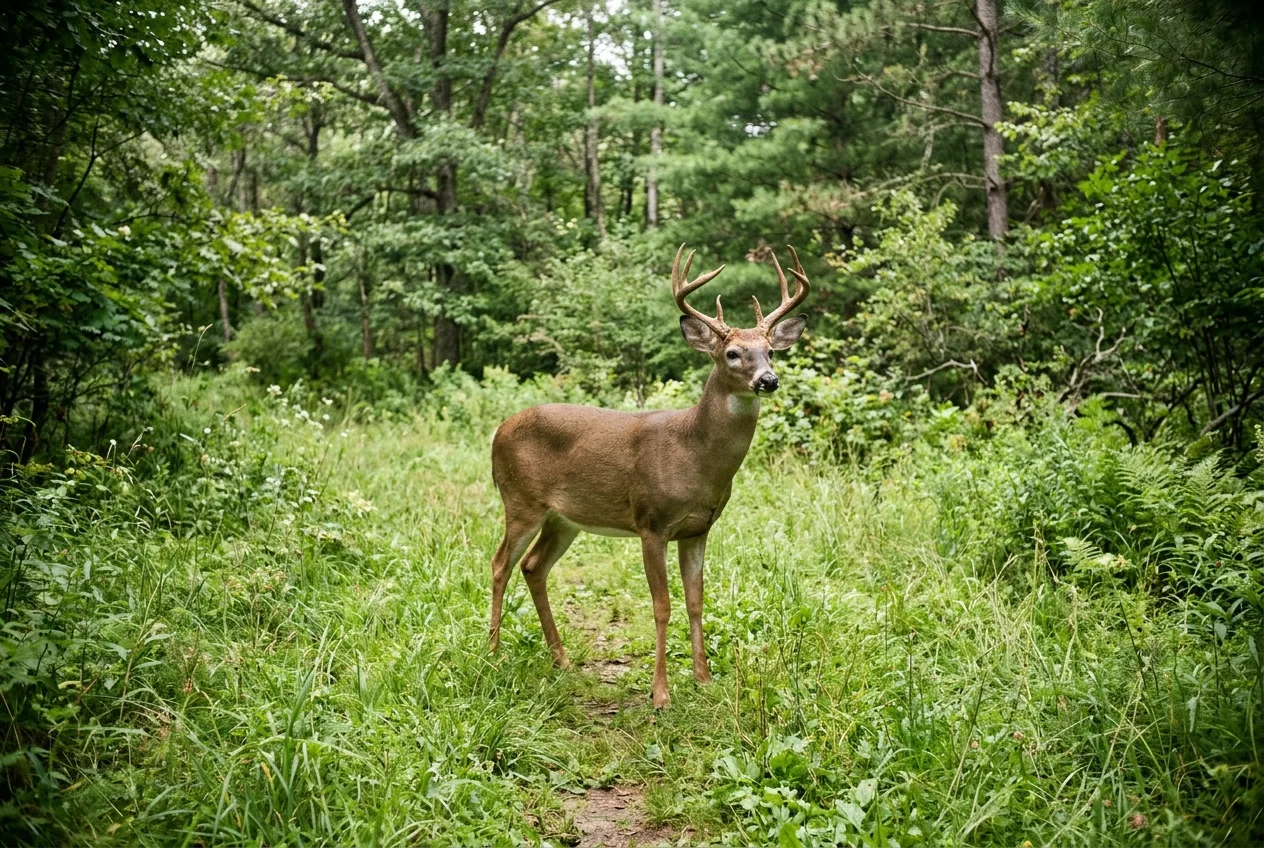
So what does it learn to look at? We can actually peek. Researchers working on a 20-species dataset from Gorongosa National Park used a technique called Grad-CAM to highlight the pixels driving each decision, and found the network often keys on exactly the features a human guide would teach you — the white stripes of a nyala, the quills of a porcupine, the spots of a civet. That's reassuring. It learned real biology.
But the same study found something less reassuring, and it's the seed of a major failure mode. The network also learned to use the background. When most images of one species came from the same camera, the model quietly started associating that habitat — the particular trees, the particular ground — with that animal. The authors are explicit that this shortcut "can well disappear if additional cameras are used," because the camera-background-to-species correlation was an artifact of the data, not a fact about the animal. The network wasn't cheating on purpose. It found a pattern that worked on the training data and had no way to know the pattern was a coincidence.
Hold onto that, because it's about to explain why these models fall apart in new places.
Where the training data comes from — and why labels are the bottleneck
A CNN "only works well with lots of labeled data". Tens of thousands, often millions, of images where a human has already written down the correct answer. Where do all those labels come from?
A lot of them come from people. Snapshot Serengeti is the canonical example: more than 28,000 registered volunteers contributed 10.8 million classifications, and a simple voting algorithm distilled those into a single "consensus" label per image. When that crowd consensus was checked against expert-labeled images, it hit 96.6% accuracy on species — good enough to serve as the ground truth that models are trained and graded against. Other big public sets do the same job for other faunas: a North American collection of 3.7 million images across 28 categories, an American Southwest set of about 243,000 images across 140 locations. Whole repositories exist just to host this labeled data for model-builders.
Here's the catch. Labeling is the expensive, slow part — the reason this whole field exists is to avoid having humans look at every photo, yet you need humans to look at a great many photos before the model can take over. That's why one of the more clever advances is active learning: instead of labeling everything, the system figures out which images would teach it the most and asks a human to label just those. One such system matched the accuracy of a model trained on 3.2 million labeled images while using roughly 99.5% less labeled data. The label bottleneck is real, and shrinking it is a live research problem.
Every model is a mirror of the labeled images it was fed. Its blind spots are your dataset's blind spots.
Reading the accuracy numbers without fooling yourself
You'll see big, confident percentages attached to these tools. A US model reported 98% accuracy at identifying species. A current ensemble reports finding 99.4% of animal images and, when it commits to a species, being right 94.5% of the time. Those numbers are real. They're also the single easiest thing to misread, so here's how to read them like a skeptic.
First, learn the three words. Accuracy is just the fraction of all predictions that were correct. But two more useful numbers hide inside it:
| Term | Plain-English question | When it's the one you care about |
|---|---|---|
| Precision | Of the frames the model flagged as species X, how many really were X? | You want to trust the hits — false alarms are costly. |
| Recall | Of the frames that truly contain species X, how many did the model catch? | You can't afford to miss the animal — false negatives are costly. |
The reason this matters is that you can trade one for the other by moving a single dial — the confidence threshold. Every prediction comes with a confidence score, and you decide how confident the model has to be before you accept its call. Set the bar high and you keep only the sure things: precision climbs, but you discard more borderline-but-correct calls, so recall drops. Set it low and you catch more real animals at the cost of more false alarms. As the metrics guide puts it, these numbers are all "calculated at a single fixed threshold, and change when the threshold changes," and tuning that threshold to favor one metric is routine.
This dial is the most important control you have. In one large citizen-science study, raising the threshold to 99% pushed species accuracy to 96.7–98.9% while still keeping a usable 76–86% of the predictions. The model didn't get smarter; you just stopped trusting its shaky guesses.
There's one more catch, and it's a subtle one that the honest sources flag. A high confidence score is not a guarantee of a correct answer. Confidence values "do not provide an accurate measure of predictive uncertainty," and a model can be confidently wrong. A newer study found its model's raw scores were "significantly overconfident" and warns plainly that "raw confidence scores from the model should not be interpreted as direct probabilities". Treat confidence as a useful ranking — which calls to trust first — not as a literal probability of being right.
So when someone quotes you a number, ask the two questions that number is hiding: accurate on which species, and at what confidence cutoff? Because the headline almost always averages over the next four problems.
Where it gets it wrong, part one: the new-location problem
This is the big one, and it has a name in the field — domain shift, or the generalization problem.
A model learns the world it was trained on: those backgrounds, that lighting, those camera angles. Move it somewhere new and accuracy can fall off a cliff. The benchmark paper that put this on the map found that recognition algorithms "show excellent performance when tested at the same location where they were trained," but "generalization to new locations is poor, especially for classification systems". Note especially for classification — the detector half travels better than the species-naming half.
How big is the drop? In a controlled Canadian study, the best model scored 95.6% accuracy on locations it had seen in training and 68.7% on locations it hadn't — same species, same model, just a different background. A US model that hit 98% at home fell to 82% on an out-of-sample dataset from another country. This is the practical reason every careful practitioner says the same thing: don't trust someone else's accuracy number on your data. The team behind the most popular detector refuses to publish a single headline accuracy figure precisely because performance "can vary in new environments," and they start every new project with a small test batch on the user's own images.
And remember that background shortcut the Gorongosa network learned? This is where it bites. A model that secretly learned "this clearing means impala" has no idea what to do with a clearing it's never seen.
There's an even sneakier version of this problem that a 2026 study surfaced: domain shift isn't only about new places, it's about the same place, later. Ecosystems change across seasons and years — the vegetation, which animals are around, even the look of the scene — so a model can degrade at a fixed camera over time. That study tested 546 cameras in chronological order and found that even big "foundation" models underperformed at many sites without local adaptation, and that naively retraining on old data could actually make future predictions worse. The new-location problem never fully goes away; it just changes shape.
A camera-trap classifier is brilliant at the places it has seen and humble everywhere else. Treat every new site as a place it has to earn your trust again.
Where it gets it wrong, part two: rare species and the long tail
Wildlife data is lopsided. A handful of common species show up constantly; most species are rare. Plotted out, the abundant species form a tall "head" and the many rare ones trail off into a long "tail" — the long-tail distribution. And here's the cruel irony: the rare species in that tail "are the ones of interest to ecologists," yet they're "often neglected" by the models because there simply aren't enough images of them to learn from.
The numbers are stark. In one study, species with more than 1,000 training images were recognized with stable, high recall (0.971); species with fewer than 500 images had recall that was both low and wildly unpredictable (0.750, give or take 0.329 — a swing so large it tells you the model is essentially guessing). Another study found that for genuinely rare classes, recall could be 0%, and noted that the one time its model labeled something the rare "striped hyena," it was wrong. A human-supervision study put 15 species classes in front of a classifier with fewer than five training images each; 11 of them came back at 0% accuracy. With one image of a particular species in the training set, you simply cannot expect the model to ever recognize it.
There's a second-order effect worth knowing. Because the model is rewarded for overall accuracy, it learns to lean on the common species — predict "wildebeest" a lot and you'll be right a lot, even if you never really learn the rare animals. Techniques exist to push back, like deliberately over-sampling rare classes during training, but they involve a trade: one method lifted minority-species accuracy by around 15% while costing the common species at least 3%. You can rob the head to feed the tail, but not for free.
The most promising direction here is foundation models — models pre-trained on enormous, broad biological image collections so they bring a rich visual prior to any new task. One such model, trained on a 10-million-image tree-of-life dataset, beat prior approaches by 16–17% and showed a real knack for fine-grained and even zero-shot recognition. That's genuine progress for the long tail. Just don't oversell it: the over-time study found these same foundation models still needed site-specific adaptation to perform. Better priors, not magic.
Where it gets it wrong, part three: night, distance, blur, and clutter
The last cluster of failures is about image quality, and anyone who's run cameras knows these conditions intimately.
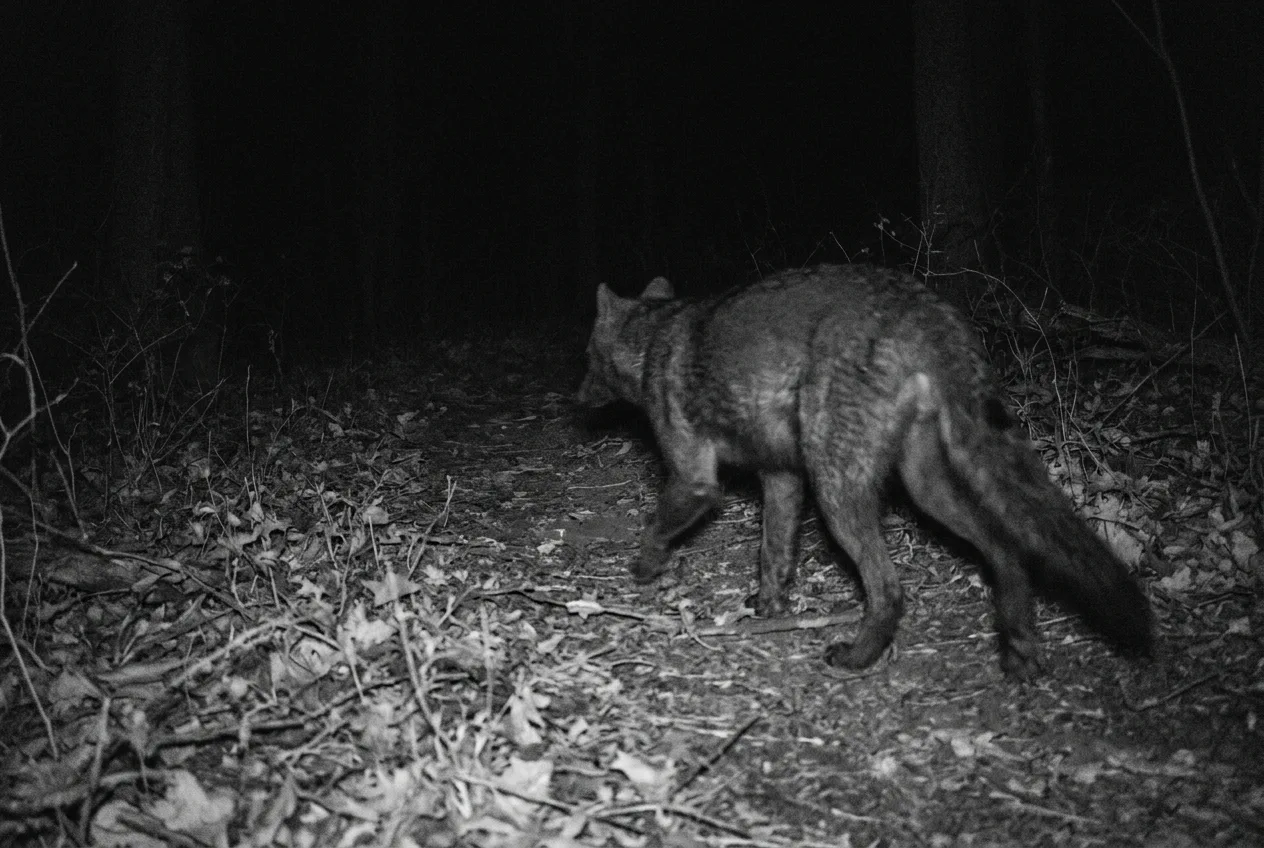
Night and infrared. After dark, most cameras switch to infrared and give you a grayscale image with flat, low contrast. Detail that a daytime color photo would carry — the subtle coat pattern, the edge of an ear — washes out. Reviewers tracing classifier mistakes repeatedly land on "low contrast between animal and background, for example in night-time images," or a "flash or sun flares" blowing out the subject. The animal is there; the information the model needs to name it isn't.
Distance and partial views. A classifier works on the cropped box the detector handed it, and it predicts each crop on its own. The trouble is that "animals further from the camera trap" produce "crops of lower quality," and predicting each one in isolation "increases the likelihood of errors". The Caltech dataset's own description is refreshingly blunt: the animals "can be very small, partially occluded, or exiting the frame — you sometimes have to look hard to find them". So does a human. When the Gorongosa team examined misclassified frames, the culprits were consistent: animals far away in the scene, over-exposed shots, frames showing "only parts of the animal," and images with multiple species jammed together. Small, camouflaged targets are hardest of all — in one dataset, lizards and toads filled a fraction of a percent of the pixels and blended into cluttered backgrounds.
There's a clever fix emerging for the distance problem. Human annotators don't judge a blurry distant animal in a vacuum — they glance at the clearer frames in the same burst, or at the other animals in the group, and reason from context. New models are learning to do the same, letting the prediction for one crop draw on the others nearby. On a Serengeti test set, that pushed accuracy from 90.5% to 95.3% without meaningful extra cost. It won't conjure detail that the pixels never captured, but it does recover a lot of the calls that independent, crop-by-crop guessing throws away.
The model can only name what the photo actually shows. Past a certain distance or darkness, even a perfect classifier is reading tea leaves.
Empty frames and false triggers. Back to where we started. The flood of empty images isn't just a nuisance to filter — it's a failure mode in its own right, because a classifier handed an empty frame will sometimes confidently announce an animal that isn't there. This is exactly why the detector step exists. Purpose-built tools that separate animals from blanks reach about 99.6% accuracy at the image level on the empty-vs-animal question and can automatically clear roughly half of false-trigger sequences without touching the real animal photos. Separating "something's here" from "nothing's here" is the one thing these systems do almost flawlessly — which is precisely why it's the foundation everything else is built on.
The human-in-the-loop: the part that makes it trustworthy
If you've read this far, the through-line is obvious: these models are powerful and they are fallible, and the fallibility is patterned, not random. So the mature way to use them isn't "let the AI label everything." It's a partnership — the model does the crushing volume, a human checks the parts the model is shaky on. The field calls this the human-in-the-loop, and the numbers make the case better than any argument.
In one rigorous comparison, the raw AI made errors on 34.9% of classifications. Add human review of those predictions and the error rate dropped to 8.7% — the humans outperformed the AI on 42 of 44 species classes. That's not a tweak; that's the difference between a draft and a dataset.
The elegant part is how the human and machine divide the work, and it ties every thread of this article together. The model already tells you where it's unsure — through that confidence score. So you let it auto-accept the high-confidence calls on the common, easy species, and you route the low-confidence calls and the rare, hard species to people. One large project used precisely this logic: a few volunteer votes were enough to retire an image the model was confident about, while disputed or uncertain images stayed in circulation for more eyes. The result was research-grade labels for a fraction of the human effort — one setup cut volunteer workload by about 43% while keeping accuracy high. Used this way, automated labels can even match expert labels for real ecological measures like species richness and occupancy.
Two honest footnotes. Humans aren't infallible either — in that 44-class study, volunteers actually did slightly worse than the model on two species with confusingly similar look-alikes, which is why low-consensus calls get flagged for a second look. And models drift: a classifier that was accurate last year can quietly lose ground as conditions change, so the loop is something you maintain, not something you set and forget.
That's the real answer to "can I trust AI species recognition?" Not blindly, and not never. Trust it the way you'd trust a sharp, fast assistant who's brilliant on the common cases, knows to flag the ones they're unsure about, and still benefits from you checking the hard calls. Built that way, it turns a hopeless pile of photos into something you can actually do science with.
Frequently asked questions
How does AI identify animal species in trail-camera photos?
In two steps. A detector model first finds and boxes any animal in the frame and discards empty shots; a separate classifier model then looks at each box and predicts the species, with a confidence score. The detector handles "is there an animal here," the classifier handles "what is it" — and most mistakes come from the second step.
How accurate is camera-trap species recognition?
On common species in familiar conditions, very accurate — models report up to 98% in some settings, and one current system names the species correctly about 94.5% of the time when it commits to one. But that headline averages over easy and hard cases. Accuracy drops sharply for rare species, unfamiliar locations, and night or low-quality images, so the right question is "accurate on what, and at what confidence threshold?".
Why does the AI miss rare animals?
Because it learns from examples, and rare species don't supply enough of them. Species with fewer than a few hundred training images get low, erratic recall, and with only a handful of images recognition can fall to zero. The model also leans toward common species because predicting them is usually right. Ironically, the rare animals models handle worst are often the ones researchers most want to find.
Why does a model that works in one place fail somewhere new?
It's called domain shift. Models partly learn the backgrounds, lighting, and angles of their training cameras — sometimes even associating a specific habitat with a species — so a new site with different scenery throws them off. Accuracy that was 95% at trained locations dropped to about 69% at new ones in one study. The same drift can happen at a single camera over time as seasons and conditions change.
What is a confidence threshold and why should I care?
It's the bar you set for how sure the model must be before you accept its call. Raise it and you keep only high-confidence predictions — more precise, but you discard more borderline calls; lower it and you catch more real animals at the cost of more false alarms. It's the main dial for tuning the model to your needs — but note a high confidence score isn't a guarantee of being right, just a useful way to rank which calls to trust.
Is AI accurate enough to replace human review entirely?
Not for work that has to be right. The proven approach is human-in-the-loop: let the AI auto-handle the high-confidence common species and have a person check its low-confidence and rare-species calls. In one study that combination cut the error rate from about 35% to under 9%. Used that way, AI does the volume and humans guard the accuracy.