A Missouri wildlife biologist named Tom Meister once got a panicked phone call about "huge piles of scat" in a subdivision backyard. The caller had a suspect ready by name: Bruno, a black bear that had wandered through the St. Louis area making headlines. The evidence seemed to fit — big piles, knocked-over trash cans, a strong smell. Except there were no bear tracks anywhere, the trash cans were merely tipped (not destroyed), and by the time the scat was reported, Bruno had already been spotted in southern Arkansas. The culprit turned out to be coyotes that had gorged on garbage.
That's the whole game with animal scat identification in one story. The poop is rarely as exotic as you fear, the right answer comes from a handful of plain features — and the size of a pile tells you a lot less than you'd think. So before you start photographing droppings on the trail and texting them to friends, let me walk you through how to actually read what an animal left behind.
Start here: what to look at before you guess the species
When you find scat, resist the urge to jump straight to "bear" or "mountain lion." Work the evidence in order. Field biologists and extension guides keep coming back to the same short checklist, and it's the fastest way to shrink your list of suspects.
Contents come first. Look at what the scat is made of before anything else. If it's packed with hair and bits of bone, you're looking at a carnivore — a fox, bobcat, or fisher. If it's nothing but plant fiber, it's a herbivore like a deer, rabbit, porcupine, or woodchuck. And if you see berries and fur together, you've got an omnivore — a fox, coyote, raccoon, or black bear that eats both meat and vegetation. Undigested clues are gold: corn, seeds, insect wings, crayfish shells, even shiny garbage can survive the trip and point straight at a diet.
Then shape. Most wildlife scat falls into one of about four shapes. The Missouri guide calls them plop, tubular, twisted, and pellet; a University of Arizona extension guide uses pellet, globular, tubular, and amorphous. Either way, the buckets are intuitive once you've seen them. Pellets mean a plant-eating animal (deer, rabbit, elk). Tubular ropes mean a meat-eater or omnivore (coyote, raccoon, bobcat). Twisted, tapered ropes wrapped in hair are the classic dog-family signature. Big loose plops belong to bears and livestock. A key sub-question: is it smooth end to end, or segmented "like a natural fibered rope"?
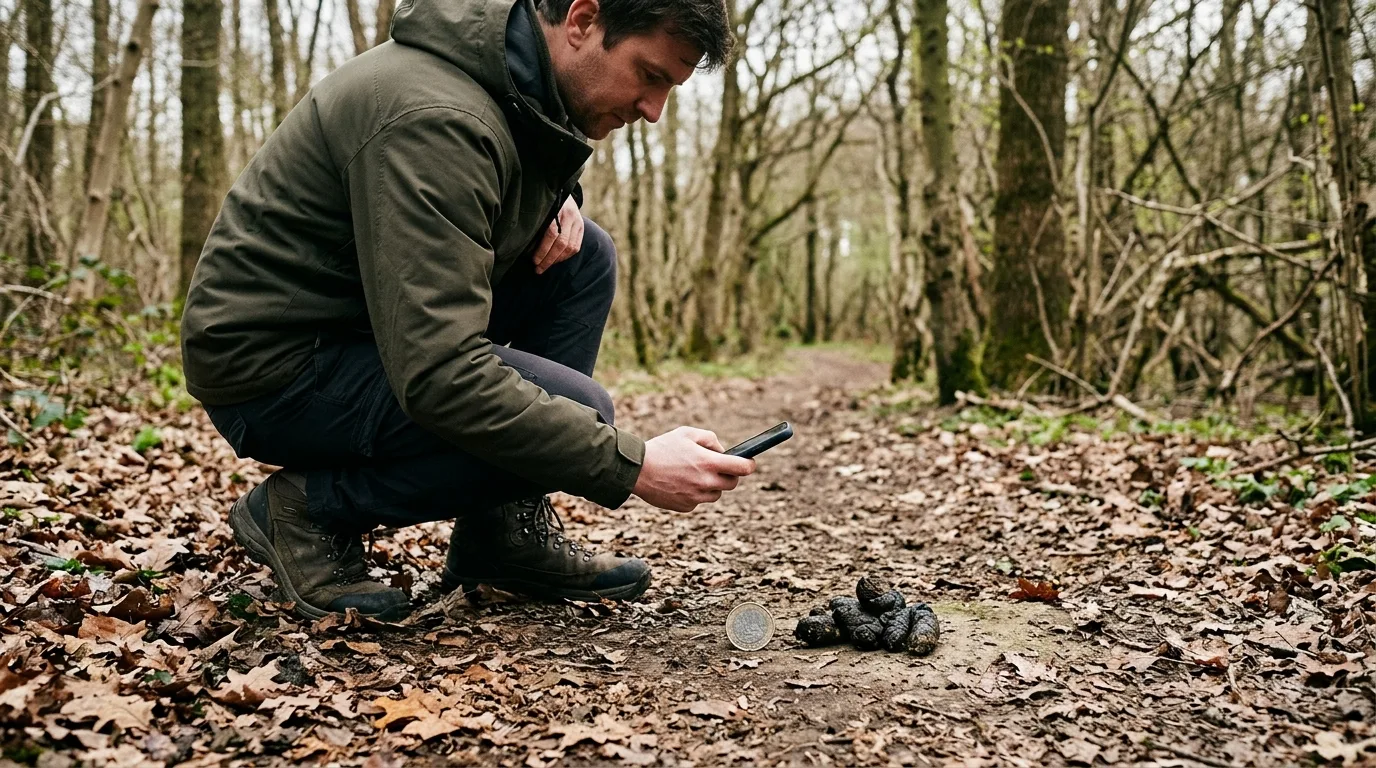
Then size, with a ruler in the shot. This is where people go wrong, so be honest about scale. Carry a coin, a pen, or a pocketknife and lay it next to the scat when you photograph it. State agencies do exactly this in their reference photos — a quarter beside deer pellets, a coffee-cup lid for scale. A "huge" pile in a panicked memory is often perfectly ordinary once a coin is in frame.
Then context — placement, volume, and habitat. Where an animal leaves its scat is often as diagnostic as the scat itself. Some animals deposit in prominent places — on a log, on top of a rock, smack in the middle of a trail — to mark territory. Others, like raccoons and river otters, return to the same spot over and over and build a latrine. Volume matters too: one dropping or a whole collection? And habitat quietly rules out half your suspects. Moose scat in a Florida backyard isn't moose scat.
One caveat that runs through every serious guide: scat is not a fingerprint. "Simple changes in an animal's diet can dramatically change the color, shape and contents of the feces," as the Arizona extension puts it bluntly — "scat identification is NOT easy". Different species eating the same ripe berries in the same week can leave dropping that look maddeningly alike. Treat your ID as a strong hypothesis, not a verdict. We'll come back to just how slippery this gets near the end.
A "huge" pile in a panicked memory is often perfectly ordinary once a coin is in frame.
A by-species field reference
Here's the practical part: the common animals you're most likely to puzzle over, and the features that actually separate them. Sizes vary with diet and the animal's own size, so treat every measurement as a center of gravity, not a hard line.
Deer and rabbit: the pellet crowd
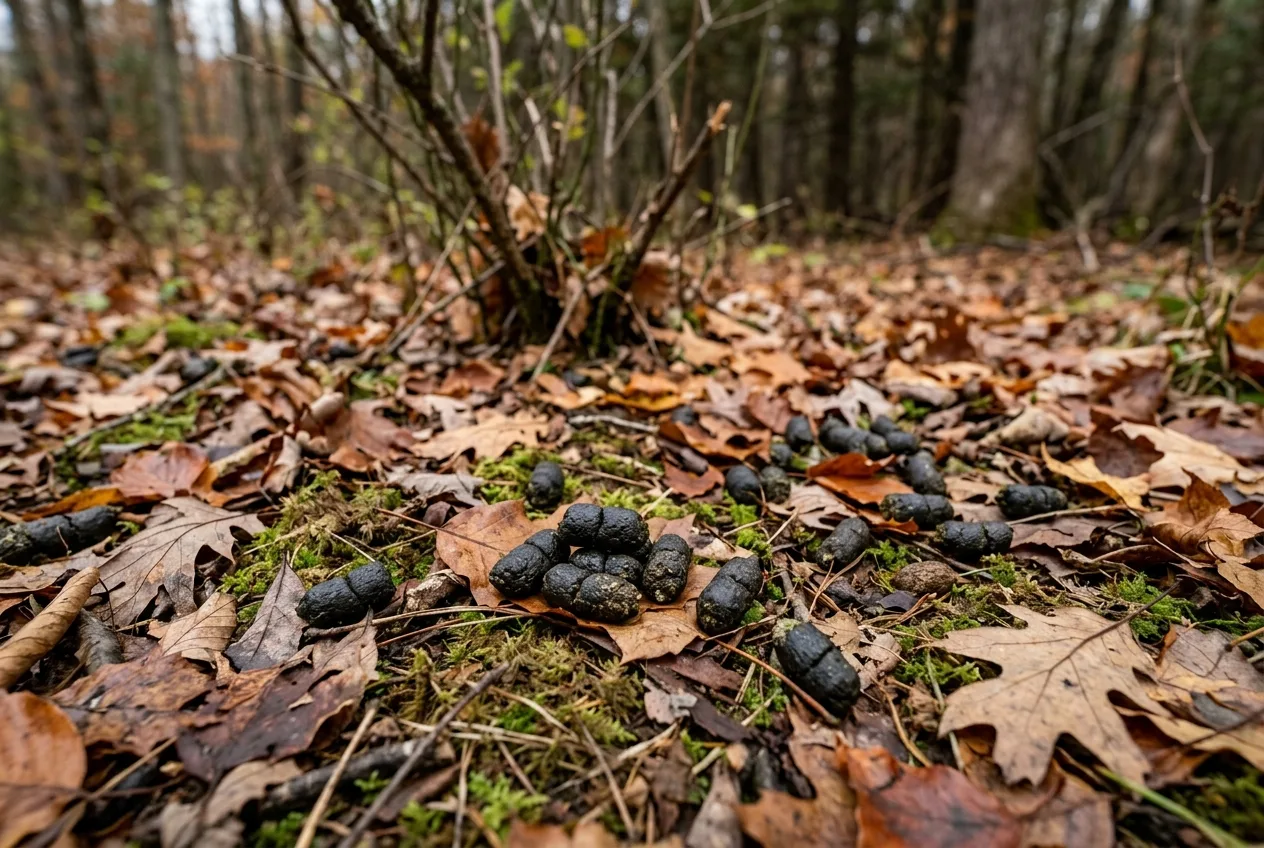
If you find a tidy pile of small, hard pellets, you're almost certainly looking at a plant-eater. White-tailed deer leave "piles of dark, cylindrical pellets ½ to 1 inch long" — similar to rabbit droppings but noticeably larger. People describe them as marble-sized, often dumped in a loose pile. There's a seasonal twist worth knowing: in winter and early spring, when deer browse on dry twigs and buds, the droppings are round and hard, almost rabbit-like; in summer, eating green shoots and leaves, they turn clumpier and softer, sometimes a single mass. That's why one homeowner watched the "same animal's" scat morph from wet plops in spring to dry pellets by fall — same deer, different diet.
Rabbits (eastern cottontails) leave "hard poop pellets about the size and shape of a garden pea," brown and very dry. UF/IFAS describes them as "rounded, pea-sized pellets with rough texture". Here's a fun bit of biology: rabbits actually eat some of their own droppings. They produce a soft pellet called a cecotrope and re-ingest it to squeeze locked-away nutrition out of tough winter food on a second pass — so the dry pellets you find are the second time that material has been through.
The deer-versus-rabbit call usually comes down to size: deer pellets are simply bigger. And both pile up in feeding areas — hedgerows, brushy field edges, browsed shrubbery — rather than on trail markers.
A useful gut-check from the field: ungulates (deer, elk, moose) all make pellets, and so do rabbits, squirrels, and chipmunks — but the non-ungulate pellets are much smaller. When a Missouri landowner found pellet piles "about the size of a chocolate-covered almond," too big for deer, the size alone ruled out the small-pellet crowd and pointed to elk or moose.
Coyote, fox, and dog: telling the dog family apart
This is the trio people most often confuse, and it's worth slowing down for.
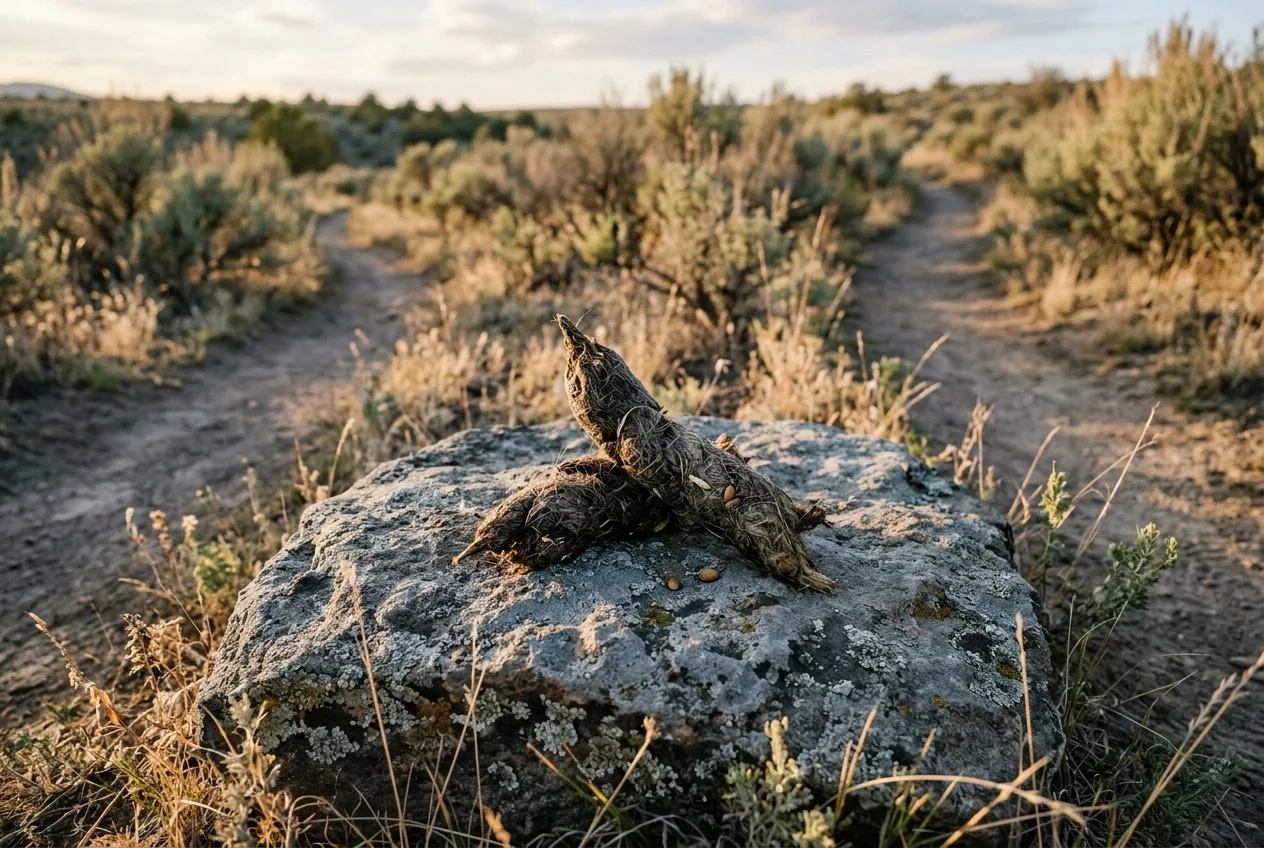
Coyote scat is the classic twisted rope. It's "typically between 3 and 6 inches long, with bits of bones, hair, seeds, grass, and even some fruit," because coyotes eat almost anything. The Northeast field guide puts a typical coyote scat around 3.0 inches long by 0.6 inches in diameter, "often tapered at the ends into long tails". A Colorado naturalist described a fresh one perfectly: "a twisted fibrous rope, except that the fibers that wrapped the outside and protruded from the inside were animal hairs". Color shifts with the meal — dark, even black, from meat and insects; lighter and fruit-colored when they've been raiding berries.
Fox scat looks like a smaller version of the same thing — roughly 2.0 inches by 0.6 inches, highly variable, "often has a tapered tail". UF/IFAS lumps fox and coyote together as "typically 2 inches long and 1/2 inch in diameter, segmented, with tapered (pointed) ends," usually containing hair and often bits of bone. Honestly, red and gray fox scat are "impossible to distinguish" from each other, and separating fox from coyote often comes down to size — fox scat is generally smaller.
Domestic dog is the one that trips everybody up, because a well-fed dog on a meaty diet produces tubular scat that looks coyote-ish. The single best tell: the ends. Coyote scat looks like it's been twisted off at the end; dog scat doesn't. Dog droppings also tend to be more uniform and blunt, and a dog eating commercial food won't have the hair, bone, and seeds that fill a wild canid's scat. If it's on a trail junction or perched on a rock and full of fur, think coyote. If it's in the middle of a lawn and looks like it came from a kibble diet, think dog.
Bobcat and mountain lion: the cat scat
Cats are strict meat-eaters, so feline scat is the carnivore profile turned up to eleven: hair and bone, rarely a seed in sight. Bobcat scat is described as looking "like a chunk of rope," "typically 3 to 5 inches long, often broken into distinct segments" with blunt ends. The Northeast guide gives about 3.0 by 0.8 inches and notes that a fresh one forms a uniform cord while a dry one crumbles; UF/IFAS says roughly 4 inches, segmented, blunt-ended. That segmentation is the most useful feline tell — in one quantitative study, 84% of bobcat scats were segmented, the clearest single morphological marker among the carnivores studied.
Behavior helps too. Like a house cat in a litter box, bobcats often cover their scat, which can make it hard to find. But when they're marking territory, they deliberately leave it uncovered in a visible spot — on a trail, on a rise — and often scrape the ground nearby as a second signal.
Mountain lion scat follows the same meat-only pattern but bigger — running roughly 6 to 15 inches long and an inch or more thick, always with hair and bone and maybe some grass, but no fruit or berry seeds. If you genuinely think you're looking at cougar scat, the safe move is to back off and report it rather than handle it.
Raccoon: the animal you should worry about
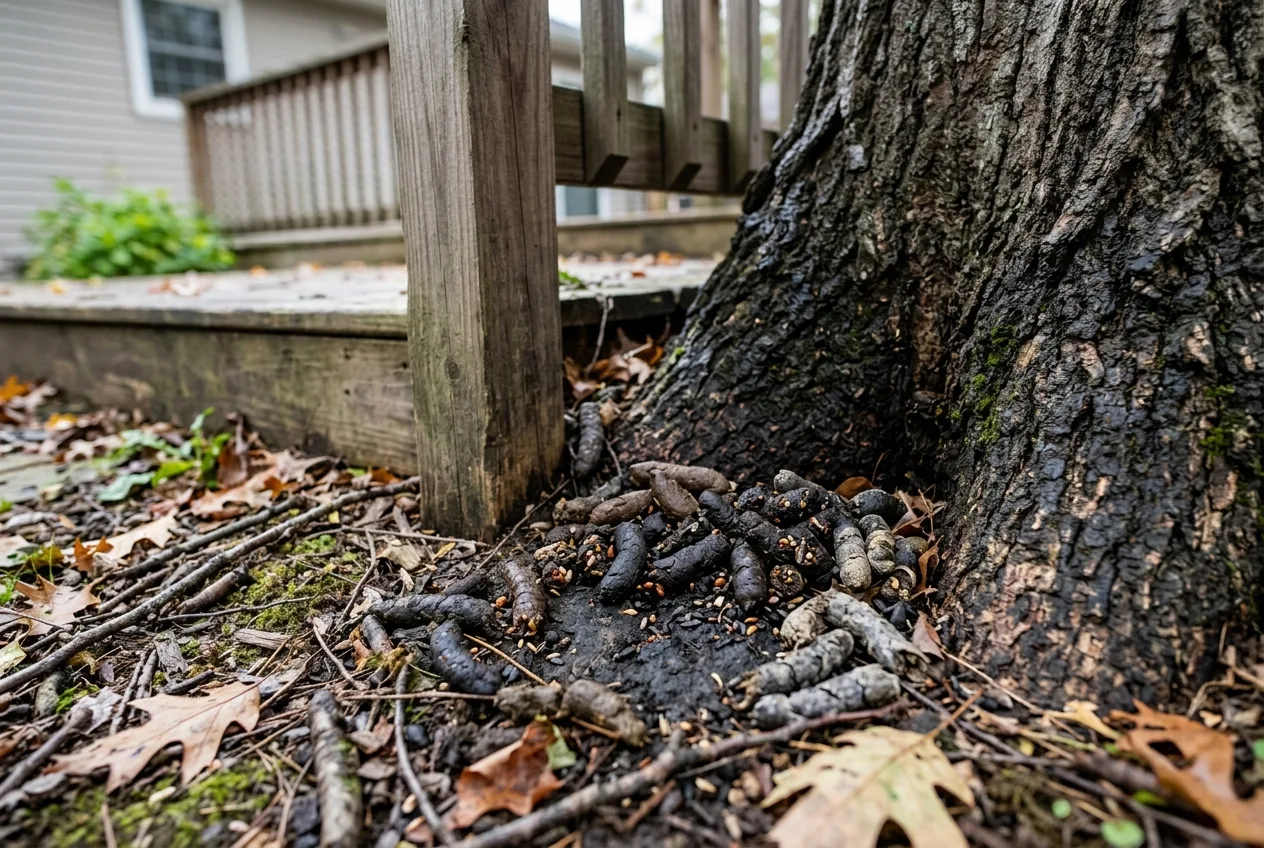
Raccoon scat deserves its own warning label, and we'll get to why in the safety section. Visually, it's "dark and tubular" with a "pungent odor," blunt on both ends and "uniform in thickness (1 inch in diameter)". The Northeast guide gives about 3.0 by 0.7 inches, most often black, and notes it "may contain crayfish, fruit, grain, seeds, or insect remains". The CDC adds that it's often "worse than dog or cat feces" in smell and frequently holds undigested seeds.
The dead giveaway is the latrine. Raccoons defecate communally, returning to the same site again and again — "often found at bases of trees, in unsealed attics, or on flat surfaces such as logs, tree stumps, rocks, decks, and rooftops". They'll even use a sandbox. So a recurring pile of dark, seed-flecked, blunt-ended tubular scat in a consistent spot near your house is the raccoon signature — and the one find on this list where what you do next really matters.
Bear: the big, sweet-smelling plop
Bear scat is unmistakable mostly by sheer volume — "a bear scat can weigh a pound or more". The Northeast guide lists black bear at roughly 7 inches by 1 inch, cylindrical, and adds a detail people never forget: it "often contains vegetation and has a sweet smell which attracts ants". That sweetness is real — bears gorging on fruit leave "big messy piles that have a sweet or pleasant odor," often studded with whole berries that passed undigested plus seeds from the ones that didn't.
Bear scat is a moving target across the seasons, which is exactly why it fools people. In spring, fresh out of the den on fibrous vegetation, it can be tubular, small, and dense; as juicier summer food comes in, it goes "large and loose". By late summer and fall it fills with seeds, berries, corn, acorns, and apples. When the meal is a carcass, it turns dark with hair and bone and the tips taper. Same animal, wildly different scat — so lean on size and that sweet, ant-drawing smell rather than expecting one look.
Rodents, weasels, and the small stuff
Down at the small end, rodents (rats, mice, chipmunks, even bats) leave "small feces pellets the size of rice grains". The weasel family is distinctive once you know it: mink, marten, fisher, and weasels leave long, thin, dark cords that often fold back on themselves and taper to a point at both ends. Mink scat near water may smell fishy and hold fish or crayfish remains; fisher scat frequently carries porcupine quills. Like bobcats, these animals often deposit on prominent objects — a log, a stump — as territorial markers.
The part nobody likes: scat can make you sick
Here's the honest, non-negotiable message every public-health and extension source repeats: do not handle scat with your bare hands, and do not put your face near it to smell it. "Animal feces are dirty and have germs," the Missouri guide states plainly; avoid handling without protection and avoid inhaling near droppings, "as some diseases, especially histoplasmosis in bat and bird droppings, can be transmitted through the air". Arizona extension is just as direct: "Do not breathe near or smell the scat as some diseases can be contracted through airborne particles". The Arizona produce-safety guide goes further still and tells field workers to treat all feces as high-risk.
The specific hazards are worth naming, because they're not hypothetical.
Raccoon roundworm (Baylisascaris) is the big one. Raccoons are the primary host of Baylisascaris procyonis, a parasite the CDC describes as "a ubiquitous roundworm found throughout North America" — up to 80% of raccoons in the Northeast, Midwest, and West Coast carry it. People get infected by accidentally swallowing eggs from raccoon feces. Cases are genuinely rare — only about 35 documented in the entire U.S. — but they can be devastating, causing larvae to migrate through the eye, organs, or brain. The eggs in fresh scat aren't immediately dangerous; they need 2 to 4 weeks in the environment to become infective, but once they do they're "resistant to most environmental conditions and with adequate moisture, can survive for years". Most victims are young children or people who might put dirt or feces in their mouths. A 2024 Los Angeles case shows how ordinary the exposure can be: a 14-year-old with pica picked up feces that had rolled off a rooftop raccoon latrine onto a stairwell; he recovered fully, but a 15-month-old in a separate case went undiagnosed for three months and was left with severe, lasting neurologic damage. An earlier cluster of seven cases included a toddler who simply played in a garage where his father stored raccoon pelts. This is why a raccoon latrine near a home isn't a curiosity — it's a cleanup job.
Hantavirus from rodent droppings is the reason you never sweep or vacuum mouse droppings in a shed or cabin. "When fresh urine, droppings, or nesting materials of an infected rodent are stirred up, the virus can get into the air," and you breathe it in. The CDC's cleanup method is the opposite of sweeping: ventilate the space for 30 minutes, then spray the droppings with a bleach solution (1.5 cups bleach per gallon of water, or 1 part bleach to 9 parts water) until wet, let it soak five minutes, and wipe up with paper towels — gloves on the whole time.
Leptospirosis spreads through the urine of infected animals — the CDC lists livestock, dogs, cats, rodents, marine mammals, and wild animals among the carriers — and the bacteria can survive in contaminated water or soil "for weeks to months," with risk spiking after heavy rain and flooding. Salmonella is shed in feces by birds, reptiles, and mammals, and tellingly, "some animals can carry the bacteria without showing any signs of infection" — a healthy-looking animal can still leave hazardous scat. That's also why bird feeders need regular cleaning.
The practical takeaway is simple. Look all you want, photograph freely, get close enough to see the contents — but keep it at look-don't-touch. If you must remove scat (a raccoon latrine in the yard, mouse droppings in a cabin), wear disposable gloves, seal the sample in a container, wash your hands thoroughly, and follow the agency cleanup steps for that specific animal. For a raccoon latrine, the CDC's outdoor protocol is to remove the feces with a shovel or inverted bag and burn, bury, or bag it for the landfill — chemicals don't kill the eggs, but heat does.
Look all you want, photograph freely, get close enough to see the contents — but keep it at look-don't-touch.
What scat tells you that a glimpse never could
Here's the payoff that makes all this worth learning: scat is a record of an animal's diet and movements, and it persists long after the animal has slipped away. Biologists use it precisely because "an animal's scat provides unbeatable insights into its diet and behavior".
The biggest study of its kind makes the point. National Park Service researchers and partners collected more than 3,100 coyote scat samples across metropolitan Los Angeles and dissected them at "scat parties." The droppings revealed that 60 to 75% of urban coyotes' diet came from human food — garbage, ornamental fruit, and yes, domestic cats, whose remains showed up in 20% of urban scat versus just 4% in suburban areas. As lead ecologist Justin Brown put it, "Whether it's cats, fruits or garbage, the food resources that we have left out for them is why coyotes hang around". Scat told them not just that coyotes were present, but why.
Scat also explains the territorial drama playing out on your local trail. Ever wonder why coyote droppings so reliably land in the middle of the path, or at a junction, or on top of a rock? It's not laziness — it's a billboard. Coyotes "go out of their way to drop scat on trails, or at the junction of two trails, or on top of a rock to communicate with other coyotes," a behavior called scent marking. A Yellowstone study of five coyote packs found scent marking concentrated right at territorial boundaries, exactly where neighboring packs intruded. Mountain lions even drape scat on tall shrubs to get the message higher. Being subtle would defeat the entire purpose.
Scat tells you a species was here and roughly what it ate; a camera tells you who, when, and how many.
When you simply can't be sure (and that's okay)
I'll close where the science lands, because honesty is the point of a guide like this. Even experts get scat wrong more often than you'd expect. A large 2026 molecular study compared field identifications of carnivore scat against DNA from the same samples and found they matched only 75.9% of the time. When researchers allowed credit for getting the right genus (coyote-versus-dog rather than the exact species), agreement rose to 80%. And the harder the call, the worse it got: two similar marten species that were correctly told apart 83% of the time where only one lived dropped to just 41% agreement where both species overlapped. A separate North American study reached the same blunt conclusion — coyote, bobcat, and gray fox scats "can neither be reliably distinguished by morphology alone"; you need DNA or solid contextual evidence for certainty.
Two things move the needle in your favor. Fresh scat is far more informative — in the DNA study, fresh samples had nearly double the odds of yielding a clean genetic result compared with older ones, and fresh feces is "moist and shiny" while old feces goes "dry, dull, and grayish". And confidence is earned by clear features — when field experts only counted their high-certainty calls, agreement jumped above 90%. So weight the cases where the evidence is unambiguous: a segmented rope full of hair on a trail rock is a confident carnivore call; a weathered gray lump with no contents is a shrug, and it's perfectly fine to leave it at "probably a canid." A good scat detective, in the words of one wildlife biologist, just keeps "asking the right questions" to whittle down the suspects — and knows when the honest answer is "not sure."
Frequently asked questions
How can you tell coyote scat from dog scat?
Check the ends and the contents. Coyote scat is usually twisted or tapered at the end "into long tails" and packed with hair, bone, seeds, or fruit; domestic dog scat has blunt, untwisted ends and, from a kibble diet, lacks those wild contents. Placement helps too — coyotes deliberately leave scat on trails, junctions, and rocks to mark territory.
Is it dangerous to touch or smell animal poop?
Yes — handle it with protection only, and never put your face close to smell it. Diseases including histoplasmosis (from bat and bird droppings) and hantavirus (from rodents) can spread through the air when droppings are disturbed, so guides advise against breathing near scat. Raccoon feces can carry roundworm eggs that cause severe disease in people. Look, photograph, but don't touch with bare hands.
What does raccoon scat look like, and why is it a concern?
Raccoon scat is dark, tubular, blunt-ended, about an inch thick, strong-smelling, and often full of seeds — and raccoons leave it in communal "latrines" they reuse, frequently at tree bases, on logs, decks, or rooftops. It's a concern because raccoons are the main host of Baylisascaris procyonis roundworm; up to 80% of raccoons in many regions carry it, and accidental ingestion of eggs can cause rare but serious illness, especially in young children.
Why is there always coyote poop in the middle of the trail?
It's intentional scent marking. Coyotes drop scat in conspicuous places — on trails, at trail junctions, on rocks — to communicate territory boundaries to other coyotes, and the marking concentrates right at the edges where rival packs intrude.
How big is deer scat, and how do I tell it from rabbit droppings?
Deer leave piles of dark, cylindrical pellets about ½ to 1 inch long. They look a lot like rabbit pellets, which are pea-sized and rounded — the main difference is size, with deer pellets noticeably larger. In summer, deer droppings can turn clumpier or merge into a softer mass as the animals switch to green forage.
Can you always identify an animal from its scat alone?
No, and good guides say so. Diet dramatically changes a scat's color, shape, and contents, and even expert field IDs of carnivore scat are wrong a meaningful share of the time — more so for look-alike species sharing the same range. Use scat as a strong clue, lean on fresh samples and clear contents, and confirm with tracks or a trail-camera photo when it matters.