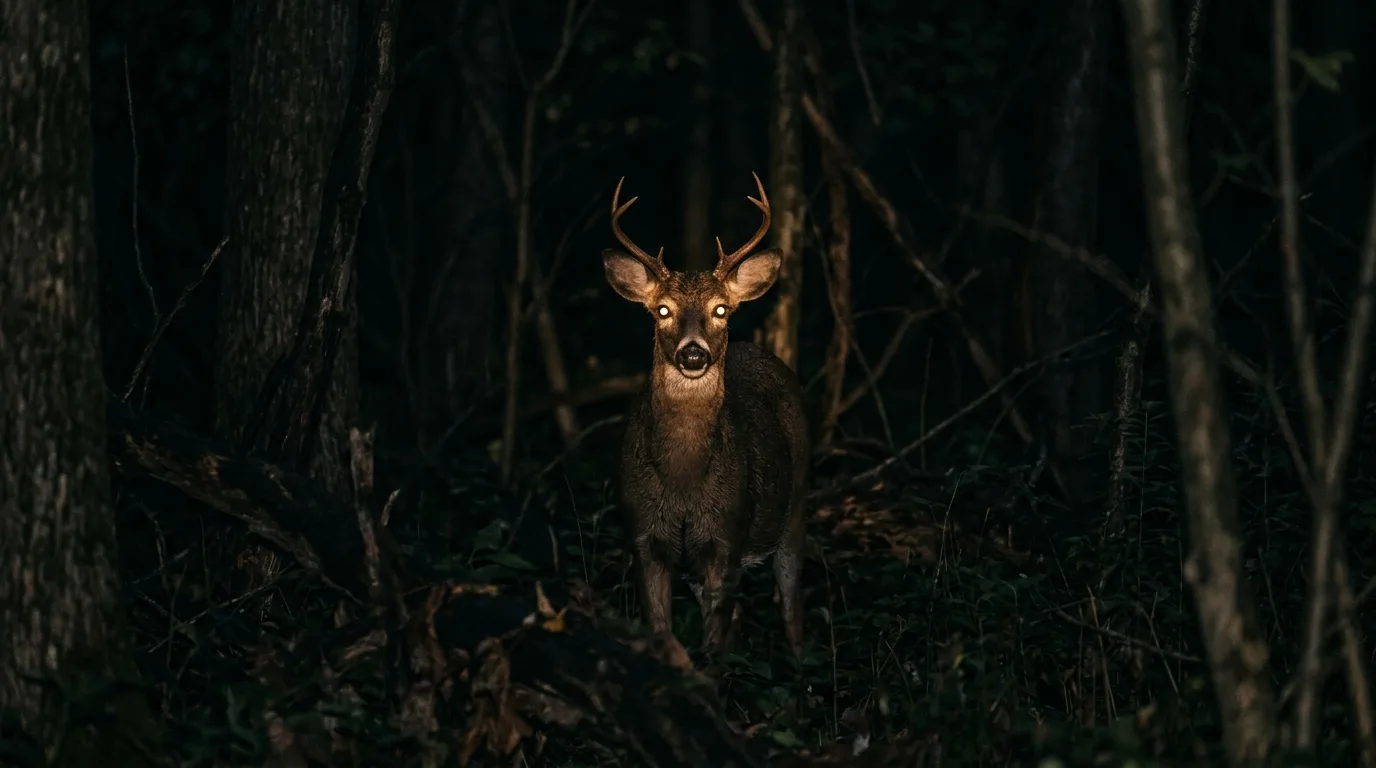
You sweep a flashlight across the yard and two points of light flare back at you out of the dark. Maybe it's the headlamp on the walk to your stand, or the porch light catching something at the edge of the lawn. The body is invisible. The eyes are not — they burn back at you, and for a second your brain runs through the list: cat, deer, raccoon, something bigger?
That flare is called eyeshine, and it is one of the most reliable "tells" in nocturnal wildlife. It is also widely misread. People want it to be a lookup table — red means fox, green means cat, done — and it simply isn't that. The color is real, the science behind it is genuinely elegant, and it can absolutely help you. But it is a soft cue that shifts with the angle of the light, the color of your beam, the minerals in the animal's eye, even the animal's age. And here's the part that trips up everyone running a trail camera: on an infrared night photo, the color is gone entirely. You get the glow, but not the hue.
So let's do this properly. What eyeshine actually is, why the colors vary, a working color guide for the animals you'll really encounter — and, just as useful, how the height and spacing of those two dots tell you the size of the animal before you ever see it.
The mirror behind the eye
Start with why it happens at all, because the mechanism explains everything that follows.
Light enters the eye and most of it lands on the photoreceptors in the retina, the rods and cones that turn light into signal. But some photons slip past without being absorbed. In an animal with a tapetum lucidum, those photons hit a reflective layer sitting right behind the retina and get bounced straight back through it — a second chance to be caught. The Texas Parks and Wildlife Department puts the everyday version of it well: these animals' eyes "don't glow — they reflect available light".
A vision-science review describes the tapetum as "a biologic reflector system… [that] provide[s] the light-sensitive retinal cells with a second opportunity for photon-photoreceptor stimulation, thereby enhancing visual sensitivity at low light levels". The payoff is large: that second pass roughly doubles the eye's sensitivity in the dark. A house cat can see in light only about 16% as bright as what you'd need. The trade-off is sharpness — light scattering off the tapetum slightly blurs the image, which is part of why the animals with the most brilliant eyeshine also tend to be the most color-blind.
We don't have a tapetum. Behind our retinas sit dark cells that absorb stray light instead of reflecting it. That's the whole reason a deer's eyes light up in your headlights and your friend's don't — and, worth saying, it's also why eyeshine is not the "red-eye" you get in a flash photo of a person. Red-eye is light bouncing off the blood-rich tissue behind the human retina; eyeshine is light bouncing off a dedicated mirror.
The animals whose eyes blaze brightest in your beam are usually the ones that see color worst — brilliant night vision is bought with a little blur.
Why the color changes — and why you shouldn't trust it too far
Here's where people get into trouble. They see a chart, they memorize "red = X, green = Y," and then reality refuses to cooperate. Understanding why fixes that.
The tapetum isn't one thing. Different animals build it from different materials, arranged differently, and that structure is what sets the reflected color. The cleanest way to think about it: the reflective layer is a microscopic stack of regularly spaced elements, and the spacing between them — on the order of the wavelength of visible light, roughly 100 nanometers — determines which color reflects back. Change the material or the spacing and you change the color.
The materials really do differ. A cat's tapetum is built largely from riboflavin — vitamin B2 — tuned to amplify the wavelengths a cat sees best. Dogs and many other carnivores lean on zinc in the reflective crystals; in domestic cats it's a mix of zinc and riboflavin, and the exact proportions shift the eyeshine color. Sharks and many fish use guanine plates instead. Hoofed animals like cattle, sheep, and horses have yet another type built from collagen fibers.
Now layer on the variables that change within a single animal:
- Angle. Eyeshine is iridescent, like oil on water. The Realtree guide says it plainly: color "will vary with the angle at which you view it". Move your head, change the answer.
- Your light. A white beam, a red filter, and a blue spotlight will not return the same color from the same eye.
- Age. Eyeshine can shift as an animal gets older.
- The individual. Even within one species — even one breed of dog — mineral content varies enough to change the glow.
The most striking proof that color isn't fixed comes from reindeer. A team working in the Arctic showed that reindeer physically retune their tapetum with the seasons: in the long bright period it reflects a gold-turquoise, the color you'd see in most mammals, and in the dark season it shifts to a deep blue that matches the blue twilight they live in. They do it by squeezing the spacing of the collagen fibrils in the eye, trading some sharpness for the ability to gather scarce blue light. The summer eye is "a luminous gold streaked through with turquoise, iridescent like a golden opal," the winter eye a flat blue. The same animal, two colors, six months apart.
There's an even better cautionary tale buried in that research. A group of reindeer living near artificial lighting were found with eyes glowing green — their seasonal adaptation essentially scrambled by light pollution. If a streetlight can rewrite the color of a reindeer's eye, you can see why "red means fox" is a shaky foundation.
Eyeshine color is iridescent, mineral-dependent, age-dependent, and angle-dependent — useful as a clue, dangerous as a verdict.
A color guide that's honest about its limits
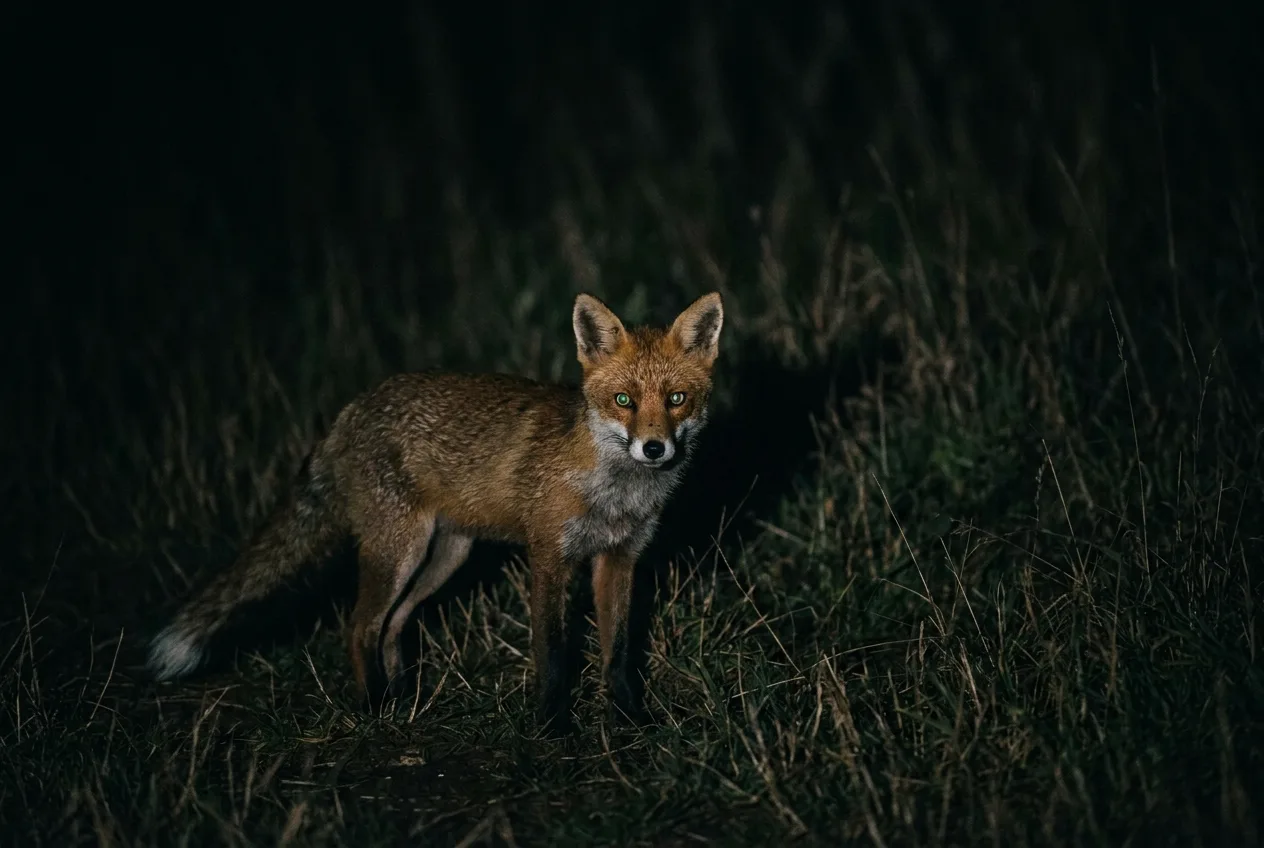
With all that said — color does carry information, especially once you combine it with everything else. Here's a working guide drawn from wildlife agencies, a conservation-science explainer, and practitioner sources. Read it as "this animal often shines this color," never "this color means this animal." The sources themselves don't fully agree at the edges, and I've flagged where they diverge.
| Common eyeshine color | Animals often seen with it | Worth knowing |
|---|---|---|
| Red / reddish-orange | Black bear (can also look yellow or green), opossum, fox, rabbit, porcupine, rodents, alligator | Bears run yellow-to-red depending on the light; opossum is typically a dull red-orange; alligators range "from a bright reddish orange to an iridescent pink" |
| Yellow / gold | Coyote, bobcat, raccoon, cougar, domestic cat | Cat eyes go "from yellowish gold to bright green"; cougars and bears overlap in the yellow-to-red band |
| White | Deer, elk, squirrel, badger | The classic "two white dots at chest height" of a deer or elk; moose, oddly, tend to read red |
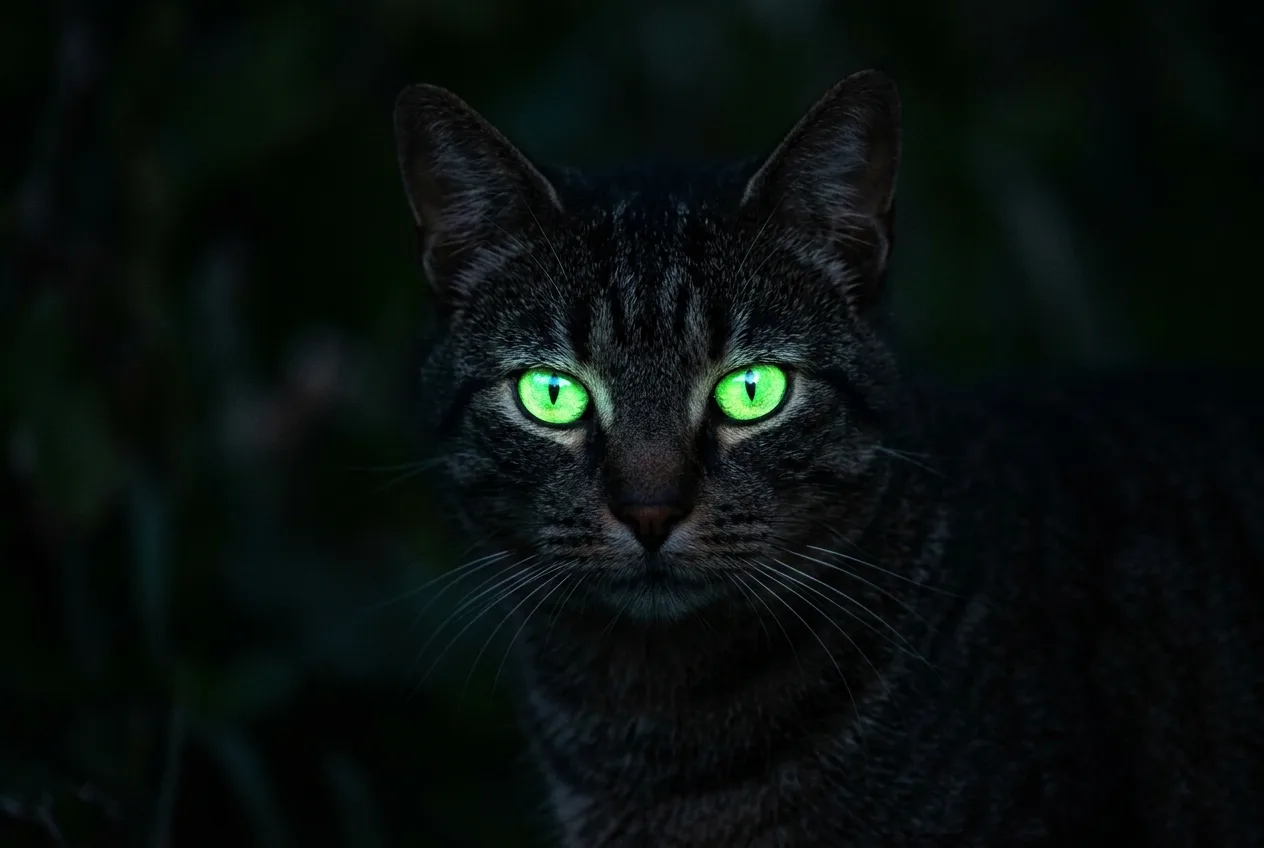
| Green | Fox, domestic cat and dog, spider, sheep, frog | Foxes, cats, and dogs "usually shine green," though cats can also flash orange-to-red; wolf-spider eyes glow "green as a traffic light" |
| Blue | Horse, woodchuck, pine marten | Horses commonly read blue |
Notice the overlaps and the disagreements. The Nature Conservancy's chart files raccoon under yellow; an education-nonprofit explainer says raccoons "often display green"; some consumer charts call them red. Foxes appear under both red and green here. That isn't sloppiness — it's the iridescence doing exactly what it does. Use the color to narrow the field, then let the rest of the picture decide.
A few species are worth pulling out of the table:
Deer and other hoofed animals. Deer typically throw a white-to-pale glow, and because their eyes are set on the sides of the head with horizontally elongated pupils, they're built for wide, panoramic motion detection rather than forward focus. That eye placement is a clue in itself, which we'll get to.
Cats, big and small. From a cougar down to the nine-pound cat asleep on your couch, felids tend toward a coppery yellow-green. Wild cats often show a heavy upper eyelid and a more vertical, slit-like pupil — a small detail that separates a bobcat's stare from a deer's.
Bears. Despite the old "bears are half-blind" line, bears have a normal tapetum and likely see better than us in the dark. Their eyes are large, round, set fairly low to the ground, and nearly pupil-less in appearance, glowing yellow to orange or sometimes red.
Alligators and other reptiles. Crocodilians are a standout — a bright reddish-orange to pink shine that researchers rely on, because at night a spotlight sweep across the water lights up their eyes like coals.
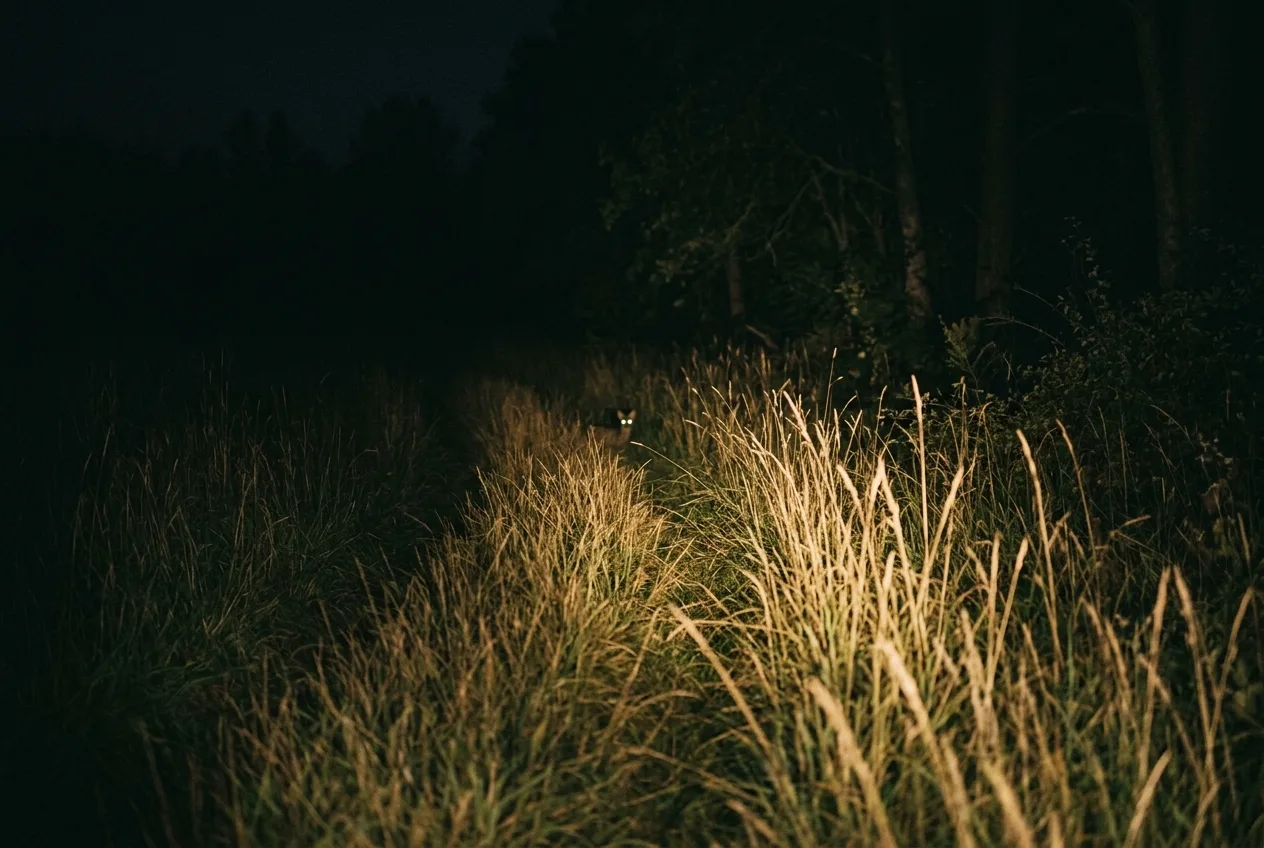
Spiders. Yes, spiders. Wolf spiders have a tapetum in their secondary eyes and glow a startling green if you catch them right. More on the "if you catch them right" in a moment.
Birds — the big asterisk. This is the correction most charts get wrong. Most birds do not have a tapetum lucidum at all. Owls' eyes can appear to catch light, but it isn't true tapetal eyeshine, and the source of it is still debated. The notable exceptions are nightjars and their relatives. One birder described chasing owlet-nightjars that he "never" saw shine — until he moved his torch up level with his own eyes, and then "its eyes shown back bright red like a Christmas tree". Which is the perfect bridge to the two things that matter more than color.
Spacing and height: reading size before you read color
Ask an experienced tracker how they identify an animal by eyeshine and they will not start with color. They'll start with geometry.
A guide at Londolozi in South Africa described how trackers work at night: from "the colour of the eye-shine, the height of the eyes and their width apart, they can immediately tell what species it is, without actually seeing the animal itself". Height and spacing are the engine of that judgment, and they're more dependable than color because they're not iridescent — a big animal's eyes are far apart and high off the ground no matter what angle your light hits them.
Think it through. Two dots glowing at chest height, set a good hand-span apart, drifting slowly — that's a large animal, a deer or something bigger. Two small dots an inch off the ground, close together, that scuttle and freeze — small mammal, maybe a rodent. The single green sparks low in the grass that wink out when you turn your head are spiders. The eyes' height above the ground and their distance apart are doing most of the work; color is the tiebreaker.
The practical version, pulled together from the field sources, is to read four things at once:
- Height off the ground. Roughly how tall is the animal? Eyes a few feet up read as deer or elk; eyes near the dirt read as something small.
- Spacing between the eyes. Wide-set eyes mean a broad skull and a bigger animal. This, with height, is your size estimate.
- Movement. Is it hopping, weaving, climbing, gliding, flying, or walking steady? A raccoon's amble, a fox's trot, and an owl's silent launch all read differently.
- Pupil and eye shape. Predators tend to have vertically elongated pupils; prey animals tend to have horizontal ones. A deer's eye is large and round-ish with a horizontal pupil; a cat's is a vertical slit under a heavy lid.
None of these alone names the animal. Together — height plus spacing plus gait plus pupil, with color as a fifth input — they get you remarkably close. That's the actual skill: not a color chart, but a quick read of the whole picture.
A tracker reads the height and spacing of the eyes first and the color last, because geometry doesn't lie the way iridescence does.
The trail-camera catch: infrared erases the color
Now the part that matters most if you're reading eyeshine off a camera instead of through your own eyes — and the one I most want you to take away.
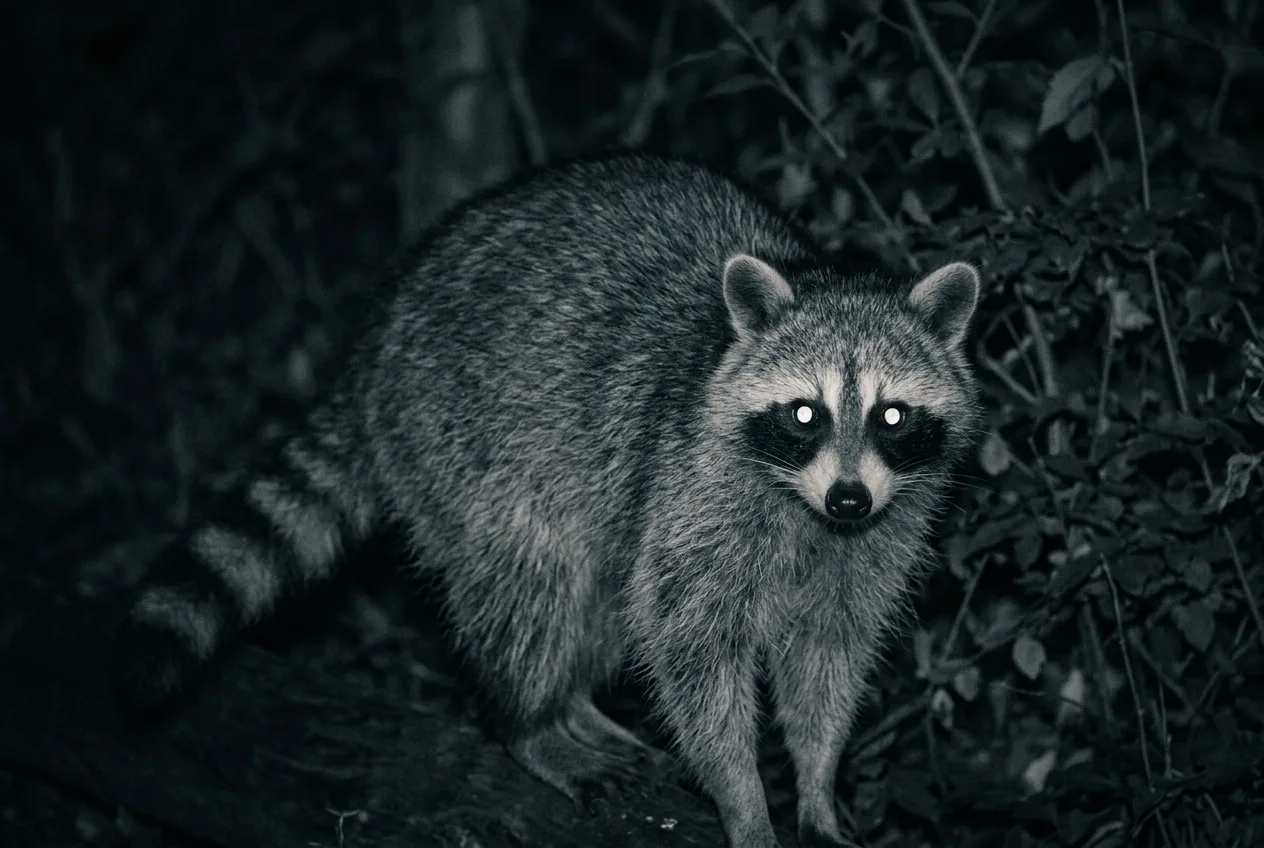
Almost every trail camera shoots its night photos using infrared light. Infrared sits outside the visible spectrum; the camera's sensor "sees" it, but it carries no color information, so the image comes out grayscale. During the day the camera blocks IR to keep colors accurate; at night it lets the IR in and the picture goes black-and-white. The eyeshine still happens — the IR flash bounces off the tapetum just like any other light, and the eyes light up bright in the frame. It's a routine sight in trail-camera sets: the same agency network notes you'll most often catch that glow in nighttime photos of deer, coyotes, and bobcats. But the color is gone.
A wildlife agency that runs a statewide trail-camera network put it about as directly as it can be put. After explaining that mineral and structural differences make eyeshine "appear white, blue, green, yellow, pink or red" across species, they add the catch: "nighttime trail-cam photos are in black and white, so these color differences cannot be seen". That's the whole point. On a standard IR trail-camera image, an opossum's red and a deer's white and a cat's green all show up as the same hot white blobs.
So if you're sorting nighttime captures, the color guide above is mostly useless to you — and the geometry guide is gold. Height of the eyes in the frame, spacing between them, the animal's body shape and gait, the pupil and ear shape: those survive grayscale just fine. Color is only back on the menu if you're using a white or colored spotlight, or one of the less common color-at-night camera setups. (The deeper mechanics of why IR night photos look the way they do — blur, glare, 850 nm versus 940 nm flash — are their own subject; see Why Your Trail Camera's Night Photos Come Out Blurry, Washed Out, or Too Dark.)
Putting it to use: spotlighting done right
If you do want to use color — out in the field with a light, not on a camera — a couple of techniques from the survey world make a real difference.
First, hold the light near your own eyes. Eyeshine only comes back to you when your line of sight is close to the beam, which is exactly why the birder above saw nothing until he raised his torch to eye level. The spider-hunting version is identical: "hold a flashlight level with your eyes" and sweep it across the grass fifteen or twenty feet out, and the green sparks appear. Off-axis, the same eyes stay dark.
Second, the color of your light matters, and brighter is not automatically better. Crocodilian researchers note that "very bright lights will wash out the eyeshine from smaller [animals]," and that a blue beam throws much less glare than a white one. A study of nocturnal mammal surveys found that plain white light actually reduced how many animals were detected compared with red light, and that white light disrupts the animals' behavior and raises the odds of startling or blinding them. That work was done on tropical forest mammals, so don't treat the exact numbers as a universal law — but the principle, that white light is the harsh default and a red or filtered beam is gentler and often more effective, lines up with what the reptile surveyors found too.
It's worth remembering that spotlighting for eyeshine isn't a novelty. Wildlife agencies use it as a formal census method — running a set route at night and counting deer by their eyeshine is a recognized survey technique, not just something hunters do on the way to a stand. The same trick that catches a raccoon in your headlights is, scaled up and standardized, how some deer populations get estimated.
Eyeshine only answers when you ask it correctly: light held at your own eye level, and ideally a softer beam than harsh white.
A quick way to think about it
Next time two eyes flare at you in the dark, run the list in this order:
- How big? Height off the ground and spacing between the eyes. That's your size estimate, and it's the most reliable read you've got.
- How's it moving? Gait and behavior narrow the species fast.
- What shape are the eyes and pupils? Vertical slit and heavy lid leans predator; large and round-ish leans prey.
- What color — if you can even see it? Under a spotlight, color is your tiebreaker; on an IR trail-camera photo, skip it, because it isn't there.
Do that and you're thinking like a tracker instead of reaching for a chart. The chart is the least of it.
Frequently asked questions
What animal has red eyes at night?
Quite a few, which is exactly why red alone won't pin it down. Common red-to-reddish-orange eyeshine shows up in black bears (though they can look yellow or green too), opossums, foxes, rabbits, rodents, and alligators. Use the eyes' height, spacing, and the animal's movement to narrow it from there.
Why do some animals' eyes glow and human eyes don't?
Glowing eyes have a tapetum lucidum, a reflective layer behind the retina that bounces light back for a second pass and boosts night vision. Humans lack it — we have light-absorbing cells back there instead — so our eyes don't shine. The "red-eye" in flash photos of people is a different effect, light bouncing off blood vessels, not a tapetum.
Can I tell the animal just from the eyeshine color?
No, and it's the most common mistake people make. Eyeshine is iridescent and shifts with viewing angle, the color of your light, the minerals in the eye, and the animal's age, so the same species can look like different colors on different nights. Color narrows the field; height, spacing, movement, and pupil shape do the real identifying.
Why does eyeshine color disappear in my trail camera's night photos?
Because those photos are taken with infrared light and come out in grayscale — black and white carries no color, so every animal's eyeshine just looks like a bright spot. The agency behind one large trail-camera project says it directly: in nighttime trail-cam photos "these color differences cannot be seen". Color only helps under a white or colored spotlight, not on a standard IR image.
Do owls and other birds have eyeshine?
Mostly no. Most birds don't have a tapetum lucidum at all, and an owl's apparent "glow" isn't true tapetal eyeshine — its source is still debated. Nightjars and their relatives are among the few birds that genuinely shine, and even they often only show it when your light is held level with your eyes.
Is it true that opossums and Australian "possums" both glow red?
They do tend to glow in the red-to-orange range, but they're entirely different animals — opossums are American marsupials, possums are Australian — so don't read one's behavior off the other. As always, color is a starting clue, not an ID on its own.