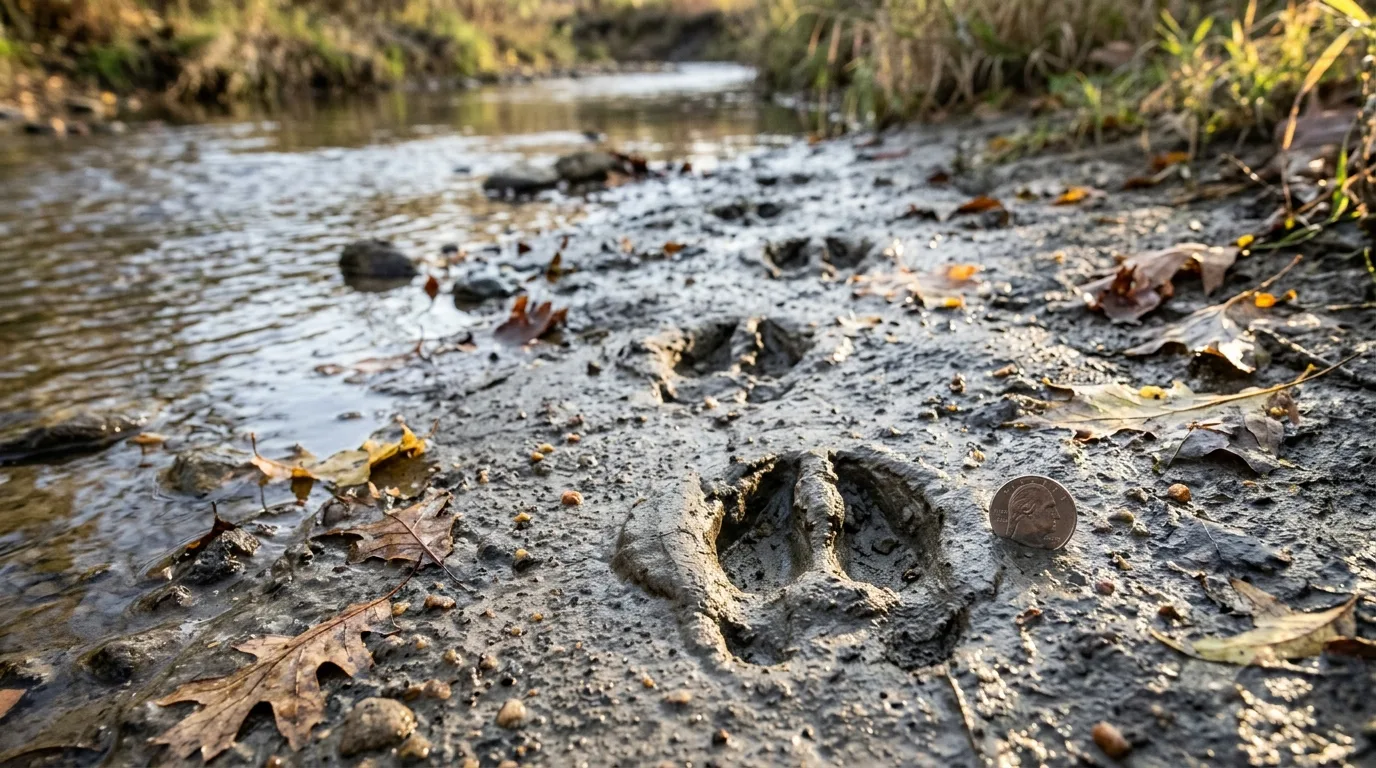
You're walking a creek bank and there it is: a clean print pressed into the mud, sharp enough that you can see every toe. Something passed here, recently, and for a second you really want to know what. A deer? A dog off its leash? Something you'd rather know about before it knows about you?
Here's the thing that turns that little flash of curiosity into an actual answer. You don't identify a track by matching it to a picture in your head. You identify it by asking a short list of questions — how many toes, are there claw marks, is it round or oval, how big, what's the heel pad shape, how is the animal walking — and letting the answers narrow the field. Get good at the questions and you can read a track you've never seen before. That's the whole skill, and it's more like learning to read than memorizing flashcards: you start with clear prints on easy ground, and over time you're reading wind-blown scuffs in sand and a single toenail scratch on rock.
This guide walks you through those questions first, then through the common animals — deer, the dog family, the cat family, raccoon and opossum, bear, rabbits and rodents, the weasel tribe, and turkey and other birds — with the real measurements and the giveaways that actually separate look-alikes. And it's honest about the tracks that can't be told apart, because pretending otherwise is how people end up sure they saw a mountain lion when it was the neighbor's Labrador.
One promise up front, straight from the people who do this for a living: don't expect every track to be a perfect specimen. The New Mexico State extension guide puts it plainly — use a guide "as a guide rather than a rigid key because a perfect track is not always found". A print in dust looks different from the same foot in mud, and a track in snow is different again after the sun has widened and distorted it. So read for the characteristics, not for a perfect match.
How to read a track: the six questions
Before you guess a species, interrogate the print. Jonah Evans — a CyberTracker-certified naturalist and tracking expert — frames identification as a set of questions that "bring your attention to the most important characteristics". Here they are, in the order I'd use them.
1. How many toes — and are they front or hind? This is the fastest cut. Cats, dogs, and rabbits all register four toes on both front and hind feet. Many rodents show four toes on the front foot and five on the hind. Weasels and their relatives, raccoons, opossums, and bears all show five. Count carefully, though: it's very common for an animal's hind foot to land in its own front track, fusing two prints into one weird-looking shape, and raccoons — which normally show five toes — will sometimes register only four and masquerade as something else. Find several tracks and pick the cleanest before you commit.
2. Are there claw marks? This one quietly settles a lot of arguments. Cat tracks usually don't show claws; most dog tracks do. Cats keep their claws retracted, so a clean feline print shows toes and pad but no nails out front. If you do see claws, read them: small and sharp suggests a climber, big and blunt suggests a digger.
3. Is it symmetrical? Draw an imaginary line down the middle and compare halves. Dog tracks are fairly symmetrical; a cat's front foot is noticeably lopsided, with its hind foot more even. Rabbits also make asymmetrical tracks. Symmetry even helps you sort front from hind and left from right once you get an eye for it.
4. What's the palm pad like? The pad behind the toes — the metacarpal pad — carries real information. Cats, dogs, and raccoons have a single fused pad; rats, mice, and squirrels show several separate little pads. And there's one feline tell worth memorizing: every cat species shows a double lobe on the leading (front) edge of that pad, while a dog's pad has a single lobe up front. That detail alone separates a bobcat from a fox more reliably than size does.
5. Is there hair in the track? Furred feet leave a fuzzy, less-defined print or just extra negative space around the toes. Rabbits, red foxes, long-tailed weasels, and a few others famously blur their own prints this way. A "soft," ill-defined cat-sized track in snow might be a furry-footed lynx rather than a bobcat.
6. Is there webbing? Webbing between the toes flags aquatic animals — river otter, beaver — and is especially useful for birds. In a webbed bird foot, the two outer toes curve slightly toward the middle one.
Run those six, and most tracks sort themselves into a family before you've even thought about a species name. From there it's mostly size and a couple of fine details.
A quick word on feet: why some animals leave heel marks and some don't
It helps to know there are three basic ways animals stand on their feet, because it explains what you see. Plantigrade animals — bears, skunks, raccoons, us — put the whole foot down, heel and all, so their prints look long and flat, almost human in the hind track. Digitigrade animals — cats and dogs — walk up on their toes, so the heel never registers and the track is compact. Unguligrade animals — deer, elk, the hoofed crowd — walk on the very tips of their toes, on what amounts to oversized toenails. That's why a bear's hind print sprawls with a big heel while a deer's is a tidy little wedge.
Measuring a track without fooling yourself
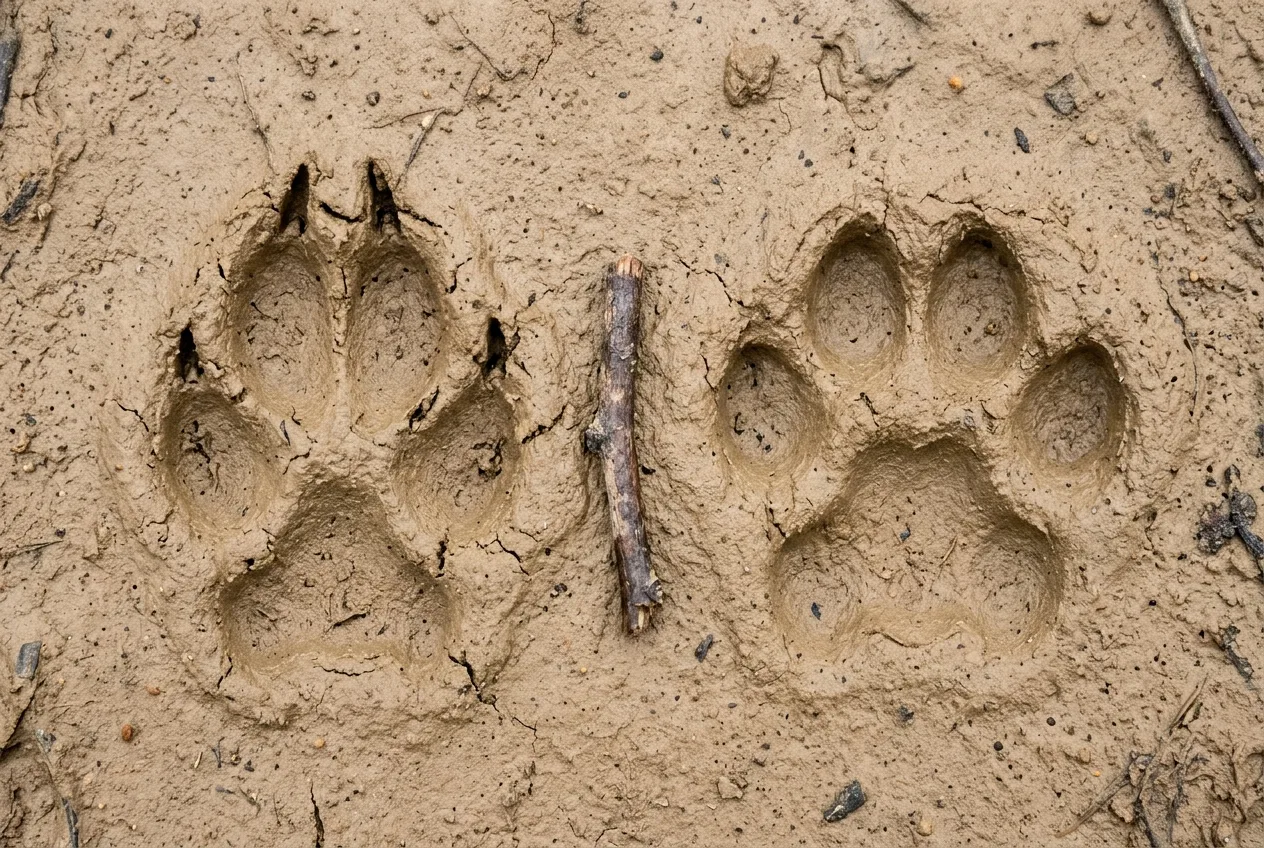
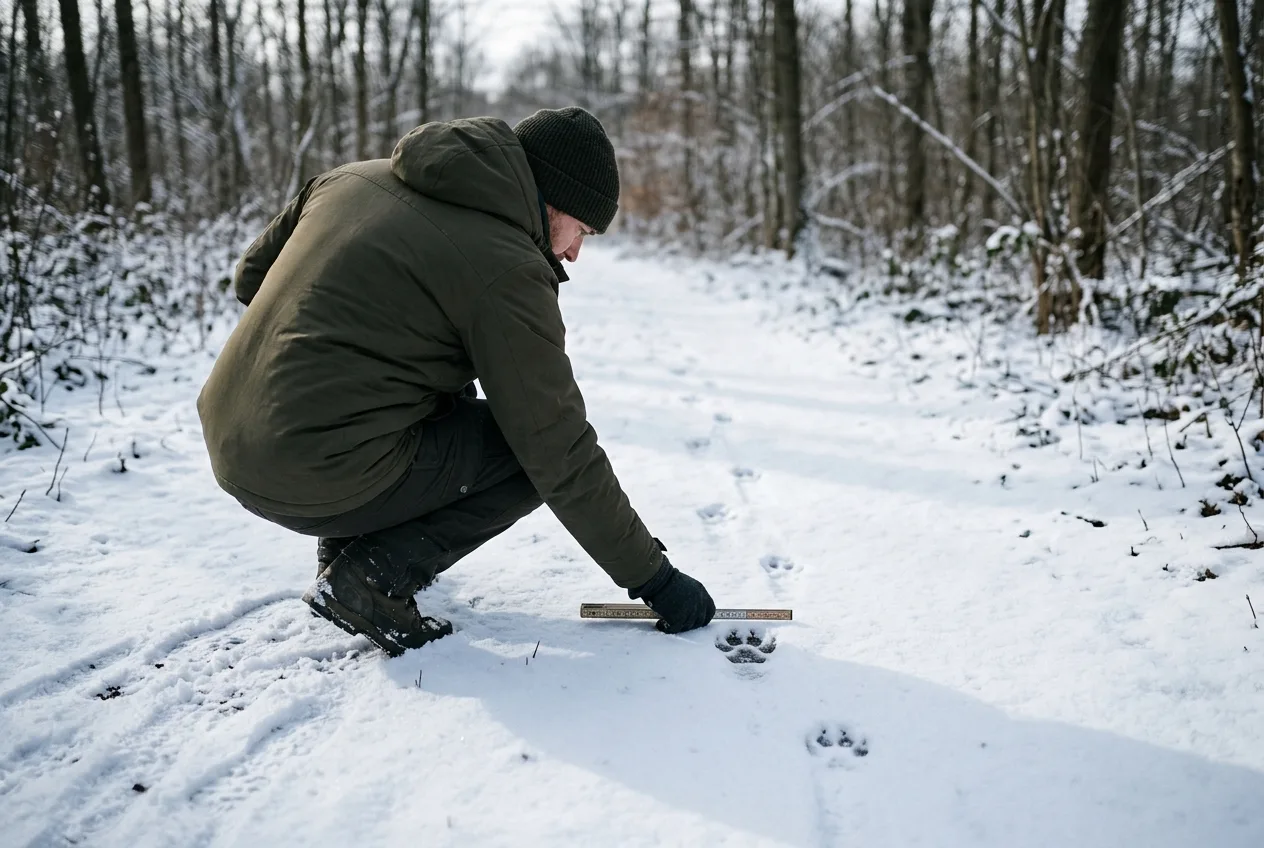
If you carry one tool, make it a small ruler or even a coin for scale. But measure the right thing. A track is bowl-shaped — the foot slides in and out, so the rim at ground level is always bigger than the actual foot. Evans recommends measuring the track floor, "from the back of the palm pad to the tip of the toes" for length and "the widest points" for width, and skipping claws and dewclaws since they don't register reliably. Rick Curtis's Princeton tracking guide makes the same point harder: read the true track, not the "overall track" at the surface. In soft soil the distortion is so large that "you could not tell the difference between a dog track and a coyote track" from the rim alone — yet the true tracks differ, because a dog's inner toes are larger while a coyote's outer toes are larger. Measure several prints, not one, and note the substrate.
Reading the trail, not just the track: gait patterns
Here's the part beginners skip and experts swear by. Most of the time you won't get a crisp print — by some estimates only about one track in a hundred shows clear toe or claw detail. What you'll have instead is a pattern of marks marching across the ground, and the pattern alone often names the animal. As one naturalist puts it, with just the track pattern and the overall trail width "you'll know the difference between the mouse and vole, or even tracks that are weeks old and covered with snow".
Animals are lazy in a smart way — to save energy they use one habitual gait most of the time — so trackers sort them into a handful of pattern families:
- Diagonal walkers move opposite corners together (front-left with hind-right). This is the deer, dog, and cat families — deer, moose, elk, fox, wolf, coyote, bobcat, mountain lion. The prints fall in an alternating line straddling an imaginary centerline, and the front feet are usually larger than the hind.
- Bounders are the weasel family — ermine, mink, marten, fisher, long-tailed weasel. The two front feet land, then the two hind feet land just behind, over and over, like a sewing-machine needle, leaving paired tracks that hold close to the centerline.
- Gallopers are the rabbits, hares, and most rodents — mice, voles, squirrels, chipmunks. The front feet land first and the bigger hind feet swing around the outside and land ahead of them. A snowshoe hare's group of four is the classic shape.
- Pacers (waddlers) are the wide-bodied animals — bear, raccoon, skunk, porcupine, opossum, beaver, muskrat. They move both legs on the same side together and rock side to side as they walk. The Pennsylvania Game Commission's brochure groups these same "waddlers" together on its track-pattern chart.
Two cautions that save real embarrassment. First, these are usual gaits — diagonal walkers and pacers especially will change their pattern when they speed up. Second, and this one humbles everyone: a tiny bounding weasel and a walking deer can leave confusingly similar trails in old snow, because the weasel's four-feet-together group is about the size of one deer hoof, and the spacing can match. The fix isn't size — it's the pattern. Diagonal or bound? That tells you weasel versus deer even when the prints themselves have melted out.
A useful sub-trick for the gallopers: if the front feet land side by side, you're likely looking at a tree dweller like a squirrel; if one front foot lands behind the other (a diagonal), it's more likely a ground dweller like a rabbit. Mice tend to plant their front feet almost exactly side by side and often leave a thin tail-drag line; a same-size vole does not.
Now, the animals.
Get good at the questions and you can read a track you've never seen before.
Deer and other hoofed animals
Deer are where most people start, because the track is unmistakable and almost everywhere. Two hard toe tips (the "cleaves") press in side by side and form a heart shape, with the pointed end aiming the way the animal was traveling. In Iowa DNR's friendly shorthand, a complete print is "two large crescents and two less distinct rounded marks behind," and it's "roughly the size of a walnut".
On size, the agency guides land in the same range. New Mexico State puts an adult deer track at 2⅜ to 3¼ inches long, with fawns around 1⅜ inches; the Aldo Leopold Nature Center says 2 to 3 inches; Pennsylvania lists front 3 inches, hind 3.5 inches. The shape shifts with the ground: on soft woodland soil the toes look pointed, on hard rocky ground the hoof wears blunt. Those two extra dots behind the main track are the dewclaws, and they tend to show only in soft mud or when the deer is moving fast — which is also when Texas Parks and Wildlife notes they appear.
Use the trail to read the deer's speed. The Aldo Leopold guide gives a clean rule: measure the stride between prints of the same foot — about 18 inches means walking, more than that means trotting, and a clear open gap separating sets of four means the deer was galloping.
Two honest limits. First, you generally cannot tell a white-tailed deer from a mule deer by a single track — the agencies don't even try, lumping them as "deer," and there are no proven methods for separating them from one print alone. (Mule deer do give themselves away by movement: they use a bouncing, all-four-feet "pronk" that whitetails don't.) Second, deer aren't the only two-toed track out there. Elk are "definitely larger and rounder in outline," running 4 to 4¾ inches long, and where they share range with cattle, young cow tracks can fool you. Pronghorn run narrower toward the front. Bighorn sheep are blockier, with straighter edges, often missing the classic heart. And in parts of the Southwest, a collared peccary (javelina) leaves a smaller, rounder deer-like track that gets mistaken for a fawn. When in doubt, look around for clearer prints and other sign.
You generally cannot tell a white-tailed deer from a mule deer by a single track.
The dog family vs. the cat family — the classic confusion
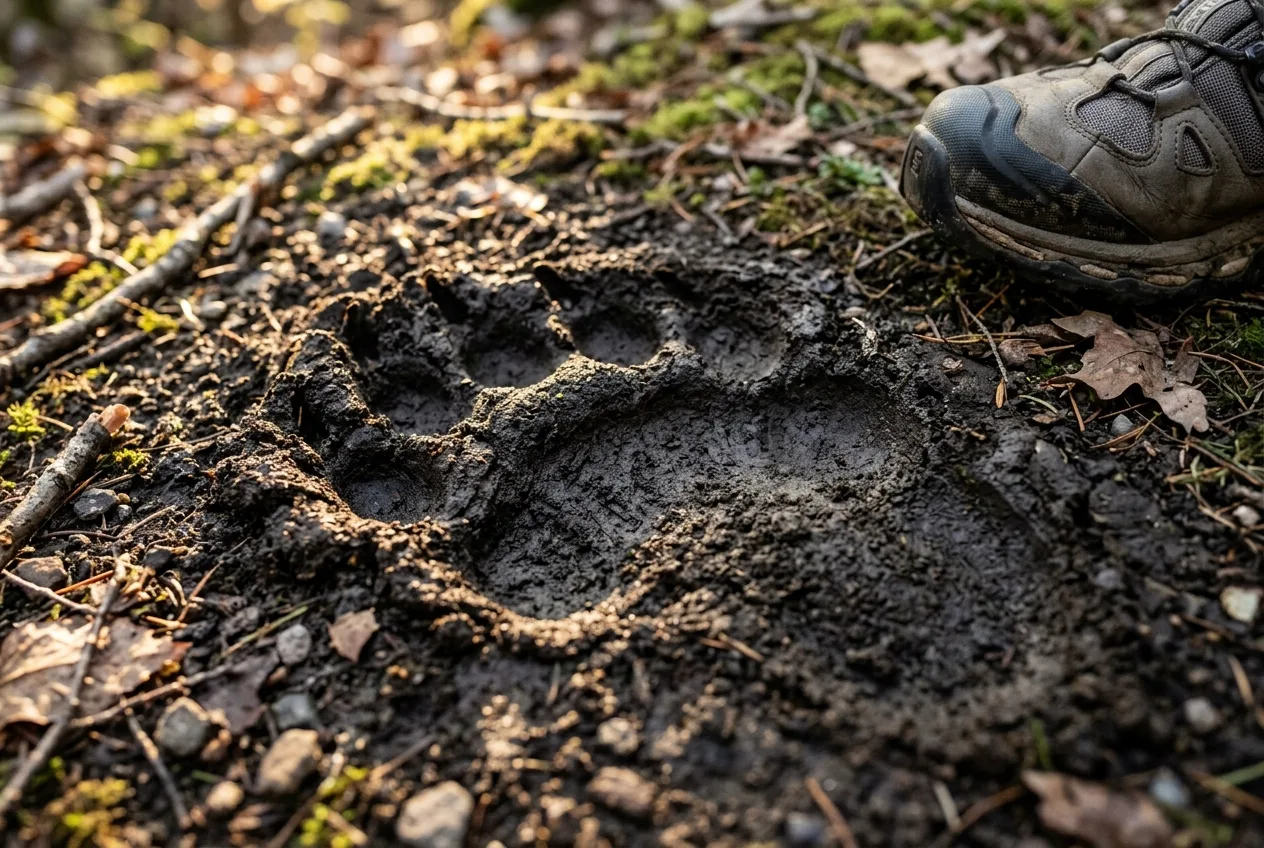
If there's one thing worth nailing in all of tracking, it's telling a canine (dog, coyote, fox, wolf) from a felid (house cat, bobcat, lynx, mountain lion). They're both four-toed and roughly oval, and people mix them up constantly. But a few features separate them cleanly.
Claws. Dogs usually leave claw marks; cats usually don't, because their claws retract. White Sands' note on a desert canine is typical — "there will be claw marks with the print".
Overall shape. Cat tracks are round; their palm pad makes up at least half the whole track. Dog tracks are more symmetrical, longer than wide, with a smaller, triangular pad. The Mount Rainier carnivore guide says those two features — roundness and a big pad — are what "distinguish cat tracks from dogs".
The pad lobes. This is the tiebreaker. A cat's pad shows a double lobe on the front edge and three lobes across the back; a dog's pad shows a single lobe up front. The Wilderness Awareness School frames the negative space the same way: in a cat track the gap between toes and pad forms a C shape, while in a dog track "an X can be drawn in negative space". Iowa DNR adds a slick field version — if the back edge of the main pad curves inward, it's a canine; if it has three rounded bumps extending outward, it's a feline. (Watch out: a fox's hind foot can show three bumps like a cat, so confirm with the front print).
Heel pad shape. A cat's heel pad is M-shaped; a canine's is more triangular.
The trail. Cats most often walk in a tidy direct-register or overstep walk; the track line is neat. With dogs, behavior helps — domestic dogs tend to wander. The Washington wildlife agency's line is a good one: the path of a wolf "usually shows a direct, energy efficient or purposeful route, whereas those of dogs often meander".
Here are the common members of each family.
Coyote, fox, wolf, and the dog problem
Coyote. The print is oval and compact, and the front foot is larger than the hind. New Mexico State measures front tracks at 2¼–2¾ inches long in soft mud; Pennsylvania lists the eastern coyote at front 3.5 inches, hind 3 inches. Telling coyote from domestic dog is the eternal headache, because they overlap. The tells: coyote tracks "tend to be more oval-shaped and compact," with less prominent nails, and they "follow a straight line more closely" than a dog's. Iowa DNR adds that coyote claws "don't dig into the dirt as much," and their prints are "much more oblong" than a dog's rounder track — plus a trail that ambles in no particular direction near houses leans dog. The Mount Rainier guide notes a nice detail: in a coyote track the outer toes can appear "like wings" around a raised mound of substrate between toes and pad.
Foxes. Smaller and often fuzzy. A red fox's furred foot blurs the print and can make it look indistinct; Pennsylvania lists the red fox at front 2.88 inches, the smaller gray fox at front 2 inches. Fox claw marks are usually fainter than a coyote's or dog's.
Wolf. Big, and longer than wide, with four symmetrical toes and obvious claws. Washington describes wolf tracks as "about 5 inches long by 4 inches wide, with four symmetrical toes and evident claws, and a single lobe on the front of the foot pad". Oregon's measured range (without claws) is front length 3.8–4.6 inches by width 3.3–4.3 inches, and it reminds you that "measurement with claws adds about 0.5" to length". The Mount Rainier guide's range runs a bit larger, to 3½–5⅛ inches long on the front — wolves vary, and males run bigger than females. Coyote tracks are "approximately half the size of wolf tracks," and even big domestic dogs usually print smaller than a wolf. Iowa's adapted guide offers an "8 out of 10" approach for the whole animal: if at least eight of ten wolf characteristics line up, it's likely wolf, "but in some cases DNA testing may be needed to confirm". (And a wolf-sized track with human prints beside it is almost certainly a large dog.)
House cat, bobcat, lynx, and mountain lion
The cats sort out mostly by size, and there's a charming rule of thumb for it from the Wilderness Awareness School: the 1-2-3 rule — "housecat tracks are typically one inch in diameter, bobcats are two, and mountain lions are three".
Bobcat. The everyday wild cat track for most of the country. New Mexico State pegs a typical bobcat track at about 1¾ inches long by 1⅞ wide, "more rounded than that of the coyote or dog," showing "no claw marks," with that telltale two-lobed front border on the pad. Iowa DNR's size cue is "approximately the size of a 50-cent piece". Mount Rainier's measured front range is 1½–2¼ inches long, and notes the hind is more symmetrical than the front. The Wilderness Awareness School's bobcat-versus-dog table is the cleanest summary going: round (or horizontally oblong) versus a dog's vertically oblong; asymmetrical front; M-shaped heel pad; "nails typically don't register"; C-shaped negative space.
Mountain lion (cougar/puma). Big and round. New Mexico State gives a width of 3 to more than 4 inches, rarely with claws, the toes spreading wide when the animal runs. Oregon's diagnostics: generally no claws, two lobes on the front of the pad and three on the back, asymmetrical toes, overall round. Mount Rainier measures the front at 3⅛–4 inches long and points out the rectangular hind-foot "scrapes" lions leave to mark territory.
Lynx. Where they occur (far north and high country), lynx tracks look big for the cat but oddly soft and ill-defined, because the feet are so densely furred — a snow adaptation. If a cat-shaped track seems too fuzzy and too large for a bobcat in lynx country, that's your hint.
A caution that cuts both ways: a bobcat in deep snow splays its toes and prints larger than life, while a house cat and a small bobcat can overlap. Lean on shape and the pad lobes, not size alone.
Raccoon and opossum — the "little handprints"
These two get confused because both leave five-toed prints that look like tiny human hands, and both haunt the same muddy edges. But they're easy to separate once you know the trick.
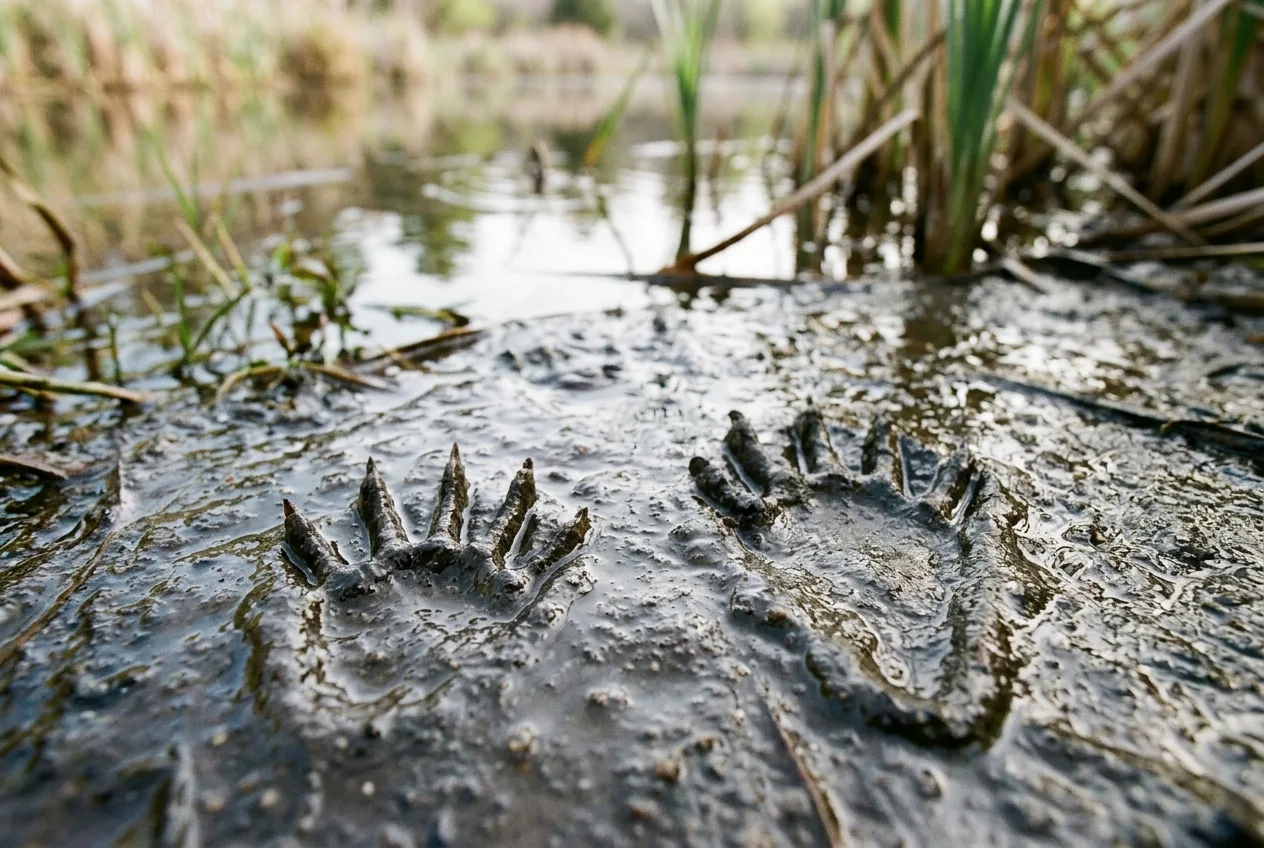
Raccoon. Long-fingered prints, often described as miniature human handprints, with all toes pointing forward and sometimes small claw dots above. Mississippi State sizes them at 2 to 3 inches across; New Mexico State lists front about 2¼ inches and hind about 3⅛ inches. The signature is in the pattern: raccoons habitually place a front foot next to the opposite hind foot, so prints come in offset pairs — New Mexico State describes "the left hind foot placed beside the right forefoot" as the animal walks. Iowa DNR's mnemonic for size is "roughly the length and width of a paper clip," with the triangular hind track set near the hand-like front.
Opossum. Also five toes, also hand-like, but the giveaway is the hind foot's opposable thumb — a stubby digit that juts out and away from the others, "making the tracks look like a human hand". Iowa DNR describes the hind print as a handprint "with a particularly muscular thumb pointing down and away from the fingers," and notes opossum front prints look "more lopsided and human" than a raccoon's perfectly spread toes. One more tell: an opossum may drag its tail, leaving a thin line between the prints. Mississippi State sums the split up cleanly — opossums spread their toes with that separated thumb, while raccoons point all toes forward.
Opossums spread their toes with that separated thumb, while raccoons point all toes forward.
Bear
A bear track stops people in their tracks, partly because the hind print is so big and so weirdly human — a long sole with a broad heel and five toes. The front is much smaller and rounder. NatureTracking measures black bear fronts at 2.1–5.3 inches long and hinds (including the heel pad) at a sprawling 2.8–8 inches long. All feet carry five rounded toes and large, blunt claws, the track is asymmetrical, and the palm pad is "wide and curved" and gets larger toward the outside of the foot.
Two details set bears apart from us and from each other. First, the big toe is on the outside, not the inside as on a human foot — and the small inner toe often fails to register in dust or shallow mud, so the print can look four-toed. Second, the question every hiker actually wants answered: black bear or grizzly? Don't use size or color — they're unreliable. Use the NPS "line test." On a front track, lay a straight edge across the top of the foot pad, just under the big toe. On a black bear, that line "runs through the top half of the little toe," because the toes are more separated and arced. On a grizzly/brown bear, the toes sit closer and straighter, so the line "runs through or below the bottom half of the little toe". Claws back this up: grizzly front claws are long, 2–4 inches, and "often visible in the tracks"; black bear claws are shorter, "less than 2 inches long and curved," and "do not always show".
Don't confuse a bear's five-toed track with a skunk's. Both are plantigrade five-toed walkers, and a skunk's heel pad print throws people. The difference is scale and shape — skunk tracks are only "around 1½ inches long," with a "long and rectangular" hind heel pad, and they're more often mistaken for cat tracks, being about the same size.
Rabbits and rodents
This group is defined less by individual prints — often too small or too furry to read in detail — than by that unmistakable galloping pattern: small front prints with the larger hind feet landing ahead of and outside them.
Rabbits. Petite and fast, with fur so thick on the feet that the pads barely show. Look for "paired long oval tracks and small round tracks," and confirm with the little round scat pellets nearby. Pennsylvania lists the cottontail at front 1.88 inches, hind 3.25 inches — note how much bigger the hind foot is, the hallmark of a galloper.
Squirrels. Another galloper, but the front feet tend to land side by side (handy for a tree climber), versus the rabbit's offset front feet. Pennsylvania lists the gray squirrel at front 1.88 inches, hind 2.1 inches.
Smaller rodents. Mice, voles, shrews, and chipmunks all gallop too, and they're separated mostly by trail details: mice plant their front feet nearly side by side and often leave a tail drag, while a same-size vole does not. Their tracks can be maddeningly faint — shrew prints "can be so faint in the snow that unless you have proper light conditions, you may not even see" them.
The bigger rodents break the rules. Porcupine, woodchuck, beaver, and muskrat don't gallop. Porcupine and beaver waddle (pacers), and the beaver gives itself away with webbed hind feet that print like a large triangular paddle, plus a tail drag and gnawed wood nearby. Pennsylvania measures the beaver hind foot at a big 7 inches. The muskrat is a useful reminder of how variable a single animal can be: it "may place his rear foot behind his forepaw print, over the forepaw print, or ahead of the forepaw print all on a very short walk," sometimes leaving a wormlike tail drag and sometimes not.
The fix isn't size — it's the pattern.
The weasel family (mustelids)
The weasel tribe — mink, marten, fisher, otter, weasels, wolverine — is its own puzzle. The prints show five toes on front and hind with obvious claws, a small palm pad with four little subpads, and a lot of negative space, the toes set asymmetrically. But the real identifier is the bounding gait: those characteristic long bodies and short legs leave paired tracks hopping along, so trail width and the spacing of groups matter as much as the print itself.
Be honest about the limits here. Mount Rainier's guide says outright that measurement is "the most reliable way to confirm species," and that overlap between the sexes muddies things badly — "it may be difficult to impossible to distinguish a large male marten from a small female fisher". For most of us, getting to "weasel family, bounding" is a real win; the species often needs careful measurement and local knowledge. The river otter is the friendly exception — big for the group, often near water, sometimes showing webbing and a tail drag, and Pennsylvania puts its hind foot at about 4 inches.
Turkeys and other birds
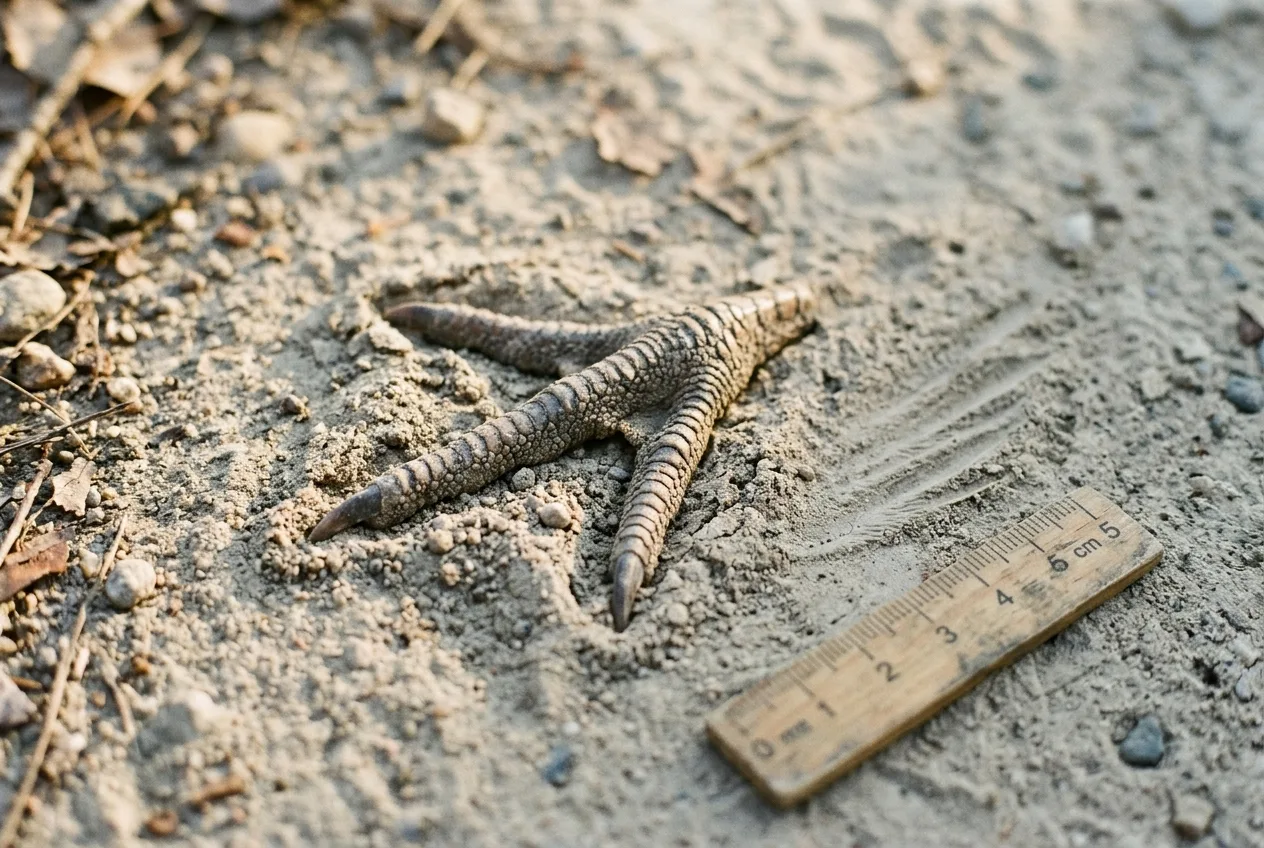
Bird tracks are their own world, and the wild turkey is the giant of it. Kim Cabrera, a CyberTracker specialist, measures a turkey track at 3.5 to 4.5 inches long by 3.75 to 4.25 inches wide, with a walking stride of 8 to 14 inches depending on speed. The structure: three toes point forward with visible claw marks, and there's a fourth toe (the hallux) that faces backward but "does not always show in the tracks," because the bird doesn't always set its foot down flat. The round spot where the three front toes meet — the metatarsal pad — also "does not always show".
Substrate matters more for birds than almost anything else; Cabrera notes the pebbly toe texture only appears "in good mud or fine soil". And turkeys leave a bonus sign in spring: strutting toms drag their wing tips, scoring distinctive wing-drag marks in the dirt beside the tracks.
For other birds, two quick distinctions go a long way. Webbed three-toed prints mean waterfowl — ducks and geese — and since they look similar across species, "look for size differences" to sort them. Skinny, unwebbed, proportionally longer toes mean a wading or shorebird. And ground birds that prefer running to hopping leave continuous, in-line tracks — White Sands notes the horned lark "prefers to run rather than hop, so its tracks are continuous and in a line," while the roadrunner's two-forward, two-back toes print a distinctive X.
You stop walking past mud and start reading it. Every creek bank becomes a page.
When a track is honestly ambiguous
Plenty of times the ground just won't give you a clean answer, and the experts are the first to admit it. A print in dry dust or loose sand may never show enough detail to be sure. Hind feet land in front tracks and create monsters that look like nothing in any guide. Sexes and species overlap in size. Whitetail and mule deer can't be split by one track at all.
The move in those moments isn't to force a guess — it's to gather more evidence. Follow the trail to a patch of better substrate; bridges and muddy seeps are gold because they protect prints and funnel wildlife. Read the gait when the individual print fails you. And look for other sign: scat, rubs, diggings, and feeding marks all corroborate an ID. Curtis's guide even sorts scat into rough family shapes — tubular for the dog family, raccoon, and bear; tapered teardrops for cats; "M&M's" for rabbits; "pencil lead" for rodents; oblong pellets for deer — which can confirm a track when the print alone is borderline. The honest tracker keeps a short list of two or three candidates and weighs them, rather than locking onto the rarest, most exciting option — because, as Evans warns, when a beginner suspects something exotic, "it's just a weird track of a common species".
If you want to keep a print you're proud of, you can cast it in plaster — but that's its own small craft, with rules about putting plaster into water (never the reverse), a "heavy cream" consistency, and cold-mixing for snow tracks. Raccoon, Opossum, or Skunk? How to ID the Animal in Your Yard at Night
Once you've got the questions down, the woods change. You stop walking past mud and start reading it. Every creek bank becomes a page, and you'll never quite see a stream crossing the same way again.
Frequently asked questions
How do you tell a dog track from a coyote track?
Look at shape and trail, not just size, since they overlap. Coyote tracks are more oval and compact with fainter, less-spread claw marks, and the animal travels in a fairly straight, purposeful line; domestic dog tracks tend to be rounder, show heavier claw marks, and wander — especially near houses. A track with human footprints alongside it is almost always a dog.
Do cat tracks show claw marks?
Usually not. Cats — house cat, bobcat, lynx, mountain lion — keep their claws retracted, so a clean feline print shows toes and a round pad with no nail marks out front. Most dog-family tracks, by contrast, do show claws. The other cat tells are a round overall shape, an asymmetrical front foot, and a double-lobed front edge on the palm pad.
How can I tell a raccoon track from an opossum track?
Both leave five-toed, hand-like prints, but the opossum's hind foot has a stubby opposable thumb sticking out to the side, while the raccoon points all its toes forward. Raccoons also walk with a front foot beside the opposite hind foot, and opossums often drag their tail.
How do I know if a track is a black bear or a grizzly?
Use the "line test," not size or color. Lay a straight edge across the top of the front foot pad just under the big toe: on a black bear it crosses the top half of the little toe (toes more arced and separated); on a grizzly it crosses the bottom half or runs below it (toes straighter and closer). Grizzly claws are also longer — 2 to 4 inches versus under 2 — and show in the track more often.
What's the easiest way to tell what gait an animal was using?
Step back and look at the whole pattern. An alternating line of prints means a diagonal walker (deer, dog, cat); paired tracks hopping along the centerline means a bounding weasel; small front prints with bigger hind feet landing ahead means a galloping rabbit or rodent; a sloppy side-to-side waddle means a pacer like a raccoon, skunk, or bear. The pattern often IDs the animal even when no single print is clear.
Can you tell a white-tailed deer from a mule deer by the track?
Not from a single print — their tracks are nearly identical and there's no reliable way to separate them from one track alone. Your better clue is movement: mule deer use a bouncing, four-footed "pronk" that whitetails don't.