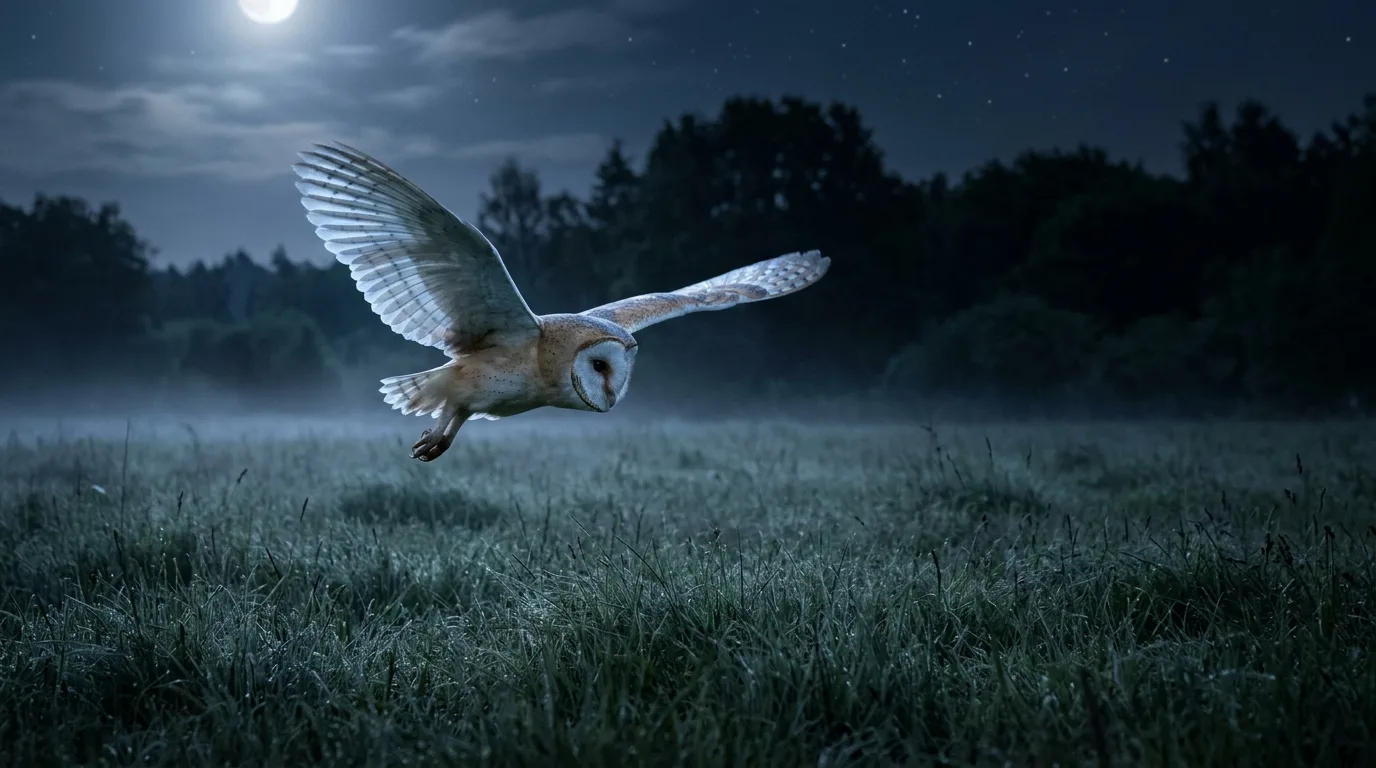
Stand in a meadow at noon and it can feel almost empty. Stand in the same spot at midnight and you're outnumbered. The owl that hunts the hedgerow, the bats stitching the air over the pond, the raccoon working the creek bank, the fox trotting the field edge, the wood mouse threading the grass, the deer that waited for dark to step into the open — most of them were there at noon too. They were just asleep, or hidden, biding their time until the sun went down and the world they're built for switched on.
So which animals are actually active at night? The short, useful answer: a lot of them, and more than most people assume. Among the animals you're most likely to meet after dark in North America are owls, bats, raccoons, opossums, skunks, foxes, coyotes, flying squirrels, mice and other small rodents, armadillos, bobcats, and — at the bookends of the night — deer and mountain lions. Reach back to the deep pattern and the numbers are startling: across roughly 5,000 mammal species, somewhere around 69 to 70 percent are primarily nocturnal. Night isn't the exception in the mammal world. It's the default. Daytime is the weird, hard-won exception that a minority of species evolved into later.
This is a piece about that hidden shift — who's out there, why they chose the dark, and the genuinely remarkable hardware that lets them thrive in it. The good news for the curious is that the night no longer keeps its secrets the way it used to. A trail camera with an infrared flash sits there patiently in the black and logs the whole parade. But before we talk about catching them on camera, let's get the words straight, because "nocturnal" is doing more work than it can really handle.
Nocturnal, crepuscular, diurnal, cathemeral — what the labels actually mean
Biologists slice the 24-hour day into four buckets based on light:
- Nocturnal — active in the darkness of night.
- Diurnal — active in full daylight (this is us).
- Crepuscular — active in the low light of dawn and dusk, the twilight windows.
- Cathemeral — a less familiar word for animals that don't pick a lane, spreading activity across both day and night with rest periods scattered through.
That's the textbook. Here's the honest part: the textbook is a rough approximation, and the more carefully scientists measure real animals, the rougher it looks. In 2025 a global consortium of 217 researchers pooled 8.9 million camera-trap images of 445 mammal species — one of the largest wildlife-activity datasets ever assembled — and checked the standard field-guide labels against what the animals were actually doing. The labels held up for only 39 percent of species at a strict confidence threshold. The "nocturnal" tag was right about 58 percent of the time; "diurnal" did best at 82 percent; and the crepuscular label was a near-total bust — no species in the analysis was strictly crepuscular, because animals that pile into the twilight hours also use other parts of the day.
What the data kept showing instead was flexibility. Most species with enough records used more than one activity pattern depending on where and when they were living. A skunk near a city behaves differently from a skunk in the backcountry; an armadillo deep in the woods keeps different hours than one downtown. So when you read that an animal "is nocturnal," translate it in your head to "leans nocturnal, most of the time, in most places." That single mental adjustment will make you a sharper observer than a lot of the printed guides.
One more reason night dominates the mammal list: it's woven into where and how big these animals are. The same 2025 study found a small mammal is far likelier to be nocturnal than a large one — a roughly half-kilogram animal was about 4.5 times more likely to be nocturnal than a 50-kilogram one — and species near the equator were about 1.9 times more likely to be nocturnal than species farther north. Zoom out to the whole globe and the pattern is geographic: the proportion of nocturnal mammals is highest in arid regions, where the desert sun is the enemy, and lowest at extreme high altitudes like the Tibetan Plateau and the Andes, where the nights are simply too cold to be worth the energy.
So when you read that an animal "is nocturnal," translate it in your head to "leans nocturnal, most of the time, in most places."
Why go nocturnal? Four good reasons
If daylight is brighter and warmer and easier to see in, why would so many animals abandon it? Because the night solves real problems. Four of them, mostly.
To avoid being eaten. Darkness is cover. For a small prey animal, moving under the protection of night means a hawk can't pick you off from a quarter mile up. Predator-avoidance is one of the deepest drivers of nocturnal behavior, and you can read it directly in the numbers — one Northern Ireland camera study clocked wood mice running about 81 percent of their activity into the night hours, and badgers more than 85 percent. Hide when the day-hunters are watching, move when they're not.
To beat the heat. In hot and dry country, the day is a furnace, and being active under it costs water an animal can't spare. Coming out at night to hunt, mate, or forage is partly a way to dodge that thermal tax — which is exactly why arid regions hold the highest share of nocturnal species on Earth.
To dodge the competition. If two species want the same food, one way to share the buffet is to show up at different times. Splitting the day this way — temporal partitioning — lets species coexist that would otherwise be at each other's throats. Gliding flying squirrels, for instance, forage at night in part to stay out of the way of the day-shift tree squirrels.
To hunt where the hunting is good. For a predator, night isn't just safer; it's where dinner is. If your prey is nocturnal, you become nocturnal too. Mountain lions are the clean example: they're most active at dawn and dusk precisely because that's when the deer they eat are moving.
Underneath all four reasons sits a far older one — an accident of deep time that shaped the entire mammal lineage. Back in 1942, the biologist Gordon Walls proposed what's now called the nocturnal bottleneck: that early mammals, sharing the Mesozoic with dinosaurs, could only survive by working the night shift and ceding the daylight to the reptiles that ruled it. The mammal lineage emerged around 250 million years ago, and for the long age of the dinosaurs — until that reign ended roughly 65 million years ago — our ancestors were, by this hypothesis, small, warm-blooded creatures of the dark. The evidence is written in mammal bodies to this day. Along the way the lineage permanently lost two of its color-detecting cone genes, which is why most mammals see the world in just two colors instead of the richer palette many fish, reptiles, and birds enjoy. We may have inherited our warm blood partly from those nights, too — endothermy keeps a body running when there's no sun to bask in. As the researchers who reviewed all of this put it, "arguments in favour of the nocturnal bottleneck hypothesis in eutherians prevail". Daytime activity, where it exists, mostly evolved later — in rodents alone, diurnality re-emerged independently at least seven separate times. We diurnal mammals are, in a real sense, the ones who came back into the light.
The night-vision kit: how nocturnal animals pull it off
Living in the dark isn't free. It demands specialized gear, and the gear is where the wonder lives.
Eyes built for starlight
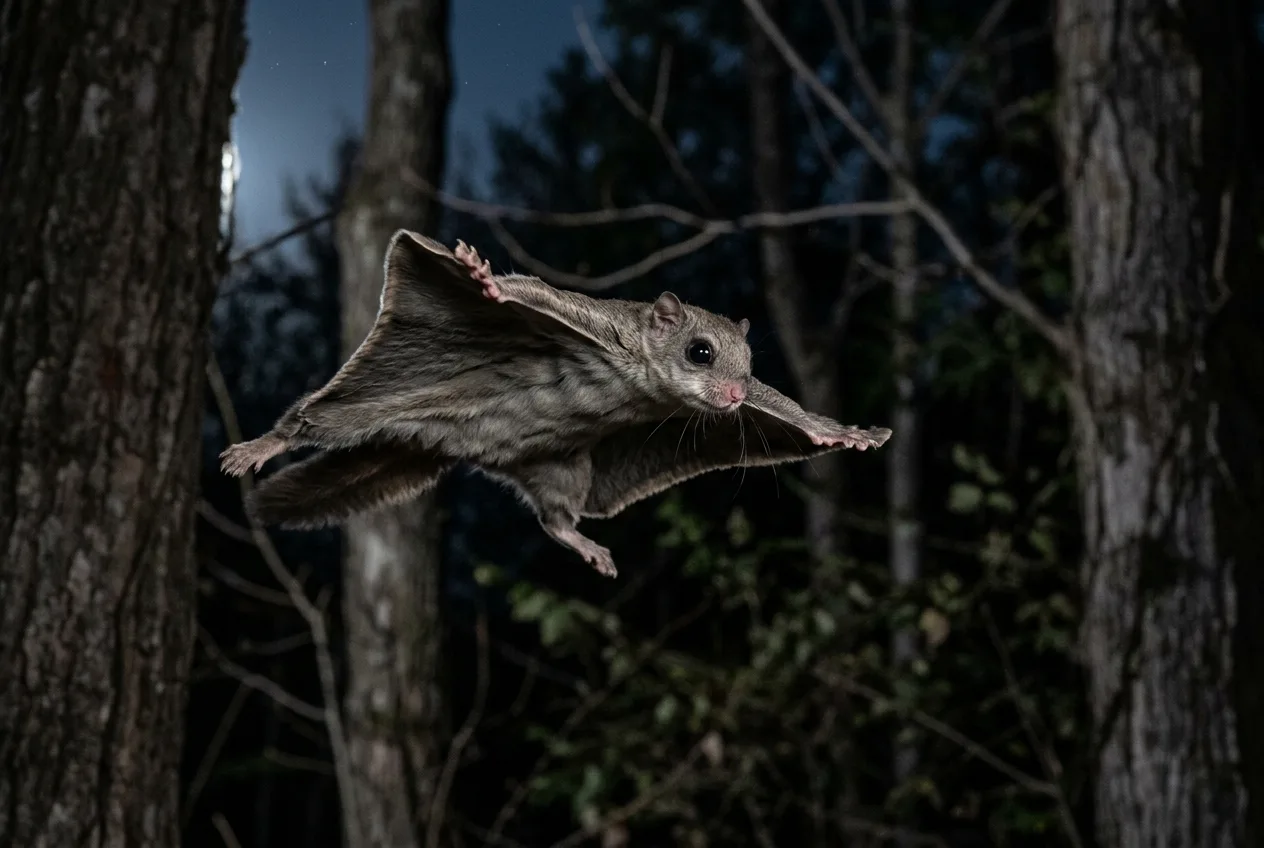
The first move is to gather every scrap of available light. Flying squirrels do it with eyes whose pupils are so enlarged the eyes look almost solid black; those oversized pupils drink in moon and starlight, and a set of the longest whiskers of any squirrel helps them feel their way through branches they can't quite see. Many nocturnal animals also load their retinas with rod cells — the receptors tuned for dim light — at the expense of the cone cells that handle color. The trade is steep but worth it in the dark.
Owls take this to an extreme that's almost comical. A human eye fills about 5 percent of the space inside the skull; an owl's eyes fill about 75 percent of theirs. If an Eastern Screech Owl were scaled up to your height, its eyes would be the size of softballs. Those enormous eyes are packed with rods and short on color receptors, so owls are essentially colorblind — the price of seeing in near-darkness. And because the eyes are so big they're locked in place, an owl can't swivel them the way we do. Its workaround is the famous one: an owl has 14 vertebrae in its neck to our 7, and can rotate its head about 270 degrees to look almost straight behind itself.
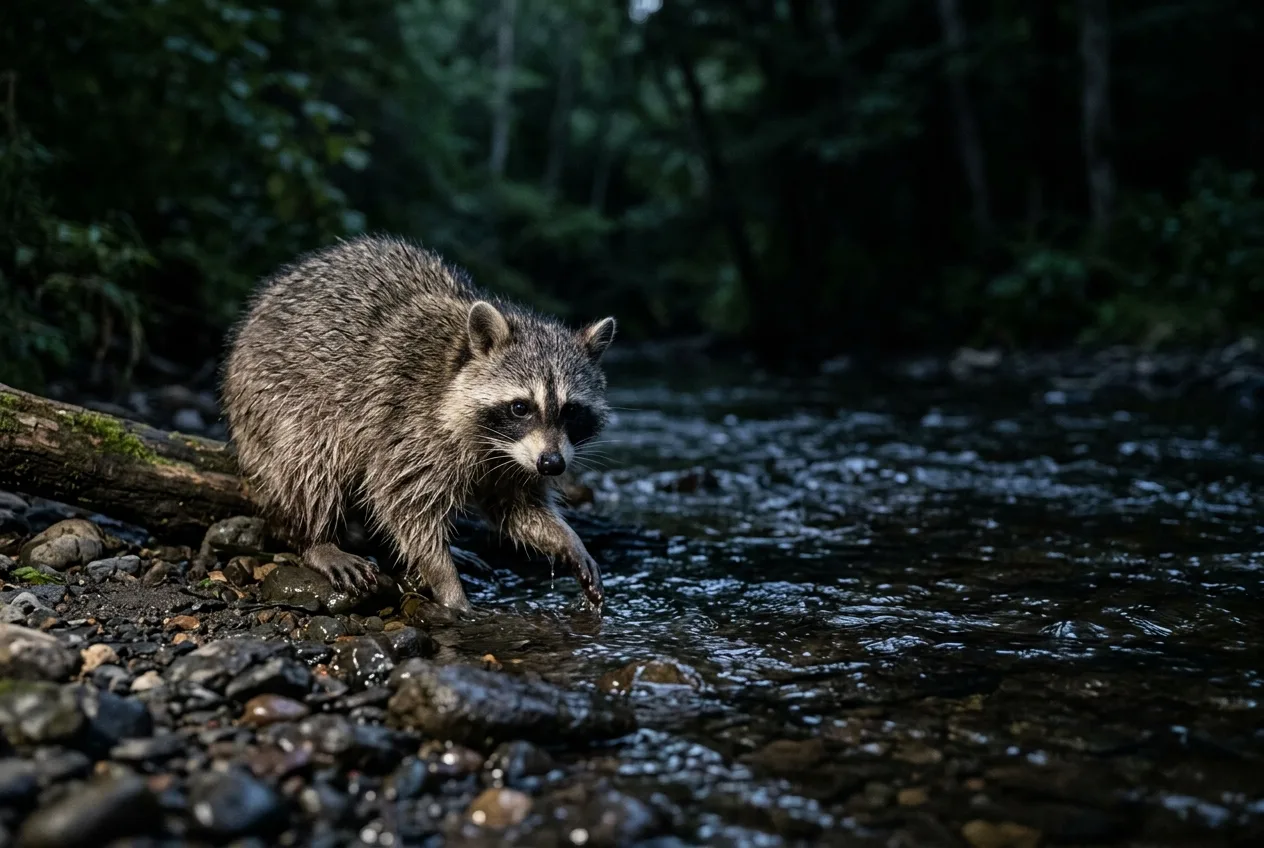
Then there's the trick you've seen yourself, in headlights or a flashlight beam — the eerie glow of an animal's eyes shining back at you. That glow is a mirror-like layer behind the retina that bounces light back through the eye for a second pass, squeezing more vision out of less light. It's the same reason a deer's, a raccoon's, or a fox's eyes light up in a camera flash, and it's a hallmark of the nocturnal toolkit.
Ears that see in the dark
When even starlight runs out, the best nocturnal hunters stop relying on their eyes at all and switch to sound. Most owls, in fact, lean more on hearing than vision when they hunt, and some can take prey moving underneath the snow, entirely by ear. The equipment is extraordinary. Many owls — barn owls among them — have ear openings set at slightly different heights on the head, so a sound arrives at one ear a fraction of an instant before the other, and that tiny gap lets the bird pinpoint a mouse in total blackness. The dished, flat face you see on an owl isn't just a look; that "facial disk" is a stiff ring of feathers that works like a satellite dish, funneling sound into the ears, and the owl can flex it to tune in different directions. The great horned owl pairs that hearing with a sensory bargain most animals would never make: it has almost no sense of smell — which is exactly why it's one of the few predators that will happily eat a skunk.
Wings that make no sound
A predator that hunts by ear has a problem: its own flapping would drown out the faint rustle it's listening for. Owls solve it by flying silently. The leading edge of an owl's wing carries a comb of tiny fringe feathers that break up the rushing air and mute the sound of the wingbeat. When BBC sound engineers wired up a flying barn owl with ultra-sensitive microphones, the wingbeats didn't even register to human ears, and the sounds the instruments did catch were, in the researchers' word, "infinitesimal".
Sound as radar
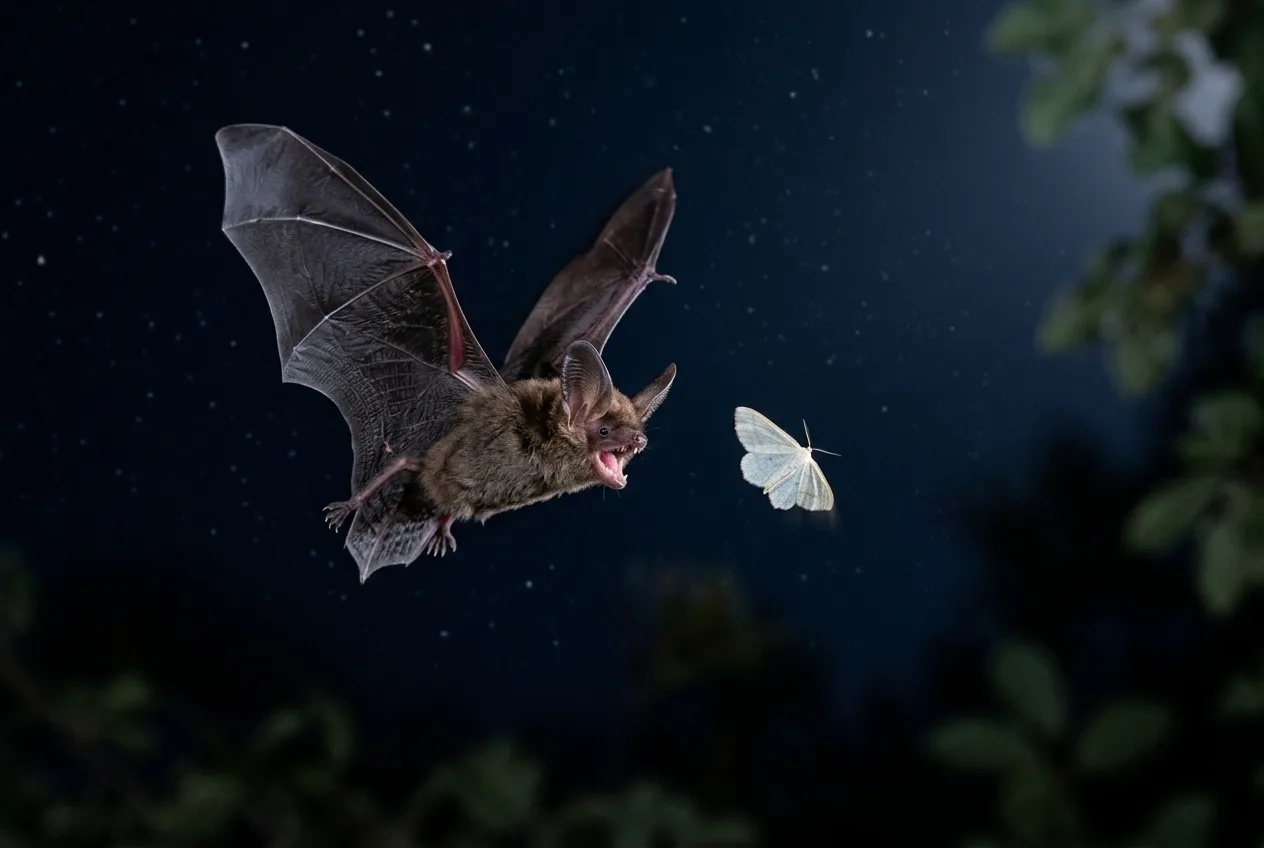
Bats skip vision almost entirely and build a picture of the world out of echoes. A hunting bat fires off pulses of ultrasound — sound pitched above what we can hear — and reads the echoes that bounce back off objects and insects, its ears finely tuned to recognize its own calls. Lock onto a moth and the bat rattles off a rapid burst of clicks to fix the target's exact position — a "feeding buzz" — then swoops in for the catch. Different bats use different calls, and each species has its own signature pattern; a few, like the spotted bat, call low enough that a person with sharp ears can actually hear them. It's a completely separate solution to the same problem the owl solved with its ears: how to find a small, moving meal in the dark.
It's a completely separate solution to the same problem the owl solved with its ears: how to find a small, moving meal in the dark.
A field tour of the animals you'll actually meet at night
Adaptations are abstract until you put faces to them. Here's a closer look at the common night-shift animals, leaning on what the sources show rather than folklore.
Owls. The signature nocturnal birds, though even here the "nocturnal" label frays. The great horned owl is the classic — nocturnal, with keen hearing and sharp eyes, hunting from a high perch and dropping onto mice, rabbits, snakes, even other owls and skunks; it has the most varied diet of any North American raptor. The barred owl bends the rule: it "hunts by night or day, perhaps most at dawn and dusk," and will call and hunt in daylight, especially in the swampy woods it favors. Its menu runs to small mammals — mice, rabbits, opossums, and, in a nice closing of the loop, flying squirrels.
Bats. The only flying mammals and almost entirely creatures of the night, navigating and feeding by echolocation. They matter more than their size suggests: across the mammal world, more than half of the unique ecological "trait space" occupied by nocturnal species is driven in part by the sheer diversity of bats.
Raccoons. The quintessential backyard night-raiders. In a camera study spanning ten US cities, raccoons were detected more than any other species — and the bulk of those nearly 35,000 detections came at night. They're also a good lesson in flexibility: in the most natural, low-human settings raccoons were more active at night, not less, easing off the strict night schedule as human density climbed.
Opossums. North America's marsupial, and a committed night-mover that pushes even harder into the dark near people — in the same ten-city study, Virginia opossums leaned further into nighttime activity as human density rose. There's a catch in their cold tolerance, though. With poorly insulated fur and cold-sensitive ears, tails, and feet, opossums seem physically unable to shift their hours as freely when temperatures drop, going less nocturnal in the cold while most other species in the study did the opposite. The body sets limits the behavior can't always overcome.
Skunks. Mostly nocturnal, shy, and solitary, with that famous chemical defense held in reserve — a striped skunk stores only about two ounces of spray and can fire it just three to five times before needing days to reload, so it bluffs first with foot-stomping and posturing and shoots only as a last resort. Its black-and-white coat is a warning sign, not camouflage. Skunks are also one of the species documented becoming more nocturnal as the human footprint grows.
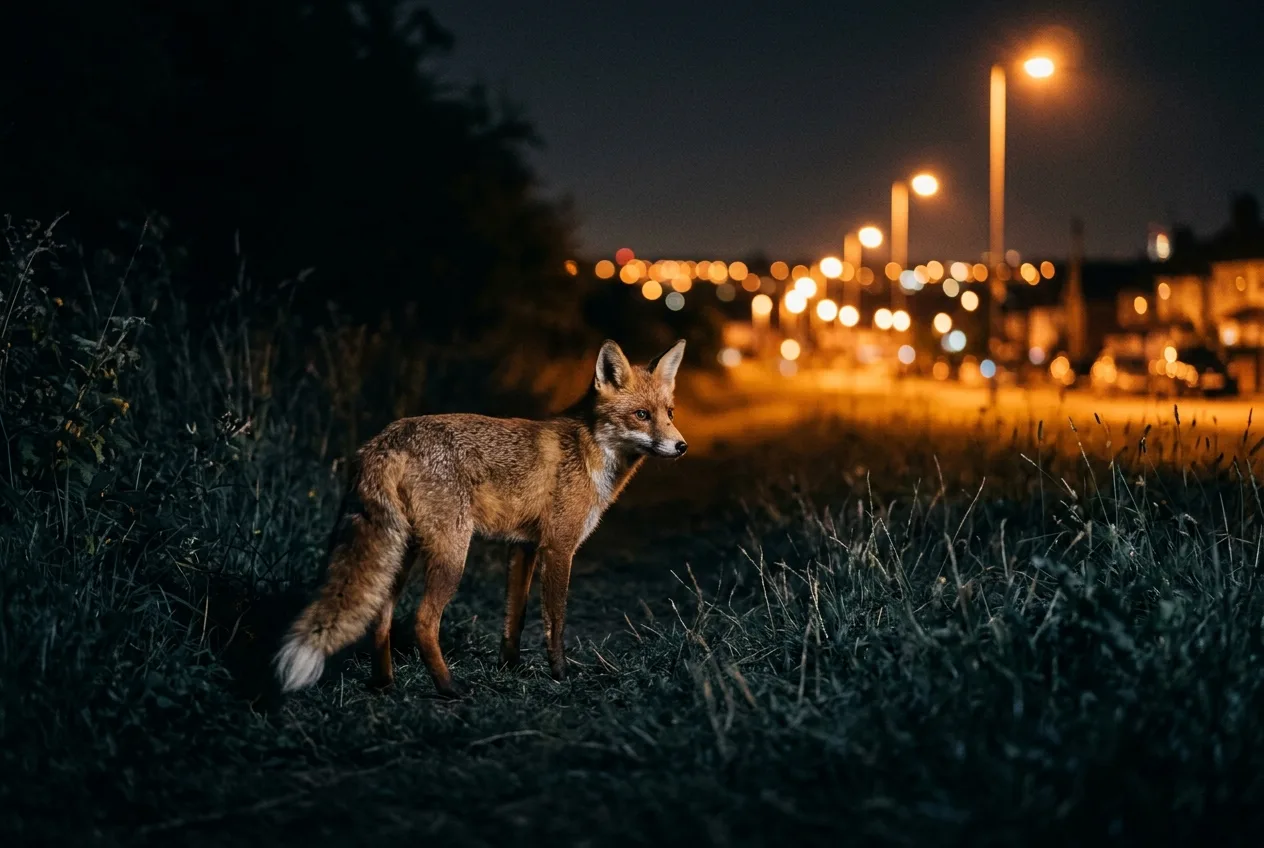
Foxes and coyotes. Both flexible canids that tilt hard toward the night around people. Red foxes are deeply nocturnal where night is safe, easing toward daytime where there's more open greenspace — likely to sidestep coyotes, which dominate them. Coyotes themselves push into the dark as human pressure rises: in the ten-city study they were about 18 percent more likely to use nighttime hours with a meaningful jump in human density, and in a British Columbia forest they were sharply more nocturnal where hiking trails were dense. They like to advertise it, too — coyotes "enjoy vocalizing at dusk, dawn, or during the night," and are far more often heard than seen.
Flying squirrels. Maybe the most charming animals on this list, and "nocturnal by nature," which is why so few people ever spot the ones living right overhead. They glide up to several hundred feet between trees "like a silent gray ghost" at 20 to 30 mph, steering with a flap of skin called the patagium. Their eyes sit far out on the sides of the head for a wide field of view — the better to catch an owl's approach in time to tuck and free-fall away. They even chatter in ultrasound, above the hearing range of the owls that hunt them, so they can warn each other without giving themselves away. And in a discovery that's pure delight: in 2019 a researcher idly pointed a UV flashlight at one and found their fur glows neon pink under ultraviolet light — nobody's quite sure why yet.
Deer. Not strictly nocturnal but a major night-mover, and a moving target depending on conditions. Across the ten-city study, white-tailed deer were one of the species most active at night in low-human, natural settings — and they reliably shifted toward darkness where there was more paved cover and traffic to avoid. In hot weather, though, they backed off nighttime activity and moved more by day. The dusk-and-dawn deer of legend is real, but the schedule slides with heat, cover, and human pressure. What Time of Day Are Deer Most Active? What the Movement Data Actually Shows
Bobcats, cougars, bears, and armadillos. The bigger and warier the animal, the more the night becomes a refuge from us. In British Columbia, bobcat activity peaked around 2 a.m., black bears grew more nocturnal where people were detected more often, and the same human-avoidance signal shows up worldwide. The armadillo makes the point most vividly: deep in the woods, far from town, armadillos in one Arkansas study were active in daylight 30 to 60 percent of the time — but at sites near downtown, more than 95 percent of their activity was squeezed into the night. Same animal, opposite schedule, set by how close the humans are.
We're the reason a lot of this is happening
That armadillo isn't a quirk. It's the headline finding of the last decade of this research, and it deserves to be said plainly: a great deal of modern nocturnal behavior is animals hiding from us.
The landmark study is a 2018 global meta-analysis that pulled together 76 studies of 62 mammal species across six continents. The result was stark and consistent: on average, animals increased their nocturnality by a factor of 1.36 in response to human disturbance, with 83 percent of cases pointing the same direction. Put concretely, an animal that naturally split its time evenly between day and night shifted to spending about 68 percent of its activity at night near people. The authors don't hedge about the cause: "We assert that fear of humans is the primary mechanism driving the increase in wildlife nocturnality," casting humans as a diurnal apex "super predator" that animals flee in time when they can no longer flee in space. And the unsettling wrinkle — the shift held even for harmless human activities. Hiking moved animals into the night about as much as hunting did. They don't seem to distinguish a hiker from a threat.
The story has nuance the headline can miss, and it's worth keeping honest. The shift isn't always toward night, and it isn't uniform. It can depend on what an animal eats: in a study across 45 forests in southwestern China, the omnivores and carnivores grew markedly more nocturnal as people modified the landscape, while the plant-eaters barely budged. Prey species sometimes do the opposite entirely, becoming more active during the day near people — in those ten US cities, deer, cottontails, and raccoons grew less nocturnal as human density rose, apparently using the daytime human crowd as a shield against predators that avoid us. In Southeast Asia, disturbed forests pushed whole wildlife communities not into the night but toward dawn and dusk, becoming more crepuscular. And one careful Canadian study concluded that the infrastructure we leave on the land — trails, roads — may bend animal schedules more than our direct presence does. The clean takeaway "humans push wildlife into the night" is mostly true and genuinely important, but the real picture is a mosaic of species-specific responses, and the better sources are careful to say so.
Hiking moved animals into the night about as much as hunting did.
The other problem: we're lighting up the dark they need
There's a sting in the tail. We're pushing animals into the night — and at the same time we're flooding the night with light, taking away the very darkness that makes it usable. More than 80 percent of the world's population now lives under light-polluted skies, and in the US and Europe it's 99 percent, with global light pollution climbing about 2.2 percent a year.
For nocturnal animals, that's not a minor nuisance. It's habitat loss. Slow-flying bats like the little brown bat avoid feeding in or even crossing lit areas because the light exposes them to owls, which means losing access to insects right when the bugs are thickest. Migrating songbirds that navigate by the stars get disoriented by city glow, circling lit towers to exhaustion. Sea turtle hatchlings that should crawl toward moonlight on the water instead head inland toward roads and parking lots. Even big cougars near Los Angeles get stopped cold by bright corridors, deepening the isolation that's already inbreeding their fragmented populations. The animals that need the dark are, as one National Park Service title puts it simply, animals that "need the dark" — and we keep switching the lights on.
Seeing the night without disturbing it
Here's the quietly hopeful part. You can witness almost all of this without losing a night's sleep or scaring a single animal off. The whole reason scientists can now map who's active when — the ten-city raccoon counts, the BC bobcat peaking at 2 a.m., the armadillo's downtown schedule, that 8.9-million-image global dataset — is that motion-triggered cameras with infrared flash sit out there in the dark and record the night shift without a human in sight. Nocturnal animals are wary of us; a camera isn't us. It's the closest thing we have to being invisible.
The animals were always there. For most of the last several hundred million years, the night belonged to them, and in a real sense it still does. We just finally have a way to watch.
Nocturnal animals are wary of us; a camera isn't us.
Frequently asked questions
What animals are most commonly active at night?
In North America the usual cast includes owls, bats, raccoons, opossums, skunks, foxes, coyotes, flying squirrels, mice and other small rodents, and armadillos, with deer, bobcats, and mountain lions moving heavily at dawn and dusk. Step back to the global pattern and roughly 69 to 70 percent of all mammal species are primarily nocturnal — night is the norm, not the exception.
What's the difference between nocturnal and crepuscular?
Nocturnal animals are active in the full darkness of night; crepuscular animals are active in the dim light of dawn and dusk. In practice the line blurs — almost no animal is strictly crepuscular, because twilight-active animals also use other parts of the day.
Why are animals active at night instead of during the day?
Mainly to avoid predators, escape daytime heat, sidestep competition for food, and follow prey that's also nocturnal. There's a deep evolutionary backdrop too: early mammals likely survived the age of dinosaurs by being nocturnal, the so-called nocturnal bottleneck, which is why most mammals still lean toward the dark.
How do nocturnal animals see in the dark?
They gather every available scrap of light with oversized eyes and pupils and retinas packed with dim-light rod cells — owls' eyes fill about 75 percent of their skull versus 5 percent in humans. When light runs out entirely, the best hunters switch to hearing: owls pinpoint prey by sound using asymmetrical ears and a dish-shaped face, and bats navigate by echolocation.
Are animals becoming more nocturnal because of humans?
Often, yes. Mammals increase their nighttime activity by an average factor of 1.36 near human disturbance — and even harmless activities like hiking drive the shift. But it isn't universal: some prey species become more daytime-active near people to use human presence as a shield against predators, so responses vary by species.
Why do animals' eyes glow at night?
A reflective layer behind the retina bounces light back through the eye to capture more of it in low light, which is what produces the bright eyeshine you see in a flashlight or camera flash — a common feature of nocturnal animals.