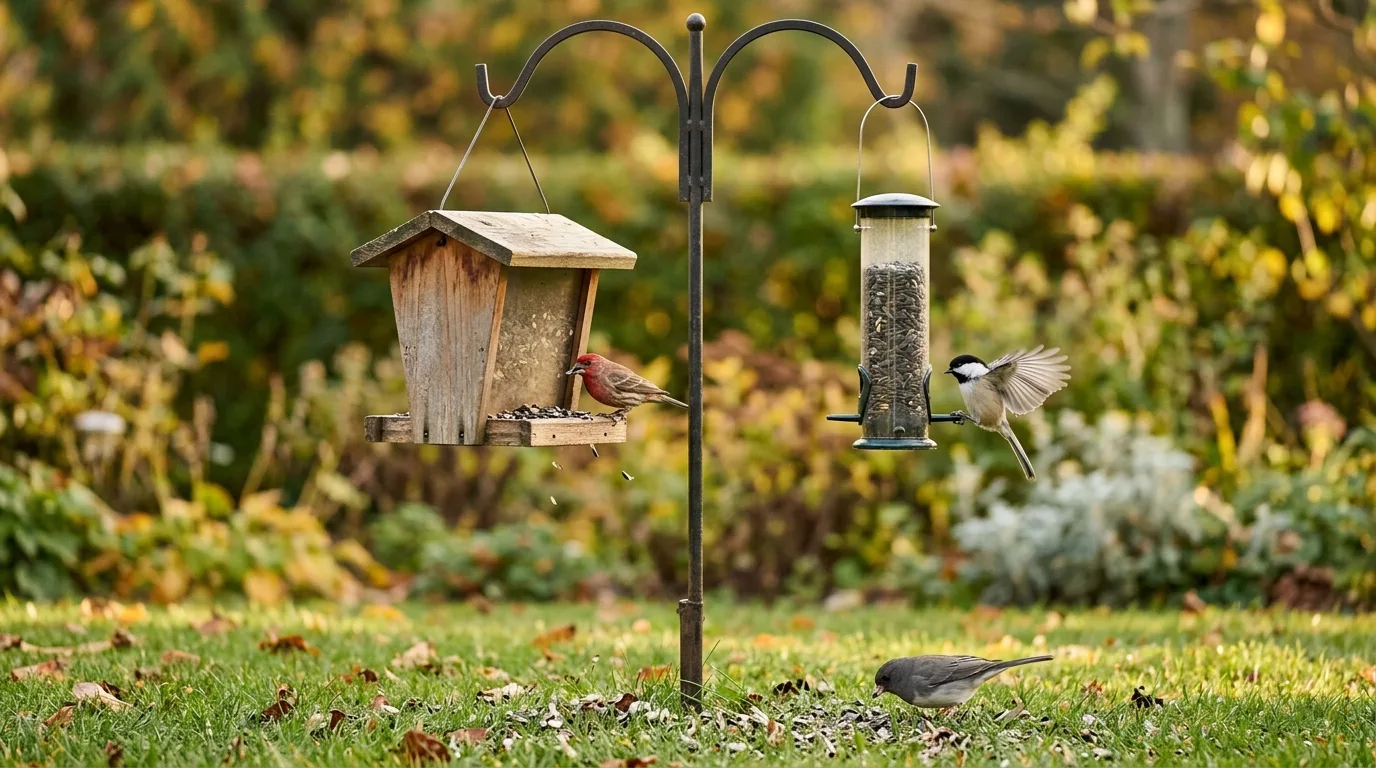
Here's the thing nobody tells you when you hang your first feeder: the hard part isn't attracting birds. It's knowing what you're looking at once they show up. A little brown bird lands, cracks a sunflower seed, and flies off before you've finished asking yourself whether that was a finch, a sparrow, or something you'll be Googling for the next twenty minutes.
The good news is that you almost never need to know all 130-odd species that show up at North American feeders to feel fluent at the window. A couple dozen birds do most of the visiting, and once you learn to read them the way a birder does — not feather by feather, but by a few quick impressions — the brown blur resolves into a name. The trick is to stop hunting for one magic field mark and start stacking up cheap, fast clues: how big is it, what's its shape, what color is doing the talking, and what is it doing. Cornell's bird guides are built around exactly this idea, what they call the four keys to ID — size and shape, color pattern, behavior, and habitat.
This guide leans on the common feeder birds of North America, because that's where the deepest, most rigorously checked ID resources live. But the way of looking travels. A birder in a British garden is running the same mental checklist on a Blue Tit or a Goldfinch that a birder in Ohio runs on a chickadee or a House Finch, and I'll point out a few of those widespread cousins as we go.
Start with size, shape, and what the bird is doing — not the color
Color is seductive and it lies. Male House Finches range from yellow through orange to bright red depending on what they've been eating, so "the red one" tells you less than you'd hope. Size and shape are steadier. Birders calibrate small birds against three mental yardsticks — sparrow, robin, crow — and most feeder birds slot somewhere on that ladder. A chickadee is smaller than a sparrow; a cardinal is "about the size of a Robin"; a Cooper's Hawk is "around the size of a crow".
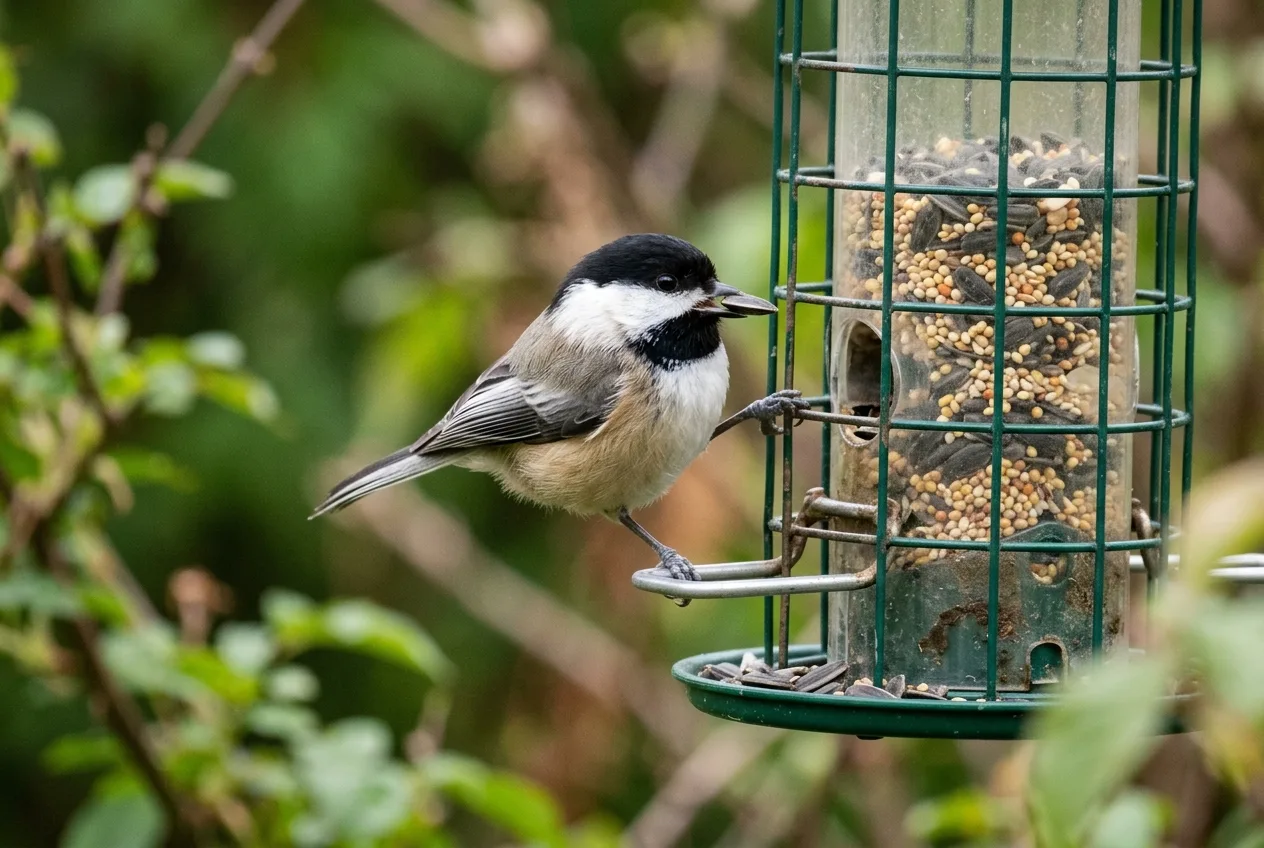
Shape is the next cheap clue, and it's surprisingly diagnostic. A chickadee reads as a tiny ball with a short neck, a large round head, and a long narrow tail — Cornell describes it as "a distinctive, rather spherical body shape". A House Finch is a slim bird with a thick conical bill and a notched tail. A nuthatch is chunky and almost neckless, with a short tail and a long pointed bill. You can often name the family from the silhouette alone, before any color registers.
Then watch what it does, because behavior is the clue most beginners ignore and most experts lean on hardest. Some examples worth burning into memory:
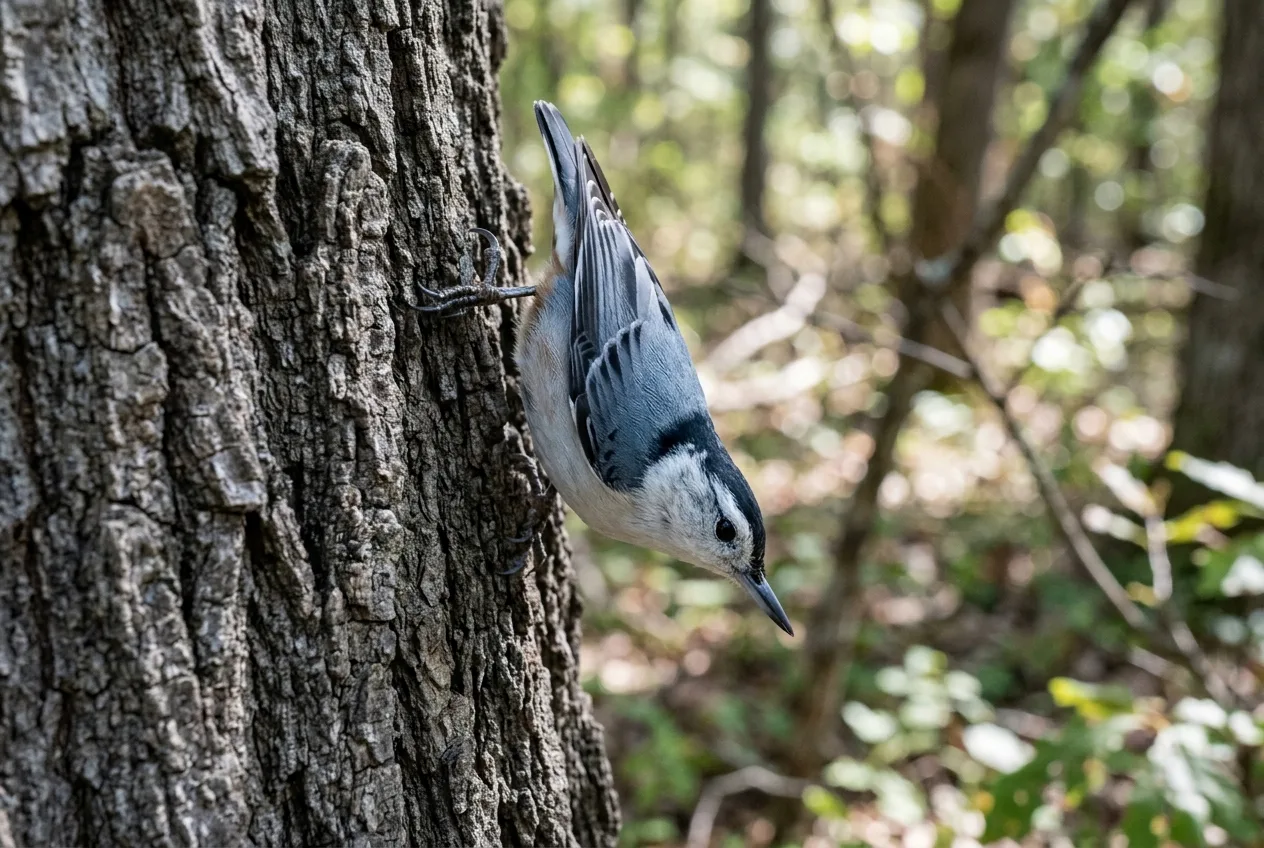
- Nuthatches walk down tree trunks head-first. Nothing else at your feeder does this. Woodpeckers and creepers hitch up trunks with their heads up, bracing on stiff tails; a nuthatch creeps down headfirst like it owns the place.
- Chickadees grab and go. A Black-capped Chickadee "seldom remain[s] at feeders except to grab a seed to eat elsewhere," flying off to wedge it into bark. A House Finch does the opposite — it parks at the feeder and sits there shelling seeds in that stout bill.
- Some birds stay on the ground. Juncos, many sparrows, and doves prefer to forage underneath, hoovering up what messier birds knock down. In the UK the Chaffinch does the same thing, hopping about below the feeder rather than clinging to it.
None of these clues is conclusive on its own. The skill is stacking them. A small spherical bird that grabs one seed and bolts is a chickadee long before you've confirmed the black cap. A chunky bird walking headfirst down your oak is a nuthatch even at a bad angle.
The birds you'll actually see most
Project FeederWatch has been logging which species visit feeders across the continent every winter since the late 1980s — more than 4,000 people enrolled in that first 1987–88 season, building on an Ontario feeder survey that started back in 1976. Decades of those counts have produced a reliable sense of who the regulars are. Here's a working portrait of the core cast, by the clues that name them.
Black-capped Chickadee. Tiny, round, hyperactive. Black cap and black bib, crisp white cheeks, soft gray back, and a buffy wash down the sides. About 4.7–5.9 inches long (12–15 cm). The all-business behavior — dart in, take one seed, vanish — is half the ID.
Northern Cardinal. The male is, in Audubon's words, "our only red bird with a crest" — there's really nothing else to confuse him with. The female is the more useful ID lesson: she's warm tan-brown, but she shares the crest, the long tail, and that "massive pink bill," so the bill and crest give her away even without the red. Roughly robin-sized, 8–9 inches (21–23 cm). Comes readily to feeders for sunflower seed.
House Finch. A slim, sparrow-sized finch with a thick bill and a shallow-notched tail. The male is rosy-red concentrated on the face and upper breast, with a brown streaky back and — the giveaway in flight — a red rump. The female is plain grayish-brown with thick blurry streaks and a notably plain face. Both sexes show heavy brown streaking down the flanks and belly, which matters when you're separating them from sparrows. Often the most numerous bird at a sunflower feeder, sitting and cracking seeds rather than flying off.
White-breasted Nuthatch. Chunky, short-tailed, blue-gray above with a clean white face and underparts, a black cap (gray on females), and often a rusty wash near the rump. About 5–6 inches (13–15 cm). The headfirst trunk-walking and the nasal "yank yank" call are the signatures.
Downy Woodpecker. The smallest woodpecker in North America, black and white and checkered, with a bold white stripe down the back and (on males) a small red patch on the back of the head. About 5.5–6.7 inches (14–17 cm). A constant suet-feeder visitor. Its near-twin, the Hairy Woodpecker, is the classic trap — more on that below.
Mourning Dove. A long, slim, soft-brown dove with a "distinctly long, tapered tail that comes to a point," about 12 inches long, usually feeding on the ground. Long one of the most common feeder-yard birds in much of North America.
Blue Jay, Tufted Titmouse, Dark-eyed Junco. Three more regulars worth knowing by impression. The Blue Jay needs no help once seen — big, crested, blue, white, and black, and loud about it — and at feeders it goes for peanuts, sunflower, and suet. The Tufted Titmouse is a small gray bird with a pointed crest, a relative of the chickadee, and a sunflower-and-suet specialist. The Dark-eyed Junco is a tidy ground-feeder — slate or brown above, clean white belly, flashing white outer tail feathers as it flushes — and it's a millet bird, working the seed that sloppier feeders scatter below.
A quick note on honesty: precise body-length figures for the Blue Jay, Tufted Titmouse, and Dark-eyed Junco weren't on a source I could verify directly for this guide, so I've described them by shape, color, and habit rather than quote a measurement I can't stand behind. That's the right instinct in the field too — when you're not sure of a number, lean on the impression.
Color is seductive and it lies.
The look-alikes that trip everyone up
This is where feeder ID gets genuinely fun, and where most of the frustration lives. Project FeederWatch maintains a whole set of "Tricky Bird ID" guides built precisely because these pairs fool people year after year. Here are the ones worth memorizing.
House Finch vs. Purple Finch vs. Cassin's Finch
The three red finches of the genus Haemorhous are, in Cornell's flat assessment, "extremely difficult" — same size, same shape, males all some shade of red or raspberry, females all brown and streaky, and ranges that overlap thanks to the House Finch turning up nearly everywhere. In parts of the West you can get all three. Cornell even runs an interactive quiz on exactly this trio. Don't expect one clean mark. Read several:
- Where the red sits. On a male House Finch the red is concentrated on the forehead, throat, and chest, often less rosy than the others, and it fades into conspicuously streaked brown sides. A male Purple Finch looks "as if someone took a streaky, brown-and-white bird and dipped it in raspberry jam" — the reddish-purple washes over most of the head, back, and chest, even onto the hindneck. A male Cassin's Finch has a bright red crown that stands out as the brightest part of the bird and contrasts sharply with the paler pink-red elsewhere.
- The female faces. This is often easier than the males. Female/immature House Finches have a plain face with no strong pattern. Female Purple Finches wear a "bold face pattern with a bright white eyebrow, a dark cheek patch, and a white stripe". Female Cassin's show a fainter white eyebrow and moustache stripe.
- The flanks and undertail. House Finches are streaky below — long, thin, blurry streaks, and broad dark streaks under the tail. Purple Finch undertail coverts are "usually white with no streaks," which Cornell flags as diagnostic if you can see it. Cassin's shows crisp, well-defined dark streaks on a white background.
A simpler version for the common case: across most of the continent your everyday red feeder finch is a House Finch, and the tells are the streaky flanks, the plain-faced female, and that curved-culmen, stubby bill. Glimpse of red on a little brown bird at a city feeder? Almost certainly a House Finch.
House Finch vs. House Sparrow
These get lumped constantly because both are small, brown, abundant, and fond of the same crumbs. But they're not even close relatives, and a couple of marks split them fast. Any red means House Finch — males have red faces, breasts, and rumps; House Sparrow males instead have gray heads, whitish cheeks, and a black bib under the chin. The bills differ too: the House Finch has a large, thick grayish beak, the House Sparrow a smaller, more sharply conical bill. And the streaking rule earns its keep — House Finches (both sexes) show significant brown streaking down the flanks and belly; House Sparrows don't. Streaked belly, finch. Clean belly, sparrow.
Downy vs. Hairy Woodpecker
Two black-and-white woodpeckers with nearly identical plumage — both with the white back stripe, both with the male's red nape patch. Cornell's advice is to forget the plumage and look at two things: overall size and, above all, bill size.
- Bill length is the money mark. On a Downy the bill is "rather short and dainty, about one-third as long as the distance from the base of the bill to the back of the head." On a Hairy it's "long, chisel-like, about as long as the distance from the base of the bill to the back of the head". If the bill looks tiny next to the head, it's a Downy.
- Size, if you can judge it. A Downy is roughly 6.5 inches; a Hairy is "about the size of a robin," averaging about 9.25 inches. Some FeederWatchers literally measured marks on their feeders to calibrate this.
- The fine print. In most of the eastern U.S. a Hairy has clean white outer tail feathers, while a Downy's white outer tail feathers are usually barred black, giving a spotted look — though western Hairys can show barring, so it's a supporting clue, not a clincher. The Hairy also tends to show a stronger black "comma" mark running from the shoulder onto the breast.
If the bill looks tiny next to the head, it's a Downy.
Black-capped vs. Carolina Chickadee
For most people, geography solves this one: the two barely overlap, and a glance at a range map tells you which you've got. Trouble only really comes in the narrow band across the east-central U.S. where ranges meet, where they even hybridize and learn each other's songs — and Cornell's honest verdict is that a bird in the overlap zone singing odd or mixed songs "cannot be positively identified in the field". If you do want to try on looks: a Black-capped is slightly larger (avg. 5.25″) with more white in the wing — the greater coverts "broadly edged in white, forming what appears to be a long white patch" in fresh plumage — and a raggedy lower edge to the black bib. A Carolina is the smallest chickadee (avg. 4.75″), grayer in the wing, with a neater line at the bottom of the bib.
White-breasted vs. Red-breasted Nuthatch
Both walk headfirst down trunks, both are blue-gray above with a dark cap and white cheek, but the rest separates cleanly. The White-breasted is the larger of the two, white underneath with at most a rusty wash near the rump, and crucially it has a clean face with no eye line. The Red-breasted is smaller, distinctly reddish-orange below, and wears a bold dark line through the eye under a white eyebrow. Habitat helps: White-breasted favors deciduous woods, Red-breasted leans coniferous. Their calls differ in cadence — the White-breasted's nasal "yank" comes in clusters of two or three like a sheep's bleat; the Red-breasted's is higher, reedier, and faster, "like the tooting of a tiny tin horn".
Sharp-shinned vs. Cooper's Hawk
Sooner or later a hawk crashes your feeder scene and scatters everything — and across the U.S. it's most likely one of these two accipiters hunting your songbirds. They are notoriously hard. Cornell is blunt: "no single field mark is likely to distinguish one species from the other," so you combine clues and trust the overall impression. Worse, female hawks run up to a third larger than males, so a big female Sharp-shinned can approach a small male Cooper's.
- Size, loosely. A Sharp-shinned is jay-to-dove-sized (avg. 10–14″); a Cooper's is crow-sized (avg. 14–20″), about six inches bigger on average.
- Head shape and projection. This is the one many birders trust most. A Cooper's has a large head — "a big ol' dome that's sort of like a block stacked on top of its body" — that projects well past the wings in flight; a Sharp-shinned has a small, smoothly rounded head that barely clears the wings.
- Tail tip. A Cooper's tail tends to be rounded at the tip with a clear white band; a Sharp-shinned's is squarer, showing corners, with a narrow white tip — though a soaring sharpie's tail can look rounded too.
- The nape. On adult Cooper's the crown is darker than the paler nape, giving a "capped" look; adult sharpies are a uniform dark blue-gray over crown and nape.
If you end up shrugging and writing "Cooper's/Sharp-shinned" in your notes, you're in excellent company — even expert birders do.
A few more honest traps
Two others worth a line because they catch people every season. The female Purple Finch and the female Rose-breasted Grosbeak are both big-ish brown streaky birds with a bold white eyebrow — but the grosbeak is substantially larger (7–8 in vs. the finch's 4.5–6.5 in) with a huge pinkish bill, where the Purple Finch has a smaller conical gray bill. And in winter the American Tree Sparrow and Chipping Sparrow look almost identical; the tree sparrow's usual tell is a dark central spot on a plain gray breast (which the Chipping lacks), plus a bicolored bill — dark above, yellow below — against the Chipping's pinkish winter bill.
If you end up shrugging and writing "Cooper's/Sharp-shinned" in your notes, you're in excellent company — even expert birders do.
Match the seed to the bird
Here's a shortcut that doubles as ID: the seed a bird chooses tells you something about the bird, and stocking the right seed brings the species you want into view. The science here is unusually solid. It traces back to a U.S. Fish and Wildlife scientist named Aelred "Al" Geis, who in the late 1970s ran a rigorous seed-preference study on his Maryland farm — testing 23 ingredients — and published it in 1980. Before Geis, birdseed mixes were "largely chosen as a matter of custom, lore, and convenience". His paper became the most popular USFWS had ever published and reshaped what goes in the bag. Decades later his protégé David Horn extended the work as Project Wildbird, tracking 1.2 million feeder visits over three years — "the most comprehensive study of avian food and feeder preferences ever conducted".
Two findings have held up since Geis's day: "Birds have always loved black oil sunflower seed. Barely anyone likes milo". Here's how the major foods sort out:
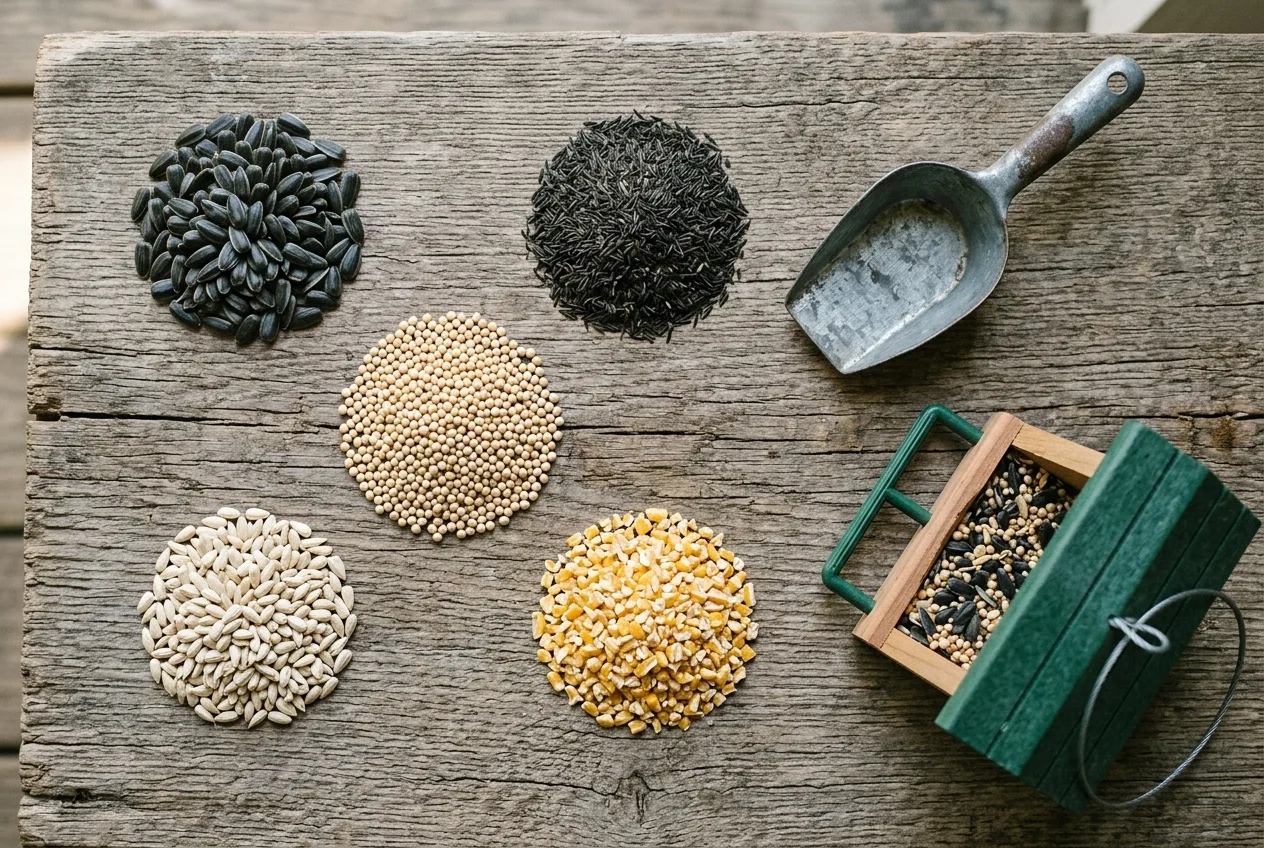
- Black-oil sunflower is the closest thing to a universal seed — Audubon flatly calls it the seed that "appeals to the greatest number of birds", and it's preferred by most small feeder birds. If you put out one thing, put out this.
- Nyjer (thistle) is the goldfinch magnet. It's "a preferred food of American Goldfinches, Lesser Goldfinches, House Finches, and Common Redpolls," sometimes nicknamed "black gold" because it's pricey. It needs a fine-ported feeder because the seeds are so small.
- Safflower is the cardinal's friend and the bully's enemy: "readily eaten by cardinals, grosbeaks, sparrows, and doves," while "starlings, House Sparrows, and squirrels usually find it less appealing than sunflower seed". A useful seed if you're trying to feed cardinals without subsidizing the mob.
- Millet is ground-feeder food. White proso millet is "the favorite food of most small-beaked ground-feeding birds" and pulls in "quail, doves, juncos, sparrows, towhees". This is your junco-and-sparrow seed.
- Cracked corn "attracts quail, doves, jays, juncos, and towhees," but it spoils fast, so offer small amounts.
- Suet and peanuts are for the trunk crowd. Suet "attracts insect-eating birds such as woodpeckers, wrens, chickadees, nuthatches, and titmice"; whole and crushed peanuts pull in woodpeckers, jays, chickadees, titmice, and nuthatches.
- Milo, wheat, and oats are the filler. "Relatively few species prefer" them; they're the cheap padding in bargain blends that mostly ends up on the ground attracting rodents.
A subtlety the research adds: it's not just the seed, it's the seed and the feeder together. Horn stresses that "the combination of seed and feeder is key to attracting many kinds of birds". Ground-feeders want a platform or the ground; sunflower specialists work tube and hopper feeders; suet needs a cage. And birds aren't choosing on taste alone. They go for seeds high in protein and fat, and ones they can handle fast — even simple-to-crack millet wins partly because it's quick to eat while staying alert for predators. One nice reassurance from the science: you won't make birds dependent. In a classic study of Black-capped Chickadees with unlimited feeder access, the birds still got 79 percent of their daily energy from wild sources.
The same logic runs in European gardens, with a slightly different cast. Black sunflower seed and sunflower hearts are the staples there too, favored by Greenfinches and tits, though birds will skip the whole seeds if easier-to-eat hearts are nearby. Nyjer pulls in Goldfinches and Siskins — the European Goldfinch, with its red face and fine bill built for teasing seeds out of thistles and teasels, is increasingly a feeder bird and takes readily to nyjer and sunflower hearts. Mealworms are the move for Robins and Blue Tits. Suet and fat-based foods are prized winter energy. It's the same playbook: match the food to the bird's bill and feeding style.
It's the same playbook: match the food to the bird's bill and feeding style.
Keep the feeder clean — this part is not optional
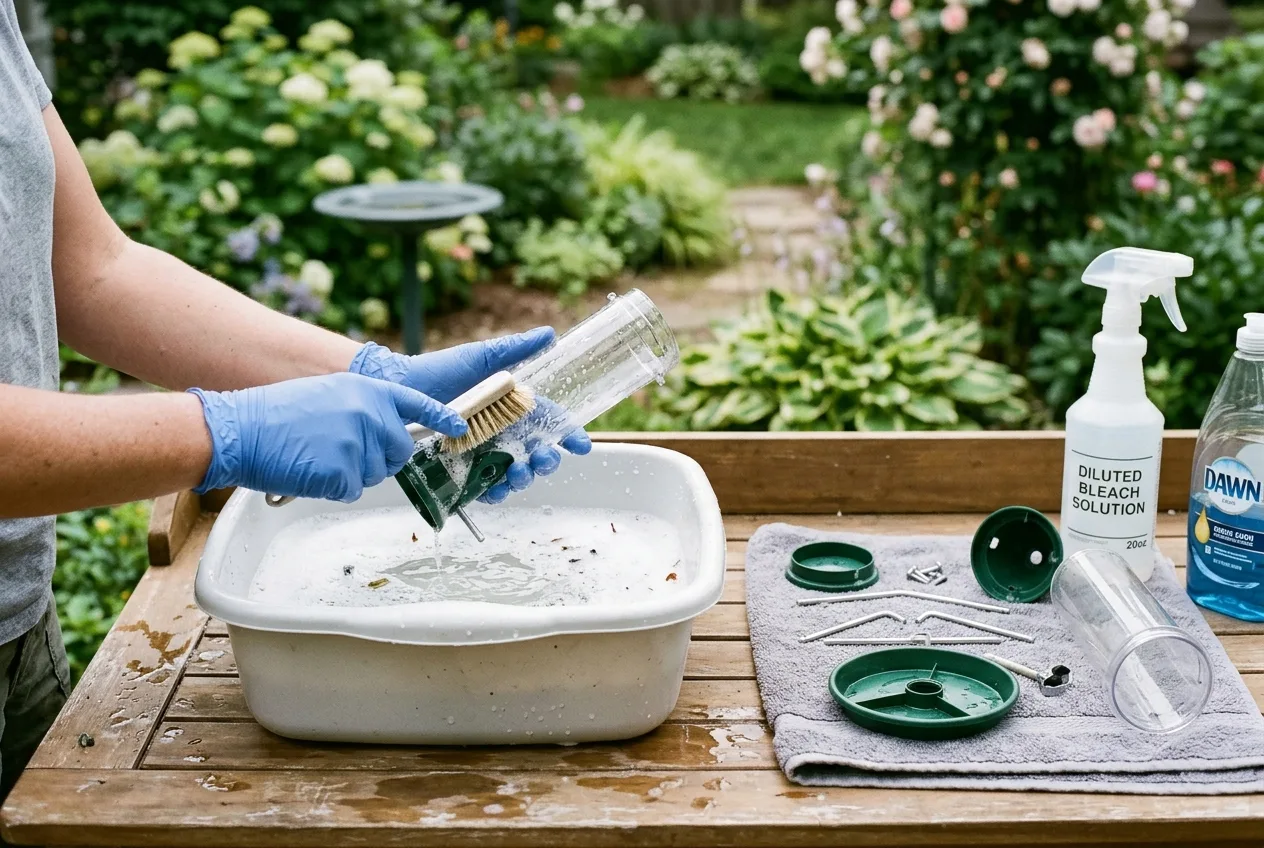
A feeder concentrates birds, and concentrated birds share germs. This isn't a scare; it's the one responsibility that comes with the hobby, and the evidence is clear on both sides of the ledger. A three-year, 11-species study found birds at feeder sites were generally healthier — lower stress (measured as heterophil-to-lymphocyte ratio), higher antioxidant levels, better fat scores and faster feather growth — and more likely to carry disease, with conjunctivitis, pox and other infections peaking at 8.3% of birds at feeders. Feeding helps; dirty feeding hurts. The fix is hygiene.
The cautionary tale is House Finch eye disease. In January 1994, House Finches with "red, swollen, runny, or crusty eyes" turned up at feeders around Washington, D.C.; in bad cases the eyes swell shut and the blinded bird dies of starvation, exposure, or predation. The culprit is a strain of Mycoplasma gallisepticum, a bacterium that had been a poultry pathogen until it jumped to finches. It spread fast through the eastern population — which descends from a tiny number of birds released in the 1940s and is highly inbred — and now an estimated 5–10% of eastern House Finches carry it; it has also turned up in American Goldfinches, Purple Finches, and Evening Grosbeaks. Cornell's guidance if you see a sick bird: take feeders down, clean them with a 10% bleach solution (one part bleach to nine parts water), let them dry fully before rehanging, rake out the old seed and droppings underneath, and space feeders widely so birds aren't crowded.
Across the Atlantic the headline disease is different but the lesson is the same. In the UK, finch trichomonosis — a parasite spread through saliva on dropped or regurgitated food — has driven a roughly 70% decline in the British Greenfinch population since 2006. UK guidance has shifted noticeably toward caution as a result: keep no more food out than will be eaten in 24–48 hours and bin the rest rather than topping up, and bodies like the RSPB and BTO now advise pausing seed and peanut feeding in the warmer months (roughly May to October), when outbreak risk in gardens runs highest. That's a real divergence from the year-round feeding common in North America, and it's worth knowing if you read advice from both worlds. A couple of universal safety rules round it out: never offer food in nylon mesh bags (birds get tangled, woodpeckers by the tongue), skip salty foods and milk, and change bird-bath water daily.
Whatever side of the ocean you're on, the through-line is simple. Clean the feeder on a schedule, don't let wet seed and droppings pile up underneath, give birds room, and pull everything down for a deep clean the moment you see a sick bird.
Frequently asked questions
What is the most common bird at backyard feeders?
There's no single answer for every yard, but the long-running Project FeederWatch counts show the regulars: chickadees, House Finches, Northern Cardinals, Dark-eyed Juncos, nuthatches, and Mourning Doves are among the birds most consistently reported at North American feeders. Which dominate depends on your region, habitat, and what you're offering.
How do I tell a House Finch from a House Sparrow?
Look for red and look at the belly. A male House Finch shows red on the face, breast, and rump; a male House Sparrow has a gray head, pale cheeks, and a black bib instead. And House Finches of both sexes have heavy brown streaking down the flanks and belly, while House Sparrows don't — streaked belly means finch.
What's the difference between a Downy and a Hairy Woodpecker?
Bill size, mainly. A Downy's bill is short and dainty, about a third the length of its head; a Hairy's is long and chisel-like, about as long as its head. The Downy is also much smaller — roughly 6.5 inches versus the robin-sized Hairy at about 9.25 inches.
What seed attracts the most birds?
Black-oil sunflower seed. Audubon calls it the seed that appeals to the greatest number of birds, and the research backs it up — if you stock one thing, stock that. For goldfinches add nyjer; for cardinals try safflower; for ground-feeders like juncos and sparrows, white millet.
Why does a hawk keep showing up at my feeder, and which one is it?
Because your feeder concentrates songbirds, which is exactly what accipiters hunt. Across the U.S. it's most likely a Cooper's or Sharp-shinned Hawk. The quickest tell is head shape: a Cooper's has a big blocky head that juts past the wings in flight, a Sharp-shinned a small rounded head that barely clears them — but even experts often can't be sure, so don't feel bad logging it as "Cooper's/Sharp-shinned".
Are bird feeders bad for birds?
On balance, no — a multi-year study found feeder birds were generally in better physiological condition than birds without feeders. But feeders also raise disease risk if you let them get dirty, so hygiene is the deciding factor: clean feeders regularly, don't let old seed pile up, and take everything down to disinfect if you see a sick bird.