
There's a sound coming out of the hedge that you can't place. Three sweet notes, then a buzzy little flourish, over and over. You can hear it perfectly. You just can't see the bird, and even if you could, it'd be a small gray-green something flitting through the leaves. So you stand there, neck craned, waiting for it to show itself — and it never does. That mystery is exactly where birding by ear begins, and it's also why it's worth learning. When a bird sings, it's telling you what it is and where it is. Your ears find birds in dense foliage, far off, at night, and among look-alikes long before your eyes ever could. That's the reason serious birders call it "birding," not "birdwatching".
Here's the short version of how to start, before we get into the why and how. Pick a handful of common birds you can already see and hear — the robin on the lawn, the cardinal at the feeder — and learn their voices cold. For each new sound, pay attention to four things: its rhythm, repetition, pitch, and tone. Turn songs into words when you can ("who-cooks-for-you," "drink-your-tea") because a phrase you already know is far easier to remember than a string of nonsense syllables. Use a sound-ID app like Merlin as a knowledgeable friend who points and suggests — not as the final word. And whenever you can, watch the bird while it sings, so the sound and the singer lock together in your memory. Do that with a few species and the whole thing starts to snowball. As master birder Kenn Kaufman puts it, "the benefits of birding by ear start to kick in as soon as you learn a handful of voices".
That last point is the one beginners miss. You don't have to learn them all. You couldn't if you tried — a spring sunrise can serve up dozens of species calling at once. The trick is to stop treating it as a wall of noise to be memorized and start treating it as a small set of voices you'll get to know, one at a time.
Song vs. call: why the difference matters
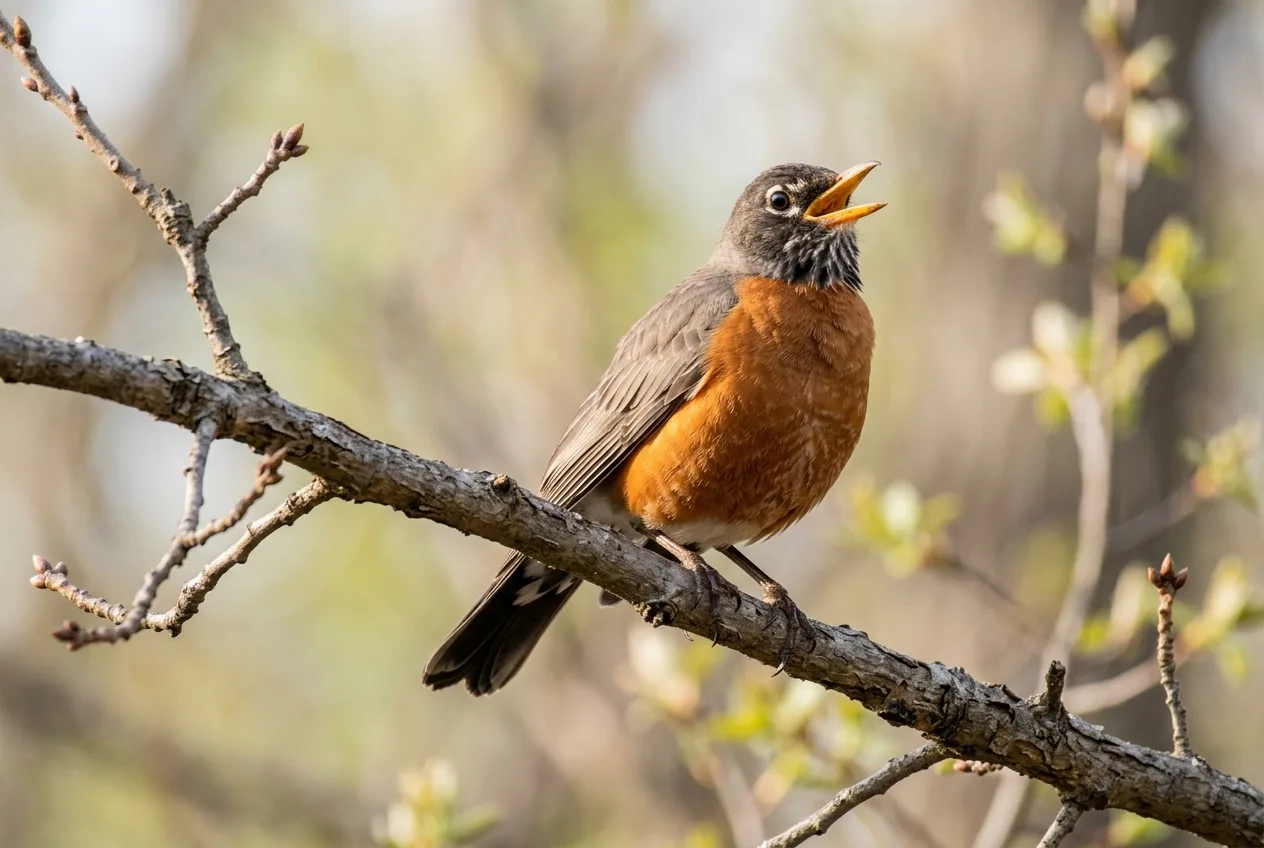
Birds make two broad kinds of sound, and telling them apart changes how you listen. A call is short and simple — "a peep, cheep, squawk, chatter," as ornithologist Roger Lederer defines it. A song is "a relatively long, often melodious, series of notes usually associated with some aspect of courtship". Think of the robin: that long, rich, caroling phrase from the treetop is the song; the sharp tut-tut-tut it gives when a cat walks under the bush is a call.
There's a deeper distinction underneath that, and it explains a lot about why this skill is learnable at all. Calls are essentially genetic — a bird hatches knowing them. Songs are partly inherited and partly learned, picked up from parents and neighbors during a critical period. That learning is exactly why songs vary from place to place, why a young bird raised in silence sings a stunted version of its species' song, and why two robins three states apart still sound recognizably like robins. It's also why so much of birding by ear comes down to the song. Songs carry the structure, the rhythm, the personality. Calls are the punctuation.
One honest caveat from the science: the line between song and call isn't a hard wall. No single trait — time of year, complexity, whether it's learned, its role in courtship — holds across every bird we call a songbird, and some ornithologists now argue we should think of songs and calls as two ends of one continuum rather than separate boxes. You don't need to resolve that debate to bird by ear. But it's worth knowing that the categories are a useful simplification, not a law of nature.
A quick word on how birds make all that sound
You don't need anatomy to identify a bird, but a little of it makes the rest make sense. Birds sing with an organ called the syrinx, sitting deep in the chest where the windpipe forks toward the two lungs — roughly where your bronchi split, not up in the throat like our larynx. In many songbirds it's no bigger than a raindrop, and it's astonishingly efficient: it "uses nearly all the air that passes through it," whereas a human creates sound using only about 2% of the air we exhale.
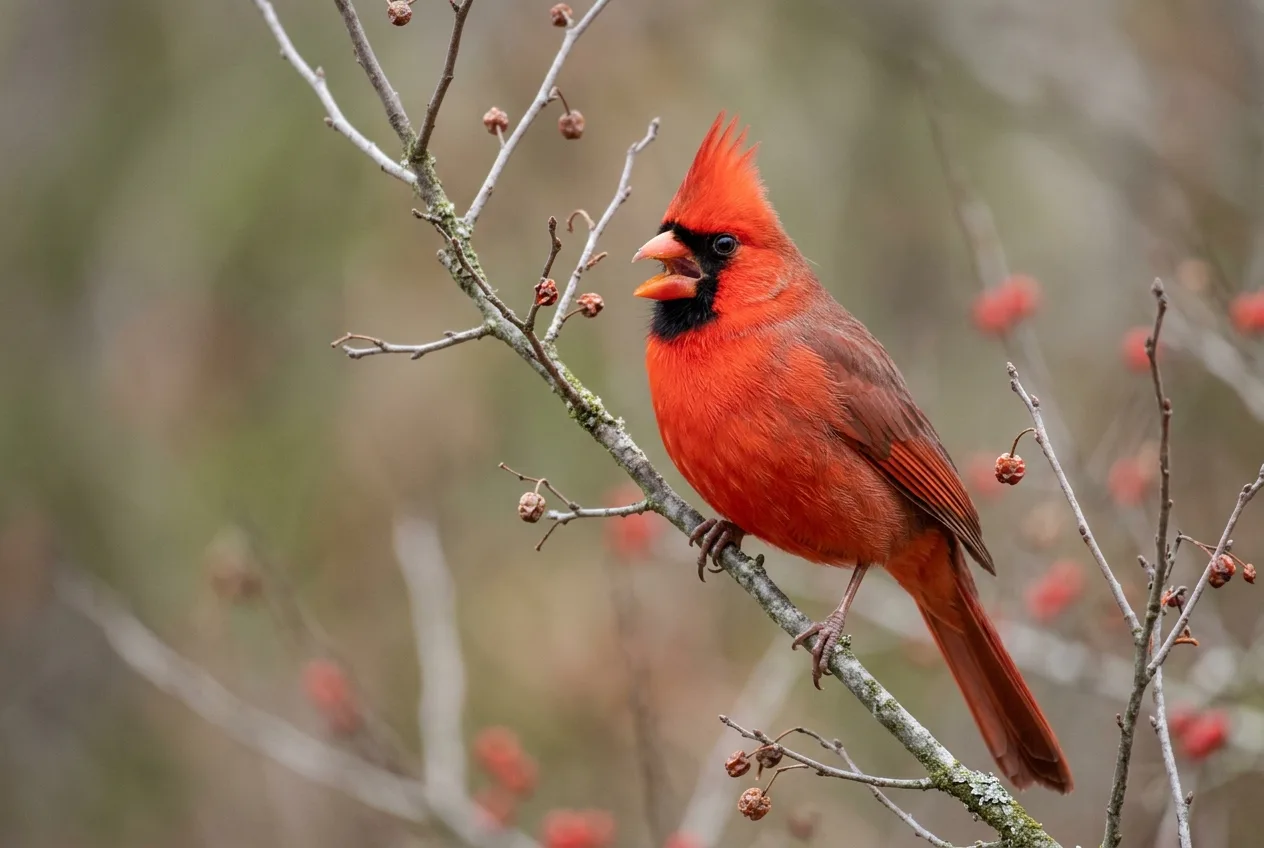
The part that matters for your ears is this: songbirds can control the two sides of the syrinx independently, producing two different notes at the same time. In a Northern Cardinal, the left side handles the low pitches and the right side the high ones. That's how a single small bird can sing those liquid, sweeping slurs that sound almost impossibly smooth — it's effectively singing a duet with itself. Roughly 4,000 of the world's 10,000-odd bird species are songbirds, the group where this machinery is most developed. When you hear something rich and complex, you're almost certainly listening to one of them.
That's how a single small bird can sing those liquid, sweeping slurs that sound almost impossibly smooth — it's effectively singing a duet with itself.
What to actually listen for: the four qualities
When you can't see a bird, you need words for what you're hearing — and the four that birders keep coming back to are rhythm, repetition, pitch, and tone. Most birds sing varied phrases but keep a characteristic voice, and these four qualities are how you pin that voice down.
- Rhythm is the song's cadence — its tempo and pacing. A Marsh Wren sings like it's in a hurry; a White-throated Sparrow is far more leisurely. Once you start hearing rhythm, you can often place a bird before you've registered a single note.
- Repetition is how phrases repeat. Does the bird say one thing over and over? Does it pair phrases, or cycle through a long medley without repeating? This is one of the single most useful questions you can ask, and we'll see it again when we get to mimics.
- Pitch is how high or low the voice sits, and whether it rises, falls, or holds steady. As a rule of thumb, smaller birds tend to have higher voices and larger birds deeper ones. A practical habit from Audubon's Kaufman: if it's a complicated song, count the notes, and ask whether the tune climbs or drops.
- Tone is the quality of the sound — clear and whistled, buzzy, nasal, harsh, musical. Tone is hard to put into words but easy to recognize once you've heard it a few times.
Run a familiar bird through that filter and you'll see how it works. The American Robin's phrases have very fast pitch changes, which gives the song a "wobbly" character, and it follows a fairly regular rhythm. Compare that to the Rose-breasted Grosbeak, which sounds like a robin that took singing lessons — same general idea, but the pitch changes are "slower, smoother, and more evenly slurred". Two birds, easily confused, separated by one quality you can learn to hear.
It helps to build on what you already know. You almost certainly have American Robins in your yard or local park. Beyond that caroling song, robins have a surprising number of different calls — spend a while learning the whole repertoire of that one bird and the knowledge travels with you almost anywhere in North America.
Mnemonics: turning birdsong into words
Some songs are kind enough to sound like English, and birders have been exploiting that for generations. The classic example is the Barred Owl, which hoots a phrase most people hear instantly as "Who cooks for you? Who cooks for you all?". The Common Yellowthroat sings "Wichity-wichity-wichity". Once you've heard the words, you can't un-hear them — and that's the entire point.
This is where I'll take a side, because the field guides don't fully agree. Some guides chase phonetic accuracy, spelling out a Carolina Wren as pidaro pidaro pidaro. But a mnemonic's job isn't fidelity — it's memory. As writer Peter Cashwell argues, a real English word is "far, far easier for people to remember...than a set of nonsense syllables," because it gives you "a familiar heading under which to file something less familiar". That's why most birders render the Carolina Wren as cheeseburger or tea-kettle, tea-kettle, tea-kettle — and why even David Sibley, who favors phonetic spellings, quietly tucks "drink your tea" in parentheses next to his rendering of the Eastern Towhee. Pragmatism wins.
A starter set worth memorizing, pulled straight from the birders who use them:
| Bird | Mnemonic |
|---|---|
| Barred Owl | "Who cooks for you? Who cooks for you all?" |
| Eastern Towhee | "Drink your tea!" |
| White-throated Sparrow | "Old Sam Peabody, Peabody, Peabody" (or "Oh sweet Canada, Canada, Canada") |
| Yellow Warbler | "Sweet, sweet, sweet, I'm so sweet" |
| American Goldfinch | "Potato chip" (often given in flight, between wingbeats) |
| Carolina Wren | "Tea kettle, tea kettle, tea kettle" |
| Olive-sided Flycatcher | "Quick, free beer!" |
| Great Horned Owl | "Who's awake? Me too" |
Plenty of birds are named for the very sound they make, which makes the mnemonic and the ID the same thing — the Northern Bobwhite whistles bob-white, the Killdeer cries kill-deer, the Eastern Phoebe says phoebe. And you don't have to settle for published phrases. Listen carefully and invent your own; a memory hook you built yourself often sticks best.
If plain words don't do it for you, there's a more elaborate technique that works astonishingly well: connect each song to a vivid mental image. The Warbler Guide co-author Tom Stephenson teaches it this way — immerse yourself in a sound you already know, let your brain conjure a picture, then build a little story around it that loops back to the bird's name. His Black-and-white Warbler sounds like a squeaky wheel, which becomes a bicycle being stolen by a crook in a black-and-white striped prison suit. A Yellow Warbler's sweet, sweet, sweet becomes a bird dripping in honey — honey being sweet, and yellow. The Northern Cardinal's long, sweeping upslurs become a Star Wars light-saber battle. "Images are the easiest things for our minds to remember," Stephenson writes. "In fact, the crazier the better!". Using this system, he's learned 300 or more songs in five to six weeks, and reckons a motivated birder could master 30 warbler species over a single spring migration.
The one non-negotiable step, whichever method you use: test yourself with the bird's name hidden. Build a short playlist of four or five songs, listen in random order, recall the image or phrase, then check the name. If your brain hears the name first, it shuts down the part that's actually doing the work.
If your brain hears the name first, it shuts down the part that's actually doing the work.
How to learn it: start small, start local, start in spring
If there's one mistake that sinks beginners, it's trying to drink from the firehose — sitting down with a 500-song app and grinding through it like flash cards. Don't. The car-CD approach, where a polite voice announces each species in turn, is "tedious and ultimately ineffective," because out in the field you'll have memorized the words and not the birds.
Here's the method that actually works, assembled from the people who teach this for a living.
Anchor on a few birds you can see. The fastest way to cement a song is to watch the bird singing it — seeing it sing engages more of your senses and locks the connection in place. Master one or two species and you've got the foundation for everything else; each new bird becomes a comparison against voices you already own. The Cornell Lab suggests a beginner's starter set of common, vocal, watchable species — Red-winged Blackbird, Song Sparrow, American Robin, Chipping Sparrow, Yellow Warbler, and Common Yellowthroat among them.
Listen to recordings on purpose. Repeated listening is how you learn to separate the genuinely confusing ones — the Chipping Sparrow, Dark-eyed Junco, and Pine Warbler all give similar dry trills, and only repetition trains your ear to tell them apart. A "Birds Near Me" style filter narrows the list to what's actually around you, which keeps you from drowning. For nearly any bird on earth, the Cornell Lab's Macaulay Library is the deepest archive there is — hand-picked recordings covering songs, calls, flight calls, displays, and even mechanical sounds for some 900 North American species, drawn from the work of more than 515 recordists, with some cuts dating back to 1935.
Pick your moment. For most of North America, spring and early summer are the peak seasons for birdsong, the time when the volume can feel overwhelming but the opportunity is greatest. Use it. A late-winter resolution to learn ten local voices, paid off across April and May, will change how the whole year sounds.
Find other ears. A local bird club or field trip puts you next to people who already know these sounds and will name them out loud as you walk. There's no faster shortcut than a knowledgeable companion.
Spectrograms: seeing a song you can't quite hear
When two songs sound maddeningly alike, it helps to look at them. A spectrogram is a simple graphical picture of a sound that maps out its pitch, tone, and volume over time — and because it's a picture, you can study it, pause it, and rewind it in a way you can't with a sound that's already faded. Field-guide transliterations like the Yellow-throated Vireo's rrreeyoo, rreeoooee are rarely much help; spectrograms let you see a song's underlying structure and arrive at a more objective ID.
You don't have to become a spectrogram expert. But even a glance at one can settle an argument. Take the Common Yellowthroat versus the Carolina Wren — two birds whose songs share the same structure, a repeated three-element phrase, where one person's wit-chi-tah is another's tea-kett-le. On a spectrogram, the difference jumps out: the wren's song contains "one abrupt, accented element" that stands out sharply, while the yellowthroat's is even and smooth. Hear that accent and you'll never mix them up again. (The Cornell Lab's free "Bird Song Hero" game is built around exactly this skill — matching sounds to their spectrograms.)

Where sound-ID apps fit — and where they don't
It's never been easier to point a phone at a hedge and get an answer. In 2021 the Cornell Lab added a Sound ID feature to its free Merlin app; you hold up the phone, and as it listens it flashes the names of birds in real time, even pulling apart several species singing at once. The technology is clever in a way that connects right back to spectrograms: Merlin converts each recording from a waveform into a spectrogram — a picture of the sound's volume, pitch, and duration — and then identifies that picture the same way it would identify a photo of a bird. It's trained on hundreds of thousands of recordings contributed by everyday birders, cross-referenced against more than a billion bird observations in the eBird database that tell it which species are even plausible at your location and date.
It has grown fast. At launch Merlin's Sound ID handled more than 400 species in the U.S. and Canada; within a year that was 458 species, trained on 750,000 recordings; today the feature covers 2,066 species worldwide, including 638 in the U.S. and Canada, with the model updated twice a year. Its sibling, BirdNET — built by the Cornell Lab and Chemnitz University of Technology — pushes even further, with a research-grade model spanning over 6,000 species globally and more than 2.2 million people contributing recordings since 2018. As BirdNET's Connor Wood put it, "You don't need to know anything about birds, you just need a smartphone".
So should you just let the app do it? Use it, absolutely — but here's the honest version. Treat Merlin as a knowledgeable friend's suggestion, not the final answer. The people who built these tools say the same thing in stronger terms. In a 2025 field study, researchers ran 144 paired point counts pitting Merlin against human observers in Maine spruce-fir forest. The humans came out ahead: they detected 72% more individual birds than Merlin and logged 382 detections to Merlin's 222. Precision was close — 92% for humans, 86% for Merlin — but Merlin generated 12 false-positive species, and, tellingly, two Merlin devices listening to the same birds at the same time disagreed with each other on 57% of the counts. The authors' recommendation was explicit: use Merlin as a supplementary observer, not a replacement.
This squares with what's known more broadly about automated ID: accuracy is real but context-dependent, false positives are a constant hazard, and how you set the confidence threshold matters. None of that means the apps are bad — they're a genuinely magical entry point, and a superb learning aid because they let you connect a name to a sound in the moment. It does mean the app is a starting point, not an end point. The goal is to use it as training wheels until your own ear takes over.
The goal is to use it as training wheels until your own ear takes over.
Two things that will trip you up
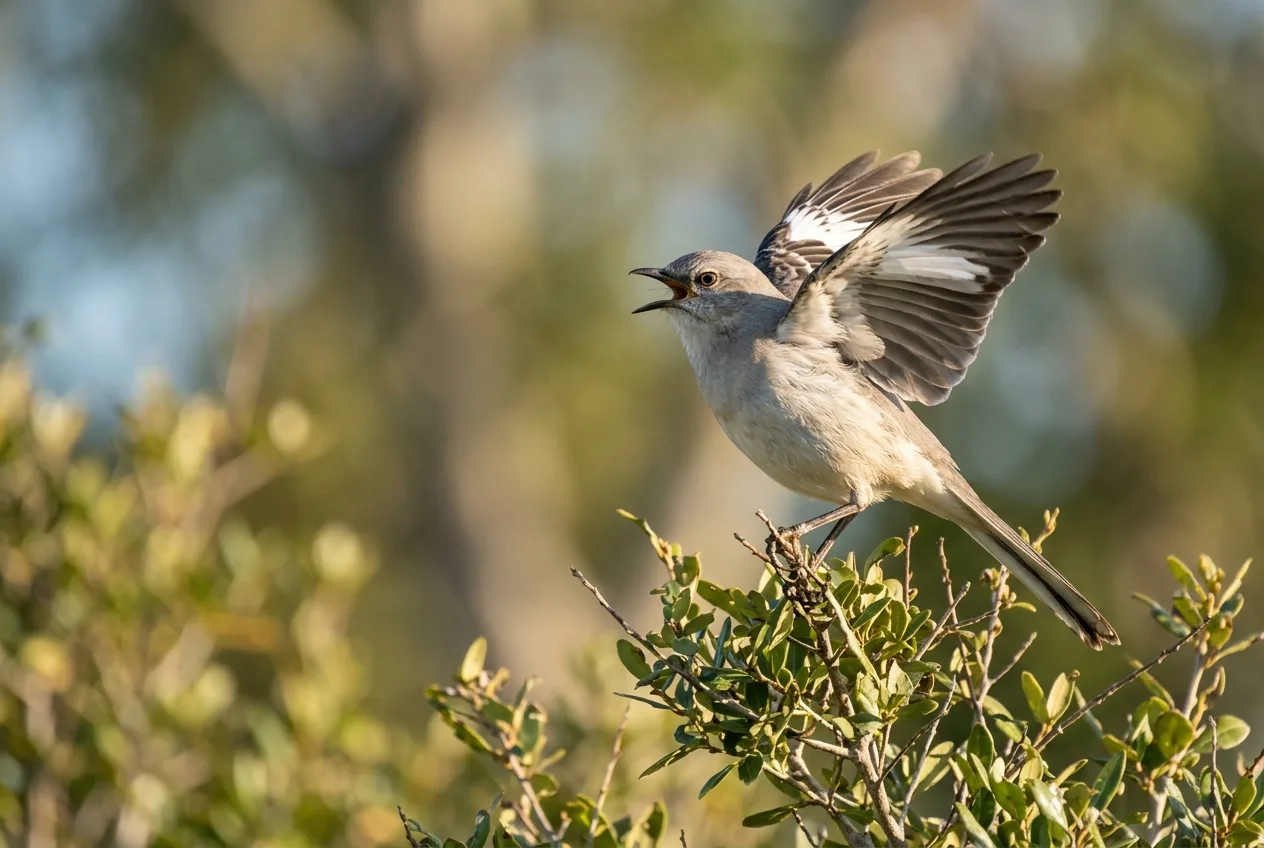
Mimics. Some of the commonest backyard birds are impersonators, and they're built to fool you. A Northern Mockingbird can sing up to 200 different song variations, each one eerily close to the real thing. A Brown Thrasher carries a repertoire of 1,000 to 3,000 songs. A Blue Jay will throw a hawk's scream into the trees just to clear a feeder. The single best tell is repetition: a mockingbird repeats each borrowed phrase several times before switching, and a thrasher tends to deliver its phrases in doublets or triplets, so if you hear an Eastern Phoebe, then a Carolina Wren, then a titmouse in quick succession, you're almost certainly listening to one mockingbird working through its set list. Quality is the other clue — a Blue Jay's hawk imitation comes out as "a shorter, gravelly version" than the real raptor, and a Gray Catbird's mimicry is woven into a jumbled, mewing ramble. When a sound seems too exotic for the spot you're standing in — "it sounds like a Sora, but why would a Sora be singing from a dogwood tree?" — suspect a mimic.
Regional accents. Birds have dialects, and they can throw you when you travel. Researchers found more than 10 distinct dialects of the White-crowned Sparrow in the San Francisco Bay Area alone — a bird singing in Golden Gate Park sounds different from one a few miles away near the Golden Gate Bridge. These accents develop mostly in year-round resident species, where young birds learn songs from their parents and neighbors and pass local variations down the generations. As ornithologist Donald Kroodsma describes it, "It's culture: learned traditions passed from one generation to the next". A mnemonic you learned in one region may not fit the same species in another, so when a familiar bird sounds slightly off, you may simply be hearing the local twang. The crowd-sourced archive at xeno-canto — hundreds of thousands of recordings you can filter by location — is a good way to learn the accent of a place before you visit.
Pairing what you hear with what you see
For all the focus on ears, the strongest IDs use both senses. Many birders find it most effective to listen and watch at the same time, because seeing the bird reinforces the audio memory, and for tricky look-alikes the voice is often the clincher. The whole skill, really, is a loop: a sound tells you where to look, your eyes confirm what your ears suspected, and that confirmation deepens the memory so the next time you'll know the sound on its own.
None of this happens overnight. But it builds faster than you'd think. Learn the robin and the cardinal cold, add a mnemonic or two, let an app double-check you, and pick a spring morning to go listen on purpose. Before long that unplaceable buzz in the hedge won't be a mystery at all — it'll be a Yellow Warbler, sweet, sweet, sweet, and you'll have named it without ever raising your binoculars.
The whole skill, really, is a loop: a sound tells you where to look, your eyes confirm what your ears suspected, and that confirmation deepens the memory so the next time you'll know the sound on its own.
Frequently asked questions
What's the easiest way to start identifying birds by sound?
Learn a few common birds you can already see — the robin, the cardinal — by watching them sing, then use those as anchors to compare everything else against. The payoff starts as soon as you know a handful of voices, so you don't need to learn them all at once.
What's the difference between a bird's song and its call?
A call is short and simple — a peep, chip, or chatter — while a song is a longer, often melodious series of notes tied to courtship and territory. Calls are largely instinctive, but songs are partly learned, which is why they vary between individuals and regions.
Can an app like Merlin reliably identify birds by sound?
It's a great learning tool and a good first guess, but not infallible. Skilled human observers still detect more birds and make fewer errors, and the app throws occasional false positives — so treat its suggestions as a starting point to confirm, not the final answer.
What does "rhythm, repetition, pitch, and tone" mean for bird songs?
They're the four qualities birders use to describe an unfamiliar voice: rhythm is the cadence and tempo, repetition is how phrases repeat, pitch is how high or low (and whether it rises or falls), and tone is the quality — whistled, buzzy, nasal, or harsh. Naming these gives you words to remember a sound by.
Why do birds sing so much at dawn?
The dawn chorus, which can begin around 30 minutes before sunrise, is mostly about defending territory and attracting mates, with a complex song signaling a male's health and quality. Ornithologists still aren't certain why singing peaks then — it may make use of a time too dark for foraging, or serve as a vocal warm-up for the day.
Are some common birds deliberately imitating other species?
Yes. Mockingbirds (up to 200 variations), Brown Thrashers (1,000–3,000 songs), Gray Catbirds, and Blue Jays all mimic other birds. The giveaway is repetition and sound quality — mimics repeat borrowed phrases and often sound hoarser or gravellier than the bird they're copying.