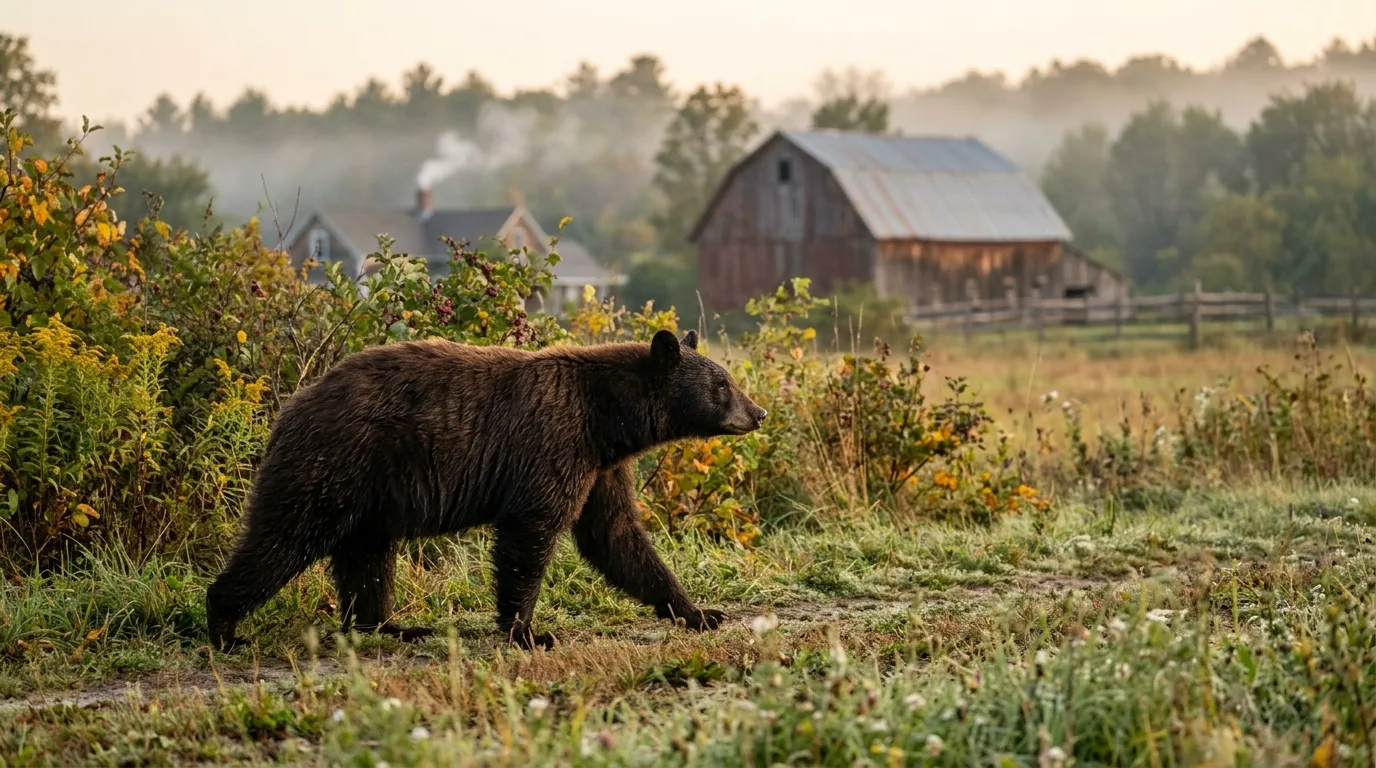
A bear doesn't do cost-benefit analysis the way you'd hope. In the fall, when it's trying to pack on the weight that gets it through winter, one garbage can with leftovers or one bird feeder full of black-oil sunflower seed can hand it a full day's calories for less than an hour's work — and a pound of acorns it has to forage across the forest for carries about 2,100 calories against blueberries' 256. Your beehives, your chicken feed, your boneyard: from a bear's point of view those are concentrated, low-effort, very-high-reward jackpots. Once it cashes one in, it comes back. Often nightly.
So the honest answer to "how to keep bears away" is two-part, and the order matters. First, take away the easy meals — garbage, feed, fallen fruit, pet food, dead stock — because most conflict is a sanitation problem wearing a bear costume. Wildlife agencies that field these calls put the figure starkly: in Washington, irresponsibility on the part of people — access to trash, pet food, and bird feeders — is behind about 95% of the complaints they get. Second, for the attractants you can't remove — live bees, live chickens, the feed they need, the orchard — put a properly built electric fence between the bear and the reward. That's not one tool among many. Across a global meta-analysis of 77 cases, electric fences were the single most effective intervention against bears, cutting damage by a median of about 97% (95% CI 79.2–100%) and beating translocation, deterrents, and shooting handily. For a beehive specifically, a well-installed and maintained fence has been called "almost 100% effective".
This is a guide to doing both, written for someone who keeps bees, runs a coop, or stores feed in real bear country — black bear across most of the continent, and brown/grizzly where the range overlaps, which changes a few of the numbers. Where the grizzly figure is stricter, I'll flag it.
Why bears show up when they do (and why timing is your early-warning system)
Bears aren't out to ruin your season. They're on a calendar, and if you know it you can see the trouble coming.
There are two windows when a bear is most likely to come looking for human-related food. The first is early spring, when it has just left the den, natural foods haven't greened up yet, and it's hungry. The second — the dangerous one for homesteads — is late fall, the run-up to hibernation. A cold, late spring or a drought year makes the spring window worse by knocking out the wild food a bear would otherwise eat. UConn's extension beekeepers put the same rhythm plainly: black bears are "most active in the spring, when they are waking up from hibernation… Fall is another active time… as they bulk up heading into their hibernation".
That fall bulk-up has a name — hyperphagia, literally "extreme appetite" — and the numbers are worth sitting with, because they explain why a bear that ignored you all summer suddenly tests your fence in October. During hyperphagia a bear can eat upward of 20,000 calories a day, roughly ten times its normal intake, and forage for up to 20 hours a day in a race against the clock. North Carolina's wildlife agency reports bears putting on as much as 3 pounds per day and gaining anywhere from 20% to nearly 100% of their summer weight before denning. And here's the part that matters even in the warm South: it's not temperature that flips the switch, it's the coming winter scarcity of natural food — so even bears that den late, briefly, or not at all still go into the fall feeding frenzy. In other words, "it doesn't really get cold here" is not a reason to skip the work.
The behavior you're actually trying to prevent is food-conditioning. A bear that gets a meal from people once tends to associate humans with food and come back for more; over 90% of human–bear conflicts trace back to bears being conditioned this way, and a wild bear can become permanently food-conditioned after a single handout. That's the quiet tragedy under all of this: the conditioned bear usually ends up dead — shot by someone protecting property, or removed by a manager. Keeping your homestead boring to a bear isn't just protecting your hives. It's keeping the bear wild and alive.
Step one: take away the easy meals
Before any fence goes up, go around your place and think like something with a phenomenal nose and no respect for your shed door. The bear-conflict programs and agencies are unanimous on what draws bears to a rural property, and the list is mostly food you control.
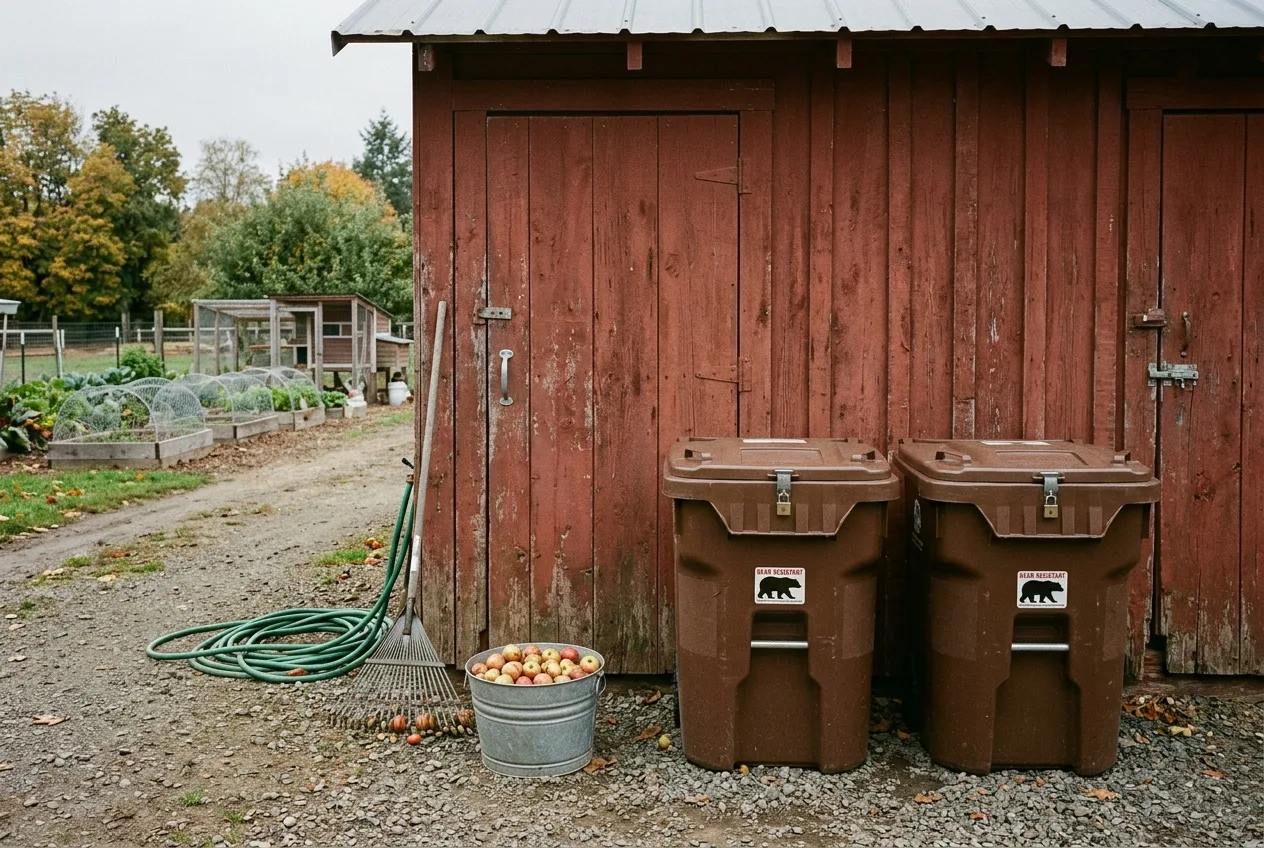
Garbage is the classic. Store it in a certified bear-resistant container or a locked, hard-sided building until the day of pickup — and if you can do both, that's ideal. If you have curbside service, put cans out the morning of collection, not the night before. Empty cans and recycling still smell like food, so they belong inside too. Where bears are established, a bear-resistant can is worth the money; look for products that have passed the testing programs run by the Interagency Grizzly Bear Committee (IGBC) or the Wildlife Management Institute (WMI), which use captive bears to try to defeat them. A regular trash can isn't bear-resistant just because it's sturdy: if a bear can pop it with a crowbar's worth of leverage, so can the bear.
Bird feeders are the trap people most hate to give up. Take them down during bear season; that includes suet and hummingbird feeders. The math is the whole argument — one feeder of sunflower seed can equal a day's calories for an hour's work — so plan to feed birds only in the dead of winter when bears are denned (December through late March in the Northeast; roughly mid-November to mid-March elsewhere — check your local active season) and clean up spilled seed.
Pet and livestock feed comes next. Feed pets indoors and don't store their food outside. Keep livestock feed out of the pens, store it in a hard-sided locked building or a certified bear-resistant container, and clean up grain spills — when you're moving grain, throw a tarp under the machinery to catch what falls. New Jersey's wildlife agency makes the overnight rule explicit: livestock feed shouldn't be left out overnight unless it's in a certified bear-resistant container.
Fruit and compost. Harvest fruit as it ripens — or even a little before, since it'll finish indoors — and pick up windfalls religiously. In the compost pile, skip meat, bones, dairy, fatty scraps, grease, and unrinsed eggshells; mix fresh scraps in rather than leaving them on top; and a sprinkle of lime cuts odor and speeds breakdown. If a compost or garden bed is a chronic draw, fence it electrically like anything else.
Dead stock and the boneyard are the attractant homesteaders forget — and one of the strongest. Carcasses and offal pull in bears, wolves, and coyotes alike. Remove a carcass quickly; if you can't, move it to open, visible ground away from buildings and animals. Don't count on burial — bears are avid diggers and will unearth a buried carcass. The durable fix for a recurring boneyard or carcass-compost site is to put electric fencing around it.
Do this part well and you've solved a large share of the problem for free. Everything below is for the food you can't simply lock away — the living, producing parts of the homestead.
Most conflict is a sanitation problem wearing a bear costume.
Step two: the electric fence (and the few numbers that actually matter)
Here's the thing that surprises people: a bear fence doesn't work by being a wall. It works by being a lesson. When a bear touches a hot wire while standing on the ground, current runs from the wire through the bear, into the soil, to your grounding rod, and back to the energizer — completing the circuit and delivering a sharp, memorable shock that "may hurt, but won't harm". The bear learns the fence is not worth it and leaves. That's why a fairly modest, four-foot fence stops a 400-pound animal that could flatten it: bears don't jump, and a shocked bear doesn't push through to find out what's inside.
Two facts shape every design decision. First, a bear's fur insulates it — its thick coat can keep the shock from reaching skin, which is why you run multiple wires positioned to catch the bear's bare nose and face, not just its flank. Second, grounding is where most fences fail. An inadequately grounded fence delivers a weak shock or none at all, and the bear walks through your "electric" fence like it's string. Get the energizer and the grounding right and the rest is geometry.
Energizer: voltage and joules
This is the spec that legitimately varies by source and by bear, so I'll give it to you as a range rather than a false single number — and tell you which figure to trust as your default.
Voltage. The figure agencies cite as a minimum depends on where they are and which bear they're dealing with. Eastern black-bear guidance runs lower: Vermont Fish & Wildlife's beehive booklet sets a 3,000-volt minimum at the wire, and UConn likewise says "a 3,000-volt charge is enough to deter bears". The most detailed agency guides, and anything written for grizzly country, go higher — BearWise and Rutgers call for at least 6,000+ volts, Montana FWP says bears need a minimum of 5,000–7,000 volts "depending on the species and the bears' level of experience," and the Northern Bear Awareness grizzly-and-black-bear guide specifies 7,000 volts. The unifying logic comes from Vermont: a long-haired animal needs at least 5,000 volts to feel a shock through its coat at all. So treat ≥5,000 volts at the wire as the safe default, push toward 6,000–7,000 in brown/grizzly country, and don't assume the 3,000-volt floor unless your guidance is specifically for eastern black bears in good, moist soil. Verify it with a fence tester, not by faith.
Joules is the spec people skip, and it's the one that determines whether the shock actually hurts. Joules measure the energy the fence delivers; Montana FWP makes the key clarification that it's amperage, not voltage, that controls how powerful a shock feels — a 0.2-joule and a 1.0-joule energizer can both read 7,000 volts, but the 1.0-joule unit lands much harder, and a bear pays attention to a shock that hurts. Note the stored-vs-output trap: an energizer's "stored" joule rating is always higher than what it puts out, so a 1.0-stored-joule unit delivers only about 0.7. The common recommendation across agencies is at least 0.7 output joules (BearWise allows a 0.5 minimum but bumps it for grizzlies); Montana frames the developed-area minimum as 0.7–1.0 stored / 0.5–0.7 output. The grizzly tag here is specific and easy to remember — BearWise's line is literally "Got grizzlies? Use 0.7 joules". Don't over-buy, either: a giant high-joule energizer is overkill and harder on anyone who brushes the wire around a small coop, where a 0.7-output-joule unit is plenty.
For power source, a 110-volt AC plug-in energizer is the most reliable and the cheapest to run, and it's what most guides recommend when you can reach an outlet. Battery (6V/12V deep-cycle or marine) and solar units work for remote or portable setups, but they live or die on maintenance — a low battery means a dead fence, and the night you forget to swap it is the night the bear shows up. If you go solar or battery, a solar panel that keeps the battery topped up is the practical answer, and you check that battery often. Whatever you choose, the energizer needs to pulse at the right rate — 45–60 pulses per minute (about one to one-and-a-half per second) — so make sure a battery unit isn't a slow-pulsing model built to save power.
Wires: how high, how many, how far apart
Designs differ in the details, but they're all solving the same problem: a bear must not be able to go under, through, or over without a wire touching its nose or hide.
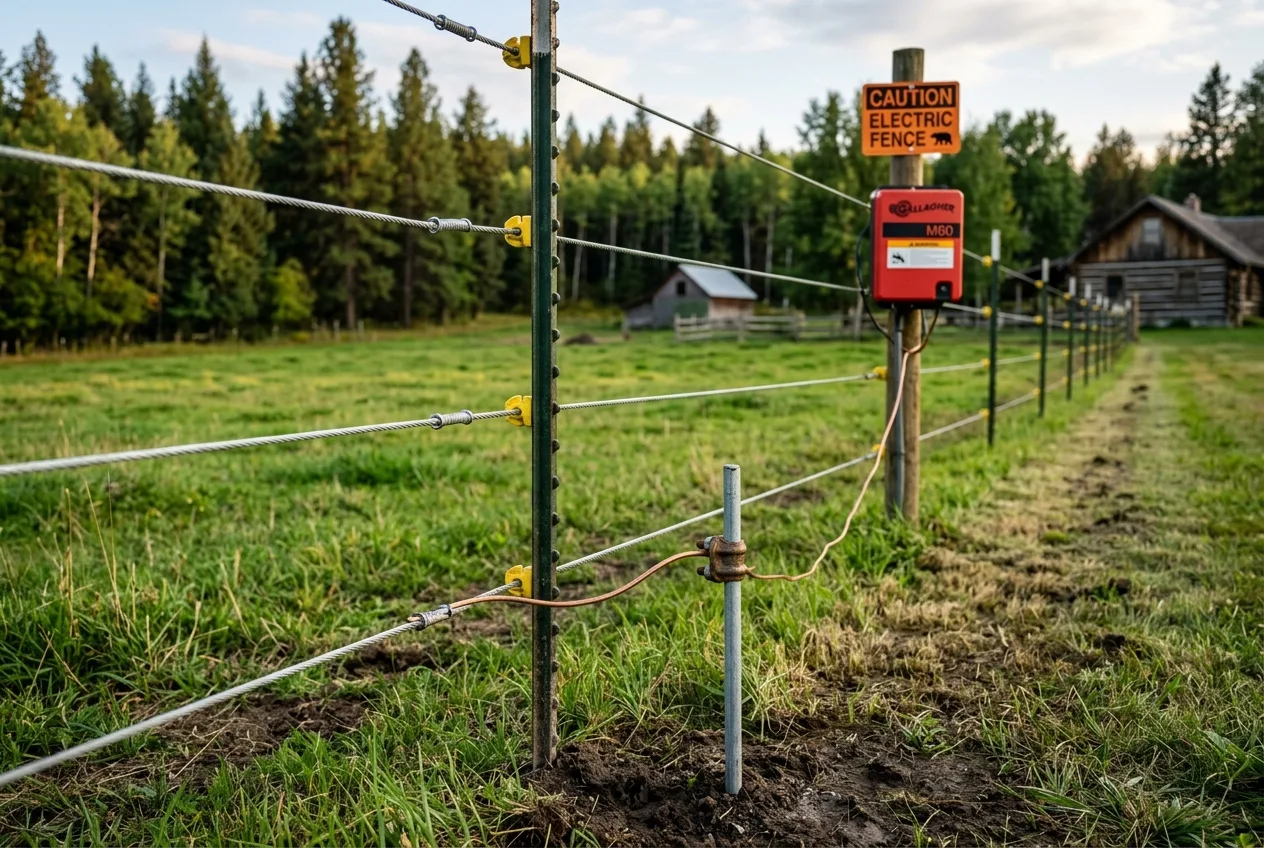
The most widely repeated, explicit layout comes from the New Jersey agency factsheet and Rutgers extension — an all-hot fence of at least 5 strands of high-tensile galvanized wire at 4, 16, 26, 36, and 48 inches above the ground. (S07 and S08, the New Jersey agency pages, were blocked when I tried to open them, so I'm citing the New Jersey specs from the research pack's recorded Key facts rather than the live page — see Editor notes.) Vermont and UConn use the same pattern without the top wire — 4, 16, 26, and 36 inches — which is fine for many black-bear situations. BearWise frames it by function rather than a fixed table: lowest wire 7–9 inches off the ground so a bear can't crawl under, highest wire 36–42 inches (tall enough to stop a bear stepping over, low enough that deer clear it safely), wires 8–10 inches apart, and a minimum of 3 strands but 5 or 6 are better. Get Bear Smart's beehive spec puts the bottom wire no more than 8 inches up and the top at least 48 inches, with at least five wires. The throughline: more wires and narrower spacing are always better, the bottom wire should be hot to defeat digging, and you want a wire right at bear-nose/knee height — because, as UConn nicely points out, a bear on all fours is shorter than you think, and knee height is nose height for most bears.
A practical wrinkle on calculating the energizer you need: size it to the total length of wire, not the perimeter. A 100-foot perimeter strung with 5 wires is 500 feet of wire for the energizer to push current through, plus any electrified gate.
Wire material: permanent fences use 12.5- or 14-gauge galvanized steel or aluminum. For temporary or seasonal fences (a fruit-season fence around the orchard, a movable bee yard), use polywire with at least 9 conductive strands, not polytape — flat polytape can flatten out against a bear's coat and fail to make skin contact. Prefabricated electric netting is the fast temporary option for coops, fruit trees, or a small bee yard, and for bears the ground-return (pos/neg) version is recommended.
Grounding: the part that quietly decides everything
If you take one thing from this section, take this: most "the bear got through my electric fence" stories are grounding failures. The shock only happens if the current can complete its loop back to the energizer through the soil and your ground rod.
Drive a galvanized-steel grounding rod — at least ½ inch in diameter — deep into moist soil near the energizer; six feet is the common figure, and Montana's rule of thumb is 3–6 feet of rod per joule of stored energy (you can't have too much grounding — think of the rod as the antenna that collects the energy to make the shock). In dry, sandy, or rocky soil, one rod won't cut it: use several rods driven as deep as possible, spaced about 10 feet apart and connected in series. Two more dry-soil fixes worth knowing: lay a grounding apron — a flat, 3-foot-wide strip of chicken wire or hog panel on the ground in front of the fence (not attached to it), so a bear standing on it while touching a hot wire is well grounded — and/or build a ground-return (alternating hot/cold) fence, where the bear completes the circuit by touching a hot and a grounded wire at once instead of relying on the soil. Keep the grounding rods well away from any building's electrical ground, and from utility and water lines — Northern Bear Awareness says at least 75 feet — so you don't induce current into your plumbing. And a low-tech trick from the field: site the energizer under a roof's dripline, or run a slow drip near the rod, to keep that patch of soil damp and conductive.
Most "the bear got through my electric fence" stories are grounding failures.
A few build details that save you a season
- Set the fence back from what it's protecting. Place it 3–5 feet away from the coop, hive, or hutch so the bear hits the fence before it reaches the structure — and clear of any tree it could climb to drop in over the top.
- Electrify the gate. A non-electrified gate is the gap a bear will find and exploit; treat the gate as a small section of fence with its own hot wires, kept clear of the handle. For a vehicle or walk-through opening, an electrified drive-over mat or cattle grate saves you opening and closing it.
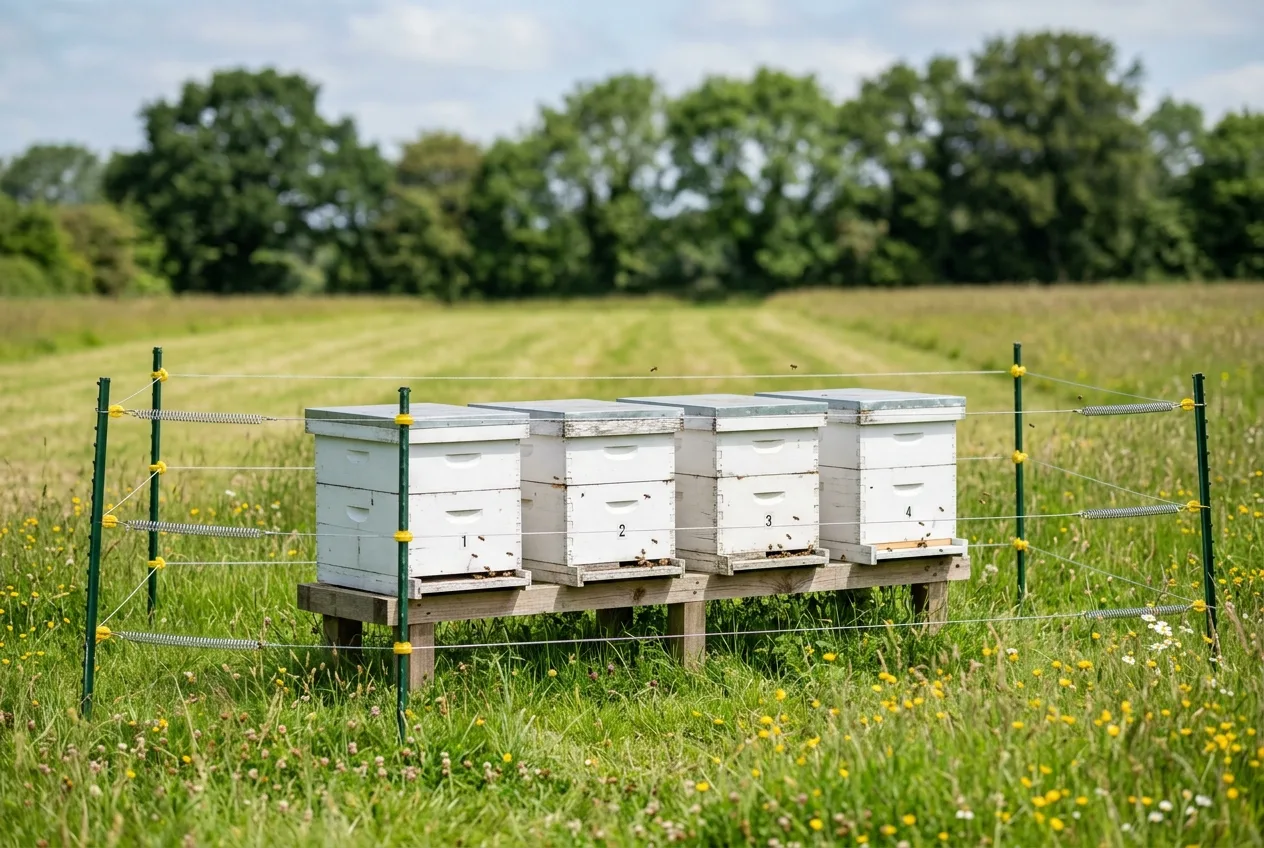
- Keep attractants well inside the wires. Bears have a long reach. BearWise says keep all attractants at least 3 feet inside the fence; Get Bear Smart specifies hives at least 4 feet in, because a bear will reach through to topple a hive it can touch.
- Existing fence? You can add hot wires to the outside of an existing mesh coop or pen — but hold the hot wire 4–6 inches off the metal mesh so it doesn't ground out, and tighten any sagging mesh first. The mesh can even serve as your ground wire if you connect it to the grounding system.
- Build it before you need it. Penn State's beekeeping advice is to put the fence up before you bring bees into bear country, not after the first raid. The same goes for a coop. A fence that teaches a bear the lesson on night one beats a fence that goes up after the bear already got paid.
Beehives: the highest-value target on the place
Bears go out of their way for hives — not just for honey but for the protein-rich larvae and bees — and some will bypass other attractants to make a beeline for the bee boxes. The damage is total when it happens, and two full hives of honey can weigh 800 pounds or more, so this is not something you rescue mid-raid.
Electric fencing is the answer, and the evidence for it is unusually good. In a northern-Michigan field experiment, researchers logged 168 bear–fence interactions across 73 visits by an estimated 15 bears; the one design that was 100% effective at excluding them was just three polytape strands charged to 5,000 volts, spaced 0.58, 0.39, and 0.23 meters off the ground (about 23, 15, and 9 inches) — low-cost and temporary. (That trial used polytape and it held; for a standing fence, though, polywire is the more reliable conductor against a bear's coat — see the wire-material note above.) A Cambridge research synthesis rates electric fencing to protect crops and attractants as "beneficial" (80% effectiveness, 70% certainty, 0% harms) across 11 studies, and in a Japanese apiary-and-cornfield study of Asiatic black bears, "no bears got through any of the electric fences".
Beyond the fence, three beekeeping habits cut your risk: place hives in the open, well back from timber, brush, and creek bottoms that give bears cover and a travel route — keep a buffer (50 yards from tree lines per New Jersey, ~100 meters per Get Bear Smart); don't site hives next to fruit trees or a pumpkin patch, which doubles the draw; and harvest honey promptly after each nectar flow so there's less reward sitting there, and move the apiary if you detect bear activity nearby. If fencing genuinely isn't possible — a constantly-moving commercial yard — the old workarounds are a reinforced garage roof rated for the weight, or hives on a fenced (three-strand electric) flatbed trailer, expensive but mobile. There are also purpose-built bear-resistant hive systems and tie-down rigs; ask your local bear manager what's working in your area.
Bears go out of their way for hives — not just for honey but for the protein-rich larvae and bees — and some will bypass other attractants to make a beeline for the bee boxes.
Coops, small livestock, and feed
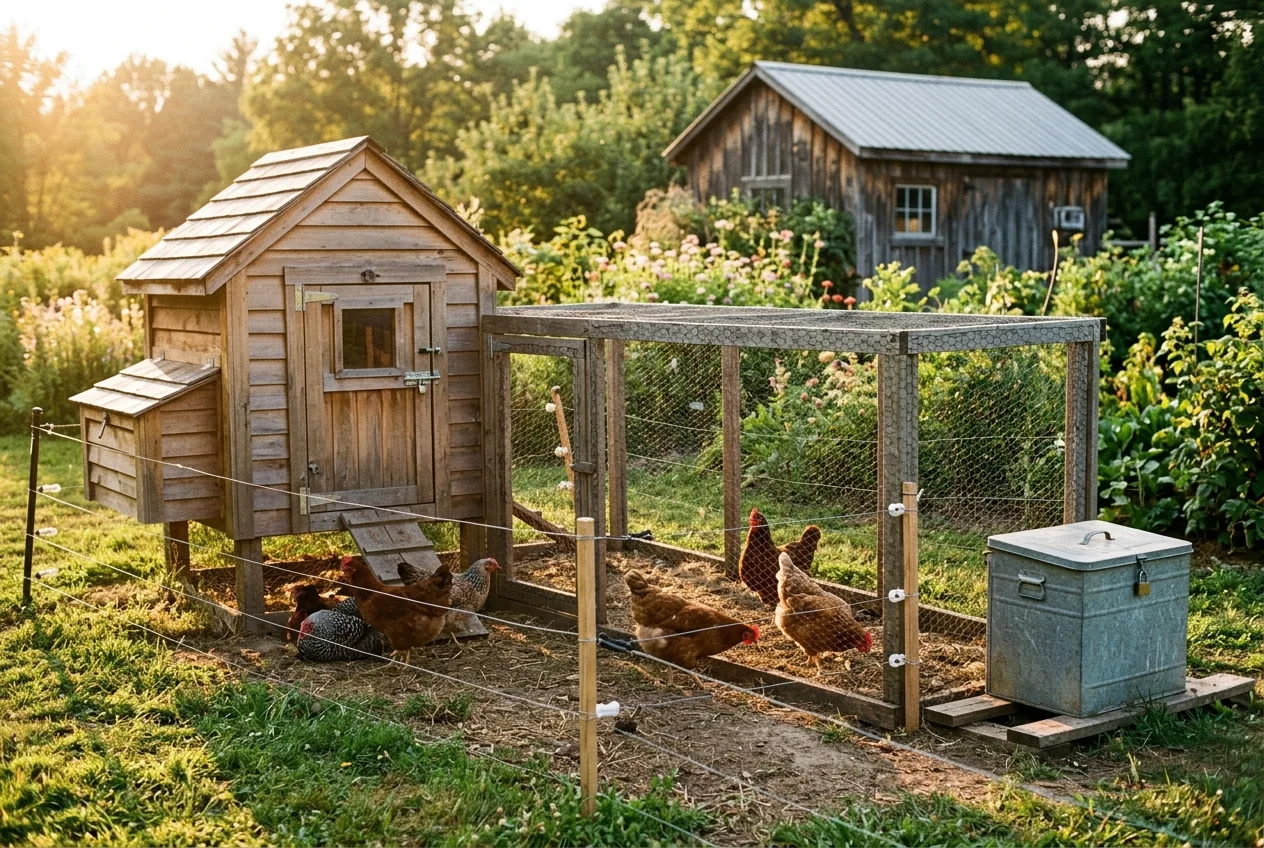
After garbage, backyard chickens are often the next-biggest cause of human–bear conflict — and it's the feed and eggs as much as the birds. The fix is the same recipe: a properly installed, maintained electric fence around the coop and run, with feed stored separately in a hard-sided locked building or bear-resistant container, ideally away from the coop. Rutgers calls electric fencing "the most effective method" for protecting coops, rabbit hutches, beehives, and animal feed alike. The same applies to ducks, geese, quail, goats, and rabbits — secure, electrified enclosure; feed locked away.
Hardening helps the fence do its job. Bring small livestock and fowl in at night into a fully enclosed shelter with a roof, closed and latched, and shut the doors on all outbuildings — inquisitive bears (and other predators) will wander into an open one. Because bears dig, bury chicken wire or hardware cloth 18–24 inches down around the outside of coop or enclosure walls to defeat digging where you're not relying on a hot bottom wire. For bigger livestock, confine animals in buildings and pens — especially during lambing or calving, when newborns and the birthing areas themselves are powerful attractants — and keep pens away from wooded cover, surrounded by electric fence.
A couple of things specific to livestock setups: pigs will short out a bear fence from the inside by rooting soil onto the bottom wire, so either board off the inside or run a separate inner fence on its own energizer for the pigs and the outer bear fence on another. And electric fencing isn't the only layer — guardian animals (a dog, donkey, or llama; at least two dogs for bears) and scare devices can add deterrence, though scare devices need their positions changed often or bears habituate and ignore them, and no single tool, guard dogs included, is 100% on its own. Pair them with the fence; don't substitute them for it.
A bear fence is only as good as its weakest day, and bears will retest a fence periodically to see if it's still hot.
Maintenance: the unglamorous reason fences work or fail
A bear fence is only as good as its weakest day, and bears will retest a fence periodically to see if it's still hot. So this isn't a build-and-forget project.
Walk the fence every few days and after storms. The tells are easy once you know them: a clicking or ticking sound means energy is arcing out somewhere — usually a broken or frayed wire, or a wire touching vegetation or a post. Keep vegetation down under and along the wires; wet grass touching a hot wire grounds it out and drains solar batteries faster — mow or clear a strip, but keep it to about 18 inches, because a wider bare strip means a bear standing on dirt instead of grass is less well grounded, weakening the shock. Test voltage with a fence tester regularly — not just whether current is flowing but how much — and check it at the far corner from the energizer, not only next to it, where a long run or a short can leave you well under your target. Fill in any digging along the fence line promptly and splice in a lower wire across the gap, or a determined bear will use that dig as the entrance next time. Tighten loose wires, replace cracked insulators, and on battery/solar units check the charge and terminals for corrosion.
One field-tested trick for a bear that's already getting determined: bait the wire to guarantee a nose-first shock — a strip of bacon wrapped around the wire at about 3 feet (nose height), or peanut butter on a square of foil. Use this deliberately, though, not as routine: it's a tool for changing the behavior of a bear that has already been rewarded at the site, it can attract other animals or a bear that wasn't in conflict, and you're fully responsible for the consequences — a well-built fence shouldn't need it.
A last word on standing behind these specs: in New Jersey, the agriculture department's cost-share program treats the wildlife agency's fence factsheet specs as enforceable requirements, mandates permanent fencing with at least a 10-year lifespan, and requires written approval to deviate. That's a useful frame for thinking about your own build — these aren't loose suggestions, they're the standard that's been shown to keep bears out. Build to it.
Frequently asked questions
How do you bear-proof a beehive?
Surround the apiary with a properly grounded electric fence — the single most effective method, shown to be nearly 100% effective when built and maintained right. Use at least 5 wires (a common layout is 4/16/26/36/48 inches, with a hot wire at bear-nose height and the bottom wire low enough to stop digging), an energizer delivering ≥5,000 volts and about 0.7 output joules, and keep the hives at least 4 feet inside the wire so a bear can't reach through. Site hives in the open away from cover and harvest honey promptly.
What voltage does a bear fence need?
Aim for at least 5,000 volts at the wire as a safe default, and 6,000–7,000 in brown/grizzly country. Some eastern black-bear guidance accepts a 3,000-volt minimum in good moist soil, but a bear's thick coat needs at least 5,000 volts to feel the shock reliably, so don't count on the lower figure unless your local guidance specifically allows it — and verify with a fence tester either way. Joules matter too: about 0.7 output joules is the common recommendation.
Is bear-proofing different for grizzlies than black bears?
The method is the same, the settings are stricter. For brown/grizzly bears, agencies push voltage toward 6,000–7,000 and specify 0.7 joules ("Got grizzlies? Use 0.7 joules"), and the most detailed grizzly-country guides call for a 1-joule, 7,000-volt energizer with multiple nose-height wires. The fence designs in this guide were developed in mixed grizzly-and-black-bear habitat and work for both.
Will an electric fence actually stop a determined bear?
A properly built and maintained one, yes — electric fences cut bear damage by a median of about 97%, and the best apiary designs have excluded 100% of black bears. The failures are almost always poor grounding, a dead battery, or vegetation shorting the wire — which is why maintenance and a fence tester aren't optional.
Do I really have to take down my bird feeders?
In bear country during the active season, yes. One feeder of sunflower seed can give a bear a full day's calories for under an hour's work, which is exactly the kind of easy reward that turns a passing bear into a returning, food-conditioned one. Feed birds only in the depth of winter when bears are denned, clean up spilled seed, and the rest of the year offer water and native plantings instead.
What's the most common mistake homesteaders make?
Leaving attractants out and treating the fence as the whole answer. Most conflict is a sanitation failure — trash, feed, pet food, fallen fruit, and uncollected carcasses — and agencies attribute the large majority of bear calls to exactly that. Secure the easy meals first, fence the living attractants you can't remove, and don't bury carcasses expecting them to stay buried — bears dig them up.