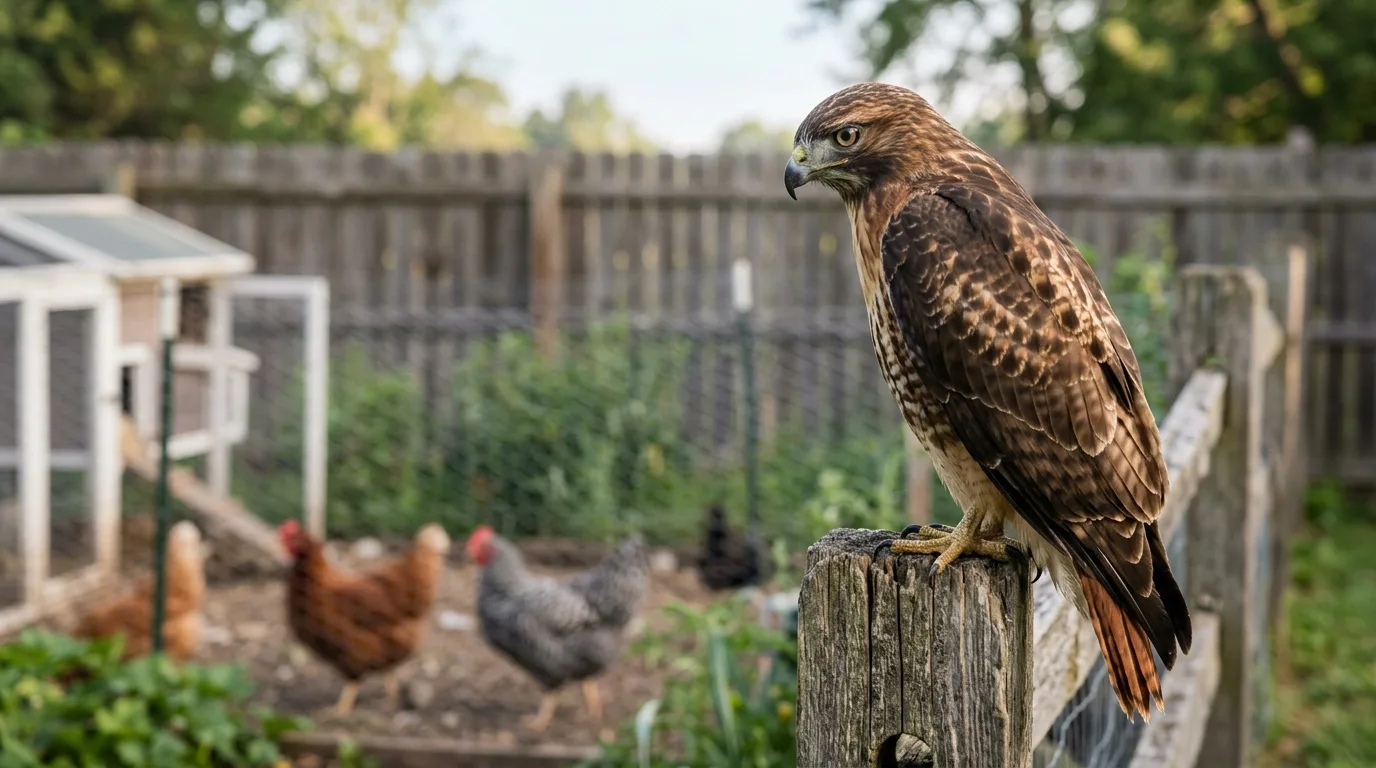
A fox leaves a mess. Feathers everywhere, a dug-out corner of the run, maybe several birds dead and one dragged off. You wake up, you swear, and you know exactly what happened. Aerial predators are quieter than that, and in a way that's the worst part. A hawk drops in while you're at work, takes a pullet off the grass near the feeder, and carries her up into a tree to eat. By evening, you're just one bird short with no story to explain it. You count heads twice, assume she wandered off, and lose another the same way next week.
That gap — birds vanishing with no clue left behind — is the signature of the predators that come from above. And they take more than most keepers think. A Dutch field study that actually sat and watched 11 free-range egg farms recorded 141 sightings of birds of prey and 16 attacks by common buzzards and northern goshawks; across the farms surveyed, predators killed an average of 3.7% of the hens, with total flock mortality running at 12.2%. In money, that worked out to a rough EUR 5,700–6,700 in lost yield per flock. This is not a freak event you can ignore. It's a structural risk of giving birds an open sky.
Here's the good news, and the whole point of this piece: you don't get to solve it the way you'd solve a fox. Hawks, owls, and eagles are protected almost everywhere, so shooting your way out isn't an option — legally or practically. But you don't need to. The defenses that actually work are physical and cheap, and once they're in place they work every single day without you lifting a finger. Let's get into which birds you're dealing with, how to tell an aerial kill from a ground kill, and exactly what to build.
Which birds are actually taking your chickens
"Raptor" covers a lot of ground — the term takes in falcons, eagles, vultures, kites, ospreys, harriers and caracaras, but the ones that bother poultry sort into three working groups: hawks by day, owls by night, and, in some regions, eagles. Knowing which you've got changes what you build.
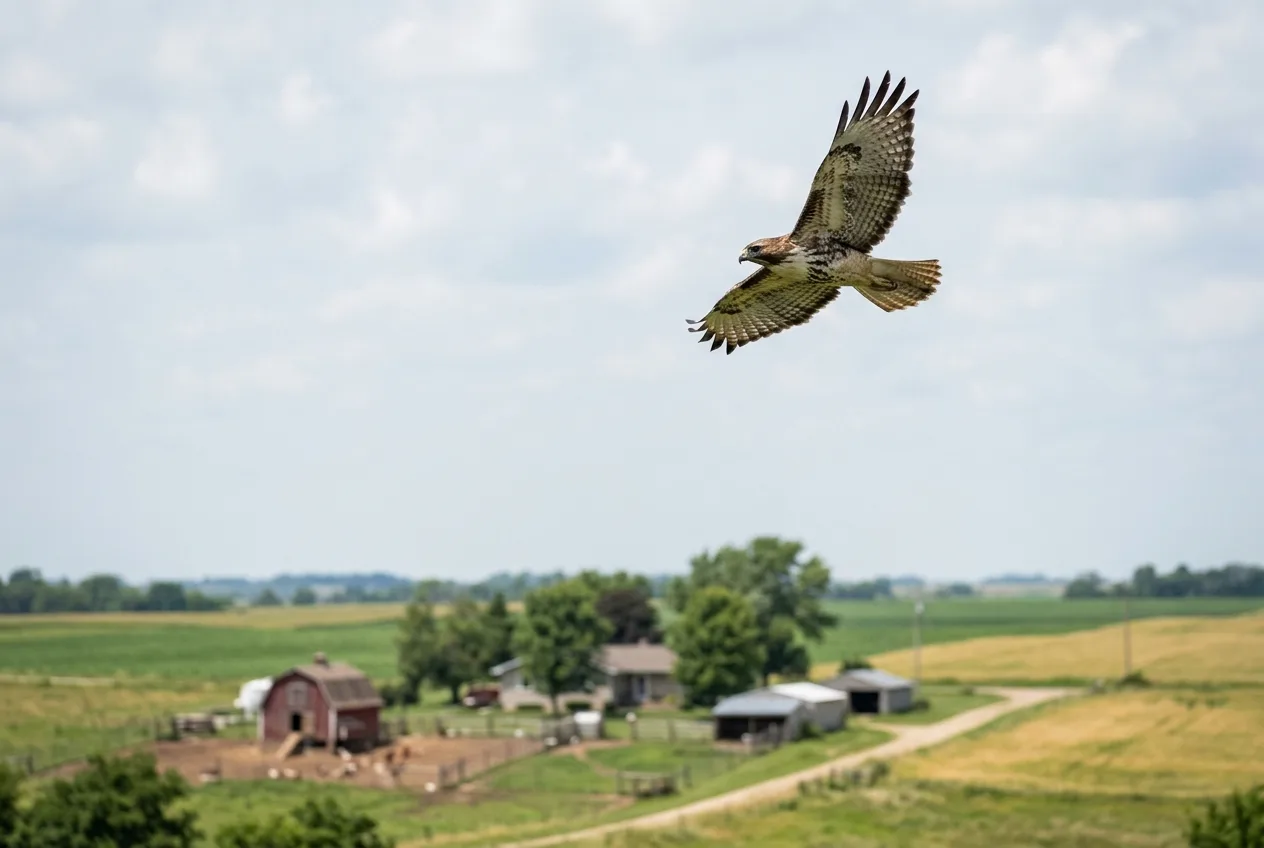
Hawks are the daytime problem on most properties. In North America the usual suspects are the red-tailed, red-shouldered, and Cooper's hawks; a hawk hunts with extraordinary eyesight, scanning from an elevated perch, then swoops and lands on the bird with its talons. There are two broad families worth knowing apart: the accipiters — forest hawks like Cooper's and the goshawk that thread through trees — and the buteos, the broad-winged soaring hawks like the red-tailed that you see riding thermals over open fields. In the UK the dominant threat is the common buzzard, itself a buteo, and it's more of a problem than it used to be: buzzard numbers have climbed about 78% since 1995, making it the country's most common bird of prey. A buzzard will take a chicken, "especially small bantams and young pullets," and tends to be boldest in spring when it's feeding its own young.
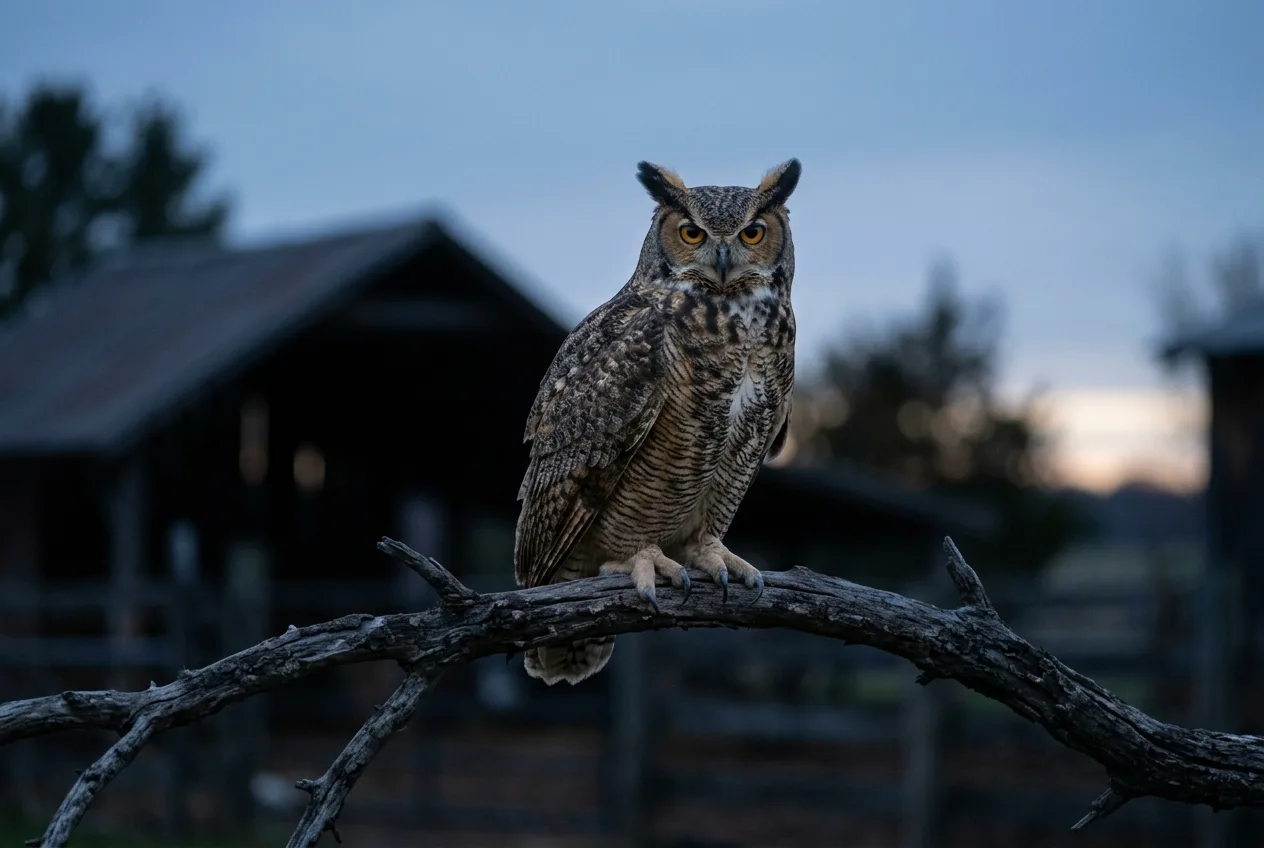
Owls are the night shift, and on most farms that means one bird: the great horned owl, the most widely distributed owl in the Americas and a generalist with one of the most varied diets of any North American raptor. It hunts by "perch-and-pounce" after dark and is a documented predator of backyard poultry. Owls take birds at night and in the dim edges of the day, and they've been known to walk right into an open coop to do it.
Eagles are regional, but where they overlap with smallholdings the conflict is real. South Africa's crowned eagle is documented taking "chickens, dogs and domestic cats" and even piglets, which drags it into conflict with farmers. The African hawk-eagle "will sometimes feed on domestic chickens and other fowl," and the result is depressingly predictable: farmers shoot them. In New Zealand the relevant bird isn't an eagle at all but the swamp harrier (kāhu), an opportunistic, day-hunting raptor that "can take poultry and game birds where unprotected".
The bird vanishing from your run with no fox-sign to explain it is doing exactly what a hawk is built to do — and it will keep doing it until the sky over your flock is closed.
The detail that should reframe how you think about all of this: these birds are not just mopping up your weakest hens. When the Dutch researchers checked the condition of birds before each observed attack, "there were no reasons to assume the attacked hens were in a poor condition prior to the attack". A hawk isn't doing you a favor by culling the sick ones. It's taking healthy, productive birds — which is exactly why prevention is worth real effort.
Was it really an aerial kill? How to read the scene
Before you spend a weekend roofing the run, make sure you're solving the right problem. The single most useful question is the one a hawk and an owl answer the same way: what's actually gone, and what got left behind?
Aerial predators tend to eat the head and neck. Hawks and owls "kill in similar ways, often eating the head and neck and perhaps leaving deep cuts in other portions of the bird from their sharp talons and beaks". From there the sign splits by bird size. A hawk or eagle will eat a larger bird where it killed it — leaving a body and a lot of cleanly plucked feathers on the ground — but it'll carry a small bird up into a nearby tree to eat, so the giveaway is feathers under the tree and an otherwise empty run. A hawk eating in place "typically eats the breast, cleanly plucking the feathers". Feathers with flesh still clinging to the ends are a hint the bird died of something else and the hawk only scavenged it.
Timing is the other axis, and it's nearly diagnostic. Hawks take chickens during the day; owls take them at night. So a bird lost in broad daylight points to a hawk; a bird lost overnight — talon marks on the head, the head and neck eaten, sometimes a whole bird simply gone — points to an owl.
Where it gets tricky is telling an aerial kill from a fox or coyote, because all three can leave you simply short a bird with feathers around. A useful rule of thumb from the field research: a kill was attributed to a fox when the hen had been decapitated and feathers were gnawed, and to a bird of prey when "parts of the hen had been eaten and feathers were pulled out". Pulled feathers and an eaten carcass lean raptor; a gnawed, dragged-off, decapitated bird leans fox. Here's a quick reference:
| Sign at the scene | Likely culprit |
|---|---|
| Bird missing, no other sign, gone in daylight | Hawk (small bird carried off — check under nearby trees) |
| Bird dead on site, head and neck eaten, lots of cleanly plucked feathers | Hawk or owl |
| Head/neck eaten, talon punctures to the head, happened overnight | Owl (great horned) |
| Multiple birds dead/mauled, feathers gnawed, body dragged off or buried | Fox or coyote |
| Feathers with flesh still attached to the ends | Likely scavenged after dying of another cause |
If you genuinely can't tell, don't guess and don't escalate. A trail camera left on the run will settle it — it's the honest way to learn what's actually visiting, day or night, before you spend money on the wrong fix. As one extension guide puts it, game cameras "can be used to help determine which predators are active in your area… While they do not deter predation, the information they can provide is beneficial in preventing loss of birds".
The defenses that actually work
Everything that follows is non-lethal, because that's both the law (more on that below) and the practical reality. Rank them roughly in this order: a real roof is the only thing close to a guarantee; cover and a rooster sharply cut your losses; habitat changes shrink the odds. Stack them.
Cover the run — the one near-total fix
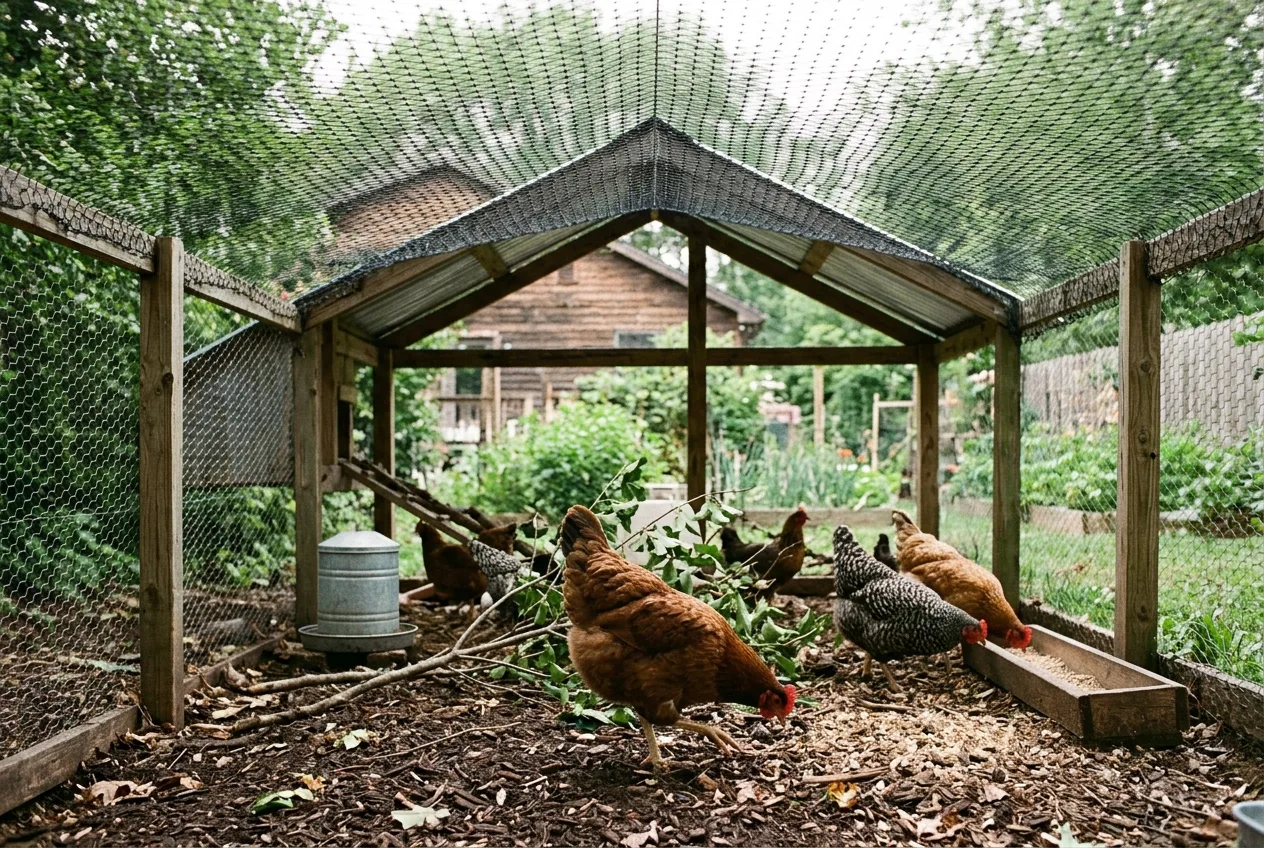
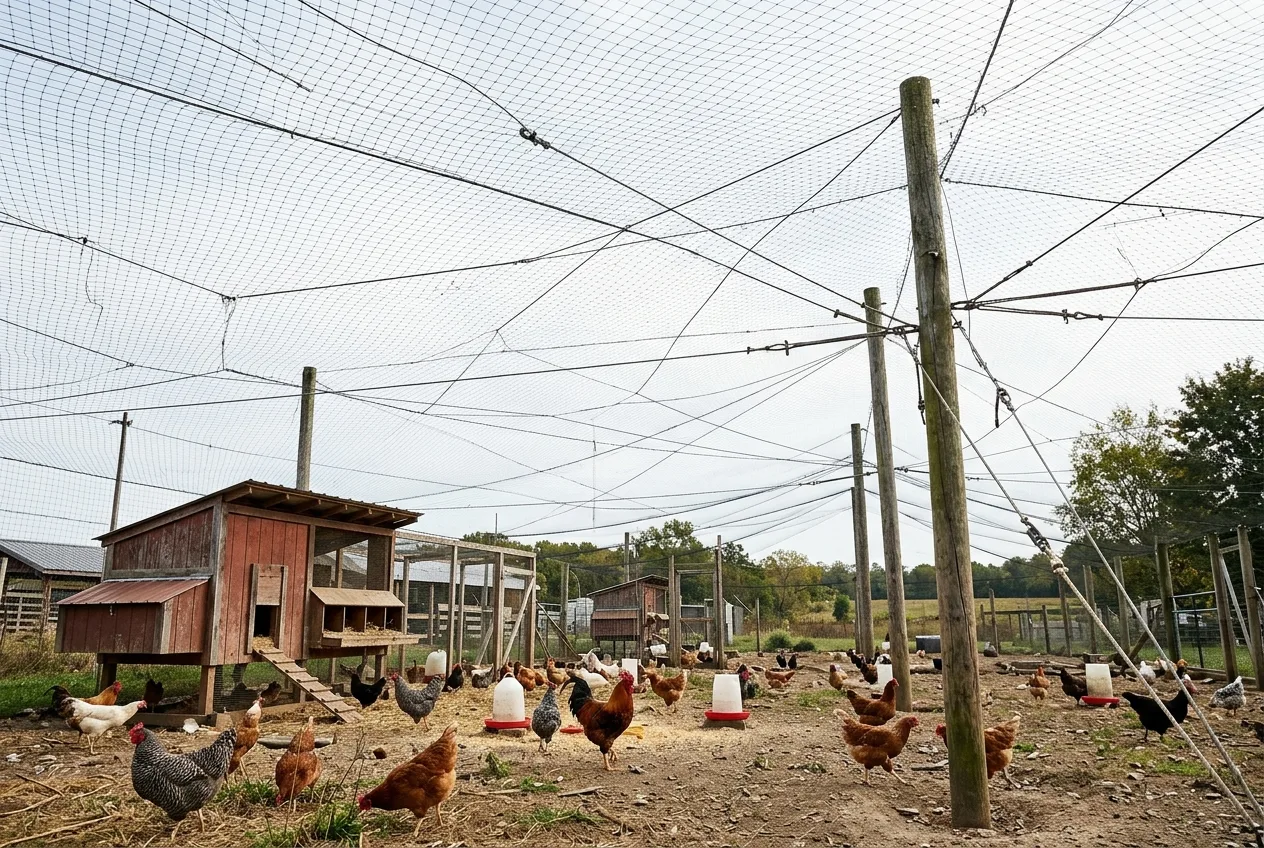
If a hawk or owl can't physically reach your birds, it can't take them. That's why a covered run is the gold standard. Extension guidance is blunt about it: "To prevent problems with hawks and owls, cover your outside runs with mesh wire or netting". Your options run from cheapest to sturdiest — plastic netting, game-bird netting, chicken wire, or well-supported welded-wire fencing — and the heavier the better if you also have raccoons or climbing predators, since "covering poultry runs with plastic netting or well-supported welded-wire fencing will ultimately take care of attacks from above".
You don't always need a solid roof. A clever, low-cost middle ground is an overhead grid: "weaving a 3–4 ft grid over the pen constructed of wire or twine will give excellent protection from flying predators" — that's roughly a 1-metre spacing — and a "random array of crisscrossing wires overhead" does the same job of denying a raptor the clean flight path it needs to drop in. The wires disrupt the approach — a hawk won't commit to a dive into a space it can't cleanly exit.
One material note worth heeding: when keepers do roof their runs, orange netting is a smart pick because "hawks and owls see orange well," so they register the barrier and look elsewhere. Whatever you use, secure it tight — "hawks can get through any loose or weak spots in the covering". A sagging corner or a gap at the wall is an invitation.
What about full free-range birds on acreage you can't possibly roof? You're honest about the trade-off. The Dutch farmers found netting a 5- or 10-hectare range "impractical… and too expensive," which is exactly why the rest of this list matters. You can't roof a paddock, but you can do everything else.
Give them somewhere to hide
A chicken in the open is a target; a chicken three steps from a bush is a much harder one. Cover is the cheapest defense there is, and it works because a raptor can't easily follow a bird into branches. "Bushes, branches, a discarded Christmas tree, and boxes can all provide cover" from hawks and owls. A keeper with nine years on a UK flock makes the same point from the other side: "birds of prey are not able to negotiate through branches, so providing some trees in your run" — even a row of bushes to dart under — gives the flock a reliable bolt-hole.
There's a subtlety to where you put it. Inside the run, cover is good — plant bushes the birds can shelter and forage under. But around the perimeter, keep it clear: an open band with no cover makes ground predators uncomfortable about crossing and removes the launch perches a hawk wants. Good ground cover inside the range — "millet, broomcorn, sorghum or other tall leafy vegetation" — doubles as both food and hiding.
Cover is the cheapest insurance you can buy: a few bushes and a brush pile turn an open killing field into a place your birds can disappear in a second.
And watch the feeder. Chickens are most exposed when they're eating — "heads lowered, guard down, often bunched together" — and hawks are smart enough to learn the routine: "Hawks in particular… will learn where feeders are, and lie in wait". Move feeders under the coop roof, under a shelter, or hard against a wall, since a raptor can't easily swoop close to a solid object.
Take away their perch and their pantry
Hawks hunt from a high seat. Take it away and you make your run a worse place to hunt. The standard advice is to "eliminate any perch sites within 9 meters (100 yards) of the flock by removing isolated trees and other perching surfaces". You're not clear-cutting your property — you're denying the bird the specific overlook it uses to watch your birds, so "remove trees that would allow perching raptors from overlooking the pen".
While you're at it, keep the place tidy. Spilled feed and carcasses draw the prey and scavengers that draw predators; remove sick, dying, and dead birds promptly and don't leave food out in the run. It's basic husbandry, and it lowers the overall pressure on your flock.
A rooster, and maybe a dog
This is where keepers' favorite folk remedies meet the evidence — and mostly hold up.
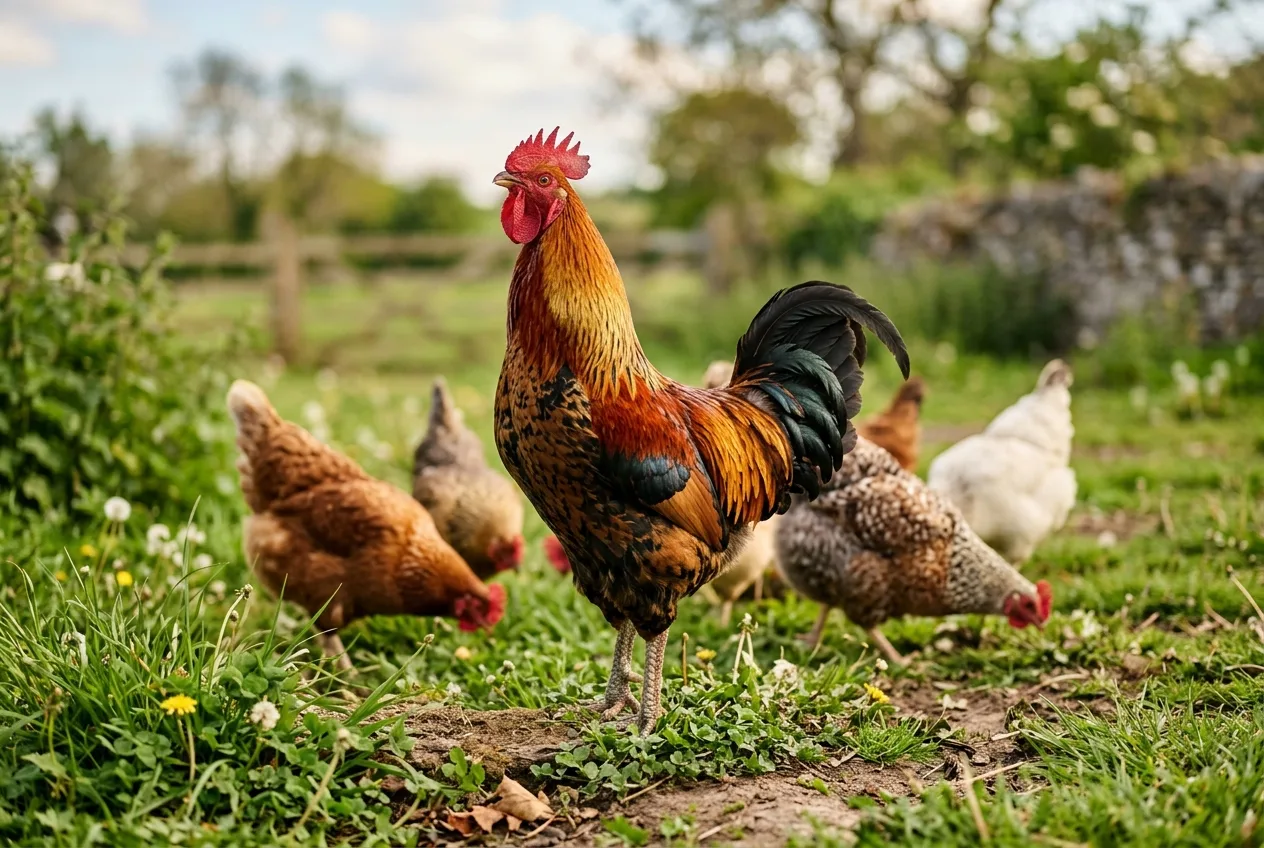
A rooster earns his keep here. His job is to watch the sky and sound the alarm, calling the hens to cover at the first sign of a threat, and if it comes to it he'll throw himself at even a large bird of prey. That's not just lore. In the Dutch field observations, when buzzards attacked, "roosters ran to [the bird of prey] and chased it away" and the hens survived — twice. Do check your local rules first: many residential ordinances prohibit roosters, so it isn't an option everywhere.
A livestock guardian dog (LGD) is the heavier-duty version, and it can be transformative — one keeper who'd lost two entire flocks to ground predators reported not losing "a single chicken" after getting a Maremma, precisely because a true LGD "has no prey instinct". But temper expectations with the research, because the popular "just get an LGD" advice oversells it. A study tracking Maremmas with pastured hens found the dogs were "more strongly bonded to people than the chickens," spending 96.1% of their nighttime near the farmhouse and only 0.09% near the chicken paddock; even so, fox activity dropped on nights the dogs roamed. And among 59 producers surveyed, fully 52% still had predation problems despite owning LGDs, with bigger flocks (100+ birds) more likely to report trouble. A guardian dog is a strong tool, not a force field — and the dog has to actually be with the birds to protect them.
A genuine warning on guard animals generally: choose a real guardian breed (Great Pyrenees, Anatolian Shepherd, Maremma) raised with poultry, because an untrained dog can become the predator — "if not trained properly, guardian dogs can become predators for your flock," and once a dog kills a chicken it tends to keep doing it. Well-chosen, though, guardian dogs "work well at deterring and controlling various predators, including raptors".
Beat owls with the clock
Owls hand you the easiest win of all, because they're on a schedule. Shut your birds in the coop at night and "owl attacks will not be an issue" — but the catch is timing: "hungry owls may grab their meal right at dusk, or slightly beforehand, so… don't wait until after dark to close up the coop". Lock up before last light, not after, and you've closed the owl's entire window. Most birds will train to it readily if you feed or water them indoors at dusk. If your run isn't predator-proof, locking up before dark is non-negotiable anyway.
One thing that doesn't work as well as people hope: noise and lights. Bird bombs and noise devices "have not been shown to be overly effective," and predators habituate to repeated sounds; lighting an area is also a poor idea for laying flocks because it disrupts egg production.
Why you can't just shoot the hawk — and why you wouldn't want to
It's worth being direct about this, because frustrated keepers ask it constantly: no, you generally can't legally kill the hawk, owl, or eagle taking your birds. This isn't one country's quirk — it's a broad principle across jurisdictions, which is the strongest argument that the law here reflects something real about these species rather than local politics.
In the United States, the United Kingdom, New Zealand, and many other countries, hawks, owls, and eagles are protected by national wildlife law. It is typically unlawful to pursue, capture, kill, or harm a bird of prey without a permit, and the protection usually covers most or all native raptors — so killing one can carry heavy fines and worse. The details vary: some places protect every bird of prey outright, while others allow tightly controlled removal only of a bird genuinely causing damage, and only after non-lethal measures have failed. But across these systems the logic is the same — the bird is protected, and lethal control is a tightly limited last resort, not a homeowner's prerogative.
And where lethal control is permitted, the law almost universally puts non-lethal measures first. Permit and licence systems typically require documentation that you tried non-lethal measures — scare devices, habitat changes — before any lethal action is approved, and expect you to keep using them even after a permit is granted. One national licensing regime puts it plainly: a licence is granted only once "all other avenues have been explored," and the applicant must show that "other reasonable and practical non-lethal alternatives have been considered and tried" and that the action is proportionate. The good news for a homeowner: simply scaring or harassing most birds of prey (the largest eagles are often a stricter exception) generally needs no permit at all — so the deterrents in this article are squarely within what you're typically already allowed to do.
Across the US, the UK, New Zealand and South Africa the rule is the same: deter the bird, don't destroy it — and where the law does allow lethal control, it demands you try non-lethal measures first.
Beyond the law, killing raptors tends to be self-defeating. Remove a territorial bird and you usually just free up the territory for the next one — New Zealand's experience with harriers is instructive: "as soon as one individual is killed another will replace it immediately," and "the evidence indicating that harriers have a negative impact on livestock is scarce" in the first place. The economics can be upside-down too. A pair of Verreaux's eagles controlling rock hyrax on a farm delivers a benefit that "outweighs the cost of occasional lamb predation by a factor of 155 times" — so the farmer who shoots the eagle is the one who loses. The persecution is real and ongoing — crowned eagles are trapped, shot, and have their nests destroyed over exactly these conflicts — and it pushes already-declining raptors toward the edge for very little gain. Sealing your run protects your birds and keeps you out of a fight you can't win and shouldn't pick.
Putting it together
If you take one thing from all this, make it the roof. A securely covered run is the only measure that comes close to ending aerial losses outright, and for a small backyard flock it's entirely achievable in a weekend. If you can't roof everything — a real free-range operation, a big paddock — then you layer: cover for the birds to bolt into, a clear perimeter and no nearby perches, feeders tucked against a wall, a rooster on watch, a guardian dog if your setup supports one, and the birds locked up before dusk to shut out owls. None of it requires harming a single bird of prey, which is good, because that road is closed — legally and practically — almost everywhere you might keep chickens.
The hawk circling overhead isn't really your enemy; it's just doing what it's built to do. The fix isn't to fight the bird — it's to change the architecture of your run so there's nothing for it to take.
The hawk over your run isn't your enemy so much as a problem of architecture — change the architecture, and the problem goes away.
Frequently asked questions
How do I know if a hawk or an owl killed my chicken?
Time of day is the fastest tell: hawks hunt by day, owls by night. Both tend to eat the head and neck and leave cleanly plucked feathers; a small bird may be carried off entirely, so check for feathers under nearby trees. A bird gnawed, decapitated, and dragged off points to a fox or coyote instead.
What's the best way to stop hawks from killing my chickens?
A covered run is the only near-total fix — cover the top with mesh, netting, or a 3–4 ft grid of wire or twine so the hawk can't drop in. If you can't roof the whole run, roof part of it and add bushes or a brush pile the birds can dive under, and keep feeders under cover where hawks like to ambush.
Is it illegal to shoot a hawk or owl that's attacking my chickens?
In most places, yes. Hawks, owls, and eagles are protected by national wildlife law in the US, the UK, New Zealand, and many other countries, and killing one without a permit can mean heavy fines. Where lethal control is allowed at all, you generally must document that you tried non-lethal deterrents first.
Will a rooster actually protect my hens from a hawk?
A good rooster genuinely helps: he watches the sky, calls the hens to cover, and will confront even a large raptor. In one field study, roosters chased attacking buzzards away and the hens survived. It's not a guarantee, and many areas ban roosters, but it's a real layer of defense.
Do hawks only take sick or weak birds?
No — that's a myth. When researchers checked hens before observed attacks, the birds showed no signs of being in poor condition beforehand. Hawks take healthy, productive birds, which is exactly why prevention is worth the effort.
Does covering the run with owl decoys, shiny tape, or noisemakers work?
Not reliably. Noise devices "have not been shown to be overly effective" and predators habituate to them; lighting can even hurt egg production. Physical exclusion — a covered run — and real cover are what hold up over time.