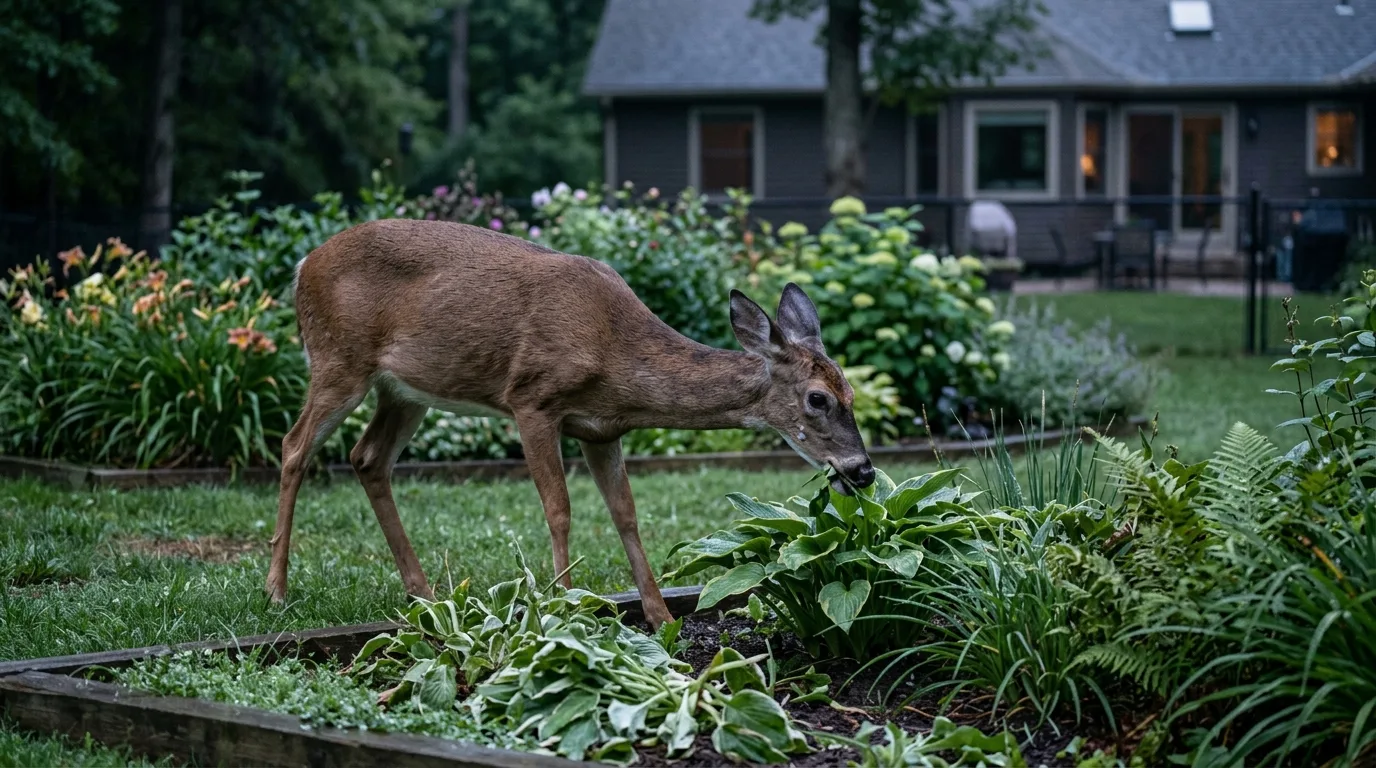
A deer can undo a whole spring in one night. You plant the hostas, the tulips come up, the yew by the porch fills back in — and one frosty morning it's all bitten to the nub, the stems left with that ragged, torn-off look that tells you exactly who did it. Not the clean snip of a rabbit, but the jagged tear of an animal with no top front teeth, yanking the growing tips off your plants.
So let's be honest with each other up front, because most of the advice out there isn't. If you want a guarantee, there's really only one: a tall, well-built fence. Every extension office and wildlife agency that has studied this lands in the same place — a properly built and maintained fence 7 to 8 feet high is the most effective control method there is, and an 8-foot woven-wire fence is "the conventional deer-proof fence". Everything else on the menu — repellents, scare devices, clever low-cost fences, resistant plants — works by persuasion, not by force. It raises the cost of feeding in your yard and hopes the deer decides the salad bar next door is easier. That works often enough to be worth doing. But it's negotiation, and a hungry deer in February is a hard negotiator.
Once you accept that, the whole problem gets clearer, and you can pick the tool that actually fits your yard, your budget, and how much you're willing to fuss with it.
Why a deer is so hard to keep out
The number everyone quotes is 8 feet, and it's worth understanding where it comes from. A deer normally won't bother jumping a 6-foot fence — but if it's chased or threatened, it can clear 8 feet on level ground. So the recommendation isn't really "deer can't jump 8 feet." It's "deer can jump 8 feet, but they'd rather not, so a fence at that height usually isn't worth the effort to them". On a slope, where the deer can launch from the high side, you may need 10 or 11 feet to keep one from sailing down into the garden.
Here's the part most people miss: deer don't mainly try to go over. Left to their own devices, they look for a way to go under or through first, and treat jumping as a last resort. You can see why in how they actually clear a fence — whitetails and mule deer "draw their legs under their bodies as they leap a fence," and if a hind leg catches between the top two wires, the wires twist and entangle it, which can seriously injure or kill the animal. They know jumping is risky. So a fence that stops deer has to do two jobs at once: be tall enough that going over isn't appealing, and tight enough to the ground that going under isn't an option either. A gorgeous 8-foot fence with a 10-inch gap at the bottom is just a very tall door.
This is also why deer are creatures of habit, and why timing matters more than people expect. Where a deer feeds is a habit, learned over time and reinforced every night it eats there safely. The single most important window is the first day, week, and month after you deny them — break the feeding habit then, and it's far easier to keep it broken. Which means the worst possible plan is to wait until the damage is bad and then react. Detect it early and act immediately; it's much easier to stop deer from forming the habit than to break it once it's set.
A gorgeous 8-foot fence with a 10-inch gap at the bottom is just a very tall door.
Fences: the only sure thing, and how to build one that works
If deer pressure is high or the plants are valuable, fencing may be the only thing that reliably works. The trade-off is always the same — effectiveness costs money and labor — so the real question is which fence buys you enough protection for what you're willing to spend.

The gold standard: 8-foot woven wire
For a serious, permanent barrier, 8-foot high-tensile woven wire is what the people who do this for a living call "the gold standard," and it earns the name: properly installed, it gives more than twenty years of highly effective deer-damage prevention. University of Maryland's recent guide puts a number on it — 8-foot fences "will effectively exclude deer from an area," with researchers reporting essentially complete deterrence and deer only rarely managing to leap that height.
The build is straightforward but not trivial. Set 16-foot posts about 40 feet apart, anchored 4 to 6 feet into the ground, and string the woven wire tight to the soil so nothing can duck under. A common trick to reach full height affordably: run an 8-foot roll of woven wire, then add two strands of smooth high-tensile wire along the top to bring the whole fence up to 9 or 10 feet. For a backyard rather than a farm, a quarter-acre garden does well with 4-inch woven-wire mesh; if rabbits are also a problem, use a smaller or graduated mesh that's tighter toward the bottom.
The honest catch is cost. That kind of fence runs in the neighborhood of $10 per linear foot installed — though if you put it up yourself, you can cut the out-of-pocket cost by roughly 35%. And you don't always need to fence the whole yard. If only a few specimens matter, the surest move is to give up on the perimeter and fence the plants: woven-wire or plastic cylinders around individual trees and shrubs are a cost-effective, widely used approach that also keeps rabbits off.
Electric fences: training, not walls
An electric fence is a completely different animal — and the mental model matters, because people install them expecting a wall and get disappointed. An energized fence is not a physical barrier. It's a psychological one: it delivers a memorable shock to a deer that's investigating it, and trains the animal to avoid the area, which means deer will keep testing it for a way in and the whole thing depends on relentless maintenance. It has to be on 24 hours a day, all year, to work.
The clever part is that good electric designs use the deer's own curiosity against it. Deer investigate with their noses, so you bait the wire — wrap peanut butter in tin foil and hang it at intervals, or smear a peanut-butter-and-oil mix right on the wire — and the deer comes in for a sniff, gets a nose-to-fence shock, and learns the fence is a thing to avoid. That conditioning is the engine of the whole approach, but it only keeps running if you keep rebaiting: the peanut butter has to be reapplied every 4 to 8 weeks, or about once a month, for the training to hold.
A few designs worth knowing, roughly from simplest to most robust:
- Polytape fence. A single strand of bright, ribbon-like polytape suspended about 30 inches off the ground, on fiberglass posts up to 60 feet apart. The visible, fluttering tape is the point — deer see it, come investigate, and get shocked. It's most effective on areas of 40 acres or less, and a second strand about 6 inches up will help with raccoons and rabbits. NC Wildlife's version runs two strands at 1 and 3 feet on posts 45 feet apart, sized for a garden of about an acre or less under moderate pressure.
- Vertical multi-wire. Five, seven, or nine wires on a roughly 5-to-6-foot vertical line of posts. Iowa State, citing the research, notes the 5-foot vertical 5-strand fence is often the most effective of the permanent electric setups. Minnesota's detailed handbook describes an eight-wire vertical fence about 6 feet tall, with the bottom wire kept within 12 inches of the ground precisely because deer probe low first.
- Slanted seven-wire. The wires lean outward, so a deer approaching has to clear both height and width at once — and it can't jump as high when it also has to jump out. The first wire sits at the 10-inch position, the rest at 12-inch intervals. This is the design for larger, high-value plantings like orchards and nurseries.
On voltage, the sources are specific and the deer themselves are the reason: because of their body shape and hollow hair, deer have unusually high internal resistance to electricity, so it takes a genuinely powerful charger to make the shock register. Minnesota says keep the fence above 6,000 volts to deter deer; other guides cite 3,000 to 4,500 volts on 13.5-gauge high-tensile wire. Don't skimp on the energizer — and don't be fooled by a single bare wire. A plain single-strand electric fence is the kind of thing deer already see all over their world and don't fear; it's hard to ground properly, and a deer can slip past it without ever getting shocked.
One more thing the practitioners stress: build it small first. Don't try to repel the herd from the whole property at once. Fence a small area, leave it working for two weeks so deer learn to avoid it and shift their feeding elsewhere, then expand the protected zone outward — and make that first fence 2 to 4 strands rather than 1 or 2, to stack the odds of teaching the lesson cleanly.
The double fence: a trick of depth perception
If you don't want a 10-foot wall, the most elegant workaround exploits a real limitation of deer: they have poor depth perception and genuinely struggle to judge the distance needed to clear a fence. Put up two parallel fences a few feet apart and a deer can't work out the geometry of getting over both — so it doesn't try.
You can build this two ways. The polished version (Clemson's two-tiered design) uses an outer strand of polytape 18 to 24 inches off the ground, an inner fence offset 4 to 5 feet from it, with two strands — one high (5 to 10 feet) and one low (2 to 4 feet) — on fiberglass posts about 15 feet apart. The portable farm version is even simpler: two rows of hot tape at least 6 feet apart and 42 inches high. On half-acre demonstration sites, that double row cut deer damage compared with no fence, the theory being that the six-foot gap "creates confusing depth perception for deer". The beauty of it is that neither fence is tall — the space between them does the work.

Low-cost and temporary options for a single bed
Not every problem calls for permanent fence. A handful of cheaper ideas hold up surprisingly well at small scale:
- Plastic mesh ("invisible") fence. Black polypropylene mesh, usually about 8 feet high, that's lightweight, easy to install, sturdy, and "practically invisible," so it doesn't make the yard look like a stockyard. It can attach to existing trees, cutting the number of posts you need. The trade-off versus wire is lifespan: makers advertise roughly 10 to 15 years for plastic mesh against 20 to 40 for wire.
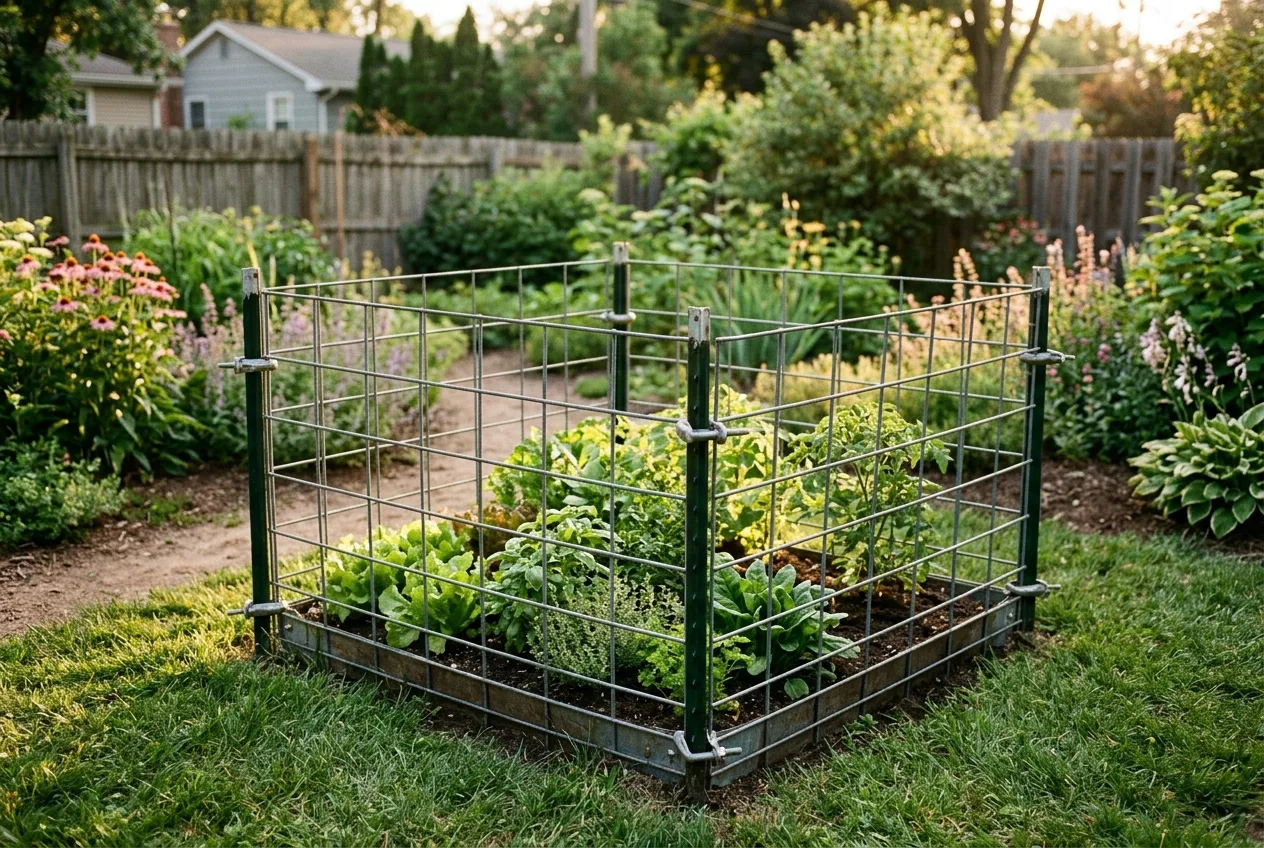
- Micro-exclosures. This one is my favorite piece of lateral thinking. Deer avoid entering small, boxed-in spaces — they read them as too risky to get into and out of quickly. So you don't build a tall fence; you build a small one. Four 16-foot cattle panels clamped into a 16-foot square, only 50 inches tall, with four T-posts for rigidity. Minnesota documented six of these built for about $150 in 2018, with one breach across 100 days of trials — fixed simply by making the enclosure smaller. They're ideal for a vegetable bed, a berry patch, or a prized clump of hostas. The same idea scales: an 8-by-16-foot exclosure only 50 inches high has successfully excluded deer.
- Fishing-line fence. High-test monofilament (30-pound or more) strung tightly around a bed, 30 to 36 inches up and about 2 feet beyond the edge of the planting. A deer moving in after dark hits an unseen line pressing against its body, gets unnerved, and backs off — it works like a repellent more than a barrier. The honest limits: it fails when deer density is high or when they feed in daylight and can see it.
- Binder-twine fence. An old grower's trick — string twine around the bed like a fence and also in a horizontal grid over the top, so the plants are caged in twine. Deer are reluctant to jump over and down through it.
So you don't build a tall fence; you build a small one.
Repellents: what the trials actually show
Repellents are where most gardeners start and where most of the myths live, so it's worth being precise. The first rule, straight from Minnesota's repellent handbook, is the one to tape to your shed wall: repellents are not fences. They're for non-commercial users with small areas and low-to-moderate damage. Success with a repellent means less damage, not none — and that's the right yardstick. As Minnesota Extension puts it plainly, a 50% reduction in browse is very successful, and a 30% reduction is the more likely result.
Which ones work
When you strip away the marketing, the field trials point in one clear direction: the best repellents are the ones that smell like death. The most effective products emit sulfurous odors — rotten egg or slaughterhouse waste — because those read to a deer like danger. In a USDA-linked trial of 20 commercial repellents on captive deer, the standouts were sulfurous and protein-based: a putrescent-whole-egg-solids product, a meat-meal-and-pepper sachet, a capsaicin-and-isothiocyanate spray, and a fatty-acid soap. Putrescent-egg products like Deer-Away Big Game Repellent are repeatedly reported at 85% to 100% effective in field studies, and deer will often avoid plants sprayed with putrescent egg solids for up to six weeks. Colorado's trials on hungry captive mule deer rated chicken eggs (20% eggs to 80% water), a commercial egg product, and full-strength coyote urine all as "High" effectiveness, alongside hot sauce at 6.2% capsaicin.
What doesn't work is just as clear, and it'll save you money: bittering agents like denatonium benzoate (sold as Bitrex or in Ro-Pel) consistently failed in trials — and the denatonium products were eventually pulled from registration anyway. Pain and irritant ingredients like capsaicin are often present at concentrations too low to do much. There's a real lesson buried here about all the foul-tasting and home-remedy products: capsaicin and bittering work by teaching a lesson — the deer takes a bad-tasting bite and learns to avoid the plant. But newer research suggests much of repellents' effect is actually food neophobia, plain suspicion of an unfamiliar smell or taste. And if a deer discovers there's no real consequence to eating the treated plant — no stomachache, nothing — the lesson never sticks and the repellent stops working.
A note for vegetable gardeners specifically: most repellents aren't cleared for use on food crops, so check the label. Some are formulated for edible crops — soap-based products and a few others can be sprayed on vegetables up to harvest — but read carefully before you treat anything you plan to eat.
The best repellents are the ones that smell like death.
The two problems that sink repellents
Even the good ones fight two forces that no amount of spraying fully beats.
The first is weather and new growth. Repellents wash off. Reapplication is usually necessary after rain, and during peak growth season, because the new leaves that push out after you spray aren't protected at all. Real-world reapplication intervals from the sources cluster tightly: roughly every 2 to 3 weeks during the growing season, every two weeks for a DIY egg spray, every 4 to 5 weeks for some commercial products, with a homemade 20%-egg mix lasting about 30 days. Area repellents in particular are volatile and generally need renewing about weekly. A sticker additive like Vapor Guard can stretch the interval so you're not respraying after every shower. Plan on roughly three applications across the early growing season and budget accordingly — and the budget is real: 2024 per-acre figures ran from about $20 for an insecticidal-soap product to $24 for an ammonium-soap one, $28 for a blood-based one, and on up to $39 and $57 for popular branded sprays.
The second is habituation, and it's the one that quietly defeats people. Every source that studies repellents over time says the same thing: they lose effectiveness as deer get used to the smell or taste. It's especially bad where deer densities are high. The standard defense is to rotate — switch repellent types periodically so the deer never settles in with a single familiar scent. Changing between an odor-based formula and a hot-pepper one, for instance, keeps the stimulus novel.
And underneath both problems sits the hard ceiling on what any repellent can do: a hungry deer eats anyway. Repellents work by making your plants less appealing than the alternatives — so when the alternatives vanish, in a drought or deep in winter, the math breaks. Deer facing little to no food in their normal range will graze right through repellent-treated plants to avoid starving. That's not a product failure; it's biology, and no spray fixes it.
Scare devices: save your money
Here's the blunt verdict, and the research behind it is unusually clean: most scare devices don't work for long, and the ultrasonic ones may not work at all. Deer quickly get used to most noisemakers — propane cannons, electronic alarms — which makes them useless for the long haul. Propane cannons buy you maybe one to two weeks before the deer figure out they're harmless.
The ultrasonic "deer deterrents" sold for yards deserve a special callout, because they're appealing and they fail. In a controlled study at a high-density deer facility, motion-activated ultrasonic devices and an electronic siren-and-strobe unit were "generally ineffective" — deer intrusions during treatment were similar to or higher than before, and any initial flinch faded in under a week as the deer habituated. There's not even good evidence deer can hear the things. Motion-activated water sprinklers do a little better as a startle, but even there a deer typically retreats only a short distance and is likely to return.
The one nuance worth keeping: novelty and unpredictability are what little power these devices have. In the research, scare tactics that fired at random intervals outlasted ones on a regular schedule, because the randomness slowed habituation. So if you use a propane cannon, move it every few days and stagger the firing pattern. And use it the instant a problem starts — once deer have established a movement pattern through your yard, it's very hard to scare them off it.
Plant choice: stack the deck, don't expect a miracle
You can absolutely make your garden a less attractive target by what you plant, and it's the cheapest lever you've got. Some species are simply less preferred — deer tend to leave them alone when tastier options exist. Rutgers maintains the best-known database for this, rating 527 landscape plants from A ("Rarely Damaged") down to D ("Frequently Severely Damaged"). The practical move is to build your beds from the A and B tiers, which Rutgers flags as best for landscapes prone to deer, and to plant anything in the C or D tiers only with backup protection like a fence or repellents.
For names to start with: among the rarely-damaged crowd are boxwood and spruce; annuals like marigold, snapdragon, sweet alyssum, and verbena; and perennials like daffodil, lavender, purple coneflower, yarrow, and hellebore. If you're screening for privacy and want evergreens deer mostly ignore, the standouts are Japanese pieris ("almost never bothered by deer"), mountain laurel (one of the few native evergreens deer largely leave alone), boxwood, eastern red cedar, Chinese juniper, and inkberry. Aromatic herbs — rosemary, sage, lavender, plus tough plants like yucca and juniper — also rate low for browsing. A nice tactical layer: place the plants deer love near the house and human activity, and put the less-tempting ones out by the woodlot where deer feel safe; some gardeners even ring the property with a "fronting border" of unpalatable plants.
But every single one of these sources carries the same warning, and it's not boilerplate — it's the whole truth of the matter. No plant is deer-proof. The lists hold "in all but the leanest of times", and when food is scarce — drought years especially — or deer are numerous, they'll eat plants right off the resistant list. Even the comforting idea that deer won't come up to the house is wrong: proximity to a building isn't enough to stop a hungry deer in the back half of winter. Resistant plants tilt the odds. They don't change the game.
Resistant plants tilt the odds. They don't change the game.
Putting it together

If there's one thread running through all of this, it's that no single tactic is a fortress, and the people who win against deer layer their defenses. The ATTRA synthesis lists five general methods — exclusion, cultural methods (like plant choice), scare devices, repellents, and culling — and the recurring advice is to combine them rather than bet everything on one.
A reasonable way to think about it, scaled to how much deer pressure you're under:
- Low pressure, a few beds: lean on resistant plants, a fishing-line fence or a micro-exclosure around what matters most, and a rotated egg-based repellent. Cheap, low-effort, often enough.
- Moderate pressure, a real garden: a temporary electric or double-tape fence around the core area, baited and conditioned early in the season, backed by repellents on the spillover and smart plant placement.
- High pressure or high-value plants: there's no substitute for the 8-foot fence — woven wire if you can afford it, 8-foot plastic mesh if you can't — installed and maintained properly.
Whatever you choose, three principles travel across all of it. Start before the damage, because breaking a feeding habit is far harder than preventing one. Match the tool to your actual deer pressure, since the same simple fence that holds under light pressure gets jumped under heavy pressure. And keep your expectations honest — even the research-grade options have their failures (a single yearling doe in one study learned to slip through a fence that was 99% effective on everyone else), and a desperate deer in a hard winter will test every defense you've built. The goal isn't a deer-proof garden. It's a garden deer find more trouble than it's worth.
Frequently asked questions
How high does a fence need to be to keep deer out?
At least 8 feet for a standard vertical fence — deer normally won't jump a 6-foot fence but can clear 8 feet if pressured, and an 8-foot woven-wire fence is the conventional deer-proof standard. On a slope, go 10 to 11 feet, since deer can jump down from the high side. A slanted or double fence can be lower because the width, not the height, does the work.
Do deer repellents actually work?
The best ones — products that smell like rotten egg or slaughterhouse waste — meaningfully reduce browsing, often by 85% to 100% in field studies, but only for a few weeks before you must reapply. Expect roughly a 30–50% reduction in real conditions, plan to reapply every 2 to 4 weeks and after rain, and rotate types so deer don't habituate. None of them stop a genuinely hungry deer.
What's the cheapest way to keep deer out of a vegetable garden?
Small-scale tricks punch above their cost: a 50-inch-tall cattle-panel micro-exclosure (about $150 in materials, built to last a decade), a fishing-line fence strung 30 to 36 inches high around the bed, or 8-foot plastic mesh attached to existing trees. Pair any of them with a homemade egg-and-water repellent and deer-resistant plant choices.
Do ultrasonic deer repellents and scare devices work?
Generally no. Controlled studies found motion-activated ultrasonic and siren/strobe devices "generally ineffective," with deer habituating in under a week, and there's no good evidence deer even hear ultrasonic units. Propane cannons work for only one to two weeks; randomizing and moving them slows the habituation a little.
Are any plants truly deer-proof?
No — every list says so plainly. Some plants are rarely damaged (boxwood, daffodil, lavender, yarrow, mountain laurel, Japanese pieris), and building beds from the "rarely damaged" tier genuinely helps. But when food is scarce or deer numbers are high, they'll eat resistant plants too, and even nearness to your house won't stop them late in winter.
When should I start protecting my garden from deer?
Before the damage starts, not after. Where a deer feeds is a learned habit, and the first day, week, and month of denial is the critical window — it's far easier to stop deer from forming the habit than to break it once they're returning every night. Install fences or begin repellents at the first sign of a problem.