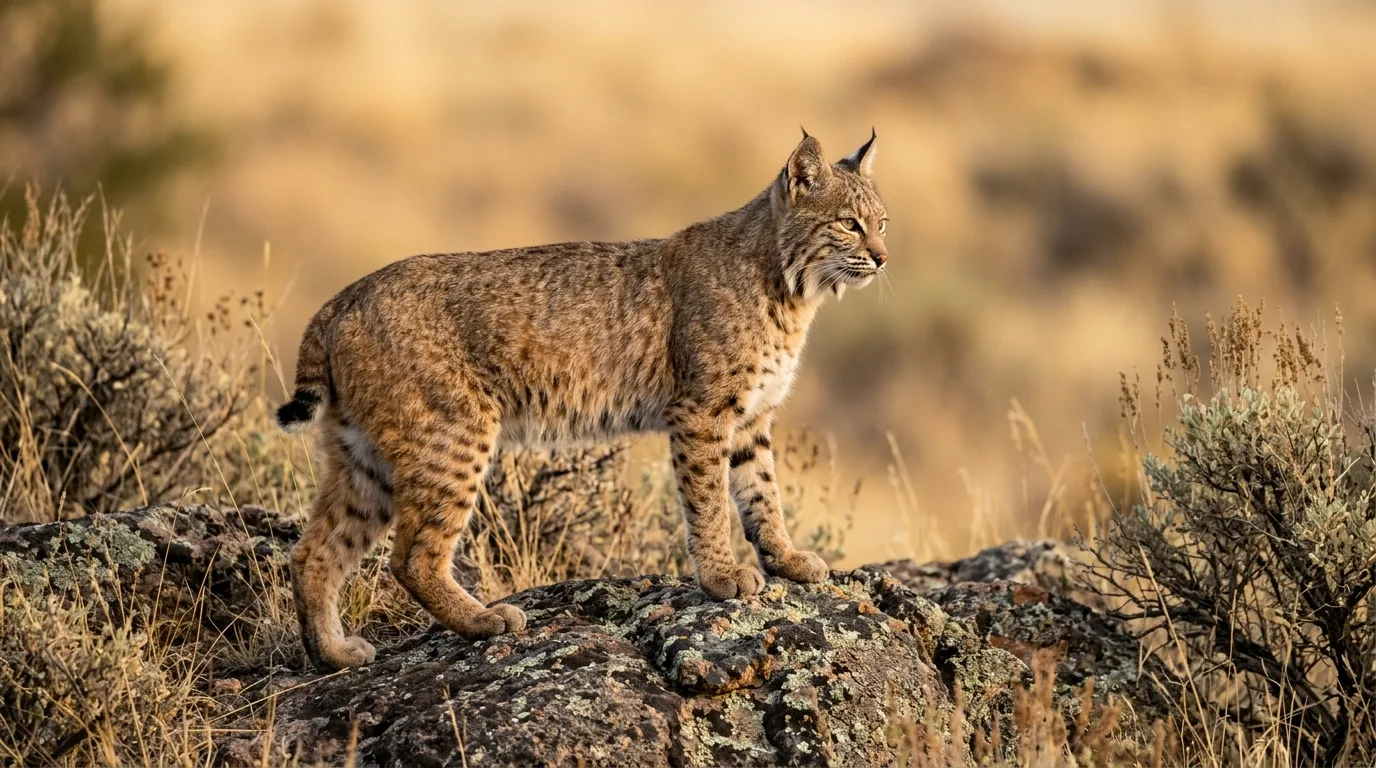
Here is the strange thing about bobcats: you can share your land with one for years and never lay eyes on it. They are common across most of North America — far more common than people realize, as Washington's wildlife agency puts it — and yet "few persons ever actually see a bobcat; spotting one in the wild is a tremendous thrill". A Smithsonian camera-trap project says it plainly: most people will only ever detect a bobcat by camera, or by learning to read the marks it leaves on the ground.
So the honest question isn't usually "what does a bobcat look like" — there's a whole separate piece on telling one from a mountain lion in a photo Bobcat or Mountain Lion? Reading Wild Cats off Your Trail Camera. The question is whether one is living around you, and that's answered by behavior and sign, not by a lucky glimpse. Get inside how a bobcat uses space and time — where it patrols, when it moves, what it leaves behind — and a quiet landscape starts telling you who's home.
The short version: a bobcat holds a territory it patrols on a loose schedule, marks with scrapes and scat left in deliberate spots, hunts mostly around dawn, dusk and night but bends that timing to its prey and to you, dens in thick cover or rock, and leaves a recognizable signature of round clawless tracks, dense segmented scat, hind-foot scrapes, and covered kills. Learn those five things and you can read your own ground.
A solitary cat that talks through scent, not company
Start with the social rule, because everything else hangs off it: bobcats live alone. Adults associate only for the brief business of courtship, and females only with their own kittens. There's no pack, no pair bond, no shared range in any cooperative sense. A bobcat's world is a patch of ground it knows intimately and shares grudgingly.
"Grudgingly" is the right word, though, not "violently." Bobcats hold defined territories, but those territories overlap — sometimes a lot. The way they keep the peace is mostly informational. In a Dallas–Fort Worth study where GPS collars logged where cats were at the same moments, bobcats living in overlapping ranges turned out to be "neither avoiding nor attracted to one another" day to day — they simply weren't in the same spot at the same time. In the Adirondacks, where ranges also overlap, "adults do not use the same areas at the same time except during the breeding season". They time-share. The fence between two bobcats is made of scent and schedule, not teeth.
That's why scent marking matters so much, and why it's the behavior most likely to leave you a clue. A bobcat establishes and keeps its range through what biologists call a land-tenure system "maintained by scent marking". The marks advertise occupancy — "this ground is taken" — so a resident rarely has to defend it in person.
The fence between two bobcats is made of scent and schedule, not teeth.
The single most revealing study of how they actually do it used motion-triggered video at marking sites in California's Santa Cruz Mountains, recording 496 separate bobcat visits. The headline finding is counterintuitive and worth sitting with: the thing bobcats did most often at these spots wasn't marking at all — it was sniffing. Olfactory investigation showed up in 38.5% of visits, more than scraping (13.3%) and urine spraying (11.7%) combined. As the authors put it, bobcats "more frequently investigate than create scent," which hints that their territoriality runs on familiarity with the neighbors as much as on flexing dominance. When a bobcat does mark, scraping and urine spraying turn out to be about equally common — overturning the old assumption that scraping dominates. And there's a timing tell buried in the data: visits peaked in January, at the presumed height of courtship.
For reading sign, the mechanics are the part to remember. A scrape is made when the cat "scrapes in substrate with their hind feet and then sometimes urinate[s] and/or defecate[s] on the scraped mound"; ESF describes the same move — scratching the substrate with the hind feet after marking the area. Urine spraying is a backed-up squat against an object. Bobcats almost always make a single scrape — they did so in 93.9% of marking visits. Hold onto that: one scrape, hind-feet-back, often with scat or urine on the little mound. That's a signature you can find.
Territory: how much ground, and why the number keeps moving
If you want one fact about bobcat home range, make it this: there is no single number, and anyone who quotes you one without a context is guessing. Range size flexes with prey density, season, sex, and how built-up the land is — and the spread is enormous.
The clearest pattern is the sex difference. In the Virginia Appalachians, male seasonal home ranges were about three times the size of females' — 33.9 versus 12.1 square kilometers — and males also moved 1.4 times faster across their ground. That's the rule across the species and across the genus: males stretch their territories to overlap as many females as possible, while females hold smaller ranges sized to feed themselves and their kittens. A male's range may blanket several others' and "include the home ranges of several females which do not overlap" each other.
Now the regional spread, which is genuinely striking. Put a few reported figures side by side:
| Setting | Male range | Female range | Source |
|---|---|---|---|
| Urban/suburban (Florida) | ~1–2 mi² (territory shrinks in the city) | — | |
| Western Washington | 2.5–6 mi² | about half the male's | |
| Southern Illinois | 7½–20 mi² | 3½–6 mi² | |
| Ohio (regional contrast) | southern ~79 km² vs eastern ~29 km² (mean) | male > female | |
| Adirondack forest (NY) | ~325 km² (~125 mi²) | ~86 km² (~33 mi²) |
A bobcat in a Florida suburb may patrol a couple of square miles "in a slow, careful fashion"; an Adirondack male may need the better part of a hundred and twenty-five. The driver is food. The Texas account states it cleanly — home-range size "depends on prey availability, season of the year, breeding season, and overall quality of the available habitat". Where prey is dense, a cat needs less ground; where it's thin, it needs more.
Cities compress ranges rather than excluding cats outright, but they do it on the bobcat's terms. Urban bobcats keep their ranges small and tolerate more overlap, with older animals holding the larger, more overlapping territories. They thread their movements through creeks, greenbelts and farmland and steer clear of roads — both directly (they avoid them) and structurally (where roads are dense, ranges overlap less). Even a city bobcat's territory is mostly stitched from the natural scraps still left in it.
A bobcat in a Florida suburb may patrol two square miles; an Adirondack male needs a hundred and twenty-five.
There's a hopeful subplot here for landowners watching new cats appear. Across much of the Midwest, bobcats were wiped out by the mid-1800s and are now recolonizing — in Ohio, more than 95% of recorded sightings have come since 2000, and the population is expanding along forested river corridors. Illinois tells the same story: nearly gone by the mid-1900s, now statewide. If bobcats are newly showing up where your parents never saw one, that may be exactly what's happening across the region.
When bobcats move — and why "crepuscular" is only half true
Ask what time a bobcat is active and the textbook answer is "crepuscular and nocturnal" — dawn, dusk, and night. That's a fine starting point and often right: Arizona's desert bobcats are "most active during crepuscular periods," Illinois cats run "from a few hours before sunset until dawn," and the genus as a whole is generally reckoned crepuscular or nocturnal. But treat that label as a tendency, not a timetable, because bobcats are one of the more flexible cats out there.
Two things bend the schedule. The first is prey. A bobcat hunts when its food is catchable, and its food is all over the clock. In coastal North Carolina, the bobcat's menu includes prey active by day (birds, gray squirrels), in the late afternoon and evening (cotton rats), and at night (rabbits, raccoons) — so a cat that "should" be crepuscular has good reason to move whenever. This is the genus-level rule, shown nicely in a study of Eurasian lynx spanning central Europe to the Arctic: lynx activity stayed bimodal and twilight-peaked "even during polar night and polar day," essentially independent of daylight, and tuned instead to the activity of the local main prey. The cat's clock is really the prey's clock.
The second is you. Where people are around, bobcats push their activity into the dark. Washington's agency draws the line cleanly: "In areas occupied by humans, these cats typically limit their activity to night... In undisturbed areas, they can be active at dawn or dusk if prey is active at that time. However, bobcats may be active during any time of day". Florida adds the everyday reason you might still catch one in daylight — a bobcat "sleeps for only 2 to 3 hours at a time," so daytime sightings aren't unusual even though it mainly hunts at night. An Oregon camera study found bobcats kept their dawn-and-dusk pattern even near town and behaved as "human avoiders," ceding space (and bright daylight hours) to people rather than abandoning the area.
Moonlight tunes it further. A North Carolina study tracked movement against lunar illumination and found bobcats moved most by day when nights were dark (new moon) and shifted more movement into the night when the moon was full and bright. The interpretation fits everything else: bobcats hunt by vision — Washington notes they see up to six times better than we do in dim light — and they go where the light and the prey line up.
For your purposes, the takeaway is practical. If a camera or a fresh track says a bobcat moved across your ground at 2 p.m., that doesn't mean something's wrong with the cat. It means the cat had a reason — undisturbed ground, active prey, a dark moon — to be out. The honest summary is the Washington one: mostly twilight and night, but possibly any hour.
Diet in brief: a rabbit specialist that won't say no
You don't need a full diet study to read a bobcat's sign, but a little context helps you interpret what you find — especially scat and kills. The one-line version: bobcats are opportunistic carnivores built around small prey, with rabbits at the center.
Across its range the pattern holds. In Texas, "rabbits are by far their most important food, followed by squirrels, rats, and mice". Illinois lists rabbits, mice, voles and squirrels as the staples, with birds, frogs, fish and snakes filling in. Desert bobcats shrink the menu to smaller items and take more birds than usual. And bobcats do tackle deer: they take fawns in summer, and adult deer mostly as winter carrion after the hunting season — though they're capable of killing a healthy adult by ambushing a bedded animal or hunting in deep snow. A bobcat hunts by sight and patience, stalking to within a quick dash and then pouncing, often working roads and game trails where prey moves.
This is why finding fur-packed scat or a deer carcass raked over with leaves tells you something specific, which we'll get to.
Denning and the next generation
Dens are where the solitary rule briefly relaxes, and they're worth understanding because a denning female changes her behavior and her sign. The first-ever study of bobcat den-site selection, in South Dakota's Black Hills, radio-collared 35 females and found 27 dens — and the structure of those dens is consistent with what agencies report everywhere: 21 in rock crevices, 4 in downed woody-debris piles, 2 in shrub thickets. Washington lists "caves, rock crevices, or hollow logs or trees" lined with dry leaves, moss or grass; Pennsylvania the same; Florida's cats use dense saw-palmetto and shrub thickets.
The why is concealment. Black Hills bobcats chose dens with high horizontal cover and rugged terrain — features that hide kittens from the coyotes and cougars that are their main predators. Survival is tightest in the first three months, when kittens are tied to the den, so a mother picks a spot a predator can't see into or easily reach. Females show strong den fidelity and cut their daily movement right down after giving birth, sticking close to the den. You can even read that in the Virginia movement data: females "increased movements during the kitten-rearing period, when foraging more intensively, and frequently returning to den sites". A female running tight, repeated loops back to one thicket or rock pile in late spring is very likely a mother.
The reproductive calendar, gathered across sources, runs roughly like this: breeding peaks in late winter (commonly February–March, with regional spread from late summer into spring), gestation is about 50–63 days, and a single annual litter of about two to four kittens is born in spring. Kittens are born blind, open their eyes at eight to eleven days, are weaned by around two months, and disperse near eight months of age as the female prepares to breed again. Females can breed in their first year (though often don't); males generally don't until their second. And the solitary rule has teeth here: females guard their litters carefully because an adult male may try to kill kittens.
Reading the sign: how to tell a bobcat actually lives near you
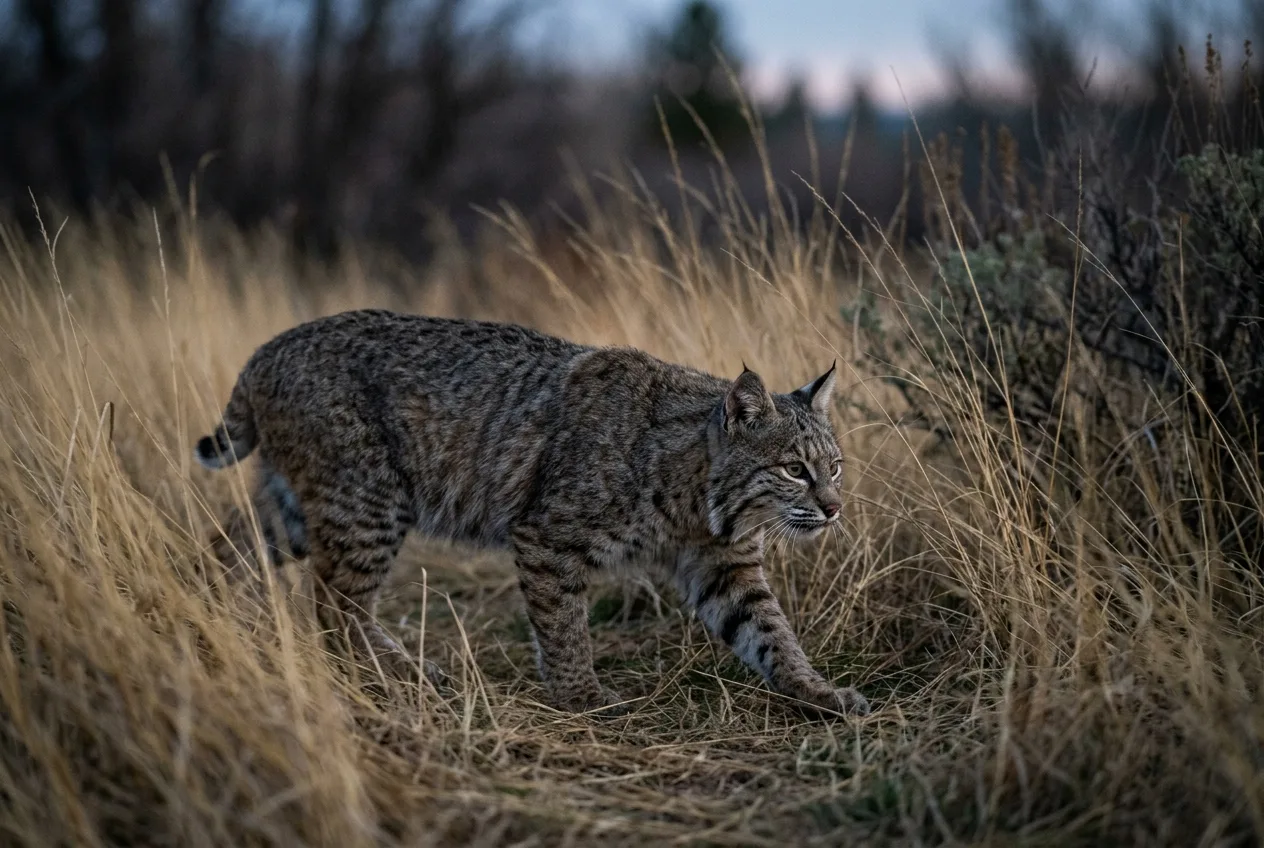
This is the heart of it. A bobcat won't pose for you, but it can't help leaving a trail. Here's how to read each kind of sign — and, just as important, how to keep from fooling yourself with a dog's or a fox's leavings.
Where to look first. Bobcats are creatures of habit on the move. They "travel in predictable patterns along logging roads, railways, and trails made by other animals," linking resting areas, hunting grounds and food. So don't wander randomly — walk the linear features: dirt roads, old logging cuts, well-used game trails, fence lines, the edges of thick cover. That's where a cat concentrates its movement, and where its tracks, scat and scrapes pile up.
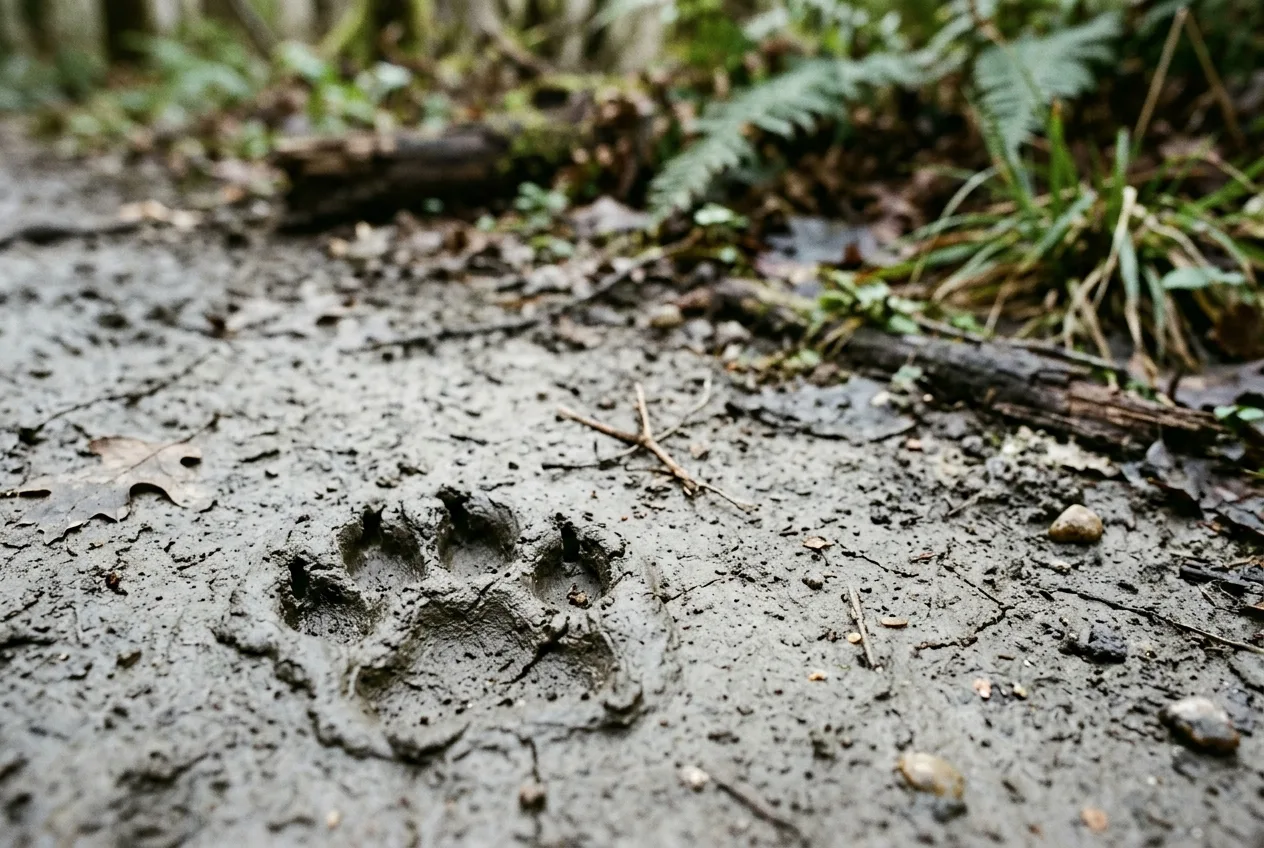
Tracks. The bobcat print is round, shows four toes, and — the single most important detail — shows no claw marks, because cats retract their claws when they walk. (A bobcat actually has five toes on each front foot and four behind, but only four register in a clean print.) It's roughly two inches across, about twice the size of a house cat's, and looks like a rounder version of a coyote or dog track. The giveaways that separate it from a dog are the missing claws and the shape; from a fox, the proportions — a bobcat's heel pad is large relative to its toes, while a fox's pad is small relative to the toes and its tracks usually show claws. eMammal adds a fine point for clear prints: one of the middle toes leads slightly, giving the track a subtle asymmetry, and the heel pad often shows two lobes at the top. Fine, damp silt or mud takes the cleanest impression.
No claw marks, a round outline, and a heel pad as big as the toes — that print belongs to a cat, and at two inches across, to a bobcat.
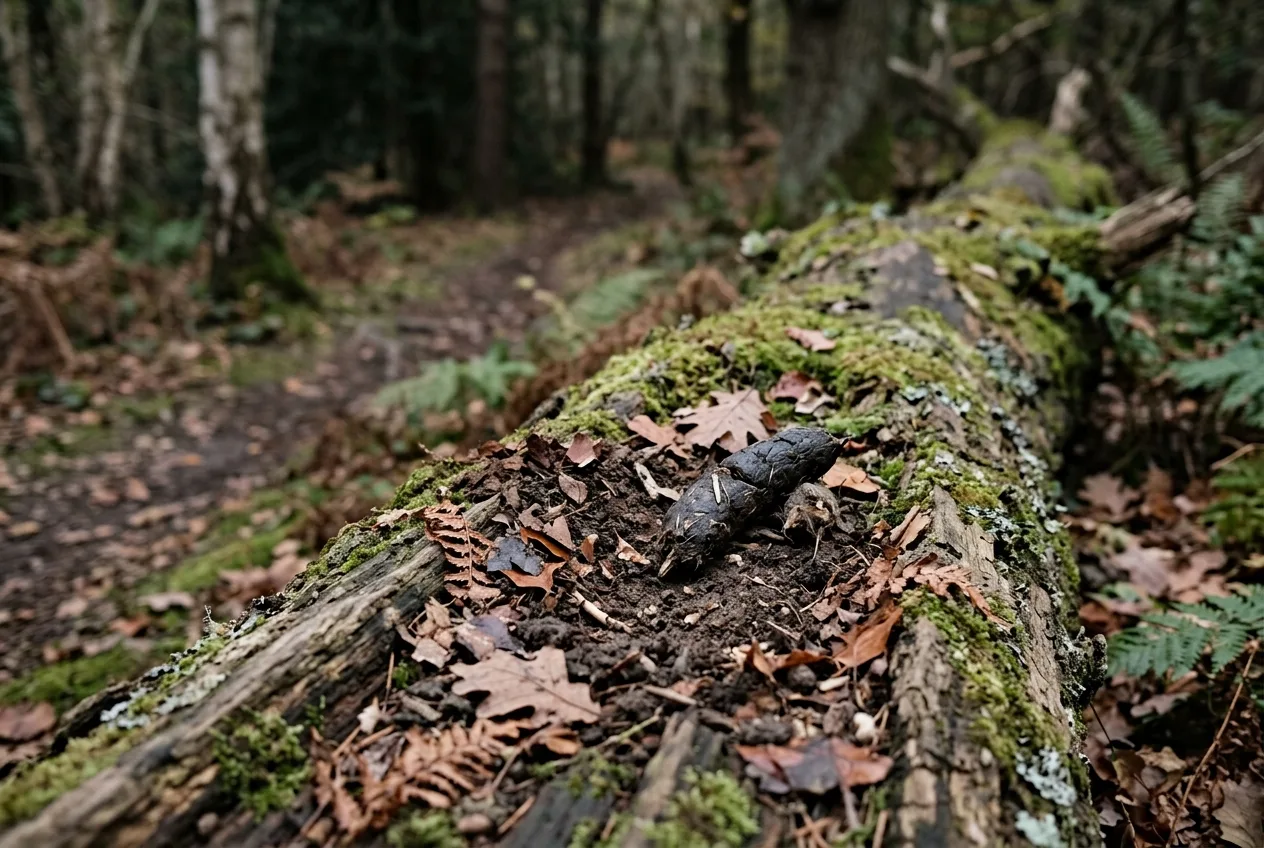
Scat. This is often your best evidence, because bobcats leave it deliberately and it's distinctive. Bobcat scat is dense, sharply segmented, and full of fur but not bone. eMammal's field test is worth knowing: bobcat scat is "more round and sharply segmented and less 'ropy' than coyote scat, and is very dense" — press old scat with your shoe and it stays hard and barely compresses, where coyote scat gives. (Old scat only, for obvious reasons.) Two behaviors govern where you'll find it. Often a bobcat covers its scat with loose soil, leaves or snow. But pointedly, it leaves some scat uncovered in prominent spots — "near dens or along trails... to help mark the bobcat's territory". A segmented, fur-filled dropping set conspicuously on a trail junction, a rock, or a rise is not waste; it's a message, and a strong sign of a resident cat.
Scrapes. A scrape is the bobcat's signboard. It scratches the ground with its hind feet, leaving a small raked patch often ending in a little pile, sometimes topped with scat or urine. eMammal describes the two forms you'll see: uni-directional, "one long scrape ending in a pile," or multi-directional, with "the pile in the middle of several paw marks". Find one near a trail, a territory edge, or a den area and you've found a marking station — a place the resident returns to. Related sign: claw marks on trees, stumps and occasionally fence posts, used to mark boundaries, "normally 2 to 3 feet above the ground" — about 60–90 cm, higher than a house cat scratches at roughly 1½–2 feet (45–60 cm).
Beds. Bobcats lie up by day in steep, well-covered ground. A used bedding area shows "several kidney-shaped depressions where a bobcat has repeatedly bedded down" — and the shape matters, because round depressions are deer beds, not cat beds. Repeated kidney-shaped forms in thick cover on a slope point to a cat that's resident enough to have a favored daytime hideout.
Caches. A covered kill is unmistakable bobcat sign and a useful one for landowners, because it also helps you tell a bobcat from a cougar. After a large kill, a bobcat "will cover the remains... with debris such as snow, grass, or leaves" and return to feed until it's gone. The tell against a cougar is scale: a bobcat reaches only about fifteen inches (~38 cm) to rake up cover, where a cougar's rake-radius is far wider — so a small cache with small clawless tracks around it — roughly 2 inches (5 cm) across — is a bobcat's, not a lion's. After feeding on a deer it may simply pull leaves over the rest.
Put these together and you can answer the real question. One ambiguous track proves little. But a round, clawless two-inch print on a game trail, a dense segmented fur-filled scat left out in the open at a trail junction, a hind-foot scrape with a little pile, kidney-shaped beds in nearby cover, and the occasional covered kill — that's not a passing animal. That's a bobcat that lives here, patrolling and marking ground it considers its own.
Where bobcats fit in the wider lynx family
Bobcats (Lynx rufus) are a North American animal, common across most of the lower 48 and into Canada and Mexico, and currently listed as Least Concern by the IUCN — they are not a species in trouble. But they belong to a small genus of lynxes whose behavior rhymes, which is useful both for readers outside North America and for understanding the cat itself.
The Canada lynx (Lynx canadensis) shares the bobcat's solitary, territorial, dusk-and-night habits but is a boreal-forest specialist built for deep snow, with oversized paws and long legs the bobcat lacks. If your range edges into lynx country and you need to tell the two apart, the tail settles it: a bobcat's tail is white underneath with a black tip and dark bands on top, while a lynx's tail tip is solid black. Where the two overlap — studied directly along Lake Huron in Ontario — they sort themselves along a snow gradient: both want shallow snow, abundant snowshoe hare and conifer cover, but lynx take the deeper-snow ground and bobcats the shallower, the two cats segregating rather than mixing. That snow line is, in a real sense, the bobcat's northern edge: deep snow grounds a small-footed cat, which is why "bobcats occur less frequently in areas of deep winter snow".
The lynx's life is also a vivid lesson in how prey rules a cat. The Canada lynx is so tied to the snowshoe hare that their populations cycle together over 8 to 11 years; when hares are plentiful a lynx takes "about two hares every three days," and when the hares crash "many lynx leave their home range in search of food," wandering far in mass dispersals roughly every decade. Bobcats, being generalists, never swing that hard — but the same logic of prey-driven movement governs them, just more gently.
Across the Atlantic, the Eurasian lynx (Lynx lynx) confirms the genus pattern at a larger scale. Its activity is bimodal and twilight-peaked regardless of daylight, set by prey rather than by the sun. By day it tucks into dense cover and rugged terrain away from people; by night it ranges into open, prey-rich habitat, its night range running more than 10% larger than its day range — the same human-avoidance-by-day, hunt-by-night rhythm a bobcat shows, written large. And its territory size is driven straight by prey density: in the Carpathians, lynx home ranges scaled with roe-deer availability, and females with kittens held the smallest ranges of all — exactly the prey-and-reproduction logic behind the bobcat numbers in that table above.
Different cats, different continents, same playbook: hold a range sized by your prey, mark it with scent, hunt the twilight, and stay out of sight.
Putting a trail camera to work
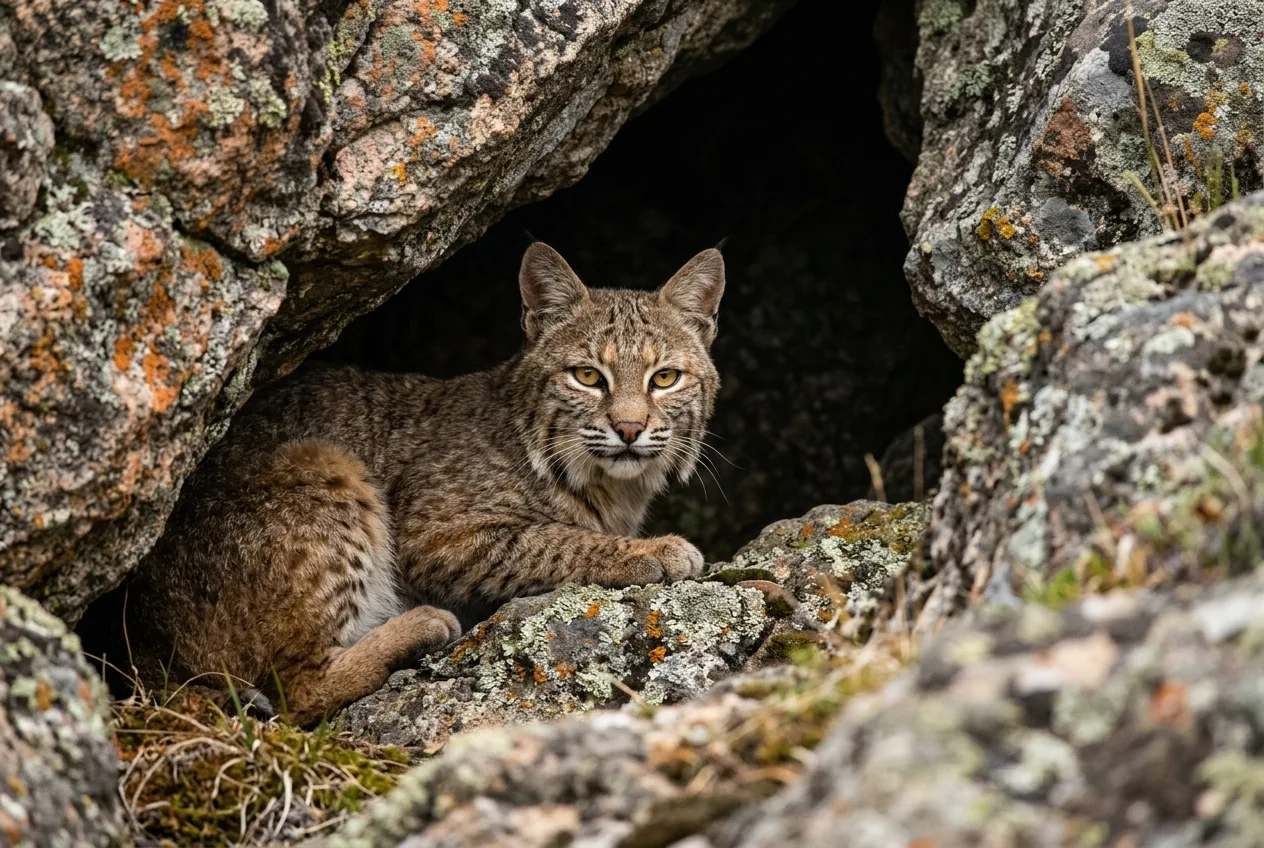
If you want to move from "I think a bobcat lives here" to actually watching one, a camera is the natural next step — bobcats are detected by camera far more than by eye. Set it on the linear features the cat already uses (a game trail, an old road, a fence line) at the spots where you found sign, and let the cat's own habits bring it past. The catch is volume: a camera on a good trail logs a lot of frames, and most won't have a cat in them.
Frequently asked questions
How can I tell if a bobcat lives on my property?
Look for a pattern of sign along trails, roads and field edges, not a single clue: round tracks with no claw marks (about two inches across), dense fur-filled scat left in the open at trail junctions or on rocks to mark territory, hind-foot scrapes ending in a small pile, kidney-shaped beds in thick cover, and occasionally a covered kill. A resident cat returns to mark the same spots; a one-off track may just be a traveler.
Are bobcats active during the day or only at night?
Mostly around dawn, dusk and night, but they're flexible. Near people they shift to the night; in undisturbed areas they'll move at dawn or dusk, and they can be active at any hour if prey is moving or the night is dark. Daytime sightings aren't unusual partly because a bobcat sleeps only two or three hours at a stretch.
How big is a bobcat's territory?
It depends heavily on prey, sex and how developed the land is — anywhere from about 1–2 square miles in a city to over 100 in a northern forest. Males hold ranges roughly three times the size of females' and overlap several female ranges.
How do I tell bobcat tracks from a dog's or a fox's?
A bobcat track is round and shows no claw marks (cats retract their claws), unlike a dog or coyote print. Against a fox, look at the pads: a bobcat's heel pad is large compared with its toes, while a fox's is small relative to its toes and usually shows claws and sometimes hair.
What does bobcat scat look like, and why is it sometimes out in the open?
It's dense and sharply segmented, packed with fur but not bone, and noticeably less ropy than coyote scat. Bobcats often bury their scat, but they deliberately leave some uncovered in prominent places near dens and along trails to mark territory — so a conspicuous, segmented dropping is a territorial signal.
Will a bobcat threaten my pets or livestock?
Bobcats mainly hunt wild small prey like rabbits and rodents, and rarely target domestic animals, but they will occasionally take poultry, small lambs or outdoor cats. Securing poultry in a covered enclosure and keeping small pets in at night handles nearly all of the risk.