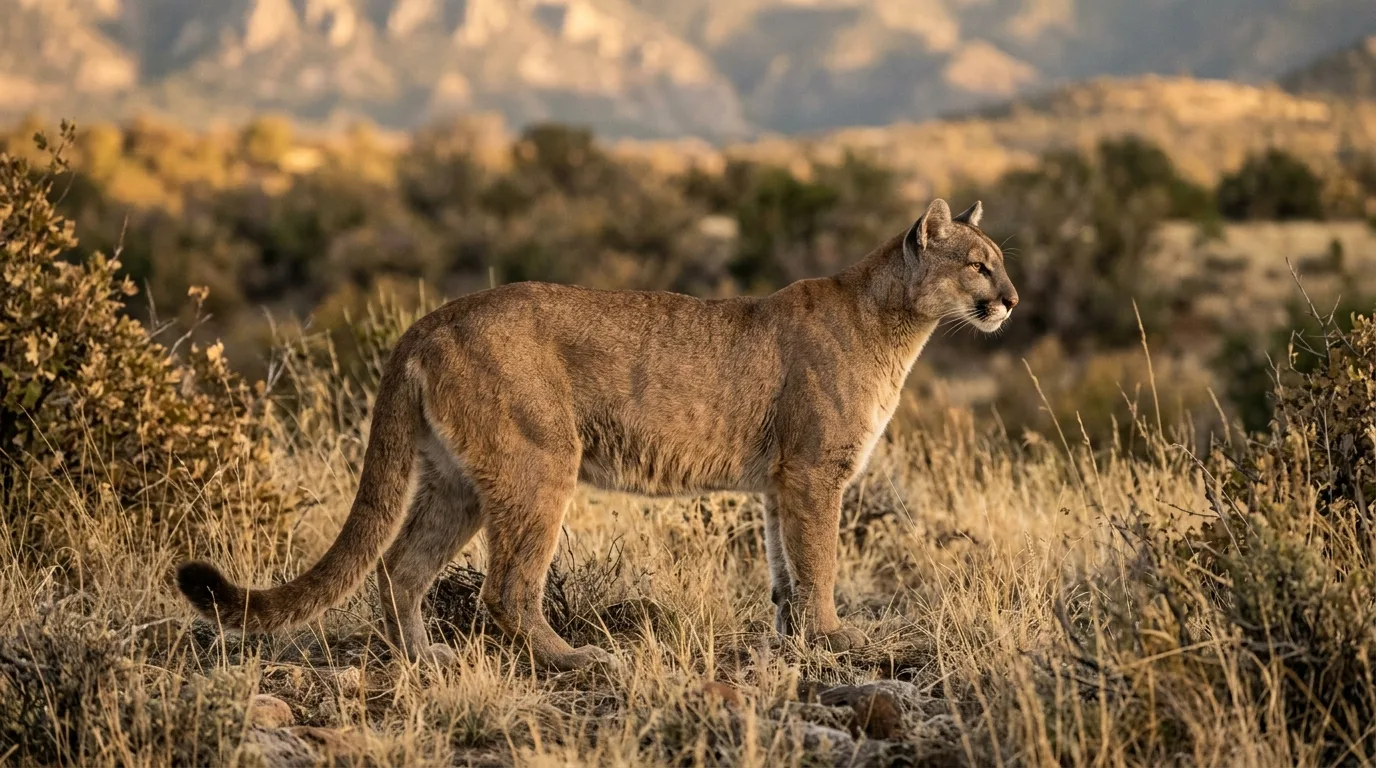
A wildlife agency in Missouri has been investigating mountain lion reports since 1994. People send in photos, plaster casts, tracks, hair, descriptions of something tawny crossing a road at dusk. The team is real, the reports number in the thousands, and the staff take every one seriously. And out of all of them, fewer than one in a hundred has produced enough hard evidence to actually confirm a lion was there.
That number is the whole story in miniature. Mountain lions — cougars, pumas, panthers, catamounts, the same cat under a dozen names — are real, they travel astonishing distances, and they genuinely do turn up far outside the maps. But the gap between I think I saw one and one was confirmed here is enormous, and it's filled almost entirely with bobcats, big dogs, house cats, coyotes, and the way a quick glimpse plays tricks on size. If you want to know whether a lion is near you, the answer isn't in the sighting. It's on the ground.
This is a guide to reading that ground honestly: the sign a cougar actually leaves, how to tell it from the animals it gets confused with, and how to think clearly about whether one is living near you or just passed through once on the way to somewhere else. It's deliberately calm, because the topic tends not to be. The aim is to make you a better, less anxious observer — someone who can look at a track or a half-buried deer and have a real opinion instead of a worry.
First, why this is so easy to get wrong
Start with the honest baseline: even people whose job is wildlife struggle with this. In a California statewide track survey, at least 9.5% of volunteers — most teams including a trained wildlife biologist — couldn't reliably tell mountain lion tracks from dog tracks. That isn't a knock on anyone. Dog tracks vary enormously in shape and size, and plenty of them land squarely in lion territory.
Now add the conditions of a real sighting. Mountain lions are, in the words of one agency, animals you're lucky to glimpse for a few seconds. They move at dawn and dusk, they're the color of dry grass, and they're usually gone before your brain has finished processing them. A long tail, a big cat shape, a tan flank — and the mind fills in the rest, often upward. Indiana's wildlife agency makes a point most people never think about: looking through binoculars or a scope magnifies the animal, so size estimates from optics run high. A house cat at the edge of a field, a bobcat with an unusually long-looking tail in the light, a yellow Labrador trotting a fence line — Alberta's agency lists exactly these as the things people report as cougars: "coyotes, bobcats, yellow dogs or even house cats".
The gap between "I think I saw one" and "one was confirmed here" is filled almost entirely with bobcats, big dogs, and the way a glimpse plays tricks on size.
None of this means the reports are foolish, or that lions aren't out there. It means a sighting is the beginning of a question, not the answer. The answer is physical, and it lasts longer than the animal — which is exactly why trackers rely on it.
Reading the real sign
A cougar in your area, if you ever detect it at all, will usually announce itself through what it leaves behind, not by showing up. There are four kinds of sign worth knowing, and they are not equally useful. Tracks get all the attention; a cached kill is far more convincing. Here's how to weigh them.
Tracks: a clue worth checking, not a verdict
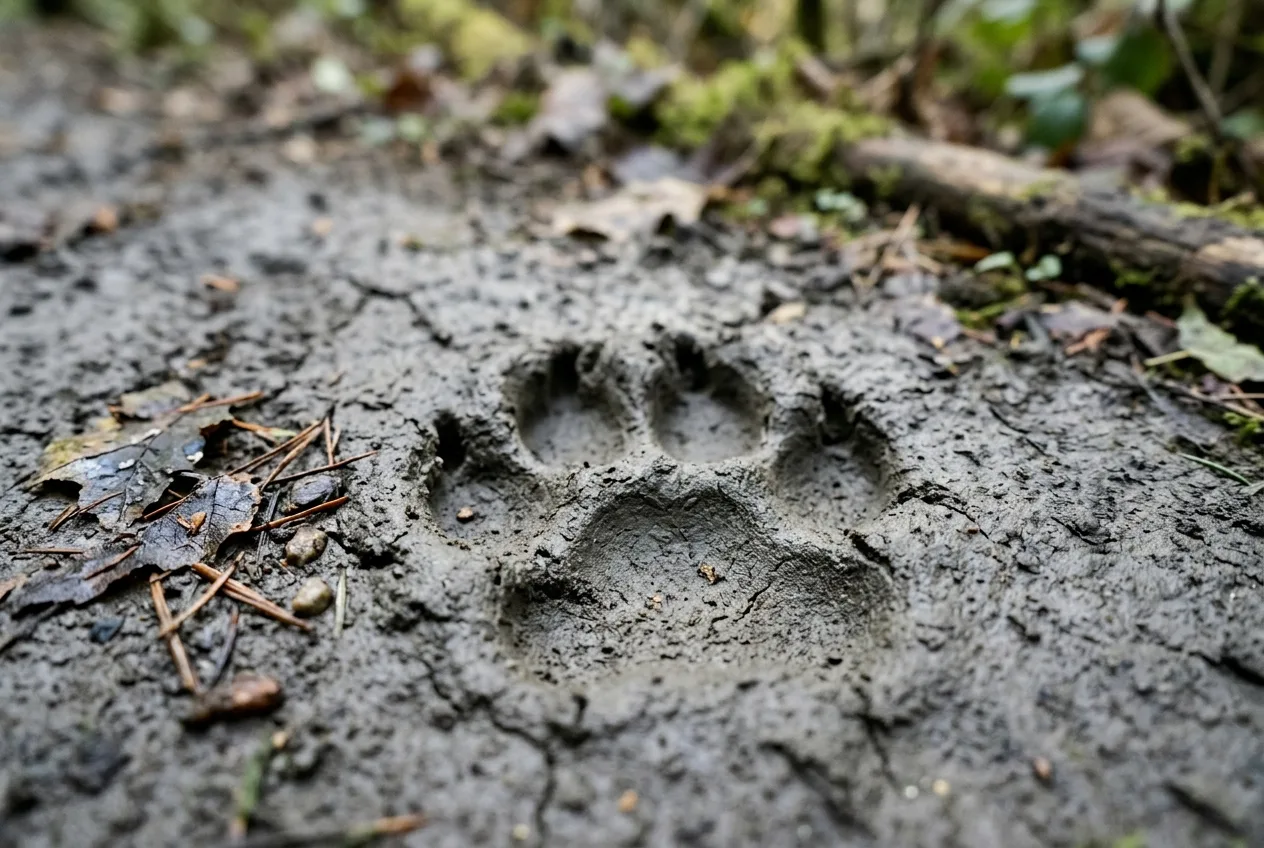
A mountain lion track is round, roughly as wide as it is long, with four toes and a large heel pad — about three inches long and front-foot heel pads two to three inches wide, shrinking to under two inches on the hind foot. Agencies put the overall width around 2¾ to 3¾ inches, sometimes up to four and a half. They genuinely are, as Missouri's field guide puts it, "like those of an enormous housecat".
The features that actually separate a lion track from a dog's are subtler than the famous one. Here's the order I'd trust them in:
| Feature | Mountain lion | Dog / coyote |
|---|---|---|
| Heel pad rear | Three lobes, roughly equal in size | Often two; if three, the outer two are smaller than the middle |
| Heel pad front | Squared or slightly concave | More rounded or pointed |
| Toes | Asymmetrical, teardrop-shaped, a clear leading toe | More symmetrical, oval, blunt |
| Claw marks | Usually absent; if present, thin and sharp | Usually present; blunt and broad — but not always |
| Gait on a road | Deliberate walk, straight lines, often hugs one side | Wanders, trots, weaves, stirs up dirt |
| Size | Not reliable on its own | Large dogs match or beat lion tracks |
Notice where "claws" and "size" land on that list. The claw rule — cats retract their claws, dogs don't — is the one everybody knows, and it's the one that fails most often. The clean version of the story comes from a 1994 case the track researchers like to cite: casts of large paw prints, four by four and a half inches, showing no claws, were sent off for identification and came back canine — a missing Great Dane. As the report's authors put it, "the presence or absence of claws cannot be used as a definite indicator". Worn-down hunting-dog nails, frozen ground, or simply a dog walking lightly can erase the claw marks entirely; and on rare occasions a cougar on slippery footing leaves them. When a cat does show claws, they're "slender and sharp"; a dog's are "blunt and flat".
Size is the other myth. "One misconception is that lion tracks are larger than dog tracks," Texas's field guide notes flatly. "Large hunting dogs can make tracks as large or larger than those of a lion". So lead with the heel pad and the toes, not the absence of claws or the size of the print.
The claw rule is the one everybody knows — and the one that fails most often.
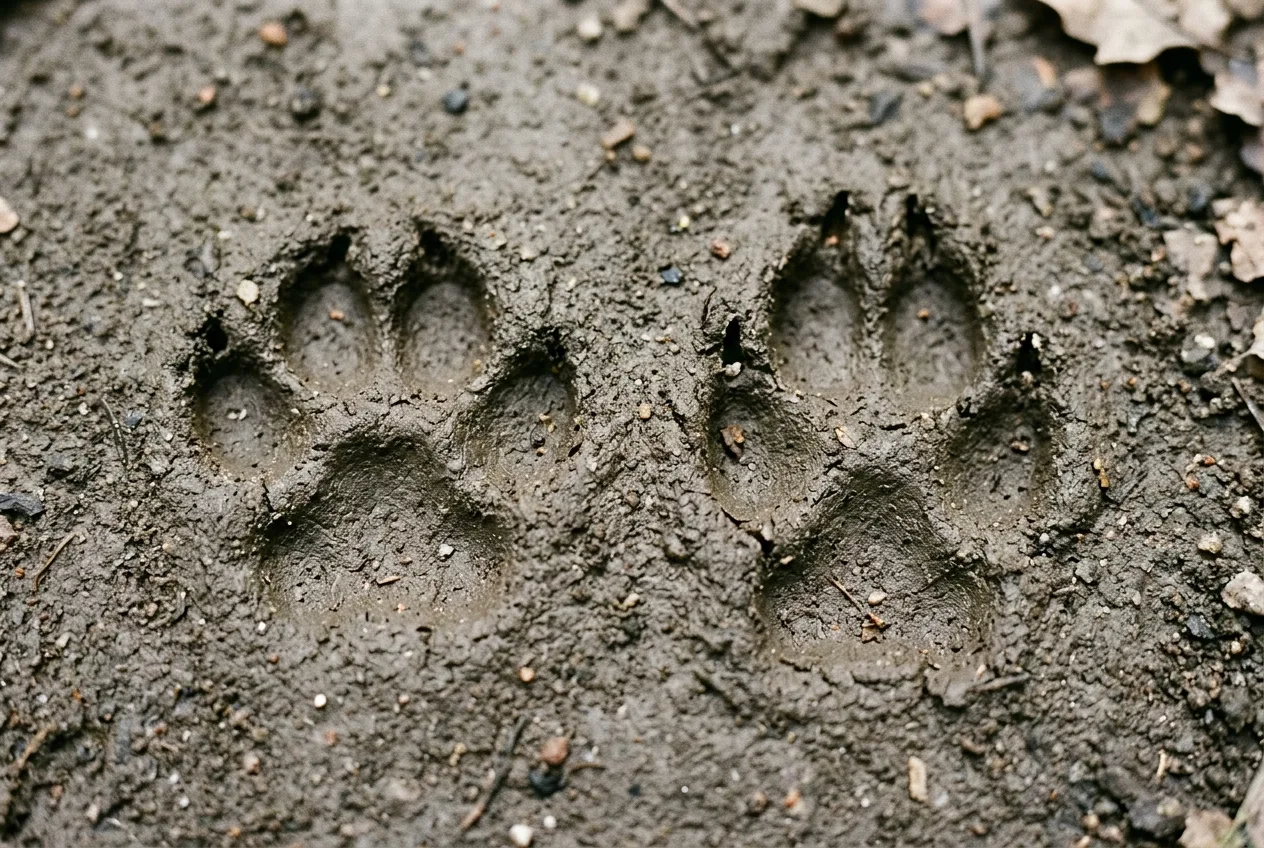
Two more things make tracks frustrating. First, cougars leave what Washington's agency calls "soft" tracks — they place their weight so evenly that on packed earth or crusted snow the print can be almost invisible. Second, when they do print cleanly, look at the trail, not just one track. A walking cougar moves in a deliberate straight line and registers its hind foot in or near the front print, so the tracks fall in neat, paired, overlapping sets; its stride at a walk runs about 20 to 24 inches. Dogs and coyotes lope and trot, wander without a destination, and kick up the ground. In snow, a cougar carries its heavy tail in a wide U, and the bottom of it can drag between prints — a tell almost nothing else leaves.
Bobcat or lion? Let size do the work
The one place size is decisive is separating a cougar from a bobcat — the cat most often mistaken for a young lion. They overlap in shape but not in scale. A bobcat's front pad is "seldom wider than 1¼ inches"; a mountain lion's track is nearly three inches across or more. Missouri's guide puts it memorably: bobcat tracks are "much smaller, less than 2 inches wide. Even six-month-old mountain lion kittens leave bigger tracks". So if you're holding a tape measure over a clean cat track and it's under two inches, you're almost certainly looking at a bobcat.
Cached kills: the sign that actually settles it
If you find one thing that should make you confident a cougar has been working an area, it's a cached kill. This is the behavior that's genuinely diagnostic, because it's something cats do and canids don't.
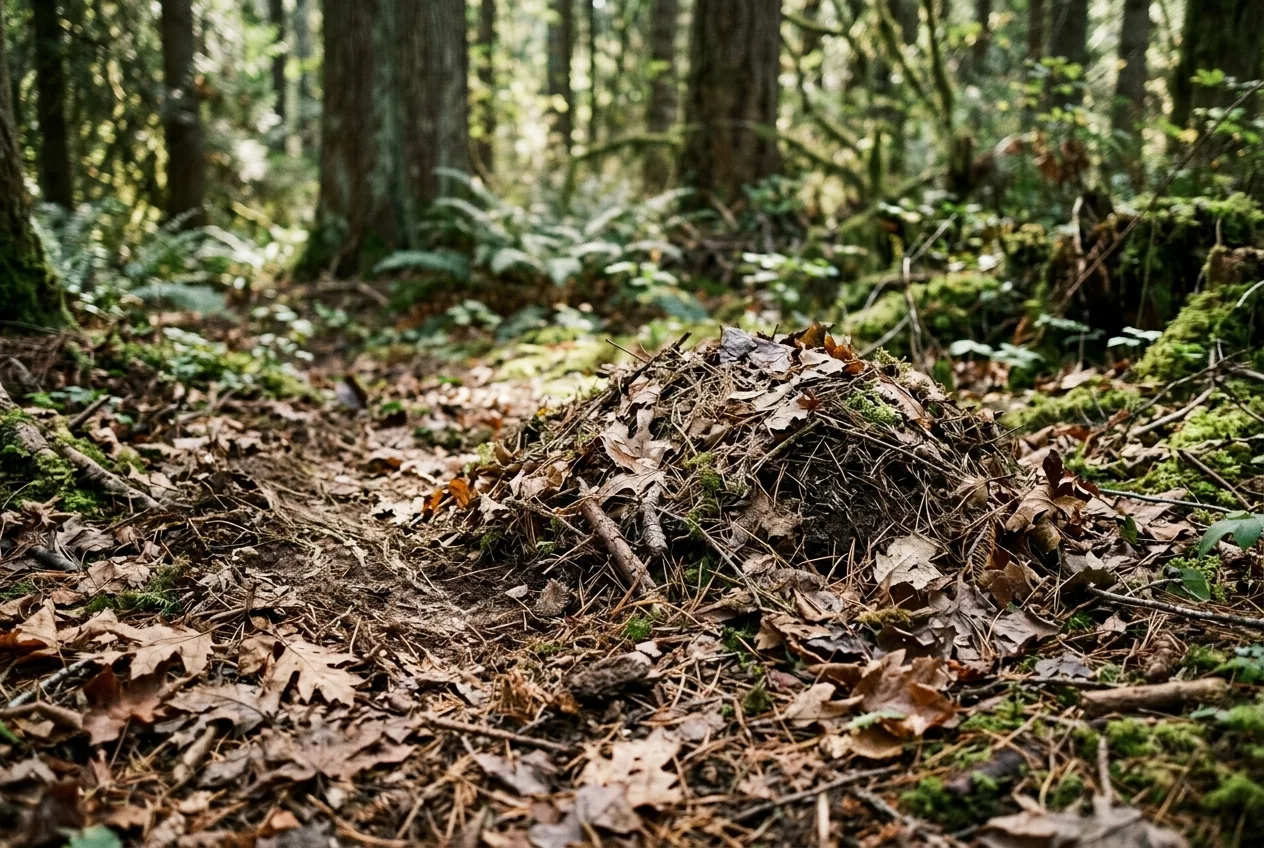
A mountain lion kills large prey — usually deer — and can't finish it in one sitting. So it drags the carcass to a sheltered spot and covers it: leaves, sticks, grass, dirt, snow, whatever's available, raked over the body by pawing at the ground around it. Then it stays in the area and returns to feed over several days, often re-covering the kill after each visit. In one northern California study of seven GPS-collared pumas and 352 kills, the cats cached 61.5% of everything they killed, and 71.6% of the deer. A large male in the Cascades was documented killing a deer or elk every 9 to 12 days, eating up to 20 pounds at a sitting and burying the rest, then feeding on it over six to eight days.
What you'd actually find: a deer carcass that's been dragged — there are usually drag marks at a fresh kill site — and deliberately covered, sometimes with the legs sticking out of a mound of debris. That combination is the signature. Coyotes and dogs scatter and gnaw a carcass; they don't tow it under cover and tuck it in. The recolonization researchers describe the rhythm well for a general reader: a puma will "stash the carcass, returning over 2-3 days," while scavengers like coyotes, bobcats, and birds of prey pick at it in between.
This is also the sign every agency tells you to back away from. Colorado, Washington, and British Columbia all give the same warning, and it's worth heeding: do not approach or linger at a recently killed or partly covered deer, because the cat that made it is very likely nearby and feeding. If you find a fresh cache, leave the area and, if it's on or near a trail, let others know.
A deer towed under cover and buried under leaves is a cat's signature — and the one sign that turns "maybe" into "yes."
Scrapes and scratches: signs of a resident
Scrapes are where sign starts telling you not just a lion but whose ground this is. A scrape is a small mound of debris a cougar kicks up with its hind feet — Colorado describes them as "piles of dirt and twigs" used to mark home-range boundaries — typically with a shallow scraped patch six to eight inches long and a little mound of urine-soaked leaves and dirt behind it. Cougars don't spray urine up onto objects the way some cats do; they work the ground.
Here's why scrapes matter for your question. They're made mostly by mature, resident males, and much less or not at all by females and young animals. In a California camera study, mature males scraped on 78.5% of their visits to marking sites, versus 13.6% for females. And research on what those marks communicate found that the number of scrapes a male had made was the strongest predictor of females choosing him — a signal tightly linked to his being an established resident. So a cluster of fresh scrapes along a ridgeline or trail junction isn't just "a lion came through." It leans toward "a resident male holds this ground" — a meaningfully different finding from a single set of tracks.
Tree scratches are weaker evidence, and it's worth knowing why so you don't over-read them. Cougars do rake trees with their claws, leaving long vertical scratches four to eight feet up that rarely strip much bark. But — and the Mountain Lion Foundation is blunt about this — "seeing scratched bark is not a clear indication of a cougar's presence." Bears claw-rake too, and remove far more bark; deer, elk, and moose rub their antlers on trunks. Height helps a little: cougar scratches sit higher (4–8 feet) than a bobcat's (2–3 feet) or a house cat's (1½–2 feet). But on its own, a scratched tree is a maybe, not a yes.
Scat: useful, but it lies more than you'd think
Cougar droppings are segmented, blunt-ended, roughly an inch to an inch and a half across and four to six inches long, and — the useful part — full of the hair and chewed-up bone fragments of prey, because a cougar's premolars slice through bone in a way a dog's gnawing doesn't. They're often left in prominent spots (trail centers, ridgelines, near a cache) and sometimes covered with scraped soil.
The catch is that scat is genuinely hard to call. A large coyote or dog can leave droppings the same size as a cougar's, and a small cougar can leave scat the size of a bobcat's. This is exactly why, when it matters, agencies don't eyeball it — they collect it and run DNA. Scat is a good thing to find and report; it's a poor thing to stake a confident identification on by sight alone.
"Is one here?" depends on what you mean by here
This is the part most people skip, and it's the part that actually answers the question in the title. Whether a mountain lion is "near you" is a question of scale, because of how much ground a single cougar uses.
A resident adult doesn't hold a backyard; it holds a territory. Estimates vary by region and prey, but they're large: Colorado puts home ranges anywhere from 10 to 370 square miles; Washington gives adult males 50 to 150 square miles; across North America the figure has ranged from about 32 to over 1,000 square kilometers. A male's range overlaps several females'. So "a lion lives near me" might honestly mean the nearest part of one animal's range is a few ridgelines over.
Then there's dispersal, which is where the truly long-distance sightings come from. When young cougars leave their mother at one to two years old, the females usually settle near where they were born — but the males strike out, often traveling hundreds of miles to find unoccupied ground. The famous case: a young male that left the Black Hills of South Dakota and was eventually documented in Connecticut, well over a thousand miles away (sources put the journey at roughly 1,500 to 1,800 miles depending on the route measured). A single disperser like that can generate a string of "sightings" across many counties and states as it moves — which is precisely why one confirmed animal does not mean a population.
A single young male, wandering a thousand miles for a territory of his own, can light up sightings across half a dozen counties — and still be the only lion for hundreds of miles.
Two cautions from the people who track these cats. First, you can't read breeding status from the absence of kittens: a mother often travels without her young at her side, so "the absence of dependent young does not mean that a female is without dependent young". Second, even sexually mature cougars rarely breed until they've established a home range — so a transient passing through isn't the same as a reproducing population settling in.
Sightings versus confirmation: the gap, in real numbers
Put the biology together with the reports and you get the central, calming fact of this whole subject: in most of the country, a confirmed mountain lion is a documented disperser, not evidence of lions living and breeding nearby.
The agency records are remarkably consistent on this. Missouri: thousands of reports since 1994, fewer than 1% confirmed; the confirmed ones average about eight a year, mostly young males whose DNA traces to western states. Illinois: eleven confirmed mountain lions across the entire state between 2002 and 2025 — every early one a sub-adult male, genetics pointing to South Dakota. Indiana: exactly two confirmed records ever, in 2009 and 2010, possibly the same animal. Wisconsin: every confirmed cat believed to be a transient male dispersing from the Black Hills population, with no evidence of breeding. Tennessee says it plainly: range expansion eastward "does not equate to population establishment. Population establishment only occurs where reproducing females are documented".
You can almost watch the dispersal in one Wisconsin story. A male collared as a yearling in western Nebraska in late 2024 was picked up by public trail cameras in North Dakota, then Minnesota, reached Wisconsin a year later, was photographed repeatedly across the state — and was killed by an apparent train strike in early 2026, still only about two years old. One animal. A trail of detections across four states. No breeding population anywhere along it.
And then the edges, because honesty cuts both ways. The map isn't frozen. Oklahoma confirmed two separate females with kittens in 2024. In March 2026, a University of Minnesota camera project recorded a female with three kittens feeding on a deer carcass — the first confirmed cougar reproduction in Minnesota in more than a century, alongside a similar breeding female confirmed in Michigan's Upper Peninsula in 2024. Models of where breeding could eventually take hold point to places like Minnesota, Oklahoma, eastern Nebraska, Iowa, and Kansas. So the careful statement is this: across most of the East and Midwest there's no resident, breeding population — confirmations are dispersers — but that's a present-tense fact, not a permanent one, and the leading edge is genuinely moving.
The one long-standing exception east of the Rockies is Florida, where a true breeding population of panthers — the same species — persists around the Everglades; it's "the only puma population east of the Mississippi River". Out West, of course, lions are simply resident across roughly half their historic US range, in the mountain and desert states. This is genuinely a hemisphere-wide cat: the puma has the largest range of any land mammal in the Americas, from Canada to the southern tip of Chile.
In most of the country, a confirmed mountain lion is a documented traveler — not proof that lions are living and breeding next door.
How presence actually gets confirmed — and what that means for you
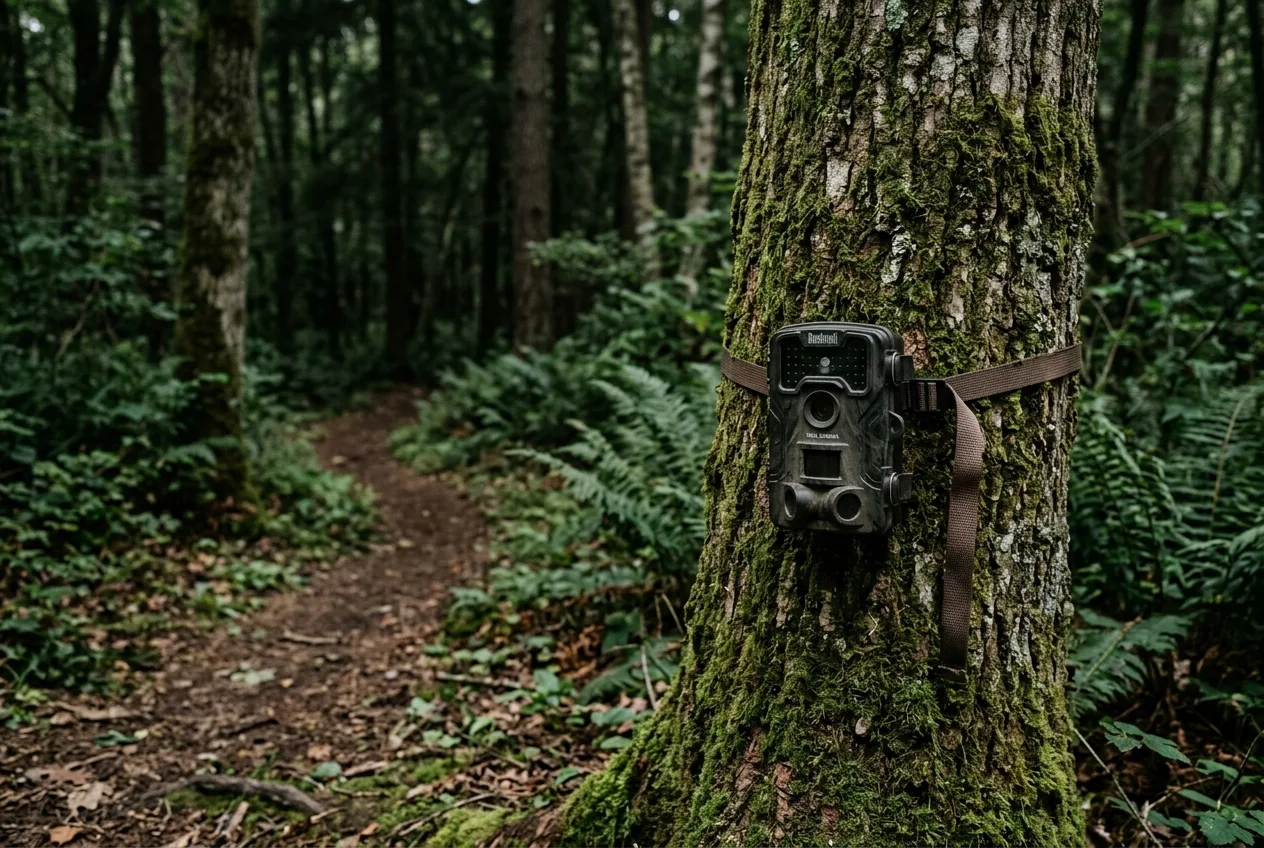
It's worth knowing what counts as proof, because it tells you what's worth collecting if you think you have a lion. Across agencies, the accepted evidence is consistent: a clear photo of the animal in a verifiable location; a measured photograph or plaster cast of a track; hair or scat that can be DNA-tested; or an unambiguous kill site. A description, however vivid, doesn't make the list — not because anyone doubts you, but because, as Missouri puts it, "a reported sighting can be very compelling," yet hard evidence is what confirms it.
Trail cameras have quietly become the backbone of this. Scroll any state's confirmed-sightings log and it's dominated by trail-camera images: Wisconsin's verified records are overwhelmingly field-camera captures, Tennessee's confirmed list is mostly "trail camera photo submitted by a landowner," and the Minnesota and Illinois breeding and dispersal confirmations came off cameras. Oklahoma notes that in areas with real lion populations, biologists routinely pull cougar photos from "the many motion-detecting game cameras that hunters use". A camera doesn't blink, doesn't overestimate size, and timestamps the evidence — which is exactly what a fleeting roadside glimpse can't do. It's the difference between I think I saw one and a verifiable, dated frame.
The same approach grounds the science on the other end of the hemisphere. In Patagonia, researchers establish how many pumas use an area not from sightings but from camera traps, collaring, and individual identification — one long-running Chilean program has collared 33 pumas and used 17 camera traps to estimate density and even map the social structure of the local cats. Presence, done right, is measured, not guessed.
If you do get something, report it to your local wildlife agency and, if there's a fresh kill or scat, tell them before you disturb it — they may want hair or a sample, and a timely report is what lets them confirm it. And know what happens next, because it's reassuring: most sighting reports don't even trigger a field visit, precisely because a lion passing through isn't a problem to be solved — agencies respond in person mainly to a pattern suggesting a safety issue or to a livestock depredation, where a cougar's "distinctive kill, caching, and feeding patterns" make a positive identification possible.
A clear word on safety, because the fear is the point
The reason this topic runs hot is fear, so it deserves a direct, proportionate answer. Attacks are genuinely rare. In the hundred years from 1890 to 1990, ten people died from cougar attacks in the entire US and Canada. Missouri notes fatal attacks have averaged about one every seven years since 1980 — against tens of thousands of annual traffic deaths and dozens from lightning, dogs, and bees. Minnesota offers the cleanest yardstick, and it travels to any market: even in California, with a population of well over 5,000 cougars, "a person is 1,000 times more likely to be struck by lightning than attacked by a cougar".
That's not a reason to be careless in cougar country, just a reason not to be afraid. If you ever do meet one, the guidance from the National Park Service and state agencies is consistent and simple:
- Stand up, stay calm, and face it. Don't run — running can trigger a chase. Make yourself look big: raise your arms, open your jacket.
- Don't crouch or bend over. Biologists think lions don't read a standing human as prey, but a person squatting or bent over "looks a lot like a four-legged prey animal" — so even picking up a child, stay upright.
- Pick up small children and pets and keep them close; their size and quick movements can draw a cougar's interest.
- If it's aggressive, get loud and throw things; if it attacks, fight back. People have driven off cougars with rocks, sticks, and bare hands.
- Never approach a kill or a female with kittens, and give any lion a clear escape route.
The everyday version, if you live where lions are resident: don't feed wildlife (you're really feeding the deer that draw the cat), keep pets in at dusk and dawn, secure small livestock at night, and keep brush cleared back from the house so nothing has cover to wait in.
The honest bottom line
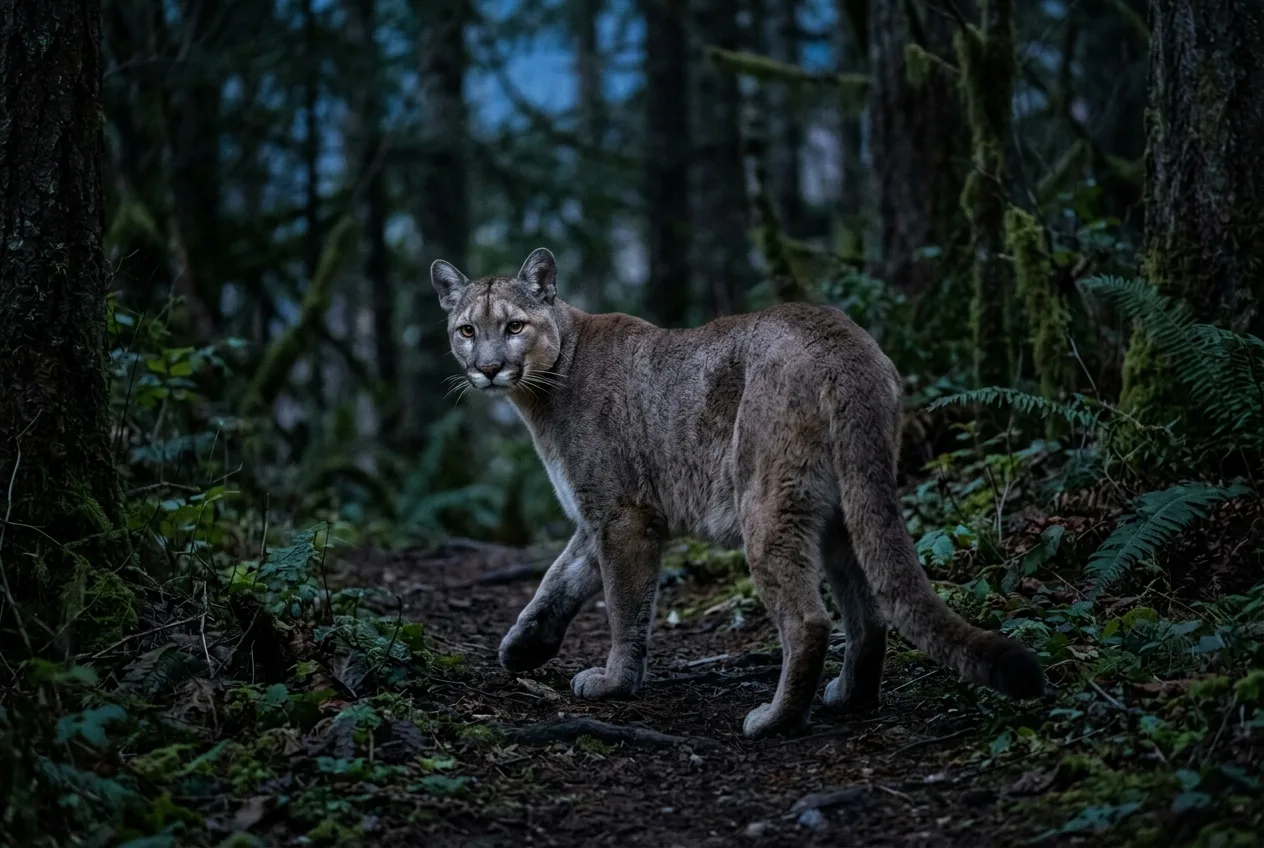
A mountain lion near you is possible almost anywhere in the Americas — the range is that vast — and in the West it's simply normal. But "near me" is doing a lot of work in that sentence. One cat's territory spans tens to hundreds of square miles, and a single young male looking for his own ground can cross a thousand miles and a dozen counties, lighting up sightings the whole way, while still being the only lion for a very long distance.
So don't settle the question from a glimpse. Settle it from the ground. Find a deer dragged under cover and buried, a line of clean three-lobed tracks walking a straight road, a fresh scrape on a ridge — and you have something real, worth reporting and worth respecting. Find a scratched tree and a vague tan shape at dusk, and you have a maybe that's statistically far more likely to be a bobcat or somebody's dog. Reading sign well is how you trade the anxiety for an answer.
Frequently asked questions
Do mountain lion tracks ever show claw marks?
Occasionally, yes — usually when the cat is running or slipping on difficult ground — but it's the exception, and "no claws" is not proof of a lion. Worn-nailed dogs and dogs on hard ground often leave no claw marks either. When a cougar does show claws they're thin and sharp; a dog's are blunt and broad. Trust the three-lobed heel pad and asymmetrical teardrop toes more than the claws.
What is the most reliable sign that a cougar is actually in the area?
A cached kill: a deer carcass dragged to a sheltered spot and deliberately covered with leaves, dirt, or snow, often with drag marks, and revisited over several days. Cats cache; coyotes and dogs don't. If you find a fresh one, leave the area — the lion is probably nearby and feeding — and report it.
How close does a mountain lion sighting mean one is "living" near me?
Less close than it feels. A resident cougar's home range covers tens to hundreds of square miles, so even a real resident may center its life several ridgelines away. And many confirmed animals — especially in the Midwest and East — are young males just passing through on a long dispersal, not residents at all.
Why do wildlife agencies confirm so few of the mountain lions people report?
Because confirmation requires physical evidence — a clear photo in a verifiable place, a measured track, DNA from hair or scat, or a classic kill site — and most reports are honest misidentifications of dogs, bobcats, coyotes, or house cats, often with size overestimated from a quick or magnified look. In Missouri, fewer than 1% of thousands of reports have ever met that bar.
Are mountain lions spreading back east?
Dispersing males have been reaching the Midwest and beyond for years, and there are now early breeding confirmations on the leading edge — females with kittens documented in Oklahoma (2024) and, for the first time in over a century, Minnesota (2026) and Michigan's Upper Peninsula. But across most of the East and Midwest there's still no established breeding population; the long-standing eastern exception is the Florida panther.
How dangerous is it to have a cougar nearby?
Statistically, very little. Fatal attacks are extraordinarily rare — even in California, with thousands of cougars, you're about 1,000 times more likely to be struck by lightning than attacked. Take sensible precautions in cougar country, but the appropriate response to confirmed sign is respect and awareness, not fear.