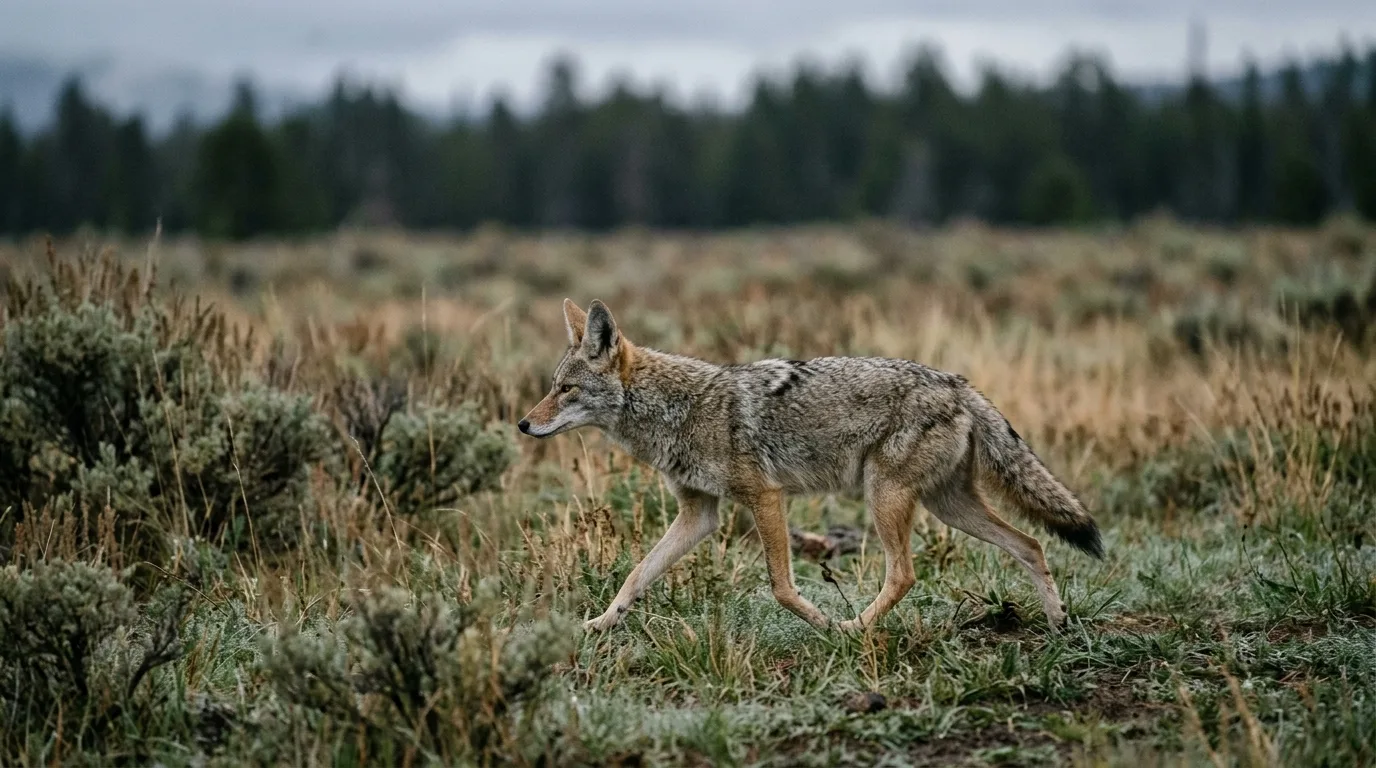
You walk out to the camera, pull the card, and there it is on frame 147: a gray, dog-shaped animal slipping through the brush at the edge of the field. Pointed face. Big ears. A tail that hangs down. Your first thought is coyote. Your second thought, because the internet has trained all of us to escalate, is wait — could that be a wolf? And your neighbor, when you show him, squints and says it's probably just somebody's loose husky.
So which is it?
Here's the honest starting point, the one every wildlife biologist and wolf-org field guide says before anything else: no single feature settles it. A single photo rarely shows you size cleanly, and the one trait people reach for first — coat color — is close to useless on its own. But a small handful of features, read together, will get you most of the way there fast. There's even a number on that idea: if an animal shows at least 8 out of 10 wolf characteristics, it's very likely at least part wolf — and in genuinely tricky cases, only DNA can confirm it. That "look at the whole package" rule is the spine of this whole guide.
For most readers in most places, the math also tilts the answer before you even zoom in. There are well over a million coyotes in North America and only about 5,500 wolves in the Lower 48, plus 8,000 to 11,000 in Alaska. Coyotes now live in 49 of the 50 U.S. states — Hawaii is the lone holdout — having expanded their range by an estimated 40% since the 1950s, at least twice as fast as any other North American carnivore, until they now range from the Atlantic to the Pacific and from Alaska to Panama. So if you're not in known wolf country, the smart prior is simple: a big wild canid is far more likely a coyote (or a dog) than a wolf. We'll come back to that, because where you are turns out to be one of your best clues.
Let's build the package, feature by feature, then put it back together into a way to actually decide.
Start with location: is a wolf even on the table?
Before you argue about ear shape, ask whether a wild wolf is even plausible where your camera sits. It usually isn't.
Gray wolves were once one of the most widely distributed mammals on Earth. After a century of habitat loss and persecution, they now occupy only about 10 percent of their historic range in the contiguous 48 states. The populations that remain are concentrated, and you can practically draw them on a map: the western Great Lakes (Minnesota around 2,900 wolves, Wisconsin roughly 1,200, Michigan's Upper Peninsula about 760), the Northern Rockies (Idaho, Montana, Wyoming), a scatter on the Pacific side (Oregon, Washington), the Mexican gray wolves of Arizona and New Mexico, and the red wolves barely hanging on in North Carolina. Alaska is its own world, with thousands.
Outside those regions, a wolf is a long shot. The practitioner who runs the Minnesota Women's Woodland Network guide says it plainly: in her state, wolves live in the forested northeast, while coyotes are common everywhere — and once you're into farmland or suburbs, especially in the south, your odds of a real wolf "greatly decrease". Massachusetts is even blunter: when people there ask wolf-or-coyote, Mass Audubon's answer is that wolves are bigger and a touch darker, "but there are no wild wolves left in Massachusetts". The International Wolf Center makes this step one of its own ID flowchart — before you use its feature guide at all, "check the range map to see if you live near wolf range".
So: if you're in occupied wolf range, keep "wolf" on the table and read carefully. If you're not, you can mostly collapse the question to the one that actually matters for most people — coyote vs dog — and treat a confident "wolf" ID with real skepticism.
Size and build: useful, but quietly deceptive
Size is the first thing everyone reaches for, and it's genuinely informative — wolves are roughly twice the size of coyotes. The trouble is that a photo flattens scale, animals don't pose next to yardsticks, and the numbers themselves shift with geography and season.
The broad strokes, pooled from several agencies: a coyote stands under two feet at the shoulder and runs maybe 20 to 50 pounds; a wolf stands two and a half to three feet and weighs anywhere from about 60 to 120-plus pounds, with Alaskan wolves reaching 145. The International Wolf Center pins coyotes at 20 to 50 pounds and gray wolves at 60 to 130. Whatever exact range you trust, the gap is real — a wolf is a much bigger animal.
But two things make raw size a trap on camera.
First, coyotes look bigger than they are. A thick winter coat puffs them up; the surprise of seeing a wild canid in a neighborhood inflates the memory. The Portland Urban Coyote Project, which has watched these animals for years, still finds itself startled by how large they seem — and then reminds everyone that a Western coyote weighs about what a Whippet or a small Border Collie does, 25 to 40 pounds, "not German Shepherd". Coyotes simply photograph heavier than the scale would say.
Second, size depends on which coyote and which moment. Eastern coyotes are genuinely larger than Western ones — on average about 10 pounds heavier, a Maine biologist told Outdoor Life. In Pennsylvania, adult male Eastern coyotes run 45 to 55 pounds and are "the largest canine found in Pennsylvania". And wolves cut the other way: a young wolf can be coyote-sized, which, as Outdoor Life's experts warn, "complicates matters". Pup season makes it worse — from roughly May to October, growing wolf pups are on the landscape and "size can be less reliable for identification".
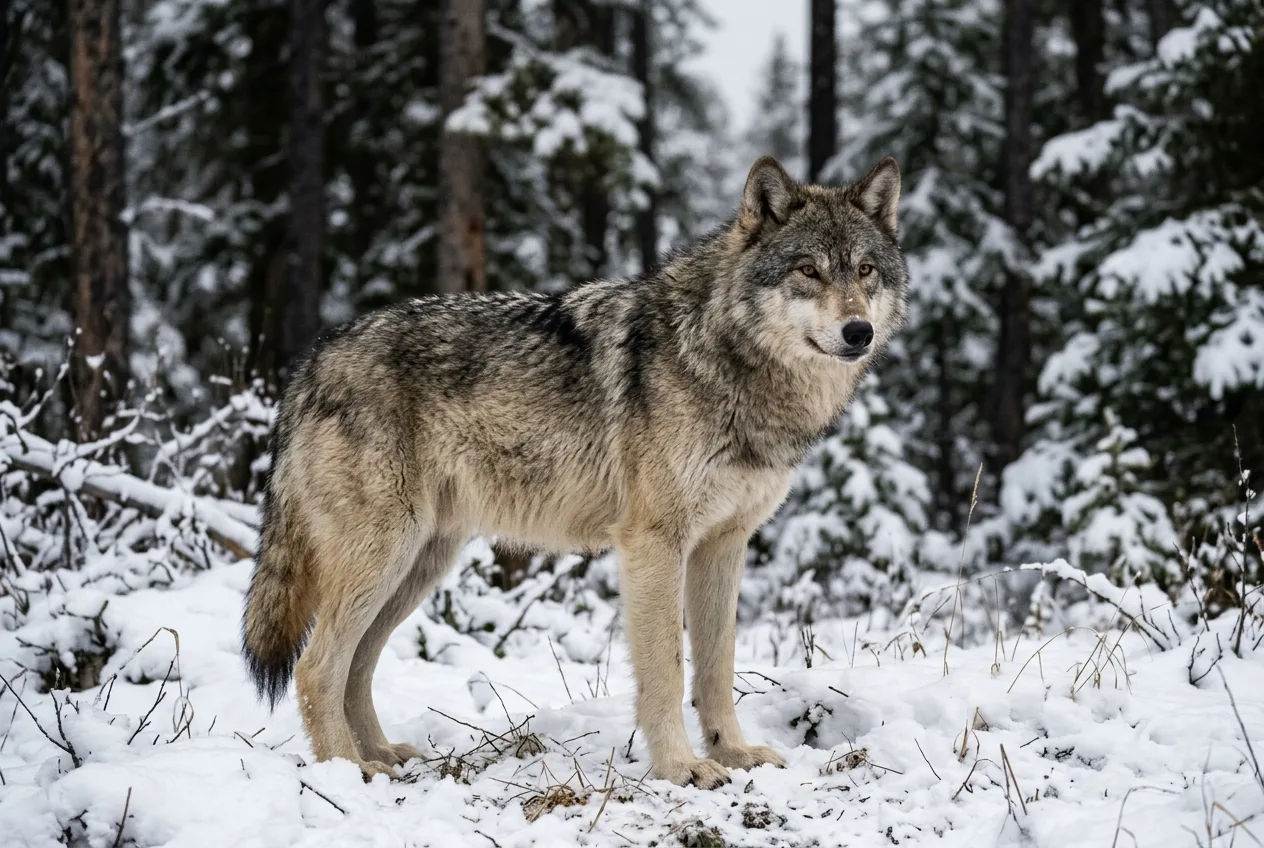
This is why experienced observers stop trusting the number and start trusting the shape. Picture the silhouettes. A wolf is built like an endurance athlete: long legs, a deep chest, big feet, a thick neck, a head that reads heavy and blocky. A coyote is a lightweight runner — narrow chest, slim legs, a delicate, "leggy and light" frame, longer from nose to tail than it is tall, almost fox-like. Outdoor Life's biologist sums the practical move up perfectly: instead of relying on size alone, "look at the build of the animal".
There's a clean way to feel the difference. As the Minnesota guide notes, put a 100-pound wolf next to a 100-pound dog and the wolf still "will appear significantly larger" — because the wild animal is built differently, all leg and chest and foot. Wyoming Game & Fish offers the same idea as a memory hook: in dog terms, a wolf is like "a streamlined Saint Bernard," a coyote more like a Border Collie.
Ears and snout: the tells that survive a bad photo
If size is the trap, the face is the rescue. Ear-to-head ratio and snout shape hold up even in a grainy, sizeless frame, and they're where I'd send a beginner first.
Start with the ears, because they're almost counterintuitive. A coyote's ears are large for its head; a wolf's are small for its head. The Iowa/Wisconsin DNR factsheet drives this home with the line that sticks: a 30-pound coyote "can have ears as big or bigger than an 80-pound wolf". So big, prominent, sharply pointed ears on a wild canid point toward coyote; modest, rounded ears on a big-headed animal point toward wolf. The International Wolf Center says it the same way — coyote ears are large relative to the head with pointed tips, wolf ears small relative to the head with rounded tips.
Now the snout. The wolf's muzzle is broad and blocky; the coyote's is narrow and pointed. Wisconsin's biologists call the snout a "distinguishing feature" outright — blocky wolf, pointed coyote. Pair it with the head: a coyote's head reads small and triangular, a wolf's large and heavy.
Put those two together — big ears on a narrow, pointed face — and you've got a coyote signature that a husky or a German shepherd almost never fakes cleanly. Which brings us to the animal people forget to rule out.
Put those two together — big ears on a narrow, pointed face — and you've got a coyote signature that a husky or a German shepherd almost never fakes cleanly.
The one everyone forgets: it's probably a dog
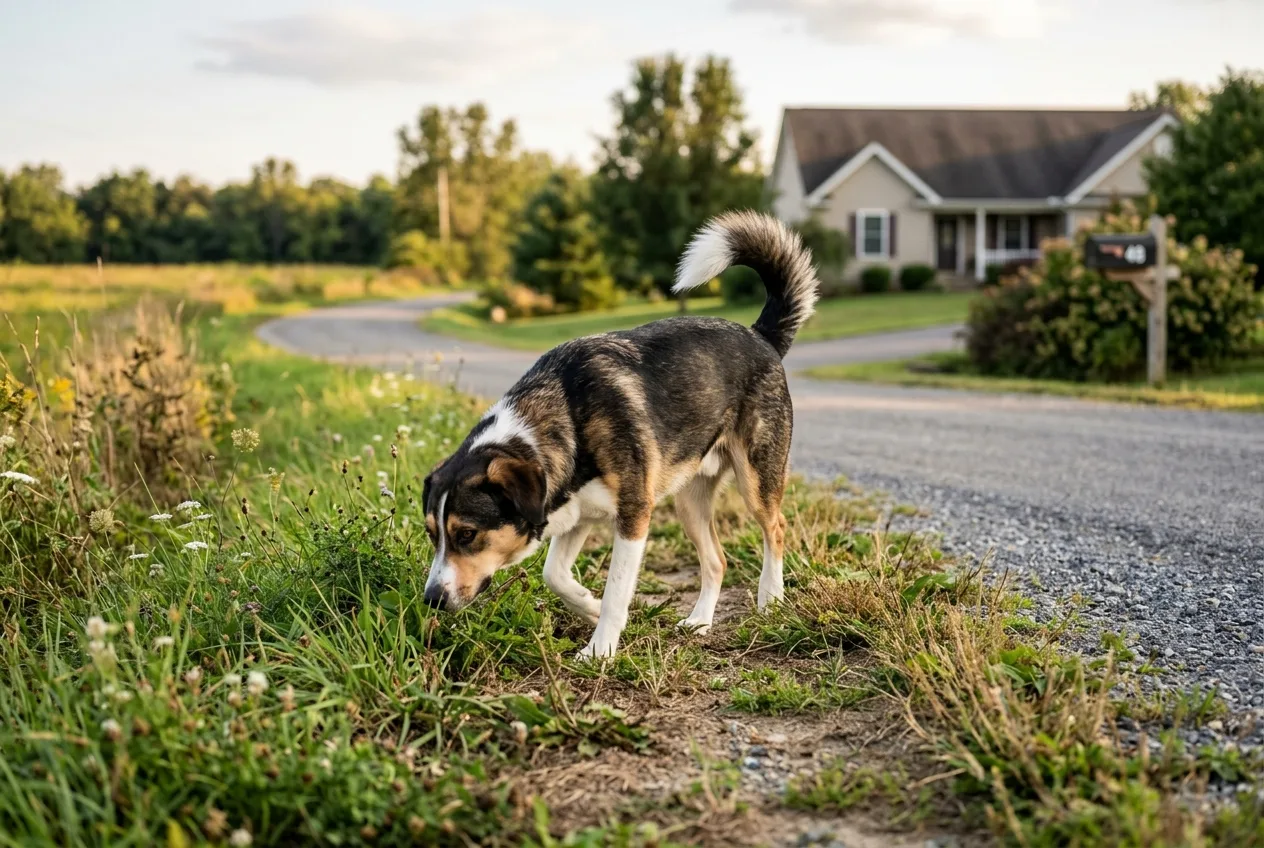
Here's the uncomfortable truth behind a huge share of "is that a coyote/wolf?" photos: it's a dog. And dogs are the hardest of the three to pin down by appearance, because we bred them into every shape imaginable. The Wolf Center's field guide is candid that with dogs the giveaways are about things being "off" for a wild canid: very short legs, an over-bulky chest, tiny feet for the body, a flat face, floppy or oddly shaped ears, or a curly tail. A wild canid has wild-canid proportions; a Corgi or a bulldog or a Pomeranian does not.
When a dog does mimic a coyote's general size and pointed-eared look — and some do, convincingly — the tail and the chest break the tie.
- Chest and stance. Domestic dogs tend to be broader through the chest, which gives them a wider stance than a coyote or wolf. Wolves, by contrast, look "disproportionately lankier with larger heads" than most dogs.
- The tail (read the next section — it's the single best dog tell).
- Coat. Dogs come in patterns and color blocks that wild canids don't — a saddle, a bib, white socks, patches. The International Wolf Center lists "patterned coat colors" as a dog flag.
- Behavior. Dogs act like dogs. The Wolf Center calls it "pet logic": wandering near homes and trails, approaching people, responding to voices, doubling back, breaking into a sudden sprint, following a scent with no clear travel line.
That last point matters more than it sounds, and it shows up beautifully in the science of how dogs use space. A four-country study of free-roaming dogs — animals with no leash and plenty of freedom — found their core home ranges were tiny and remarkably consistent: medians of roughly 0.25 to 0.33 hectares, with extended ranges of about 5.6 to 7.7 hectares. Even "free-roaming" dogs, the authors note, are "not completely under human control but, contrary to wildlife, they strongly depend upon humans". A wild coyote or wolf ranges over square miles; a loose dog orbits a house. If your "wolf" keeps reappearing on the same camera near a road or a yard, day after day, that's a dog's footprint, not a wolf's.
A wild coyote or wolf ranges over square miles; a loose dog orbits a house.
Tail carriage: the fastest single clue
If I could keep only one quick clue, it'd be the tail — because it's visible the instant the animal walks by, and the three species carry it differently.
A coyote's tail is bushy with a black tip, and it hangs down. The Portland project gives the best description I've found: the tail looks "like a paintbrush, the tip often dipped in black ink," it's held straight or low, it "often ends around the ankle," and — critically — it does not touch the ground. Pennsylvania calls it a "bottle-brush tail" held in a downward position. Mass Audubon: bushy, black-tipped tails "that hang down when they run". When running, a coyote carries that tail low; a wolf tends to carry its (shorter, heavier) tail more horizontally.
A dog, on the other hand, often carries its tail high — up, curled over the back, wagging, or flagging. That single difference rules out a lot. As the Portland guide puts it, "You'll never see a coyote's tail held high or wagging. If you see that, you are probably looking at a dog". Even a coyote with a stubbed or missing tail "won't hold it high above their back". Most domestic dogs also show a curved or curled tail tip, which wild canids lack. So: low, straight, black-dipped paintbrush that floats above the ground = coyote/wolf; high, curled, or wagging = dog.
One worthwhile aside, because it trips people up: a fox is not a coyote. A red fox's tail is bushier and much longer in proportion, and it "drapes all the way to the ground" — where a coyote's stops at the ankle. Foxes are also smaller and shorter-legged. An adult coyote is "more than double the size" of a gray fox.
Gait: the strongest tell of all — if you've got video
Here's the clue the field experts rate highest, and it's the one a trail camera is uniquely good at catching: how the animal moves. A still frame can hide size and lie about color. A few seconds of video can't hide a gait.
Wolves move like they're going somewhere. The Wolf Center describes a "steady ground-eating trot," efficient, in a straight line, "minimal bounce" — an animal that "looks like it can travel forever". The International Wolf Center calls the wolf's stride "smooth" and "deliberate," versus a coyote's walk, which is "light-footed and bouncy". Wyoming's biologist says the same: wolves trot with a smoother gait and longer stride; coyotes have a "bouncier, punctuated trot" because of their shorter build. So a coyote looks busier, quicker, more bounce, more direction changes; a wolf looks calm and metronomic.
And dogs? Dogs wander. This is the oldest trick in the canid-tracking book, and the agencies all cite it: wild wolves and coyotes travel in a "purpose-driven straight line" from A to B, while domestic dogs "meander, sniff, chase squirrels, and bound back to their humans". WDFW: a wolf's path shows "a direct, energy efficient or purposeful route," whereas a dog's path "often meander[s]". On video, a wild canid is on a mission; a dog is on a stroll.
On video, a wild canid is on a mission; a dog is on a stroll.
What the tracks and scat say (when the animal's already gone)
Sometimes you don't have a photo at all — just prints in the mud or scat on the trail. These corroborate, and they're worth knowing.
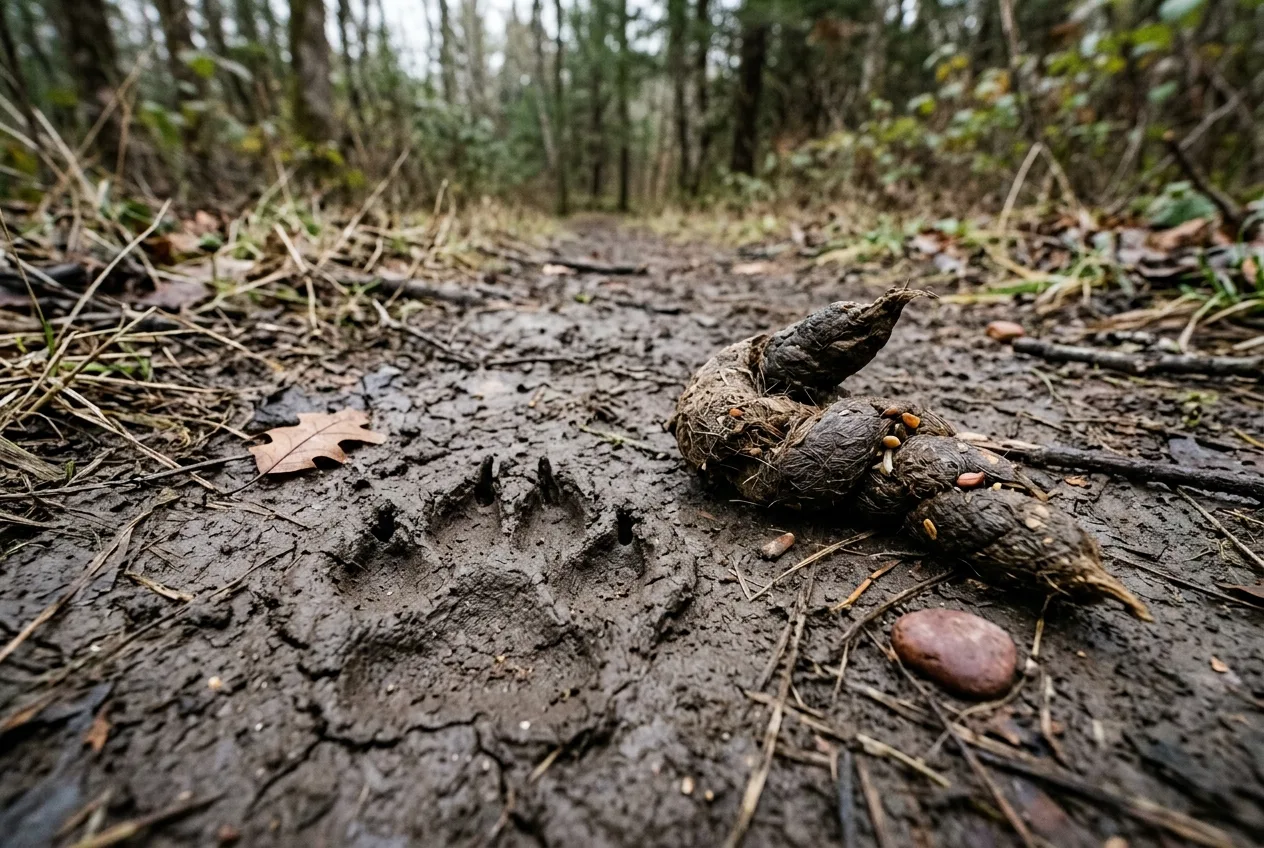
Tracks. Canid tracks are longer than they are wide, more symmetrical than a cat's, with four toe pads and claw marks usually showing (cats retract their claws) and a triangular palm pad. Size separates the canids: a wolf's front track runs about 5 inches long by 4 wide; a coyote's is roughly half that. The National Park Service's Mount Rainier guide gives the measured ranges — wolf front tracks about 3.5 to 5 inches long, coyote front tracks about 2 to 3 inches, matching Outdoor Life's rule of thumb of "approximately 4 inches versus 2.5 to 3 inches across". Telling a big dog's track from a wolf's is harder, but two things help: wolf tracks tend to look longer and narrower while dog tracks look rounder, with the dog's toes splaying outward; and the NPS notes the dead-giveaway context clue — a "wolf" track running alongside human footprints is a dog.
Scat is, if anything, easier. Wolf scat is cylindrical, often over an inch in diameter (up to 1.5 inches and 4 to 7 inches long), and laced with the tapered hair of deer or other large prey. Coyote scat is usually under an inch across, often full of small-mammal hair, and frequently dropped right in the middle of a trail as a territorial sign — commonly with berries or seeds visible in it. Domestic-dog scat stands apart by what's missing: little hair, no tapered fringe, and often full of "cereal matter" from kibble.
Color: trust it least
We've saved the trait everyone reaches for first for last, because it deserves to be demoted. Coat color is the least reliable clue you have, and treating it as decisive is the single most common way people get this wrong.
All three species overlap heavily. Wolves come in gray, black, white, tan, even a bluish cast in old animals. Coyotes run from "light blond to reddish blond to gray" to nearly black, often "gray to a German shepherd coloration" with rusty legs and a pale throat. And dogs, of course, come in literally anything. The expert behind the Minnesota guide says it from direct experience: "many guides state that wolves are light gray to black and coyotes are light gray to brown," but "coat colors can vary widely across both species". The Wolf Center's rule is the one to remember: "Wolves are not always gray. Coyotes are not always 'tan.' Dogs can be anything. Use color only as a secondary clue". Color can support an ID built on shape, ears, snout, tail, and gait. It should never lead one.
Color can support an ID built on shape, ears, snout, tail, and gait. It should never lead one.
A field-ready way to decide
Put it back together and you have a quick mental checklist — the "whole package" the experts keep insisting on:
- Where am I? Not in known wolf range? Then it's almost certainly coyote or dog; be very skeptical of "wolf".
- Tail: Low, straight, black-dipped, floating above the ground → coyote or wolf. High, curled, or wagging → dog.
- Ears vs. head: Big, pointed ears on a small triangular head → coyote. Small, rounded ears on a big blocky head → wolf.
- Snout: Narrow and pointed → coyote. Broad and blocky → wolf.
- Build: Lightweight, leggy, narrow-chested → coyote. Long-legged, deep-chested, big-footed → wolf. Off-proportioned (very short legs, barrel chest, tiny feet, patterned coat) → dog.
- Gait (if you have video): Bouncy and busy → coyote. Smooth, straight, tireless → wolf. Meandering, sniffing, doubling back near people → dog.
- Color: Use only to confirm, never to decide.
A note on "coywolves," coydogs, and other ID rabbit holes
If you've read this far, you've probably heard that Eastern coyotes are part wolf and part dog — and you may have seen the word "coywolf." A little clarity here will save you from over-thinking the next big coyote you photograph.
Eastern coyotes really are hybrids. Genetic work shows that as they expanded east about a century ago — when Great Lakes wolves were so scarce that some couldn't find a wolf mate — coyotes interbred with wolves, and somewhat later picked up dog genes too. The dog contribution came in mostly through male dogs long ago, then got diluted by generations of backcrossing into coyotes. The result is a slightly larger, more variable Eastern coyote: in the Northeast, the genetic mix runs roughly 60–84% coyote, 8–25% wolf, and 8–11% dog, sliding toward more dog and less wolf as you move south.
But two myths deserve to die. First, "coywolf" is a misnomer. As the NC State zoologist who has studied these animals puts it: "There are no animals that are just coyote and wolf… The coywolf is not a thing". They're coyotes with a dash of wolf and dog, not a fifty-fifty blend. Pennsylvania's Game Commission likewise flags "coy-dog" as a misnomer for the Eastern coyote. Second, living "coydogs" are vanishingly rare. Coyotes are seasonal breeders and mate for life — "they stay mated together until one of them is dead," the Chicago researcher Stan Gehrt says, and over an entire career he documented only two genetically confirmed first-generation hybrids, both born in captivity. So that odd-looking canid on your camera is almost never a fresh dog-coyote cross; it's far more likely just an Eastern coyote showing the normal range of coyote variation.
The takeaway for ID is simple: you don't need to solve the genetics. An Eastern coyote still reads as a coyote — upright pointed ears, long muzzle, the same short bushy black-tipped tail — just a bit bigger. Identify it as a coyote and move on.
Frequently asked questions
Is that a coyote or a dog?
Look at the tail and the chest first. A coyote carries a bushy, black-tipped tail low and straight — floating just above the ground, never high or wagging — and has a narrow chest, a pointed muzzle, and big pointed ears for its head. A dog usually carries its tail high or curled, has a broader chest, and often wears patterned coloring; it also tends to meander and approach people rather than travel in a purposeful line. When in doubt, behavior near homes and roads is a strong dog tell.
Is that a coyote or a wolf?
Mostly, it's a coyote — wolves number only about 5,500 in the Lower 48 and live in a few specific regions, while coyotes are in 49 states. Where both occur, a wolf is much larger and blockier with small rounded ears, a broad muzzle, long legs, and a smooth, straight-line trot; a coyote is lighter and leggier with oversized pointed ears, a narrow pointed face, and a bouncier gait. Remember that a 30-pound coyote can have ears as big as an 80-pound wolf.
Can you tell a coyote from a wolf by size in a photo?
Not reliably on its own. Photos hide scale, coyotes look heavier than they are because of thick fur, Eastern coyotes are bigger than Western ones, and young wolves can be coyote-sized — especially during the May-to-October pup months. Use proportions instead: leg length, chest depth, ear-to-head ratio, and snout shape.
Why isn't coat color a good way to identify wild canids?
Because all three species share the same palette. Wolves and coyotes both range from light gray and tan to black, and dogs can be any color or pattern, so color alone proves nothing. An expert tracker's rule: use color only as a secondary clue, after shape, ears, snout, tail, and gait.
What is a "coywolf," and is it real?
Eastern coyotes do carry some wolf and dog DNA, but a true 50/50 "coywolf" doesn't exist — they're mostly coyote (often 60–84%) with smaller wolf and dog fractions. As the biologist Roland Kays wrote, "The coywolf is not a thing". For identification, treat an Eastern coyote as a (slightly larger) coyote.
How can tracks help me tell these animals apart?
A wolf's front track is about 5 inches long; a coyote's is roughly half that, and a big dog's tends to look rounder with splayed toes. Canid tracks show claw marks and a triangular pad. The best context clue: a "wolf" track running next to human footprints is almost certainly a dog.