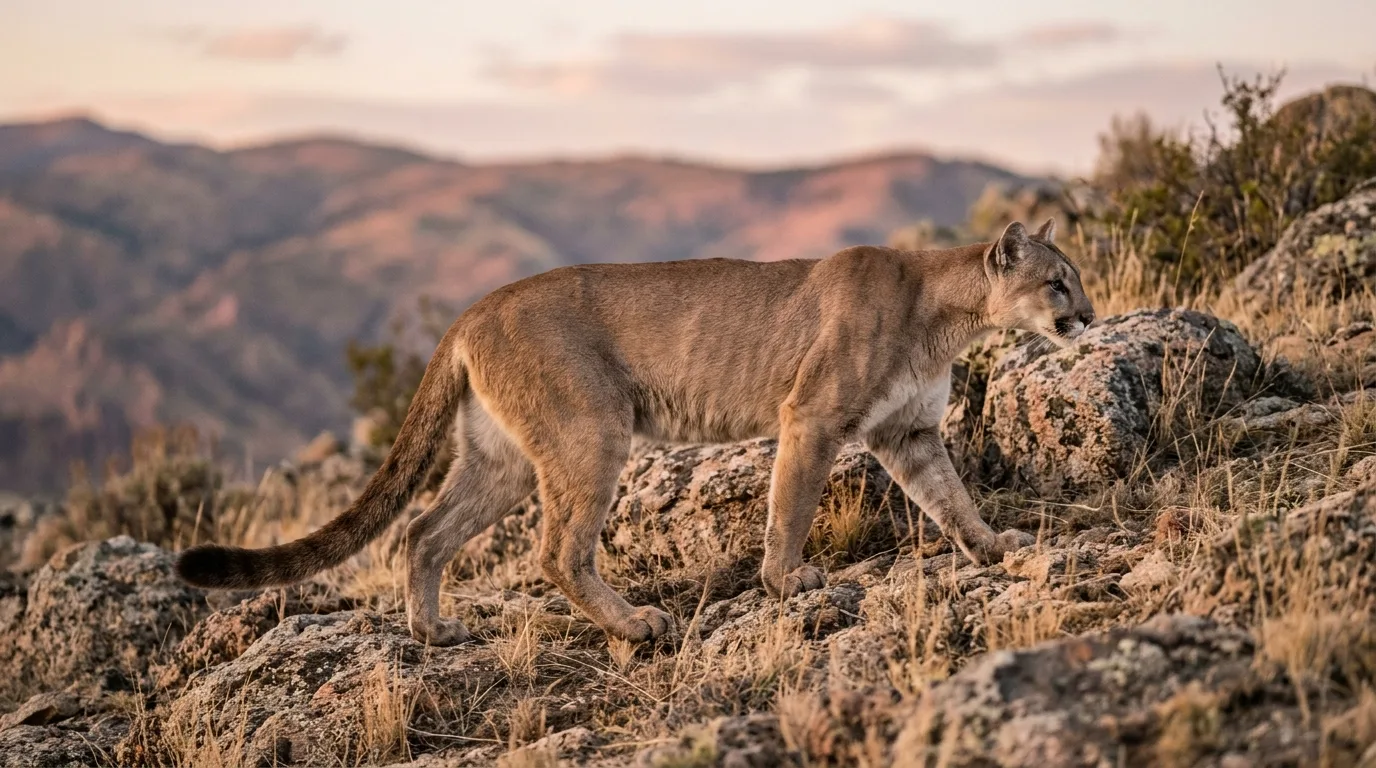
Here is the uncomfortable truth most "I saw a mountain lion" stories run into: the photo on your phone almost certainly isn't one. The Mountain Lion Foundation estimates that up to 90% of reported sightings turn out to be something else entirely. A grainy nighttime frame, an animal half-hidden in brush, a jolt of adrenaline that makes everything look bigger — and a bobcat, a big orange house cat, or the neighbor's Labrador becomes an apex predator. Trail cameras have only fed the fire. They catch wildlife people never used to see, and they catch it in exactly the conditions that make a cat hard to read: dim light, odd angles, no clean sense of how big the animal really is.
So let's settle the bobcat vs mountain lion question the way the people who verify these sightings for a living actually do it. The good news is that once you know what to look for, the two cats are not subtle. A mountain lion and a bobcat are built on completely different blueprints, and one feature gives it away nearly every time.
Start with the tail — it ends most arguments
If you take one thing from this article, take this: look at the tail. A mountain lion's tail is long, thick, and ropey, trailing well behind the body; a bobcat's is a short stub. The Mountain Lion Foundation calls the tail "perhaps their most defining identifying characteristic," noting it can run about a third of the animal's body length. The Nature Conservancy puts it about as plainly as it can be put: "A mountain lion's tail is long; the bobcat's is short. That should immediately rule out the possibility of most misidentification".
The numbers back up the eyeball test. State agencies describe the mountain lion's tail as roughly 2.5 to 3 feet long, up to 36 inches, and "about one-third" of the cat's overall length. A bobcat's tail is a different category altogether — under 10 inches in Iowa's side-by-side, typically 4 to 6 inches in California's description, a "stubby, 6-inch tail" in Pennsylvania. The bobcat literally takes its name from that bobbed tail. On a trail-cam frame, that contrast is usually unmistakable even when nothing else is: a heavy rope versus a stump.
A small honest caveat on length. Most western agencies peg the lion's tail at roughly a third of its body; a couple stretch the range, with Oregon calling it "a third to a half of its total length" and Oklahoma saying "more than half the length of the body". Don't get hung up on the exact fraction. The point that every source agrees on is direction, not arithmetic: it's long and it hangs low and heavy. Washington describes the cat carrying "its heavy tail in a wide U shape" as it walks; Indiana describes a "long rope-like tail" with a "blunt, black tip that is held low, not uplifted". A short, upright, or curled-over-the-back tail is not a mountain lion.
A short, upright, or curled-over-the-back tail is not a mountain lion.
Then check the size — but don't trust it blindly
A mountain lion is a genuinely big animal. Adult males average around 140 pounds and can top 180 in rare cases, standing about 30 inches at the shoulder and stretching 7 to 8 feet from nose to tail tip. The Mountain Lion Foundation's quick gauge: "Mountain lions are big. They can weigh anywhere from 75 pounds (a young female) to 200 pounds (a full-grown male)". Different regions cite different ceilings — California lists males "up to 170 pounds", a National Park Service page in South Dakota notes males "over 180 pounds", and Illinois shows an outer range stretching to 240 — but the shape of the animal is consistent: a long, large cat the rough size of a German shepherd or bigger.
A bobcat is a quarter of that. California spells it out directly — "Bobcats are approximately one quarter the size of mountain lion" — with adults generally 12 to 25 pounds. Most fact sheets land in the same window: 10 to 40 pounds, 18 to 24 pounds with big males to 35 in Pennsylvania, 15 to 30 in Indiana's comparison. A bobcat is bigger and beefier than a house cat, two to three times its size with a more muscular build, but it is nowhere near lion-sized.
Here's the trap, and it's the whole reason these get confused on camera: a photo rarely tells you how big the animal is. The Nature Conservancy nails it — "One challenge can come with trail cameras, as the images can be less-than-clear and it may be difficult to tell scale". A bobcat ten feet from the lens can fill the frame like a giant; a far-off lion can look pocket-sized. This is why agencies that field these reports keep hammering on context. Indiana flat-out tells people to "factor in the size of items or vegetation near the animal you observed to help estimate the observed animal's size," and warns that binoculars or a scope "can magnify an animal's size". The Mountain Lion Foundation's advice for a real sighting is the same: gauge the animal's height "compared to the trees and vegetation behind" it. With a trail camera you have an advantage — the scene is fixed, so a fencepost, a log, a tuft of grass you can measure later becomes your ruler.
The coat: uniform tawny versus spotted and barred
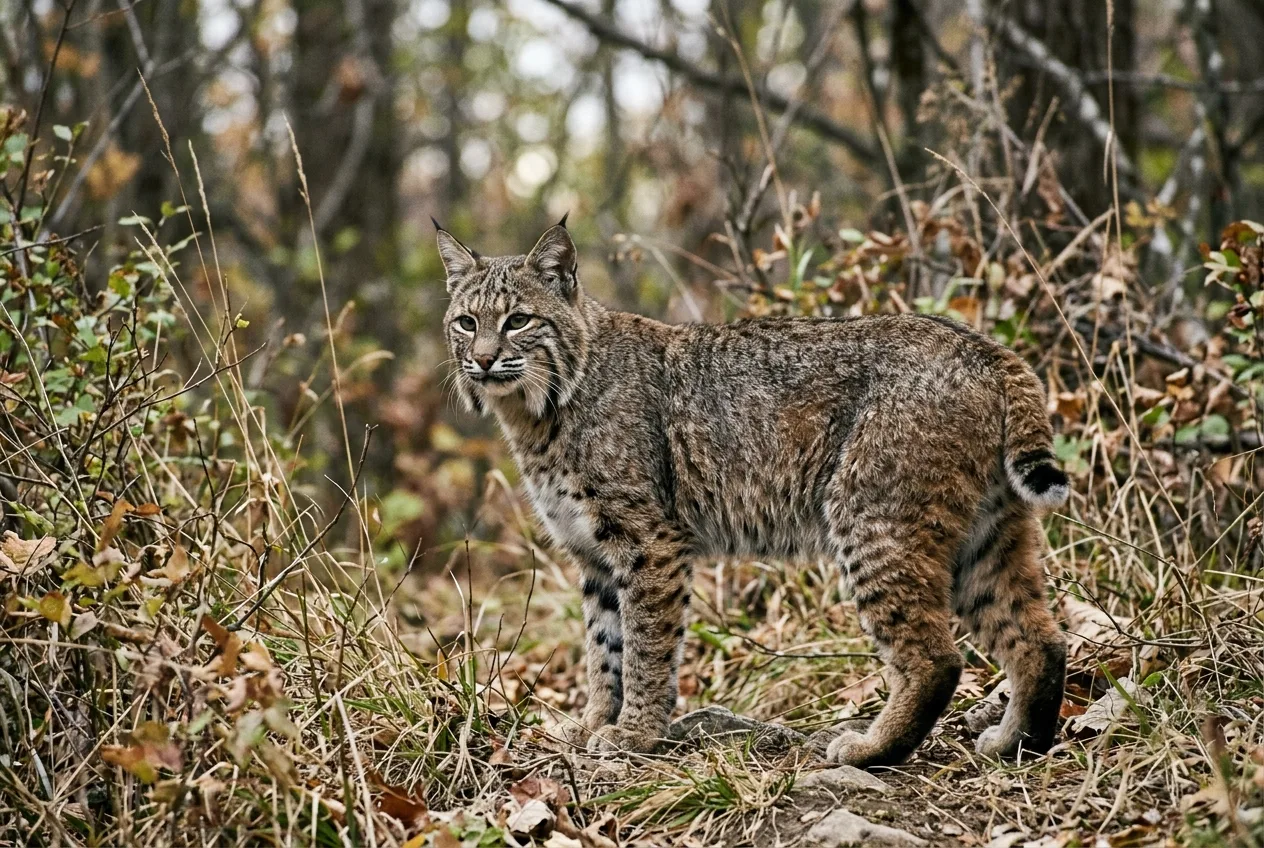
Color and pattern are your third pillar, and they're easy to read once you know the rule. A mountain lion is, more or less, one color. Its scientific name Puma concolor literally means "cat of one color". Adults are a plain tawny, tan, or light-cinnamon coat with a white chest and belly, a black-tipped tail, and black on the backs of the ears. No spots, no stripes, no bars. As the Mountain Lion Foundation puts it, lions "are usually tawny in color with no stripes or markings".
A bobcat is the opposite — it wears its markings. The coat is brown to gray, broken up by black spots and bars that are "especially noticeable on the legs", with a white, black-spotted belly. One wildlife rescue that handles bobcats regularly is blunt about it: "Bobcats essentially always have spots," whether as leopard-like rosettes, bold solid spots, or "misty freckles". If your cat is clearly patterned — spotted flanks, barred legs — it's a bobcat, not a lion.
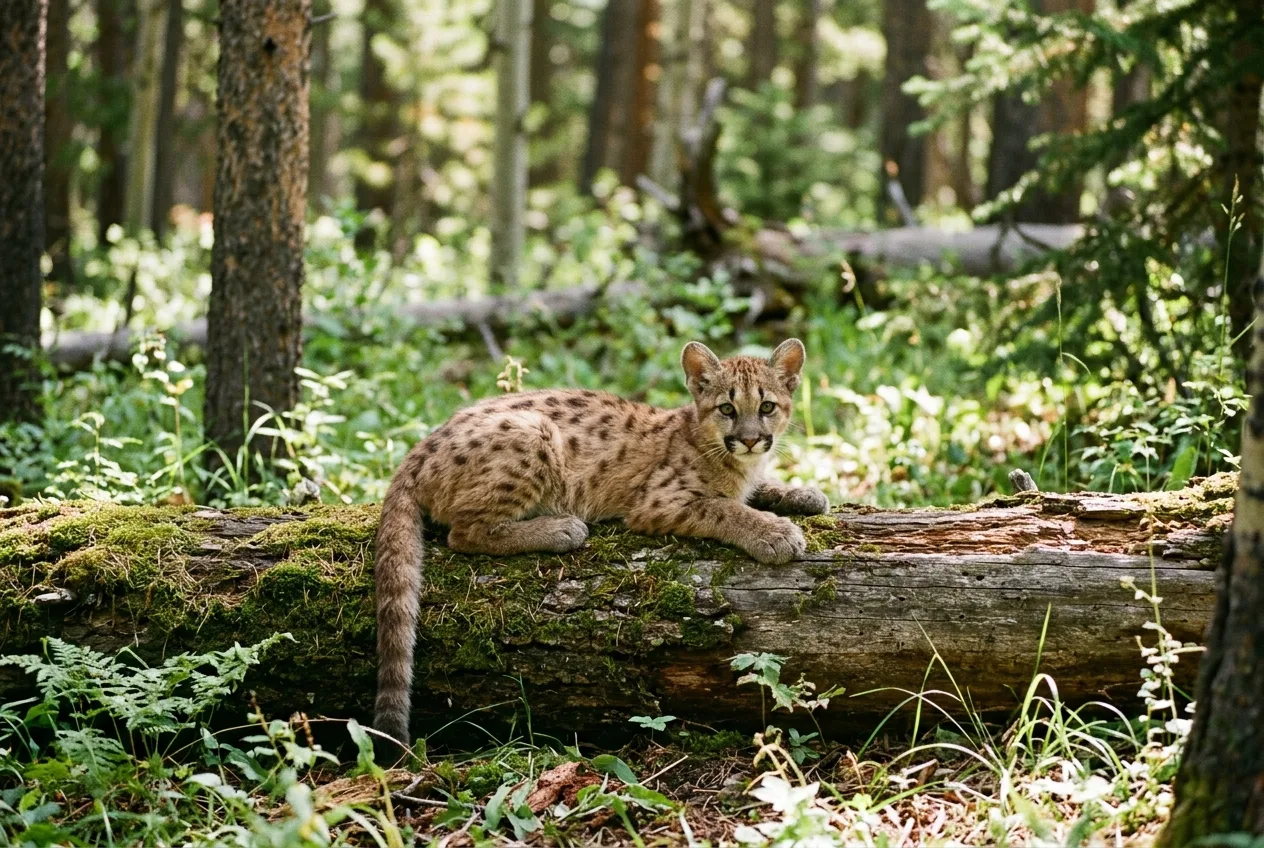
There's one important exception that trips people up, and it cuts the other way. Mountain lion kittens are spotted. They're born heavily spotted for camouflage, and those spots fade slowly — starting to dapple around three months and lingering, faintly, up to a year or even two. So a spotted cat could be a lion cub. The tail saves you here too. As that South Dakota park page notes, bobcats "can be mistaken for young mountain lion cubs," but the bobcat "has a much shorter, stumpy tail". A spotted cat with a long rope of a tail is a lion kitten; a spotted cat with a stub is a bobcat.
Ears and face: the bobcat's tell
Get a clear look at the head and the bobcat gives itself away in two more places. Its ears are pointed and topped with short dark tufts, and the backs of those ears are black with a bright white spot in the center. Those white spots aren't decoration — one rescue describes them as "false eyes" that help intimidate rivals and help kittens follow their mother. The face is framed by long fur on the cheeks, a "ruff" that reads like sideburns.
A mountain lion's head is plainer and, in proportion, smaller — Indiana describes "oval heads" that look small relative to the body. The ears are rounded, not tufted, dark on the back, and crucially without the white spot. Illinois draws the line cleanly: the lion's ears are "rounded; no ear tufts; backside of ear dark with no white spot," while the bobcat's are "tufts make ears appear pointed; backside of ear dark with white spot". Tufted ears with white spots and bushy cheeks = bobcat. Rounded, plain, dark ears = lion.
Tufted ears with white spots and bushy cheeks = bobcat. Rounded, plain, dark ears = lion.
When the photo's no good, read the ground instead
Plenty of trail-cam frames are just too dark or too blurred to call. That's when tracks and scat earn their keep, and Iowa's advice is worth taping to your camera: "Try to use tracks and scat to aid in your identification efforts!".
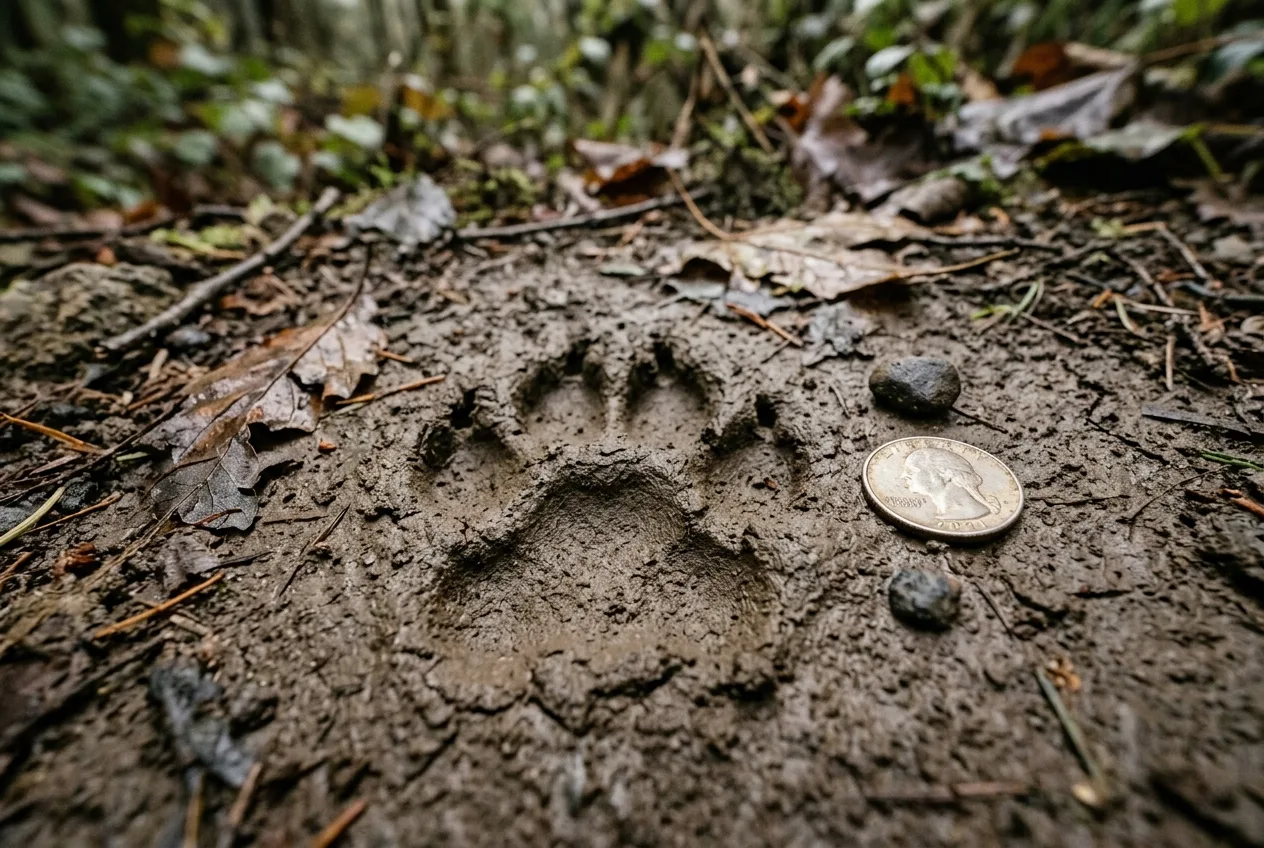
A cat track is round and clawless. Both bobcat and lion keep their claws retracted to stay sharp, so a clean print shows toes and pad but no nail marks — the opposite of a dog or coyote, whose claws print plainly. A mountain lion track is big, "about the size of a baseball, 3 to 3½ inches in diameter", with Missouri putting it at 2¾ to 3¾ inches wide. Two cat-specific details to look for: the heel pad shows three lobes along its bottom edge (dogs show a single indent), and the toes are teardrop-shaped and set asymmetrically rather than the oval, even arrangement of a canine. Washington and Oregon describe that heel pad as forming an "M" shape.
A bobcat track is the same shape but much smaller — under 2 inches wide, roughly 2 to 2½ inches in Illinois' chart. Missouri offers the cleanest rule of thumb for separating a big bobcat from a small lion: a bobcat's track is "less than 2 inches wide—which is smaller than the print of a 6-month-old mountain lion kitten". Even a half-grown lion outprints a full-grown bobcat.
I'll be straight about the limit, because the agencies are. Iowa notes that "the tracks from a small mountain lion and a large bobcat can be difficult to distinguish", and Washington adds that "smaller cougars may deposit scats similar in size to those left by bobcats". At the margins, sign overlaps. For scat, a lion dropping is segmented and cylindrical, an inch or more across, usually full of hair and bone fragments because lions chew through both — 4 to 6 inches long in Washington's description. Dogs gnaw bones but don't cut them up the same way.
If you're stuck, you're not alone, and you don't have to guess in a vacuum: the Nature Conservancy points to a #CougarOrNot hashtag run by experts who help people sort exactly these images.
A quick reference: bobcat vs mountain lion
| Feature | Mountain lion | Bobcat |
|---|---|---|
| Tail | Long, thick, ~⅓ of body length, held low; black tip | Short "bobbed" stub, ~4–6 in; black on top, white below |
| Weight | Males ~140 lb (to 180+); females ~75–110 lb | ~12–40 lb; small females can hit 8–10 lb |
| Coat | Uniform tawny/tan, no markings (adults); white belly | Brown to gray with black spots and bars; white spotted belly |
| Ears | Rounded, no tufts, dark back, no white spot | Pointed with short tufts; black back, white "false-eye" spot |
| Face | Plainer, oval head small for its body | Cheek ruff like sideburns |
| Spots | Only on kittens; fade by ~1–2 years | Adults and young alike |
| Track | Round, no claws, ~3–3½ in, M-shaped heel pad | Round, no claws, under 2 in |
Don't forget the other suspect: a house cat
Bobcats sit between two confusions. People size them up as mountain lions, but they also get mistaken for — and reported as — ordinary house cats, and that end of the spectrum is harder than it sounds. In some regions bobcats are the smallest in the world, and a female "weighing only 8-10 pounds" falls right inside the normal house-cat range. Size alone can fail you here.
The same cues that separate a bobcat from a lion separate it from Felix. Bobcats "never have tabby stripes" — they have spots — so a striped tabby pattern rules a bobcat out. The underside of a bobcat's tail is "always white or very light gray... with a black tip on the top half," a combination "rarely, if ever, seen in house cats". Add the black-and-white ear spots, which "never occur on fully domestic cats," and the heavier, muscular build — "beefy apex predators" versus "lean and sleek" pets. Missouri makes the point that house cats get mistaken for mountain lions too, mostly "because of the longer tail" — another reminder that the tail is doing most of the heavy lifting in these IDs.
Bobcats sit between two confusions. People size them up as mountain lions, but they also get mistaken for — and reported as — ordinary house cats, and that end of the spectrum is harder than it sounds.
The reality check: is a mountain lion even possible where you are?
Before you convince yourself the cat in your driveway is a cougar, it's worth knowing the map. If you live across most of the western United States, sure — a lion is plausible. East of the Plains, it's a long shot, and the science is unusually firm on why.
Breeding mountain lion populations exist in at least 16 western states. The easternmost established populations sit in the Dakotas, Nebraska, the Cypress Hills of Canada, and a separate population in southern Florida — and that's it. Everywhere east of that line, confirmed lions are overwhelmingly young, dispersing males wandering far from home in search of mates, not evidence of a local population. These animals can travel staggering distances. The most famous example was a young male that left South Dakota's Black Hills and turned up dead on a Connecticut parkway in 2011, after a journey researchers documented with DNA and trail-camera photos at more than 2,450 kilometers straight-line — "the longest dispersal documented for the species". Felidae Conservation Fund pegs that trek at roughly 1,800 miles.
The honest framing the agencies use, again and again: most reports prove to be something else. In Illinois, "domestic dogs, domestic cats, and bobcats are the animals most commonly misidentified as mountain lions". In Iowa, only sightings "validated with tracks, photos, video, or other evidence are considered confirmed," and the state averages just 1 to 7 confirmed lions a year. Oklahoma's list of animals mistaken for cougars runs to "bobcats and house cats... along with domestic dogs, coyotes, foxes, deer, and even rabbits". None of this means a lion is impossible where you are — dispersers do show up in unexpected places, and a few states have recently confirmed lions with kittens. It means the smart money, especially in the East, is on the more common animal. As the Nature Conservancy puts it: "If in doubt, you probably saw the least exciting option".
Frequently asked questions
What is the easiest way to tell a bobcat from a mountain lion?
The tail. A mountain lion has a long, thick, low-hanging tail roughly a third of its body length; a bobcat has a short bobbed stub a few inches long. That single feature settles the great majority of these IDs.
How big is a mountain lion compared to a bobcat?
A mountain lion is about four times a bobcat's size. Lions average around 140 pounds (males up to 180+); bobcats generally run 12 to 40 pounds. But scale is hard to judge in a photo, so use nearby objects in the frame as a ruler rather than trusting your gut.
Do bobcats have spots and mountain lions don't?
Adults, yes — bobcats are spotted and barred, while adult mountain lions are a uniform tawny with no markings. The catch: mountain lion kittens are born spotted and keep faint spots up to a year or two, so a spotted cat with a long tail can be a lion cub, not a bobcat.
Can a bobcat track be confused with a mountain lion track?
Usually not — a lion's clawless round track is about the size of a baseball (3 to 3½ inches), while a bobcat's is under 2 inches, smaller even than a six-month-old lion kitten's. At the extremes, though, a large bobcat and a small lion can leave tracks that are genuinely hard to separate.
Are there really mountain lions in the eastern United States?
Established, breeding populations? No — the easternmost ones are in the Dakotas, Nebraska, and southern Florida. The eastern lions that do turn up are almost always young males dispersing huge distances from western populations, like the South Dakota cat that reached Connecticut. Most eastern "lion" sightings are bobcats, dogs, or house cats.
Why do so many people mistake other animals for mountain lions?
A mix of bad conditions and human wiring. Trail-cam and security footage is grainy and gives no sense of scale, lions are secretive and usually distant, and fear floods the moment — "adrenaline can warp your perception, making dangers look bigger". The Mountain Lion Foundation estimates up to 90% of reported sightings are false alarms.