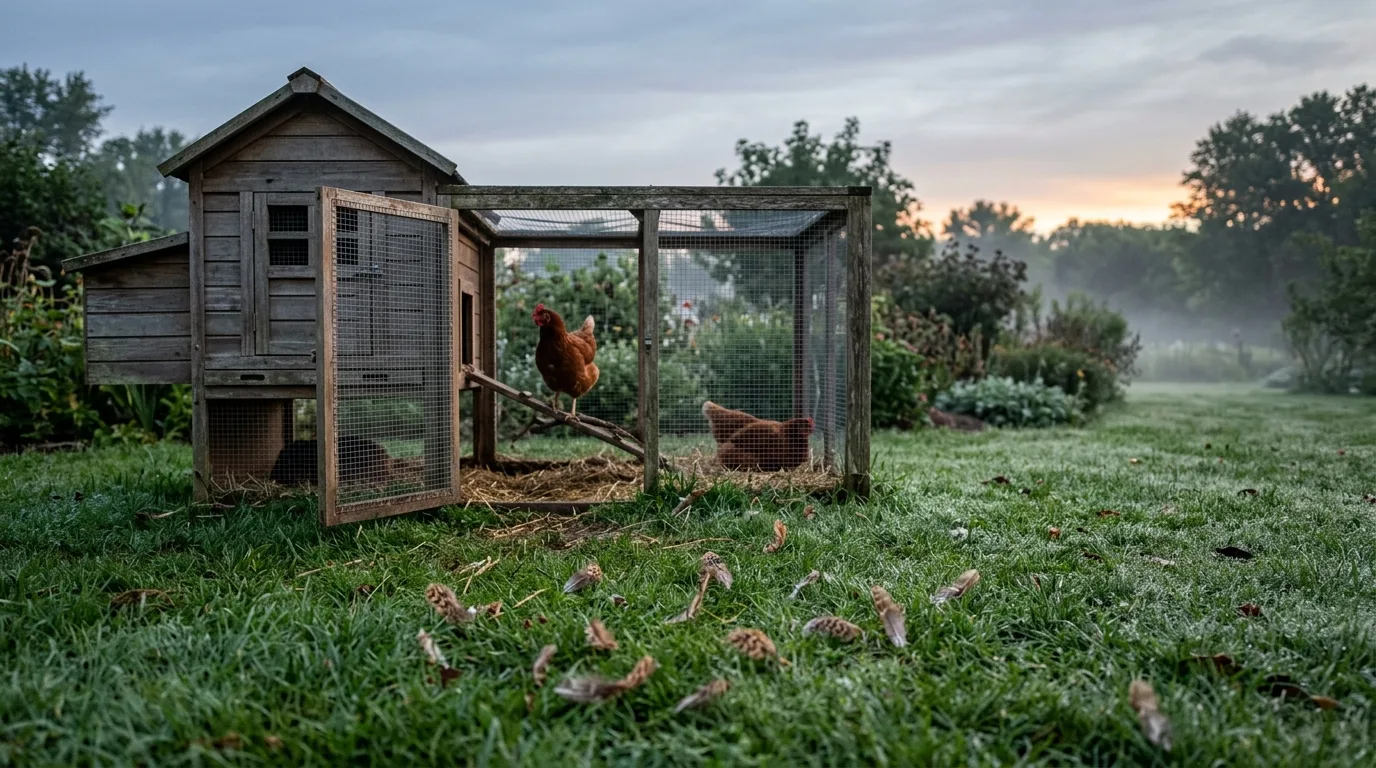
You walk out at first light, coffee in hand, and something is wrong before you even reach the run. Maybe there's a fan of feathers on the grass and one hen short. Maybe a body is lying in the dirt with no head. Maybe the coop looks untouched and a bird has simply vanished. Whatever it is, your stomach drops, and the question that matters most is the one you can't answer yet: who did this, and are they coming back tonight?
Here's the good news. A predator almost always leaves a signature. What was taken, what was left behind, how the bird died, and how the animal got in add up to a short list of suspects — often a single one. Extension wildlife specialists treat a dead bird the way an investigator treats a scene: get to the carcass fast, before scavengers muddy the picture, and read the evidence while it's fresh. The carcass that's still warm tells you far more than the one you find two days later.
So before you do anything else, slow down and look. This guide walks you through reading the kill site, matches the signs to the usual culprits, and then shows you how to confirm it for certain — because the surest way to convict the right animal is to put a camera on your coop and watch who shows up after dark.
Start with the body: what the evidence tells you
Most of the time you won't see the predator. You'll see what it left. Different animals kill and eat in different, surprisingly consistent ways, so the condition of your flock is usually your best clue. Four questions sort the field fast.
Is the bird gone, or is there a body? A bird carried off whole points one direction; a carcass eaten on the spot points another. If adult birds are simply missing with no other sign of a struggle, you're looking at a predator big enough to kill and carry — a dog, coyote, fox, bobcat, hawk, or owl. If chicks vanish without a trace, the list shifts to snakes, rats, raccoons, and house cats — animals that can swallow or carry off something small.
What got eaten, and what got left? This is the single richest clue. Some predators are tidy and surgical; some are messy; some kill and barely eat at all. A bird found dead but not eaten, body bloodied, maybe with the head or crop gone, is the classic calling card of a weasel or mink. A body left with only the head missing points to a raccoon, hawk, or owl. Intestines pulled out through the vent — the cloacal opening at the rear — means an opossum or a member of the weasel family.
How did the bird die? Most predators that kill cleanly go for the head or neck. Whether it's a bite to the base of the skull, talon punctures to the head, or canine teeth marks on the throat, the wound location and spacing narrow things further. One quick field test the extension inspectors use: hemorrhage — bruising and bleeding into the tissue — only happens if the bird was alive when it was bitten. A carcass with tooth holes but no bleeding underneath probably died of something else and was scavenged afterward. That matters, because a predator that merely cleaned up a bird that died of disease isn't the problem you think it is.
How did they get in? A tunnel under the fence, a torn-open corner, a popped latch, a gap up high where something climbed — the entry point is half the diagnosis and all of the cure. We'll come back to it, because once you know how they got in, you know how to stop them.
A couple of honest caveats before we name names. Tracks and droppings near a dead bird prove an animal was present, not that it did the killing — scavengers visit kills they didn't make. And not every dead bird is a predator at all: chickens that pile in a corner to escape something can suffocate the birds underneath, leaving intact bodies with no wounds. If the bird is whole, unmarked, and unbled, think disease or piling before you blame a fox.
If the bird is whole, unmarked, and unbled, think disease or piling before you blame a fox.
The suspect list, predator by predator
With those four questions in mind, here's the rogues' gallery — what each one does, and the dead giveaway that separates it from the others.
Raccoons: the head through the wire
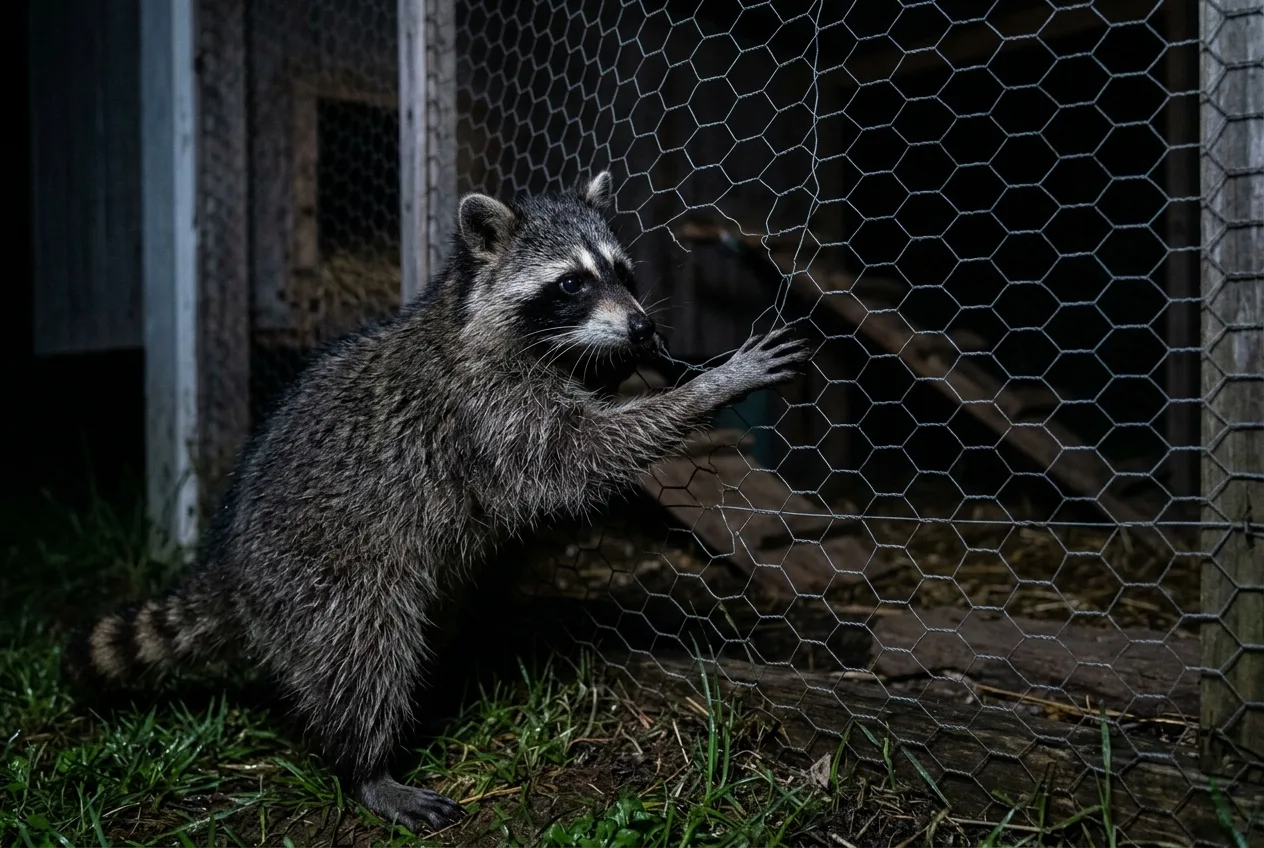
If you keep chickens near people, the raccoon is your most likely repeat offender, and it's a frustrating one because a fence often doesn't stop it. Raccoons are dexterous and clever enough to open simple latches, so a coop that isn't actually locked isn't closed. They'll climb, reach through wire, and grab a bird they can't fully pull through — which produces the signature so many keepers know: a headless body left against the mesh, because the raccoon could only get the head through the wire. When they do get inside, they take several birds in a night and tear into the breast and crop, sometimes eating the entrails. They love eggs and will carry them off, often 50 yards or more from the nest before eating them.
Two tells worth knowing. Raccoons sometimes work in pairs — one spooks the birds to the end of the pen while the other picks them off as they pile against the fence. And they tend to be creatures of routine: one Oklahoma State guide notes that a predator hitting your flock only once every five to seven days, eating the head, crop, and breast, is very likely a raccoon, and that raccoons "defecate a lot where they feed," so their droppings may give them away.
Foxes and coyotes: the bird that simply disappears
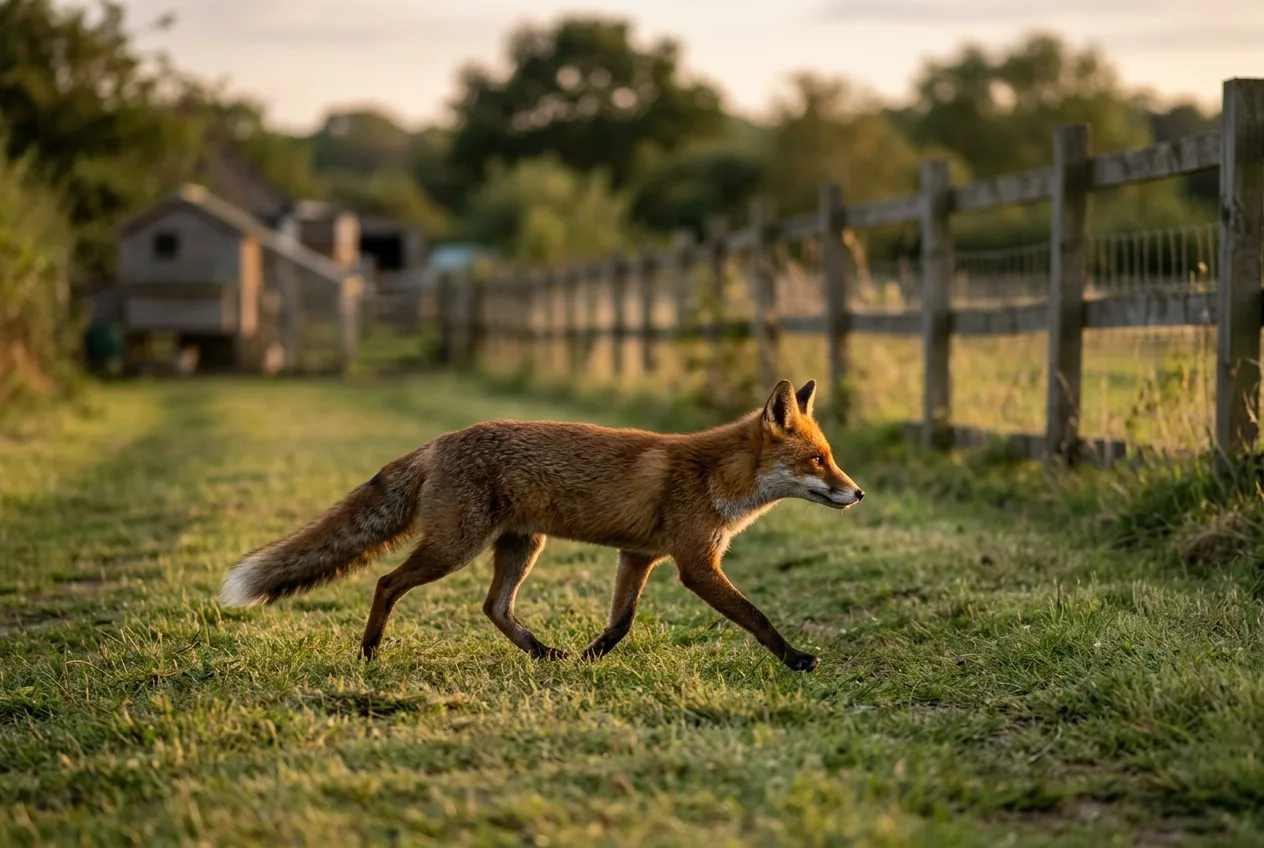
Foxes are the neat ones. A fox usually kills with a bite to the throat, or several bites to the neck and back, and then carries the bird off whole — often back to a den to feed kits. That's why the aftermath is so sparse: "the only evidence is a few drops of blood and feathers". Foxes also raid eggs, opening them just enough to lick out the contents and leaving the shells beside the nest. They stake out a coop for days before striking and turn up most in spring, when they're feeding young and other food is scarce.
Coyotes leave a very similar scene — a missing bird, scattered feathers — which makes the two hard to tell apart. The deciding clue is the entry. A coyote "often tunnels under the pen or forces its way in, leaving evidence, while a fox rarely leaves such evidence behind". Coyotes dig fast and can clear a five-foot fence. If a chunk of your flock is gone and there's no clue at all, fox (or, frankly, a human) is the honest answer. Tracks can help here too: coyote prints are longer and narrower than a dog's, with toes and claws pointing forward, and they fall in a fairly straight line, where a dog's tracks are rounder, toes spread, and staggered.
Foxes are the neat ones.
Weasels and mink: the killers that barely eat
This is the one that scares people, because the morning after a weasel or mink gets in, you can find several dead birds and not a meal among them. Members of the weasel family kill far more than they can eat — "surplus killing" — especially when faced with a coop full of chickens. The bodies are left behind, bloodied, often with the internal organs eaten and the rest untouched.
The kill method is the fingerprint. Weasels and mink dispatch a bird with a bite to the base of the skull or neck and feed on the blood of victims bitten in the head or neck. Mink leave "closely spaced pairs of canine tooth marks," and both mink and weasels will sometimes line the dead birds up — mink "may place many dead chickens neatly in a pile". A row of headless or neck-bitten birds, stacked almost tidily, with little eaten, is a weasel-family calling card you won't mistake twice.
Size is why they're so hard to keep out. A least weasel is only six and a half to eight inches long, weighs one to two ounces, and can squeeze through a hole as small as a quarter inch — small enough to pass straight through chicken wire. That single fact dictates the fix: against weasels, chicken wire is useless. One more clue to separate weasel from rat damage, since both hit at night: rats tend to eat parts of the body and drag carcasses into holes or burrows, while weasels don't cache the bodies that way. Mink carry an extra tell — they're semi-aquatic and tied to water, so a mink is a stronger suspect if there's a stream, pond, or ditch nearby.
Hawks and owls: the daylight raid and the night raid
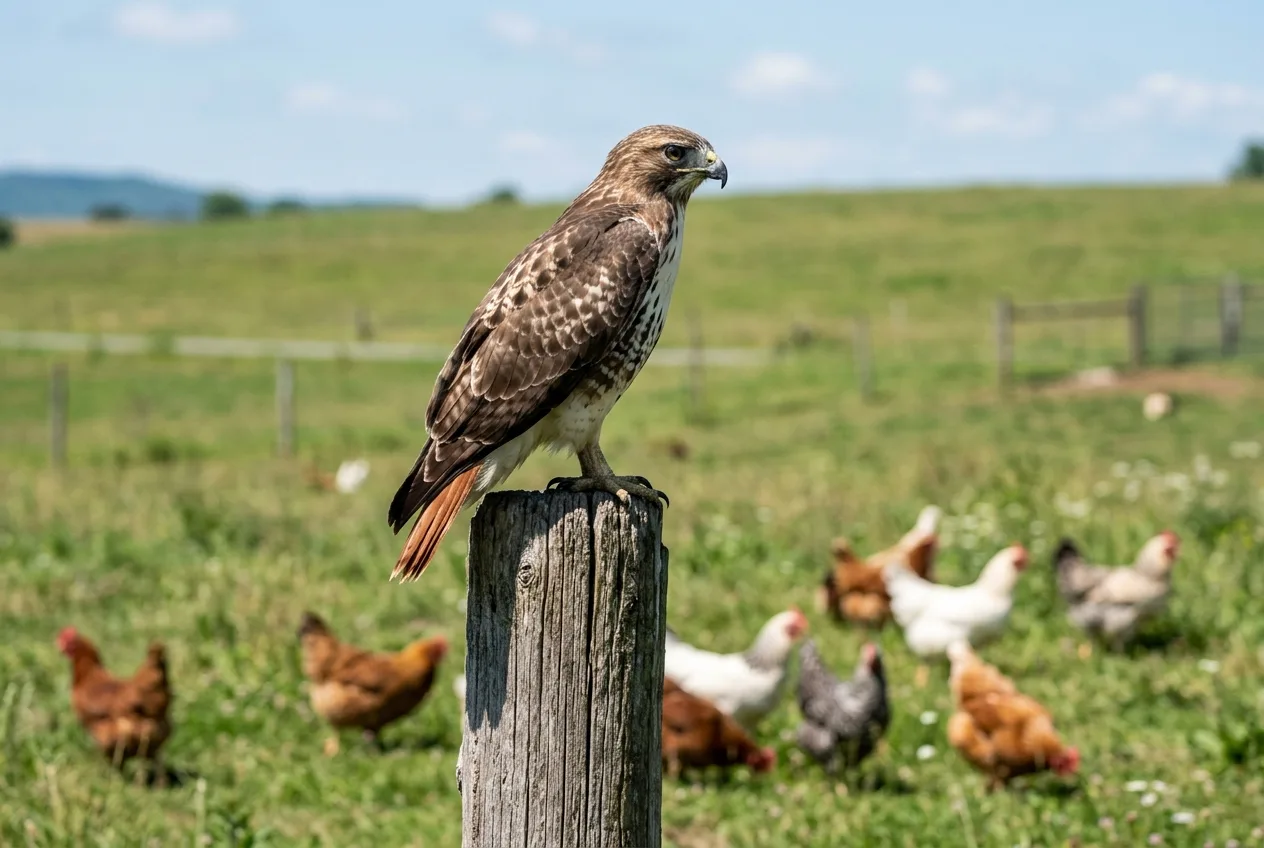
Raptors split neatly by the clock, and that alone often names the bird. Hawks hunt by day; owls hunt by night. A hawk scans from a perch, drops on the bird, and usually kills on impact with its talons. If it eats in place, it takes the breast and plucks the feathers clean, leaving a tidy pile of feathers right by the kill. If it carries off a small bird, you may find nothing but a gap in the flock. One careful distinction from the extension literature: feathers with bits of flesh still clinging to the shafts suggest the bird was scavenged, not freshly killed by a hawk — a reminder to check for that hemorrhage before you blame the raptor.
The owl to know is the great horned owl; barn and screech owls generally leave poultry alone. It strikes in the early morning, at dusk, and through the night, will enter a coop, and tends to take the head and neck, sometimes piercing the skull with its talons. Both hawks and owls kill in similar ways — head and neck, deep talon cuts — so timing is your best separator: a kill found in broad daylight is a hawk's; a bird taken from a roost at night is far more likely an owl's.
There's one more thing about raptors you need to hear, and it's not optional. You cannot legally kill them. Hawks, owls, eagles, and falcons are legally protected, so with raptors the entire game is protection and deterrence, not removal. More on how to handle that below.
Bobcats: claw marks and a hidden carcass
Bobcats are opportunists that take poultry of any size and can carry off a bird or two with ease. Two signs set them apart. First, because they grab with their claws, you'll often find scratch marks along the sides, back, and shoulders of the dead bird, or on the survivors — a single throat bite leaves canine punctures roughly three-quarters of an inch to an inch apart. Second, and this is the giveaway: a bobcat will cache a carcass it didn't finish, raking leaves and grass over it to hide it. As the Kentucky extension guide puts it, that caching "is a good indicator of a bobcat, because coyotes and other predators do not cache carcasses in this manner". Bobcats and coyotes are also excellent jumpers that clear a four-foot fence without trying, so a low run is no obstacle.
Opossums and skunks: the rear-end feeders
These two are usually after eggs and chicks, and both tend to start feeding at the back of the bird. An opossum normally kills just one bird per visit, mauls it, and begins feeding at the cloacal opening; it will eat a chick completely and leave only a few wet feathers. A skunk rarely kills many adults — it'll take one or two and maul the rest — but it loves eggs, opening an egg at one end and punching its nose in to lick out the contents. A skunk-opened egg can look hatched except that the edges are crushed. And skunks leave the obvious bonus clue: a lingering smell after the raid, though it's worth knowing they don't always spray.
Snakes: the missing egg with no trace
Snake predation is the quiet one, because snakes eat the evidence. A rat snake swallows a chick or an egg whole, so often the only sign is an egg or a young chick simply gone, with nothing left behind. That absence is itself the clue: raccoons, skunks, and opossums leave shell fragments, so a clean disappearance of eggs with no shells points to a snake. Snakes only take chicks under about a month old, and the gap they came through has to be big enough to let them back out after they've eaten — a quarter-inch gap or smaller won't admit a snake that can do damage.
Rats: chicks down a hole
Rats mostly take eggs and chicks, but a serious infestation with scarce food will push them to attack juveniles and even adults at night. They kill by biting the head or neck, eat parts of the body, and drag the corpses into burrows or concealed spots to feed — so a chick that's vanished into a hole near the coop, or bite marks on the hocks of young birds, points to rats. You may never see them; they're shy and nocturnal, and the first sign is often gnaw damage on the coop itself.
Dogs and house cats: the ones close to home
Don't overlook the domestic animals. Dogs often kill for sport rather than food — they chase, maul, and leave birds scattered around the yard, frequently with bites all over because a dog's teeth don't kill cleanly. The body is usually left near where it died, and sometimes a dog carries a bird home, which conveniently identifies the culprit. Dogs typically strike in daylight, and a pack is far worse than a lone animal. House cats rarely bother a full-grown hen unless it's already injured, but they readily kill chicks, leaving wings and scattered feathers, and they leave tooth marks on exposed bone.
To pull it together, here's the at-a-glance version that extension specialists use — read the condition, get your short list:
| What you find | Likely culprit |
|---|---|
| Adult birds missing, no other sign | Dog, coyote, fox, bobcat, hawk, or owl |
| Chicks missing, no other sign | Snake, rat, raccoon, or house cat |
| Birds dead, not eaten, bodies bloodied; head/crop may be eaten | Weasel or mink |
| Birds dead, not eaten, missing only their heads | Raccoon, hawk, or owl |
| Birds wounded but alive, bites all over | Domestic or feral dog |
| Young birds wounded, breasts or legs bitten | Opossum |
| Young birds wounded, bitten on the hocks; may be cached | Rats |
| Intestines pulled out through the vent | Opossum or weasel family |
| Eggs gone, no shells, no evidence | Snake |
| Eggs eaten, shells left behind | Skunk, rat, opossum, raccoon, blue jay, or crow |
Treat it as a starting point, not gospel — the same guide that publishes this table warns there are exceptions, because individual animals and local conditions vary.
Snake predation is the quiet one, because snakes eat the evidence.
Let the clock narrow it down
If the evidence is ambiguous, when the attack happened cuts the list almost in half. Most mammal predators are nocturnal, which is exactly why "lock them up at night" is the single most repeated piece of advice in this whole field. Rats, raccoons, skunks, opossums, foxes, owls, weasels, mink, bobcats, and coyotes all hunt mainly after dark. The daytime raiders are a shorter list: dogs, house cats after small birds, snakes, and the hawks.
A few animals blur the line. Coyotes were once daytime hunters but have shifted to the night to avoid people, so they turn up at both ends. Bobcats favor the twilight of dawn and dusk but will hit any time of day. So a kill discovered first thing in the morning was almost certainly an overnight job — weasel, raccoon, owl, fox — while one that happens while you're out in the yard in daylight is pointing hard at a hawk or a dog.
There's a data point here that surprises people. In a study of organic and free-range egg farms, researchers found that of the hens killed by predators, 73% were taken by birds of prey and only 9% by foxes — and the attacks they documented happened in the afternoon and evening, while the hens were out on the range; the researchers recorded no attacks in the morning. Two lessons fall out of that. First, for free-ranging flocks, daytime raptors can be a bigger threat than the nighttime mammals everyone fears. And second — sobering — the birds taken were healthy, productive hens, not the sick or weak ones. Predators aren't doing you a favor by culling the frail; they're taking your best layers.
Read the entry point, then close it
Knowing the species is only useful if it tells you what to fix, and the entry point usually does. Dug under the fence? That's a digger — fox, coyote, skunk, or rat. Torn through wire or a body left jammed in the mesh? Think raccoon or weasel. Latch popped or door ajar? Raccoon. Bird taken from an open run in daylight with no ground sign at all? Aerial — a hawk. Vanished from a roost at night? Owl. The animal tells you how it travels, and that's the line of defense you've been missing.
There's one more diagnostic trick worth its weight: lay down fine sand or talc powder around the coop in the evening and check it for tracks at first light. Raccoons leave a distinctive five-toed print that looks like a small human handprint; coyote tracks are narrow and rectangular in a straight line, a dog's rounder and staggered. Just remember the standing rule — tracks tell you who was there, not necessarily who did it.
Tracks tell you who was there, not necessarily who did it.
Confirm it on camera
Even after all this, you can read the signs and still guess wrong, especially when two suspects overlap. There's a reason wildlife specialists keep pointing at the same tool. As the University of Kentucky's extension guide puts it plainly: "Another option to identify wildlife using the area around your operation is the use of a trail camera or game camera. These cameras, if set up at the correct angle, can be triggered to take a picture by animals as small as rats". Their advice on hardware is practical, too — look for a model with a black-flash or infrared-only flash so the camera doesn't startle the flock, and note that "quality cameras are now as affordable at $100 each, and will last many years".
This is where the case gets closed. A camera aimed at the run, the coop door, or the spot where birds keep vanishing will catch the culprit in the act and end the guesswork — was it the raccoon you suspected or the opossum you didn't? The science backs the approach: in one forensic study, camera footage identified the predator at the majority of monitored nests, and where the image was ambiguous, lab work settled it — in one case the camera couldn't tell a striped skunk from a badger, and DNA from saliva at the scene proved it was the skunk. Most of us won't run DNA swabs, but the principle holds: an actual picture beats an inference every time.
A trail camera also does something the kill site can't — it shows you the predator casing the coop before it ever gets in, often for several nights, the way foxes are known to stake out a flock before they strike. That's your early warning to fix the weak spot first.
Predator-proof the coop for good
Identifying the killer means nothing if the coop stays open tonight. Across every extension source, the advice converges on the same handful of fixes — and they map directly onto the predators above.
Lock them in at night, every night. This is the foundation, because most predators hunt after dark. Train birds to come in at dusk by feeding and watering them inside, then close and latch every door — remembering that raccoons open simple latches, so you need a lock or a two-step closure, not a hook. Solid-sided coops are best; they keep reaching paws and beaks out.
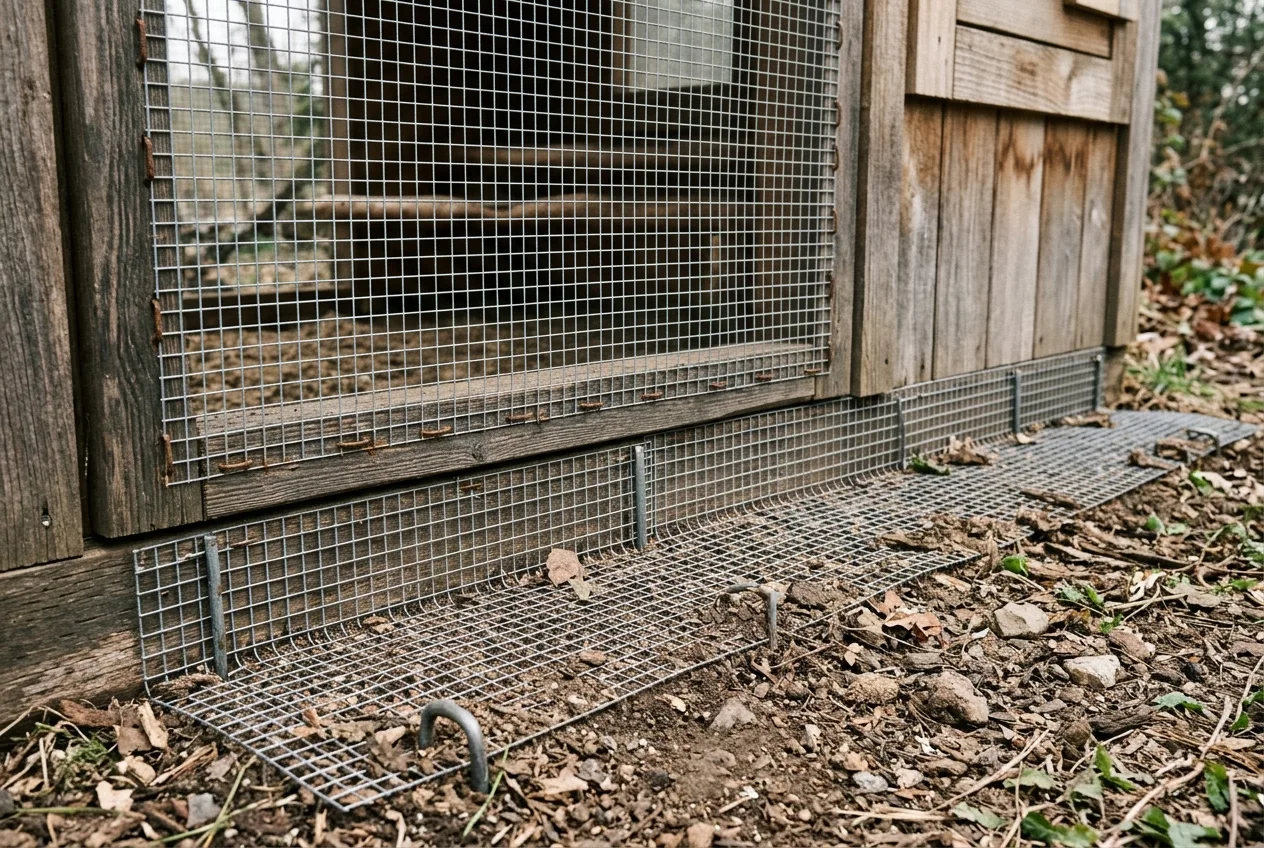
Use hardware cloth, not chicken wire. This is the fix people get wrong most often. Chicken wire keeps chickens in; it does not keep predators out. Rats bite through it, raccoons tear it, and weasels walk straight through the holes. Use half-inch or quarter-inch hardware cloth, and make every gap smaller than an inch so a raccoon can't reach through and a small predator can't slip in.
Stop the diggers with a buried apron. Bury hardware cloth at least twelve inches into the ground around the run to defeat foxes, coyotes, and rats. Better still, bend the bottom outward in an L-shape — bury it a foot down and turn it 90 degrees outward for another 8 to 10 inches, so a digging animal hits the apron, can't get past it, and gives up. An outward skirt does the same job laid on the surface and pinned down.
Cover the run against raptors. Wire, mesh, or netting over the top stops hawks and owls; the eXtension guide notes orange netting works best because hawks and owls see orange well. Even a crisscross of wires or fishing line overhead makes it hard for a bird to drop in. And site the coop away from tall trees and isolated perches — clearing perch sites within about a hundred yards of the flock takes away the hawk's launch pad.
Raise the coop and clean up the buffet. Lift the coop off the ground a foot or so to deny rats, skunks, and snakes a place to nest underneath. Then stop feeding the predators by accident: store feed in metal containers, pull feeders and waterers at night, clean up spills, and keep compost and garbage well away from the coop. A tidy, food-free perimeter is one of the cheapest deterrents there is.
For free-range birds, electric poultry netting is an effective ground-predator barrier as long as it stays charged. And on the live-animal front, guardian animals genuinely work — a livestock guardian dog of a true guarding breed (Great Pyrenees, Anatolian, Maremma) that's raised with the flock deters predators day and night. In one study of Maremmas living with free-ranging chickens, there was no direct predation over the monitoring period, and pairing the dogs with motion-activated lights deterred foxes better than either alone. Just choose carefully and supervise early, because an untrained "guard" dog can become a predator itself.
Chicken wire keeps chickens in; it does not keep predators out.
Before you reach for a trap
Trapping should be a last resort, after you've sealed the coop. Where you do trap, target only the specific individual causing the problem, not every animal in the area — remove the wrong ones and you simply open the territory to newcomers. And don't relocate a live animal: it can spread diseases like rabies across the landscape.
One group to leave alone entirely: birds of prey. Hawks, owls, eagles, and falcons are legally protected, and you should never kill or trap one. You don't need to, either — the answer is deterrence: netting or a covered run, removing the perches a hawk hunts from, and temporary confinement when a raptor is working your area. That's where your effort belongs.
The whole job, start to finish, is a loop: read the evidence, name the suspect, confirm it on camera, close the entry it used. Do that once and you don't just save the bird you lost — you stop the next ten. The morning after is never fun. But a coop you've actually diagnosed is a coop the predator gives up on.
Frequently asked questions
What is killing my chickens at night and leaving the bodies behind?
A predator that kills without eating much, and leaves bloodied bodies — sometimes lined up, often with heads or crops gone — is almost always a weasel or mink, which surplus-kill far more than they can eat. If instead you find bodies with only the heads missing, jammed near the wire, suspect a raccoon reaching through the mesh.
My chicken vanished completely with no trace — what took it?
A bird that disappears whole, leaving little more than a few feathers and maybe a drop or two of blood, was most likely carried off by a fox, coyote, hawk, or owl. A fox raids cleanly and carts the bird to its den; if there's a fresh tunnel under the fence instead, lean toward a coyote.
Is it a hawk or an owl that's getting my chickens?
The timing usually answers it: hawks hunt by day and owls by night. A kill found in daylight with a neat pile of plucked feathers points to a hawk; a bird taken off the roost overnight, often with the head and neck eaten, points to a great horned owl.
What's stealing my eggs, and how do I tell which animal?
Look at the shells. Eggs gone with no shells at all usually means a snake, which swallows them whole. Shells left behind, opened at one end with crushed edges, point to a skunk; raccoons, opossums, and rats also leave shell fragments and may carry eggs off.
How do I figure out which predator it is for certain?
Set a trail camera at the run, the coop door, or wherever birds keep disappearing — wildlife specialists specifically recommend it, and a black-flash or infrared model won't disturb the flock. A photo of the animal in the act ends the guesswork in a way that tracks and kill signs, which only prove an animal was nearby, never quite can.
Will chicken wire keep predators out of my coop?
No. Chicken wire is built to keep chickens in, not predators out — rats bite through it, raccoons tear it, and weasels squeeze through the gaps. Use half-inch hardware cloth instead, keep every opening under an inch, and bury an apron at least a foot deep to stop diggers.