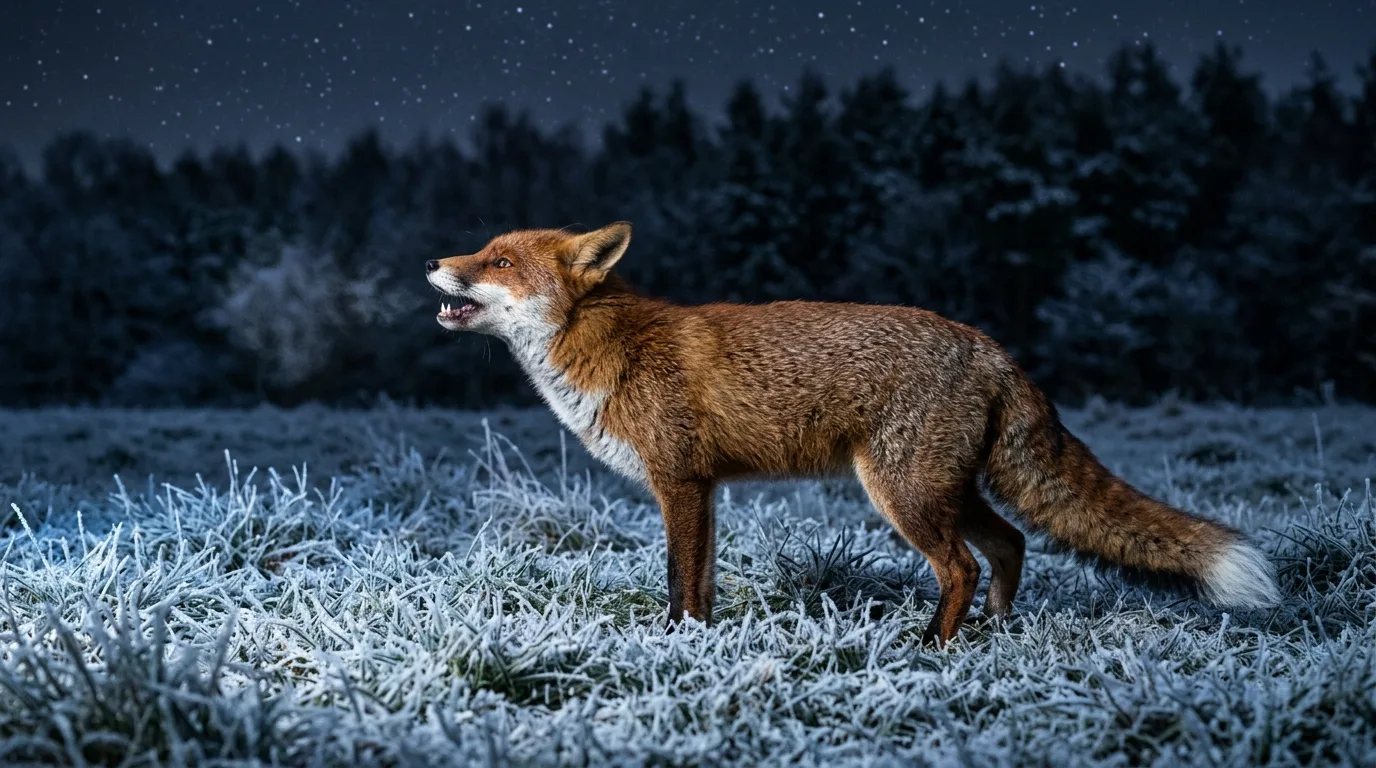
It usually happens around two in the morning. You're half asleep, the window's cracked, and something out past the tree line lets loose a scream so raw and human that you sit straight up in bed. A woman in trouble. A child crying. Some animal being torn apart. You lie there listening, heart going, and it comes again — and then nothing, just the regular dark.
Here's the reassuring part, and it's worth saying right at the top: when you ask what animal is screaming at night, the answer is almost always a red fox. Not a person, not a crime, not a monster. A small dog-sized animal advertising itself across a frozen field in late winter. The runners-up are owls — several of which scream and shriek rather than hoot — plus the occasional bobcat or coyote, and, in a handful of places, a mountain lion. None of them is coming for you. Most of them are talking about territory and mating, and they're doing it at the time of year when the nights are coldest and sound carries farthest.
This is a guide to telling those callers apart by ear. We'll start with the fox, because it's the one you're most likely hearing — and because it's the one that gets blamed on the wrong animal more than any other.
The red fox: the "screaming woman" you keep hearing
If a single sound is responsible for the most 2 a.m. panic in North America, it's the red fox's scream. North Carolina's wildlife agency describes the genus bluntly: foxes "are very vocal and people are most likely to hear a fox during the breeding season," and their range of sounds runs "from mews and coos, to growls and snarls, to barks and screams." People, the agency notes, "often mistake their vocalizations as that of a screaming woman, a bobcat or a mountain lion". Yellowstone's own sound library files a red fox recording under a description that says it plainly — "a red fox emits a series of yowls during a quiet night".
Two things make the fox the prime suspect. First, timing. A year-round acoustic study of red foxes found that vocal activity clustered hard into one season: spring accounted for 61.9% of all recordings, a peak "associated with the breeding season," with the rest scattered across autumn, winter, and a near-silent summer. So the screaming isn't random — it tracks the rut, which in much of the continent means the dead of winter into early spring. Second, the clock. That same study recorded fox calls across the night, "from 17:51 to 01:38," with the bulk of it — 86% of registrations — happening before midnight. Evening into the small hours, peak in the cold months: that's exactly when people report the scream.
It's worth knowing that the fox's main call isn't actually the scream — it's a bark, recorded across a frequency range of 700 to 3600 Hz, used to make contact between a male and female who may be far apart, "primarily during the rutting period". A series can run anywhere from a handful of barks to over a hundred, spaced a few seconds apart. But it's the higher, drawn-out shriek layered into that vocabulary — the one that sounds unmistakably like a person — that sends people to the window. If you hear a repetitive, hoarse, almost rhythmic scream-bark coming from open ground or a field edge on a cold night, you've almost certainly found your fox.
Gray foxes do it too, just less. They make "a hoarse, gravelly bark that can be easily confused with that of a red fox," but they're "less talkative than their distant cousins and less likely to be heard," according to Indiana's wildlife agency. One useful tell for the gray fox isn't a sound at all: unlike red foxes, coyotes, and dogs, gray foxes climb trees — their claws partially retract to stay sharp — so a fox-like bark coming from up in the branches points toward a gray. Both species are mainly nocturnal and both mate in mid-to-late winter, gray foxes "once a year during January and February", which is why their season of noise overlaps so neatly with the red's.
If you hear a repetitive, hoarse, almost rhythmic scream-bark coming from open ground or a field edge on a cold night, you've almost certainly found your fox.
The fisher doesn't scream — at least, not the scream you're thinking of
Now for the myth, because if you've gone looking online for "what's screaming in my woods," you've been told it's a fisher. It almost certainly isn't.
The fisher — a large, dark member of the weasel family, often miscalled a "fisher cat" — has a reputation as the banshee of the suburbs. The trouble is that the reputation is built on nothing. Mass Audubon is direct about it: "Some videos and audio recordings online show loud, unearthly 'screaming' sound that people have attributed to them, however, the nighttime vocalist in these videos is nearly always a Red Fox". It fits the animal's biology. Fishers are ambush hunters that rely on scent, and "successful hunts require silence and stealth" — a screamer would be a bad hunter.
The most honest account of the whole tangle comes from writer James Freitas, who spent years believing the screams in his woods were fishers — he'd even catch the animals on his trail camera and assume they were the culprits — until he went down the rabbit hole and found the evidence wasn't there. He quotes Mass Audubon's line that fishers "are pretty quiet creatures," and recounts a National Geographic experiment in which a crew played animal sounds through a speaker in the Vermont woods for a woman convinced she'd heard fishers. Barn owl, bobcat, hare, red fox — and the sound she'd been calling a fisher turned out to be the fox. As Freitas notes, "none of the scientists he's reached out to have seen, heard, or can verify a fisher screaming".
There's a fair caveat, and Freitas keeps it in: fishers can make noise. He found footage of a young, presumably injured fisher and another at a wildlife shelter, and "both animals are certainly screaming". So a distressed fisher isn't silent. But the recurring, viral, "woman being murdered in the forest" scream — the one people swear is a fisher year after year — is the fox. The researcher Roland Kays, who has studied fishers and their alleged screams, summed up the uncertainty with a line worth carrying into any backyard mystery: "an absence of evidence is not evidence of absence". Fair enough. But the working answer, the one supported by every authority that has looked, is fox.
Owls: the screamers people never suspect
The second great source of nighttime screaming has feathers. We expect owls to hoot — and several do — but the family is far stranger and louder than its reputation, and a couple of them make sounds no one associates with a bird at all.
Barn owl: the shriek that sounds like ripping canvas
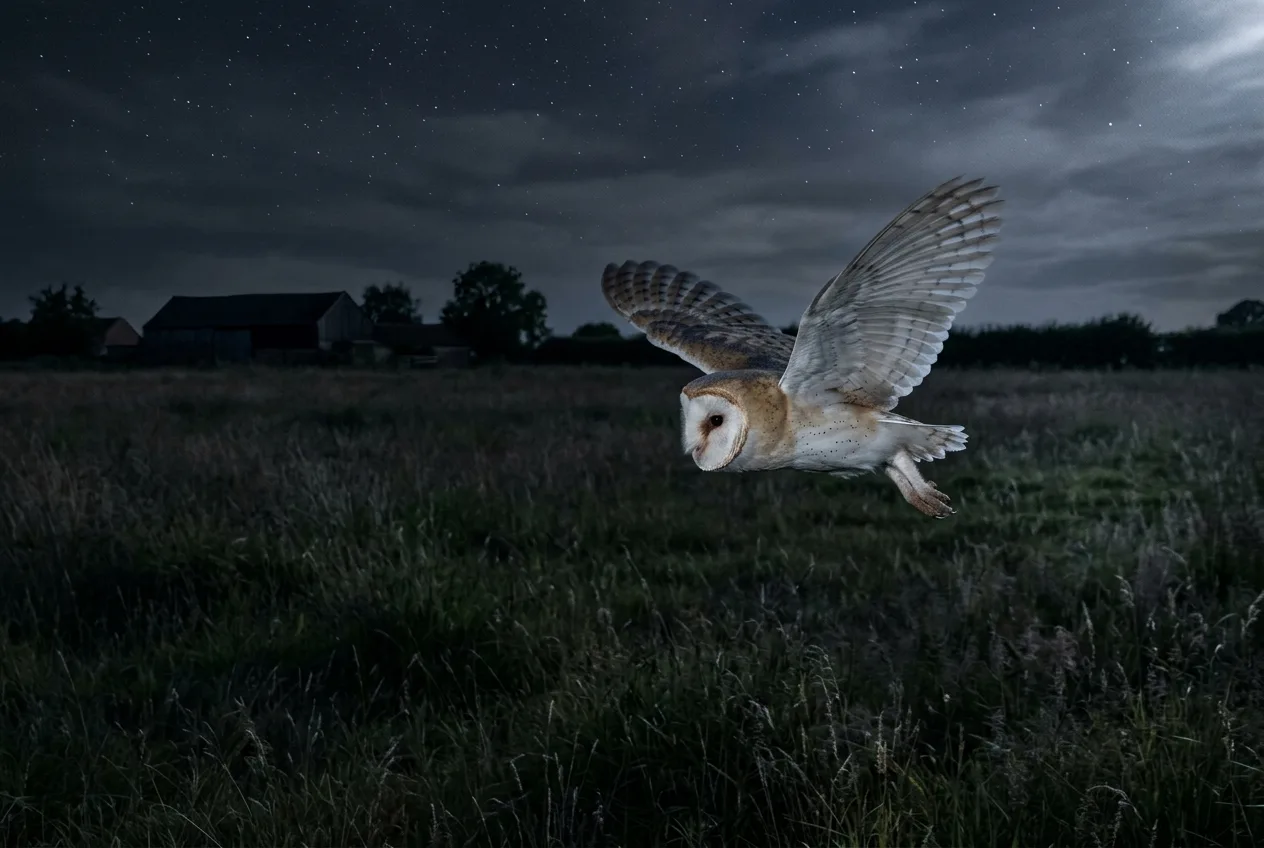
Start with the one most likely to genuinely frighten you. The barn owl doesn't hoot. As Indiana's wildlife agency puts it, "their calls at night consist of eerie screams or raspy hissing sounds". Washington's wildlife agency gives the best single description I've found: "a long hissing or raspy scream, cssssshhH which sounds similar to a canvas being ripped". Cornell's All About Birds clocks the main call as "a long, harsh scream that lasts about 2 seconds," made mostly by the male, who "often calls repeatedly from the air". Picture that — a pale, silent bird drifting over a field, screaming every few seconds from the dark sky. It's no wonder this one ends up in horror films.
Two things make the barn owl easy to place. It's a bird of open country — "pastures and croplands," farmland with good rodent numbers — and it doesn't even start working until well after dark; barn owls "do not emerge from their roosts until several hours after dark". But here's the catch that runs through this entire topic: a screaming owl isn't necessarily a barn owl. Indiana's agency flags it directly — "a screeching owl is not necessarily a barn owl," because "more common owl species also screech and scream". Hold that thought.
Eastern screech-owl: the little owl that doesn't really screech
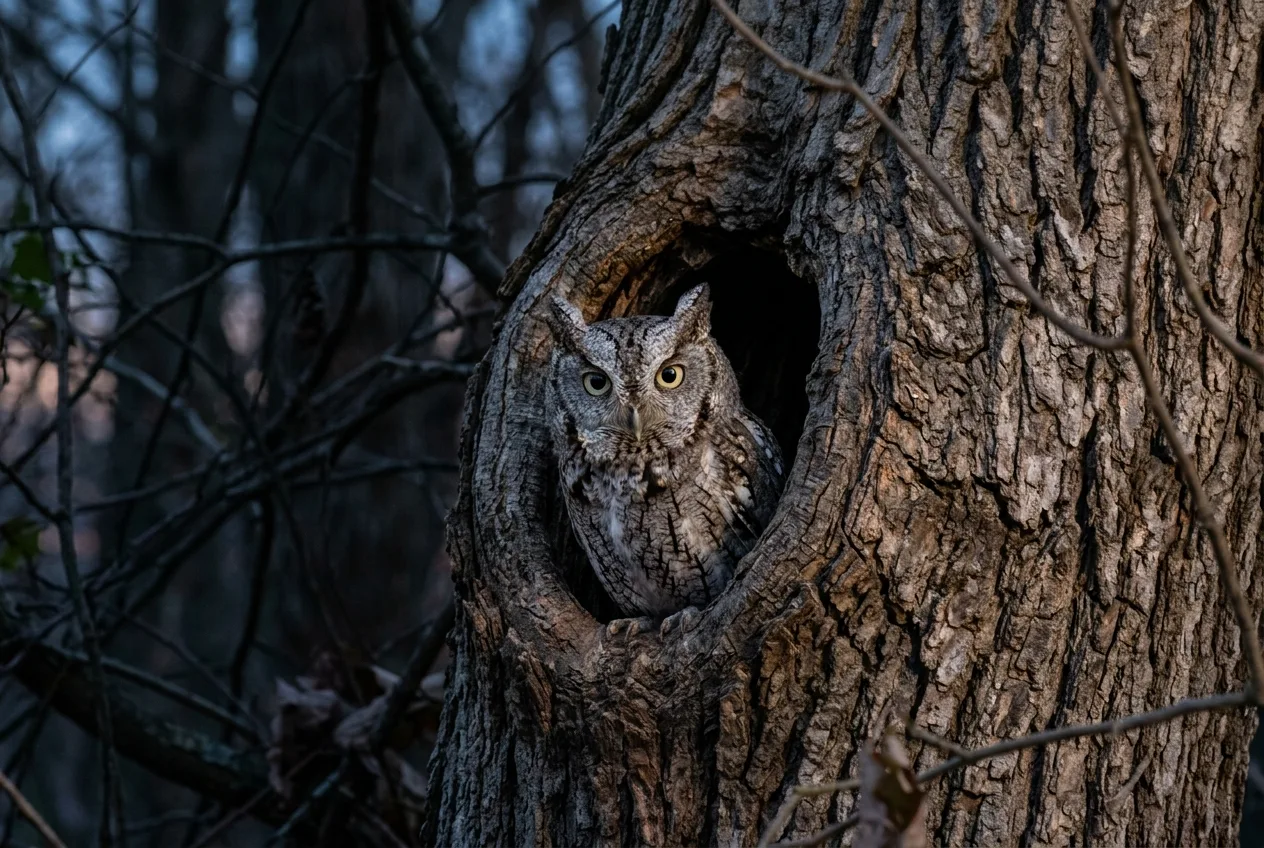
The screech-owl is almost a practical joke on the listener. Despite the name, "the screech-owl's most common call is not a screech," Missouri's agency notes — it's a trill, "an even-pitched sound referred to as a tremolo," and "a call that sounds like a descending whinny". Audubon nails the image: think of "a horse on helium," a descending whinny "capped off with a trill". Cornell measures them out: the even-pitched tremolo runs "3–6 seconds" and is used by pairs and families to keep in touch, while the shrill, descending whinny is "0.5–2 seconds long and is used to defend territories".
This is a tiny owl — about the size of a robin — and its whinny is genuinely uncanny when it's close. Writing for Audubon about the screech-owls outside his bedroom window, naturalist Les Line said the whinny was so loud and insistent the first night that he "was certain one of our neighbor's draft horses was in dire distress". The same descending wail "was once described as 'a most solemn, graveyard ditty'". If you hear a quavering, descending, slightly mournful whinny — not a scream, more like a small spooked horse — coming from a tree near the house, that's your screech-owl. And it really does screech sometimes; that harsher sound is "usually only in defense," around the nest.
Great horned and barred owls: the hoots that turn into screams
The two big "hoot owls" mostly do what you'd expect, but both have a wilder side that surprises people.
The great horned owl is the classic deep hooter — "a series of four or five deep, resonant hoots," rendered as "who's a-wake, me too," carrying like "a muffled foghorn from a distance". You'll hear it most "in the early evening or predawn hours," and most often in fall and winter as the male advertises and defends his territory. But the screaming attributed to this species usually comes from its kids. Fledgling great horned owls "beg with a high, scratchy reeeek well into the summer," a call Washington's agency notes is "similar, but usually shorter and less rasping, than the barn owl's call". So a raspy, repetitive begging shriek heard in mid-to-late summer, often from the same patch of woods night after night, can easily be a young great horned owl rather than anything sinister.
The barred owl is the one that says "who cooks for you? who cooks for you all?" — eight or nine clear hoots, the most recognizable owl phrase in the eastern woods. It's also the most vocal owl on the continent, and that's where it gets interesting. Beyond the signature call, the barred owl has "more than a dozen calls, ranging from a 'siren call' to a 'wail' to a wonderfully entertaining 'monkey call,'" as Audubon puts it. A pair of barred owls going at each other in full caterwaul — sirens, wails, cackles, that ridiculous monkey-house racket — is one of the loudest, most chaotic, most alarming sounds in the nighttime woods, and almost nobody guesses owl. They're vocal enough that if you imitate the "who cooks for you" call back at them, they'll often answer and sometimes even come closer to investigate.
A pair of barred owls going at each other in full caterwaul — sirens, wails, cackles, that ridiculous monkey-house racket — is one of the loudest, most chaotic, most alarming sounds in the nighttime woods, and almost nobody guesses owl.
The cats: real screams, but rare, and they can't roar
Two wild cats genuinely scream in the night. The catch is that you're far less likely to hear them than the fox or the owls, and what you've seen in the movies is wrong.
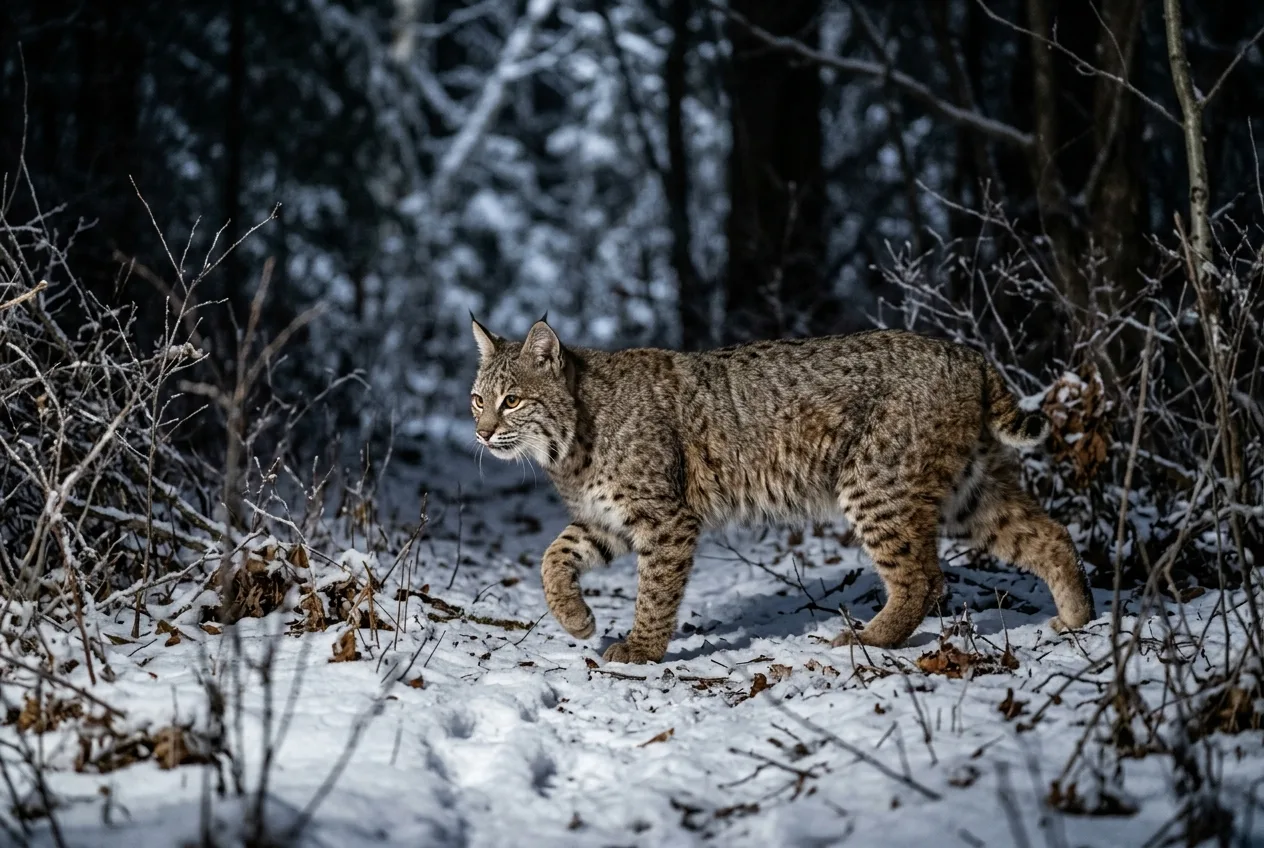
The bobcat is the more widespread of the two, and it's the better candidate for a backyard scream because bobcats "appear to be using suburban settings more often" and near people "typically limit their activity to night hours". They're quiet most of the year. But Washington's wildlife agency notes they "often yowl and hiss during the mating season, especially when competing males have intentions toward the same receptive female," and those mating calls "have been likened to a child crying, a woman's scream, and the screeching of someone in terrible pain". That's a vivid, specific match for what people describe — but it's seasonal, tied to the late-winter breeding period, and bobcats are reclusive enough that most people never hear it.
The mountain lion — cougar, puma, same animal — is the one wrapped in the most myth. "Mountain lions rarely make any noises," Missouri's agency states. Their best-known call is "a caterwaul," described "to sound like a loud screaming like noise," and they make it "primarily during the winter breeding season". The female's caterwaul is a mating advertisement — it "alert[s] males in the area that they are available to mate," according to research summarized by the Natural History Museum of Los Angeles County.
But here's the correction that matters most, and the one that should make you skeptical of a lot of "cougar scream" clips: mountain lions cannot roar. Only the big cats of the genus Panthera — lions, tigers, jaguars, leopards — have the specialized larynx to roar, and they can't purr. "All other cats, including mountain lions, purr but can't roar". The dramatic roaring-and-hissing cougar of film is special-effects fiction. Real puma vocalizations are subtler; one of the most common, recorded from L.A.'s famous urban lion P-22, is a "chirp/whistle" — "a short, high-pitched call that is categorized as a contact call," not a scream at all. And critically, Missouri's agency adds the line that ties this whole article together: "more often than not, when people hear scream like noises in the woods, it's a bobcat or fox" — not a mountain lion. Unless you live in confirmed cougar country, the cat you're hearing is the smaller one, or it isn't a cat at all.
The dramatic roaring-and-hissing cougar of film is special-effects fiction.
Coyotes: when two animals sound like a dozen
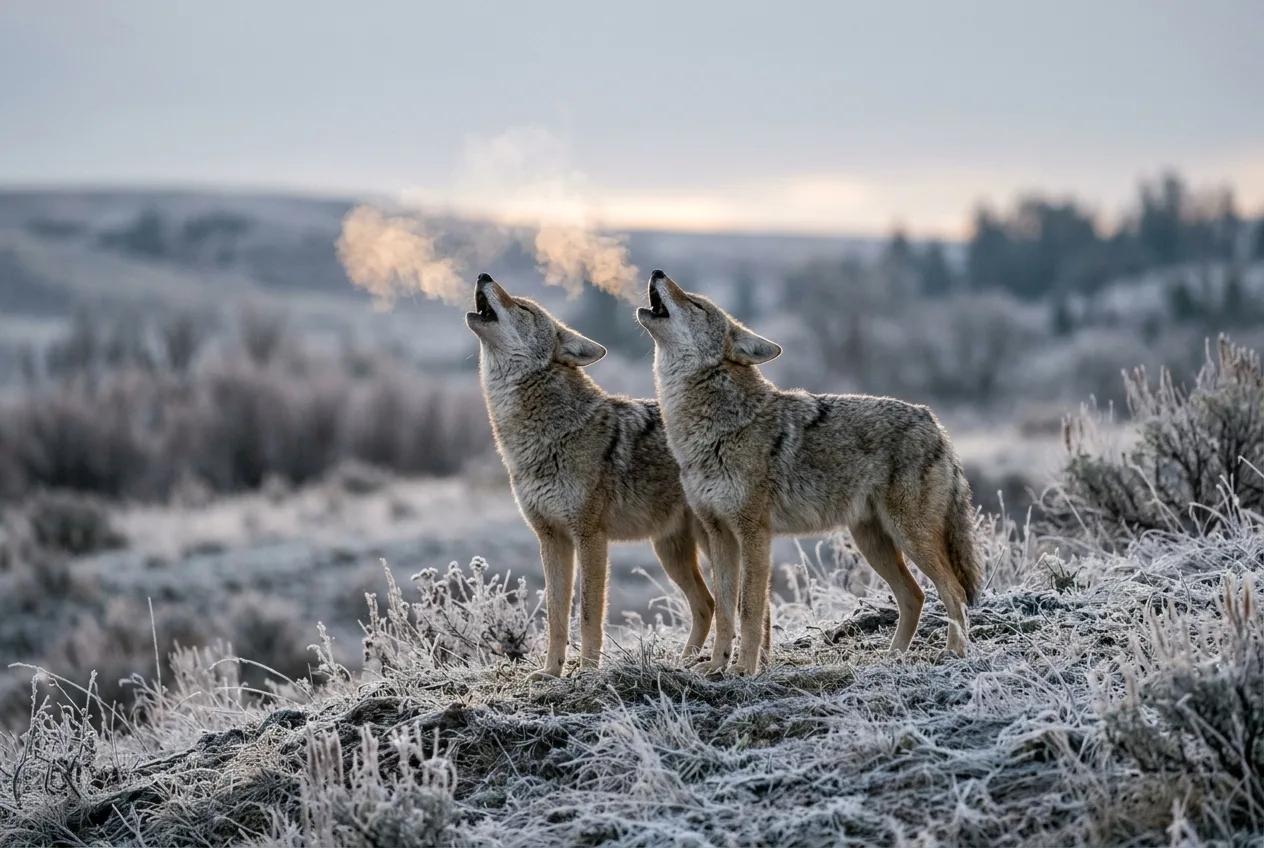
Coyotes don't usually scream, but they produce the other sound that empties people onto their porches: the group yip-howl. It's an unmistakable, eerie chorus — and one of the most misread sounds in nature.
The Penn State wildlife program describes how it builds: "It starts with a few falsetto yips, then blossoms into something resembling maniacal laughter, the yips stringing together into chattering howls," heard "usually in the evening or at night". The Nature Conservancy, quoting coyote researcher Brian Mitchell, breaks down who's calling: "Group yip-howls are produced by a mated and territorial pair of 'alpha' coyotes, with the male howling while the female intersperses her yips, barks, and short howls," with the year's pups sometimes joining in.
The famous illusion is that it sounds like a pack of dozens when it's usually a family of a few. As The Nature Conservancy explains, when "a couple of coyotes begin calling, their sounds can vary rapidly in pitch and sequence, which can sound like a lot more coyotes than actually are there," and "coyote howls often echo against hillsides, compounding the confusion". Mitchell calls the effect an "auditory fence" — sounding like a big pack helps a small family hold its turf. So if you're sure a huge pack just moved in behind the house, you were probably fooled by two or three animals. Like the foxes and cats, coyotes get loudest in breeding season — "generally occurs between late January and March," with a noticeable uptick in February and March.
The quiet ones people wrongly accuse
It's just as useful to rule animals out. Two backyard regulars get blamed for night screams and almost never deserve it.
Opossums are near the top of the wrongly-accused list, and they're one of the quietest animals around. Washington's wildlife agency calls them "among the most silent animals" in the state; when frightened or threatened "they growl and hiss," and that's about the extent of it. Connecticut's agency agrees — a cornered opossum will "bare their 50 sharp teeth and hiss or growl," and its signature move is to play dead, not scream. They're strictly nocturnal scavengers, so they're out there in the dark with you, rustling and occasionally hissing — but a blood-curdling scream is not in their repertoire.
Raccoons are the other animal people reach for, and here I'll be straight with you about the limits of what I can stand behind: I don't have an authoritative, citable source in hand describing raccoon vocalizations in detail, so I'm not going to invent a list of their sounds. What I can say from solid ground is that the loud, human-sounding scream that started you down this path is far better explained by a red fox or an owl. If you're hearing rustling, chittering, growling, and the occasional snarl from low in a tree or near the trash, a raccoon is plausible. A scream like a woman in distress is the fox.
A scream like a woman in distress is the fox.
How to tell them apart
Once you know the cast, a few simple questions usually crack the case.
What time of year is it? This is the single most useful filter. The classic screams — fox, bobcat, cougar caterwaul, coyote chorus — concentrate in late winter through early spring, the breeding season, when these animals are advertising and defending territory. Great horned owls are loudest in fall and early winter as they set up territories, while a raspy begging shriek in mid-to-late summer points toward young great horned owls rather than an adult of anything.
Where is the sound coming from? A scream from open ground — a field, a pasture edge, a meadow — fits a fox or a hunting barn owl. A call from up in a tree fits an owl, or possibly a gray fox, which can climb. A chorus that seems to bounce around a whole hillside is coyotes and the echo playing tricks.
What's the shape of the sound?
- A repetitive, hoarse, rhythmic scream-bark on a cold night → red (or gray) fox.
- A long, raspy, two-second shriek "like ripping canvas," often from a bird in flight over open land → barn owl.
- A quavering, descending whinny like a small spooked horse → eastern screech-owl.
- A deep, foghorn-like series of hoots → great horned owl; a clear "who cooks for you" → barred owl, which may also throw in sirens, wails, and a "monkey call".
- A scream "likened to a child crying" in late winter, from a reclusive animal you'll probably never see → bobcat.
- A chorus of yips that "blossoms into something resembling maniacal laughter" → coyotes, almost always fewer than they sound.
And the rule that underlies all of it, in the words of Indiana's wildlife agency: a screaming owl "is not necessarily a barn owl," and by extension a scream in the dark is not necessarily anything exotic. Start with the common, local, in-season explanation before you reach for the rare one.
Frequently asked questions
What animal sounds like a woman screaming at night?
Most often a red fox, especially in late winter and early spring during its breeding season — its scream-like call is routinely mistaken for "a screaming woman". Bobcats produce a similar mating scream "likened to a child crying, a woman's scream" in late winter, but they're far less commonly heard.
Is the screaming at night a fisher cat?
Almost certainly not. Wildlife authorities say the viral "fisher scream" recordings are "nearly always a Red Fox," and no scientist has been able to verify a healthy wild fisher making that sound. A distressed or captive fisher can scream, but the recurring backyard scream is the fox.
Do owls scream, or do they only hoot?
Several owls scream. The barn owl doesn't hoot at all — it makes "a long, harsh scream that lasts about 2 seconds" — and the barred owl adds sirens, wails, and a "monkey call" to its hoots. A "screeching owl is not necessarily a barn owl," since other owls screech too.
Why do I hear these screams more in winter and early spring?
Because that's breeding season for most of the culprits. Red fox vocal activity peaks in spring with the rut, coyote breeding runs "between late January and March", and bobcat and mountain lion caterwauls are tied to the winter mating season.
Can a mountain lion's scream be what I'm hearing?
Only if you live in confirmed cougar range, and even then it's rare — "mountain lions rarely make any noises". They cannot roar (only big cats in the genus Panthera can), and their best-known call is a winter-breeding caterwaul; far more often a woodland scream is "a bobcat or fox".
Are opossums or raccoons the ones screaming?
Opossums are "among the most silent animals" and only "growl and hiss" when threatened, so they're not your screamer. There's no strong authoritative source pinning the classic human-like scream on raccoons either — that sound is best explained by a fox or an owl.