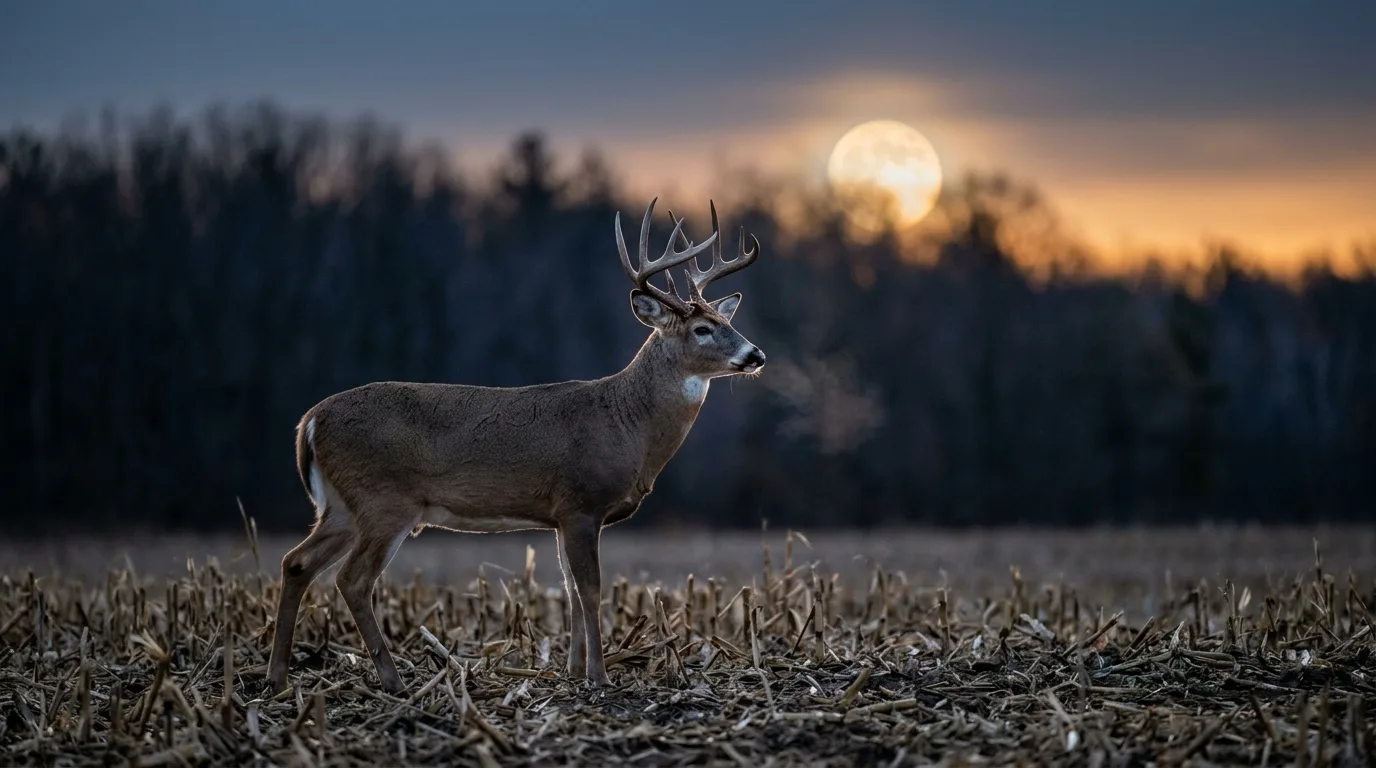
Ask a deer camp whether the moon moves deer and you'll start a fight. One guy plans his whole week of vacation around a "rutting moon." Another swears bucks go nocturnal under a full moon and won't leave the house until it wanes. A third, usually the one with the most antlers on his wall, hunts the moon overhead and underfoot like scripture. It's hard to argue with a guy who kills big deer.
So here's the honest answer up front, because you came for the straight story: when researchers strap GPS collars on deer and watch them around the clock, moon phase barely registers. The biggest, most careful studies find deer move a handful of yards more or less per hour depending on the moon — a difference so small it's "merely a few steps", the kind of change that disappears into the noise of a GPS reading. Deer are crepuscular. They move at dawn and dusk, full moon or new, and that pattern swamps anything the moon does. The rut, by contrast, nearly doubles how far a buck travels in daylight. If you want a real edge, that's where it is.
But "the moon barely matters" is not the same as "the moon is pure myth," and that's the part most hot takes get wrong. There's a thread of real, repeatable signal buried in the data — about where deer go and when in the day they show up, not how much they move overall. The folklore isn't crazy. It's just aimed at the wrong target. Let's walk through what the believers claim, what the data actually shows, and how a hunter should think about it.
Where the moon beliefs come from
The whole edifice traces back to one man: John Alden Knight, who coined "solunar theory" in his 1942 book Moon Up, Moon Down. Knight, watching marine fish move with the tides, proposed that animals have predictable daily activity peaks tied to the position of the moon — two "major" periods (moon overhead and underfoot) and two "minor" ones (moonrise and moonset) — and that these peaks get stronger near the new and full moon. Outdoor companies turned that idea into the solunar charts and apps you can still buy today, which rate each day 1 to 4 based on lunar phase.
Knight's mechanism was gravity. The same pull that lifts the tides, the theory goes, tugs on animals too. It's an appealing image. It's also, for a land animal, almost certainly wrong — there's no evidence that lunar gravitational pull drives activity in terrestrial species, and even the researchers most sympathetic to lunar effects say so plainly. The tides move because the ocean is a vast, fluid mass; a 150-pound deer is not.
Layered on top of solunar charts is a second belief specific to deer hunting: the "rutting moon," popularized by writers like Charlie Alsheimer — the idea that the second full moon after the autumn equinox triggers or sharpens the rut. And a third, the most intuitive of all: that a bright full moon lets deer feed all night, so they bed down at dawn and barely move in daylight. Each of these is testable. Each has been tested.
What the GPS data actually shows on movement
Here's what changed the conversation. Before GPS collars, you studied deer by watching them — and you can only watch what you can see. On a dark new-moon night, deer are nearly impossible to count, which quietly biased a lot of older work. GPS collars don't care about moonlight. They log a deer's position every 15 to 30 minutes, day and night, for months. As biologist Grant Woods put it after abandoning his own moon-based prediction index, "a GPS collar follows that deer everywhere, 24 hours a day".
The most thorough test to date comes from the Mississippi State University Deer Lab: 48 GPS-collared bucks in central Mississippi, tracked every 15 minutes from September through February, with the confounding effects of the rut and opening day stripped out so the moon's influence could stand alone. The team first established what normal looks like. Over a full season, bucks averaged about 265 yards traveled per hour during legal shooting light and were bedded 34% of the time. Then they checked the best solunar days — a day-rating of 4, full moon, during a "major" window. The result: bucks moved about 4 yards per hour more, with essentially no change in bedding time. The strongest outliers they could find were an 18-minute shift in when a buck bedded and a 10-yard-per-hour bump in movement — and since the collars carry a 10-to-15-yard margin of error, even those "probably represent a number closer to zero". Team member Luke Resop's summary is the cleanest verdict in the whole debate: "This is essentially the data you expect to see when there's no effect". Dr. Bronson Strickland called the differences "trivial".
For comparison, the same bucks averaged 219 yards per hour outside the rut and 400 yards per hour at peak rut — nearly double, with bedding time dropping by 11 points. "We can all agree on the increase in activity during the rut," Strickland said. "The changes associated with the moon don't come close to that magnitude". That contrast is the heart of the matter. A real driver of deer movement looks like the rut. The moon does not look like that.
This isn't one lab's quirk, either. Penn State's Deer-Forest Study ran female deer through the same question using hourly GPS data across three state forests, sorting nights into full (>67% illumination), partial (33–67%), and new (<33%). Deer moved about 6 meters per hour more under a new moon than a full moon, and about 4 meters per hour more in daylight under a partial moon — but with deer routinely covering hundreds of meters in an hour (the data ranged from 0 to 2,748 m/hr), the researchers called those gaps neither statistically nor biologically significant. "That extra 4 to 6 meters... is merely a few steps, like walking over to a new oak tree to snack on the more desirable acorns". A Texas study on the King Ranch tracked 43 collared bucks from October through January and reached the same place: lead researcher Mickey Hellickson "could find no difference in buck movement between a full moon and a new (or dark) moon". Going all the way back to 1986 — before GPS, using thousands of binocular counts of free-ranging Illinois deer — Roseberry and Woolf found "no difference in numbers of deer seen nor in the frequency of sightings between Solunar and nonsolunar periods".
Different states, different decades, different methods, same answer: as a knob for how much deer move, the moon is turned almost all the way down.
A real driver of deer movement looks like the rut. The moon does not look like that.
The part the skeptics oversimplify: position, illumination, and timing
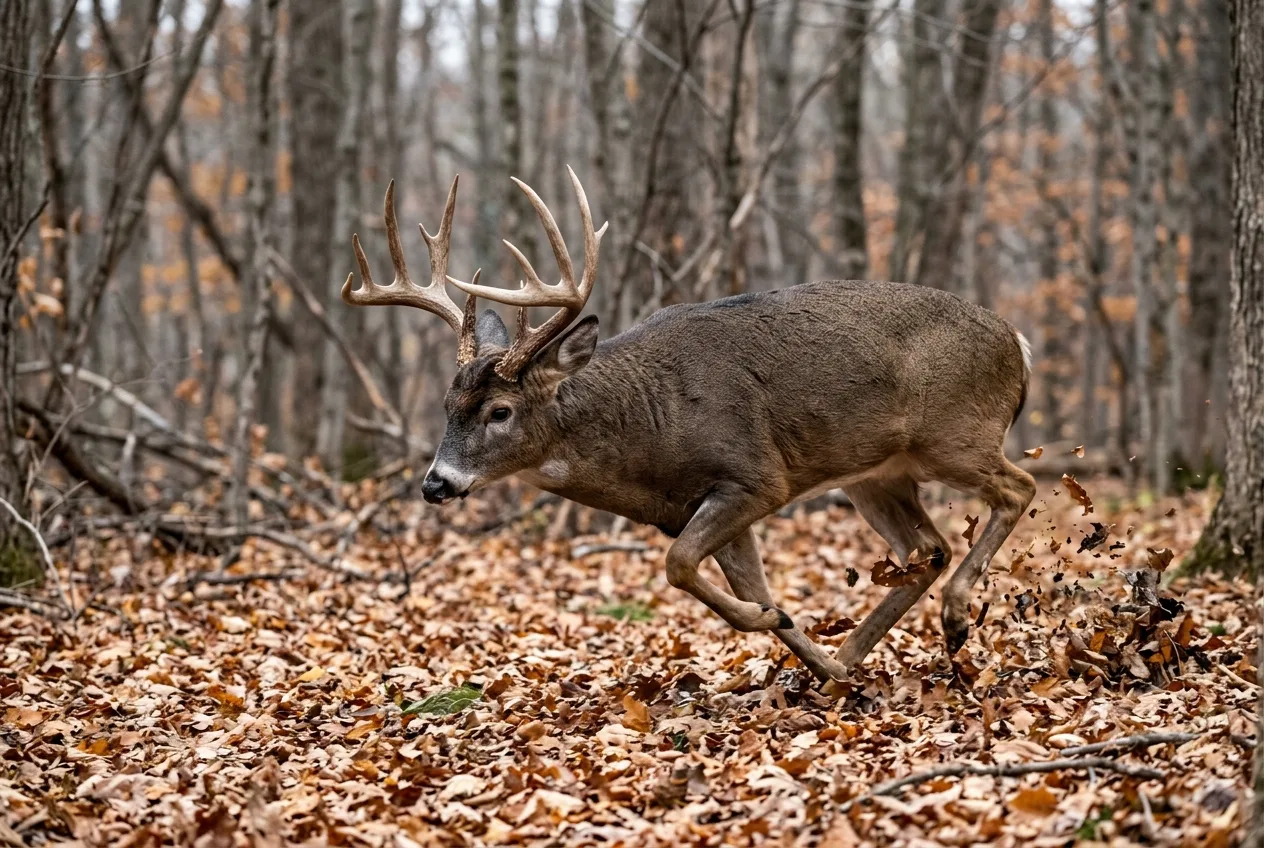
If the story ended there, you could throw away the lunar calendar and we'd be done. But the careful studies keep finding a faint, stubborn signal that the "it's all myth" crowd glosses over — and being honest about it is what separates a useful answer from a smug one.
Start with the original Auburn solunar study, the one that kicked off the modern research. Sullivan and Ditchkoff put GPS collars on 38 bucks in South Carolina and tested Knight's four lunar positions directly. They did find a real relationship — just a weird one. Near the full and new moon, bucks were genuinely more likely to be active around moonrise and moonset, but less likely during moon overhead and underfoot — the exact opposite of what solunar charts label "major" periods. Their conclusion was carefully hedged: lunar events have "some association with deer activity. However, the relationships between lunar events and lunar phase expressed in solunar charts may be misleading". In other words, the charts get the direction backwards half the time.
Then it got stranger. When the same lab replicated the study with a different set of bucks in Alabama during the breeding season, they found patterns directly opposite to the South Carolina results — more activity around overhead and underfoot on high-rated days, less around moonrise and moonset. Their takeaway was that solunar charts "may be accurate only half of the time," but also, pointedly, that "we cannot completely disregard solunar charts and lunar effects on Deer activity". Two rigorous studies, same researchers, contradictory results. That's not a finding you can build a hunt around — but it's also not nothing. Something is varying with the lunar cycle; it just won't sit still long enough to predict.
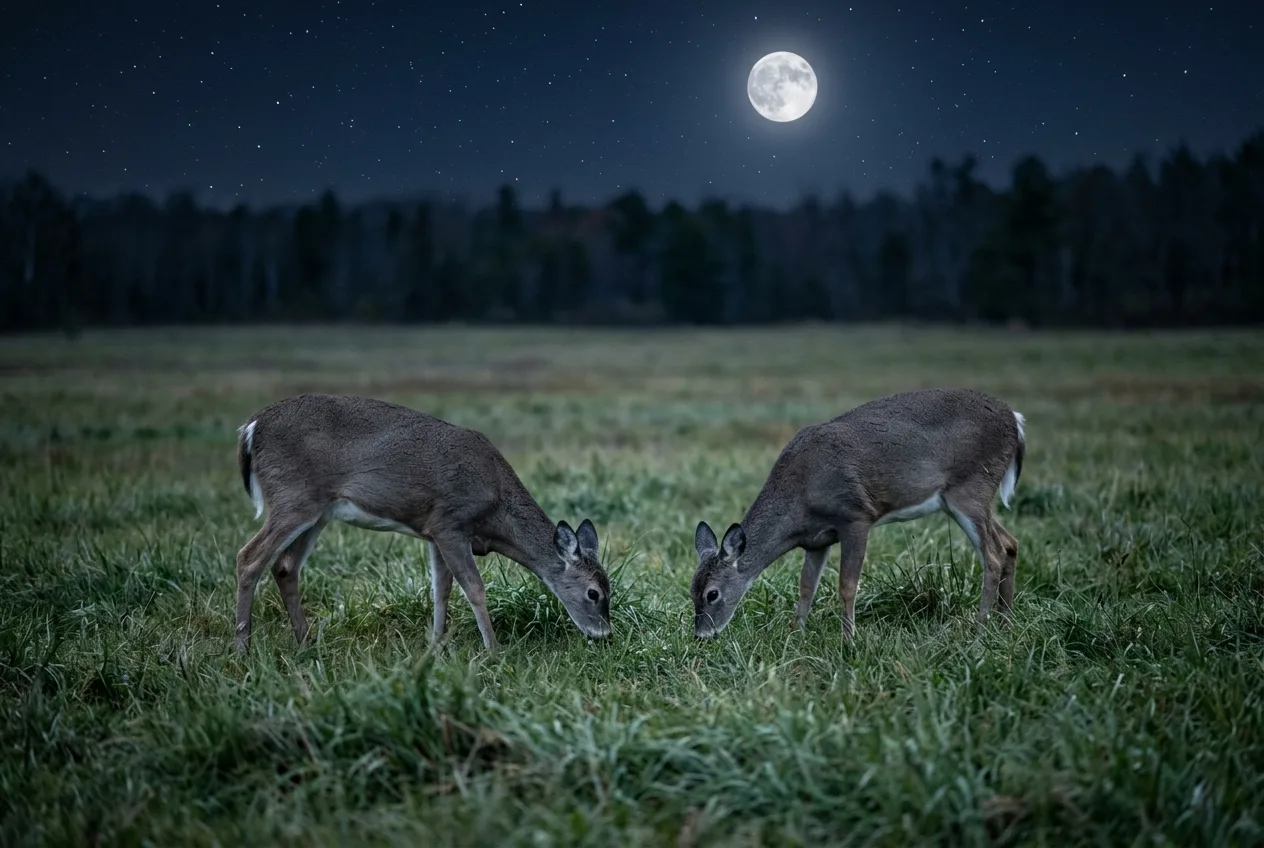
The more promising thread is illumination, not gravity. A fine-scale study of suburban deer near Philadelphia tracked 17 animals at five-minute intervals and asked not how much they moved but where. The answer was clean: when the moon was above the horizon at night, deer significantly preferred open field habitat (p = 0.001), and when it was below, they shifted back to forest. The likely reason isn't mystical — it's that a prey animal can see predators coming in open ground under moonlight, so bright nights make the open feel safer. As the authors put it, "it is the luminosity of the moon that affects deer movement and habitat preference," explicitly not gravitational pull. The moon "may not dictate where a deer is going to be, but it appears to play a role in predicting what habitat a deer is going to prefer".
That same luminosity logic shows up as a possible timing shift. Mike Hanback, a hunter with 36 years and roughly 3,000 days in the stand, flatly rejects the "deer feed all night under a full moon" folk wisdom and cites a North Carolina State study that tracked collared deer through the moon phases. Its finding, in the researchers' words: "A common misconception is that deer can see better at night because it's brighter when the moon is full. But according to our data they move less on average at night during a full moon and more during the middle of the day". A midday shift, if real, matters to a hunter even if the total movement is unchanged — it changes when the deer is on its feet during legal light. The honest caveat: that's a small effect in absolute terms, and the broad GPS studies don't all see it.
Something is varying with the lunar cycle; it just won't sit still long enough to predict.
What trail-camera data adds
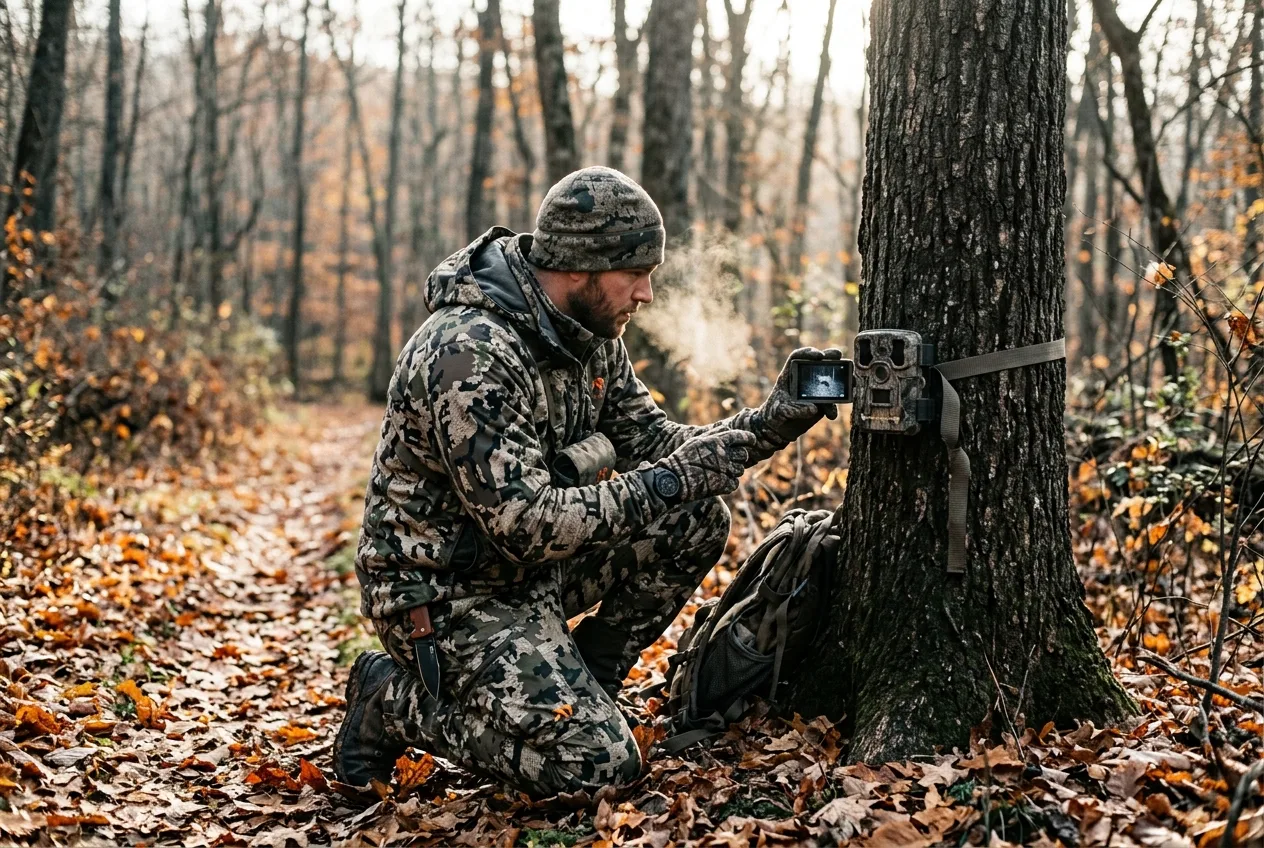
Here's where it gets personal for anyone running cameras. One hunter compiled ten years of trail-camera photos — every buck, hunting season only, mature defined as 3.5-plus years — and tagged each image with the moon phase. It's single-observer practitioner data, not a controlled study, and it can't separate the moon from weather, rut stage, or hunting pressure, so hold it loosely. But it's the only trail-camera-specific dataset on the question, and what it found rhymes with the peer-reviewed work in an interesting way.
The one phase that stood out was the full moon, and only at night: mature bucks moved after dark 18% of the time under a full moon, the single highest nighttime number in the dataset. Around bedding areas, full-moon nighttime movement again topped the chart at about 14% — consistent with the idea that bright nights let deer feed and travel late, then return to bed by dawn. Flip it around and the darker phases drove daylight feeding: mature bucks showed up at food sources in daylight most often around the new moon (15%) and the waning and waxing crescents — exactly when the night is darkest and the open feels least safe after dark. New moon also produced the most daylight activity at scrapes (22%).
And moon position — overhead, underfoot, moonrise, moonset, the windows the solunar apps sell? Across every camera location, all four came in under 2%, indistinguishable from a deer wandering past at random. The blunt verdict around food sources: "From our survey, we found nothing. Literally". That lines up with the GPS studies' weakest, least repeatable signal being exactly the "major" solunar windows.
The rutting moon: the cleanest debunk in deer hunting
Of all the moon claims, the rutting-moon theory is the one the data flattens most completely — and it's worth knowing because it's the one that costs hunters the most when they get it wrong.
The rut isn't triggered by the moon. It's triggered by photoperiod — the shrinking ratio of daylight to darkness in the fall, which sets off the hormonal cascade that brings does into estrus. That's not a hunch; it's settled deer biology, and the breeding-date studies are remarkably consistent. Penn State biologists aged 3,507 road-killed does over eight years and found the median conception date simply "bounced around" November 13 for adults every year — even though the full moon's date swung by about nine days annually. "There is no relationship between the rut and the moon," they concluded. "You can plan your hunting vacation around the rut months ahead of time and not even worry about the moon". Pennsylvania's Game Commission ran the same analysis on more than 6,000 does and put it bluntly: "For deer, it's serious business and they aren't about to change their schedule for the moon or latest marketing ploy".
The biggest dataset is the most decisive. The National Deer Association compiled a University of Georgia study of more than 2,500 wild does across seven states and a nine-year New Brunswick study of over 1,600 does. The Georgia work found no correlation between moon phase and breeding at any location. New Brunswick found that the average conception date landed in the same four-day window — November 26 to 29 — in eight of nine years, regardless of where the full moon fell. As the NDA's summary put it, breeding "is primarily influenced by photoperiod (day length)" and stays "relatively consistent among years within a particular population".
So why do hunters swear the rut shifted? Usually it's an outlier doe. Breeding follows a bell curve, and a few does come into heat in mid-October or mid-December every year. New Brunswick researcher Rod Cumberland traced the early breeders to "nutritional plane" — does that didn't carry a fawn the prior year were in better condition and ready sooner. Watch one of those early does get chased and it's easy to decide the moon moved the rut. It didn't. You just caught the tail of the curve.
Watch one of those early does get chased and it's easy to decide the moon moved the rut. It didn't. You just caught the tail of the curve.
So how should a hunter actually use this?
Here's the way I'd put it after reading the whole pile.
Hunt the calendar, not the moon, for the rut. Photoperiod is fixed. Find your area's historical breeding peak and book your time off around it — the moon's date that year is irrelevant. Burning your best week chasing a "rutting moon" instead of the actual rut is the single most expensive mistake in this whole topic.
Don't let the moon talk you out of a good day. The total-movement difference between a "great" solunar day and a terrible one is a few yards per hour — smaller than your GPS error bar. If the wind and access are right, hunt. The rut, weather, and pressure all dwarf the moon, and even weather's effect is weaker than most hunters assume; cold fronts, for instance, don't reliably get deer on their feet the way folklore claims.
Where the moon might earn its keep is timing and location, in small ways. On bright full-moon mornings, deer may be wrapping up a late night and heading to bed, so some hunters push their best sit toward midmorning and midday rather than first light. On dark new-moon stretches, lean into daylight feeding — sit food sources and scrapes, where the darker-phase daylight signal is strongest. And on moonlit nights, expect deer to favor open ground after dark, which can shape where you set up for a dawn ambush. None of these is a sure thing. Think of them as the sweetener, not the coffee — the last small factor you stack on top of wind, food, and the rut, not the thing you build the hunt around.
Frequently asked questions
Does a full moon make deer move only at night?
Mostly no. Deer stay crepuscular — most active at dawn and dusk — through every moon phase. Bright full-moon nights may let deer feed and travel later after dark, with a bump in nighttime mature-buck movement under a full moon, but daytime movement doesn't drop off the way the folklore claims.
Is there a "best" moon phase to deer hunt?
Not for overall movement. The difference between the highest- and lowest-rated solunar days is only a few yards per hour, well inside a GPS collar's margin of error. If anything is usable, it's subtle timing: darker phases (new moon) seem to nudge a bit more daylight feeding, while full moons may shift some activity toward midday.
Does the rutting moon control when the rut happens?
No. The rut is triggered by photoperiod — shortening daylight — not the moon. Breeding dates land in nearly the same window every year regardless of the full moon's date. Plan around your area's historical breeding peak, not a "rutting moon."
Do solunar charts and moon overhead/underfoot times actually work?
The evidence is weak and contradictory. Solunar charts predict deer activity no better than chance, and careful tests have produced opposite results for the same lunar windows — so there's no reliable pattern to hunt.
If the moon doesn't matter much, why do good hunters swear by it?
Mostly observation bias. We remember the buck we killed under a certain moon and forget the empty sits — and one researcher notes "we often ignore observations that contradict the patterns we believe exist". Before GPS and night vision, deer were also nearly impossible to count on dark nights, which skewed older observations toward "more movement on bright nights".
Does the moon affect deer movement more than weather?
Both effects are smaller than hunters tend to think. The rut dwarfs both — bucks move nearly twice as far at peak rut. Among weather factors, even cold fronts don't reliably boost movement, and biologists generally find "little to no effect of weather on deer movements" strong enough to plan a hunt around.