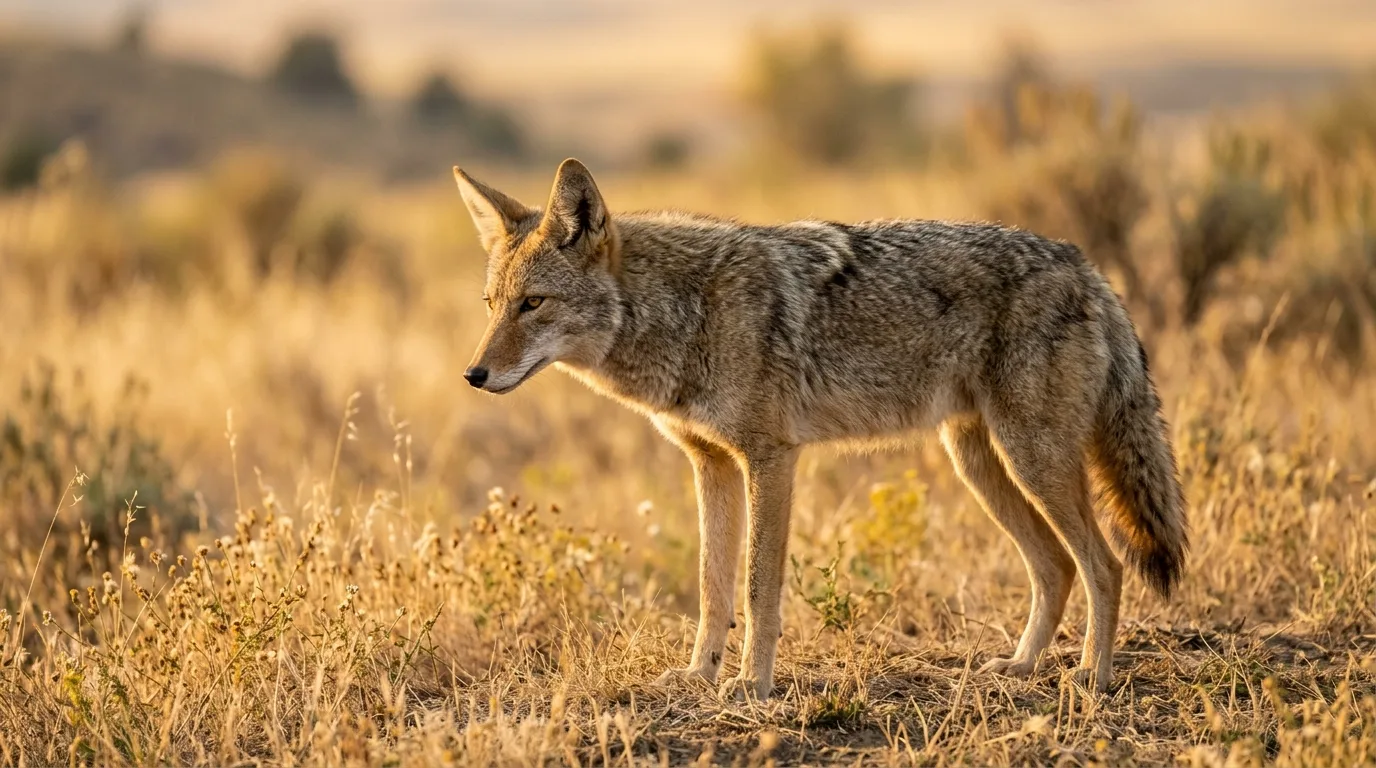
A researcher in Chicago once picked apart 1,429 coyote droppings to find out what the city's coyotes were actually living on. If you believe the internet, the answer should have been garbage and house cats. It wasn't. The top items were small rodents, fruit, deer, and rabbits — in that order. Cats and trash barely registered.
That gap, between what people are sure coyotes eat and what coyotes actually eat, is the whole reason this article exists. Coyotes are one of the most successful predators in North America precisely because they'll eat almost anything, and "almost anything" is exactly the kind of phrase that breeds rumor. So let's replace the rumor with what the scat, the cameras, and the death-loss ledgers really show — and then talk honestly about the part that is true: that a coyote will, given the chance, take a kitten, a lamb, or a hen.
The short version: coyotes are opportunistic omnivores. Across most of their range the bulk of the diet is rodents, rabbits, fruit, and carrion, with deer (especially fawns in spring) a major seasonal item in many regions. Pets and livestock are a real but usually small and highly local share of what they eat — bigger on farms with sheep or poultry, smaller in the average suburb than the headlines suggest. The threat is worth managing, not panicking over.
One note on geography before we start. The coyote (Canis latrans) is a North American animal — native to the western and central parts of the continent and, over the last century, spread east to the Atlantic and south toward Central America. If you're reading this where coyotes don't live, treat it as a window into a generalist predator; if you share ground with them, read on, because most of what worries people is fixable.
The honest answer: coyotes are generalists, and it shows
If you want one word for the coyote's diet, it's opportunistic. The wildlife researchers who've watched them longest say exactly that: coyotes "are also opportunistic feeders and shift their diets to take advantage of the most available prey". Missouri's conservation agency boils the menu down to "rabbits and mice make up a majority of the coyote diet, with other animals and plants (such as persimmons) making up the rest," plus carrion.
The peer-reviewed diet studies say the same thing in numbers. In the Denver metro area, researchers analyzed 64 coyote scat samples and found rodent hair in every single one; rodents and rabbits were the most prevalent items by a wide margin. In Chicago, small rodents — voles and white-footed mice — had the highest frequency of any food in every season and at every site, followed by deer, fruit, and cottontail rabbits. In a study spanning urban, peri-urban, and rural zones around Bakersfield, California, coyotes ate "primarily rabbits and rodents in all three zones".
Notice what's not topping those lists. The animals people picture coyotes hunting — cats, dogs, livestock — sit far down the menu, when they appear at all. The everyday coyote is mostly a mouser with range.
The everyday coyote is mostly a mouser with range — a small-rodent specialist that happens to eat everything else too.
That's not the same as saying coyotes are harmless, and we'll get to the real risks. But it's the right baseline. A predator built to thrive on voles and rabbits and fallen fruit is not a predator that needs your pets to survive — which, as you'll see, changes how you should think about prevention.
The full menu, from the studies
Pulling the diet research together, here's the actual spread of what coyotes eat, with rough sense of how much each matters:
| Food group | Role in the diet | What the evidence shows |
|---|---|---|
| Small rodents (voles, mice, rats, ground squirrels) | Core staple, year-round | Top item in Chicago and Denver; present in 100% of Denver scats |
| Rabbits and hares | Core staple | Co-dominant with rodents across urban-to-rural zones |
| Fruit and soft mast (berries, persimmon, grapes, palm) | Major, seasonal | Over half of summer diet (with fawns) in South Carolina; 23% of Chicago scats |
| Carrion (roadkill, gut piles, dead livestock) | Major, underrated | Coyotes scavenge heavily; deer often eaten as carrion year-round |
| Deer — fawns | Major, spring pulse | 62–86% frequency in spring scats in one SC study; leading fawn predator in parts of the Southeast |
| Birds, insects, reptiles, amphibians | Minor to moderate | Grasshoppers for pups; iguanas in South Florida; birds opportunistically |
| Human food (garbage, pet food, ornamental fruit) | Variable — small to large by city | Minimal in Chicago/NYC; up to 60–75% of the LA diet |
| Pets (cats, small dogs) | Small everywhere; regional | ~3% of the Denver diet; 4–20% of LA scats; <5% in NYC |
| Livestock (sheep, calves, poultry) | Small in diet studies; real on farms | Rarely shows in urban scat work; significant in agricultural loss data |
The thing to hold onto is that no single number is "the" coyote diet. It's a portfolio that shifts with the season and the place — which is the next two sections.
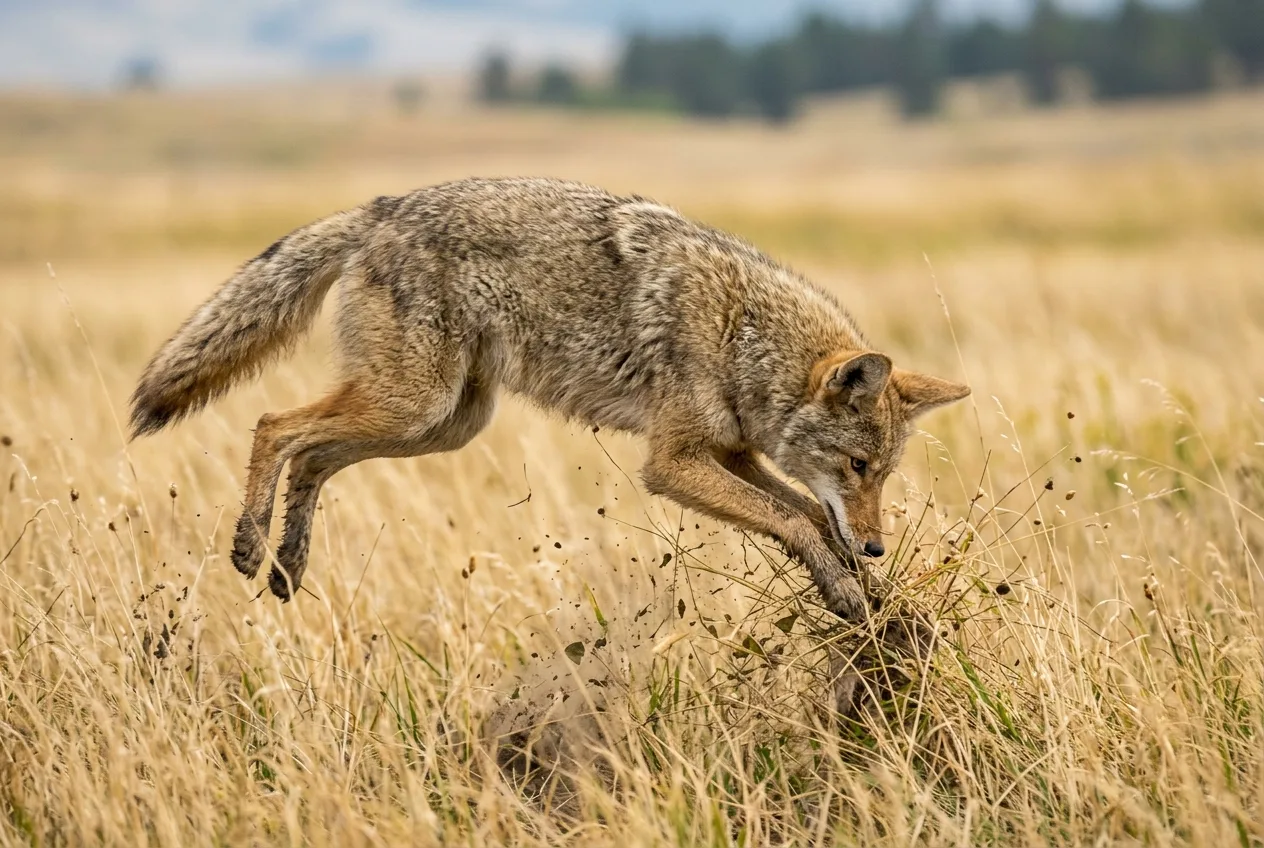
How the menu changes through the year
Coyotes eat what's easiest to get, and what's easiest changes month to month. The cleanest demonstration comes from a three-year study in South Carolina that tracked diet against "resource pulses" — those brief windows when a food becomes suddenly abundant.
In that population, two pulses dominated summer: newborn deer fawns and ripe blackberries. Together they made up over half the diet in summer. Come fall, persimmons took over as a key food. The researchers found that when a pulse was on, the coyotes' diets converged — nearly every animal piled onto the same easy resource — then spread back out once it passed. They're not picky; they're efficient.
The Denver scat work shows the same rhythm from a different angle: more mammals and birds in winter and spring, then more fruit and insects in late summer and autumn as plants and grasshoppers become abundant. Rabbits were eaten less in summer, probably because thick vegetation makes them harder to catch and fruit gives the coyotes an easier option. In subtropical South Florida, the swing was between seasons rather than temperature — more animal prey in the cool, dry season and more plants in the warm, wet season.
Fall is the fruit season worth flagging, because it surprises people. Coyotes are genuine fruit-eaters, and not as a last resort. A review of carnivore diets found that meat-eaters across the order are "prolific seed dispersers" — eating fleshy fruit is normal carnivore behavior, not an oddity. Persimmons are the textbook case: coyotes swallow the fruit, and the seeds pass through their gut unharmed and actually sprout a little faster afterward, so the coyote is effectively planting next year's persimmon trees. If you find a late-fall scat packed with seeds and skins, that's a coyote that's been eating well off the land.
A coyote that swallows a persimmon is, quite literally, planting next year's persimmon trees.
City coyotes vs country coyotes: a spectrum, not a number
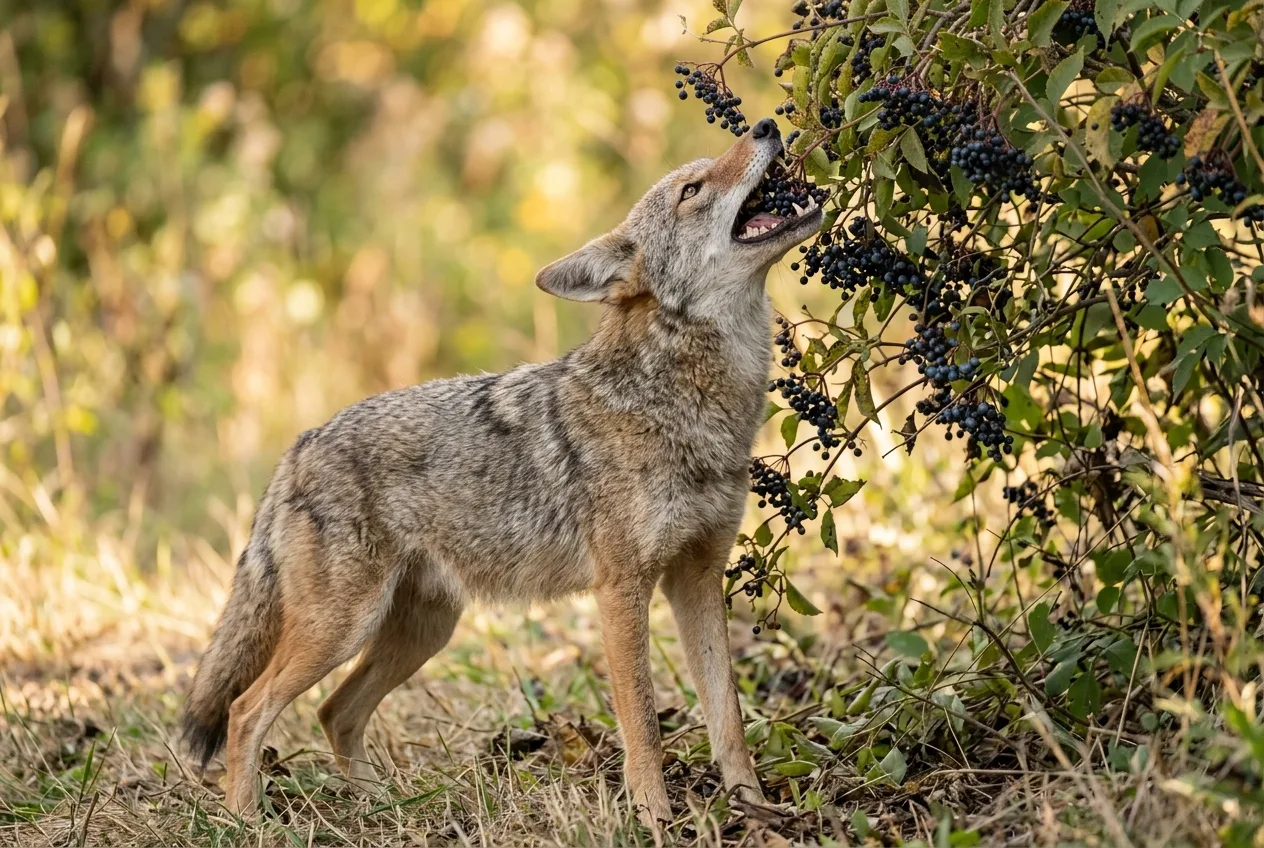
Here's where a lot of "coyotes eat garbage and cats" lore comes from — and where it falls apart. Urban coyote diets are not one thing. They run along a spectrum, and most cities sit closer to the wild end than people assume.
At the low-human-food end is Chicago, home to the largest urban-coyote study in the world. There, human-associated food — garbage, garden vegetables, pet food, and the occasional cat — turned up in only 2 to 25% of scats depending on the site and season, and the coyotes lived mostly on rodents, rabbits, deer, and fruit. New York City tells a similar story: a modern DNA study of NYC coyote scat found they ate a wide variety of native prey and did not depend on human food to get by; the most common human item was chicken, and domestic cat showed up in under 5% of scats. Bakersfield's coyotes ate mainly rabbits and rodents even inside the city, leading the researchers to conclude their "relatively low use of anthropogenic foods may reduce the potential for human–coyote conflicts".
At the high end is Los Angeles. There, a National Park Service study found that human food — garbage, ornamental fruit, and domestic cats — made up 60 to 75% of the urban coyote diet, with cat remains in 20% of urban scats versus just 4% in nearby suburbs. That's a striking number, and it's the one that goes viral. But it's the exception, driven by a specific, food-rich, heavily developed landscape — not the rule for coyotes everywhere.
The lesson cuts two ways. First, don't take LA's coyotes as representative; most urban coyotes eat far less human food than that. Second, and more useful: the diet tracks what's available, which means you have leverage. The same NYC study found human food in 88% of individual coyotes' scats — not concentrated in a few "problem" animals — which tells you that wherever people and coyotes share space, coyotes will sample whatever we leave out. Lower-conflict cities aren't lucky; they're cities where coyotes still have better, wilder options and fewer easy human handouts.
The two deer stories: killing fawns and cleaning up carrion
Deer come up constantly in coyote diet studies, and it's easy to get the wrong impression unless you separate two very different things: coyotes killing deer and coyotes scavenging deer. Both are real. They happen at different times of year and mean different things.
The killing story is mostly about fawns, in spring. When does drop their fawns, predators that can find them get a brief, rich opportunity, and coyotes are very good at exploiting it. In a Wyoming study, coyotes measurably shifted their movement and search behavior to track the mule-deer birth pulse, hunting hardest right at peak fawning. The scat numbers can be dramatic: in one South Carolina study, deer turned up in 62 to 86% of spring coyote scats. In parts of the Southeast, coyotes are the leading cause of fawn death — one Georgia study attributed 52% of all fawn mortalities (and 69% of predation deaths) to coyotes.
That sounds alarming for deer hunters and managers, and it can matter locally. But the honest research adds two crucial caveats. First, whether fawn predation actually dents the adult deer population is genuinely complicated — it depends on habitat, doe condition, and whether the deaths are "additive" or simply replace other causes. A Red Hills study found predation caused 95% of fawn deaths (three-quarters of that from coyotes), yet survival also hinged heavily on where fawns were born — far better in pine cover than in dense hardwoods. Second, and tellingly, the South Carolina pulse study found that nearly every coyote eats fawns when they're available, which led the authors to conclude that trying to remove specific "fawn killers" would be futile — you can't subtract the behavior by subtracting a few individuals.
Nearly every coyote eats fawns in spring, which is exactly why blaming a few "problem" animals misses the point.
The scavenging story runs the other way, and it's underrated. For most of the year, especially winter, coyotes get a lot of their deer not by killing it but by cleaning it up. They're enthusiastic scavengers of carrion — roadkill, winter-killed animals, hunters' gut piles, and dead livestock. Missouri's agency puts it vividly: after deer season, coyote droppings "often are full of deer hair," from coyotes finishing off field-dressed carcasses and wounded deer. A camera-trap study on the Savannah River that staked out deer carcasses found coyotes were the most common scavenger, showing up at 90% of the carcass sites. So when a scat in January is full of deer hair, it usually means a coyote found a carcass — not that it pulled down a healthy buck.
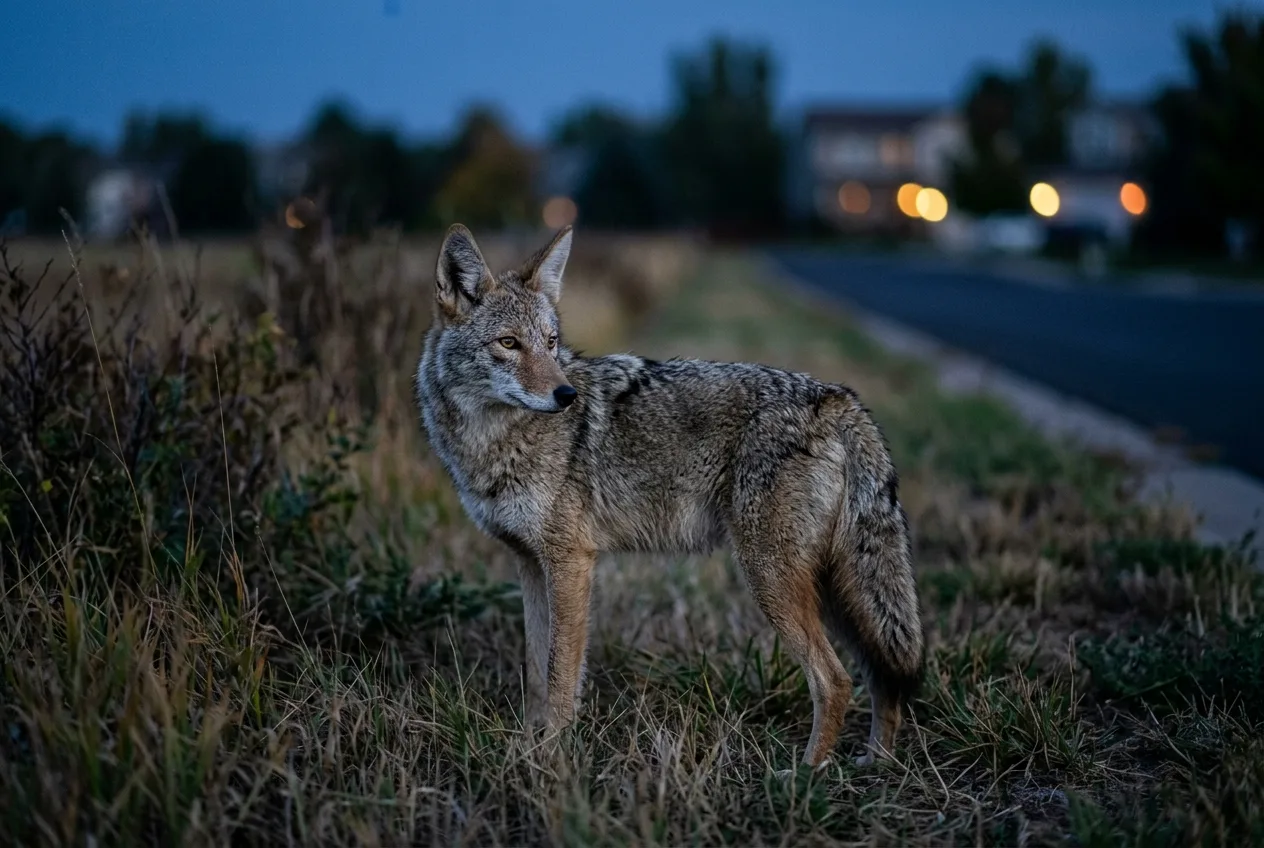
Reading coyote scat: what it tells you
You can learn a lot about the coyotes on your land without ever seeing one, just by reading their scat. It's the single best on-the-ground record of what they're eating.
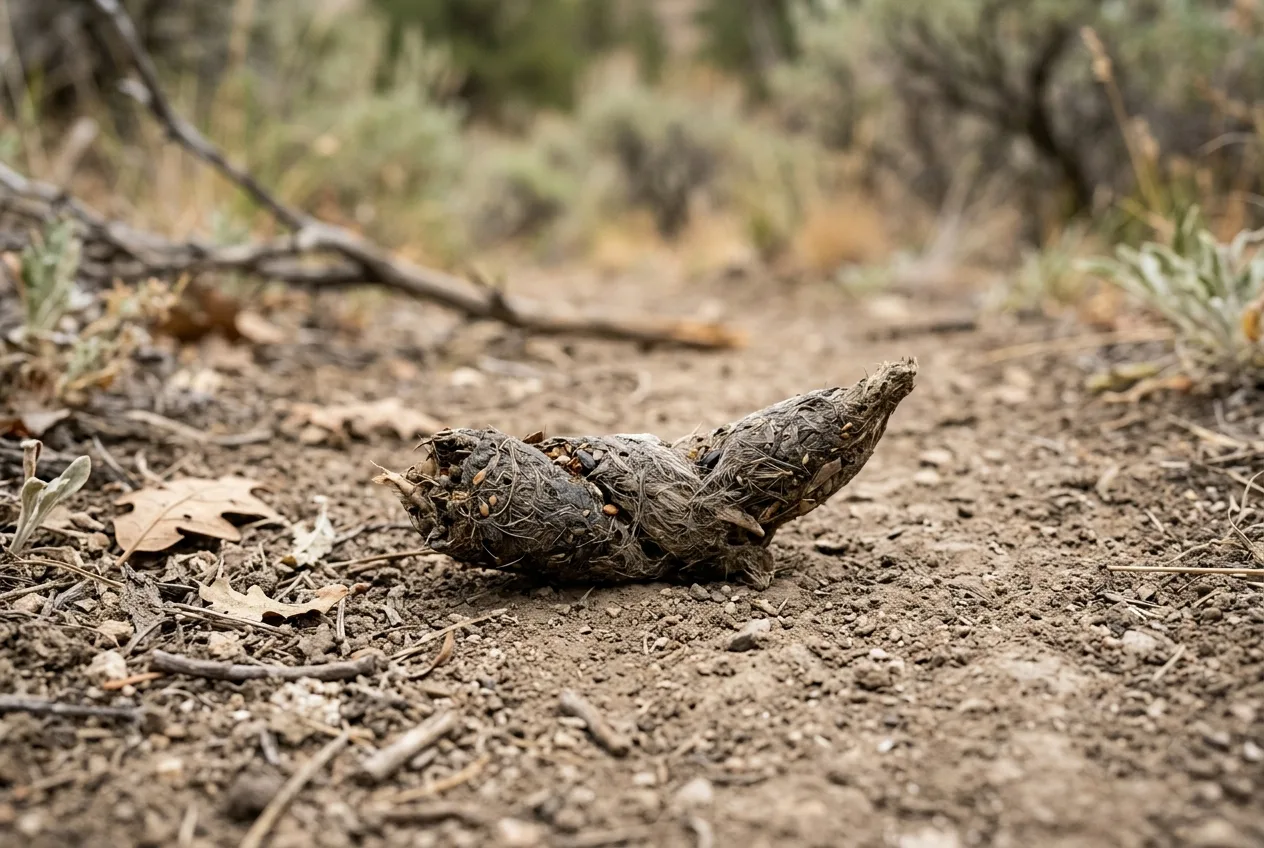
Start with the obvious features. Coyote scat is typically rope-like with tapered, twisted, pointy ends, and its size and contents "vary tremendously based on diet," according to a New Hampshire wildlife guide. Location is a clue in itself: coyotes use scat to mark territory, so they tend to leave it in conspicuous, often elevated spots — on a rock, in the middle of a trail or dirt road, or right at a trail junction. A dropping placed deliberately on a trail intersection is doing a job.
Then look at what's in it, because the contents are a seasonal diary:
- Hair and bone fragments point to a meat- or carrion-heavy meal — common in winter, and a scat packed with deer hair after the hunting season usually means scavenging.
- Seeds, fruit pulp, and berry skins — cherry or persimmon pits, grape seeds — signal the late-summer and fall fruit season.
- Insect exoskeletons (beetle shells, grasshopper parts) show up in warmer months, especially from young coyotes.
- Bird feathers, eggshell, or reptile scale point to opportunistic small prey.
One firm safety rule: don't handle it. Wildlife scat can carry pathogens — the New Hampshire guide warns specifically that some scat can contain roundworms dangerous to people. There's a coyote-specific version of this concern, too. In Edmonton, Canada, researchers tested coyote scat for Echinococcus multilocularis, a tapeworm whose eggs can infect humans, and found about 26% of samples positive — with infection notably more common in scat found near compost and in scat containing human food. It's an emerging, regional issue rather than a reason for alarm, but it reinforces the point: read coyote scat with your eyes, photograph it if you want an ID, and leave the poking to a stick.
The real risk to pets
Now the question people actually came for: are coyotes dangerous to cats and dogs? The honest answer is yes, sometimes — but in a way that's narrower and more manageable than the fear implies.
Start with diet, because it's reassuring. Pets are a small part of what coyotes eat almost everywhere. In Denver, pet hair made up only about 3% of the coyote diet, and — this is the key finding — pets did not show up more in the diet during winter, even though winter is exactly when coyote–pet conflicts spike. If coyotes were killing pets out of hunger, you'd expect more pet remains in winter scat. You don't see it. The researchers concluded that coyote–pet conflict is driven mostly by competition and territorial defense, not predation — coyotes often kill cats and dogs they don't eat, treating them as rivals (cats hunt the same rodents; dogs are competing canids, especially during breeding season).
Cat risk specifically varies enormously by place — which is why the studies disagree at first glance. Domestic cat appeared in under 5% of NYC coyote scats and around 3% or less in Chicago, San Diego, Tucson, and several other cities. But in food-rich Los Angeles, cats turned up in 20% of urban scats. The difference isn't a different species of coyote; it's how many free-roaming cats are out at night in coyote habitat, and how habituated the local coyotes have become.
Attacks on people are genuinely rare, and the data show clearly what drives the exceptions. The most complete record — 367 coyote attacks on humans across the US and Canada from 1977 to 2015 — found them heavily concentrated in California (165 of them) and strongly tied to food-conditioning: coyotes that have learned to associate people with food. Attacks peaked from March through August, the breeding and pup-rearing season, and the authors flagged a rising trend in attacks on pets. The throughline of the whole dataset is that a coyote that has been fed — deliberately or by careless garbage and pet food — is the dangerous coyote. A wild, wary one generally isn't.
So the practical pet picture: keep cats indoors or supervised, especially at dawn, dusk, and night; don't leave small dogs out unattended in coyote country, particularly in spring; and never, ever let coyotes get comfortable around your home by feeding them or leaving food out. The risk is real, it's local, and it's largely within your control.
The real risk to livestock
This is where the calm-down message has to give some ground, because for farmers and smallholders the coyote threat is more substantial — and the data are blunt about it.
Coyotes are the number-one predator of livestock in the United States. But two things are true at once, and you need both to think straight about it: coyotes lead the predator losses, and predators as a whole are a small fraction of total livestock deaths.
Take cattle. In 2010, US cattle and calf losses from all causes totaled about 4 million head — and predators accounted for just 5.5% of those deaths. Of that predator slice, coyotes caused 53% (the leading predator), but the overwhelming majority of cattle died of non-predator causes like respiratory and digestive disease. By 2015, the pattern held: non-predator causes still accounted for roughly 98% of adult-cattle deaths. The vulnerable class is calves, not grown cattle — the calf share lost to predators climbed from 3.5% in 1995 to 11% in 2015. A coyote is a threat to a newborn calf, not to the herd.
Sheep are where it genuinely bites. Sheep and lambs are small, and coyotes take them readily, so the numbers are far higher than for cattle:
| State / year | Predators as share of all sheep & lamb deaths | Coyote share of predator losses | Coyote share of all deaths |
|---|---|---|---|
| Wyoming, 2019 | 42% | 67% | 28% |
| Idaho, 2023 | 31% | 72% | 22% |
In both states coyotes were the leading predator, and they accounted for roughly a quarter of all sheep and lamb deaths from every cause combined. Lambs bear the brunt. For a sheep operation, that's not a rounding error — it's a real economic loss worth taking seriously.
Poultry rounds out the picture. Coyotes will take chickens, and they're listed among the predators that backyard flocks need protecting from, alongside dogs, raccoons, bobcats, and aerial hunters. The balanced way to hold all of this: a typically shy, elusive coyote doesn't normally go looking to raid livestock, but a hungry or habituated one will take a lamb, a calf, or a hen if it's left within easy reach. The risk scales with how easy you make it.
Coyotes are the top livestock predator and a small share of livestock losses at the same time — both halves of that sentence are true.
Prevention that works — without killing coyotes
The good news running through all of this is that coyote conflict is preventable, and the most effective tools are about denial — denying coyotes easy food, easy access, and easy comfort — rather than about removal. (Removal is often a treadmill anyway: take out a few coyotes and others move into the vacated territory.)
Remove the attractants. This is step one for both pets and livestock. Don't leave pet food outside, secure garbage, clean up fallen fruit and birdseed, and keep the rodent population down by clearing debris and brush that shelters mice — because rodents are what draw coyotes in the first place. The Los Angeles diet study is really an argument in disguise: the city's coyotes ate so much human food because so much was available.
Lock up poultry and use the right fencing. Coyotes and bobcats are excellent jumpers and "can easily clear 4-foot-high fences," so a chicken run needs to be tall, or covered with a net or wire top. Train birds to return to a secure coop and shut them in every night; bury hardware cloth around the run perimeter to stop digging; raise the coop off the ground. Most poultry losses happen at night to a flock that wasn't shut in.
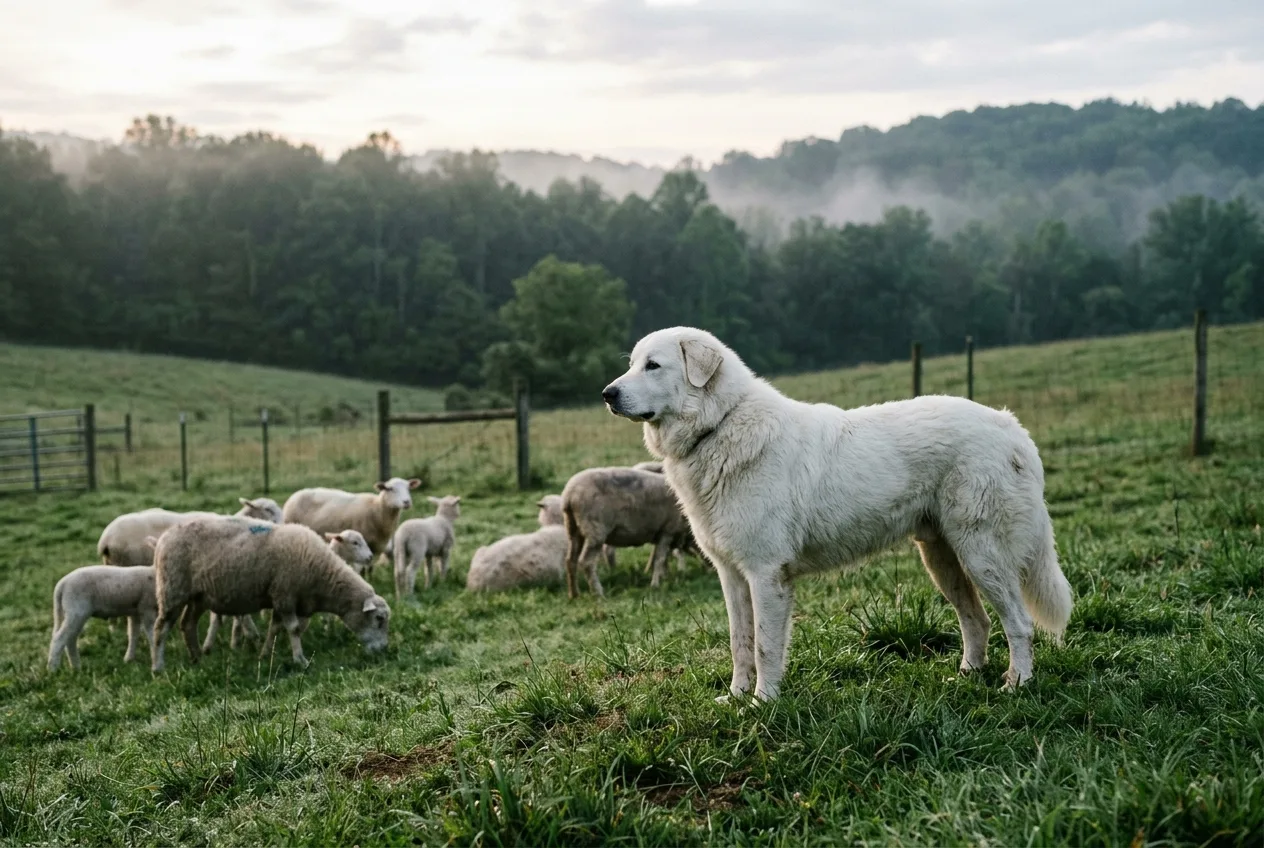
For sheep and goats, livestock guardian dogs are the proven tool. Guardian dogs work by being present continuously — they exclude predators from territory, investigate and disrupt intrusions, and confront predators when needed, deterring them before a kill rather than reacting after one. They're particularly valuable on open rangeland where a human can't watch the flock; as one extension service notes, in regions where coyotes are the predominant predator, guardian dogs provide the continuous protection a shepherd can't. One Texas operation saw its lamb crop exceed 100% after bringing dogs in. Good fencing, night penning of vulnerable animals, and removing carcasses (which draw scavenging coyotes) round out the toolkit.
For pets, supervision is the whole game. Keep cats indoors or in a "catio," walk small dogs on a leash in coyote areas, be extra cautious at dawn and dusk and through the spring pup-rearing season, and never feed or tolerate bold coyotes near the house. A coyote that stays wild and wary is a coyote that stays a non-problem.
It's also worth keeping the ledger balanced. The same coyote that worries you is doing real work on your land — Missouri's agency credits coyotes with controlling rodent pests and, as scavengers, "cleaning the woods and fields" of carrion. A landscape with a healthy, wary coyote population is usually a landscape with fewer voles, mice, and rotting carcasses. The goal isn't a coyote-free property; it's a property where coyotes can't get at your animals and have no reason to lose their fear of you.
Frequently asked questions
What do coyotes eat the most?
Small rodents — voles, mice, rats, and ground squirrels — along with rabbits, make up the core of the coyote diet almost everywhere it's been studied. In a Chicago study, small rodents had the highest frequency of any food in every season; in Denver, rodent hair was in 100% of scats. Fruit and carrion are major secondary foods, and deer (especially fawns) matter seasonally.
Do coyotes eat cats and dogs?
Yes, but pets are a small part of the diet — about 3% in one Denver study — and coyotes often kill pets without eating them, treating cats and dogs as competitors or territorial rivals rather than prey. Cat risk varies a lot by location: under 5% of NYC coyote scats contained cat, versus 20% in food-rich Los Angeles.
Are coyotes dangerous to humans?
Attacks on people are rare. A review documented 367 across the US and Canada from 1977 to 2015, concentrated in California and strongly linked to coyotes that had been fed or had become habituated to people. A wild, wary coyote almost never attacks; a food-conditioned one is the real risk — which is why feeding them, even accidentally, is the core mistake to avoid.
How can I tell coyote scat from dog scat?
Coyote scat is usually rope-like with tapered, twisted, pointed ends, and it's frequently left in conspicuous spots — on rocks, in trail centers, at junctions — as territorial marking. Its contents give it away: hair, bone, seeds, berries, and insect parts, where dog scat tends to be more uniform and food-pellet-based. Don't handle it; some scat carries parasites.
Do coyotes really kill a lot of deer?
They're significant fawn predators in spring — in parts of the Southeast the leading cause of fawn death — but they scavenge far more adult deer than they kill, especially in winter. Whether fawn predation actually reduces the deer population is complex and depends heavily on habitat and local conditions.
How do I protect my chickens and sheep from coyotes?
For poultry, lock birds in a secure coop at night, use tall or covered runs (coyotes clear 4-foot fences easily), and bury wire to stop digging. For sheep, livestock guardian dogs are the most effective tool, deterring predators continuously. For all livestock, remove attractants and carcasses and pen vulnerable animals at night.