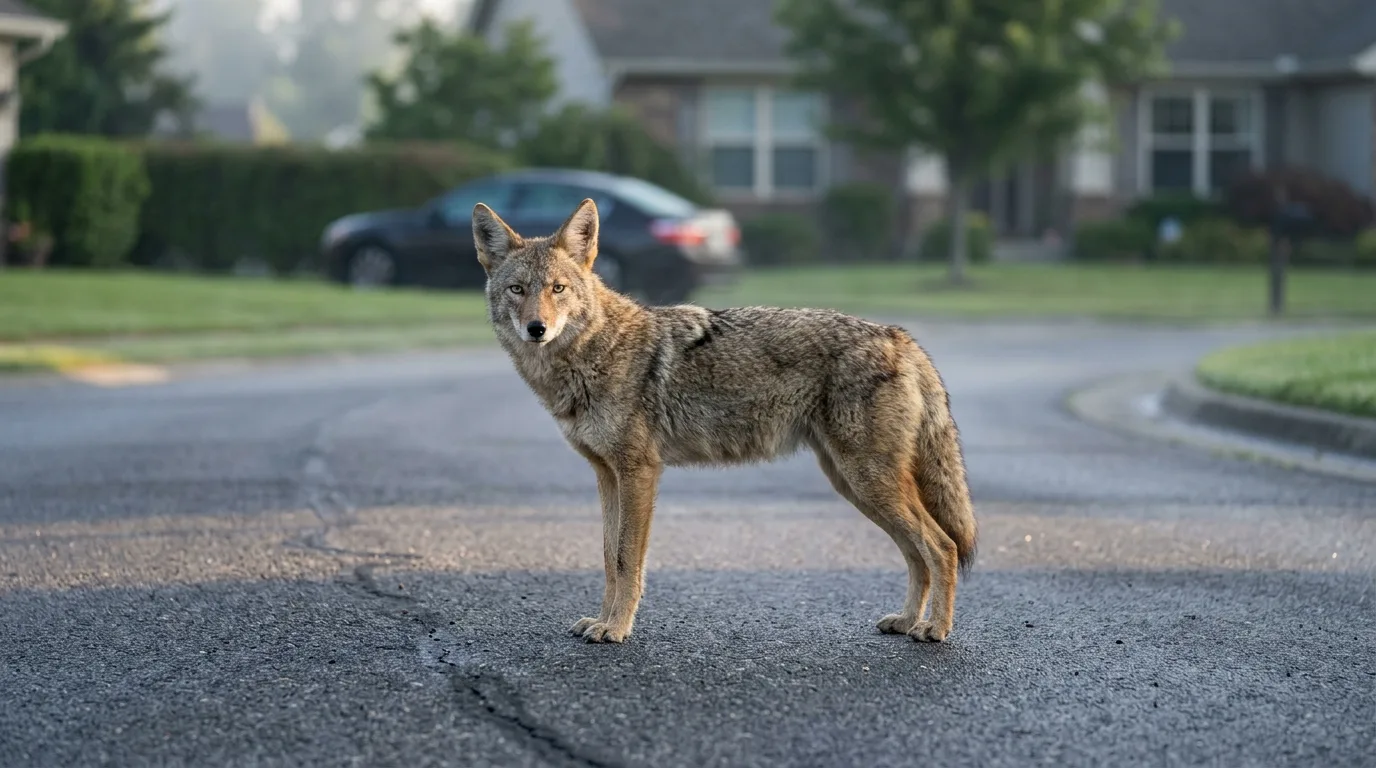
You came around the corner with the dog one morning and there it was: standing in the cul-de-sac, ears up, watching you with those pale yellow eyes. It trotted off before you could decide whether to be scared. And now you can't stop wondering — what is a coyote doing here, two blocks from a grocery store, and should you be worried?
Here is the short version, because it's genuinely reassuring. Coyotes live in your neighborhood for the same boring reason raccoons and rabbits do: there's food, water, and cover, and nothing big enough to eat them. The risk they pose to you personally is very low — over a roughly 46-year span, researchers could document only 142 coyote bite incidents across the entire United States and Canada, in a country where dogs bite more than 4.5 million people a year. Most of what a suburban coyote eats is rodents, rabbits, and fruit, not pets. The animal you saw almost certainly wants nothing to do with you.
That doesn't mean do nothing. It means the right response is informed, not frightened. Once you understand what that coyote is actually up to — why it's here, what it's eating, when it moves, and what it wants from your yard — the whole situation gets a lot less mysterious and a lot more manageable. Let's read the behavior.
Why coyotes are in the suburbs at all
A century ago, you mostly wouldn't have seen one. Coyotes were animals of the prairies and deserts of Mexico and central North America. Then two things happened. We removed the competition, and we rebuilt the landscape in their favor.
Across most of the eastern half of the continent we wiped out wolves and cougars — the larger predators that used to keep coyotes in check and, frankly, kill them. That left a wide-open niche. At the same time, clearing forests for farmland gave this open-country animal exactly the kind of edge habitat it thrives in, and where eastern coyotes met the remnant wolf populations, some interbreeding folded new genes into the mix. The result was one of the fastest range expansions of any North American carnivore: coyotes have grown their range by an estimated 40% since the 1950s — at least twice as much as any other carnivore on the continent over the same period — and now occur from the Atlantic to the Pacific and from Alaska to Panama.
What makes this expansion unusual is that it ran in the opposite direction from every other big predator. Wolves and bears were pushed out of the cities and most of the settled country; coyotes walked in. In the Northeast they reached New York in the 1930s and 40s and were firmly established statewide by the 1970s. Today they live in essentially every major metropolitan area in the United States, from Los Angeles to downtown Chicago.
And the suburbs, it turns out, are a pretty good place to be a coyote. Parks, golf courses, wooded lots, creeks, retention ponds — that patchwork supplies cover, water, and a buffet of small prey. The animals are flexible enough to make a living in it, which is the whole story of their success. As one National Park Service ecologist put it bluntly about the Los Angeles coyotes, "the food resources that we have left out for them is why coyotes hang around… If we don't provide the food sources in our neighborhoods, they would not be living in them".
What suburban coyotes actually eat (and why "they're after your pets" is mostly wrong)
This is where the fear and the data diverge most sharply. If you believe coyotes are slinking through the suburbs hunting cats and raiding trash cans, the science mostly disagrees — with one important regional asterisk we'll get to.
Start with the biggest, longest study. In the Chicago metro area, researchers analyzed 1,429 coyote scats and found a diet dominated by wild food. Across all sites, small rodents — voles and mice — showed up in 41.8% of scats, the single most common item in every season. Fruit appeared in 22.7%, white-tailed deer (largely as carrion) in 22.0%, and cottontail rabbits in 17.7%. Human-associated food? Just 1.9%. Domestic cat? 1.3%. Even though these coyotes had access to garbage, they largely ignored it and ate prey. The Cook County research team's plain-language summary is worth quoting: "the majority of coyotes in our study area do NOT, in fact, rely on pets or garbage for their diets".
Denver tells the same story. In a study of 64 fecal samples, rodents led at 43.0%, rabbits and hares at 25.7%, and other wild carnivores (mostly raccoon) at 15.7%. Pets — cats and dogs combined — were 3.3%, and trash was effectively zero by mass, around 0.3%.
Now the asterisk. Los Angeles is a different world. There, a much larger study analyzing more than 3,100 scats found that human-related food — garbage, ornamental fruit, and domestic cats — made up 60 to 75% of the urban coyotes' diet. Cat remains turned up in 20% of urban scats, versus just 4% in the suburbs nearby. Ornamental fruit (ficus, loquat, grapes, palm) was the most common single item, in 26% of urban scats; human trash was in 22%. By the isotope chemistry of their whiskers, human food made up about 38% of the urban coyotes' actual diet.
So which is it — rodents or garbage? Both, and the difference is the point. Coyote diet is a gradient, not a single number. The more arid and built-up the city, and the more unsecured human food is lying around, the more a coyote leans on it. Chicago coyotes living near forest preserves eat like predators; deep-urban Los Angeles coyotes eat like opportunists working a food-rich, prey-poor grid. Don't let anyone hand you one tidy "coyotes eat X% pets" figure — it depends entirely on where you live and, crucially, on what your neighborhood leaves out. (That last part is the lever you can actually pull, and we'll come back to it.)
One more thing the diet data quietly settles: even where coyotes do kill cats, they often aren't eating them for hunger. In Denver, pets were a tiny slice of the diet and didn't spike in winter when pet conflicts peaked — which points to coyotes treating cats and dogs as competitors or threats, not groceries. That reframes pet safety in a useful way, as you'll see.
Chicago coyotes living near forest preserves eat like predators; deep-urban Los Angeles coyotes eat like opportunists working a food-rich, prey-poor grid.
How big is its territory, and is it alone?
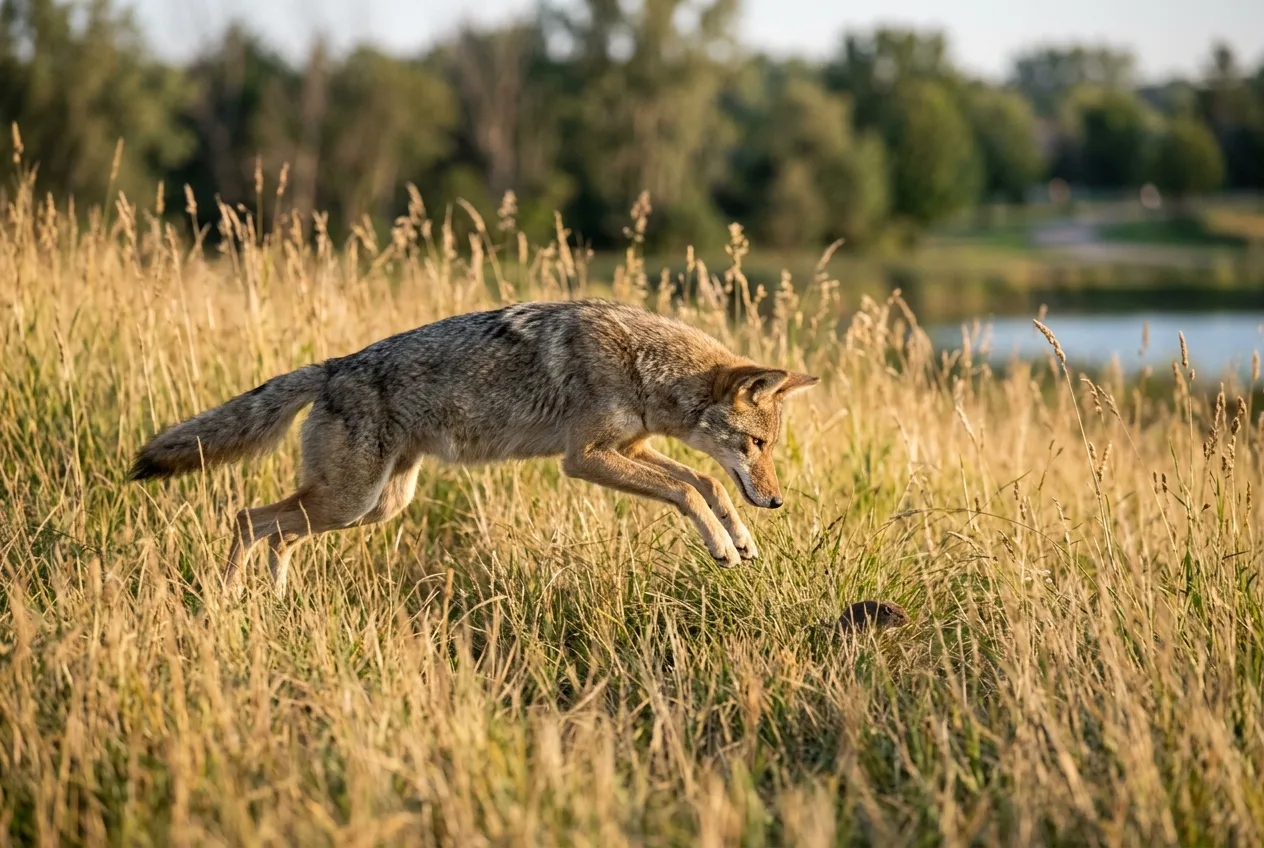
The coyote you saw is probably a member of a family group with a defended patch of ground. In urban areas these resident territories are surprisingly compact: across eight metro studies the mean home ranges ran roughly 5 to 13 square kilometers, with a grand average around 7.3 km² once an outlier was set aside — smaller, generally, than rural coyotes use, because the city packs more food into less space. State agencies describe the same thing in round numbers: a New York family unit defends a territory of 2 to 15 square miles.
A "pack," for a coyote, is mostly just family. The typical group is an alpha male and female plus a few others — usually their own grown offspring — and genetic work shows nearly all packmates are close relatives. In protected habitat a group might run five to six adults plus that year's pups. But here's the catch that fools people: even though they live in family groups, coyotes usually travel and hunt alone or in loose pairs. The lone animal crossing a field tells you nothing about whether it's solitary or part of a pack.
And some genuinely are loners. At any given time, between a third and a half of the coyotes in the Chicago study were solitary — young animals that have left home looking to start their own territory, or older ones pushed out. These wanderers cover enormous ground, up to 60 square miles across many towns, with the largest tracked Chicago range hitting 101 km². So the coyote in your subdivision might be a settled local or a transient just passing through. Either way it's not lost, and it didn't escape from anywhere.
Den season: why spring coyotes act differently
If you're going to see odd, edgy coyote behavior, it'll most likely be in spring and early summer — and there's a simple reason.
Coyotes mate in February, and after a 62-to-65-day pregnancy the female finds or digs a den in April. Litters usually run four to seven pups, and here's a neat detail: females adjust litter size to the food supply, so well-fed suburban coyotes tend toward larger litters. The den is the one time of year coyotes bother with a burrow at all — otherwise they sleep above ground — and in town that den might be under a shed, a porch, a rock pile, or a brushy corner of a park. The pups stay underground about six weeks, then start ranging short distances with the adults; they're weaned by five to seven weeks and the family disperses from the den around then. Different agencies put the protective pup-rearing window anywhere from roughly March through July to as late as September.
Why this matters for you: a coyote guarding pups is a different animal. Parents become far more territorial and bold near the den, and that "stalking" coyote shadowing a dog-walker in April is very often a parent escorting a perceived threat away from its young, not a predator sizing up a person. It may hunch its back, bark, or "huff" and walk toward you. The fix is almost insultingly simple: it can't move the den, so you move your walk. Give known den areas a wide berth from late winter into summer, and keep dogs leashed and close.
That "stalking" coyote shadowing a dog-walker in April is very often a parent escorting a perceived threat away from its young, not a predator sizing up a person.
When are they out? The nocturnal shift
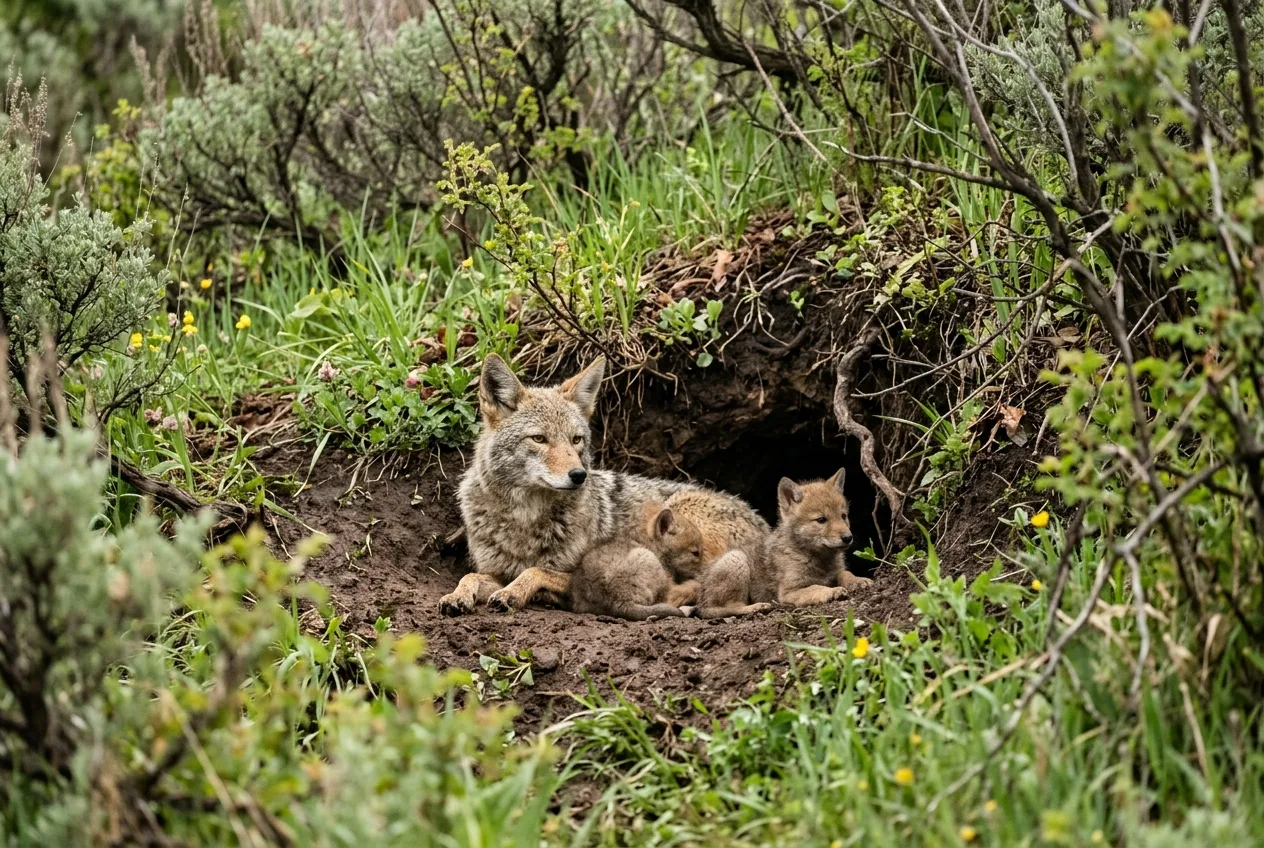
People assume coyotes are nocturnal. The truer answer is that they become more nocturnal the more people are around — it's a learned accommodation to us, not a fixed trait.
Out in quieter country, coyotes are classic dawn-and-dusk animals, most active at sunrise and sunset, and active at any hour. Seeing one in daylight is not, by itself, a sign of a sick or rabid animal — agencies are emphatic about this; daytime activity is normal, especially when they're feeding pups. But push human density up and the pattern shifts toward the dark. Across urban studies, coyotes consistently cut their daytime activity and add nighttime activity as development and human use increase. A 10-city, multi-species camera-trap study found that urban mammals shuffle their daily timing as a way to manage risk and coexist with people — using the clock, in effect, to stay out of our way.
There's a hard survival logic underneath it. The number-one killer of urban coyotes is cars — vehicle collisions account for 40 to 70% of deaths in the Chicago study every year, and some roads those coyotes cross carry over 100,000 vehicles a day. Traffic thins out at night and so do people, so a coyote that shifts to the small hours both avoids us and gets hit less. The shift isn't a simple switch, though. One British Columbia study found coyotes were more nocturnal where foot-trail density was high but less nocturnal where road density was high — they read the specific kind of human pressure in front of them and adjust accordingly. The takeaway for a homeowner: a coyote moving at 2 a.m. is behaving exactly as expected, and a relaxed coyote ambling through at noon usually just means it's a quiet block, not that something's wrong.
The honest risk to people: low, and worth keeping in perspective
Let's put the scary part where it belongs. Coyote attacks on humans are real but genuinely rare. The benchmark analysis combed newspaper archives, agency records, and prior studies and could document just 142 attack incidents resulting in 159 bitten victims across the U.S. and Canada from 1960 to 2006. Of the incidents the researchers could classify, 37% were predatory and 22% investigative; only 7% involved a coyote confirmed rabid. Attacks skew heavily to the arid Southwest — 49% in California and 13% in Arizona — which lines up with those regions' more food-conditioned coyotes.
For scale, set that against the City of Albuquerque's flat statement: there have been no documented coyote attacks on a human in the city, coyote attacks nationwide amount to "a handful of attacks per year," and meanwhile over 4.5 million people are bitten by domestic dogs annually. The world's largest urban-coyote study, running in greater Chicago since 2000, has recorded no verified coyote attack on a human within its study area — even as local newspaper coverage of "coyote conflict" jumped more than twentyfold. The perceived threat and the measured threat are not the same animal.
And the single biggest driver of the rare bad outcome is something we control: feeding. Across the agencies the refrain is identical — attacks are usually linked to coyotes that have learned to associate people with food. A coyote that's being fed, on purpose or by accident, gets bold; a coyote that stays wary stays away. Which is exactly why what's in your yard matters more than what's in the coyote.
The perceived threat and the measured threat are not the same animal.
Keeping pets safe — the part you can actually act on
Here's the reframe that helps. Even though pets are a tiny fraction of what coyotes eat, the conflict with pets is the real issue: in Denver, over 92% of reported coyote–human conflicts from 2003 to 2010 were incidents involving pets. The collision is mostly about territory and competition, not the coyote going hungry — but to your cat or small dog the distinction is academic. So:
- Leash up, and keep it short. Agencies are unanimous: keep dogs on a leash, and Albuquerque specifies no longer than six feet near coyote country. A loose dog near a den is the classic setup for trouble. If a coyote approaches while you're walking your dog, keep the dog close, don't run or turn your back, and calmly leave.
- Don't let small pets roam, especially at dawn and dusk. Supervise cats and small dogs outside, and be extra alert at first and last light. Cats left out are the pets most likely to become a statistic.
- Mind the calendar. Conflicts climb in pup-rearing season as parents defend dens, and even large dogs can draw a territorial response then.
- Fence if it fits. A coyote-resistant fence is roughly an 8-foot barrier, or a 6-foot fence with a roller or extension on top.
None of this requires hating the animal. It just requires not handing it easy opportunities.
Attractants: what's actually inviting them in
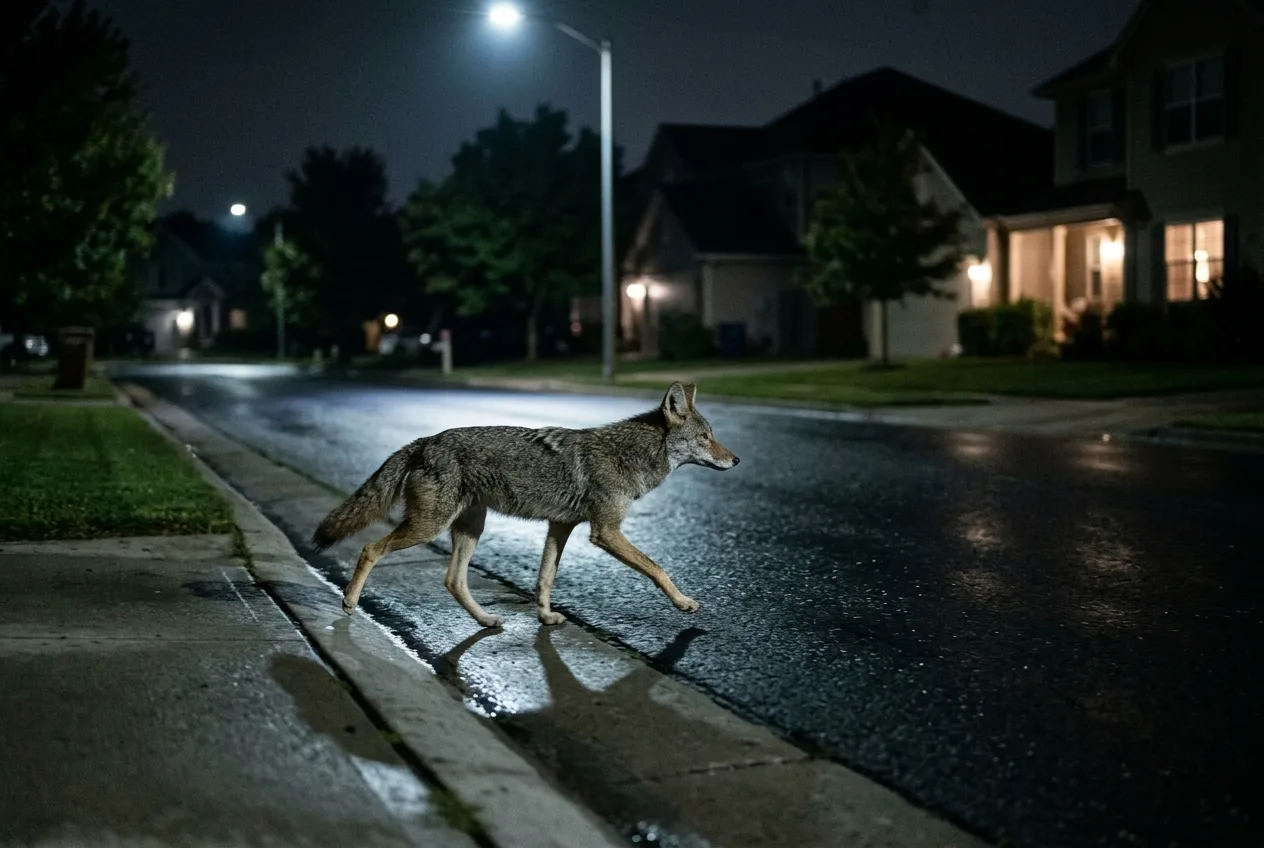
If a coyote keeps showing up, it has usually found a reason to. The reasons are predictable, and every one of them is on you to remove:
- Garbage and compost — secure both in animal-proof containers.
- Pet food — never feed pets outdoors; store the food indoors.
- Birdseed — not for the seed itself but for the rodents it draws, which are the main course; clean up spillage or pull the feeder.
- Fallen fruit — rake it up, especially under ornamental trees, which the LA data shows coyotes love.
- Standing water — empty pet bowls and other easy water sources, which matters most in dry climates.
And the cardinal rule, the one that turns a wild coyote into a dangerous one: never feed a coyote, deliberately or carelessly. Food-conditioning is the documented path from "wary neighbor" to "bold problem", and a controlled experiment showed coyotes that had been hand-fed by people needed dramatically more effort to scare off than coyotes that hadn't.
Hazing: how to keep a coyote wild
If a coyote is getting too comfortable — strolling your street in daylight, lingering in yards, not flinching at people — the tool is hazing: scaring it enough to refresh its natural fear of humans, without hurting it. It works, and the science backs both the technique and the logic.
The move, in the words of the Project Coyote field guide, is to act "Big, Bad, and Loud": stand your ground, make eye contact, wave your arms or a jacket over your head, shout, and if it hesitates, advance — throwing objects toward, not at the animal — until it leaves. Noisemakers help (your voice, a shaker can of pennies, pots and pans, an air horn, a whistle), as do "surprises" like a garden hose, a water gun, or a pop-up umbrella. Don't haze from inside a car or building where the coyote can't connect the scare to a person. And be consistent — half-hearted, occasional hazing just teaches the coyote that the racket is normal.
Does it actually change behavior? Yes. In a controlled study, the more times a coyote had been hazed, the less it approached people — they learn. Out in the real world, a Denver-area citizen program trained 207 residents who logged 96 hazing events, with the most common coyote response being simply leaving the area, and participants came away more confident and more accepting of coexistence. The catch worth knowing: hazing is far less effective on coyotes that have been fed — boldness wins — and it loses some of its bite when a dog is present, since the coyote fixates on the dog rather than backing off from the person. Remove the food, control the dog, and the tool works.
Two firm exceptions: don't haze a coyote that looks sick or injured — call animal control instead — and ease off near active dens in spring and early summer, where a defensive parent isn't a behavior problem to be corrected but a parent doing its job; give it room.
A defensive parent isn't a behavior problem to be corrected but a parent doing its job; give it room.
Living with the neighbors

Strip away the alarm and what's left is an adaptable native predator that mostly eats rodents, mostly avoids you, mostly moves at night because of us, and is here because we made room for it. The Project Coyote guide isn't being cute when it says coyotes "can make good neighbors," including "free and healthy rodent control" — a settled, wary coyote family quietly running down the voles and mice in your greenbelt is doing work you'd otherwise pay for.
The whole job comes down to one principle: keep them wild. Don't feed them, secure the things that feed them by accident, watch your pets at the edges of the day, and haze the ones that get too bold. Do that, and the coyote in the cul-de-sac stays exactly what it should be — a glimpse of something wild at the end of your street, not a problem on your doorstep.
Frequently asked questions
Why are there suddenly coyotes in my neighborhood?
They've been spreading for decades, not days. With wolves and cougars removed from most settled country and the landscape reshaped in their favor, coyotes expanded their range about 40% since the 1950s and now live in nearly every U.S. metro area. A new sighting usually means one moved into available habitat — or a young one is passing through looking for territory.
Are coyotes dangerous to people?
The risk is low. Researchers documented only 142 coyote bite incidents across the U.S. and Canada over roughly 46 years, versus more than 4.5 million dog bites a year. The world's biggest urban-coyote study has logged no verified attack on a human in its area. The rare attacks are strongly tied to coyotes that have been fed by people.
Do coyotes eat cats and dogs?
Sometimes, but pets are a small part of their diet — about 1–3% in Chicago and Denver studies. In Denver, over 92% of coyote conflicts involved pets even though pets were barely in the diet, which suggests coyotes often treat cats and dogs as rivals or threats rather than food. In dense, arid Los Angeles, cats show up more — in about 20% of urban scats — so risk varies by region.
Is it normal to see a coyote during the day?
Yes. Coyotes are naturally most active at dawn and dusk and can be out anytime; daytime activity alone does not mean an animal is sick or rabid. They tend to shift more nocturnal in busy areas mainly to avoid people and traffic.
Why is a coyote following me and my dog?
Especially in spring and early summer, that's usually a parent escorting you away from a nearby den, not hunting you. Keep your dog leashed and close, don't run, and calmly leave the area — and avoid that spot during pup season.
What's the best way to scare a coyote away?
Haze it: stand tall, make eye contact, yell, wave your arms, and use noisemakers or a hose until it leaves — throwing things toward it, not at it. Be consistent, and never do it from inside a car or house. It works because coyotes learn to avoid people who haze them — but remove food sources first, since fed coyotes are much harder to deter.