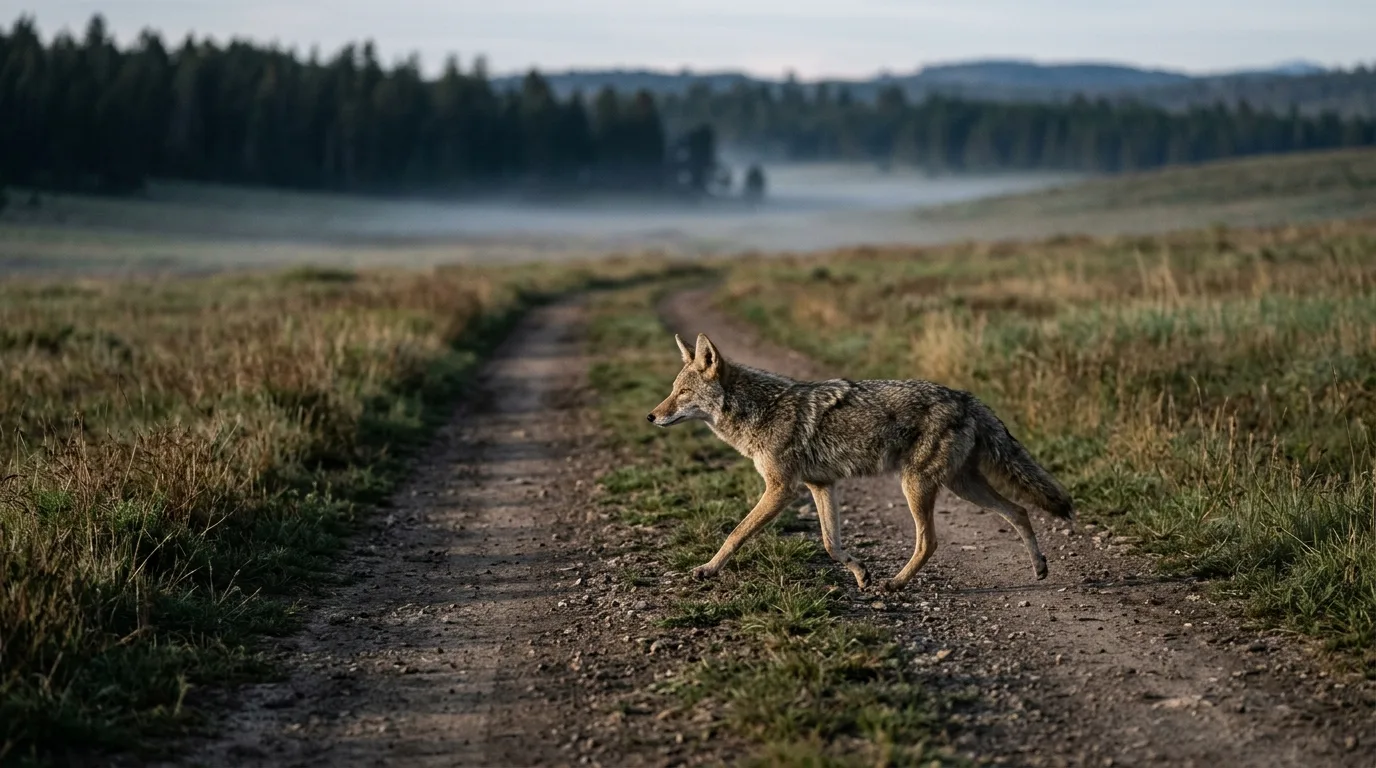
Here's a number that should change how you read your own camera data. In a Mojave Desert study, researchers ran two sets of cameras side by side for two years to estimate coyote density — one set placed randomly across the landscape, the other placed deliberately on coyote travel routes. The random cameras needed, on average, seven straight days of operation to produce a single coyote photo. The strategic cameras averaged two coyote detections per day — about sixteen times the rate. Same animals, same desert, same study. The only difference was where the camera looked.
That gap is the whole problem and the whole opportunity of predator monitoring in one example. Coyotes and foxes are exactly the species cameras are best at catching and worst at counting. They're wide-ranging, they sit at low density, and they use the land anything but randomly — so a camera on a dirt road can make a thin population look thick, and a camera in the wrong spot can make a healthy one look absent. If you're a game manager, a landowner watching your fawn crop, or a biologist trying to track a declining gray fox, the camera is the right tool. You just have to know what it's actually measuring.
So let's be concrete about the things that matter. Where you set cameras for canids (which is not where you set them for deer), whether lure and scent stations earn their keep, how to tell a coyote from a red fox from a gray fox at 2 a.m., what the activity timestamps really mean, and — the part most people skip — the hard limits on what a pile of predator photos can tell you about how many predators you have. The honest answer to "how many coyotes are on my land?" is usually "more than your cameras suggest, and you can't count them from photos alone." Everything below is about getting as much real information as possible despite that.
Why monitor the mesopredators at all
The case for watching coyotes and foxes is partly that they've quietly become the most important predators on most of the continent, and partly that what they do shows up in the species you actually care about.
Start with the coyote, because its rise is the backdrop to everything else. Coyotes have expanded their geographic range by an estimated 40 percent since the 1950s — "at least twice as much any other North American carnivore during the same time period". They pushed north into taiga, east into the deciduous forests, west to the coastal rainforests, and south into the tropics, filling the vacuum left when wolves and cougars were wiped out, exploiting the edge habitat that farming and fragmentation created, and in the East picking up wolf and dog genes through hybridization that may have helped them colonize. One useful myth to drop along the way: coyotes were never just a Great Plains animal. Museum and fossil records put them across California and the arid West throughout the Holocene, well before European settlement. They didn't invade the West; they were always there, and then they took the rest.
The national picture from cameras confirms how complete that takeover is. Snapshot USA, the first coordinated nationwide camera survey, deployed 1,509 cameras across all 50 states in the fall of 2019 and logged more than 166,000 detections of 83 mammal species. The single most broadly distributed animal in that entire dataset wasn't the deer or the raccoon — it was the coyote, detected in all 49 continental states. If you run cameras in the Lower 48, coyotes are on your landscape whether you've photographed them yet or not.
Then there's what that means for game. The clearest data come from deer fawns. In a northern Georgia study in the southern Appalachians, researchers radio-collared 71 fawns and watched survival crater to just 15.7 percent by twelve weeks — "among the lowest recorded survival rates in North America". Predation caused 45 of 55 deaths (82 percent), and coyotes were the leading killer at 22 events. The detail that matters for management: black bear predation stopped by day 24 and bobcat predation by day 66, but coyote predation "continued at a consistent rate until the end of the monitoring period," with the oldest coyote-killed fawn at 71 days. Coyotes don't just hit fawns in the first vulnerable week and quit; in that system they kept switching back to fawns all summer, which the authors read as a delayed prey-switching pattern tied to a habitat too uniform to offer fawns cover or coyotes alternative food. And coyote pressure on deer isn't only about fawns — a southeastern diet study estimated the average coyote pack consumes roughly 270 kg of deer per year (range 55 to 490 kg), eating adult deer year-round, not just scavenging hunter-shot carcasses in winter as was long assumed.
Foxes matter for a different reason: they're the canaries. Where coyotes surge, smaller canids tend to lose ground, and cameras are how we watch that happen. A landmark southern Illinois survey of 357 camera clusters found coyote occupancy at a near-ubiquitous 0.95 while gray fox occupancy stayed stuck at 0.36 even in 100 percent forest cover, with gray fox local-extinction rates running nearly double those of red fox. Minnesota's decades-long scent-station survey shows the same fingerprint at the state scale: "fox indices are lowest in the zone with the highest coyote index (Farmland), while coyote indices are lowest in the zones where wolves are present". So monitoring the whole canid guild — not just the coyote — tells you something about the health and trajectory of the system, not only the headcount of one species.
Where coyotes surge, smaller canids tend to lose ground, and cameras are how we watch that happen.
Setting cameras for canids: forget where you'd put them for deer
This is the section to read twice, because the instinct most of us bring from deer cameras is actively wrong for predators.
For deer, you set up on food, edges, and pinch points and let the animals come to a resource. Coyotes and foxes don't work that way. They're cursorial hunters that travel — a lot — and they exploit linear features to do it efficiently. GPS data make the scale of that movement vivid: resident breeding coyotes in Georgia averaged 5.5 to 6.3 km of travel per day, and a behavioral breakdown found they spend only about 28 percent of their time foraging and 9 percent walking, against 62 percent resting. When a coyote does move, it tends to follow roads, trails, ridgelines, and drainages. So the best canid camera isn't aimed at a food source; it's aimed at a travel corridor.
The numbers behind this are striking. A multi-site study across North American roads and off-road lured stations found coyotes were encountered 28 times more often at cameras on unlured secondary roads than at lured random sites off-road. Gray foxes showed the strongest road preference of any species tested — 106-fold more encounters on roads than at lured random sites — and even red foxes, the least road-bound of the three, showed a 9-fold increase. (Note: S05's full text was blocked when our research was assembled, so these fold-differences come from the verified research-pack summary of that paper, not a page we could read directly — treat the exact multipliers accordingly.) The point survives the caveat, and it's reinforced by the Mojave study, where coyotes used dry washes as highways and strategic cameras on those washes outproduced random ones sixteen to one. If you want canids on camera, find the lines they travel and watch those.
A second, cheaper lever: run more than one camera per site. A Maine study tested one, two, and three cameras at the same survey location and found coyote was the species that gained the most from extra units — detection probability jumped from 13 percent with a single camera to 51 percent with two and 65 percent with three. Across all six species, "the magnitude of the effect was greatest when increasing from one single camera to two cameras," and coyote showed the rare case where the third camera still bought a meaningful gain. The reason is mechanical: coyotes had "the lowest probability of availability for detection during any one survey occasion" — they're just not in front of any given camera very often — so spreading two or three cameras across nearby microsites dramatically cuts your odds of a false absence. Pooling two or three cameras at a site, the authors conclude, is "a cost effective approach to increase detection success over a single camera".
And don't bring an old camera to this job. Canids are fast and often nocturnal, which is the exact combination that exposes a slow camera. A Scottish trial pitted three cameras of different vintages against each other for 50 days: a high-spec unit with a 0.1-second programmable trigger, a budget unit at 0.5 seconds, and a decade-old model at 0.6 seconds. The premium camera logged 22 predator events; the budget camera caught a single one (an otter), and the vintage camera caught zero. The high-spec unit even captured 262 percent more individual deer than the budget model and 1,223 percent more than the vintage one — and deer are slow. The authors found budget cameras frequently fired a blank frame one to three minutes before or after the premium camera caught a predator, meaning the animal was there and the slow camera simply missed it. Their blunt takeaway for anyone comparing data across gear: "researchers should avoid comparing numbers of images obtained from more than one camera trap model or from a mixture of newer and older versions". For predator work, trigger speed and night-vision range aren't luxuries; they're the difference between a detection and a phantom.
For predator work, trigger speed and night-vision range aren't luxuries; they're the difference between a detection and a phantom.
Lures and scent stations: useful, but read the fine print
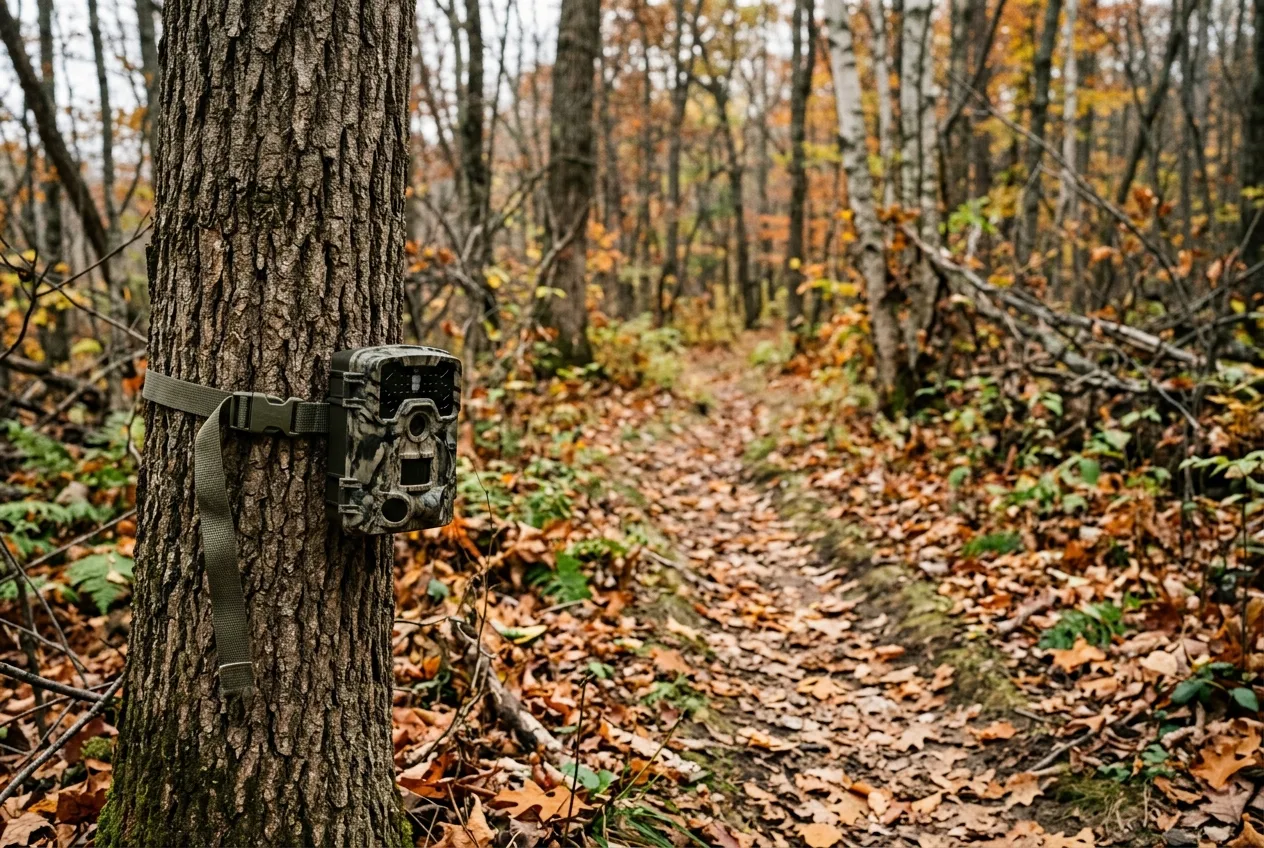
Once your camera is on a travel route, should you bait it with scent? Mostly yes for predators — but the effect is messier than the marketing suggests, and it changes what your numbers mean.
The cleanest evidence comes from an Alberta study comparing 404 lured and 440 unlured camera stations over 120-day periods. Predators as a group responded strongly and positively to scent lure (a skunk-and-musk blend), while prey species — deer, hares, ground squirrels — showed no response at all. So a lure is essentially a predator-selective amplifier: it pulls in the canids and cats without much changing your deer counts. Coyotes were the third most-detected species in that whole survey, behind only white-tailed and mule deer.
Here's the fine print, though. The lure effect is wildly species-specific, even within predators. In that same study, fisher detections shot up under lure (a huge effect) while gray wolf detections didn't budge at all. The authors' warning is the one to internalize: "researchers should explicitly consider the variable effects of scent lure on camera trap detections across species when designing, interpreting, or comparing multi-species surveys". Translation for your program: if you lure some sites and not others, or change lures between years, you've baked a bias into any comparison you draw. Pick a protocol and hold it constant. (One honest gap: that study analyzed coyotes only inside the broader "predator" group, not as their own line, so we can't pull a clean coyote-specific lure multiplier from it.)
On lure choice, the road-vs-lure study found salmon oil pulled roughly two to four times more canid encounters than a fatty-acid scent oil for coyote, red fox, and gray fox alike — a useful tiebreaker if you're choosing a bottle.
The grandparent of all scent-based predator monitoring is the scent-station survey, and it's worth understanding because it's still running and still informative. Minnesota's DNR has operated one since 1975, inheriting a method the U.S. Fish and Wildlife Service built in the early 1970s specifically "to monitor trends in coyote populations in the western U.S.". The protocol is simple and standardized: a 0.9-meter circle of sifted soil with a fatty-acid scent tab in the middle, stations spaced 0.5 km apart in routes of ten, read once each September–October for tracks. In 2007 that meant 274 routes and 2,571 operable stations across the state. The output isn't density — it's a visitation index, the percentage of stations an animal visited — but tracked consistently for decades it reveals trends and, crucially, the competitive signal between species: that same Minnesota data shows red fox highest in the Forest zone (43 percent) and coyote highest in the Farmland zone (33 percent), the two playing tug-of-war across the state. A modern camera grid is, in a sense, a scent-station survey with a memory card — and the same discipline applies. Standardize everything, and read indices as trends, not counts.
A modern camera grid is, in a sense, a scent-station survey with a memory card.
Telling them apart: coyote vs. red fox vs. gray fox at 2 a.m.
A camera that can't distinguish your three canids is just generating mystery. The good news is that people are genuinely good at this once they know the tells. An eMammal citizen-science study found volunteers correctly identified North American mammals from camera photos more than 90 percent of the time — and the three species that "routinely get stumped" people were exactly the red fox, gray fox, and coyote. They look alike at a glance. They're not, if you know where to look.
Work the field marks the eMammal guide lays out:
- Coyote. The giveaway is size and proportion. A coyote has "much longer limbs, ears and snout, making it larger and taller" than either fox, with a dog-like face and a long, fluffy tail. Typically gray, brown, or black. When in doubt, judge the build: a coyote stands tall and rangy where a fox sits low and light.
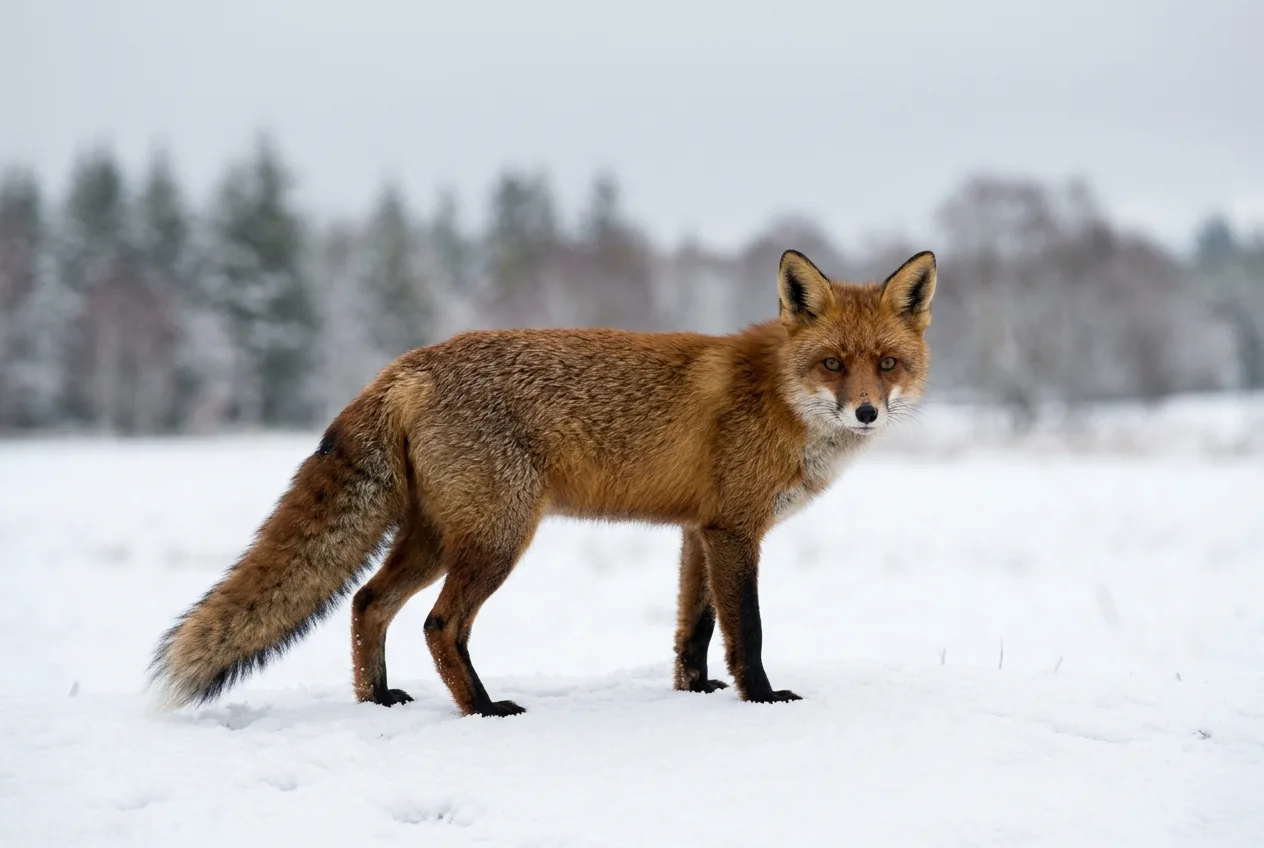
- Red fox. Look for the "black boots." Red foxes have black legs, black-tipped ears (visible from behind), a white-tipped tail, and a more dog-like face than the gray fox. Don't trust color alone — a "red" fox can be red, gray, black, or even albino, so the black legs and white tail-tip are your anchors. Rutgers' extension guide notes red foxes "always have black legs, black-tipped ears, and a white-tipped tail," which is the reliable combination.
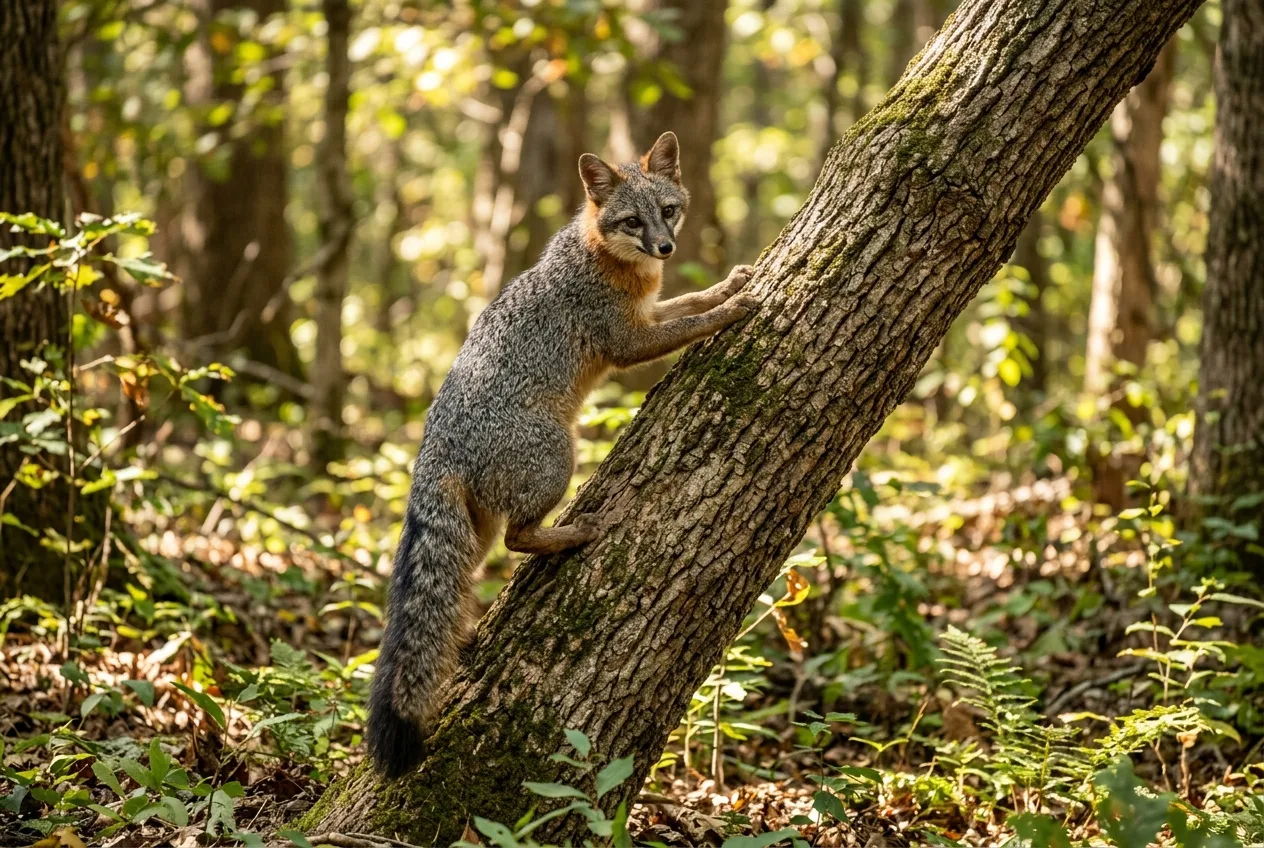
- Gray fox. The two tells are a black "racing stripe" down the back and a black-tipped tail (versus the red fox's white tip), plus "a more cat-like face than either the red fox or the coyote". One behavioral clue no other canid offers: gray foxes climb trees, and a fox photographed up a trunk is a gray fox.
Two practical warnings. First, low light is when misidentification happens — Rutgers explicitly blames "the low-light conditions of the dusk to dawn (crepuscular) hours in which they are typically seen" for the constant mix-ups. That's another argument for a camera with good night optics and the resolution to show you a tail tip or an ear back. Second, telling species apart is hard enough; telling individuals apart is much harder, and you should be skeptical of anyone claiming to count individual coyotes or foxes from photos. A two-year Bristol study that shot roughly 800,000 photos of urban red foxes managed individual IDs in 99 percent of usable images — but only by working through a long checklist of morphological features, multiple angles, both flanks, and high-resolution color images, with heavy manual labor. Their sober conclusion: "currently available automated identification systems are unlikely to achieve the same levels of accuracy," because "identifying individuals of subtly-marked species requires multiple images taken from different angles, under varying environmental conditions". Coyotes and foxes don't carry spots or stripes. Treat individual-ID claims with suspicion.
Reading the clock: activity and nocturnality
Once you trust your IDs, the timestamps become the most useful data a camera produces about predators — far more reliable than counts. Here's what the activity record consistently shows.
Coyotes are largely nocturnal, and foxes more so. Across the Snapshot USA mesocarnivore dataset, every one of seven species was primarily nocturnal, but the degree varied: opossums topped out at 96.6 percent of detections at night, gray foxes ran 85.9 percent, red foxes 80.6 percent, and coyotes 69.5 percent, with bobcats the least nocturnal at 60.0 percent. A British Columbia study pinned coyote activity to peaks "around 6:00 am and 9:00 pm" — the crepuscular shoulders, bleeding into the night. So when your coyote and fox photos cluster after dark, that's the species being itself, not an anomaly.
But that clock is plastic, and the shifts carry information. The most counterintuitive finding in the literature is that it's infrastructure, not people directly, that pushes coyotes around the day. The same BC study found "no strong evidence that any species' nocturnality was impacted by direct human presence" — even though 87.8 percent of more than 111,000 human detections fell between 9 a.m. and 6 p.m.. What did move the coyotes was the landscape: they were "more nocturnal in regions of higher trail density" and, oddly, "less nocturnal in areas of greater road density". The urban gradient adds another layer — coyotes grew more nocturnal moving from low to medium development, and red foxes shifted their activity toward dusk in the most developed areas. Chicago's 25-year urban coyote study captures the endpoint: city coyotes "confine most of their activity to nocturnal hours," a sharp departure from rural populations that "tend to be diurnal or crepuscular". The lesson for your data: a population going more nocturnal over time often means it's feeling more human pressure, and that's a real signal worth tracking.
Activity timing also tells you about predator–prey overlap, which is where management questions live. In the West Virginia deer study, coyotes were "largely nocturnal" and deer "largely crepuscular," with only partial overlap. Interestingly, the deer mostly didn't dodge coyotes by changing when they moved — they "did not exhibit large shifts in daily activity patterns based on coyote occupancy" — but they did move more, showing up detectable about 13 minutes a day where coyotes were present versus 6 minutes where they weren't. The one consistent exception in the broader literature is does with fawns, which several studies find shift toward midday to avoid the crepuscular-and-nocturnal coyote window. So your camera's clock can show you not just when predators are active but, read alongside your prey data, whether the prey is adjusting to them. (If you're reading activity timing off your own cards, the timestamp is doing the heavy lifting — see From Timestamps to Animal Activity Patterns: A Camera Trap Workflow for how to build a clean activity curve from a season of photos.)
Activity timing also tells you about predator–prey overlap, which is where management questions live.
What cameras can't tell you: the density trap
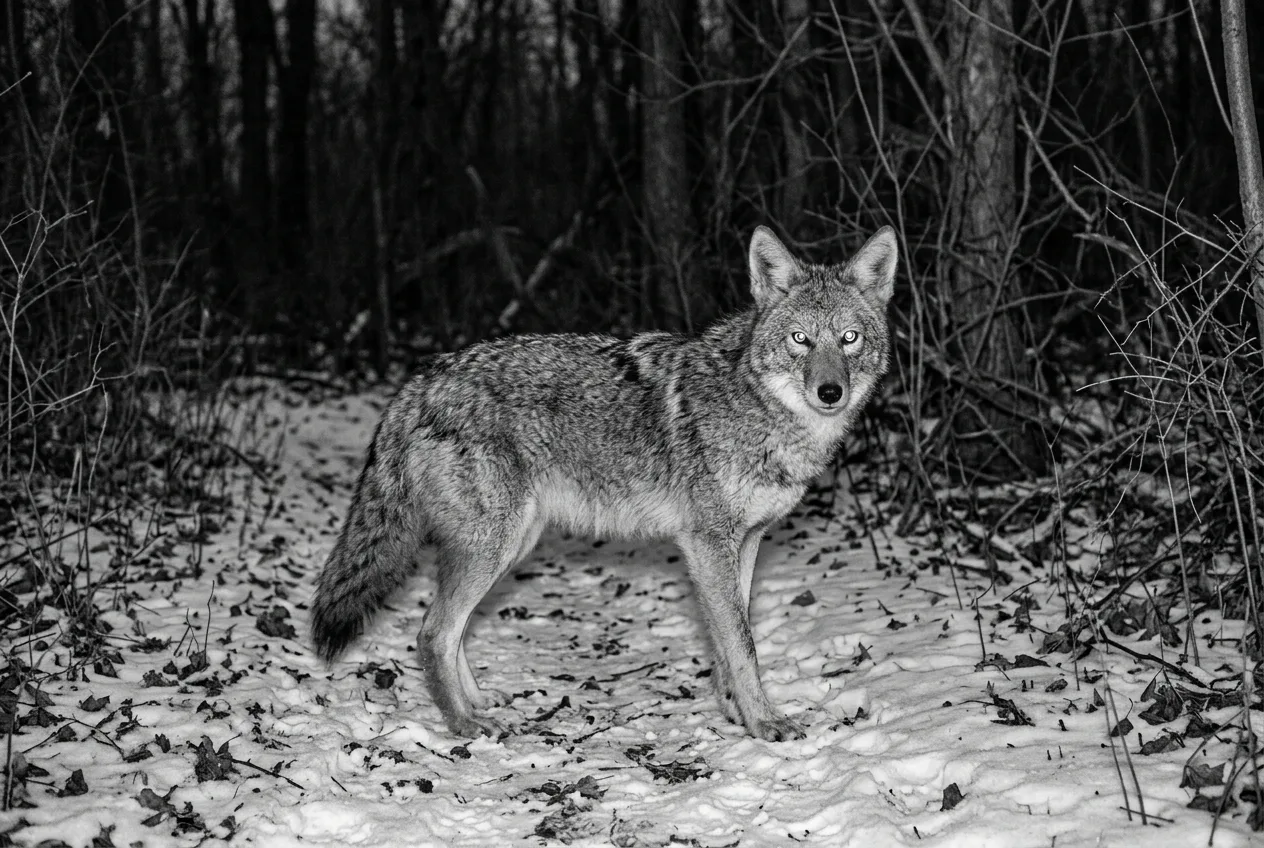
Now the discipline. If you remember one thing from this piece, make it this: a pile of predator photos is not a population estimate, and raw photo counts are one of the easiest ways to fool yourself in wildlife management.
Go back to that Mojave study. Because strategic cameras on coyote travel routes produced sixteen times the detections of random cameras, feeding those strategic detections into a popular density model (the Random Encounter Model) inflated the coyote density estimate by an eye-watering 1,663 to 2,180 percent versus the properly random baseline. And the contamination spread to the prey: the same misplaced cameras inflated jackrabbit density too, because cameras set to catch the predator aren't randomly placed relative to the prey either. The authors then reviewed the published literature and found 91 percent of REM density estimates in predator–prey studies used non-random cameras or borrowed movement values — and so were "likely not of the quality or reliability necessary for informing effective wildlife conservation or management". If peer-reviewed density estimates are mostly unreliable, the relative-abundance number off your own SD card deserves real humility.
The deeper reason is everything earlier in this article. Coyotes range over enormous, variable territories — resident home ranges of 13.4 to 47.3 km² in coastal North Carolina, but transient "floaters" wandering 64.5 to well over 600 km². Roughly 70 percent of a coyote population may be residents and 30 percent transients passing through, so the same camera can photograph a settled local pack and a stranger just passing, and you'd never know which from the image. Red fox home ranges swing from under 1 km² to 44 km² depending on how productive the land is; gray foxes average around 299 hectares but shift month to month. A camera samples a tiny, fixed window of those moving, overlapping ranges. More photos can mean more animals, or one busy animal, or a travel route that funnels many animals past one spot.
So what can you do? Stop chasing density and use the tools cameras are honestly good at:
- Occupancy and trend. Instead of "how many," ask "what fraction of my sites have coyotes, and is it changing?" That's a question cameras can answer, if you survey enough. For a common-but-hard-to-detect species like the coyote (high occupancy, low daily detection of just ~0.03), the efficient design is to add survey days at relatively few cameras — about 600 total camera-days (say 10 cameras for 60 days) gets you a usable occupancy estimate, scaling to ~1,600 camera-days for a tight one. Gray fox, being a bit more detectable, needs around 800 camera-days, and "sampling periods over 40 survey days provide no substantial reduction in associated error" for it — so 30 to 50 cameras for 40 days is the sweet spot. Plan the effort before you deploy.
- Indices, held constant. A standardized visitation or detection rate, run the same way every year — like Minnesota's scent stations — tracks trends even though it never yields a true count.
- Presence, distribution, and behavior. Confirming a species is on the property, mapping where, and reading its activity clock — all of that is solid camera work.
None of this is as satisfying as a number you can put on a management plan. But a defensible "occupancy is up 15 percent and going more nocturnal" beats an indefensible "we have 40 coyotes" every time.
A defensible "occupancy is up 15 percent and going more nocturnal" beats an indefensible "we have 40 coyotes" every time.
From data to decisions: what monitoring is actually for
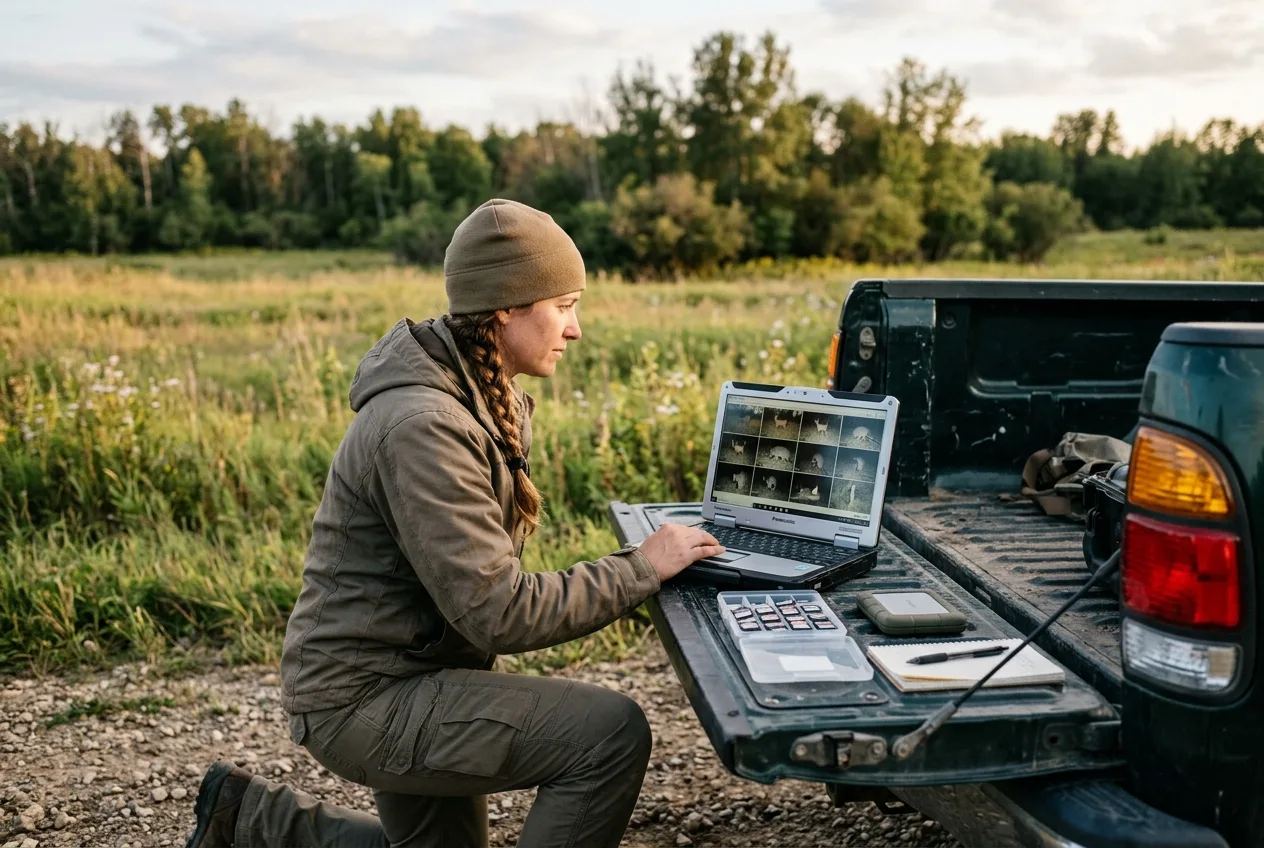
Pull it together and the value of predator monitoring is in informing management, not replacing it — and the sources are refreshingly honest about the limits of the obvious response.
Take the most common impulse: if coyotes are killing fawns, kill coyotes. (This is also where predator data and deer data should be read together — if you're already running a How Many Deer Are on Your Land? Running a Trail Camera Survey on the property, the coyote layer slots right on top of it.) The Georgia fawn study, which had every reason to endorse removal, instead cautioned that "coyote control may produce variable results without long-term effectiveness across a large landscape due to their ability to quickly fill the void," and pointed to habitat work — restoring early-successional cover that gives fawns refuge and predators alternative prey — as the more durable lever. The biology behind that warning is in the movement data: because ~30 percent of coyotes are transients constantly seeking vacant territory, and 88 percent of those that settle do so in or near areas they'd already been scouting, a removed resident is replaced fast. Monitoring's job here isn't to justify a cull; it's to tell you whether a fawn-recruitment problem even has a predator signature, and whether anything you try moves the needle.
Monitoring also catches the slow-motion stuff a single season hides. The gray fox's quiet collapse under coyote and dog competition only became legible through years of camera and harvest data showing extinction outpacing colonization; the swift fox's near-exclusion from coyote-occupied sites in Kansas (occupancy of 0.013 with coyotes present versus 0.096 without — a sevenfold gap) is a camera-occupancy finding, not something you'd see by eye. These are the population-level repercussions that justify watching the whole guild over time rather than reacting to one dramatic fawn kill.
And it scales. The same approach that works on your back forty drives the national programs — Snapshot USA building the first camera baseline for measuring change in mammal populations, Minnesota's scent stations tracking carnivore trends for half a century, Chicago's project following 25 years of urban coyote adaptation. Whatever the scale, the discipline is identical: standardize your methods, place cameras to answer the question you're actually asking, read indices and occupancy as trends rather than counts, and stay humble about density. Do that, and a wall of canid photos stops being a curiosity and starts being evidence.
Frequently asked questions
Where should I put trail cameras to catch coyotes and foxes?
On travel corridors, not food sources — the opposite of deer setups. Coyotes and foxes follow roads, trails, ridgelines, and drainages, and cameras on those linear features dramatically out-detect random placements. Running two or three cameras at a site also helps a lot, since coyote detection rises from about 13 percent with one camera to 65 percent with three.
Do scent lures actually work for predator monitoring?
Yes for predators as a group — they respond strongly and positively to scent lure while prey species ignore it — but the effect varies enough by species that you must keep your lure and protocol constant or you'll bias any comparison. For canids specifically, salmon oil pulled roughly two to four times more encounters than fatty-acid scent oil. A lure amplifies detections; it doesn't turn detections into a headcount.
How do I tell a coyote from a red fox from a gray fox on camera?
Size and a few field marks. Coyotes are taller and longer-limbed with a dog-like face; red foxes have black legs ("black boots"), black-tipped ears, and a white-tipped tail; gray foxes have a black stripe down the back, a black-tipped tail, a more cat-like face — and they're the only one that climbs trees. Don't rely on color (a "red" fox can be gray or black), and expect mistakes in low light, which is when these species are usually photographed.
Can trail cameras tell me how many coyotes are on my property?
Not reliably. Coyotes use the land non-randomly and range over huge, overlapping territories, so photo counts mostly reflect where you put the camera, not how many animals exist — and most published predator density estimates are unreliable for the same reason. Cameras are good for presence, distribution, activity timing, and occupancy trends — not absolute density.
Are coyotes mostly active at night?
Largely, yes — about 69 percent of coyote detections in a national dataset came at night, with peaks around dawn and dusk that spill into darkness; foxes are even more nocturnal (red fox ~81 percent, gray fox ~86 percent). Urban and high-traffic areas push coyotes further toward strict nocturnality, so a population shifting later over time often signals rising human pressure.
Do coyotes really hurt deer numbers, or is that overblown?
It depends on the system, which is exactly why monitoring matters. In a homogeneous southern-Appalachian forest, coyotes were the leading fawn predator and kept killing fawns all summer, driving fawn survival to 15.7 percent — but the same researchers warned that coyote removal is often ineffective long-term and favored habitat improvement instead. Elsewhere deer hold steady alongside coyotes. Coyote diet studies confirm deer are a major food (around 270 kg per pack per year), so the pressure is real even where the population absorbs it.