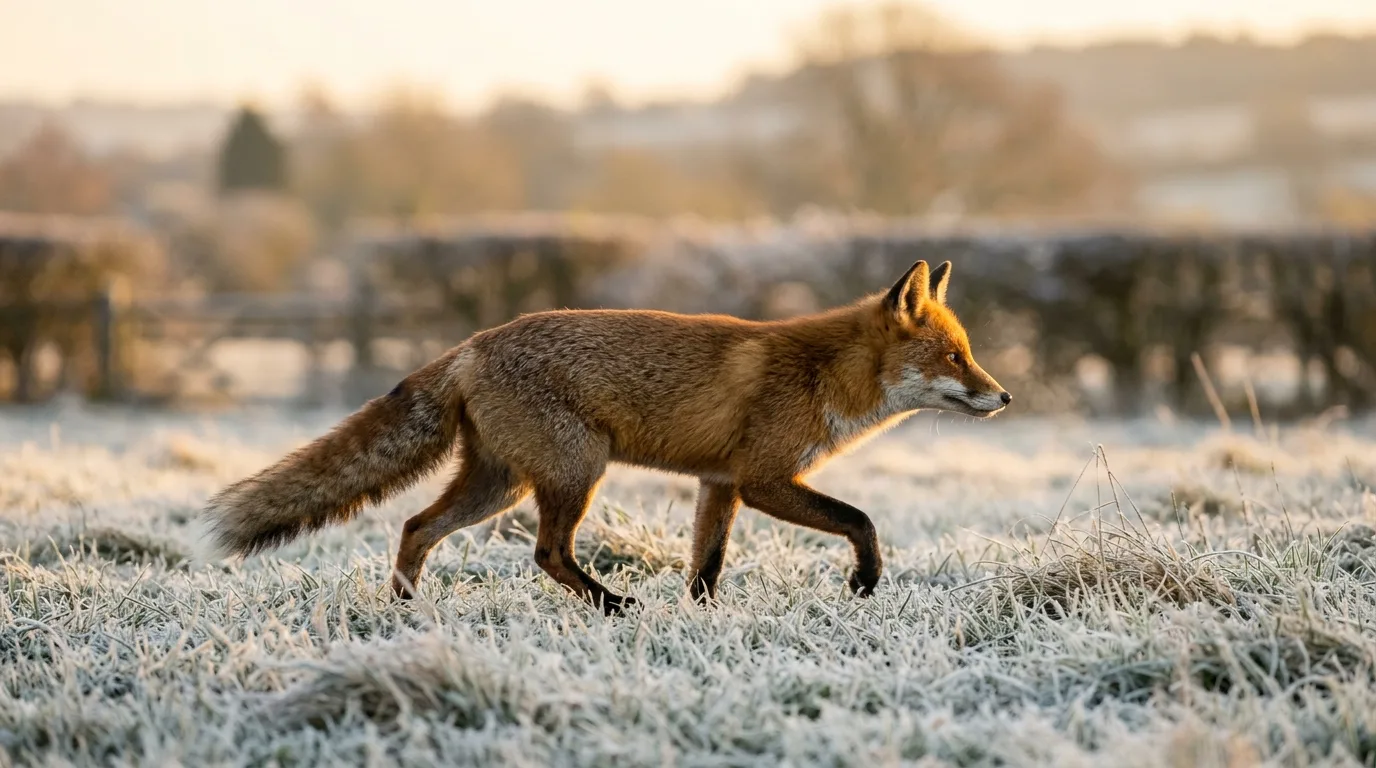
You pull the card, scroll to frame 212, and there's a fox trotting past at 3 a.m. — gray, grainy, lit by the camera's infrared flash. Your gut says "red fox." But the coat looks more salt-and-pepper than rusty, and in black-and-white you honestly can't tell. So which fox did you catch?
Here's the thing most people get backwards. They reach first for color — red fox is red, gray fox is gray, done — and color is exactly the clue most likely to betray you. Not all red foxes are red. A red fox can come in a silvery-gray phase that looks, at a glance, a lot like the species it's named against. And the gray fox isn't simply gray: its neck, legs, and flanks are washed with rusty cinnamon, enough rufous to fool a casual look into calling it a red. The two animals are also nearly the same size, so you can't just go by how big it looks.
So if color is unreliable, what's dependable? One feature settles it more often than any other: the tip of the tail. A red fox has a white tail tip no matter what color the rest of it is. A gray fox's tail tip is black, always. Tonal, not colored — which is why it survives even a washed-out night photo. Pair that with build (lean and long-legged versus stocky and short-legged), the gray fox's black-maned tail, leg color, and one near-diagnostic behavior — climbing trees — and you can identify almost any fox on your camera with real confidence. This guide walks through each clue and, just as important, tells you which ones still work on a grainy night-vision shot and which ones quietly fall apart in grayscale.
Why "just look at the color" fails you
Start with the trap, because almost everyone falls into it.
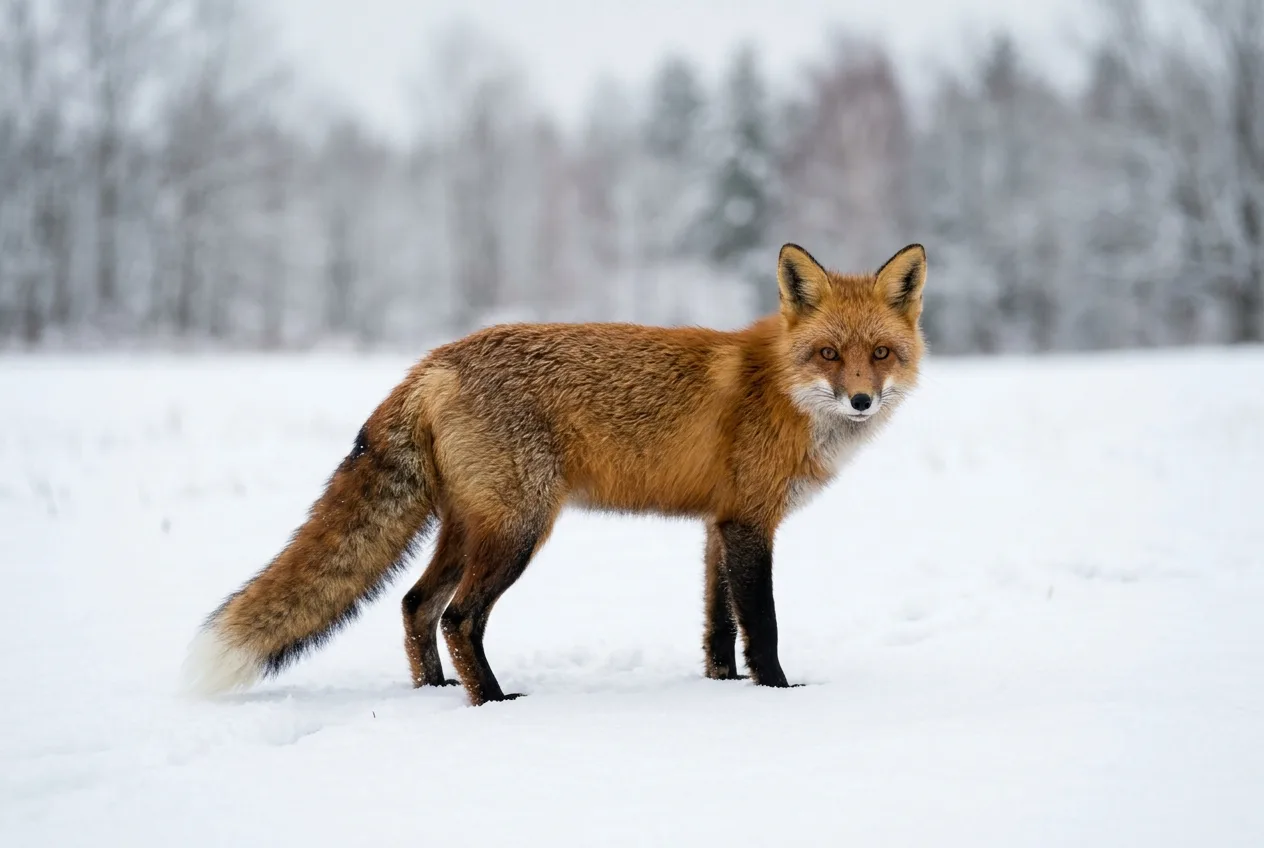
The red fox earns its name most of the time — the classic animal is "reddish orange" with a white belly, dark legs, and that flag of a white-tipped tail. But "red" is the species' most common coat, not its only one. Across its range the red fox shows several recognized color morphs: the standard red, the silver fox (essentially black with white-tipped guard hairs giving a frosted look), and the cross fox (browner and darker, with a dark stripe down the back crossed by another over the shoulders). Vermont's wildlife agency is blunt about the consequence: a red fox "may also be grayish color and can often [be] mistaken for the gray fox". In one Virginia tally, cross foxes make up around 25% of red foxes and silver foxes about 10% — these aren't freak rarities.
Not all red foxes are red — and the gray fox wears enough rust to be mistaken for one.
Worse for the would-be identifier, the color isn't even consistent within a family. Canada's Hinterland Who's Who notes that "two or more" color variations can occur within a single litter. So a fox's overall shade tells you surprisingly little about which species it is.
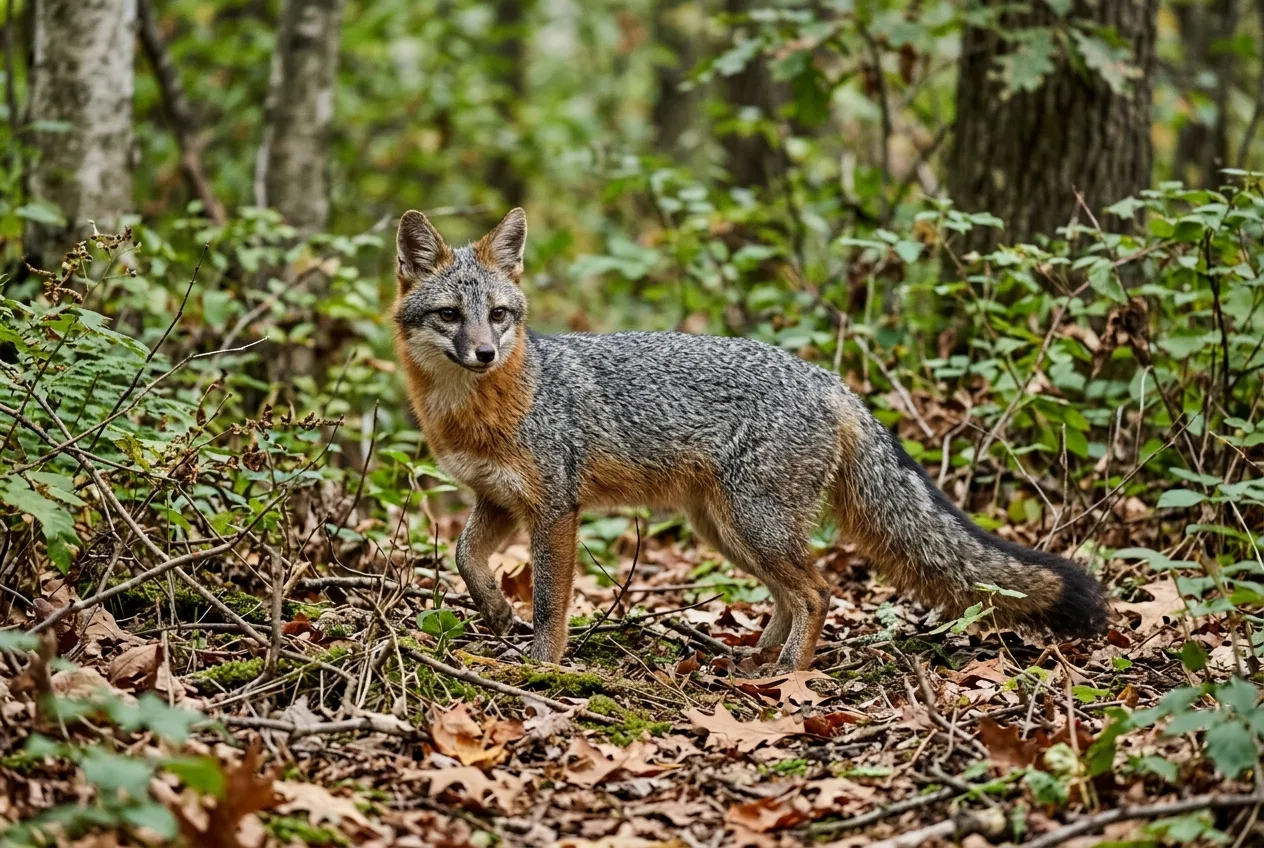
Now flip it. The gray fox's coat is a grizzled "salt-and-pepper" — individual guard hairs banded with white, gray, and black, which is what gives it that peppered look. But its neck, lower sides, chest, and legs are a warm rusty or cinnamon brown. Animal Diversity Web describes the gray fox's belly, chest, legs, and sides of the face as "reddish brown". That's the fox that gets misreported as a red.
So both species can wear the other's apparent color. Color is a starting hypothesis, not a verdict. Let's get to the clues that actually decide it.
The tail tip: your single most reliable clue
If you remember one thing, remember the tail tip.
The agencies are unusually unanimous here, which is rare in wildlife ID. Illinois's Forest Preserve District of Will County states it cleanly: "A red fox will have white fur at the end of its tail, no matter what color the rest of their fur is… Gray foxes will never have a white tip on their tail," whose tips "are always black". Pennsylvania's Game Commission describes the red fox's "long, bushy, white-tipped tail," white "no matter the color phase," against the gray fox's tail "with a black streak running down its length and a black tip". Minnesota's mammal database reduces the whole ID problem to a sentence: "Red foxes have white tail tips… gray foxes have black tail tips". California's Department of Fish and Wildlife lays it out as a side-by-side: red fox tail tip "WHITE," gray fox tail tip "BLACK".
Two things make this clue special. First, it holds across the red fox's color morphs — even a silver-phase red fox keeps the white tail tip. Second, and this matters enormously for trail cameras, it's a difference of tone, not hue. White-versus-black reads as light-versus-dark even when your photo has no color at all. Most other field marks are colors that turn to mush in the dark; this one doesn't.
A caution worth stating: you need to actually see the tip. A tail caught mid-swing, tucked, motion-blurred, or pointed straight at the lens can hide it. When the tip is visible, trust it. When it isn't, fall back on the rest of the package below.
Build and size: lean and leggy vs. stocky and low
People assume size separates these foxes. It mostly doesn't.
They overlap heavily. A camera-trapper's rule of thumb — "about the same size (around 7–14 lbs)" — isn't far off the agency figures. New York pegs the gray fox at 7 to 13 pounds; Pennsylvania lists the red at 8 to 12 pounds and the gray at 7 to 13. Body weights legitimately differ by region — European red foxes run heavier, around 5 to 7 kilograms, than the smaller Nearctic animals — but within any given place, a fox's bulk won't reliably tell you which species you're looking at. Texas's mammal account says it directly: the red fox is "similar in size to the gray fox".
What does separate them is proportion and build. The red fox is the lean, leggy one — Will County describes "longer legs, a leaner body and bigger feet than gray foxes". Animal Diversity Web makes the same contrast from the gray fox's side: red foxes have "larger feet, longer legs, and a leaner body". The gray fox is the opposite — shorter-legged and stockier, sitting lower to the ground, which the Adirondack field guide attributes to "rather short legs, giving these foxes a stocky appearance". The Massachusetts camera-trapper saw exactly this on his own footage: "the red fox has a slender build, while the gray fox is a little shorter and stockier".
There's a reason for the difference, and it's a satisfying one. A peer-reviewed camera-trap study frames it as two different body plans for two different escape strategies: "Gray foxes are forest specialist with shorter limbs adapted for climbing compared with more cursorial canids adapted for running speed". The red fox is built to run; the gray fox is built to climb. Once you know that, the silhouettes start to look obviously different — and silhouette is something a night photo still gives you.
The gray fox's tail stripe and mane
Here's a clue that's almost as good as the tail tip and survives grayscale just as well: the black stripe running down the gray fox's tail.
The gray fox carries a "mane of short, stiff black hairs" along the top of its tail, ending in that black tip. Pennsylvania describes "a black streak running down its length"; Animal Diversity Web, "a distinct black stripe along the dorsal surface and a black tip". It's prominent enough that "Maned Fox" is an old common name for the species. The red fox's tail has no such dorsal stripe — it's a bushy red (or whatever-phase) brush with a white tip.
On a clear daytime photo this stripe is unmistakable. On a night shot it reads as a dark line down the back of the tail — again, a tonal contrast that infrared preserves. If you can see a dark stripe running the length of the tail to a dark tip, you're almost certainly looking at a gray fox.
Legs, ears, face, and eyes: the finer marks
Once you've used the big clues, the finer marks confirm the call — though several of these are colors, so flag them mentally as daytime tells.
Legs and "stockings." The classic red fox has black legs and feet — "black 'leg stockings'" as Vermont's fact sheet calls them, alongside black ears and the white-tipped tail. Texas describes the pattern precisely: "forefeet and legs to elbow black". The gray fox runs the other way — "pale feet and legs," often with a rusty wash, not black. Vermont sums up the whole confusion neatly: "the black booties on all four of the red fox's legs and its white tipped tail are excellent field markings that distinguish it from the gray fox".
Ear backs. Subtle but useful in color. The red fox's ears are black on the back. The gray fox's ear backs are rufous — California's side-by-side lists red fox "Back of ear: BLACK" against gray fox "Back of ear: ORANGE".
Face. The gray fox has a distinctly marked face: a thin black stripe from the outer corner of the eye, a thicker black stripe from the inner eye down the muzzle to the mouth, and white cheeks, muzzle, and throat. The red fox's face is rusty, grizzled with white, without that crisp black-and-white patterning.
Eyes. Look closely and the pupils differ. The red fox has vertically slit, oval pupils — "slit-shaped eyes" — with a tawny iris. The gray fox has rounded, oval pupils and a darker, dark-brown iris. Missouri leans on this: the gray fox has a "dark brown (not tawny) iris of the eye". In a good close-up, the slit-versus-round pupil is a clean tell; at distance or at night, it's usually too small to read. The red fox's eyes are also described as "amber, forward-facing" in good light.
Throat. A small one that helps on grayer animals: red foxes have white throats and underfur, while gray foxes show yellow or orange on the throat. Minnesota's database actually lists the discriminators between the two as "tail-tip color, throat coloration, and muzzle length" — the gray fox having the slightly shorter muzzle.
The clincher: a fox in a tree is a gray fox
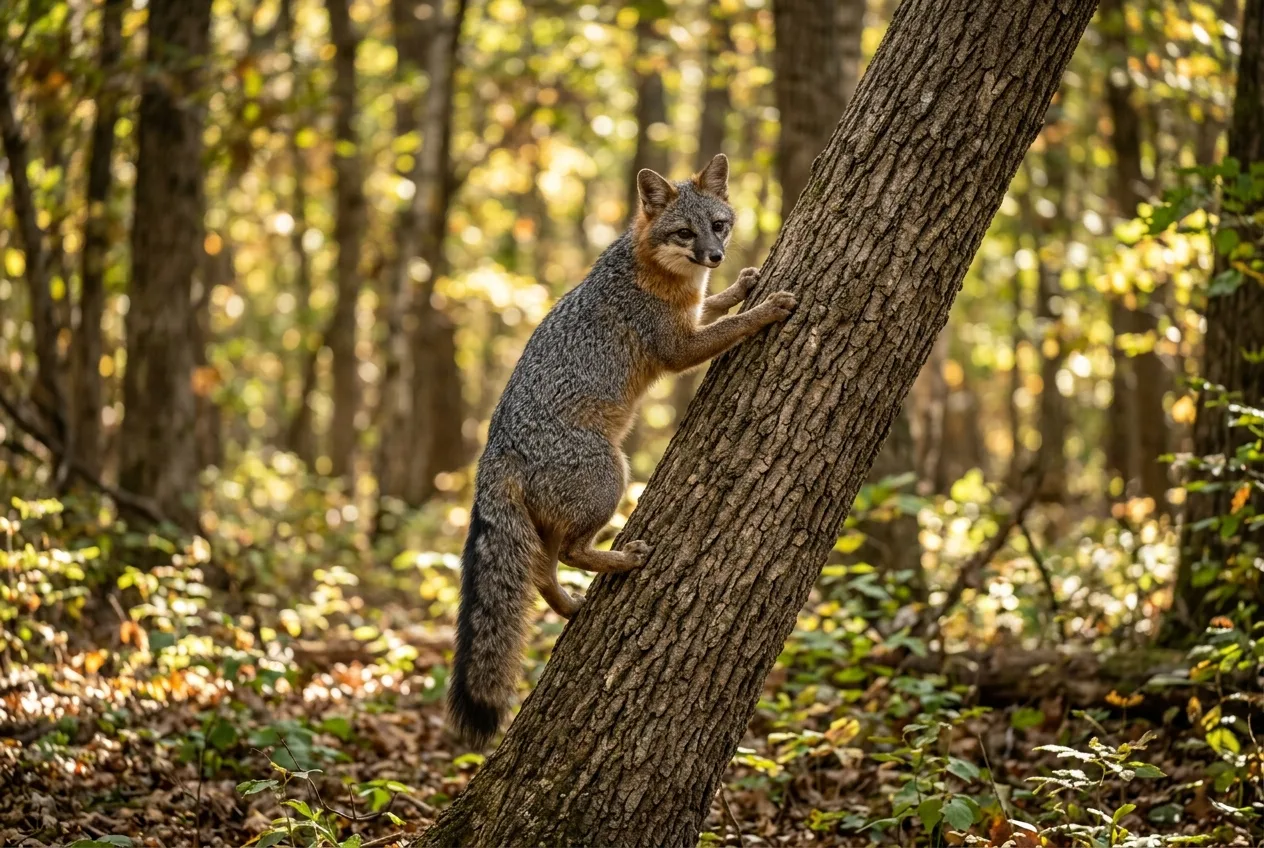
If your camera ever catches a fox climbing — on a leaning trunk, up among branches, resting on a limb — you can stop guessing. That's a gray fox.
This is the closest thing to a diagnostic behavior these two species offer, and the sources are emphatic. Animal Diversity Web calls the gray fox "the only member of the Canidae family that can climb trees". Pennsylvania agrees it's "the only member of the canid family" with the ability. The gray fox climbs to escape predators, to rest, and to find food — it'll go after fruit and refuge up in the canopy. One was documented "resting 15 feet… above ground on a saguaro limb", and dens have been found up to 20 feet up in tree hollows.
The mechanics are specific. The gray fox grips the trunk with its forepaws and pushes up with its hind feet, re-gripping higher and higher; up in the crown it hops branch to branch; to come down it backs down a vertical trunk or runs headfirst down a leaning one. It's equipped for the job in ways the red fox isn't — hooked, semi-retractable claws and an unusual ability to rotate its forearms. The red fox, by contrast, is a runner that "depend[s] on speed for escape" rather than climbing.
So: a fox up a tree, or clearly built to be there, is gray. A fox sprinting flat-out across open ground is behaving like a red. You won't get this clue often on camera — but when you do, it's as good as a signature.
A fox up a tree, or clearly built to be there, is gray.
Where you are narrows it down
Geography won't identify an individual fox, but it shifts the odds before you even zoom in — and in some places it does most of the work for you.
The two species partition the landscape. The red fox favors open and edge country — "sparsely settled, rolling farm areas with wooded tracts, marshes and streams," in Pennsylvania's words, and it tolerates people well, including suburbs. It's an extreme generalist, with "the widest distribution of any carnivore," found across most of the Northern Hemisphere. The gray fox is the woodland specialist, preferring "brushy areas, swampy lands and rugged, mountainous terrain" and deciduous forest laced with brush. Where the two overlap, the gray fox tends to stick to the denser cover.
Their ranges differ in a way that occasionally settles the question outright. The gray fox is a New World animal only — its range runs "from extreme southern Canada to northern Venezuela and Columbia," and it's absent from the northern Rockies and the northern Great Plains. The red fox, on the other hand, is Holarctic — native across Europe, Asia, and North America, and introduced to places like Australia. The practical upshot: if you're outside the Americas — in the UK or continental Europe, say — your fox is a red fox. The gray fox simply doesn't occur there. Within North America, the gray fox has actually been expanding northward over the past several decades into New England, the Great Lakes, and the northern Plains, so the overlap zone is growing.
One regional wrinkle worth knowing: in some places the "red" is the newcomer. In Vermont, the gray fox is the native species and the red fox was introduced by European colonists for hunting because the native gray "proved too elusive".
Tracks and scat: lower-confidence backup
If you've got prints or droppings near your camera rather than a clear photo, they can corroborate — but treat them as softer evidence than the tail and build.
On tracks, the cleanest agency comparison comes from Pennsylvania: "The gray fox has much larger toe pads and a smaller foot than the red, so the two can often be distinguished by their tracks". So, counterintuitively, the smaller-footed animal (the gray) leaves the chunkier-looking toe pads. Virginia notes a red fox print runs about 2 inches in each direction, with four claws registering alongside the pads. A general fox print is roughly 3.5 cm wide and 5 cm long, with four toes. These are real differences, but fox tracks are easy to confuse with small dogs, and the red-vs-gray distinction is genuinely subtle in the field — lean on it only to support a call you've already made on better clues.
On scat, the honest answer is that no source here cleanly splits droppings by species. What you can say is generic: fox scat is typically twisted with a tapering end, packed with fur, bone fragments, and fruit remains, and often left in prominent spots like footpaths and rocks. That tells you "a fox passed here," not which one.
Reading the clues at night, in black and white
Most fox captures happen after dark, and that changes everything — so it's worth being deliberate about it.
Trail cameras light night scenes with infrared, and infrared images come out monochrome. As one camera-builder explains, at night "the sensor only 'sees' one color — IR — which it renders as black and white and shades of gray". NatureSpy describes both common LED types — low-glow (around 850 nm, with a faint red glow) and no-glow (around 940 nm, effectively invisible) — and either way the night image comes out in that same grayscale. No-glow cameras tend to look "greyer and grainier" still, because they push exposure to compensate for less light, which also blurs moving animals.
Here's why that matters for fox ID: every color clue you just learned disappears at night. The rusty red coat, the black "stockings," the cinnamon neck, the orange ear backs, the throat color — all of it collapses into shades of gray. As one practitioner notes, in some situations "color variation is critical to identifying species" — which is exactly the problem.
So shift your weight onto the clues that survive grayscale:
- Tail-tip tone. White-versus-black is light-versus-dark. A pale tip glows; a dark tip stays dark. This is still your best clue at night.
- The dark tail stripe. The gray fox's black dorsal tail stripe reads as a dark line in any light.
- Build and silhouette. Lean-and-leggy versus stocky-and-low doesn't depend on color at all.
- Behavior. A fox in or heading up a tree is gray regardless of lighting.
What to mostly set aside at night: coat color, leg color, ear-back color, iris color, pupil shape. They're daytime tells. If you want those — if you're trying to confirm a silver-phase red fox, or read a subtle face pattern — your realistic options are a daytime capture or a white-flash camera, which is precisely why some camera-trappers convert their gear to recover color at night. One last quirk worth a smile: even a "no-glow" camera isn't truly invisible to your subject. As NatureSpy puts it, "don't be surprised if your fox has a glance at your camera even if you chose no-glow".
Every color clue you just learned disappears at night.
Putting it together
You rarely need every clue. Read them as a stack, strongest first, and stop when you're confident.
- Can you see the tail tip? White → red fox. Black → gray fox. In most photos, this alone settles it.
- Is there a dark stripe down the tail? Yes → gray fox.
- What's the build? Lean, long-legged, big-footed → red. Stocky, short-legged, low → gray.
- Any climbing, or obvious climber's build? → gray fox.
- Daytime and in color? Now use the fine marks — black stockings and white tail tip (red) versus pale/rusty legs and rufous neck (gray); slit pupils and tawny iris (red) versus round pupils and dark-brown iris (gray).
- Where are you? Outside the Americas, it's a red fox. In dense forest within North America, the odds tilt gray; in open farmland and suburbs, toward red.
Color is where you start guessing. Tail tip, build, and behavior are where you actually decide.
Frequently asked questions
What's the easiest way to tell a red fox from a gray fox?
Look at the tip of the tail. A red fox has a white tail tip; a gray fox has a black one — and it holds true regardless of the animal's overall coat color. Because it's a light-versus-dark contrast, it usually works even on a grainy black-and-white night photo.
Can a red fox be gray?
Yes — and it's a common cause of mistaken IDs. Red foxes occur in silver and cross color phases, and can look distinctly grayish, which is why a "gray" fox isn't automatically a gray fox. Check the tail tip (white = red) and the legs (black "stockings" = red) instead of the coat color.
Do gray foxes really climb trees?
They do. The gray fox is the only member of the dog family in North America that routinely climbs trees, using hooked semi-retractable claws and rotating forearms to grip the trunk; it climbs to escape predators, rest, and feed. Red foxes don't climb — they rely on running speed to escape.
Are red foxes and gray foxes the same size?
Close enough that size isn't a reliable clue. Both run roughly 7 to 14 pounds, with heavy overlap, so a fox's bulk won't tell you the species. Build is more useful: red foxes are leaner and longer-legged, gray foxes shorter and stockier.
Which fox is in my backyard in town?
Statistically, probably a red fox. Red foxes tolerate people well and readily live in suburban and urban areas, while gray foxes prefer wooded, brushy cover and are more secretive around people. Confirm with the tail tip and build rather than assuming.
How do I identify a fox on a night-vision (infrared) photo?
Ignore color — infrared night images are grayscale, so the rusty coat, black legs, and rufous neck all vanish. Use clues that survive black-and-white: the tail-tip tone (pale vs. dark), the gray fox's dark tail stripe, the body's build and silhouette, and any climbing behavior.