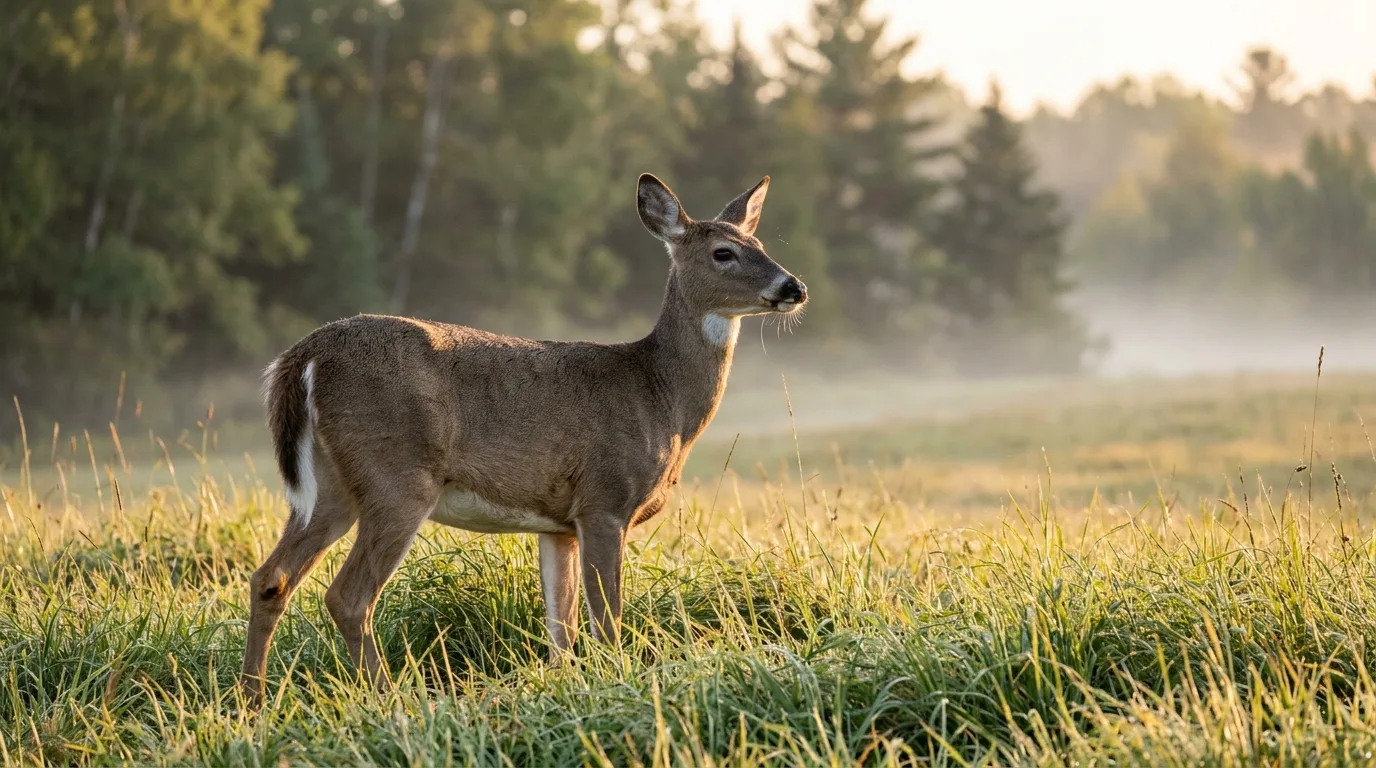
Ask ten hunters when deer move and you'll get ten confident answers, half of them about the moon. Then you put a GPS collar on the deer, or a wall of cameras on the property, and the noise collapses into something almost boring in its consistency: deer move most at first light and last light. Dawn and dusk. The animals are crepuscular — built for the half-dark — and almost everything else you've heard is a second-order tweak on top of that one fact.
Here's the short version, the part you can act on before you finish your coffee. Across the biggest datasets we have, white-tailed deer show two daily movement peaks, one around sunrise and one around sunset, with a long midday lull and a moderately active night in between. In October, deer average about 60 meters an hour at night and under 50 during the day, but 120 to 140 meters an hour at dawn and dusk — more than double the daytime rate — and they're a touch more active at the evening peak than the morning one. That bimodal rhythm holds from North to South, in hunted woods and unhunted parks. What changes is how that curve gets stretched, shifted, and squashed by the rut, by weather, by pressure, and by the time of year. The skill isn't memorizing a magic hour. It's knowing which of those forces is in play on the day you're hunting, and reading the curve accordingly.
The skill isn't memorising a magic hour — it's reading which force is bending the curve on the day you hunt.
Let me walk through what the data really says — and flag the "rules" that turn out to be folklore.
Why dawn and dusk, and why it's so stubborn
The crepuscular pattern isn't a habit deer could break if they felt like it. It's wired into their eyes and their place in the food chain.
Start with the biology. Deer eyes are built for twilight, not noon. A 2024 review of cervid vision describes the standard prey-animal package: a reflective tapetum lucidum behind the retina that bounces light back through the photoreceptors for a second pass, squeezing more vision out of dim conditions; laterally placed eyes and a horizontal "visual streak" that give near-panoramic detection of motion along the ground; and a rod-heavy retina tuned for sensitivity over fine detail. That last part is a genuine trade-off — the adaptations that let a deer see in low light come at the cost of sharpness, and measured visual acuity in white-tailed and red deer comes in under 6 cycles per degree, blurry by our standards. A deer is, in effect, a low-light specialist that gave up reading the fine print to own the gloom. Twilight is its home court.
Now the second reason, which is about staying alive. Deer are prey, and the timing of dawn and dusk threads a needle between two kinds of danger. A ten-year Michigan study that tracked 777 deer alongside 300 cameras laid the logic bare: in that system the carnivores — black bears, bobcats, coyotes, wolves — were essentially nocturnal, and the humans were diurnal, which collapsed a messy five-predator problem into a simple choice between a dangerous day and a dangerous night. The relatively safe seam runs right through the twilight in between. You can watch deer act on this when the stakes spike: does with fawns in that study shifted toward daylight, accepting more overlap with people (39 percent more) in exchange for 24 to 38 percent less overlap with the carnivores most likely to kill a fawn. Adults without fawns, facing low risk either way, didn't bother shifting. The pattern is a risk calculation, run constantly, and twilight is usually the answer.
And notably, deer mostly solve that calculation by adjusting their movement, not their schedule. A West Virginia study modeling 319 cameras found that where coyotes were present, deer actually spent more time detectable — roughly 13 minutes a day versus 6 at coyote-free sites, consistent with moving more to dodge encounters — yet "did not exhibit significant shifts in daily activity patterns based on coyote occupancy". The deer stayed "largely crepuscular," with detection peaking at dawn and dusk, coyotes or no coyotes. That's the pattern's stubbornness in one dataset: a predator on the landscape changes how much a deer moves, but not when.
There's a fascinating wrinkle in how deer keep time. A GPS study of red deer in the Netherlands and elk in Canada found the morning and evening activity peaks always lagged behind civil twilight rather than anticipating it — in the Canadian herd the dawn peak landed almost two hours after first light. The authors read this as evidence of a "weak" internal clock: deer aren't running an appointment on some circadian schedule, they're reacting to the light changing around them, with "marked periods" of no clear daily rhythm at all in some individual records. Practically, that means dawn and dusk activity tracks the actual light on a given morning — clouds, terrain, canopy — not a fixed clock time. The peak shifts with the sun through the season, and it'll shift a little with the weather on the day.
So when you read that deer "are most active at dawn and dusk," understand it's not a soft tendency. It's eyes, predators, and light all pushing the same direction. That's why it survives contact with so many other variables that hunters obsess over.
The night isn't a hiding place — it's the same deer, somewhere else
The most useful myth to kill early is the "nocturnal buck." The idea that a mature buck flips a switch and becomes a creature of the dark is, by the data, almost entirely an artifact of where your cameras are pointed.
The National Deer Association put it flatly: "Deer are crepuscular, not nocturnal," and "there is no such thing as a nocturnal buck" — a buck that only shows on camera at midnight is simply one whose daylight movements you aren't seeing. Three things create the illusion. First, your cameras cover a sliver of the property and none of the thick bedding cover where deer spend the day — a buck on his feet for hours can be invisible to you the whole time, then trip a camera at 12:30 a.m. when he finally crosses it. Second, hunting pressure pushes daylight movement into heavier cover and away from the open spots you tend to watch. Third, a big acorn year scatters deer across the woods, so they abandon the predictable food plot where your camera waits. None of that is the deer going nocturnal. It's the deer going somewhere you can't see.
That said — pressure genuinely does shift the clock, and this is where the sources are worth taking seriously. A clean experiment on sika deer in Japan varied culling intensity and watched the activity curve respond: under light pressure (about two culling days a month) the deer kept their normal dawn-and-dusk peaks, but under heavy pressure (ten days a month) "peak activity shifted towards the night," and — this is the part that should bother you — the nocturnal shift "persisted during the post-culling period," more than a year after the shooting stopped. Hammer a property and you can teach the herd to be nighttime animals, and that lesson sticks long after you back off.
You can see the same fingerprint in places with non-lethal but relentless human traffic. In a nature reserve near Montreal, deer in the sectors open to hikers peaked in activity around 3 a.m. — before the gates opened — and went quiet by mid-morning, while deer in the closed-off preservation sector kept a normal, steady curve. Tellingly, the disturbed deer kept their pre-dawn peak but lost their dusk peak entirely, apparently slipping out of the reserve to feed elsewhere after sunset. Constant human presence doesn't make deer stop using a place; it shoves their use of it into the dark.
The mechanism shows up beautifully in GPS work from a hunted South Carolina forest, where researchers tracked both sexes through the season. Both bucks and does strongly preferred to feed in the hunted food plots at night (selection probability over 0.65 after dark for both sexes) while spending daylight in unhunted cover. Same food, same deer — they just visited the risky open ground after the hunters went home. The buck that "won't come to the field in daylight" hasn't disappeared; he's eating there at 2 a.m. and bedding in the thicket you don't hunt.
But here's the honest counterweight, because the sources don't all agree on how strongly pressure moves the needle: it depends entirely on how much pressure there actually is. A study of 20 GPS-collared does across seven firearms hunts in northern Georgia found essentially no biologically meaningful change in movement — step lengths during shooting hours barely budged (87 meters pre-hunt versus 78 during), and core areas shrank only marginally. Why the muted response? Hunter density was tiny — at the busiest hunt, one hunter per 35 hectares, on rugged ground full of laurel thickets the deer could already hide in. The lesson isn't "pressure shifts deer" or "it doesn't." It's a dose-response curve: light, infrequent pressure on big cover-rich ground may not move them at all, while sustained heavy pressure can flip and lock the whole herd nocturnal. Where your property sits on that curve is the question worth answering — and a camera in an unhunted corner is how you answer it.
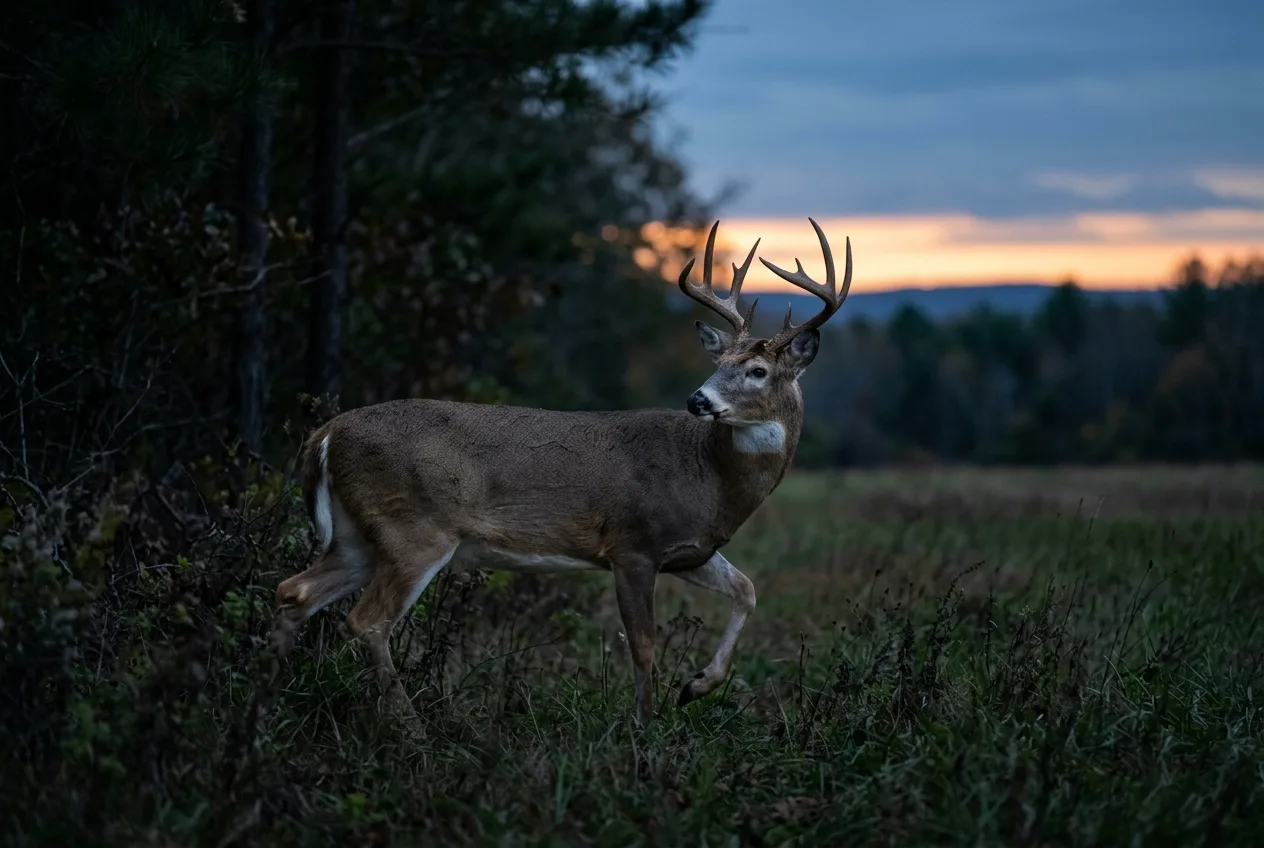
The rut: more movement, more daylight — but still crepuscular
If there's one time the dawn-and-dusk rule gets genuinely bent, it's the peak of the rut. The data here is some of the best we have, and it's encouraging for anyone who likes an all-day sit.
The cornerstone is a Wisconsin study that put GPS collars on 188 bucks and logged hourly locations over four straight Octobers and Novembers. A few findings every rut hunter should internalize. Movement climbed steadily toward the peak breeding window — pinned by the data to October 23 through November 12 in that region — topping out in the week of November 5–11, then falling off toward post-rut levels by December. The single strongest predictor of how much a buck moved on a given day wasn't weather or moon — it was simply the day of the year, with buck age the only other factor that mattered. As the NDA's writeup of the study quoted the co-author: "The day of the year is just overwhelming in terms of predicting buck movements".
What about the daily clock during the rut? It stays a U-shape — sunrise peak, midday slump, sunset peak — through all six weeks. But the slump fills in. During the two peak-breeding weeks (roughly October 29 to November 11), midday movement ran 50 to 100 meters an hour higher than in other weeks. That's the real, data-backed case for the famous all-day rut sit: not that midday becomes the best time, but that it stops being dead. As the researcher put it, you're "still more likely to see bucks moving on the evening of October 15 than you are at noon on November 4". The peaks still win. The middle just gets worth sitting through.
Age changes the picture too, in a way that explains a lot of frustration. The 2½-year-olds move the most — highest hourly rates, biggest daily ranges, going "all out" searching, and they're the bucks you're most likely to catch on their feet. The mature 3½-plus bucks are sneakier: they showed the highest variance in daily movement, consistent with switching between long search runs and hours of tending a single doe, and during peak rut the older bucks "showed signs of moving from crepuscular activity patterns to transitioning towards nocturnal activity" — the closest any group came to genuinely nocturnal, and still not all the way there. So the buck cruising the field edge at 10 a.m. is often a dumb two-year-old, while the giant is bedded with a hot doe in cover. That's not bad luck; it's the age structure of rutting movement.
The does drive all of this, and they move more during the rut too. Auburn GPS work on 36 collared females found movement rate climbing from about 54.6 meters per half-hour pre-rut to 68.0 at peak breeding, with the biggest ranges right around conception. Crucially, "while white-tailed deer are crepuscular by nature," the breeding push throws does outside their normal ranges at any hour — researchers logged 23 excursions among 21 breeding females, some 43 days before conception, some 36 days after. The same story holds in European red deer: stags' average daily movement roughly tripled from before the rut (2,403 meters) to the searching phase late in the rut (6,638 meters), with the home range ballooning 4.3-fold as the number of receptive hinds dwindled and males had to roam farther to find them. The engine of rut movement is females coming into estrus; the bucks are just chasing the schedule the does set.
One myth the rut data quietly executes: there is no magic "lockdown" where every buck stops at once. Individual bucks go quiet while tending a doe for a day or so, but they do it on their own staggered schedules — the herd-wide movement curve keeps climbing right through the peak.
You don't even need a collar to see this rut-plus-twilight signal — the crash data shows it. Georgia's wildlife agency flags October through December as "peak deer activity season," precisely because rutting bucks are crossing roads in search of mates, and it pins the most dangerous hours to dawn and dusk, "the same times most people are commuting". The collision record is just an enormous, involuntary movement study, and it draws the same picture the GPS collars do: deer on their feet at the edges of the day, moving most when the breeding season peaks.
The peaks still win. The middle just gets worth sitting through.
Weather and moon: where the folklore lives
Now the fun part — the stuff that sells almanacs and apps, and mostly doesn't survive the GPS era.
Moon phase. This is the big one, and the science is about as one-sided as deer science gets. A Penn State analysis of GPS-collared does across two Octobers found "moon phase has an insignificant effect on deer movement" — the difference between a new moon and a full moon worked out to roughly 6 extra meters per hour, which the researcher likened to "a few steps, like walking over to a new oak tree," against deer that routinely cover hundreds of meters in an hour. Deer stayed most active at dawn, dusk, and through the night regardless of phase. The hunters surveyed in that same project mostly believed the opposite: only 12 percent of 1,680 respondents thought the moon had no effect. Even the believers have been forced to recant — biologist Grant Woods built a "Moon Peak Activity Index" in the 1990s that predicted deer activity with 72 percent accuracy from field observations, then abandoned it once GPS collars came along: "The better our scientific tools become, the less you see connections". The Wisconsin rut study found the same peak arriving on the same calendar dates all four years "regardless of weather, moon phase, or hunting pressure". If you love a rising moon at last light, fine — hunt it. Just don't skip a good evening because the calendar says the moon's wrong.
Temperature. Hunters swear a warm spell shuts deer down and a cold one fires them up. The data says: barely, and less so the closer you get to the rut. The NDA's review of the GPS research calls temperature's impact on overall distance moved "negligible," and Penn State couldn't find any difference in the amount or timing of movement during a warm October snap heading into the rut — bucks kept moving "at around 1/2 mph 24 hours a day". The Wisconsin collars agree: temperature had no significant effect on rut movement. "It's the rut, not cold fronts". There's a real second-order effect in hot weather — a clever Mississippi State experiment showed deer restricted to unshaded feeders ate 17 to 23 percent less during the heat of the day and made it up by feeding when it was cooler. So extreme heat can push feeding later into the cool of night and early morning, sharpening the crepuscular pattern rather than erasing it. But "it's 65 instead of 45" is not a reason to stay home.
Cold fronts, wind, rain. The cold-front theory — that a dropping front gets deer on their feet — is the one hunters defend hardest, and the Deer-Forest Study "found no overall difference in movement speed before, during, or after fronts". Wind is genuinely mixed and worth knowing: Penn State actually saw the least movement on dead-calm days, with activity rising as wind picked up, while a separate Auburn study saw buck movement decline with wind post-rut. Rain is the most real of the weather effects — Penn State found bucks cut movement by up to half on rainy days, unless the rain came with strong wind, which canceled the effect. But studies in different regions don't always agree, and the honest synthesis comes from Mississippi State's deer lab: "we generally found little to no effect of weather on deer movements. Certainly not enough of an effect to motivate a hunter to hunt or not hunt based on the weather forecast". The crepuscular peaks, one Auburn researcher noted, show up "regardless of weather condition".
The throughline: weather and moon nudge the curve; they don't redraw it. The forces that actually move deer in a big way are food, the rut, and hunting pressure — and of those, time of day is the one constant you can always plan around.
Season changes the shape of the curve
Time of year does more than trigger the rut. It reshapes the daily rhythm in quieter ways worth tracking on your own cameras.
In winter, deer in cold country tend to compress activity toward the warmer middle of the day to conserve energy. The Japanese camera survey of sympatric mammals — 13,279 detections over two years, sika deer making up 84 percent of them — classified the deer as crepuscular spring through autumn but found they "changed peaks from sunrise and sunset during spring–autumn to day-time in winter," likely a thermal calculation. The same flavor of seasonal shift shows up in the culling study, where the clean dawn/dusk pattern of spring and summer gave way to a trimodal pattern in autumn — dawn, dusk, and a midnight peak. And local habitat bends the curve further: a camera study across Indiana found that in two of three regions deer were textbook bimodal, but in the third the activity was "predominantly evening" with barely any morning peak — driven by the interaction of crop availability and natural browse. Deer aren't metronomes. The same species runs a different daily schedule in December than in June, and on cropland than in big woods.
That regional variability is exactly why generic advice only gets you so far, and why the deer on your ground are the only deer whose schedule truly matters.
The deer on your ground are the only deer whose schedule truly matters.
How to actually use this in the stand
Strip away the folklore and a short, defensible playbook falls out of the data:
- Default to the twilight. Be settled and quiet before first light and stay past last light. Across every dataset, that's when the odds peak. If you can only hunt one end of the day, the data gives a slight edge to the evening.
- In the rut, sit all day — but keep your expectations honest. From roughly the last week of October into mid-November, the midday slump fills in enough to be worth sitting. The peaks still beat the middle; you're hunting the bonus, not a new prime time.
- Hunt the food the deer are actually using, where they'll use it in daylight. Once pressure builds, deer feed the open plots at night and move in cover by day — so set up on the daylight side of that behavior, on cover-to-food transitions, not the open field at noon.
- Stop blaming the moon and the thermometer. Don't burn a good evening because an app rated the day poorly. Weather and moon are minor tweaks, not gatekeepers.
- Manage your pressure like it's the variable it is. The factor you fully control is how hard and how predictably you hunt a spot — and lean on it can flip deer nocturnal for over a year. Rotate stands, mind your access, and leave sanctuaries alone.
The deer have been telling us the answer for as long as we've had collars and cameras to listen with. They move at the edges of the day. Everything else is detail — important detail, but detail. Get to the stand for the twilight, and let the data settle the rest.
Frequently asked questions
What time of day are deer most active?
Most active at dawn and dusk — deer are crepuscular. They move 120 to 140 meters an hour at first and last light, against about 60 at night and under 50 midday, with the evening peak slightly stronger than the morning. That two-peak pattern holds across regions and seasons.
Do deer really become nocturnal when hunted?
Sometimes, and it depends on how hard you push them. Heavy, sustained pressure can shift deer activity into the night and keep it there for over a year. But light pressure on cover-rich ground may barely move them. Often a "nocturnal" buck is just moving in daylight where your cameras can't see him.
When do deer move most during the rut?
Movement peaks with the breeding window — late October into mid-November across much of the whitetail range, roughly October 23 to November 12. Deer still move most at dawn and dusk even during the rut, but the midday lull fills in: peak-rut midday movement runs 50 to 100 meters an hour higher than other weeks, which is why an all-day sit pays off then.
Does the moon phase affect when deer move?
Not meaningfully. The difference between a new and full moon is about 6 meters per hour, against deer that travel hundreds of meters an hour. Deer stay most active at dawn, dusk, and night across all phases, and the rut peaks on the same dates yearly regardless of the moon.
Are bucks or does more active, and at what times?
Both are crepuscular, but bucks move more overall and dusk is the single strongest peak — males average about 100 meters per half-hour to females' 72, with dusk the highest period for both sexes. During the rut, 2½-year-old bucks move the most, while mature 3½-plus bucks move more erratically and skew slightly more nocturnal as they tend does.
Does cold weather or a cold front make deer move more?
The popular belief doesn't hold up well. There's no reliable difference in movement before, during, or after a cold front, and temperature has no significant effect on rut movement — it's the rut, not cold fronts, that gets deer on their feet. Extreme heat can push feeding later into the cool hours, but mild temperature swings won't keep deer off their feet.