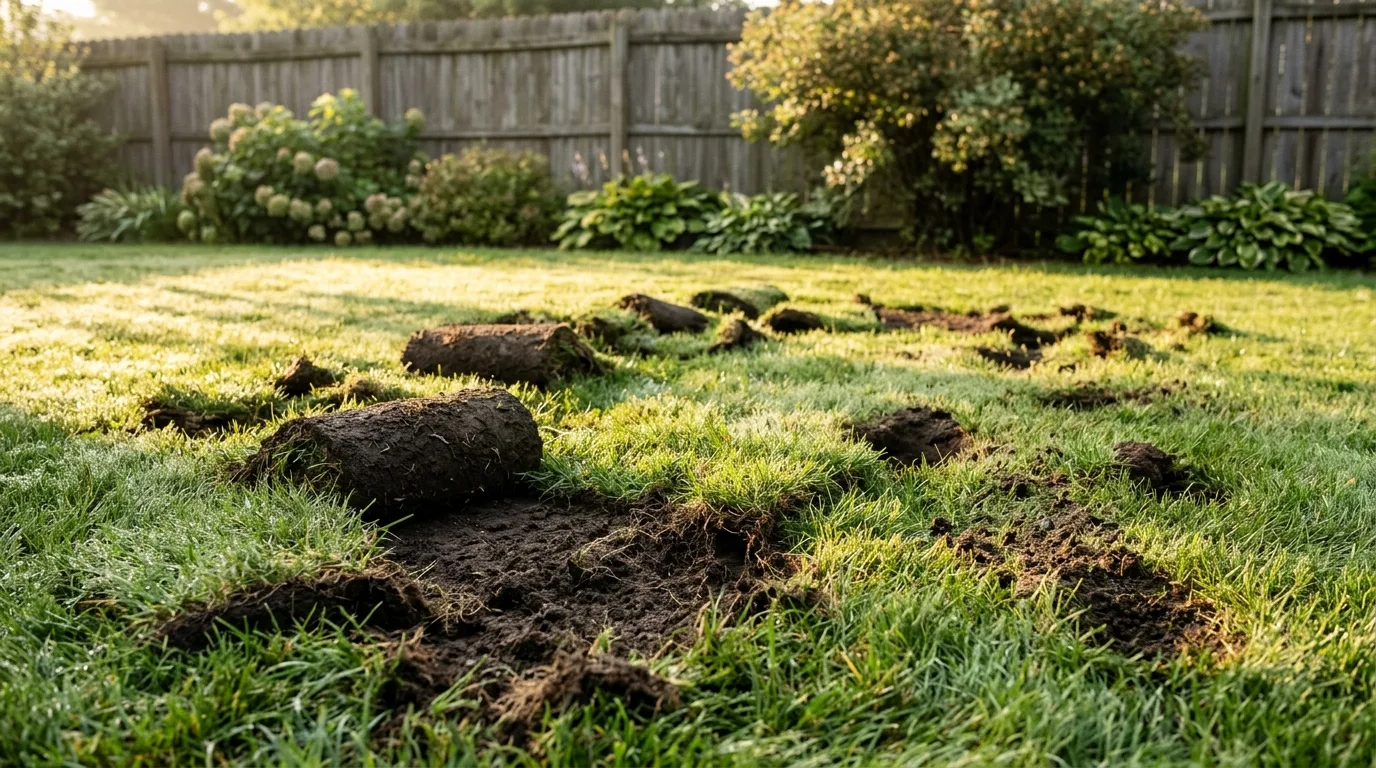
You went to bed with a lawn. You woke up to a crime scene.
Maybe it's a scatter of neat little craters by the back step. Maybe it's whole sheets of turf flipped over like someone started re-sodding and quit halfway. Maybe it's a raised ridge snaking across the grass that wasn't there yesterday. Whatever it is, the digger came and went in the dark while you slept, left no note, and is probably planning a return visit tonight.
Here's the good news, and it's the most useful thing on this page: you usually don't need to see the animal to know who it was. The damage itself is a fingerprint. The shape of the holes, whether the sod is dug into or peeled back, whether there's a mound of dirt, the size of any burrow, even the time of day it shows up — each one narrows the list fast. Most overnight lawn damage in a typical yard comes down to a short cast of suspects: skunks and raccoons digging for grubs, moles or voles working just under the surface, the occasional armadillo in the South, and squirrels or chipmunks doing minor housekeeping. The thing they're almost all really after is bugs — usually grubs — and that turns out to be the key to making them stop.
Let's read the evidence.
First, read the damage — it tells you more than you think
Before you buy a single trap or repellent, walk the yard in good light and ask four questions. They'll get you most of the way to an ID.
Is there a mound of loose dirt, or not? A dirt mound points you toward a burrowing tunneler or a digger throwing up spoil — think moles, woodchucks, an armadillo, or pocket gophers in some regions. No mound, just holes or disturbed turf, and you're looking more at skunks, voles, chipmunks, or surface-feeding moles.
How big is any hole that opens into a real burrow? This is one of the cleanest tests there is. A hole three inches or less across was likely made by a chipmunk, a vole, or a rat. Once you're past three inches — say six to twelve — you're into woodchucks, foxes, skunks denning under a shed, or, in armadillo country, an armadillo. Measure it. Guessing "kind of big" is how people end up blaming the wrong animal.
**Was the turf dug into, or peeled back?** Cone-shaped holes punched down into the soil say one thing; sod lifted and flipped like a rug says another. Skunks make the holes; raccoons do the peeling. More on that fight in a second.
When did it appear? Damage that shows up overnight, time after time, is the work of a nocturnal animal — raccoon, skunk, armadillo, opossum, or a woodrat. Damage that appears during the day points to something diurnal, like a squirrel, a chipmunk, or a woodchuck. This single clue quietly rules out half the field.
Keep those four answers in your head. Now here's how each suspect actually behaves.
This single clue quietly rules out half the field.
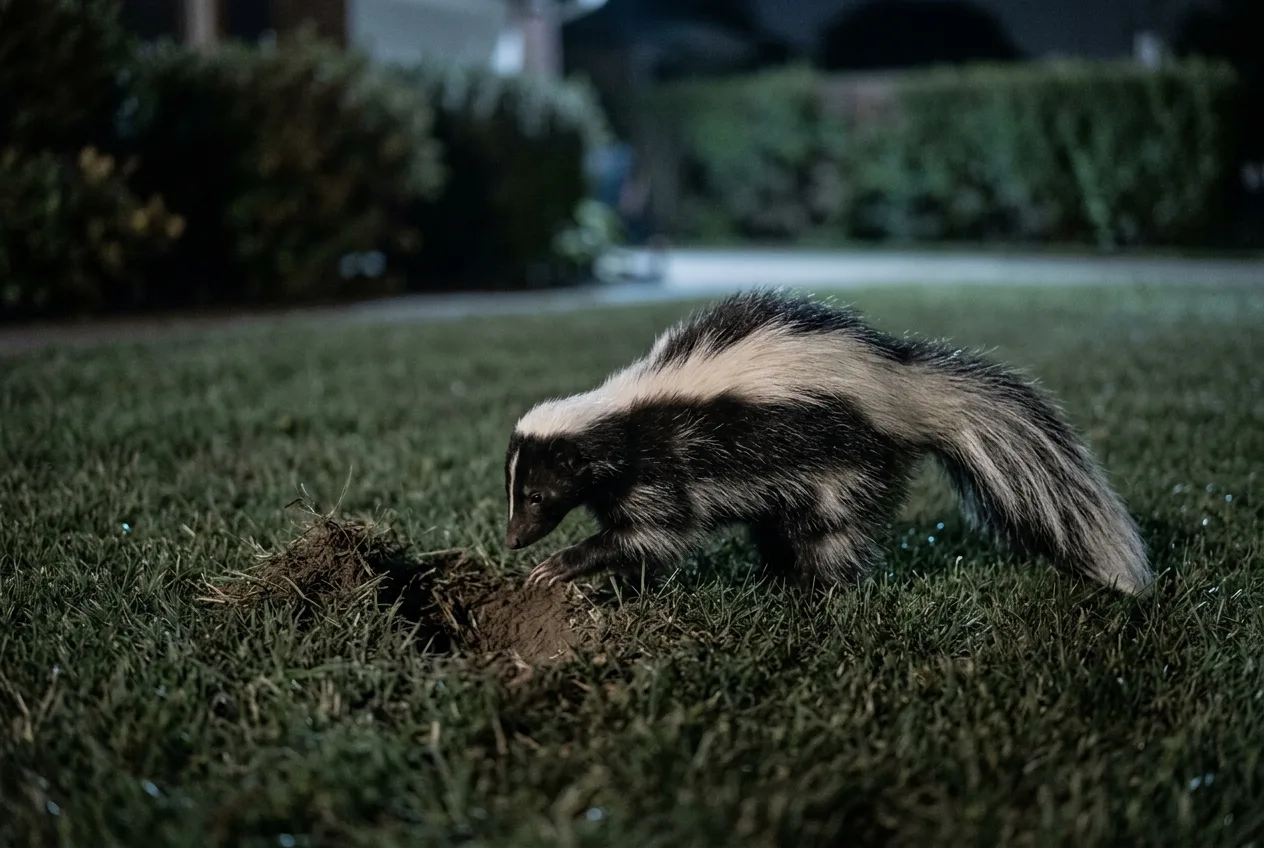
Skunks vs. raccoons: the two most common overnight diggers
If you're in a suburban yard in late summer or fall and the lawn got torn up overnight, these two are your prime suspects, and they're after the same thing — grubs, earthworms, and other soil insects. Telling them apart is mostly about how they dig.
Skunks dig holes. Distinct, separate, surprisingly tidy holes. A skunk pushes its nose into the turf, then digs out the spot with its front paws. The result is a small cone-shaped pit — Maryland's extension describes them as "cone-shaped holes, about 3 inches wide and deep", and other guides put them in the 3- to 4-inch range. Illinois Extension has my favorite description: the hole is "shaped like a top — wide at the opening and pointed at the bottom," about two to three inches across, "rather neat looking in appearance". A Utah State wildlife specialist summed up the look even more plainly — most skunk diggings "look like a small hole or divot caused by an errant golfer". A skunk digs one, maybe finds a grub, moves a few inches, and digs another. Work the math over a whole night and you get an array of individual holes clustered together. Where the grubs are thick, those separate holes can run together "into a large disturbed patch of grass". Skunks tend to be methodical, working a lawn section by section on successive nights, and they usually quit a site after about three weeks once the food runs out.
There's one bonus clue only skunks leave: the smell. If there's a faint skunk odor over the diggings, you have your answer — that telltale scent often lingers if the animal was startled while foraging.
Raccoons don't dig holes so much as redecorate. A raccoon uses its front paws like hands. Instead of punching down, it grabs the edge of the sod and flips it. Iowa State's description nails the signature: raccoons "lift and flip sod pieces over," and "sometimes the sod appears as if someone has neatly rolled it back with the intent of transplanting it elsewhere". Maryland's guide puts it the same way — raccoons "roll or lift up pieces of sod, leaving the removed grass in more discrete chunks". Of the common diggers, the raccoon is usually the most destructive. It's got powerful claws and strong hind legs, and when it senses a meal it'll "rip up the lawn in a bit of a backwards motion… to peel back the grass," leaving real wreckage behind.
So: a field of neat little cones, maybe a whiff of skunk? Skunk. Sod rolled back like loose carpet, larger torn chunks, heavier damage? Raccoon. The honest caveat is that the two can look "very similar," especially once the damage is extensive, and both work at night where you'll rarely catch them in the act. When the sod is rolled but you're not sure who rolled it, that's exactly the moment a camera earns its keep — we'll get there.
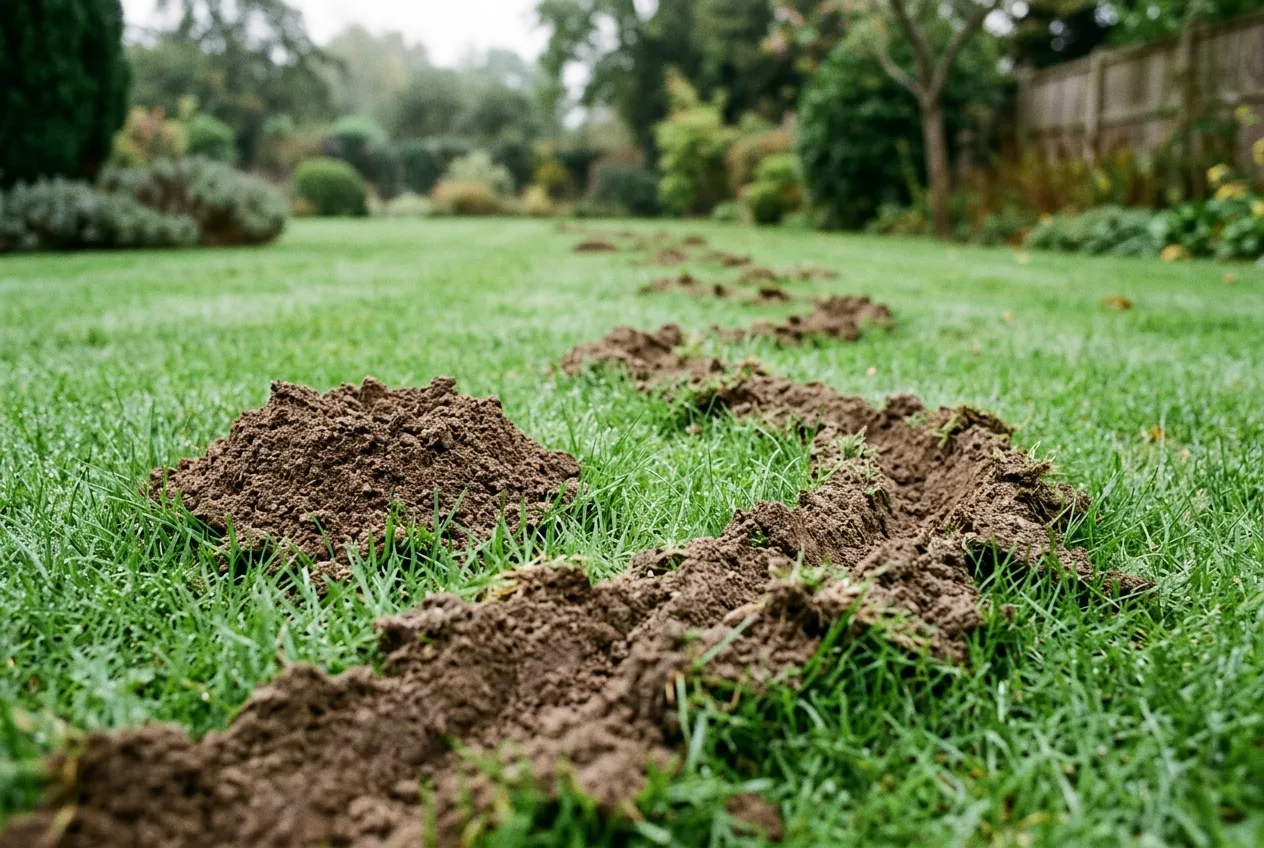
Moles and voles: when the damage runs in lines
Switch gears completely. If your "damage" isn't holes at all but raised ridges or narrow runways tracing across the lawn, you're not dealing with a grub-hunter that comes and goes — you've got a resident tunneler. And the two animals people blame, moles and voles, are constantly confused for each other even though they're barely related. Moles are insect-eaters, cousins to shrews; voles are small rodents.
The cleanest way to keep them straight comes from Maryland Extension: "voles are vegetarian, moles eat meat". That one difference drives everything you see.
Moles tunnel in search of earthworms and grubs, never touching your plant roots on purpose. Iowa State is blunt that the worm is the headline act — "the 'Main Mole Meal' is earthworms supplemented with some insect larvae". As a mole hunts just below the surface, it shoves the sod up into "raised ridges that appear to wander aimlessly," the grass can dry out and die along the ridge, and a mower will scalp the raised line and make it worse. When a mole digs its deeper living tunnels — six to twenty-four inches down, used for years — it pushes the excavated soil up into a "volcano-shaped mound". Those molehills are round and cone-like, anywhere from a couple of inches to a foot tall, with the burrow opening hidden right under the center of the pile.
Here's the myth worth killing, because half the lawn-care world gets it wrong: moles are not proof of a grub problem, and dumping grub insecticide on the lawn usually won't get rid of them. Iowa State calls the "insecticides will cure the problem" idea "the great landscape lie," for the simple reason that earthworms — not grubs — are the mole's main food, and grub products don't touch earthworms. Florida's extension says it just as flatly: "the damage caused by moles is almost entirely cosmetic," and moles are "often falsely accused of eating the roots of grass" when they actually eat the insects that do the damage.
Voles leave a different mark. They cut surface runways right into the grass — little trails of clipped, matted turf at ground level, often most visible right after snow melts in spring. Their holes are tiny, dime-sized, frequently down around the roots of plants. And because voles are vegetarian, they're the ones actually gnawing bulbs, roots, and stems. There's a sneaky twist here: a lot of the plant damage blamed on moles is really voles using the mole's tunnels as a subway to reach roots. So if tunnels show up and your plants are dying at the roots, suspect a vole riding the mole's infrastructure.
Quick gut-check on the tunneler question: ridges and volcano mounds, plants fine = mole. Surface runways cut in the grass, dime holes, chewed roots and bulbs = vole.
A lot of the plant damage blamed on moles is really voles using the mole's tunnels as a subway to reach roots.
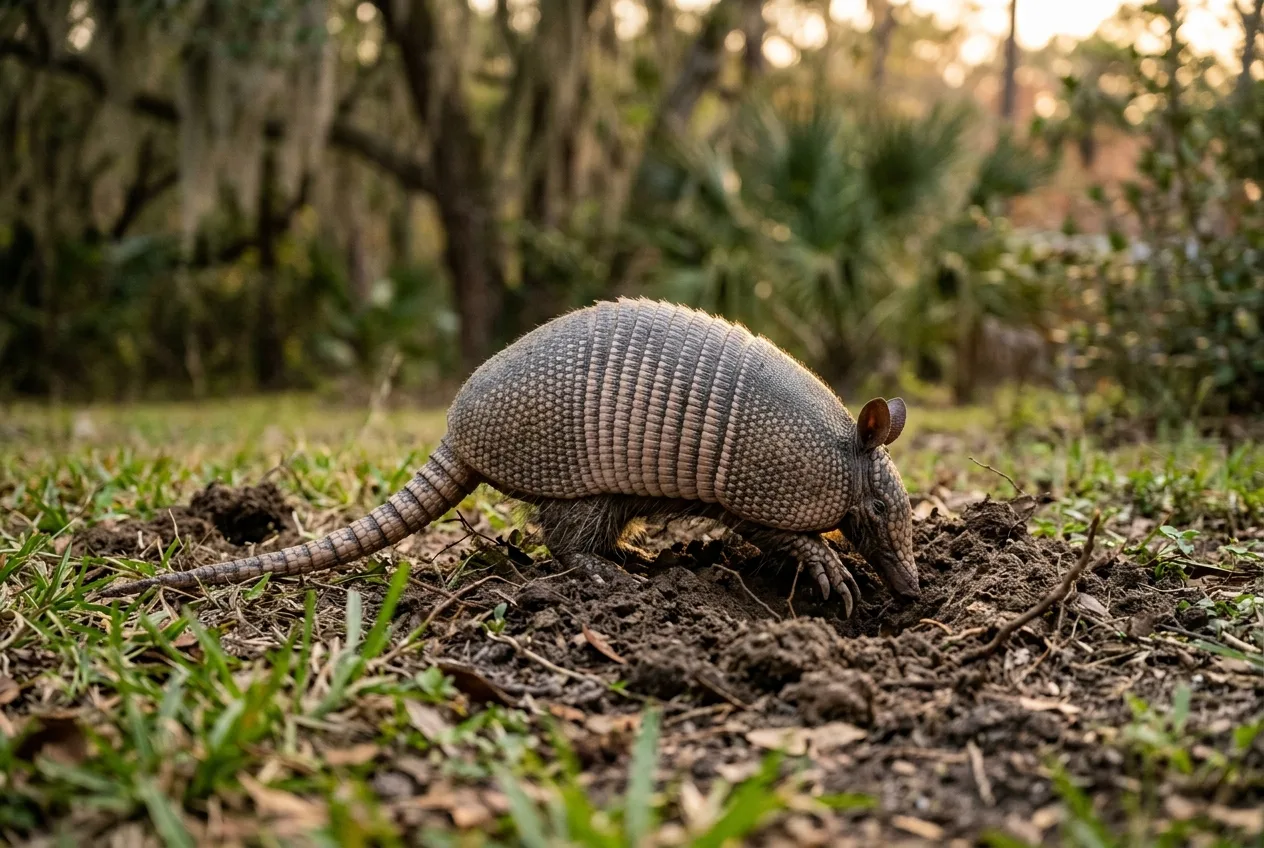
Armadillos: the Southern wildcard that looks like a raccoon
If you're in the Southeast and something's punching shallow holes all over the yard, add the armadillo to your suspect list — and brace yourself, because its damage is genuinely hard to tell from a raccoon's.
An armadillo roots for grubs and other invertebrates in the top few inches of soil, leaving "shallow holes 1 to 2 inches wide and up to 6 inches deep," scattered wherever it smelled food. Other guides log them a bit wider — "1 to 3 inches deep and 3 to 5 inches wide" — and Georgia Extension describes the classic armadillo dig as an "inverted, cone-shaped hole, 3 to 4 in. deep and 1 to 2 in. in diameter". (Don't get hung up that the exact dimensions vary source to source; the picture is consistent — a lot of small, cone-ish foraging holes, sometimes with ornamental plants uprooted in the process.) The Internet Center for Wildlife Damage Management is candid that armadillo turf damage "can be difficult to distinguish from damage by raccoons" without more digging on your part.
What does help separate them: armadillos also burrow. Their dens are distinctive — "round and 7 to 8 inches across," matching the shape of the animal's shell, often tucked under a foundation, slab, driveway, or pool. Find a clean round 7–8 inch burrow near the house alongside the diggings and you've got your armadillo.
One safety note worth taking seriously: armadillos can carry the bacterium that causes leprosy and the parasite behind Chagas disease, so the guidance is to avoid handling them bare-handed or touching their bodily fluids. Admire from a distance; let a pro do any hands-on removal.
Squirrels and chipmunks: the minor offenders
Sometimes the "damage" is barely damage. Squirrels and chipmunks dig small depressions to bury or dig up cached food — about two inches across, a few inches deep, with no real pile of soil beside them. Illinois Extension ranks the squirrel as the least destructive of the common diggers: it digs "just enough to set some seeds and take off again," nothing like the skunk's cones or the raccoon's peeled sod.
Two tells set these two apart from the night crew. First, they work in daylight — you can often watch a squirrel patrolling the lawn for stash spots in the afternoon. Second, location: chipmunk burrow entrances tend not to sit out in the middle of the lawn, and a clean chipmunk hole is "silver dollar-sized". If the holes are small, shallow, soil-pile-free, and appearing by day, relax — this is low-stakes vandalism.
Groundhogs, feral hogs, and other heavy hitters
A few diggers operate on a bigger scale, and you'll know them by the size of what they leave.
Groundhogs (woodchucks) don't usually pepper a mowed lawn with holes, but when they burrow, the entrance is unmistakable — "about 8 to 12 inches wide," often with a "dirt porch" of excavated soil mounded in front, typically along a structure, fence line, or field edge rather than open turf. Groundhogs are active by day, another point that separates their work from the overnight crew.
Feral hogs are a different category of problem, mostly rural and regional but spreading, and the damage is on another scale entirely. Hogs root — they plow the soil "to depths of 2 to 8 inches," and a rooted area "looks like it has been tilled". This isn't a few holes; a single group of ten hogs "can destroy 10–20 acres overnight," and feral swine cause a conservatively estimated $1.5 billion in damage a year in the U.S.. Their tracks help confirm it: hog tracks are rounder and blunter than the heart-shaped tracks of deer, and the dewclaws often register wider than the hoof. If you genuinely have hogs, this stops being a DIY job — Missouri's wildlife agency specifically warns not to shoot at them, because scattering a sounder just makes the survivors trap-shy and harder to remove; report them and let trappers take the whole group.
A couple of impostors worth clearing off the list. Ground-nesting bees, earthworms, and even crayfish (near wet ground, leaving little mud "chimneys") can all leave soil mounds that look alarming but do no real harm to the grass.
It almost always comes back to grubs
Step back and you'll notice most of these suspects are at the same buffet. Skunks, raccoons, armadillos, even moles and many lawn-raiding birds are digging because the soil is full of food — and the headline item is the white grub, the fat, C-shaped larva of beetles like Japanese beetles and masked chafers. The grub is pudgy and "bent in the shape of the letter 'C,'" running about three-quarters of an inch to an inch long.
Two numbers are worth tattooing on your brain, because they explain the timing and the fix:
- It takes a fairly heavy grub load — roughly 10 or more grubs per square foot — before the grubs themselves kill the grass, and healthy turf can shrug off "20 or more grubs per square foot" before it shows injury.
- But it only takes about 5 or more grubs per square foot to attract skunks and raccoons to come digging — far below the level that hurts the grass, so they show up before you'd ever notice turf damage.
That gap is the whole story. The animals find the grubs long before your lawn looks sick, which is why "my lawn got plowed overnight" is usually the first sign of a grub problem, not the last — Iowa State puts it bluntly: the first hint of trouble "is likely to be that your lawn was 'plowed' by varmints overnight". It also explains the calendar: grub damage and the digging that follows tend to peak from mid-August through October, as the larvae fatten up near the surface.
Here's the catch that trips people up. Finding diggers does not automatically mean you should reach for grub killer. Check first. Cut three sides of a one-square-foot flap of sod near the damage, pry it back, and count the grubs in the top couple inches of soil; sample a few spots and average them, since grubs cluster in patches. If you're under the threshold, treating does nothing for the animals and a lot of nothing for your wallet — Iowa State cites Cornell research that "over 70 percent of all grub control treatments were applied needlessly because there were no grubs in the lawn". And if moles are your problem, remember the grub fix is mostly a myth anyway, because worms are what they're really eating. Confirm the grubs are actually there and abundant before you spend a dime on insecticide.
"My lawn got plowed overnight" is usually the first sign of a grub problem, not the last.
Confirm it at night with a trail camera
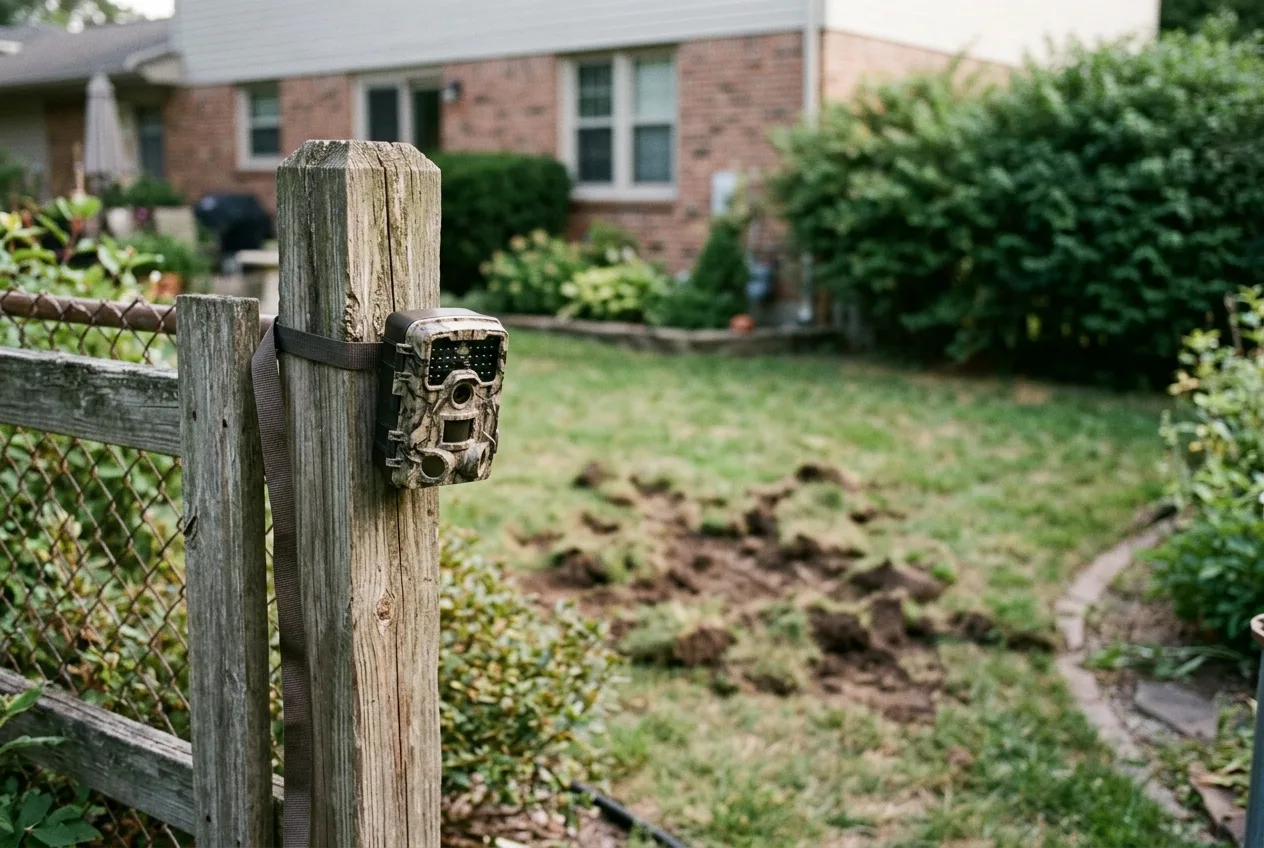
Reading the damage gets you a strong suspect. If you want certainty — or you've got two animals on the short list and the sod damage honestly could be either — the cleanest way to close the case is to let the culprit identify itself on camera. These animals operate in the dark, on their schedule, not yours, so a motion-triggered camera is doing the stakeout you'd never stay up for.
University of Georgia Extension recommends exactly this and gives the setup, which is worth following because the small details matter:
- Aim the camera at the fresh damage, and mount it on a tree, post, or other solid object near where the digging is happening — roughly 8 to 15 feet away, since the focal range is limited and a too-distant camera just photographs empty grass.
- Face the camera toward the nearer pole — north in the northern hemisphere, south in the southern — so the midday sun stays out of the frame; never aim it due east or west, where the rising or setting sun washes out your shots with glare.
- Set it for maximum sensitivity and have it fire a burst of three photos (or video, if it does that) per trigger, so you get more than one frame to work with.
- These cameras shoot color by day and switch to high-quality images at night, which is the whole point here — your digger is nocturnal, and that's when you need to see it.
One reading of the night's photos and the guesswork is over.
Once you know who it is, here's how to make them stop
Identification is most of the battle, but a quick word on what to do, because the right move depends entirely on the animal.
Fix the lawn first — it usually recovers. For the grub-hunters, the damage is temporary, and fall is a good time to repair it: replace any flipped sod, water it in, and overseed the bare spots. Tamp down mole and vole ridges to close the air pockets that dry out roots.
Exclusion beats gadgets. The most reliable defense is a physical barrier. Skunks don't climb, so a chicken-wire or woven-wire fence pinned to the ground keeps them out; raccoons climb easily, so for them you lay hardware cloth, chicken wire, or bird netting flat across the at-risk turf and stake it down. For burrowers like moles and armadillos, buried hardware cloth angled outward underground is the move.
Be honest about repellents and "scare" devices. Ultrasonic emitters, vibrating stakes, and the rest have a poor track record — Florida and Iowa extensions both note that vibrating/ultrasonic devices haven't proven effective, and the mole tunnels running right alongside highways are evidence enough. Scent repellents like castor oil or predator urine can take a little edge off but need constant reapplication and aren't very effective on their own. If you do use deterrents, the rule is to start early, rotate tactics, and hit more than one sense at once, because animals habituate to any single trick fast. Motion-activated sprinklers are one of the better scare options precisely because they target nocturnal prowlers like skunks and armadillos and don't give the animal time to get used to them.
Know when to step back. Skunks and raccoons are primary rabies carriers, and many places require that trapped ones be handled a specific way rather than relocated — this is a job to leave to a licensed professional, not a Saturday project. Feral hogs, as noted, mean a call to your state wildlife agency. And if you can't ID the digger even with a camera, or the damage keeps escalating, your county extension agent or a licensed nuisance-wildlife operator can take it from there.
The animal came in the night, but it left a confession in the dirt. Read it, confirm it on camera if you need to, treat the cause and not just the symptom — and you've solved it.
Frequently asked questions
What is digging small, cone-shaped holes in my lawn overnight?
That's the classic signature of a skunk hunting grubs and earthworms — small, fairly neat cone-shaped holes about 3 to 4 inches wide, often in a cluster, dug one at a time across the night. A faint skunk odor over the diggings confirms it. In the Southeast, an armadillo can leave similar cone-shaped foraging holes, so check for a round 7–8 inch burrow nearby to tell them apart.
How can I tell if it's a skunk or a raccoon tearing up my grass?
Look at how the turf was disturbed. Skunks punch distinct cone-shaped holes and may leave a skunky smell; raccoons grab the sod and flip or roll it back "as if someone has neatly rolled it back," leaving larger torn chunks and generally worse damage. Both feed at night on the same grubs, so the style of damage — holes versus peeled sod — is your best clue.
Why is something digging up my yard if I don't have a lawn problem?
Because the diggers find the grubs long before the grubs hurt your grass. It takes about 10+ grubs per square foot to damage turf, but only around 5 per square foot to attract skunks and raccoons — so overnight digging is often the first sign of grubs, not the last. Confirm by cutting a square-foot flap of sod and counting the C-shaped grubs underneath before treating.
What's making raised tunnels or ridges across my lawn?
Those wandering raised ridges are mole foraging tunnels, pushed up as the mole hunts earthworms and insects just below the surface; deeper digging leaves volcano-shaped mounds. If instead you see narrow runways cut into the grass at ground level — especially after snowmelt — and chewed roots or bulbs, that's a vole, which is a plant-eating rodent, not a mole.
Do I need to kill the grubs to stop the digging?
Only if you actually have a lot of grubs — check first. Most grub treatments are applied needlessly, sprayed on lawns with no grubs at all. And if moles are the diggers, grub control usually won't help, because earthworms, not grubs, are their main food.
Will a trail camera really show me what's digging at night?
Yes — it's the most reliable way to confirm a nocturnal digger. Mount the camera on a stake or tree 8–15 feet from the fresh damage, face it toward the nearer pole — north in the northern hemisphere, south in the southern — to keep the daytime sun out of frame and avoid glare, set maximum sensitivity and a 3-photo burst; it shoots color by day and clear images at night. One night of captures usually settles the ID for good.