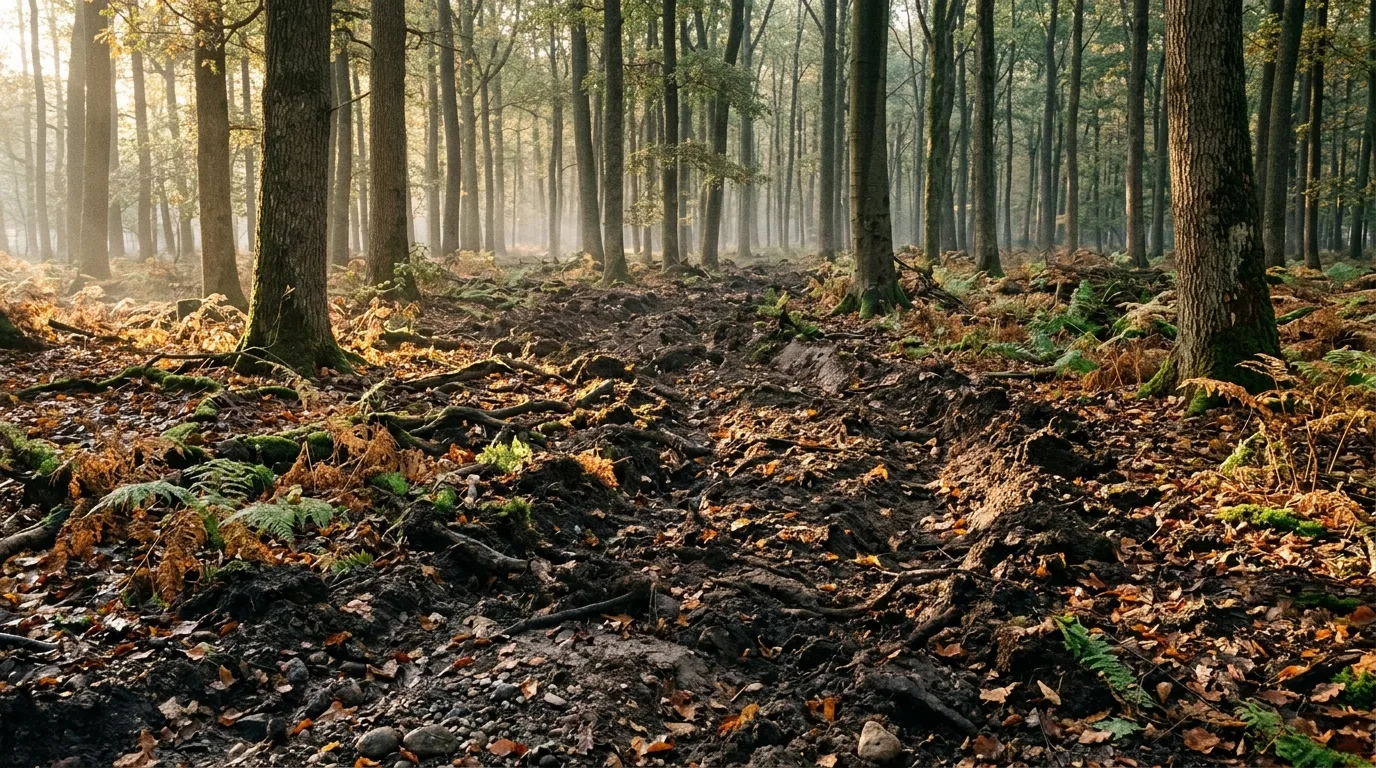
You walk a field edge you've crossed a hundred times and something's wrong. A strip of pasture that was grass on Tuesday looks, on Thursday, like someone ran a rototiller through it and gave up halfway — turf flipped, roots in the air, dark soil turned to the sky in long ragged patches. No tire tracks. No machine. Just the ground, opened up overnight.
The first question almost everyone asks is the right one: did a wild boar do this? And the honest, useful answer is that you can usually tell — not by catching the animal, which you rarely will, but by reading what it left behind. Wild boar (the same species as feral hogs, feral pigs, and wild swine — Sus scrofa the world over) are secretive and mostly nocturnal, so the sign is the story. Their single most distinctive calling card is rooting: ground churned up by the snout as the animal digs for roots, tubers, earthworms, and insect larvae. One agency guide calls rooting "the most reliable indicator of feral pig presence," and it's the thing landowners notice first — often the first they know hogs are on the place at all. A field that "looks like it has been ploughed" is the classic description, and it's a good one.
But rooting alone isn't proof, because plenty of other animals dig. So this is a piece about reading the whole scene — the rooting and the wallows and the muddy rubs and the tracks — and about the handful of tells that separate a boar from a badger, a deer, a bear, or a raccoon working your lawn. Get those straight and you'll rarely be fooled.
Rooting: the sign you'll almost always see first
Start with what rooting actually is, because the mental model makes everything else click. A boar feeds by driving its snout into the ground and levering up the soil to get at what's underneath — digging and overturning the topsoil to reach belowground food like plant rhizomes, bulbs, and earthworms, as peer-reviewed work describes it. They're equipped for it: powerful neck muscles and a long, mobile snout let them, in the words of Forestry England, "plough through the ground in search of food" and "turn over a large area in a very short space of time". The result isn't a hole. It's a worked surface — turf peeled and flipped, plant roots exposed, bare earth turned up across an area that can run from a few square feet to, in the literature, hundreds of hectares.
A field that looks like it has been ploughed overnight is the single most reliable sign that wild boar have moved in.
The detail that trips people up is depth, because two honest numbers float around and they sound contradictory. They're not. On grassland and pasture, where boar are skimming the topsoil for worms and larvae, the disturbance is typically shallow — peer-reviewed grassland work in Italy found boar "can reach depths of 5–15 cm". But where the soil is soft and the food is deeper, they'll go much further down: US and Australian agency guides put the maximum at "up to 3 feet (0.9 meter) in depth" in soft soil, and Australia's national pig-sign sheet notes diggings "up to half a metre deep". So the right way to hold it in your head is: usually a few centimeters of turned topsoil, occasionally a deep gouge where the ground is soft. Either way it reads as overturned, tilled soil — not a tidy round hole.
A couple of things rooting does not tell you, and it's worth knowing so you don't over-read it:
- It's not a headcount. A common mistake is to look at a torn-up paddock and assume a big herd. Australia's CISS guide is blunt about it: "the area of rooting does not necessarily indicate population size because a small number of pigs can root up large areas," and "even small numbers of pigs can dig up large areas of ground in a single night". A handful of animals can wreck a lot of ground.
- It's seasonal, and it follows the soil. Boar root most when the ground is soft and the food is active. The Italian grassland study found rooting "peaked in autumn and winter," when rain softens the soil and soil-dwelling invertebrates are concentrated near the surface. Forestry England describes the same trigger — rooting of grassland "is triggered by the softening of the ground and a large amount of insect activity in the soil," with boar after "the larvae of insects such as leatherjackets (daddy-long legs) and cockchafers (may bugs)". In a drought, rooting can go quiet and you'll have to lean on the other signs instead.
Where you find it matters too. In pasture and on native range, rooting "destroys pasture, crops, and native plants, and can cause soil erosion". In woodland, high densities can "completely remove woodland ground flora," including valued plants like bluebell and pignut. And in town — on lawns, golf courses, sports fields, around the base of a stock water trough — the same behavior "overturns and tills the soil, uprooting plants, exposing bare soil," and can do "extensive damage to lawns and gardens". Same animal, same snout, very different-looking crime scenes.
Tracks: the most reliable way to confirm it's a hog
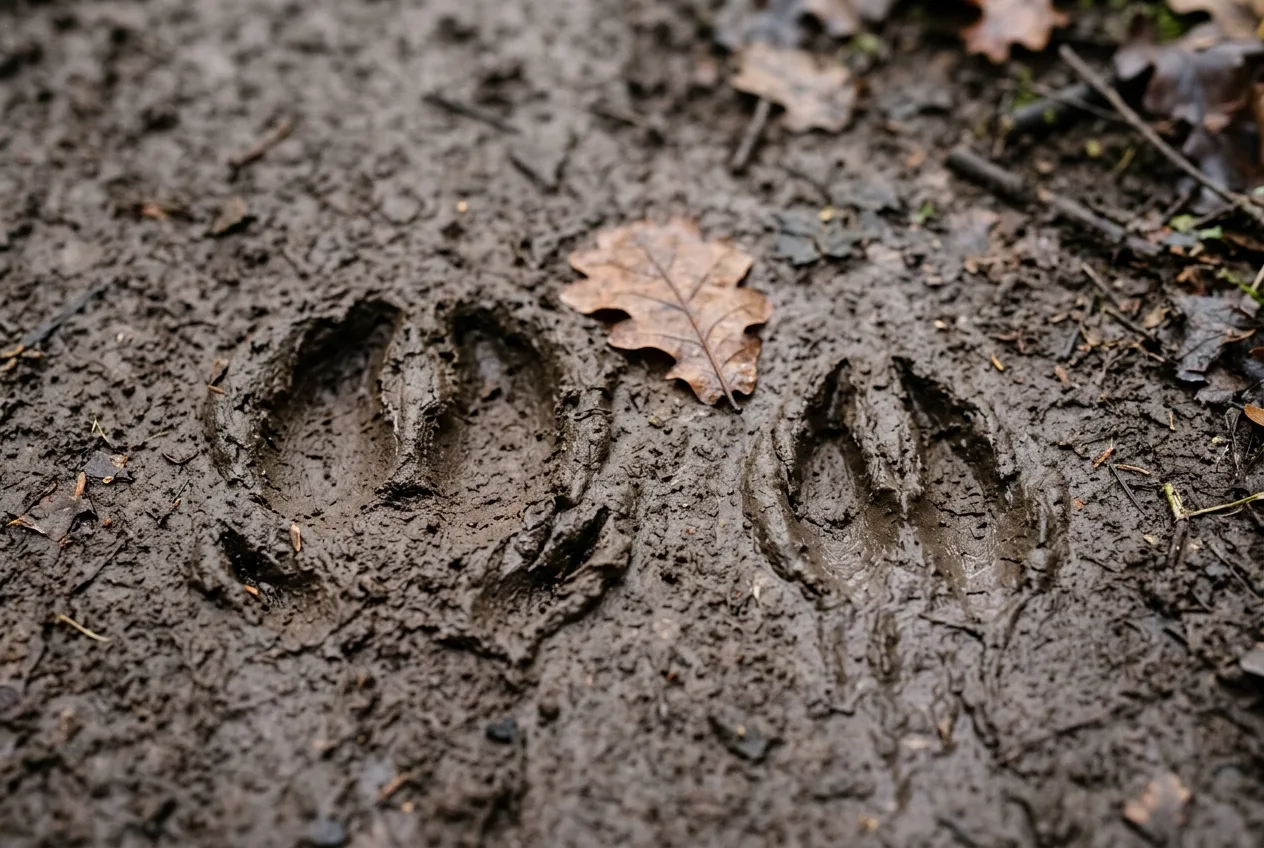
If rooting is the sign you see first, the track is the sign you should trust most — it's the one point nearly every wildlife agency on three continents agrees on. Boar leave a cloven, two-toed hoof print, which immediately invites confusion with deer, sheep, and goats. The thing that sorts it out is shape.
A deer track is heart- or spade-shaped: the two halves taper to points at the front and the print reads narrow and pointed. A boar track is the opposite — "more rounded or blunt tips with an overall squared or rounded shape," as the US federal field guide describes it. Texas extension puts it simply: "Hogs have blunted or rounded toes… Deer tracks are typically heart- or spade-shaped; feral hog tracks appear more rounded". Wild Pigs Canada gives the single best mental image — the boar's toe tip is rounded "like a 'coffee bean,'" versus the pointed toe of a deer. Australia's guide adds a useful proportion: "A pig track is square in shape with similar length and width," where deer, sheep, and goat tracks "are often heart-shaped when not splayed".
Then there's the tell that clinches it: the dewclaws. These are the two small toes higher up the leg. In a boar, they sit wide and they print readily. Texas extension's caption is the one to remember: "When visible in the tracks, hog dewclaws typically register wider than the hoof… In deer tracks, the dewclaws typically do not register wider than the hoof". Wild Pigs Canada notes the dewclaws "are more often visible in invasive wild pig tracks as compared to deer tracks and occur on the outside of hooves instead of inline with the hooves". The UK's Mammal Society goes furthest, calling the dewclaws the defining feature outright: "it is the dew claws, which in soft ground are impressed even when walking slowly, that serve to identify wild boar tracks" — and for confusion species, they list "None".
Rounder and blunter than a deer's, more square than pointed, with dewclaws set wider than the hoof — that's a hog, and the track rarely lies.
One honest caveat, because a good source raises it. Dewclaw registration depends partly on the going. Noble Research Institute points out that dewclaw marks from either a hog or a deer can simply mean "the animal was running or stepping on a soft surface," so a deer bounding through mud may drop dewclaws too. That's why you read the whole track — overall round-and-square shape, blunt toes, and dewclaws sitting wide — rather than betting everything on one feature. For size, the agency numbers give you a yardstick: Missouri pegs front and hind tracks at about "2½ inches long," and the Mammal Society puts UK boar prints at "up to 7cm in width," varying with the animal.
A track rarely travels alone, either. Boar wear obvious trails — "tunnels and worn trails leading through thick vegetation," the kind of single-file pads they push between feeding and bedding areas. Where a trail ducks under a fence, check the bottom wire: hogs "often leave hair and mud on the wires as they pass underneath," which is both a confirmation and a clue to where they're moving.
Wallows and rubs: the summer signature
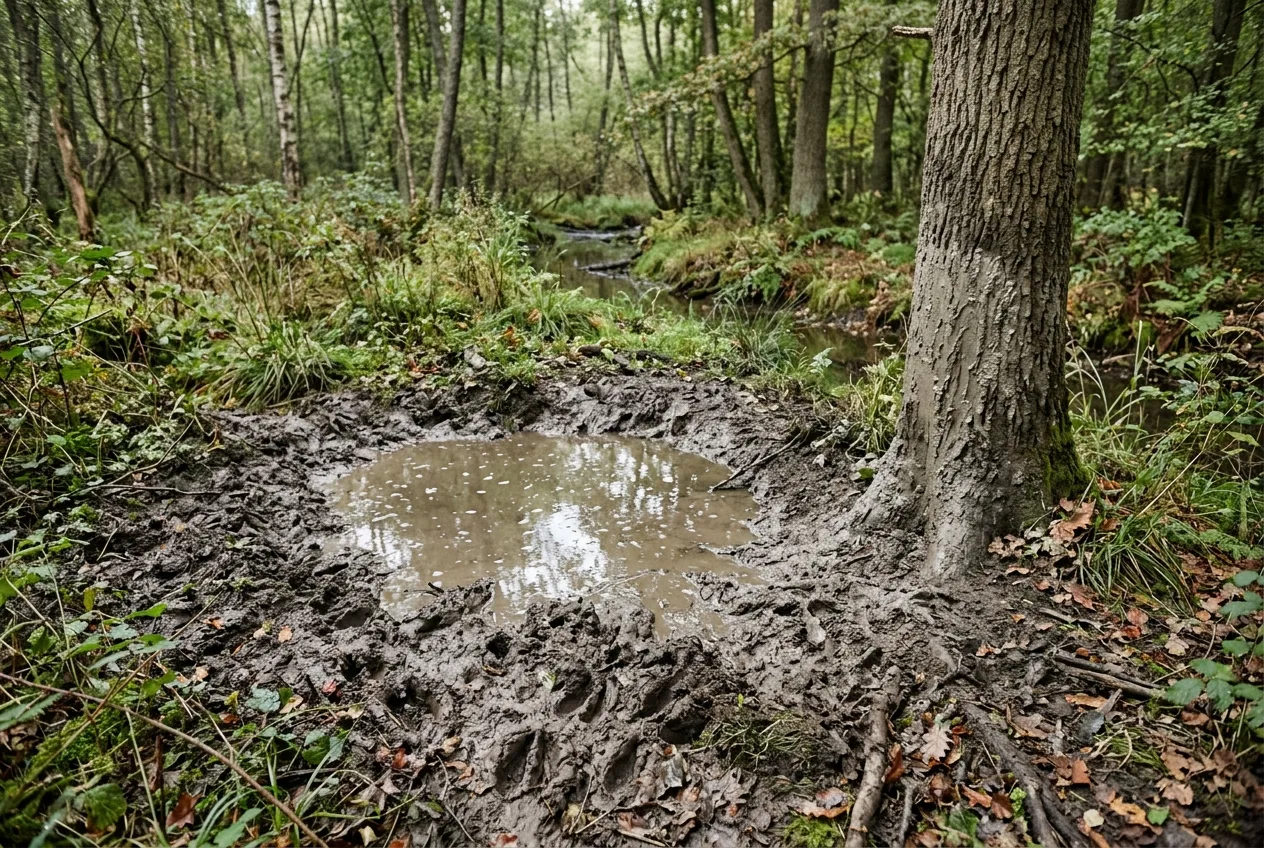
Here's a piece of boar biology that explains a whole category of sign: they can't sweat. Wild boar "largely lack functional sweat glands for evaporative cooling," so when it's hot they have to shed heat some other way — and the way they choose is to wallow in mud. A peer-reviewed thermoregulation study spells out the consequence: in the heat, wild boar "particularly use wallowing in mud or other wet substrates to cool and prevent hyperthermia". The same work notes boar are built for cold, not heat — their cold tolerance puts them "in the realm of arctic animals, such as the polar bear" — which is exactly why wallowing shows up as a warm-season sign and fades when the weather cools.
So in spring and summer, in wet ground near ponds, creeks, seeps, and sloughs, look for wallows: shallow muddy depressions, often holding water, where the animal has rolled to coat itself. Texas extension describes hogs creating them "in moist areas near ponds, creeks, and sloughs… to access mud, which helps them cool down and ward off biting insects," and notes that "in hot weather, hogs often lie in wallows during the day". Forestry England's version is nicely concrete — "look for smooth hollows in wet ground". The mud does double duty: it cools, and it smothers ticks, fleas, and other skin parasites.
The wallow has a partner sign, and they almost always travel together. After a boar wallows, it rubs the drying mud off against something solid — and that gives you rubs. Texas extension: "After wallowing, hogs rub on fixed objects to remove dried mud, hair, and parasites. Look for mud and hair on trees, fallen logs, fence posts, rocks, and utility poles, particularly those near water or wallows". Indiana DNR describes the result as "areas on trees coated in mud that may be missing the bark layer". There's a quirk worth knowing: boar have a real fondness for creosote-treated wood. "Hogs have an affinity for utility poles treated with creosote, and many poles within a hog's home range will have visible markings". If you find a fence post or pole with a muddy, hair-flecked band rubbed shiny around it, that's a strong sign — and the height of that band even hints at the size of the animal, since the rub is left where the hog's body reached.
Two more details to lift a rub from "probably" to "definitely":
- The hair. Boar guard hairs are coarse and distinctive. Alberta's guide notes "the coarse guard hairs of wild boar and domestic pigs have a distinctive fork or split at the ends," and GOV.UK flags that "wild boar hair has distinctive whitish split ends, which can sometimes get caught in fences". Pinch a few hairs off a rub or a fence wire and look at the tips — that split is a good confirmation.
- Tusk marks. Boars (the males) sometimes slash trees with their tusks, partly to mark and partly to get at sap. Alberta notes boar "may also see where they have slashed the trees, often spruce, with their tusks," and the US federal guide describes "tusking" as cutting a tree "to release the tree's sap," after which the animal rubs in the sap as another anti-parasite trick. Distinct gouges or slashes on a trunk near a rub point to a boar, often a big one.
Beds, nests, and "pigloos"
Boar also leave resting and birthing sites, and they're easy to walk past because they're tucked into the thickest cover around. A bed is simple — hogs "create shallow beds by overturning the soil to expose the cool dirt in which they lay," usually in dense vegetation like brambles, vines, or a fallen treetop. During the heat of the day that's where they'll be, which is also why beds often sit near wallows.
A farrowing nest — where a sow gives birth — is a step up in construction. The US federal guide draws the distinction cleanly: beds and farrowing nests "often appear similar, but farrowing nests are generally larger and lined with leaves, vegetation, or grass". The Mammal Society describes the farrowing nest as "usually a mound made from vegetation," and Forestry England notes a sow will go stationary in thick cover "for a week or more" around birthing. In wetlands you may even find boar building nests out of cattails and other marsh grasses; in the northern US these winter wetland nests get the nickname "pigloos".
Is it actually a boar? Telling it apart from other diggers
This is where most mistakes happen, because rooting and digging are common behaviors and a lot of animals do some version of them. The good news: the look-alikes separate cleanly once you know what to compare. The deciding factors are nearly always scale, pattern, and the shape of the disturbance.
| If you see… | It's most likely… | The tell |
|---|---|---|
| Broad, continuous tilled/ploughed turf; snout gouges; soil flipped over a large patch | Wild boar | Extensive overturned soil, often with tracks, wallows, or rubs nearby |
| Shallow soil disturbance under ~5 cm, smaller patches, in woodland | Badger | Boar disturbance is "typically 5 to 15cm deep… badger disturbance… less than 5cm," with larger boar patches and snout marks at the edges |
| Many small holes 1–2 in wide, up to ~6 in deep | Armadillo | Lots of shallow foraging holes searching upper soil, not broad tilling |
| Tidy cone-shaped holes ~3 in wide and deep, clustered | Skunk | "Cone-shaped holes, about 3 inches wide and deep… an array of individual holes" |
| Sod rolled or lifted into discrete chunks | Raccoon | Raccoons "roll or lift up pieces of sod, leaving the removed grass in more discrete chunks" |
| Volcano-shaped mounds with a central hole; raised surface ridges | Mole | "Symmetrical, volcano-shaped mounds" with "an exit hole in the center," plus raised tunnel ridges |
| Surface runways cut into the grass, visible after snowmelt | Vole | Narrow surface runways with clipped grass, not overturned soil |
| Bark stripped with vertical incisor scars, or deep claw grooves, on a tree | Black bear | Bears "strip the bark and then scrape the cambium… leaving vertical scars," plus climbing claw grooves — they don't till turf for roots |
| Bark rubbed off one side of a small stem, 2–4 ft up | Deer (antler rub) | "Bark is often removed along only one side of the stem at heights of 2–4 feet," on small-diameter trees |
A few of these deserve a word, because they're the ones that genuinely fool people.
Badger vs. boar (the classic woodland mix-up). In the UK especially, badgers and boar get confused because both "use their sensitive, flexible snouts to dig and probe the forest floor," and in autumn badgers will "root about like a pig for hidden delicacies" — fruits, acorns, beech mast — just as boar do. So the behavior overlaps. The damage doesn't. GOV.UK gives the cleanest split there is: boar "soil disturbance is typically 5 to 15cm deep (compared to badger disturbance which is less than 5cm)," boar make "larger rooted patches," there are "large snout marks often visible at the edges of the patches," and boar leave that split-ended whitish hair on fences. Deeper, broader, snout-gouged, with split hair = boar; shallow and smaller = badger.
Skunk and raccoon vs. boar (the suburban lawn mix-up). This is the one for homeowners. The difference is scale and method. A wild pig "causes more extensive damage while rooting in the soil… deeper holes across larger areas," and adds wallows in wet spots — a whole worked surface. A skunk leaves "an array of individual holes," tidy little cones about three inches across. A raccoon doesn't dig so much as peel, rolling sod back in discrete chunks to get at grubs underneath. If your lawn looks like separate cone holes or flipped sod patches rather than broad churned-up ground, you're looking at a skunk or raccoon, not a hog — and that matters, because the fix is completely different.
Bear vs. boar. Where ranges overlap, people sometimes credit a bear with rooting. But a black bear's tree damage is its own thing — stripped bark with vertical incisor scars and deep claw grooves from climbing — and bears don't generally till open turf to get at roots the way a hog does. The crossover is mostly in scat, not damage: boar droppings "may be confused with bear or deer droppings," which is one more reason scat is a poor sign to lean on.
Armadillo and mole vs. boar. In the southern US, rooting in a yard is "most likely caused by foraging armadillos or wild pigs," and the split is size and number: armadillos make "many shallow holes 1–2 inches wide and up to 6 inches deep," while wild pigs "create deeper holes across larger areas" plus wallows. Moles never look like boar — they throw up symmetrical, volcano-shaped mounds with a hole in the center and leave raised surface ridges where they tunnel.
Deeper, broader, snout-gouged, with split hair = boar; shallow and smaller = badger.
A note on scat, and why it's the weakest sign
It's tempting to ID a digger by its droppings, and for some animals that works. For boar it mostly doesn't, and it's worth understanding why so you don't put weight on it. Boar are omnivores with wildly variable diets, so the droppings vary to match. The US federal guide describes boar scat as "segmented clumps that are irregularly shaped," with appearance and size depending "on the diet and size of the animal". Texas extension says it "ranges from that resembling those of domestic dogs to those of horses," and Noble Research Institute notes it's "shorter-lived and is harder to identify or confirm than other signs," looking "similar to dog scat in shape, size and consistency". Alberta is the most direct: because boar are omnivores, "their droppings can be highly variable and may be confused with bear or deer droppings," which makes droppings "a less reliable sign". So: note the scat if you find it — partly digested acorns, grain, hair, or feathers in it do point to a hog's diet — but confirm with the rooting, tracks, wallows, and rubs. Don't let it carry the case.
Confirm with the rooting, tracks, wallows, and rubs. Don't let it carry the case.
Why getting the ID right is worth the trouble
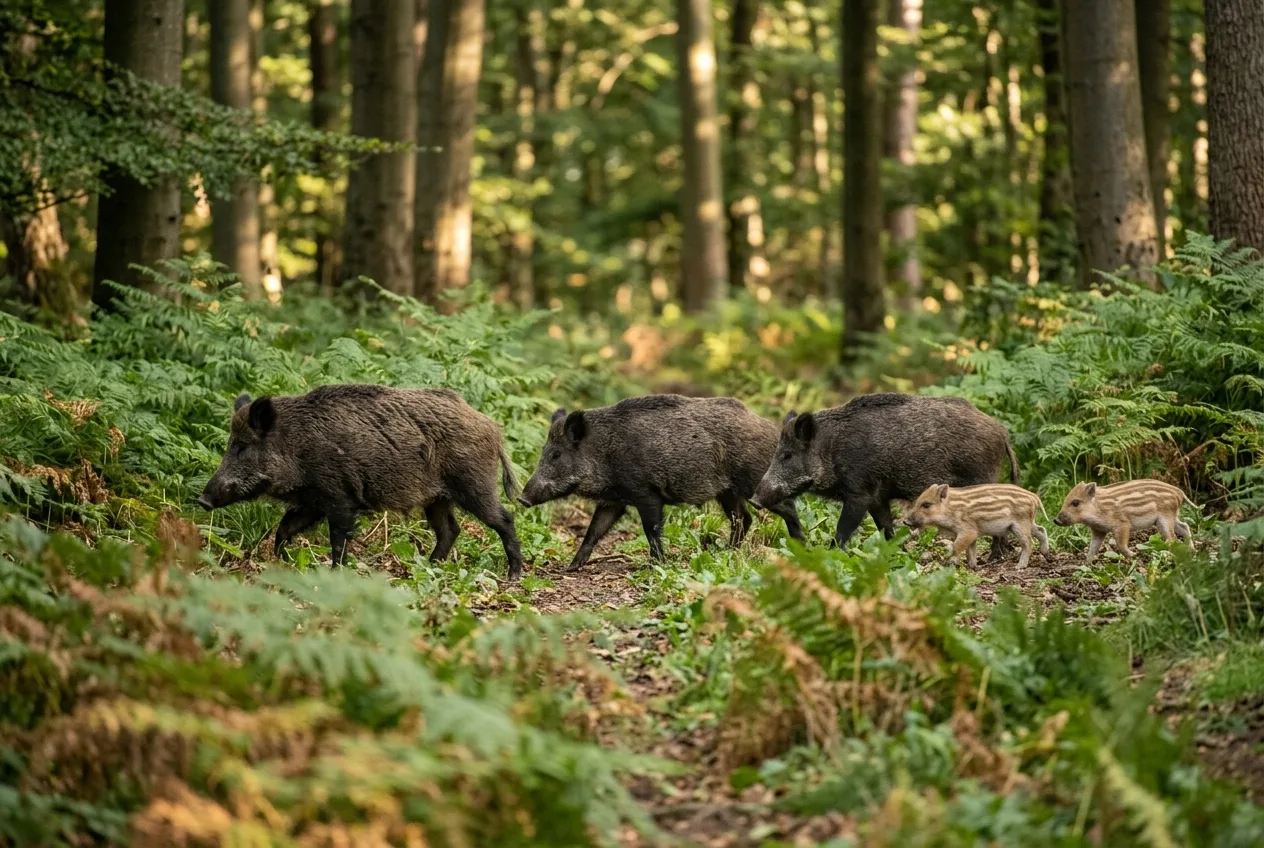
This isn't an academic exercise. Wild boar are among the most damaging invasive animals on the planet, and correctly reading the early sign — before a field is wrecked or a population digs in — is the whole game. A global review found wild pigs "threaten 672 taxa in 54 different countries," with "14 species… driven to extinction as a direct result of impacts from wild pigs"; the single biggest documented threat mechanism is habitat disturbance, affecting 584 taxa — that is, the rooting and digging this article is about. In the US alone, feral swine have been "reported in at least 35 states," with a population "estimated at over 6 million and… rapidly expanding". The damage is expensive and the spread is fast — which is exactly why noticing the first ploughed-up patch, and knowing it's a hog and not a badger, is more than a curiosity.
Boar are also genuinely hard to catch in the act: they're secretive, "often more active at night," and routinely present on a property well before anyone lays eyes on one. That's where a trail camera earns its keep — set on a fresh wallow, a rubbed pole, a trail under a fence, or the edge of new rooting, it can confirm overnight what the sign suggests. The catch is the volume of empty frames and the look-alike problem (a boar trail also catches deer, raccoons, and everything else that uses it).
Frequently asked questions
What does wild boar rooting look like?
It looks like the ground has been ploughed — broad, continuous patches of turf flipped over and soil turned up, with plant roots exposed, rather than neat individual holes. On pasture the disturbance is often just a few centimeters of topsoil (around 5–15 cm), but in soft ground boar can dig down to about 0.9 m (3 ft).
How do I tell a wild boar track from a deer track?
Shape and dewclaws. A boar track is rounder and blunter with an overall square outline; a deer's is heart- or spade-shaped and pointed. And a boar's dewclaws sit wider than the hoof and print readily, while a walking deer's dewclaws usually don't register wider than the hoof.
Could a badger or a raccoon have done this instead of a boar?
Possibly — that's why scale and pattern matter. Badger soil disturbance is shallow (under ~5 cm) in smaller patches; boar is deeper (5–15 cm or more) over larger areas with snout marks at the edges. Raccoons peel sod back in chunks and skunks dig tidy ~3-inch cone holes, versus the broad tilled ground a boar leaves.
Why are there muddy patches rubbed on my trees and fence posts?
That's wallowing-and-rubbing. Boar wallow in mud to cool off because they can't sweat, then rub the dried mud off on trees, posts, and especially creosote poles — leaving muddy bands and coarse, split-tipped hair. It's mainly a warm-season sign.
Is wild boar scat a reliable way to identify them?
No. Boar are omnivores, so their droppings vary enormously with diet and are easily confused with dog, deer, or bear scat. Use it as supporting evidence at most — confirm with rooting, tracks, wallows, and rubs.
What time of year is wild boar sign easiest to find?
Rooting tends to peak in autumn and winter, when rain softens the soil and soil invertebrates are near the surface. Wallows and fresh rubs are a spring-and-summer sign, tied to heat. So between the two, there's tell-tale sign to find in most seasons.