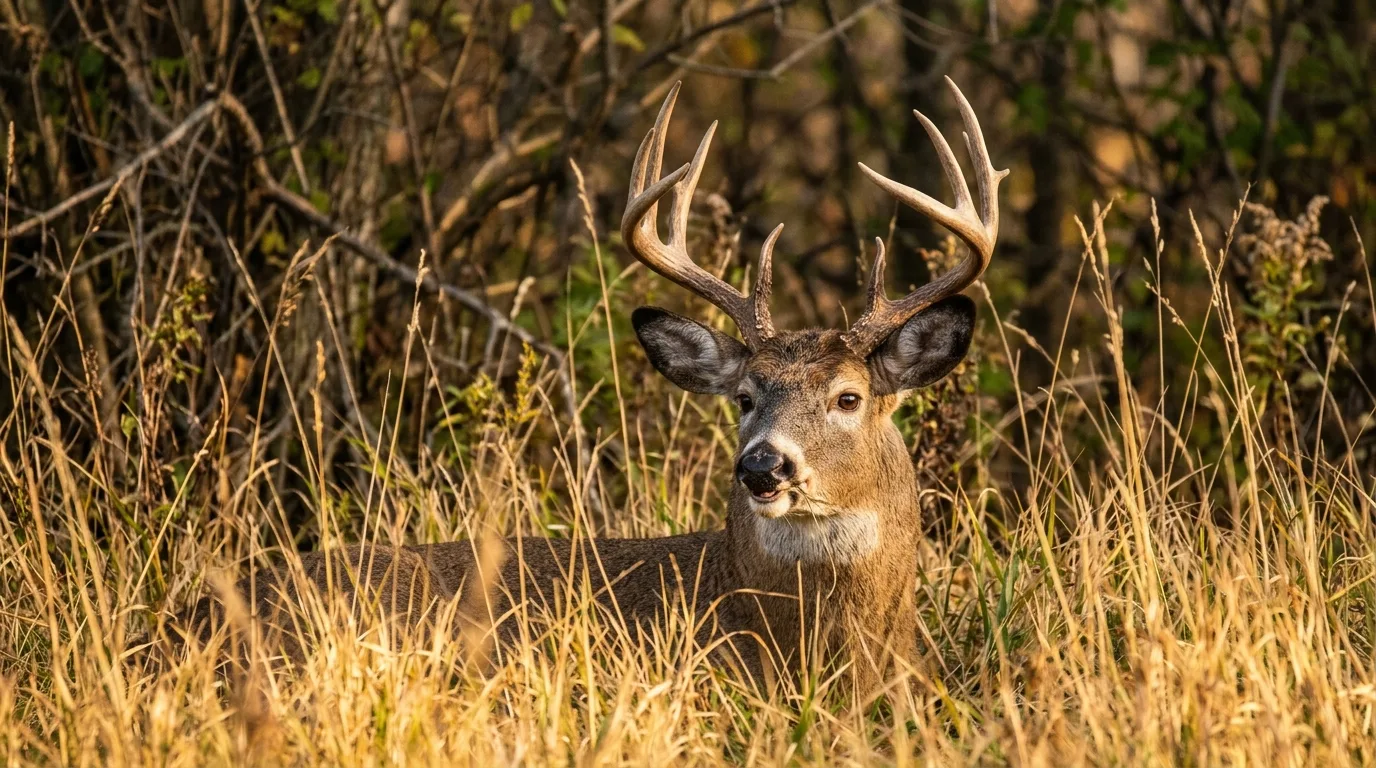
Here's a confession most deer-hunting articles won't make: finding the bedding area is the easy part. Deer have to sleep somewhere thick, somewhere with the wind right and an escape route close, and once you learn to read cover and terrain you'll find those somewheres all over your ground. The hard part — the part that actually separates people who kill mature bucks from people who keep "almost" getting one — is having the discipline not to walk into it.
So let's split this cleanly, because it's really two skills. The first is the fieldcraft: knowing what bedding cover looks like, reading the beds and trails and rubs, and using maps and cameras to pin down where deer spend their daylight hours — ideally without setting foot in there. The second is the strategy, and it's mostly a strategy of restraint: you hunt the edges of bedding and the travel routes between bed and food, not the bedroom itself. Pressure the bed and you teach the deer you're hunting to move only after dark, or to leave entirely. As one state wildlife agency puts it about mature bucks, "all it takes is one slip up and a mature buck will go nocturnal or totally leave an area".
The good news, and the thing I want you to hold onto through the whole piece: a pressured deer doesn't actually vanish into pure darkness the way hunting lore claims. That's a myth, and busting it is what makes the "hunt the edge" approach work at all.
What a bed actually is — and why deer choose one over another
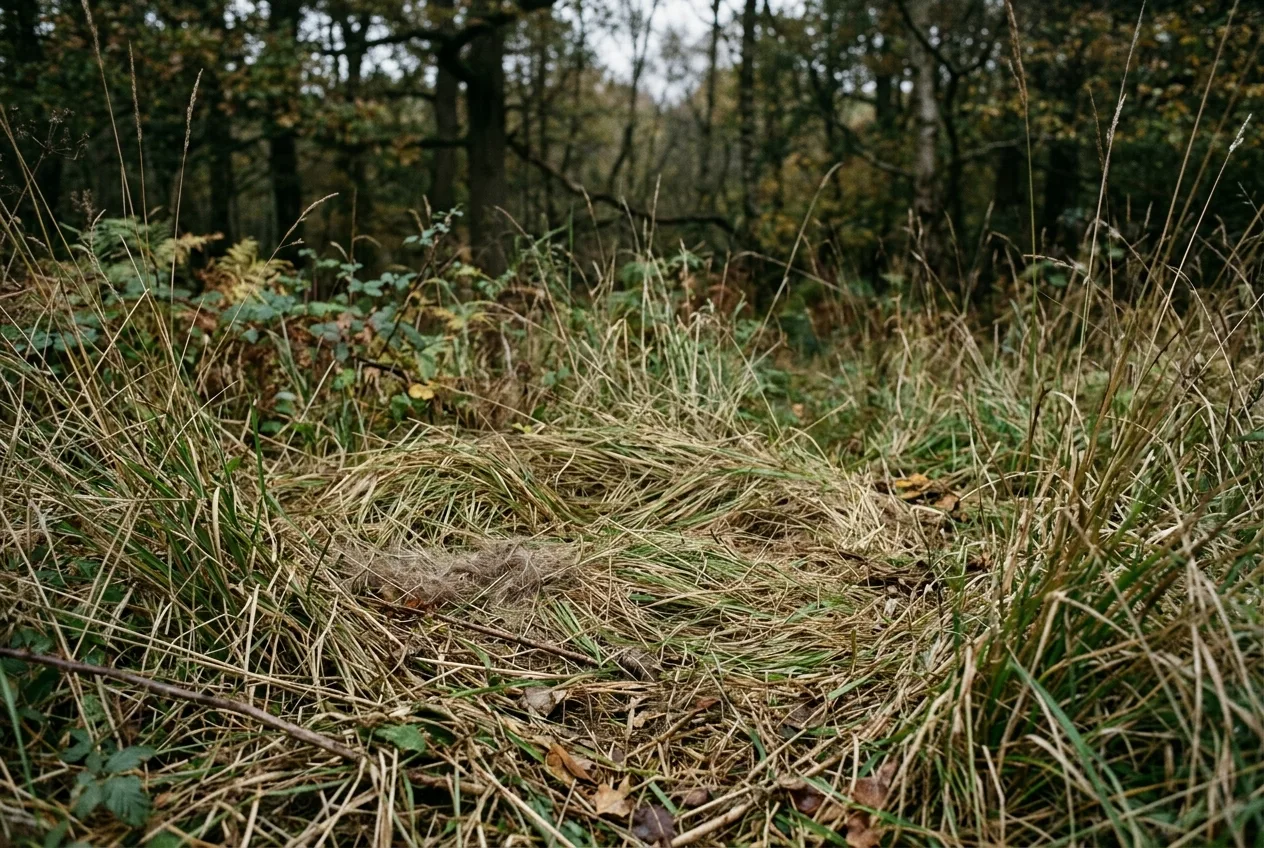
Walk into the right patch of cover after the deer have left it and you'll see them: ovals of matted grass or leaves, maybe a little scraped down to soil, often clustered a few yards apart where a family group lay together. That's the physical thing. The interesting question is why there — because deer don't bed randomly, and once you understand the "why," you can predict the "where" without stumbling around in the cover looking for flattened grass.
A bed does three jobs at once: it manages the deer's temperature, it hides the deer, and it keeps an escape route open. Different beds weight those jobs differently, which is the single most useful idea in this whole topic.
Start with temperature, because it's the most measurable. When it's hot, deer move into shade — and the science here is clean. A Texas study of male white-tailed deer found they "selected areas with taller vegetation in morning and midday activity periods but selected shorter vegetation during evening and nighttime," seeking out woody thermal cover at midday "when they are less active and incident solar radiation is greatest". That tall cover is genuinely cooler: the same researchers measured soil-surface heat under the canopy at "48 ± 3°C beneath mesquites compared to 61 ± 3°C in non-canopied areas". A bedded deer is essentially picking a cooler microclimate to ride out the heat of the day. In Norway, roe deer did the same with the cover overhead — bed-sites averaged 66% canopy versus 52% at nearby random spots — and added a second trick: on warm days they chose "bed-sites with humid substrates, probably to increase heat loss by conduction," basically lying on cool, damp ground to dump body heat.
There's a body-size wrinkle worth knowing, because it explains why a roe deer and an elk don't bed the same way. A 2025 Swedish study of three deer species found that "during warmer daily temperatures, moose and red deer selected areas with more canopy cover for thermal shelter," while "roe deer showed no influence of high temperatures on canopy cover selection". Bigger animals overheat more easily, so the bigger the deer, the more its summer bed is about shade. The researchers put the general principle plainly: "thermal cover, proximity to browse and predator avoidance are all considered important drivers behind moose and red deer selection of beds". Temperature, food, safety — that's the whole list, and a good bed splits the difference.
Now flip the season. When it's cold, the calculus inverts and — this is the part that surprises people — a single deer will use two completely different kinds of bed on the same winter day. The cleanest data on this comes from central Ontario, where researchers measured 97 day beds and 326 night beds of wintering whitetails. The contrast is stark:
| Winter bed feature | Day beds (sun-warming) | Night beds (sheltered) |
|---|---|---|
| Overhead cover | 12.8% | 84.7% |
| Coniferous composition | 11.3% | 76.2% |
| Vegetation volume around bed | 4.1% | 58.8% |
| Distance to nearest tree | 1.7 m | 0.9 m |
Source: Armstrong et al., central Ontario.
Read those two columns and you can see the deer thinking. As the authors describe it, in winter "white-tailed deer usually bed at night in closed forests near coniferous trees… Day-bedding sites are in areas exposed to the sun". At night, when there's no sun to catch and the cold is the enemy, the deer burrows into dense conifer that traps body heat — that 84.7% overhead cover. By day, it moves to a sparse, open, sun-exposed spot to soak up solar radiation and warm back up. A Minnesota study found the same counterintuitive behavior: deer "made greater daytime use (55 to >80% probability of use) of open vegetation types at the lowest daily minimum temperatures," literally sunbathing on the coldest days. So if you find a deer bed out in surprisingly open cover in winter, you haven't found a careless deer — you've probably found a day bed doing exactly its job.
A good bed splits three jobs at once: warmth or shade, concealment, and a fast way out — and which one wins tells you where to look.
The cover types deer bed in
Translate all that biology into "what does it look like on the ground," and you get a handful of cover types that show up again and again. None of them is universal — the mix depends on your terrain — but the menu is short.
Thick brush and early-successional tangle. This is the default. A Mississippi State analysis of GPS-collared bucks found their "most heavily used bedding areas had twice as much physical or structural screening cover than unused areas". Deer don't bed in average cover; they bed in the thickest stuff available to them. Plum thickets, sumac, regenerating clearcuts, brushy draws, anything that breaks up a predator's line of sight.
Conifer and thermal cover. In cold country, evergreen stands are the night bedroom. Dense conifers "offer a most effective buffer against loss of body heat by convection and radiation," a Maryland study of winter night beds found, creating "a more stable environment where deer may select optimal microhabitats for energy conservation". Deer pack into these "yards" hardest when snow gets deep — a long-term Minnesota study found dense-conifer use climbed most steeply with snow depth, and reframed it nicely: in deep snow the conifers may be working "as snow shelter rather than thermal cover," intercepting snow so the deer can move and lie down on shallower ground.
Benches, points, and leeward slopes. This is where terrain reading pays off, and we'll come back to it with maps. Deer love to bed where a slope gives them a thermal and wind advantage with a view below. On a point of a ridge, hunting writer Mark Kenyon describes the classic setup: "Deer love bedding with a wind at their back coming from the ridge, and then facing down into the lowland ahead of them, keeping watch for danger". Cover behind, eyes and nose covering everything in front — their back is protected by the rising ground, their nose checks the wind coming over it, and their eyes watch the open downwind side. It's a near-perfect security arrangement, and it's readable off a topo map.
Field edges and cover margins. Deer bed near the seam between cover and food more than you'd think. A winter study of red deer in Inner Mongolia found "the forest thicket margin had positive marginal effect on the population distribution of red deer," with distance to forest edges ranking as a top habitat factor. The edge gives them thick cover at their back and easy access to feed — which, conveniently, is also where you can watch them without going in.
Swamp islands and isolation. Anything that's a pain to reach is prime. Deer in central Ontario bedded "on the leeward side of islands" in winter. The general principle, from study after study of pressured deer, is that security scales with how hard a spot is to get to — a theme we're about to lean on hard.
How wind and thermals shape the bed (and your approach)
You can't talk about bedding without talking about wind, because a deer's nose is the sense you're really fighting, and the deer beds with that nose in mind. The arrangement deer favor is simple to state: cover at their back, scent and sightlines covering the open side in front of them. They watch downwind with their eyes and check upwind with their nose, so almost nothing approaches undetected. That's why leeward slopes and ridge points are such reliable bedding — the terrain does half the work of covering them.
Here's the piece a lot of hunters miss, though: the wind near a bed isn't just the prevailing breeze on the forecast. On any terrain with relief, you also have thermals — air that rises and falls with the daily heating and cooling of the ground. In the morning, as the National Deer Association's Anthony Harris explains it, "as the sun heats the ground, air at ground level rises," carrying scent uphill; in the evening "the opposite occurs when the sun is setting and the earth starts to cool down… air cools and settles back toward the ground, pulling your scent along with it". That settling evening air pools in the low ground "just as fog and frost settle in the lowest ground" — and the low ground is very often exactly where deer are bedded or staging.
The practical rule that falls out of this is "hunt high in the mornings and low in the evenings" — but understand it as a rule about air movement, not a fixed direction. It's mechanism, not compass. And the mechanism flips with sun and shade in ways that can bite you: a slope that warms later in the day (the shaded side, whichever way it faces in your hemisphere) keeps its air falling longer into the morning, so your scent can drift downhill toward approaching deer even after the ridgetop is sunlit. The honest takeaway is to check the actual air at your specific spot — Harris recommends a smoke or wind-checker in the off-season — because thermals at one location can contradict the day's prevailing breeze. The deer already knows this about its bedroom. You have to learn it.
Deer bed with cover at their back and their nose in the wind — which is exactly why you can't sneak up on a bedroom, only watch its edges.
Reading the sign: beds, trails, and the rub ring
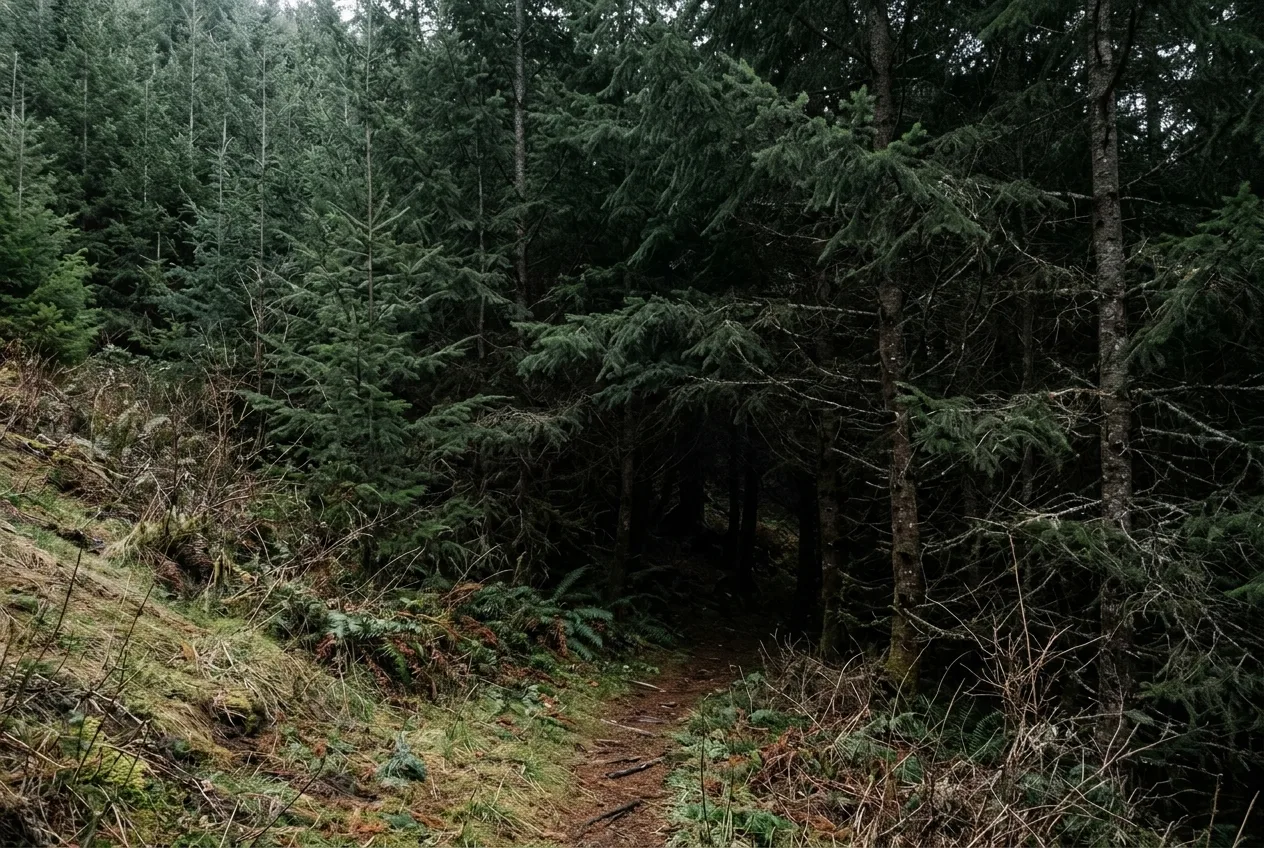
When the time is right to put boots in the cover — and we'll define "right" as firmly not during the season in a minute — here's what you're reading.
The bed itself is the obvious sign: a matted oval, sometimes a cluster of them where deer lay as a group. Researchers studying resting behavior use a deliberately mechanical definition that's useful for you, too. The Penn State Deer-Forest Study, working from GPS collars, counted a deer as resting when "a movement was <5 meters from the previous hour" — barely moving for an hour means it's bedded. That's worth internalizing: a "bedding area" isn't one magic bed, it's a zone where a deer logs a lot of those low-movement hours. And those zones drift. The same Penn State data showed that by mid-October "there are fewer resting sites, and they're not in the same location" as in early fall. A bedding area is a neighborhood of options, not a fixed address — which is one more reason not to over-invest in a single spot.
More valuable than the beds, honestly, are the trails running in and out of cover. Missouri's wildlife agency frames scouting around a single repeated question: every time you find a well-used trail, ask "Where is the main food source from here and where is the main bedding area or heavy cover from here?". Trails are the connective tissue between bed and food, and those are the lines you want to hunt. Follow them, the agency advises, "in the off season, especially in late January… because they will not be as easy to find in the dense cover of summer".
And there's one elegant tell for a buck's core bedding without walking on top of it: the rub ring. As Missouri's biologists put it, "circular rub lines around thickets or small timber blocks may indicate a core bedding area for a particular buck". A buck working the edge of his bedding thicket leaves rubs in a rough ring around it. Find that ring and you've located his bedroom from its perimeter — which, as a way to learn where he lives without barging in, is close to ideal.
A ring of rubs around a thicket locates a buck's bedroom from the outside — exactly where you want to stay.
Finding bedding from maps — before you ever walk in
The best scouting you do for bedding happens at a screen, because terrain features that hold bedding are visible on aerial and topographic maps, and reading them off a map costs the deer nothing. This is where you can do real work without leaving a single track.
Kenyon's "Big 5" approach is a clean framework: pull up aerial and topo maps and mark every funnel, edge, saddle, point, and ridge line on your ground. Each of those features concentrates deer, and several of them are bedding magnets you can spot from contour lines alone:
- Points — where a ridge juts out — are prime bedding for the cover-at-back, view-in-front reason we covered; deer "often use these points to bed on".
- Benches — flat shelves partway up a slope — give deer a level place to lie with the slope protecting one side. Early-fall day beds in the Penn State data skewed to "higher elevation sites," consistent with deer bedding up on these mid-slope shelves.
- Saddles — low dips in a ridge — are travel funnels between bedding areas; deer "naturally prefer traveling on the path of least resistance," so a saddle channels them predictably.
- Edges — cover-to-cover or cover-to-field seams — are where bedding cover meets feeding, the exact margins deer bed against.
Mark those features, and you've got a map of likely bedding and the travel routes between it and food — all before you've risked bumping anything. From there you verify lightly: a quick look for the sign you'd expect given the terrain, ideally from the edge, ideally outside the season.
The trail-camera trick: watch the edge, never the bed
Here's where a camera earns its place, and where most people get it backwards. The instinct is to put a camera in the bedding area to see what's living there. Don't. You'll leave scent walking in, you'll leave it again retrieving cards, and you'll do exactly the thing that pushes a mature buck nocturnal — all to confirm what the edges would have told you anyway.
The agency line is blunt. Oklahoma's wildlife department, writing specifically about bedding areas: set trail cameras "on travel corridors and trails entering and exiting the bedding area, not in the area itself". You don't need a photo of the buck in his bed. You need a photo of him leaving it in daylight, on a trail you can hunt.
Kenyon, who hunts heavily pressured ground, runs the same playbook: "I place almost all of my cameras near edges. This might be the edge of a food source, the edge of a logging road, or maybe the edge of two different cover types" — chosen specifically so he can reach them "without my wind blowing into bedding areas and without bedded deer hearing or seeing me". By watching the food-source side and the cover seams, he captures deer "at their end destination, without needing to penetrate deep into their sanctuary cover where you're likely to educate those deer". During the rut he repositions a few cameras to "pinch points or terrain features that funnel bucks traveling in between doe bedding areas" — letting the cameras tell him when bucks start moving in daylight without him ever sitting on a bedroom.
There's a clean trail.cam angle here, and it's the one place a camera platform genuinely fits this topic. A camera on a bedding-area edge — aimed at the entry trail or the food-side seam — is doing intelligence work: it maps which deer use which route between bed and feed, and when in the day they do it, which is the whole question. The catch is that an edge camera in a sensitive spot can't be checked often without defeating its purpose, which is why Kenyon leans on cell cameras or only checks them "when I'm passing by," noting that "anything I can do to reduce my human scent and overall presence is beneficial".
You don't need a photo of the buck in his bed. You need a photo of him leaving it in daylight, on a trail you can hunt.
Why you don't hunt the bedroom
Now the second skill, the discipline. Everything above tells you where deer bed. This tells you why finding it should mostly make you want to set up somewhere else.
The core reason is that deer respond to human pressure by changing when and where they move, and they do it fast. A multi-year red deer study across the Alps found that during the day — when humans are out — deer "selected for denser tree cover, greater distances to trails, steeper slopes," and at night reversed it, choosing "low tree cover density… flat terrain and short distances to trails". Translation: pressured deer push their daylight life deep into the nastiest, least accessible cover and save the open, easy ground for after dark. A German study of red deer and recreation found the same pattern around trails and feeding areas, "avoided during day, whereas a positive association was found during night" — the textbook signature of disturbance-driven nocturnality.
Mississippi State's collar data shows the dose-response in a hunting context: "as the risk of harvest increases from low to moderate and from moderate to high, adult bucks chose [open] habitats less and less," and "adult bucks visit food plots mainly at night" once pressure climbs. The biologists' bottom line is one every hunter should tape to the wall: "in the absence of vegetative cover, increased hunting pressure at some point will drive deer to move to other properties". Push too hard, and the deer doesn't just go nocturnal — it leaves.
So the bedroom is the worst place to spend your pressure. Walk into it, leave your scent, bump a deer out of its bed once or twice, and you've trained the most valuable animal on your property to treat daylight as dangerous. The Oklahoma line bears repeating because it's exactly right about mature bucks: "all it takes is one slip up and a mature buck will go nocturnal or totally leave an area". (Worth noting: that fragility is a mature buck trait. The same source notes "does can tolerate human disturbance and being bumped off their beds to a much greater degree" — but the deer you're usually after is the one with the lowest tolerance.)
Push too hard and the deer doesn't just go nocturnal — it leaves.
Hunt the edges and the in-between
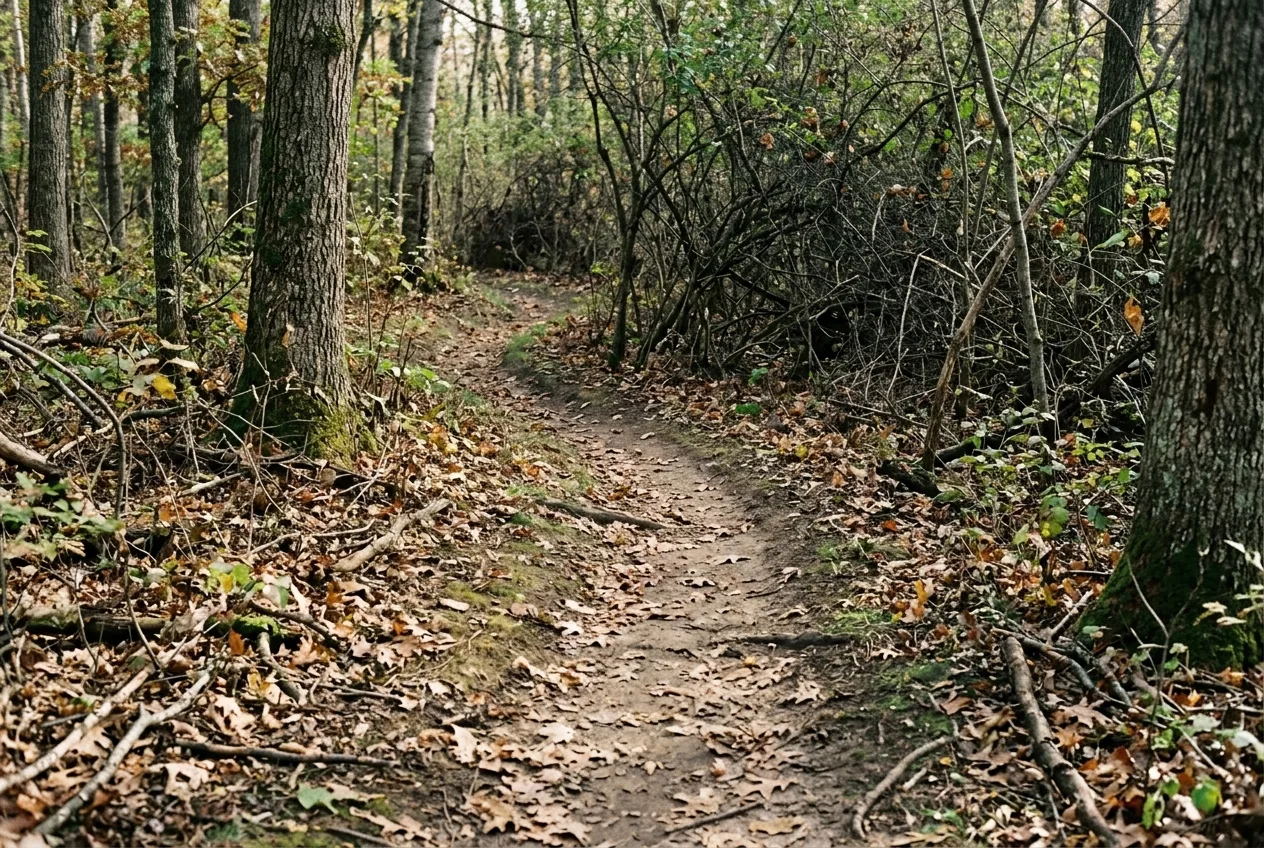
If not the bed, then where? The travel routes between bedding and food, and the cover edges around them — that's the answer the whole literature converges on.
Mississippi State again: "rather than hunting directly over food (like a food plot), consider hunting along travel corridors between vegetative cover and foraging areas to increase observation rates of adult bucks during legal hunting hours". Missouri's agency makes the parallel point about food, and it transfers straight to bedding: hunt "the transition zones between food and cover and only rarely hunting directly over a food plot". The bed and the food plot are both destinations — and deer reach destinations on their own schedule, often after dark. The travel route in between is where you catch them on the move while it's still light.
The National Deer Association's Kip Adams describes this as the payoff of knowing where the bedding is: "with known bed sites and feeding areas… you can do a much better job intercepting mature bucks in between". Knowing the bedroom's location isn't license to hunt it — it's what lets you set up off it, on the route out, with the wind right. He frames the bedding blocks themselves as fixed anchors: "those blocks provide areas we know deer use to bed in. That allows us to strategically select stand sites to catch deer moving to or from that cover to feed".
And the thing that makes any of it work is access — getting to your stand and back without the deer knowing. Adams is emphatic: "it doesn't matter how good a stand setup is if you can't get in and out of it without spooking deer," which is what lets his group "hunt them productively 10 or more times per year because we spook few if any deer on our way in and out". Missouri's agency reduces stand selection to the same idea — put the stand "to have your scent blow away from where deer are coming and going," and remember "the key to entering and exiting a stand is to do so undetected". A bedroom-edge stand you can't reach cleanly is worse than no stand at all, because every blown approach is a lesson the deer keeps.
The nocturnal myth — what pressure really does
I promised early on that the "deer goes totally nocturnal" story is overblown, and it matters enough to give it its own section, because it's the difference between despair and a workable plan.
When deer get pressured, they shift activity toward darkness and into heavier cover — that part is real and well documented. But "shift toward" is not "disappear into." Here's the National Deer Association's Kip Adams, flatly: "regardless of how pressured deer are, they don't become completely nocturnal. That is a myth. They still get up at least seven to 10 times during daylight hours each day to stretch, urinate and defecate". A deer is a ruminant; it physically has to rise and reposition through the day. Those daylight movements are short and they happen close to the bed — which is precisely why secure cover next to food is the whole game. When a deer feels safe enough, Adams notes, it'll step into a feeding opening before dark instead of waiting for full night, "comfortable feeding in daylight because cover/safety was one bound away".
A Scottish camera-trap study of red deer puts the coexistence mechanism in plain terms: deer in good cover tolerate people better, and "the primarily diurnal activity of humans may complement a more crepuscular or nocturnal ungulate activity, allowing ungulates to coexist alongside human activity". In other words, deer cope with us by adjusting their clock and leaning on cover — and your job is to not be the disturbance that pushes that adjustment past the point where you ever see them in daylight.
This is also why "scout the bedroom, but do it at the right time" isn't a contradiction. You absolutely should learn the cover intimately — just do it when it can't cost you. The National Deer Association's sanctuary guidance is to minimize human entry "from a month prior to the opening of deer season through its closing date," then go back in afterward. Post-season is when you confirm everything: a working bedding sanctuary "should be very apparent" in sign — heavy trails, beds, browse — when you walk it after the season closes. Late January, when the cover is bare and the deer are about to forget you were there, is your window to read the trails and map the beds. Then you stay out, and you let the edges and the cameras carry you through the season.
That's the whole ethic in one line: find the bedroom, learn it cold, and then hunt everywhere but inside it.
Frequently asked questions
How do you find a deer bedding area without spooking the deer?
Do most of it from a screen and from the edges. Mark the likely bedding terrain — points, benches, leeward slopes, thick cover near food — off aerial and topo maps first, verify lightly from the perimeter, and put any trail cameras on the trails entering and exiting the cover rather than inside it. Save the actual walk-through for the off-season, ideally late winter when sign is easy to read and the season is over.
What does a deer bed look like?
A matted oval of flattened grass or leaves, sometimes scraped down to bare soil, often in clusters where a group bedded together. Researchers define a "bed" functionally as a spot where a deer barely moves for an hour or more, so a bedding area is really a zone with lots of those low-movement hours rather than one fixed depression.
Why shouldn't you hunt right in a bedding area?
Because pressure on the bedroom is what turns a daylight buck into a nocturnal one — or drives him off your land entirely. Pressured deer push their daytime movement into thick, hard-to-reach cover and feed in the open only after dark, and as one agency warns, with a mature buck "all it takes is one slip up" to lose him. Hunt the travel routes between bed and food instead.
Do deer really go completely nocturnal when pressured?
No — that's a myth. They shift activity toward darkness and heavier cover, but they still rise to move several times during daylight, because a ruminant has to. Deer with secure cover right next to food will even step out to feed before dark, which is exactly the situation you want to hunt.
Where should I put a trail camera to learn where deer are bedding?
On the edges — the entry/exit trails, a food-source margin, or a seam between two cover types — never deep in the bedding itself. An edge camera tells you which deer use which route between bed and food and at what time of day, which is the information you need; a cellular camera or a "check it only when passing by" approach keeps you from contaminating the spot.
Where do deer bed in winter versus summer?
Differently, and a single deer may use two beds a day in winter. In heat, deer bed in shade and dense overhead cover to stay cool; in cold, they use sheltered conifer "night beds" packed with overhead cover to trap heat, and sun-exposed, open "day beds" to warm up in solar radiation. Which slope catches that warming sun depends on your hemisphere — describe it by sun and shade, not a fixed compass direction.