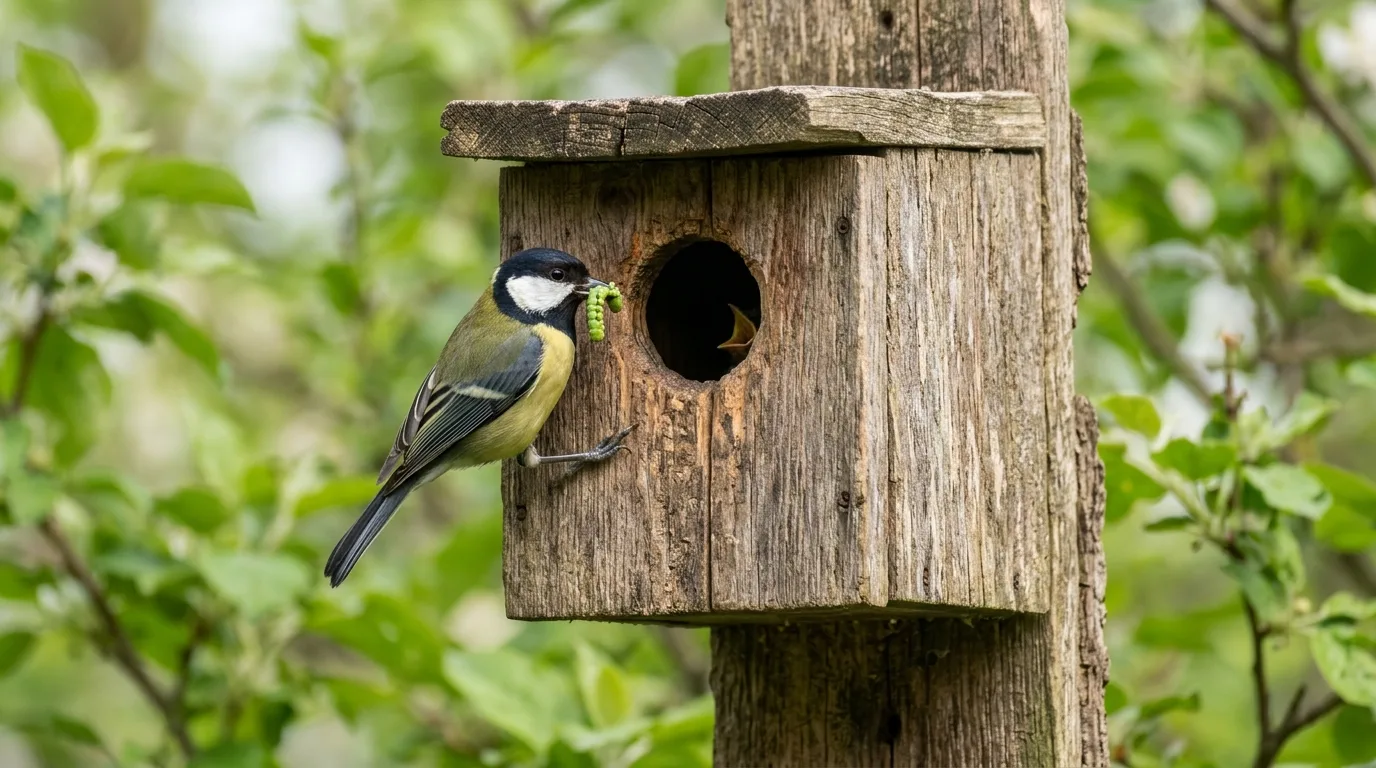
A nest box is the rare piece of bird gear where one number does almost all the work. Not the price, not the brand, not how pretty it looks screwed to your fence — the diameter of the entrance hole. Get that hole right and you've quietly decided which species can move in and which ones are locked out before they ever land. Get it wrong, and you've either built a vacancy no small bird trusts or, worse, a comfortable home for the exact aggressive competitor you were trying to keep out.
That's the mindset shift worth making early. A good nest box isn't decoration; it's a piece of carefully sized habitat that replaces something the landscape has lost. Across continents the same story keeps repeating — old trees with natural cavities get cut down, dead "snags" get tidied away, and the cavity-nesting birds that depended on them run out of places to raise young. Oregon alone has 45 bird species that nest in tree holes, and many of those holes are vanishing from yards and towns. A box you build to the right spec gives one of them back.
So if you want the short version: match the box and its hole to the bird you actually have, mount it where predators can't climb to it, point the entrance away from your wettest weather and your hottest afternoon sun, and then leave it mostly alone. The camera — the fun part, the reason a lot of people start — comes last and changes nothing about the box itself except how much you get to see. Here's how to do all of it without guessing.
The hole is the whole game
Start where it matters. Every serious source on nest boxes says the same thing in slightly different words: the entrance hole is the single most important feature, because it controls who gets in. Oregon State's extension guide puts it flatly — "the entry hole is the most important way" to control which species use the box. The Cornell Lab's NestWatch frames it as a feature, not a limitation: "By providing a properly sized entrance hole, you can attract desirable species to your birdhouses while excluding predators and unwanted occupants".
The catch is that the "right" number is not universal — it's specific to the bird and the region, and that's exactly where a lot of well-meaning advice goes wrong. A North American bluebird box and a British blue-tit box are different objects with different holes, and copying one country's number onto the other continent's bird is a mistake. So here are the real figures, kept where they belong.
In the UK, the British Trust for Ornithology's hole-fronted standard is 25 mm for Blue, Coal and Marsh Tit; 28 mm for Great Tit and Tree Sparrow; and 32 mm for House Sparrow and Nuthatch. The BBC's Discover Wildlife extends the same UK ladder upward: 45 mm for Starling, 50 mm for Great Spotted Woodpecker, and an oval slot for Swifts. The principle baked into those numbers is exclusion — as the RSPB notes, "a hole size of 25mm will exclude larger species". If you can only buy one drill bit, the BTO's pragmatic pick is a 32 mm bit, which "will potentially allow any of the common small birds to use the box".
In North America the units flip to inches and the species change, but the logic is identical. For most songbirds the hole is "exactly 1 1/2 inches in diameter and 1 1/8 inches from top" (about 38 mm, set 29 mm down), with species-specific exceptions. A House Wren wants a 1-inch (25 mm) hole; Tree and Violet-green Swallows 1 1/4 inch (32 mm); Western Bluebird 1 1/2 inch (38 mm). Mass Audubon's rule for towns and suburbs is simpler still: "a hole no bigger than 1.25 inches" (32 mm), big enough for chickadees and wrens but too small for House Sparrows.
| Species (region) | Entrance hole | Source |
|---|---|---|
| Blue / Coal / Marsh Tit (UK) | 25 mm | S09, S13 |
| Great Tit (UK) | 28 mm | S09, S13 |
| House Sparrow / Nuthatch (UK) | 32 mm | S09, S13 |
| Starling (UK) | 45 mm | S13 |
| Great Spotted Woodpecker (UK) | 50 mm | S13 |
| House Wren (US) | 1 in (≈25 mm) | S16 |
| Black-capped Chickadee (US) | ~1 1/8 in (≈29 mm) | S16, S20 |
| Tree / Violet-green Swallow (US) | 1 1/4 in (≈32 mm) | S16 |
| Eastern / Western Bluebird (US) | 1 1/2 in (≈38 mm) | S16, S20 |
| Wood Duck (US) | ~3 in round / 3×4 in oval | S16, S20 |
Two cautions on the numbers themselves. First, exclusion is a ceiling, not a guarantee: keep the hole at or below 1 9/16 inches (40 mm) and you've shut out almost all European Starlings, and at or below 1 1/4 inches (32 mm) you've shut out House Sparrows — but House Sparrows "defend their nests very aggressively and are difficult to exclude" even so, and may need to be managed directly. Second, body size drifts with climate. Sialis, a long-standing North American cavity-nester reference, flags Bergmann's rule here: a bird of the same species can be larger in a colder region, so "a Canadian starling may be bigger than a Florida starling" and squeeze through a hole that excludes its southern cousin. Treat the figures as starting points for your bird in your place, not as laws of physics.
The entrance hole is not a detail of the box — it is the box's entire security system.
Build it (or buy it) to last and stay dry
The hole decides the tenant; the rest of the box decides whether the tenant survives the season. The features that matter are unglamorous and consistent across sources.
Wood, untreated, thick enough to insulate. Use natural, unpainted wood — cedar, pine, cypress, or fir — and skip anything treated, stained, or painted, because the fumes can harm birds and paint clogs the pores that let heat and moisture escape. Thickness is doing real work: NestWatch wants walls "at least 3/4 inch" (19 mm) "thick to insulate the nest properly"; the BTO's UK guidance is "at least 15mm thick" to prevent warping and insulate chicks "from heat or cold"; Discover Wildlife suggests 19 mm, "no less than 15mm," with an internal floor of at least 130 cm². Plastic and metal are poor choices on their own because they "can get too hot, which can harm the birds".
That said, the wood-versus-everything-else question is more interesting than it looks. A UK study comparing wooden and plastic boxes found essentially no difference in temperature or humidity between the two materials (mean 12.59 °C in wood versus 12.51 °C in plastic, P = 0.917) — but the wooden boxes carried roughly "30-fold higher numbers of fleas" and a higher bacterial load on the chicks. And yet the birds did better in wood anyway: "Fledging success for blue tit broods was significantly higher in wooden boxes," and the birds occupied them at higher rates. Wood wins overall — just don't imagine it's the sterile option, which is one more reason the annual clean-out below matters.
Drainage, ventilation, and a roof that sheds rain. Water is the enemy. Drill at least four drainage holes (3/8 to 1/2 inch, 10–13 mm) in the floor, or cut the floor corners off, so anything that gets in can run out. Add ventilation near the top — NestWatch specifies "two 5/8 inch" (16 mm) "diameter holes on each of the side walls, near the top (four total)". Recess the floor about 1/4 inch (6 mm) up from the bottom so the nest stays dry. Give the box a sloped roof that overhangs the front by a couple of inches and the sides by about two, with shallow drip-cuts underneath to channel rain away. Even ventilation can be a fix after the fact: in that UK study, plastic boxes that had "5 holes, 5 mm wide" drilled across the side walls were occupied more and fledged more chicks than unventilated ones.
A rough inner wall, and no perch. Nestlings — especially swallows — need to climb the inside wall to reach the hole and fledge, so roughen the interior below the entrance or cut a few shallow horizontal grooves like a tiny ladder. And leave the perch off entirely. It's the one piece of "extra" that actively hurts: "A perch is unnecessary for the birds and can actually help predators gain access to the box". Every major source agrees — no perch.
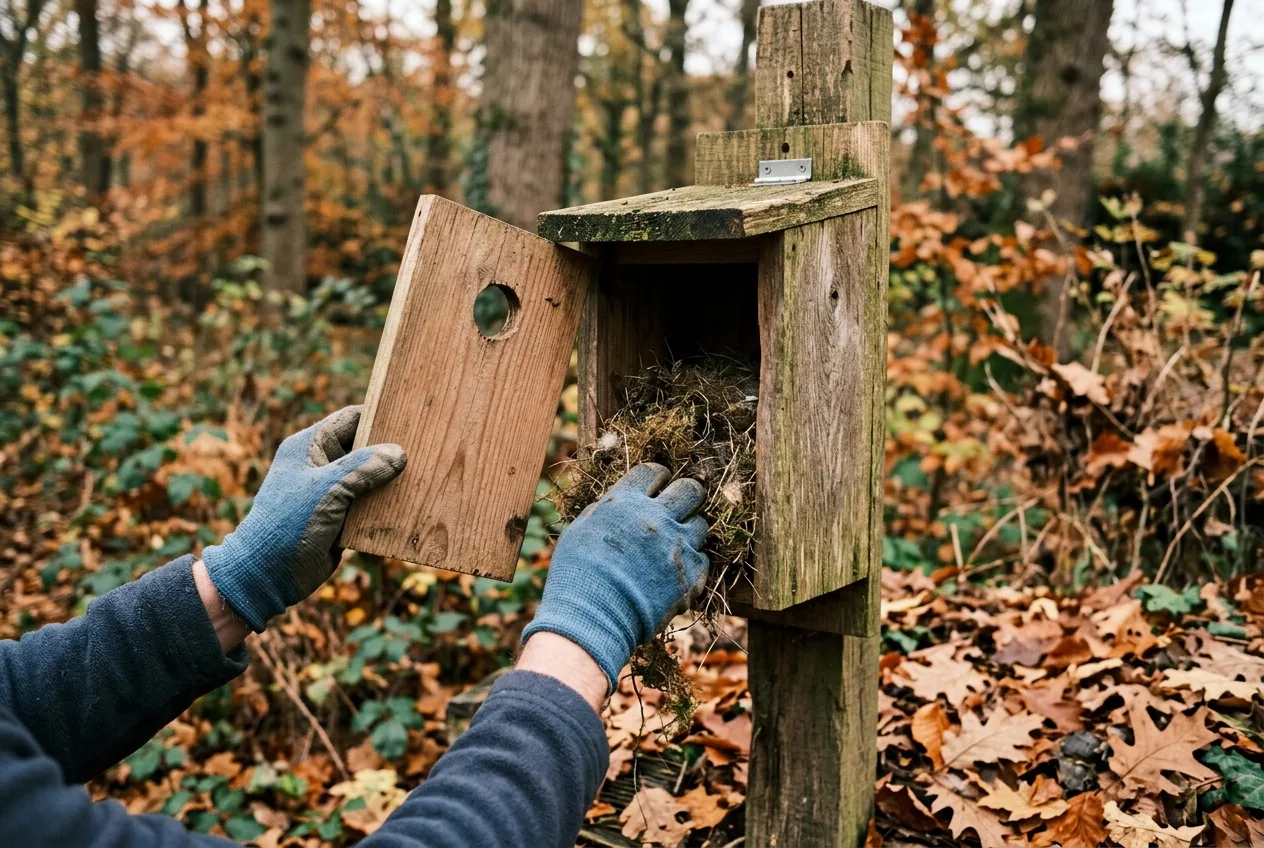
Finally, build in a hinged side or roof with a secure latch. You'll need to open the box once a year to clean it, and a box you can't get into is a box you can't maintain.
Mount it where nothing can climb to it
Here is the advice that quietly does more for nest success than almost anything else, and the advice most people ignore because nailing a box to a tree is easy. Don't nail it to a tree.
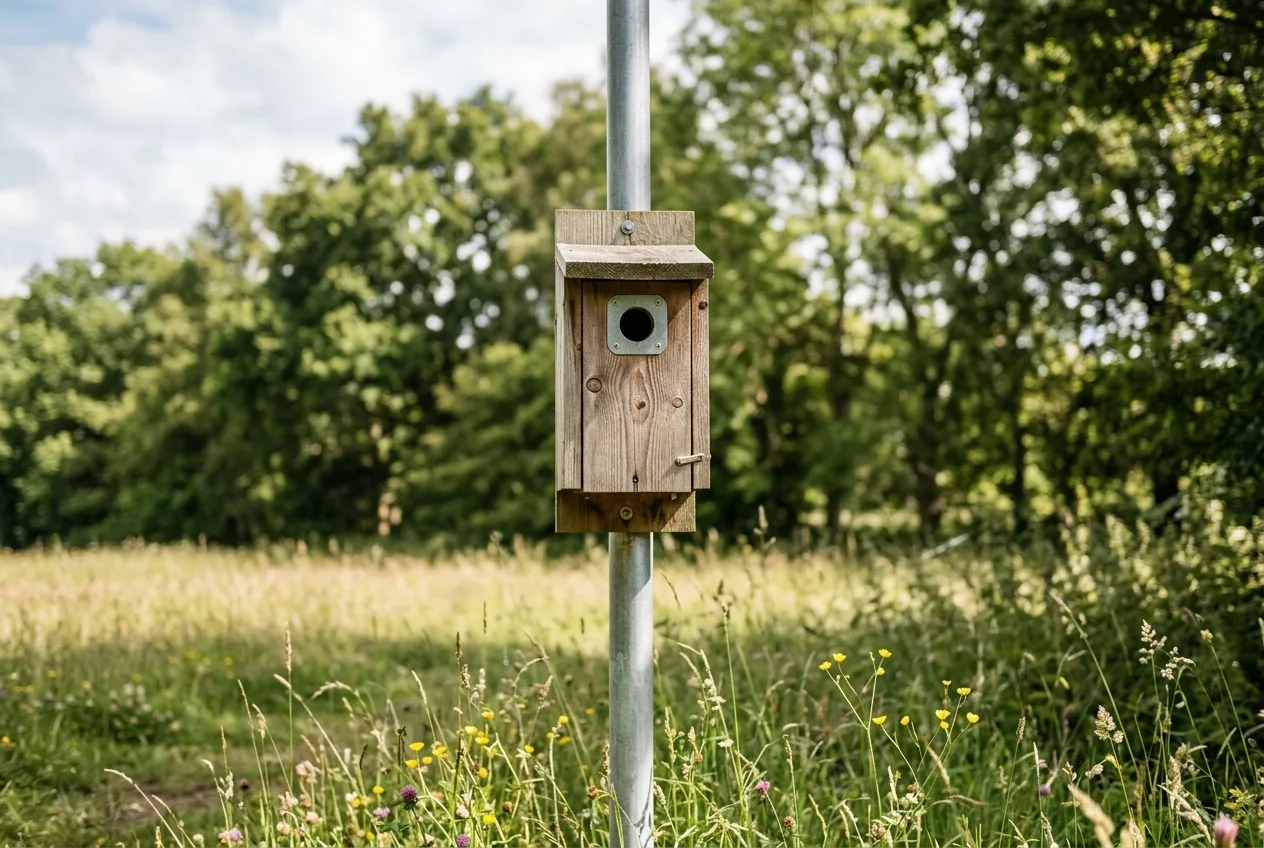
Mount the box on a smooth, round metal pole instead. The North American Bluebird Society's go-to is a length of half-inch to one-inch (13–25 mm) electrical conduit — drive two feet (0.6 m) into the ground, leave about six feet (1.8 m) standing — because the zinc-plated surface stays slick for years and gives raccoons, snakes, and cats nothing to grip. Nailing a box to a tree or fence post, by contrast, hands climbing predators a highway: raccoons climb trees and walk fence lines, and mice, chipmunks, and squirrels raid tree-mounted boxes too. NestWatch is blunt about raccoons specifically — "Mount nest boxes on a metal pole equipped with a baffle; avoid mounting them on trees or fence posts".
The other half of pole-mounting is clearance. A pole accomplishes nothing if a predator can simply jump to the box from somewhere nearby, so keep the box "at least 10 feet" (3 m) from a tree, a roofline, or any other launch pad. Cats are the reason the number is that big: some can leap as high as six feet (1.8 m), so the standing guidance where cats are around is to place the box high on a smooth pole and well clear of jumping-off points.
Is a tree-mounted box ever defensible? Sometimes — and the sources are honest about the trade-offs rather than dogmatic. In regions with few climbing predators, tree mounting can work, and trees offer shade that a bare pole doesn't; one experienced California bluebirder describes hanging boxes in trees successfully in a dry area where raccoons and climbing rat snakes are scarce. But that's a local exception built on knowing your predators, not a general license. If a tree or utility pole is genuinely your only option, you can still protect it — more on the acetate snake guard below.
Nailing a box to a tree is the easiest thing to do and one of the most consequential mistakes you can make.
Aim the entrance at your weather, not at a compass point
This is the part where copied advice does the most quiet damage, so it's worth slowing down. You'll read, confidently, that a nest box should "face northeast" or "face between north and east." That's good advice — in the northern hemisphere. It is exactly backwards as a universal rule, because the whole point is local weather, and weather is not the same on both halves of the planet.
The principle is what travels. Face the entrance away from the prevailing wind-driven rain and away from the hottest afternoon sun, and shade it from midday heat. Get that right and the compass direction sorts itself out for wherever you live. The British sources are writing for the northern hemisphere, where the cool, sheltered quarter is north-to-east: in that hemisphere the RSPB says "directions facing between north and east are best,", and in the same northern-hemisphere context Discover Wildlife agrees — "between north and east, unless there are trees or buildings to provide shade". Now flip hemispheres. South Australia's government guidance, written for the southern hemisphere, inverts every one of those compass words for the same physical reason — in that hemisphere the entrance "needs to face away from the hot westerly sun," orienting "from a north-easterly to southerly direction" in Adelaide. Same logic, opposite directions.
Why care so much about which way a box faces? Because heat inside a box is not a comfort issue, it's a survival one. A study of nest-box temperature in Australia found that surface color and aspect together can cook a box: dark boxes facing the afternoon sun reached internal temperatures far above the air around them — in one extreme case a "west-facing dark-green" box hit 53.0 °C while the ambient air was 31.3 °C. The authors put the danger line at "nest box temperatures ≥ 40 °C," likely "thermally stressful" for the animals inside. That study was on bats and gliders, but the physics — dark surface plus afternoon sun plus poor shade equals lethal heat — applies to any box. Their practical fix is the deepest lesson here: don't bet everything on one orientation. Instead, "consider using several different colors and installing boxes across a range of both orientations and shade profiles" so the birds get a choice.
And birds do choose by orientation — but, importantly, not all in the same direction, which is the final nail in the coffin for any one-size compass rule. A 15-year UK study of 295 nest boxes found that orientation mattered in a "species-specific" way: Great Tits occupied south-southwest-facing boxes less, and Pied Flycatchers fledged fewer young from south-southwest boxes, while Blue Tits showed no orientation effect at all. Cross to Canada and the preference can flip with the climate: House Wrens in Alberta "preferred south-facing boxes," and the researcher's own explanation is the whole point — in a cold climate birds may want the extra warmth a sunnier aspect brings, "whereas in Alberta birds prefer added warmth in our colder climate," the opposite of what a hot-climate bird wants. The honest takeaway isn't a direction. It's: read your own weather, give some shade, and if you're running several boxes, vary the aspect.
The right way to face a nest box is written in your local weather, not on a compass — which is why a single direction can never be the rule.
Predator guards: the specs that actually stop a raccoon
Predator guards are the highest-leverage cheap upgrade you can make, and we finally have data instead of folklore to back that up. Using more than 24,000 nest records, the Cornell Lab found that, across all species, boxes with predator guards had a "6.7% increase in nest success" over boxes without — and "7% is actually a large increase at the national level," more than most other single actions a homeowner can take. Stack guards and it gets better: boxes "with multiple predator guards (such as a cone baffle and a hole extender) were more successful, on average, than birds nesting in boxes with only a single guard".
A few honest caveats before the specs, because a guard is not magic. The benefit varies by species and site — Carolina Wrens showed a 15.7% jump in nest survival when guarded, while Western Bluebirds showed no measurable benefit, probably because predators weren't their limiting factor. And as the same researchers put it, there is still "no such thing as a 'predator-proof nest box'" — bears and House Sparrows in particular shrug guards off.
Here are the guard types worth knowing, with real dimensions.
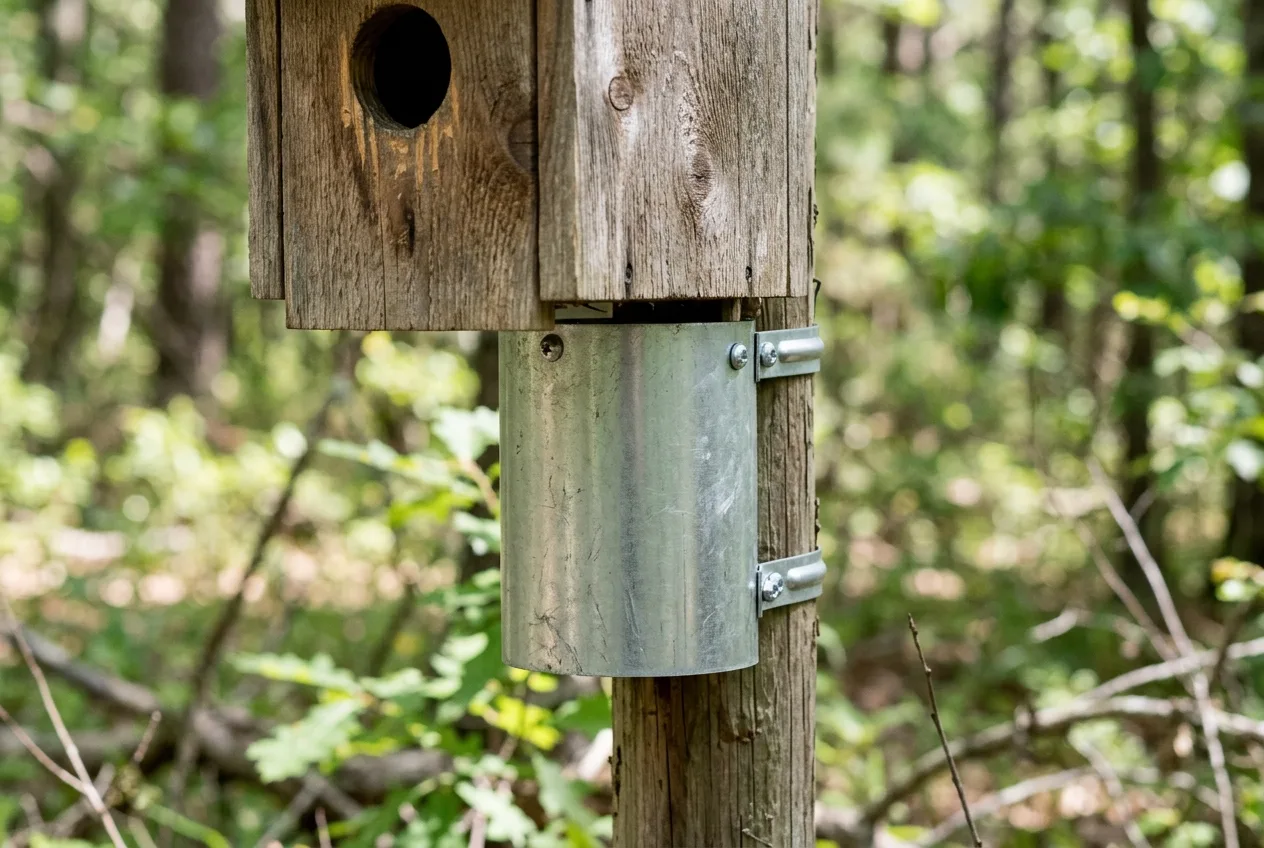
- Stovepipe (Kingston) baffle. A cylinder of "galvanized stove or vent pipe, 8-inch diameter x 24 inches long" (≈20 cm by 60 cm), held on the pole by hardware cloth and straps. Mount it so "the top of the baffle needs to be at least four feet" (1.2 m) "off the ground," and let it "wobble freely to further discourage climbing predators". NestWatch calls the stovepipe baffle "perhaps the most effective" of the common designs.
- Cone (Zeleny) baffle. A "3-foot diameter circle" (≈90 cm) "of 24- or 26-gauge galvanized sheet metal" formed into a cone around the pole below the box, with the center hole sized to the post (a 7.25-inch hole fits a 6-inch post, roughly 18 cm over 15 cm). NestWatch describes it as "a circular piece of galvanized sheet metal that is placed around the pole underneath the nest box".
- PVC baffle. "4-inch thin-wall PVC at least 2 feet long" (10 cm wide, 0.6 m long) capped on top, hung so it's "free-swinging" and wobbles when a raccoon or cat tries to climb; size the cap hole about 1/8 inch (3 mm) larger than the pipe, which also keeps mice from shinnying up.
- Noel guard (entrance cage). "A rectangle of 1/2-inch" (13 mm) "hardware cloth placed around the entrance hole," forming a tube the bird flies through but a predator can't reach down. It's "estimated to be 90% effective in keeping raccoons or cats from reaching into the box" — but it does nothing against snakes or competing birds, so use it as a backup, not the only line.
- Hole extender / wooden block. An extra block of wood with a same-size hole that deepens the entrance. NestWatch's data ranked these among the most effective guard types — but NABS notes that a shallow 3/4-inch (19 mm) block is too thin to stop a determined raccoon on its own, so it's more useful for reducing an enlarged hole or protecting smaller birds than as primary raccoon defense.
- Roof overhang. The quiet one: a roof that "extends five inches" (13 cm) "beyond the front of the box" stops raccoons and cats from leaning over the top and dipping a paw into the hole.
Snakes deserve their own line because they defeat several of the above — they "can climb smooth poles, even greased ones," and the bigger the baffle diameter the better. For tree-mounted boxes, where a pole baffle isn't an option, there's a tidy evidence-backed trick: wrap the trunk in a smooth acetate sheet. In a Spanish trial, an acetate band "80 cm (31.5 in) tall and 1 mm (0.04 in) thick" wrapped around the trunk cut predation dramatically — "20% of the control boxes were depredated... while only 2% of boxes protected by the plastic sheets were depredated". Clear branches within about a meter so a snake can't bypass it by jumping from an adjacent limb, and only fit it once the birds have started laying. And for the gardeners in the southern hemisphere fighting introduced Common Mynas, there's an analogous entrance trick: an anti-myna baffle or hood that shields the hole, set "the same as the diameter of the entrance hole" out in front, exploiting the fact that mynas fly straight at a hole while parrots climb up to it.
A predator guard isn't a fortress; it's a 7% edge that compounds, and stacking two beats relying on one.
Timing: put it up early, clean it out once
Two pieces of timing matter, and both are easy.
Putting it up. Earlier is better, and there is no real penalty for "too early." Across the UK and US sources the advice converges on autumn or late winter: the RSPB likes autumn because "it gives birds a chance to get used to its appearance before choosing to nest in it come early spring," and notes many birds will roost in a box over winter anyway. Mass Audubon says "fall or winter so that birds will have plenty of time to locate them". UK pairs "begin to prospect in the latter half of February," so a box up by late winter is in good time. National Nest Box Week's honest summary cuts through the hand-wringing: "the best advice is to put up your box as soon as it's ready".
Cleaning it out. Clean once a year, after the breeding season, and it's not optional — that 30-fold flea load in old wooden nests is exactly the kind of parasite carryover an annual clean-out prevents. Remove the old nest material and clean the box: boiling water is the simplest method (the UK guidance is to "use boiling water to kill any remaining parasites" and then dry thoroughly), while Mass Audubon uses "one part bleach to nine parts water," rinsed and fully dried. Skip insecticides and flea powders, which can harm the next brood. Then re-hang it, where it may double as a winter roost.
The one genuine landmine here is legal timing, and it's local. In the UK, the law sets the window: cleaning is permitted "between 1 September and 31 January," and any unhatched eggs may only be removed in that window (August–January in Scotland) and must be destroyed. Multi-brood species may still be using a box into September, so check it's truly inactive before you clean. The lesson generalizes even where the dates don't: confirm the season is over and check your own jurisdiction's rules before you open an occupied-looking box.
Spacing, and matching the box to the place
Two quieter placement points round out the box itself.
Don't crowd boxes of the same type. Same-species neighbors set too close trigger territorial fights — the BTO warns that boxes "should not be sited too close together as this may promote aggressive behaviour between neighbours", and Mass Audubon's rule of thumb is "no more than two houses per species per acre". Different species tolerate closer spacing, but keep House Sparrow boxes well away from boxes meant for other birds.
Match height and habitat to the species, and use a selector if you're unsure. Heights are species-specific — UK small-hole tit boxes go "about 3 metres" up (1–3 m on trunks), House Sparrows want "at least 2m," Nuthatches "at least 3m"; US bluebird boxes sit around 4–6 feet (1.2–1.8 m), wrens 6–10 feet (1.8–3 m), Wood Ducks 10–20 feet (3–6 m) near water. Rather than memorize a table, the cleanest entry point in North America is the Cornell Lab's Right Bird, Right House tool, which takes your region and habitat and returns the species you can host plus the recommended plans, heights, and spacing. The deeper principle, stated outright by the South Australian guide, is that "there is no one-size fits all nesting box" — size, hole, height, and aspect all follow from the bird and the place.
Watching it: how to add a nest cam without wrecking the nest
Now the part a lot of people came for. A camera inside a nest box turns a wooden box into a window onto behavior you'd otherwise never see — and unlike most "smart" gadgets bolted onto wildlife, a nest cam is a genuinely good fit, because it lets you watch constantly while visiting never. That's the whole game: every benefit of a camera flows from the fact that it replaces the disturbance of checking the box yourself.
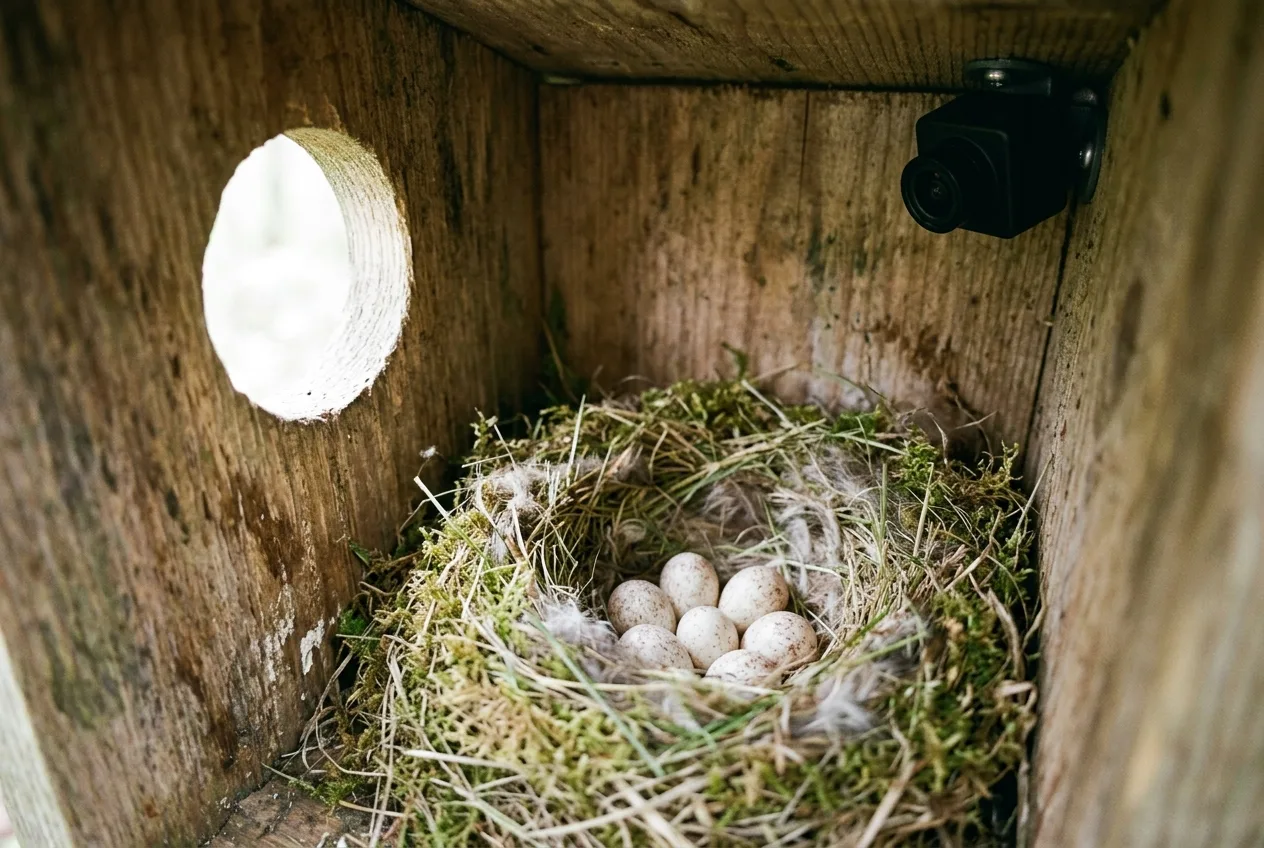
Which is exactly why timing comes first. Install the camera before the birds start nesting. NestWatch is explicit: "the right time to install a camera is before the birds start nesting," because once a nest is active you should never be opening that box, and in the US "it is illegal for you to touch or otherwise physically disturb an active nest". A peer-reviewed Polish study took this further and habituated the birds to the hardware: before the season they put dummy cameras — a green-painted block with fake lens and sensor — in the box first, because "the sudden appearance of artificial objects, especially containing round, glossy elements (like a lens), may disturb brooding behavior," swapping in the real camera only once nest-building was underway. For a backyard box, the takeaway is the same: get the camera in and looking right while the box is still empty.
Where to mount it. The standard interior placement is the underside of the roof, looking down into the nest cup — "most cameras can be mounted to the underside of the nest box roof with a few screws," and if the camera is too big for the box, build a small "attic" or false roof to house it. The Polish researchers did exactly that, building a camera chamber into the roof with the lens 30 cm above the floor and the camera lying horizontally, sensor toward the entrance. An interior camera gives you the intimate view — eggs, hatching, feeding; an exterior camera at the entrance trades that intimacy for traffic counting and predator ID, which is what most earlier trail-camera nest work captured before anyone put a lens inside the cavity.
Infrared, and the overexposure trap. This is the single most useful technical thing to know, because it bites everyone. Birds can't see or feel infrared, so IR night vision lets you watch around the clock without bothering them — "birds, like people, cannot see or feel infrared light and are not bothered by it". But inside a box the camera sits only a hand's width from the nest, and at that range the IR flash is wildly too bright. The Polish team hit it head-on: "photos taken inside nest boxes were overexposed, even with minimal IR LED flash intensity," because of "the short distance between the camera and the nest." Their fix was simply to dim the light physically — they "covered IR LED flash with double layers of semi-transparent black plastic wrap". So plan to diffuse or dim your camera's IR, not crank it. And kill the indicator light: choose "a cam without a power indicator light, or the ability to disable the light so that it's not visible to the birds".
Powering it, and getting the picture out. Every camera needs power "including wireless ones," and the options NestWatch lists are battery (explicitly "not recommended," because swapping batteries means revisiting the box), a wall outlet, power-over-ethernet (one cable for power and video), or solar. PoE is the tidy choice for a fixed box. Secure the cables to the outside of the box with clips or staples, and run them through conduit if they're going underground. How far the signal can travel depends on the camera type: a USB webcam is happiest within about 15 feet (4.5 m) of a computer; an analog camera reaches roughly 200 feet (60 m) to a TV; a network (IP) camera handles up to about 325 feet (100 m) wired and produces the best low-light video, "the best choice for online streaming" — at the cost of being bigger and sometimes too large for a small box. Whatever you pick, "check that the cam is working before you install it in the box" — testing a sealed-up camera after the birds move in is not an option.
You don't need a commercial rig to do this well. Researchers have built capable nest cams cheaply: a Cardiff University team made a Raspberry Pi Zero camera with a 160-degree fisheye lens and IR LEDs, motion-triggered by a PIR sensor, recording 30-second clips with a 10-second gap, for about £86 (~$115) plus ~£23 (~$31) for weatherproof housing. It was reliable enough — "70% of all deployments... were deemed to be Successful" — and, crucially, portable, so one camera could be moved between nests across a season. The same portability shows up in the trail-camera study, where off-the-shelf cameras dropped into boxes "required about 75% less time" than hand-checking nests and detected the first egg in 85% of nests. That's the real payoff: more seen, far less disturbance.
A last word the sources keep returning to: the camera is a tool for watching, never a reason to intrude. The entire ethic of nest monitoring is to see without being seen.
A nest cam earns its place by letting you watch constantly and visit never — every benefit flows from the disturbance it spares the birds.
Monitoring ethics: see without being seen
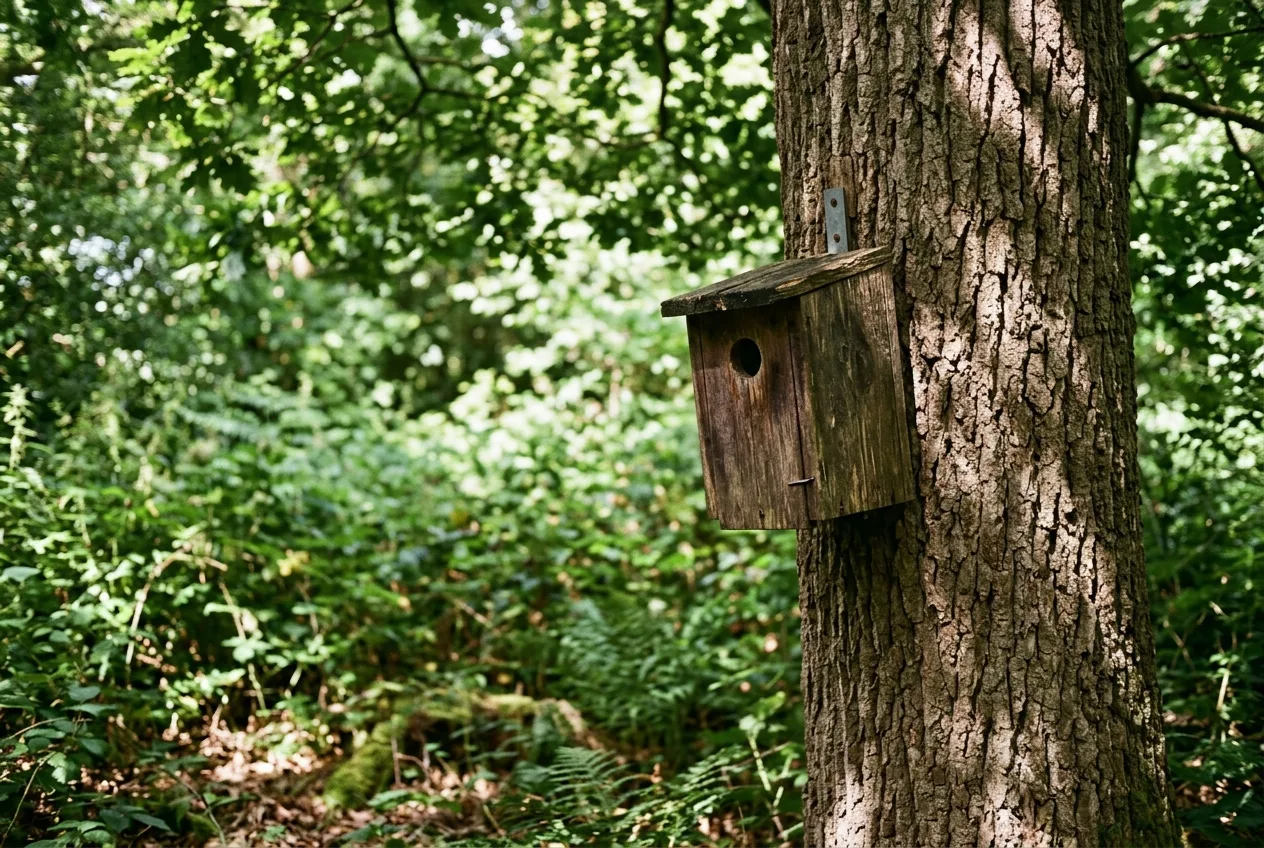
Even with a camera, you'll sometimes check a box by hand, and how you do it matters as much as the box's specs. The Cornell Lab's NestWatch Code of Conduct is the clearest standard, built to avoid three harms: accidentally damaging a nest, scaring the parents into deserting it, and leaving a scent-and-track trail that leads predators straight to it.
The rules are specific and worth following exactly:
- Check every 3–4 days, or at least weekly — frequent enough to know the outcome, rare enough not to harass.
- Keep each visit under a minute.
- Don't check in the early morning (most birds lay then, and eggs and young chill fast if the adult flushes) or at or after dusk (when females settle in for the night).
- Skip the first few days of incubation, and stop approaching once the young are close to fledging — disturb them late and they may "leave the nest prematurely," with low survival once out.
- Don't check in cold, wet, or windy weather — postpone to a better day.
- Tap the box first, then again when you open it, to let a sitting adult slip away, and "if a sitting bird does not leave on its own, do not force it off the nest".
- Don't handle eggs or nestlings without the proper permits.
- Vary your route to and from the box so you don't wear an obvious "dead-end trail" a predator can follow. For high boxes, a mirror on a pole or binoculars from a distance lets you check without climbing up to it.
None of this is onerous. It mostly amounts to: install the camera early so you rarely need to open the box at all, and when you do, be quick, be quiet, pick your moment, and leave no trail. Do that, and the box does its job — which was never to entertain you, but to put back a safe place to raise young that the landscape had taken away.
Frequently asked questions
What size entrance hole should a nest box have?
It depends entirely on the bird and the region — sizing the hole is how you pick the tenant and lock out competitors. In the UK that's 25 mm for Blue Tit, 28 mm for Great Tit, 32 mm for House Sparrow or Nuthatch. In North America it's about 1 inch (25 mm) for a House Wren, 1 1/4 inch (32 mm) for Tree Swallows, and 1 1/2 inch (38 mm) for bluebirds. Keep it at or under 1 9/16 inches (40 mm) to exclude European Starlings and at or under 1 1/4 inches (32 mm) to exclude House Sparrows.
Which way should a nest box face?
Away from your prevailing wind-driven rain and the hottest afternoon sun, with some midday shade — the compass direction depends on where you live. In the northern hemisphere that usually means facing roughly north to east; in the southern hemisphere it's the opposite, away from the hot westerly afternoon sun. Box orientation effects are real but species- and climate-specific, so if you run several boxes, vary the aspect.
How high should I mount a nest box, and on what?
Mount it on a smooth metal pole with a predator baffle rather than a tree or fence post, and keep it at least 10 feet (3 m) from anything a predator can jump from. Height is species-specific — UK tit boxes sit around 3 m, House Sparrows at least 2 m; US bluebird boxes around 4–6 feet (1.2–1.8 m), wrens 6–10 feet (1.8–3 m), Wood Ducks 10–20 feet (3–6 m) near water.
Do predator guards actually work?
Yes, measurably. Across a large citizen-science dataset, boxes with guards had nest success about 6.7% higher than boxes without, and boxes with two guards beat boxes with one. Effectiveness varies by species and site, and no guard is fully predator-proof — bears and House Sparrows in particular defeat them — but a stovepipe or cone baffle plus a roof overhang is a strong, cheap setup.
Will a camera or its night-vision light bother the birds?
Not if you set it up right. Birds can't see or feel infrared light, so IR night vision doesn't disturb them — but at the short range inside a box the IR flash badly overexposes the image, so dim or diffuse it. Install the camera before nesting starts, disable any visible indicator LED, and you won't need to disturb the active nest at all.
When should I clean out a nest box?
Once a year, after the breeding season is over, to clear out parasites that otherwise carry over — old wooden nests can hold dramatically more fleas the next season. Remove the old nest and clean with boiling water or a 1:9 bleach solution, rinse, and dry fully, skipping insecticides. Check local law first: in the UK, cleaning and removing unhatched eggs is only legal between 1 September and 31 January.