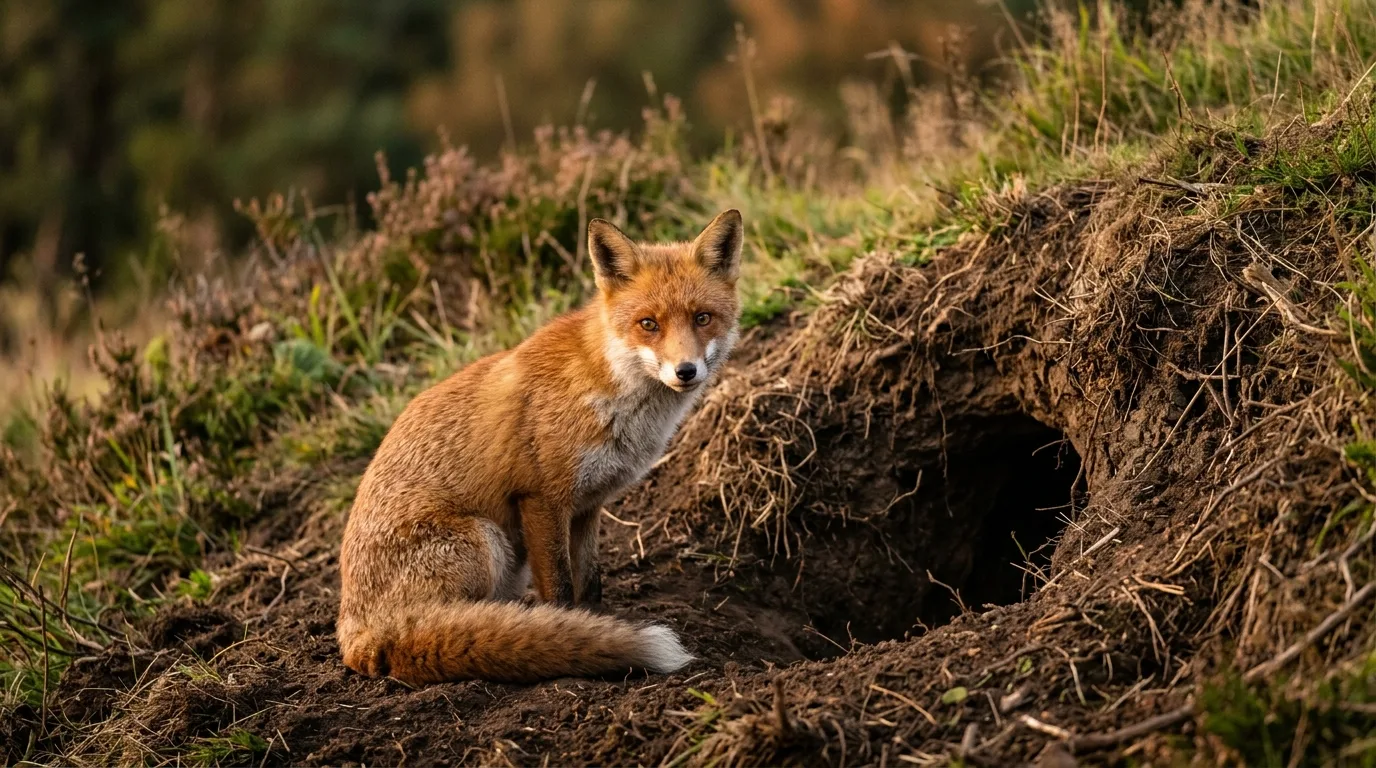
You find a hole in the ground and your first instinct is to guess the animal. Resist it. The animal is the last thing you figure out, not the first. What you actually read is the hole — how wide it is, whether it's round or shaped like a D lying on its side, how much dirt got thrown out and where it landed, whether there's one entrance or fifteen, and what's lying around the mouth. Get those right and the resident usually names itself.
The other thing to get straight early: the animal you eventually see at the hole may not be the one that dug it. Foxes move into old rabbit warrens and badger setts. Cottontails overwinter in the front rooms of a hibernating groundhog's burrow. A vacated badger digging can host more than thirty other species before the season's out. So "what made this hole" and "what's living in it now" are two different questions, and the entrance answers the first one more reliably than the second.
This guide is about reading a real burrow, den, or sett to identify its maker. It is not about the lawn that looks like someone took a rototiller to it overnight — that surface grub-digging is usually a raccoon or skunk working for insects, and it's a different read. It's also not about the soft ridges and molehill-style mounds with no open hole — those belong to moles, voles, and pocket gophers, the subsurface tunnelers, and they get their own treatment. The fastest way to tell you're even in the right guide: a tunneler's mound has no usable entrance. A pocket gopher leaves a crescent-shaped heap of soil with the hole plugged and offset to one side; a mole leaves a symmetrical volcano with the exit hole in the center. If there's no open doorway, you're looking at a tunneler, not a burrow. Everything below assumes there is a doorway.
Start with the tape measure, not the field guide
Entrance diameter is the single most useful number you can take, because it sorts the suspects into two piles before you've considered anything else. Wildlife-damage specialists draw the line at roughly three inches. Holes three inches (about 8 cm) or less are the small mammals — chipmunks, thirteen-lined ground squirrels, voles, rats, and the occasional crayfish near water. Holes bigger than that open up the heavier company: skunks, foxes, woodchucks, badgers, and so on.
A second agency key puts useful names on the bigger buckets. Large holes around four inches and up are typically skunks or foxes; the genuinely large ones, ten to fourteen inches (25–35 cm), are coyotes, badgers, or woodchucks; and anything near water — muskrat, mink, weasel — is its own category you'll read by location more than size. None of this is precise to the inch, and it shouldn't be. Burrow mouths get enlarged with use, slump after rain, and vary with the digger's age. Treat the size as the first sort, then let shape, spoil, and surroundings do the real identification.
The animal you eventually see at the hole may not be the one that dug it — the entrance answers what made it more reliably than what's living there now.
Here's the at-a-glance version. Use it to get into the right neighborhood, then read the detail sections for the tells that actually clinch an ID.
| Entrance width | Likely maker | Shape & spoil | Where & other tells |
|---|---|---|---|
| ~3 cm (1 in) | Mouse / vole | Round, often hidden or plugged with debris | Under tree roots; vole holes dime-sized near plant stems |
| ~5–7 cm (2–3 in) | Rat / water vole / chipmunk | Rat: fan of fresh spoil, near cover. Chipmunk: clean, no mound | Rat near water/buildings; chipmunk near foundations, seen by day |
| ~4 in (10 cm), many holes | Ground squirrel | Clean openings, scattered soil; some plugged | Colonies, 6–20 entrances, short grass, active by day |
| ~10–15 cm (4–6 in), clustered | Rabbit warren | Round, sloping in; spoil + droppings + grazing | Slopes, banks, woodpiles, under sheds and rock piles |
| ~20 cm (8 in), few holes, taller than wide | Red fox (earth) | Modest spoil; prey remains Apr–Jun | Banks, woods, under sheds; often a reused warren or sett |
| ~8 in (20 cm), one main hole + a big dirt porch | Woodchuck / groundhog | Large lookout mound at main hole; back doors have none | Fields, fencerows, near foundations; flies at an active hole |
| Under rocks / talus, high up | Marmot | Burrows tucked under boulders | Rocky slopes, mountain meadows; colonies |
| 25–35 cm (10–14 in), wider than tall, D-shaped, many holes | European badger (sett) | Huge furrowed spoil; bedding dragged out; latrines | Well-drained slopes, woodland edges, hedgerows |
| 16–30 cm, round/oval, 1–2 holes, fan mound | American badger | Fan-shaped soil mound; few entrances | Open country with ground squirrels/prairie dogs |
| 5–8 in (13–20 cm), below the waterline | Muskrat (bank den) | Underwater entrance; feeding platforms nearby | Pond/stream banks, dams, dikes |
| Submerged entrance in a high bank | Beaver (bank burrow) | No lodge needed if bank is tall enough | Steeper banks on slow water; gnawed stumps nearby |
Keep two cautions in mind as you use it. First, the table is hemisphere-neutral on the wide-ranging animals — red foxes, badgers, rabbits, and marmots live across Eurasia and North America — but the groundhog (woodchuck) and prairie dog are North American, so don't expect those names to fit a hole in, say, the Scottish Highlands. Second, "badger" is two very different animals depending on where you stand, and they dig differently. That's worth its own moment.
A fox earth versus a badger sett: the classic confusion
In much of Europe and the British Isles, the two large burrows people most often mix up are the red fox's earth and the European badger's sett, and they reward a careful look because the animals build to very different plans.
A badger sett is the bigger, busier structure. The entrances are large — 20 to 30 cm (roughly 10–12 inches) across — and distinctively wider than they are tall, shaped like a capital D lying on its side, mirroring the badger's low, broad body. A clan keeps not one hole but a system: setts "range in size from one to more than fifty holes," with broad, well-worn paths running between them. Outside, you'll find large spoil heaps, often with a furrow down the middle where the badger backed out dragging soil, and the spoil is frequently mixed with stones and old bedding — dried grass and bracken the animals haul in and out of their sleeping chambers. Two more signs are close to diagnostic. Badgers are "the only animals to use an open dung pit," and clusters of these shallow pits — latrines — sit near the sett and along territory boundaries. And their tracks show a broad kidney-shaped pad with five toes in a line.
A fox earth is a smaller, simpler affair. The entrance runs about 20 cm (8 inches) and tends to be taller than it is wide — like a fox — sometimes surprisingly small for the animal. There's usually only a hole or a few, with modest spoil, because, bluntly, "foxes are far less capable diggers than badgers". The giveaway is the litter: from roughly April to June, when cubs are present, you'll see fresh prey remains scattered at the mouth — feathers, birds' wings, bits of fur, bones. Badgers rarely leave food remains above ground, so prey debris at a hole is a strong vote for a fox. Fox tracks show four toes, and there's the classic test: draw a diagonal cross over the print, and if the lines clear all the toe pads, it's a fox rather than a dog.
Prey remains at the mouth vote for a fox; an open dung pit nearby votes for a badger. Read the debris, not just the doorway.
And here's where humility helps. Foxes routinely "commandeer and enlarge part of a rabbit warren or take over a section of a badger's sett". So you can absolutely find a big D-shaped entrance — textbook badger — with small spoil heaps and a scatter of feathers out front, which means a fox has moved into an old sett. When the signs disagree, don't force a verdict from the architecture. Watch the hole over time and let the resident show itself.
A rabbit warren rarely enters this particular confusion: the holes are smaller, 10 to 15 cm (4–6 inches), more or less round, and slope inward at a shallow angle, usually in a cluster, with droppings and tufts of fur at the entrances and obvious grazing nearby. Warrens favor slopes and banks where drainage is better, and you'll find them tucked around woodpiles, sheds, and rock outcrops. One wrinkle worth knowing: a warren is mostly a connected system, but rabbits also dig short, single-entrance breeding stops off on their own, so a lone small hole near a known warren isn't a contradiction.
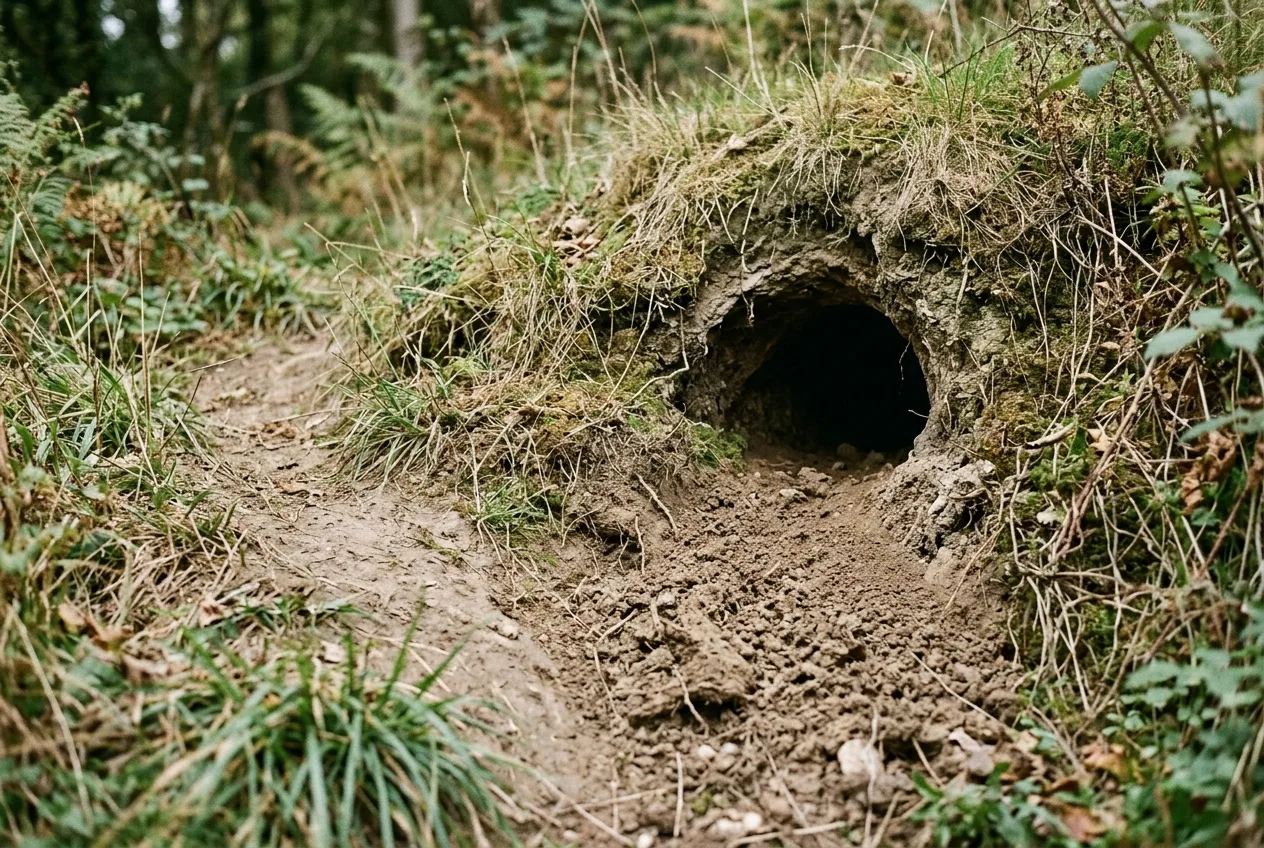
The two badgers dig differently
If you're in North America, "badger" means the American badger, and almost everything above gets rewritten. This is a digging predator that hunts ground squirrels and prairie dogs by excavating them, so its burrows are scattered across open country wherever that prey lives. The entrances are round or oval, 16 to 30 cm across, with a fan-shaped mound of soil thrown out front — not the European badger's tidy D and furrowed heap. Crucially, an American badger digging "generally has one or two entrances," not the multi-holed sett of its European cousin. It's also a far more transient architect: a badger can throw up enormous numbers of burrows and occupy only a few at a time, "leaving many vacant burrows behind". Which sets up the single most useful idea in this whole subject.
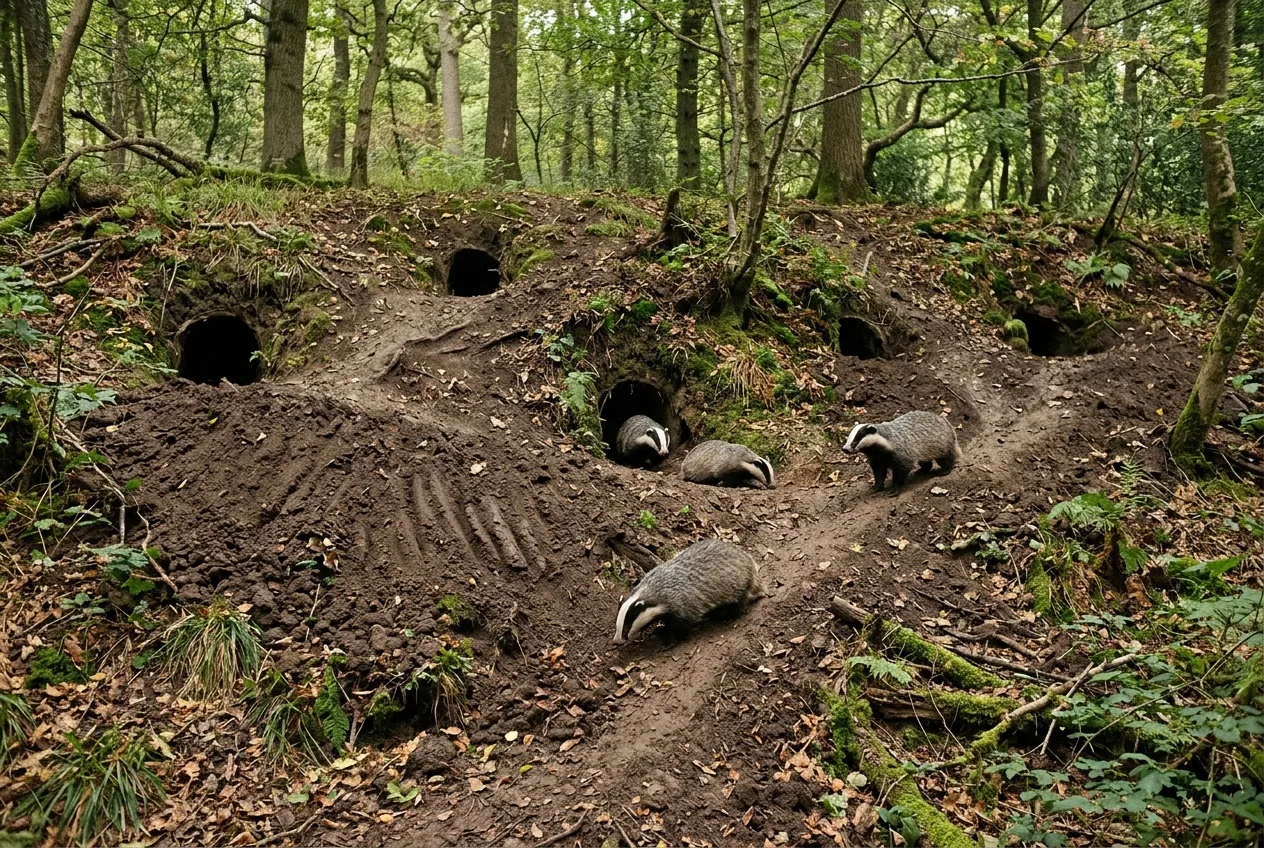
An empty burrow is real estate
A hole that one animal digs and abandons doesn't sit idle. In one Wyoming study, researchers put trail cameras on twenty-three abandoned American-badger burrows and logged thirty-one other species using them — a dozen mammals, eighteen birds, and a snake — including weasels, cottontails, mice, and, famously, burrowing owls that nest down old badger holes. Groundhog burrows do the same favor up north: while the owner hibernates in a grass-lined chamber a few feet down, the upper tunnels shelter other wildlife, and cottontail rabbits are "common squatters". Old woodchuck burrows that the digger has moved on from "provide cover for rabbits, weasels, and other wildlife". Foxes, as we've seen, skip the digging altogether when they can and remodel someone else's hole.
The practical upshot: the burrow's architecture tells you who the original engineer probably was, but the current resident is a separate finding you confirm from fresh sign — new tracks, fresh prey remains, a cleared and smoothed entrance — or by simply watching the hole. A sett entrance that's "smooth and cleared of sticks" with fresh bedding is in use; one stuffed with leaves and laced with spider webs is probably not — though even that's a soft call, because a sett can collect leaves and look abandoned in a single autumn day.
Groundhogs, marmots, and the lookout mound
The North American groundhog — same animal as the woodchuck, and a member of the squirrel family, not the pigs — builds the most recognizable big burrow in open country, and its tell is the dirt porch. The main entrance is 10 to 12 inches (25–30 cm) wide with a large mound of excavated earth beside it, and the animal sits up on that mound to watch for danger. The numbers behind the mound are almost comic: when researchers dug out and weighed the spoil from several main entrances, the heaps "averaged 275 pounds". The whole system can run up to 65 feet (about 20 m) of tunnel with separate nesting and toilet chambers.
Now the part that catches people out. A groundhog burrow has secondary entrances — usually one to three "back doors," or "spyholes" — and here's the trick: those are dug from below the surface, so they have no mound of soil beside them at all. A clean, moundless hole near a big mounded one isn't a different animal; it's the same groundhog's escape exit. So an active groundhog burrow reads as one main hole with a renewed dirt porch (often with flies buzzing around an occupied entrance), plus a couple of well-hidden clean holes nearby. Look for a worn path leading away from the main hole, and remember the location signature: field edges, fencerows, stone walls, roadsides, and — to many homeowners' irritation — right up against building foundations.
Out west and up high, the groundhog's relatives the marmots play the same role with a different address. A yellow-bellied marmot digs "elaborate mazes of burrows underneath high-elevation meadows and rocky fields", and the location is the cue: marmot burrows are tucked under boulders and talus, in colonies, often with a sentinel that whistles when danger appears. If a big rodent burrow is set into a rock pile on a mountain slope rather than out in an open pasture, you're likely looking at a marmot, not a groundhog.
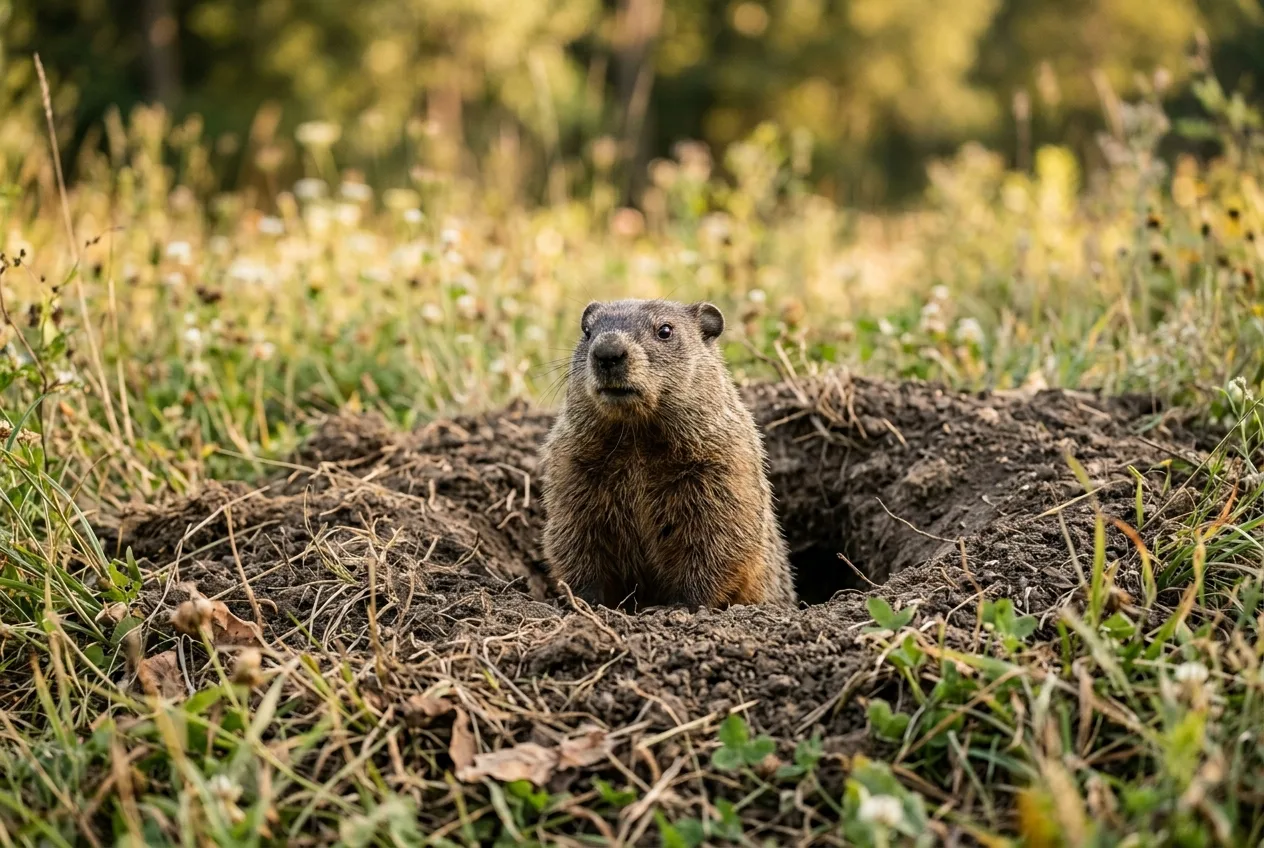
The small holes: chipmunk, ground squirrel, and friends
Below the three-inch line, the read shifts to cleanliness, count, and company. A chipmunk hole is "cleanly dug and silver-dollar-sized," with no mound of soil around it — they carry the spoil off — and you'll often see the animal itself by day. A thirteen-lined ground squirrel makes similar small, very clean holes, but in the plural: expect "another hole of similar size within twenty feet," with little grooves worn in the grass where the animal travels between them. That multiplicity is the key. Ground squirrels live in colonies, and their burrow systems carry 6 to 20 entrances; the openings run "about four inches in diameter," sometimes more on older holes, with soil scattered rather than mounded.
Ground squirrels add one cue worth knowing. During hot spells some go dormant — estivation — and when they do, the burrow looks open but is actually plugged with soil deeper in, and inactive holes collect cobwebs at the mouth. So a cobwebbed opening doesn't mean "no animal"; it can mean "asleep downstairs." Voles leave the smallest holes, "dime-sized," often right at the base of plants, and they're primarily nocturnal. And if a small hole sits near water and looks like a little chimney or "tube of mud with a hole in the middle," that's not a mammal at all — it's a crayfish.
A cobwebbed hole isn't always empty — a ground squirrel may simply be asleep downstairs with the door plugged behind it.
The skunk is the odd one in this section because it isn't fussy and isn't small. Skunks "dig specific, individual holes" hunting grubs, but they also den in larger openings, four inches and up, very often under a structure — a deck, shed, porch, or foundation. A large, single, somewhat ragged hole going under a building, with a faint musk you won't have to be told to notice, is a strong skunk candidate. (Prairie dogs, another North American grassland species, ring their colony holes with soil pushed up higher than the surrounding ground and live in obvious towns — but they're rarely the "mystery hole in my yard," so they're more a field-edge curiosity here.)
At the water's edge: muskrat and beaver
Down by a pond, ditch, marsh, or slow stream, the burrow read changes completely, because the best entrances are underwater and you may never see the hole itself — you read the other sign instead.
A muskrat burrows into a bank to make its den, and "one or more entrances are hidden underwater and lead to chambers located above the waterline". When you can see them — in tidewater at low tide, or in a pond drawn down by drought — the entry holes run 5 to 8 inches (13–20 cm) across and sit anywhere from a few inches to three feet below the water's surface. Because the doorways hide, you confirm muskrats from their habits: feeding platforms and small feeding huts of cut vegetation near the den, often "littered with piles of vegetative debris and occasionally crayfish or mussel remains," plus droppings on a favored rock or log; slides about a hand's width wide where they enter the water; and, in winter, "push-ups" — masses of plants shoved up through a hole in the ice to make a covered breathing and resting spot. Pond owners often don't notice muskrats at all until a dry spell exposes the bank holes, by which time the animals have usually moved on.
A beaver at the water's edge isn't always living in the classic stick lodge. "If the bank is high enough, the beavers only dig out a burrow," with the entrance below the water surface, visible only at low water. So a submerged hole in a tall bank on slow water, with gnawed and felled trees nearby — beavers leave an unmistakable "hour-glass stump" — points to a beaver bank den rather than a muskrat's, and the scale (and the woody construction if there is a lodge) is larger. If you're unsure which swimmer you've got, weight and tail settle it: a beaver runs up to about 30 kg with a flat, paddle tail, a muskrat is much smaller with a thin, ratlike tail, and a nutria sits in between with white whiskers.
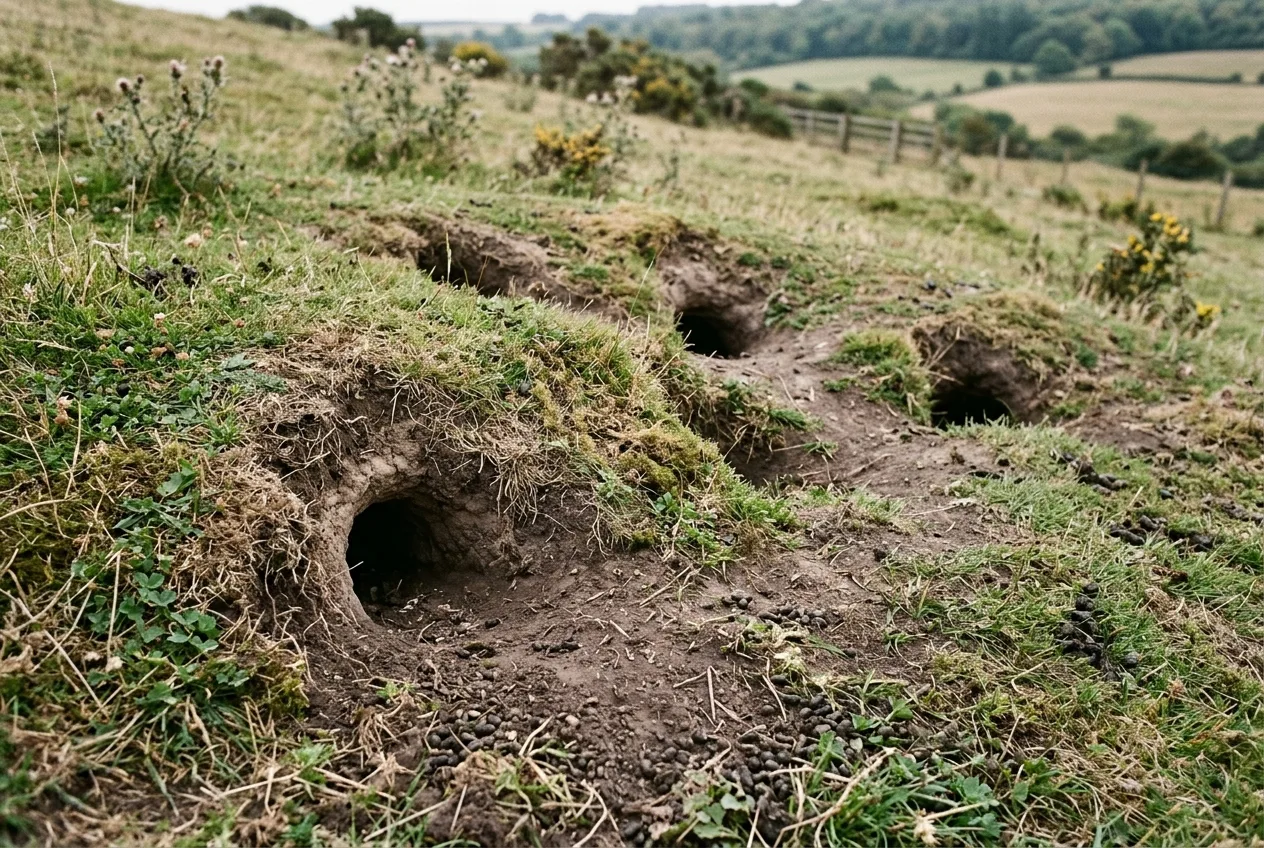
When the signs won't agree, watch the hole
Some holes simply won't resolve from the architecture and the litter alone. The entrance is the wrong shape for the prey remains; a sett looks active and abandoned at once; two animals are clearly sharing the same doorway, which happens more than you'd think — badgers, foxes, and rabbits have all been recorded "sharing the same badger sett". When the static sign is ambiguous, stop trying to force a verdict and let the animal tell you.
This is exactly where a trail camera earns its place at the mouth of a burrow. Surveyors now lean on them: "trail cameras have revolutionised how we observe badgers… and can easily confirm whether a sett is in current use or not". The Wyoming burrow-web study did precisely this — a camera trained on each hole, tallying every animal that came and went, occupant and visitor alike. A camera resolves the two questions the entrance can't fully separate: who dug this (read from the architecture) and who's home now (read from the footage). Watching a den over several days will "give a clearer idea of who is using it" when the cold sign is contradictory.
A few habits make camera work at a burrow both kinder and more productive. Don't block or crowd the actual entrance — at a protected species' sett that can even be an offense — and avoid a bright white flash or harsh red glow right at the hole, which can disturb a sensitive animal like a badger. Set the camera back, cover the whole approach, and let it run. Where you've got a lot of holes and only some are active, the footage also sorts that out fast: the cleared, smoothed, frequently-used doorways will rack up passages while the leaf-stuffed ones stay quiet.
For the reader who wants to go deeper than any single web guide can, the standard field reference for identifying dens and burrows by size, shape, depth, and landscape position — alongside the tracks and scat that confirm the resident — is Mark Elbroch's Mammal Tracks and Sign of North America, long treated as the bible of sign identification.
The entrance tells you who dug the hole; a few nights of footage tell you who's living in it. They're not always the same animal.
A quick field routine
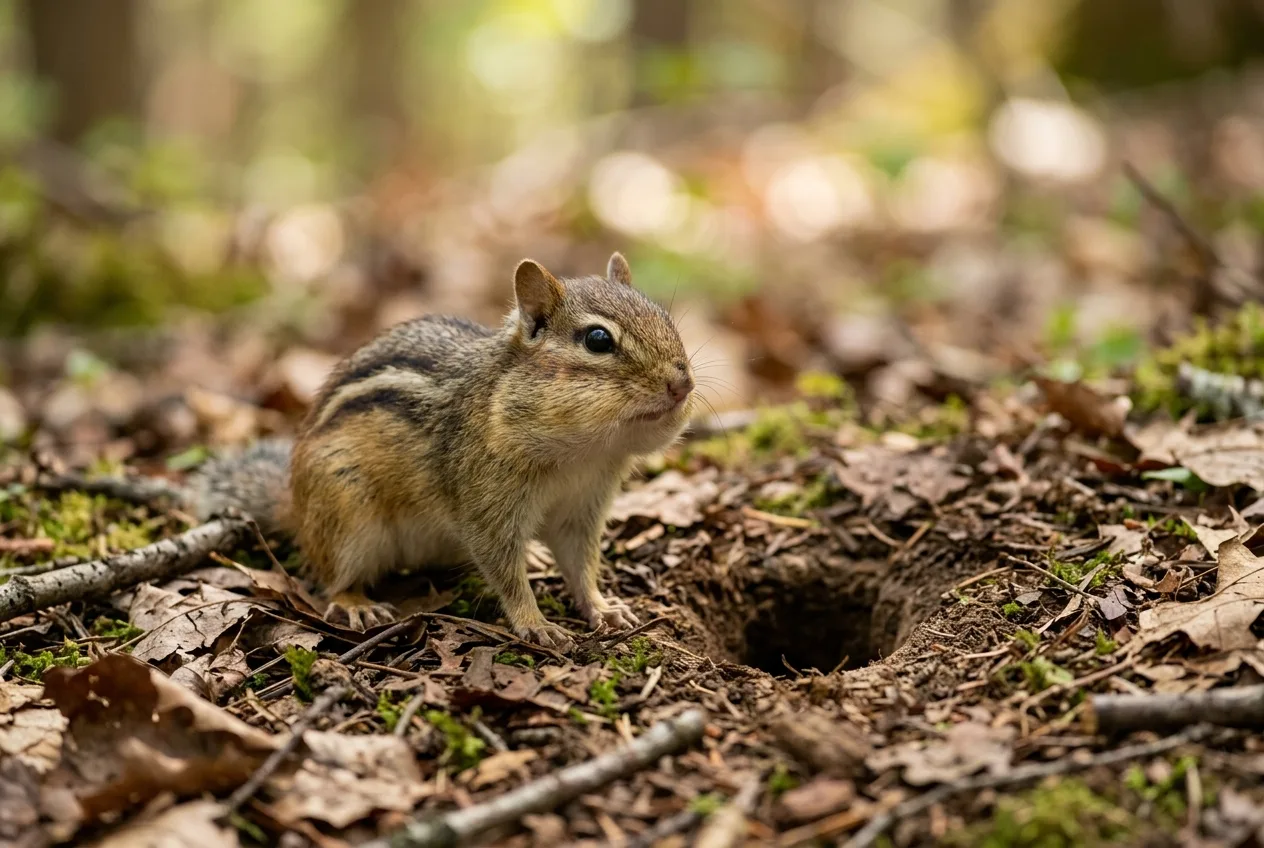
Put it together and the read takes about two minutes. Measure the entrance and sort it big or small. Note the shape — round, D-wider-than-tall, or taller-than-wide. Look at the spoil: a big lookout mound at one hole, a furrowed heap across many, scattered soil, or none. Count the doors — one or two, a handful, or dozens. Place it — open field, bank, water's edge, talus, or under a structure. Then read the company: prey remains, latrines, droppings, bedding, tracks, a worn path. The maker is usually obvious by the time you've done that — and where it isn't, a camera at the mouth settles both the maker and the current tenant.
Frequently asked questions
What animal makes a hole with no mound of dirt around it?
A clean, moundless hole has two common explanations. If it's small — silver-dollar to a couple of inches — it's most likely a chipmunk or a ground squirrel, which carry the spoil away rather than piling it up. If it's a back door near a big mounded burrow, it's the same woodchuck's "spyhole," dug from below so no soil shows. A no-hole mound (a crescent or a volcano) is the opposite case — a pocket gopher or mole, which don't leave an open entrance at all.
How can I tell a fox hole from a badger hole?
Size and shape first: a European badger's hole is larger, 25–30 cm and D-shaped, wider than tall, while a fox earth is about 20 cm and taller than wide. Then the surroundings: badgers leave huge furrowed spoil heaps, dragged-out bedding, and nearby latrines; foxes leave modest spoil and prey remains — feathers and fur — at the mouth in spring. Tracks confirm it: five toes for a badger, four for a fox.
What dug a 4-to-6-inch (10–15 cm) hole next to my shed or deck?
That size under a structure is classic skunk, woodchuck, or fox territory. A skunk den is often a single large ragged hole with a faint musk; a woodchuck leaves a dirt-porch mound at the main entrance and a worn path; a fox earth shows prey remains in spring and is frequently a remodeled rabbit or other burrow. Rabbits also den around sheds and woodpiles, but their warren holes come in clusters with droppings at the mouth.
There's a hole at the edge of my pond — what is it?
Almost certainly a muskrat or a beaver, and you'll often confirm it from sign rather than the hole, since both keep their entrances underwater. Muskrat bank dens are 5–8 inches (13–20 cm) across, paired with feeding platforms and slides; in winter look for plant "push-ups" on the ice. A beaver may skip the lodge entirely and just burrow into a high bank, with felled and gnawed trees nearby.
Does the number of holes tell me how many animals live there?
No — and this trips up a lot of people. With badgers especially, "the number of setts… and the number of entrance holes per sett has no bearing on the number of badgers living there"; one or two animals can produce a lot of sign. A multi-holed system tells you the species and that it's an established site, not a population count.
Is the animal I see at the hole the one that dug it?
Not necessarily. Foxes take over rabbit warrens and badger setts, cottontails move into groundhog burrows, and abandoned badger diggings host dozens of other species. The architecture suggests the original digger; fresh tracks, prey remains, or a few days of trail-camera footage tell you who's actually home now.