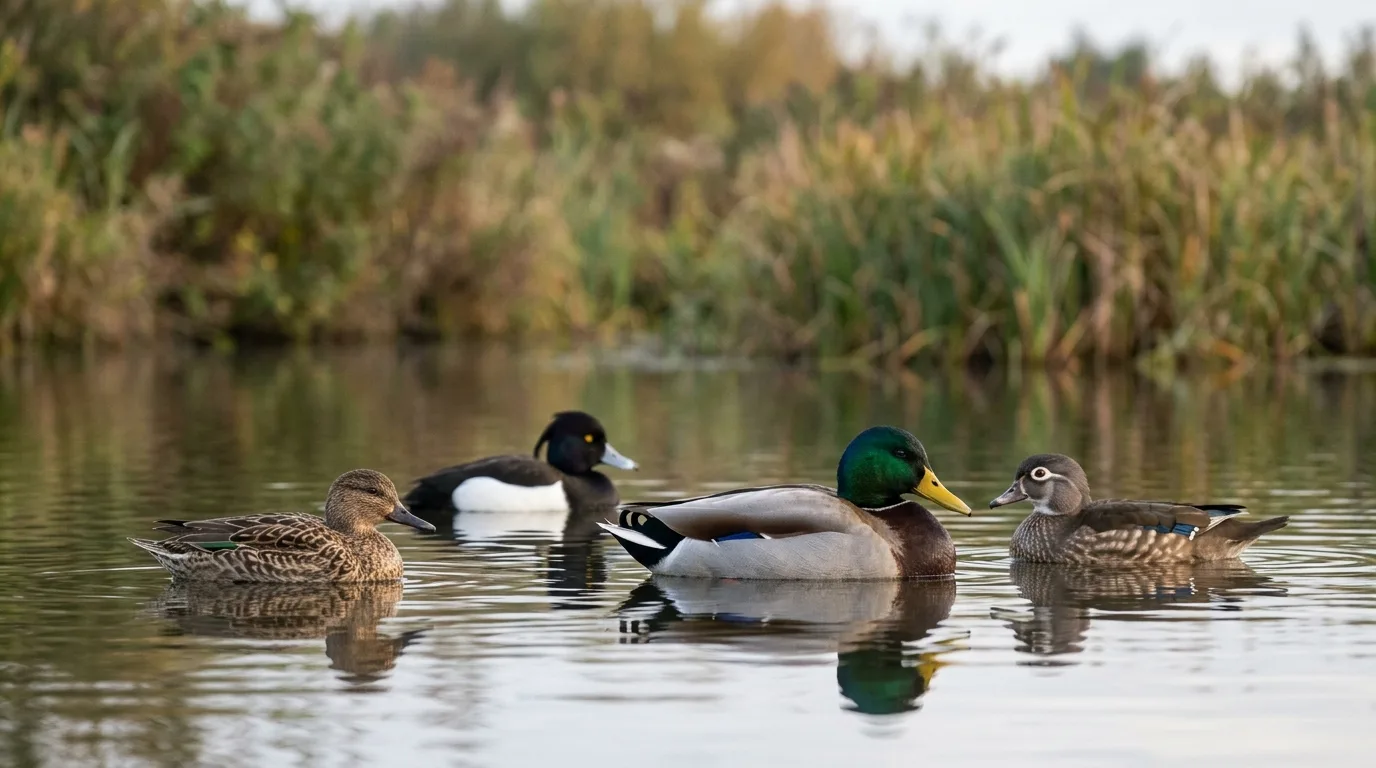
The duck is too far away. It's a dark lump on grey water, the light is flat, and you've got about four seconds before it tips up and vanishes behind a reed bed. This is the real problem with waterfowl. Most field guides open the page on a drake in perfect spring plumage, lit like a jewelry advert — and then you go outside and the bird is a silhouette, or it's July and every duck on the pond is brown, or it's a hen and hens are, frankly, a conspiracy.
So forget the postcard drake for a minute. The way experienced birders and hunters actually identify ducks is not by memorizing every feather. It's by asking a short series of questions in the right order, each one cutting the field of possibilities roughly in half. Is it even a duck? Is it dabbling or diving? What's its shape and size? Where is the white? And — the one nobody tells you — is that "female" actually a male in disguise?
Get those right and you'll name most of the ducks you see, in most conditions, including the brown ones. This guide walks through that sequence and then applies it to the common, widespread species you'll meet on fresh water and coast across the Northern Hemisphere, with their Southern-Hemisphere counterparts alongside — because a mallard's cousin lives on a pond in New Zealand too, and the same logic identifies it.
First question: is it even a duck?
It sounds too obvious to bother with, but a surprising number of waterbird misidentifications happen because the bird wasn't a duck at all. Coots, grebes, loons, cormorants, and shorebirds all share the same ponds, and at a glance a dark blob on the water could be any of them.
Ducks (and their larger relatives, geese and swans) have a particular body plan. One waterfowl hunter describes it memorably: most ducks have "roughly potato-shaped torsos, egg-shaped heads, and long necks," and geese are the same but bigger — "more like a football-to-egg ratio". The bill is a giveaway too. With the single exception of the mergansers, ducks and geese have flat, rounded bills "like a small gardening spade," not the pointed beaks of grebes, loons, or coots. And they all have at least partly webbed feet.
The bird most often confused for a duck is the coot, because it lives in the same water and has roughly the same proportions. The tells: a coot has a pointed white beak, not a rounded bill, and in normal flight its feet trail behind it rather than tucking up out of sight. Loons and grebes give themselves away by their slim, dagger-pointed bills and longer, thinner necks.
Once you're sure you're looking at a duck, the family sorts into a few big groups, and knowing which group you're in does most of the work. Taxonomically, the whole tribe — ducks, geese, and swans — sits in the family Anatidae, split into the ducks proper, the geese and swans, and the tropical whistling-ducks. North America alone holds around 70 "duck-shaped" species when you count the true ducks, geese, swans, mergansers, eiders, scoters and whistling-ducks together — which is why the Cornell Lab's field tools start by sorting birds on overall shape before anything else. But you don't identify birds with a taxonomy key. You identify them with the next question.
The way experienced birders actually identify ducks is not by memorizing every feather, but by asking a short series of questions, each one cutting the field of possibilities roughly in half.
The big split: dabblers versus divers
If you learn only one thing from this guide, learn to tell a dabbling duck from a diving duck. It's the most reliable cut you can make, it works at any distance and in any light, and it instantly halves your list of candidates. As a Ducks Unlimited biologist puts it: once you know whether you're looking at divers or dabblers, "you immediately narrow the field".
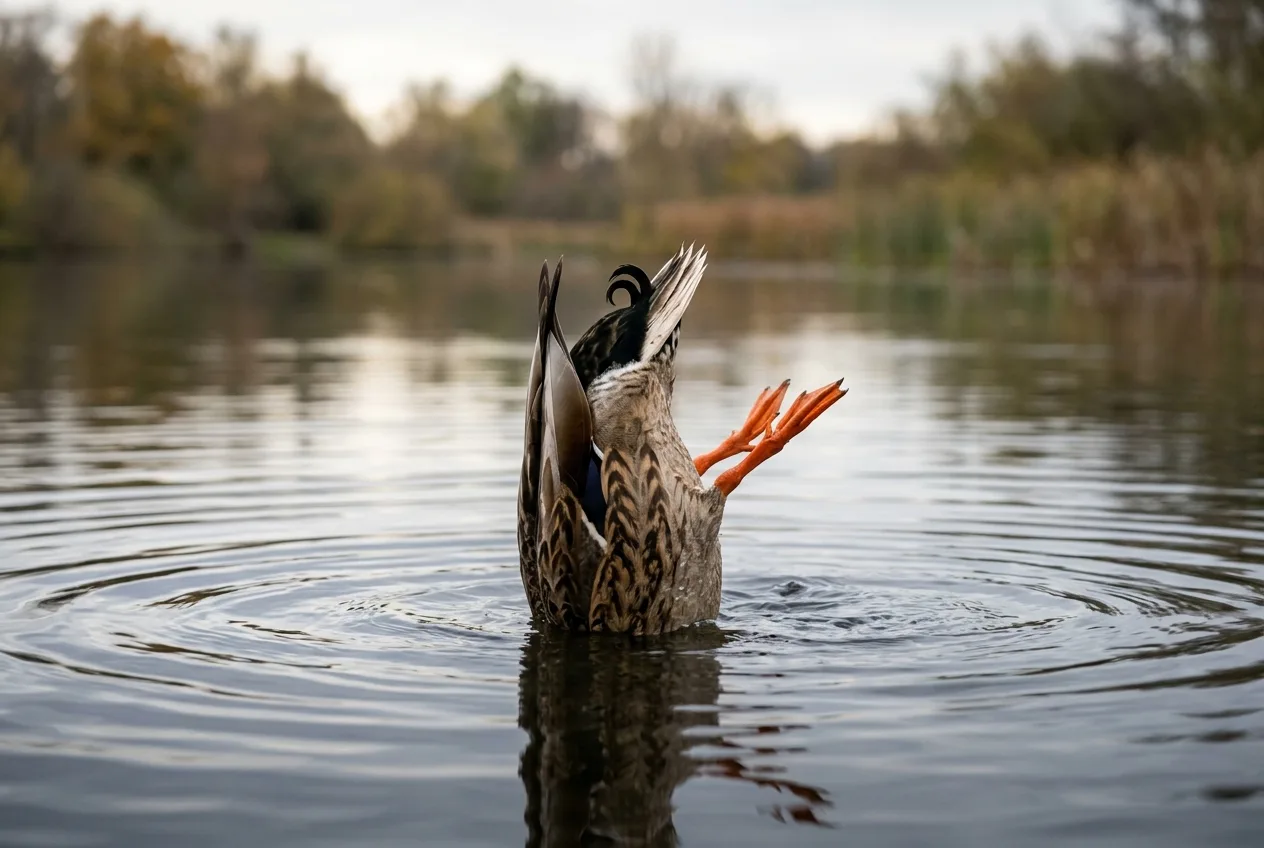
Dabbling ducks — also called puddle ducks — feed at or just below the surface. They tip forward, head underwater and tail pointed at the sky, or they skim food off the top; many also walk onto land to graze. The mallard is the archetype. Diving ducks fully submerge, swimming down with powerful feet to feed on the bottom — vegetation, mollusks, small fish. Canvasbacks and scaup are typical.
That single difference in how they eat shapes the entire bird, which is why behavior, not color, is the foundation of ID:
- How they sit on the water. Dabblers ride high, showing a lot of their flanks above the waterline, with the tail held up. Divers ride low — sometimes you see little more than their back and head — with the tail flatter to the water. A duck floating like a cork versus one half-submerged like a loaded barge tells you which group you're in before you've seen a single field mark.
- How they take off. This is the cleanest test of all. Because dabblers are buoyant and have their legs near the center of the body, they "spring straight out of the water" and climb fast. Divers, dense-bodied with legs set far back, can't do that — they need "a long, sustained running start" or "pattering" across the surface to get airborne. If a flock claws its way along the water before lifting off, they're divers.
- How they behave on land. Those rear-set diving legs make divers wonderful underwater propellers and clumsy walkers — they waddle awkwardly and spend as little time ashore as possible. Dabblers, with central legs, walk and graze comfortably.
- How they flock. Dabblers tend to spread out in smaller, looser groups along the shallow edges. Divers gather in dense "rafts" out on open water that can number in the hundreds or thousands.
One honest caveat: this isn't an iron law. "Dabbling ducks can and will dive, and diving ducks might sometimes dabble". But the characteristic behavior holds the vast majority of the time, and the structural differences — posture, takeoff, gait — never lie.
There's a neat number behind all this. Dabblers are tied to water shallow enough to tip up in, "generally less than 45 cm deep — the limit of a full tip-up". That waterline is, quite literally, the ecological divide between the two groups: above it, lightweight dabblers in the shallows; below it, dense divers working the depths.
If you learn only one thing from this guide, learn to tell a dabbling duck from a diving duck — the most reliable cut you can make, at any distance and in any light.
Read the shape before you read the color
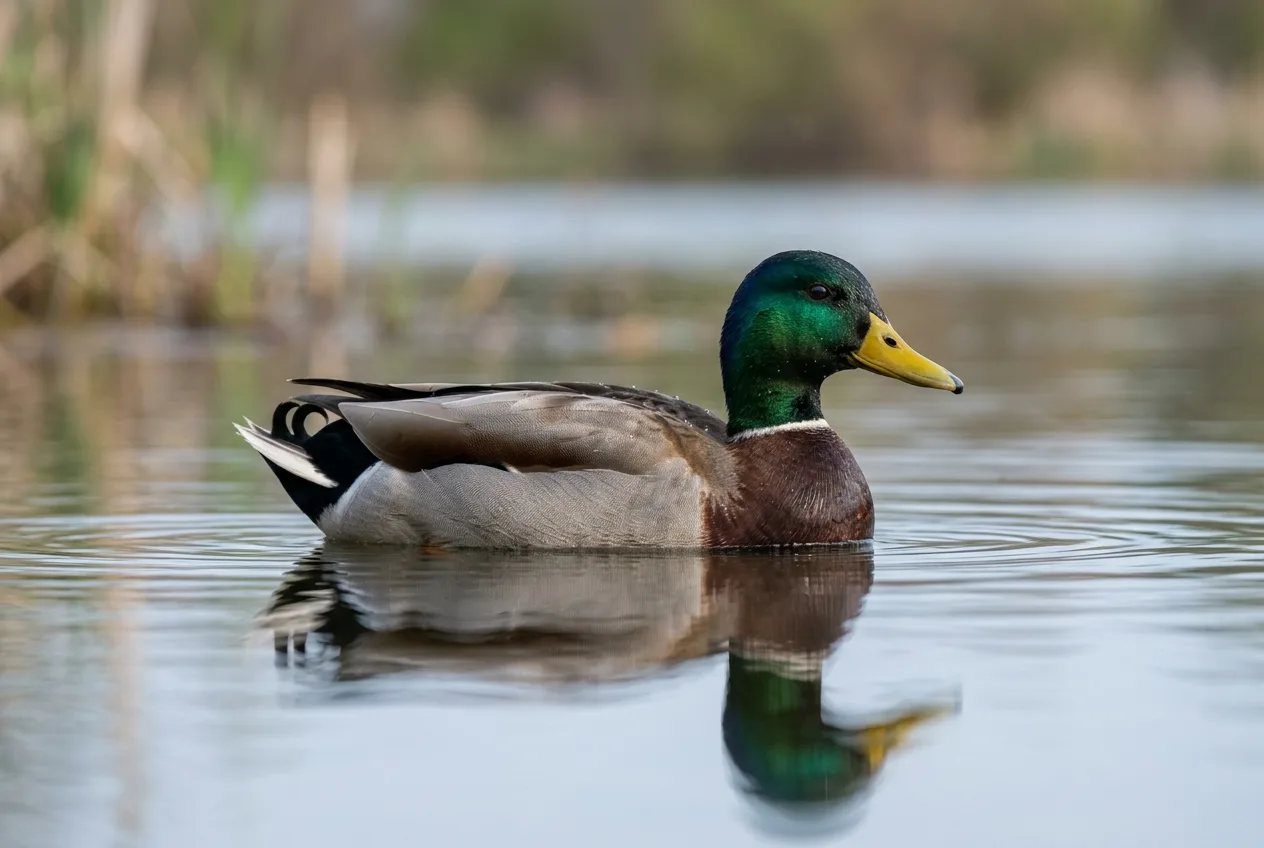
Color is seductive and unreliable. It depends entirely on light: a mallard's emerald head "might appear blue, purple, or even black" depending on the angle, and male scaup heads do the same dance between green and purple. Iridescence is a liar. Shape isn't.
So when the light is bad — backlit birds, glare on the water, an overcast morning — switch to outline. Several species are identifiable from silhouette alone:
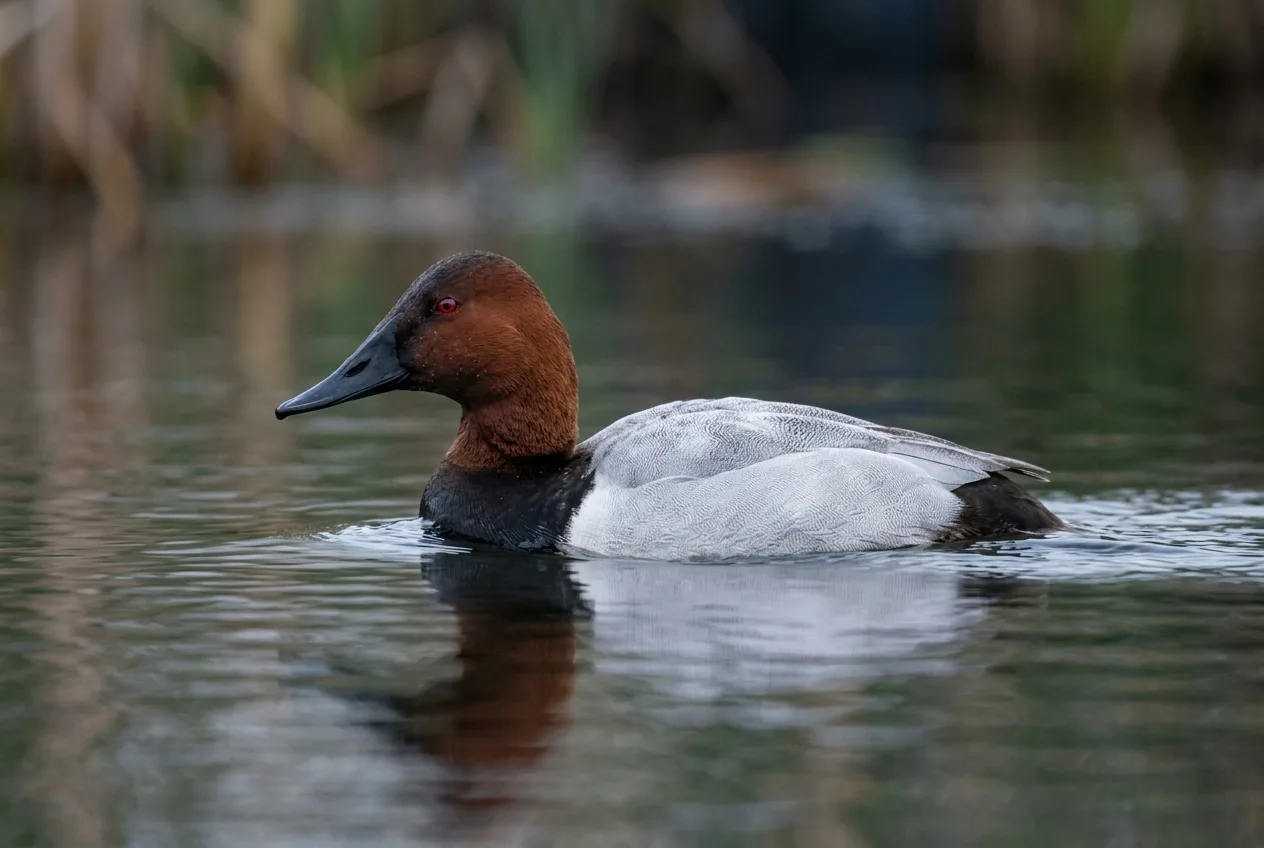
Bill shape is the most powerful structural clue. A few bills are unmistakable. The Northern Shoveler carries a huge, flat, spatula-shaped bill that looks heavy even in flight. The canvasback's bill runs in a long straight slope right up into its forehead, with none of the gentle dip you see on a mallard — a profile so distinctive it separates the canvasback from the similarly red-headed redhead at a glance. Mergansers have thin, straight, pointed bills with a little hook at the tip.
Head shape matters too. A ring-necked duck has a tall, peaked crown that looks slightly poofy on top. A wood duck's head is oddly boxy because of its swept-back crest, and a male hooded merganser can raise or lower his fan-shaped hood at will, so he changes silhouette in real time.
Tail shape rescues you when all you can see is the back end of a tipped-up bird. A ruddy duck holds its stiff tail cocked straight up "like a popsicle stick". A pintail's tail is long, thin, and elegant — the whole bird looks elongated and refined. And a male mallard has a couple of curled-up central tail feathers that betray him even in silhouette.
Size is worth a glance but don't lean on it hard, because a lone duck on open water gives you nothing to compare against. The one reliable use is spotting the genuinely tiny species: teal and buffleheads look "dwarfed" next to a mallard. A useful mnemonic — "teal are tiny" — and you've narrowed a small fast duck to a short list.
Where's the white?
Here is the trick that ties the whole visual approach together, and it's the one the Cornell Lab of Ornithology built a whole method around: look for the white. White patches are easier to spot at a distance than almost anything else, and crucially, they stay visible when poor light has erased every subtle color. Learn where the white sits on each species and you can often identify a bird by that alone.
The white shows up in predictable places. A drake American wigeon flashes a big white forewing patch in flight; a canvasback shows a white back and belly; a male gadwall — otherwise a plain grey-brown duck — carries a small white patch on the wing that's often the easiest way to confirm a drab female gadwall against a hen mallard. Gadwall and wigeon make a useful contrast: gadwalls "have white on their speculums, whereas wigeon have white shoulder patches".
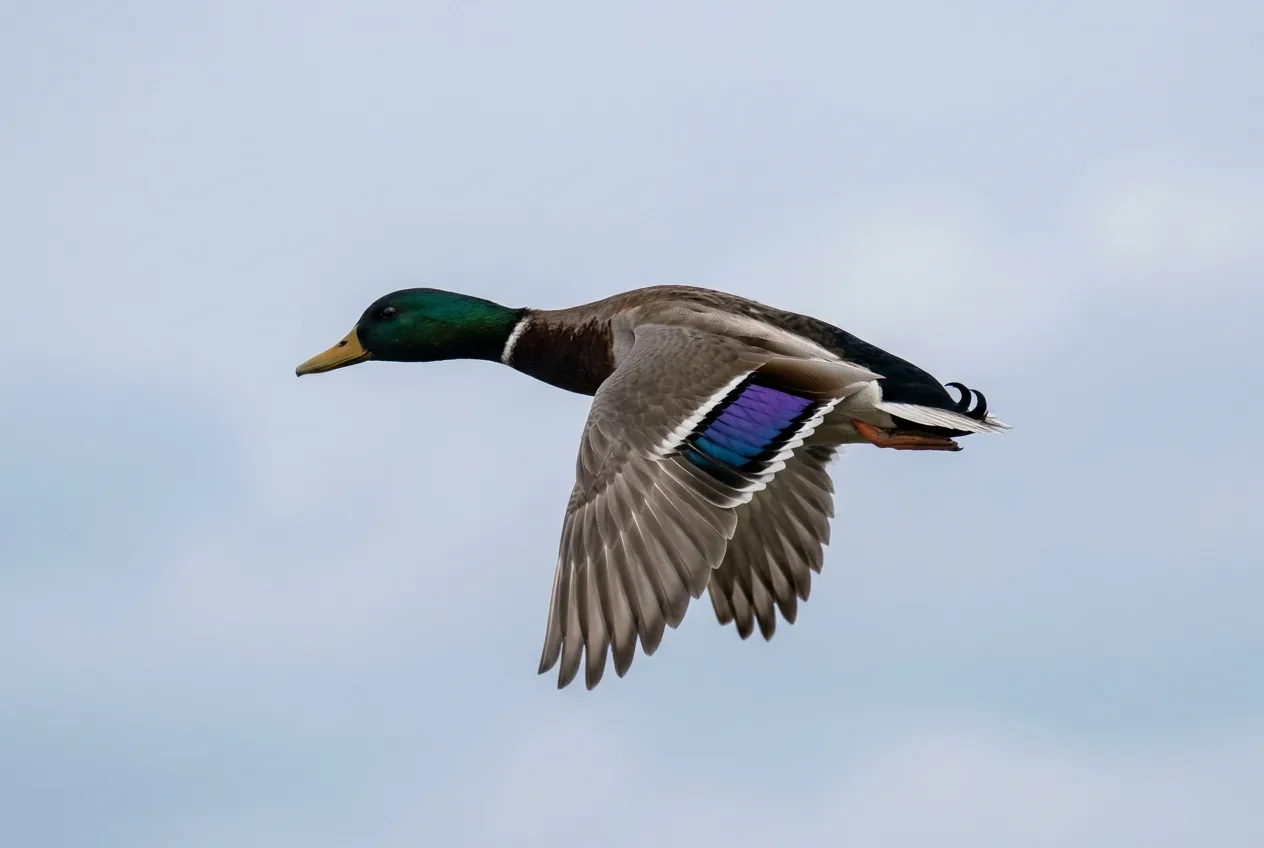
That word — speculum — deserves its own moment, because it's the secret weapon for the hardest IDs of all: the brown females. The speculum is the colored, often iridescent patch on the secondary flight feathers, at the trailing edge of the wing near the body. It's frequently visible not just in flight but on a bird sitting or standing. And it's diagnostic. Among the dabblers, the speculum is a near-perfect species key even when the rest of the bird is anonymous streaky brown:
| Dabbler (Northern Hemisphere) | Speculum color | Other quick tells | Southern-Hemisphere counterpart |
|---|---|---|---|
| Mallard | Dark blue, white border both sides | ♂ green head, white collar, yellow bill; ♀ streaky brown | Pacific black duck / NZ grey duck |
| Gadwall | Small white patch | grey ♂ with black rear; ♀ like small mallard | — |
| Northern Pintail | Dark green, white rear border | long neck, long pointed tail | — |
| Northern Shoveler | Green (+ big blue forewing patch) | enormous spatula bill | Australasian / blue-winged shoveler |
| Teal (green-winged / Eurasian) | Bright green | tiny size | grey teal, chestnut teal |
| Wigeon (American / Eurasian) | Green (+ large white forewing patch) | round head, small blue bill, whistles | — |
Sources for the table: dabbler speculum colors and field marks; counterparts. Colors describe breeding-plumage birds, seen autumn through spring.
Two things make the speculum so valuable. First, its colors don't change with the seasons. As the old USFWS field guide notes, "wing feathers are shed only once a year; wing colors are always the same" — so even when a drake molts his showy body plumage, the speculum stays put. Second, it cuts through the mallard-hen problem that bedevils beginners. A female mallard, a female gadwall, a female pintail, and a female wigeon are all variations on brown — but their specula are blue, white, bronze-brown, and green respectively.
This isn't only a Northern-Hemisphere trick. In New Zealand it solves the single most important local ID: the native grey duck has "an iridescent turquoise green speculum," while the introduced mallard's is "blue or purple," and on the hybrids that now blur the two, "the blue speculum tends to predominate". Same method, opposite side of the planet.
The speculum is the secret weapon for the hardest IDs of all — the brown females — because its colors are diagnostic even when the rest of the bird is anonymous streaky brown.
The common dabblers, on the water and in the air
Put the pieces together and the widespread dabblers resolve quickly. The mallard is the baseline: a big duck, the drake with an iridescent green head, white neck-ring, and yellow bill, the hen streaky brown. Most medium-sized brown-and-green ducks on a town pond are mallards — but always check, because a male shoveler wears a similar green head, and only the gigantic bill and white breast give it away.
In flight, the dabblers separate by silhouette and by the placement of white. The wigeon shows a white belly and, on the drake, a bold white wing patch that "looks square" — "if you see lots of white on the wing, it's a drake wigeon". The pintail is unmistakable for its "angled, gull-like wings" and long wedge of a tail, obvious even on hens. The shoveler can fool you in the air until you notice the silhouette — the head looks like it has "a kink" in the neck, the big bill pointed slightly down. Wood ducks fly with a twisting, erratic style and a long, rounded, blocky tail. Teal are simply much smaller than everything around them and fly fast and tight.
Sound is a genuine shortcut once you know it, and it's where a phone app earns its place. Among the dabblers, the hens mostly quack and are hard to tell apart by voice — but the drakes each have a distinctive whistle. One hunter renders them like this: the mallard a soft "zshwee," the wigeon "a whistley whoo-WHHHEAT-who," the green-winged teal "a high-pitched prrp prrp," the pintail "a deeper, slower, fluty prrp prrp trill," and the wood duck drake "a funny zeet zeet" with the hen giving a rising "oo-eek" squeal. If you hear one of those from a single bird, you have a definitive ID — though never assume a whole mixed flock matches the one voice you picked out, because ducks fly in mixed company.
The mallard's reach is genuinely global, and it brings its relatives with it. In Australia the equivalent dabbler is the Pacific black duck — a large, dark, pale-faced duck with a bold dark eye-stripe, so close to the mallard ecologically that the two interbreed wherever mallards have been introduced. The very same species is the grey duck in New Zealand, where introduced mallards have hybridized with it so heavily that pure grey ducks are now scarce, and the turquoise speculum (versus the mallard's blue) is the best way to tell an unmixed bird. It's a useful reminder that "duck" is a worldwide problem with local accents — and that the global mixing of mallard genes is itself part of the ID challenge.
The common divers, and the head-shape problem
The diving ducks announce themselves by riding low, rafting on open water, and pattering to take off. Up close they tend toward bold black-and-white in the drakes, with the brown of the hens running plainer than in dabblers. They also tee up the classic confusion pairs.
The toughest is the two scaup — greater and lesser — joined by the ring-necked and tufted ducks in a quartet sometimes called the "Oreo ducks" for being "black at either end and white in the middle". Sort them like this: the ring-necked duck has a boldly ringed bill and a tall, peaked head, so it's the easiest to peel off. The tufted duck wears an obvious head tuft. That leaves the two scaup, which are genuinely hard, and the honest answer is that head shape carries you furthest — greater scaup show a rounder, smoother head, lesser scaup a more peaked one — and the difference "hold[s] true for females and juveniles, too… that may be the only distinguishing clue you can see". The catch is to judge head shape only when the bird is loafing or asleep, because an actively feeding duck keeps moving its neck and the shape changes. In flight, look at how far the white extends along the wing: "if it extends to the primary flight feather, the bird is a greater scaup".
The canvasback and redhead are another red-headed pair, and here the sloping bill profile of the canvasback is the clean separator — that, plus the canvasback's far whiter body and the redhead's blockier, stockier build in flight. Bill color settles it up close: the canvasback's bill is black and triangular, the redhead's a light blue.
The goldeneye earns a special mention for a non-visual cue: its wings make an "eerie whistling" sound in flight loud enough to identify a passing flock, which is why old hunters call goldeneyes "whistlers". On the water, look for the big rounded head — glossing green or purple depending on the light — the golden eye, and the white cheek patch behind the bill. Across the Holarctic, the common goldeneye, the two scaup, the tufted duck and the pochard recur as the standard cast of diving ducks, so a birder who learns them in one region is most of the way to identifying them in another.
Diving ducks reach the Southern Hemisphere too, though they're rarer there. Australia's hardhead is a true diver — a dark brown duck that floats very low, with a white undertail, the male's white eye, and in flight "a large white band across the belly" and translucent white underwings. New Zealand's only true diving duck is the little New Zealand scaup, a compact dark duck whose huge feet, set far back, make it a superb diver and a clumsy walker — exactly the diving-duck body plan, shrunk and endemic.
Learn the diving-duck body plan in one part of the world and you are most of the way to naming its relatives on the other side of it.
Geese: grey ones and black ones
Geese look daunting as a group and turn out to be tidy once you know the one structural split that organizes them. The grey geese belong to the genus Anser — "large, predominantly grey birds" — and the black geese to the genus Branta, a name that comes "from an Old Norse word meaning 'black' or 'burnt'". That single division — grey-and-pink-toned versus boldly black-and-white — sorts most geese you'll see, before you get anywhere near the species.
Among the grey geese, work the bill and legs. The greylag (the ancestor of most farmyard geese) is the largest and palest, with a heavy orange bill and pink legs. The pink-footed goose is smaller, with a short dark-and-pink bill, a dark rounded head, and pink legs. The white-fronted geese carry a white blaze at the base of the bill and black bars on the belly, with bill color separating the two populations — pink-billed in the Russian birds, orange-billed in the Greenland ones. The bean geese are the darkest and brownest of the group, with dark heads and black-and-orange bills.
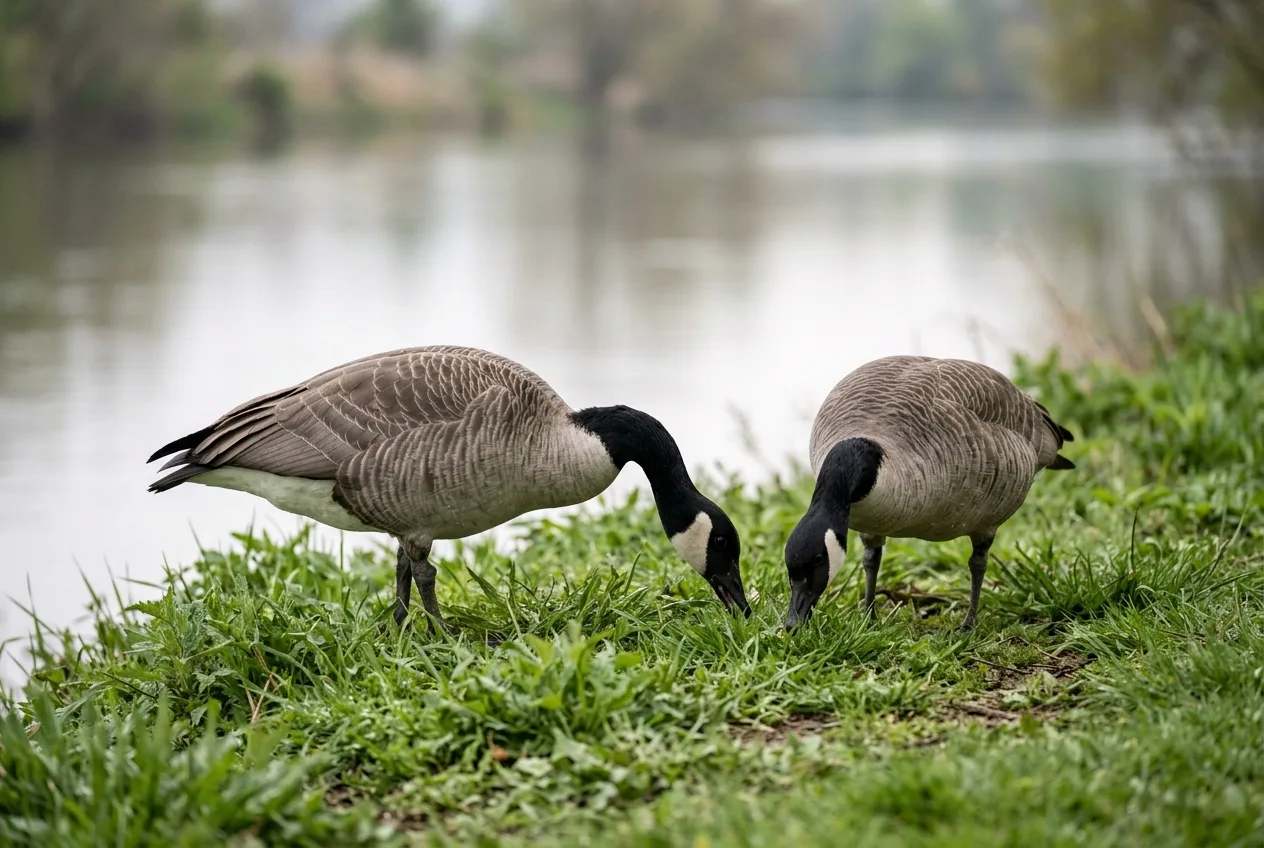
The black geese are more boldly marked. The Canada goose — the giant of the group, introduced well beyond its native North America — has a black neck and head with a broad white chinstrap. The barnacle goose pairs a white face with a dark back. The brent goose is small (barely bigger than a mallard), dark, with just "a small white crescent under the chin".
Two warnings keep goose ID honest. Juveniles lack the clinching adult marks — there's literally "no white-front on white-fronts" yet — so a featureless young goose may not be identifiable. And an odd-looking goose on a park lake is very often a domestic greylag descendant or an escaped ornamental species rather than anything wild, because geese hybridize and feral birds are common. As WWT puts it plainly, "it can take years of study to become confident in goose ID" — so don't be discouraged when one won't resolve.
Swans: three in the Old World, three in the New
Swans come in small, confusing sets on both sides of the Atlantic, and the good news is that the same two clues crack both: voice first, then the bill.
In Europe, the trio is mute, whooper, and Bewick's. The mute swan is the resident, identifiable by its orange bill with a black knob at the base — bigger in males — and the habit, despite the name, of grunting and hissing rather than staying silent. The two migratory swans both have yellow-and-black bills, and the amount and shape of the yellow separates them with a famously useful pair of food metaphors: the rounded yellow on a Bewick's is "reminiscent of a knob of butter," while the yellow on a whooper forms a forward-pointing triangle "more like a wedge of cheese". Size and neck help too — Bewick's is the smallest with a shorter, straighter neck, while whoopers hold the neck with more of a bend.
In North America, the trio is trumpeter, tundra, and the introduced mute, and the Trumpeter Swan Society recommends leading with the voice: the trumpeter gives a "resonant, sonorous, loud, low-pitched, bugle-like" call that can carry two miles, while the tundra (long known as the whistling swan) is "high pitched, often quavering". When you can't hear them, the bill again does the work. The trumpeter has an all-black bill with a "lipstick red" line on the lower mandible, an angular head, and — viewed head-on — black that meets the eye in a "V" shape. The tundra usually shows a small yellow spot in front of the eye, a more rounded head, and a flatter "U" of black between the eyes. The introduced mute, as in Europe, is the orange-billed, knobbed one.
A couple of honest caveats from the swan specialists themselves: the bill-shape differences "can be subtle… even to the trained observer," some trumpeters show a little yellow and some tundras have all-black bills, so use voice whenever you can. And a grey swan is not a mystery species — it's a cygnet under a year old. Don't be thrown, either, by a swan with an orange-stained head and neck; that's tannin staining from feeding in iron-rich water, not plumage.
Mergansers: the fish-eating sawbills
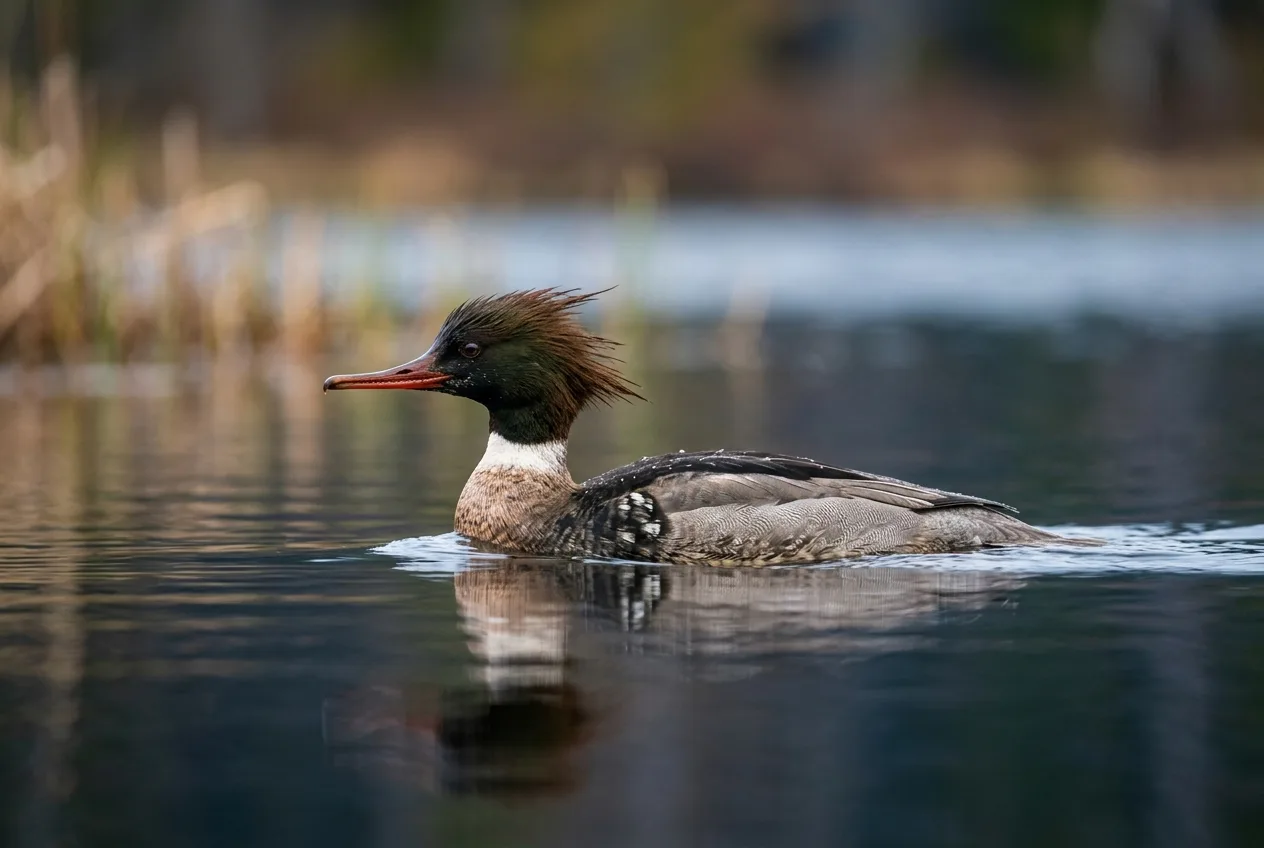
The mergansers — often called sawbills — break the rounded-bill rule that defines the rest of the family. They're built to catch fish, with slim bills lined by backward-pointing serrations for gripping slippery prey, which is why their bills look thin and pointed where every other duck's looks like a spade. They sort into two size pairs.
The large sawbills are the goosander (called the common merganser in North America, where it's a different subspecies) and the red-breasted merganser. The drakes are easy: the goosander is the bigger, heavier bird with a clean dark-green head, a deep-based red bill, and salmon-flushed white underparts; the red-breasted merganser is slimmer, with a wispy double crest, a white collar, a rusty breast, and a very fine red bill. The hard part — and the reason this group has a reputation — is separating the brown-headed females and "redheads," and the key is the boundary between the head and the neck: on a goosander "the border between the chestnut head and the largely grey body is abrupt," with a crisp white chin, while on a red-breasted merganser the head color "blends subtly into the paler neck" with no clean line.
The small sawbills are the smew and the hooded merganser. The smew is a tiny, compact duck "little larger than a Eurasian Teal"; the drake is startlingly white with a black mask — "black 'panda eyes'" — while females and young males are "redheads," chestnut-capped and grey-bodied, oddly like a small grebe at range. The hooded merganser, a North American bird, is small and crested too; the drake is "a riot of chestnut, black and white" with a white-centered fan of a crest he can raise and lower, and even the drab females keep that distinctive erectile crest.
In flight, look for the long, lean profile and the white wing patches, and note that mergansers fly with a shallow, almost flat wing-stroke, "much more shallow than other ducks'" — a useful tell when a long thin duck rockets past low over the water.
On the females, the line between head and neck does the work that bright plumage does on the males: sharp on a goosander, blurred on a red-breasted merganser.
Why the ducks all look like females in summer
You will, at some point, scan a pond in midsummer and find it full of brown ducks with not a green head in sight, and conclude that the males have left. They haven't. They're hiding in plain sight, "disguised as females".
This is eclipse plumage, and it's the single biggest reason summer and early-fall ducks are so hard. Here's the mechanism. Most birds molt gradually and keep flying throughout. But ducks do something unusual: they "replace all of their wing feathers at once," which leaves them briefly flightless and dangerously exposed. So the drakes hedge against it — shortly after breeding, the males shed their bright feathers fast and grow a drab, female-like intermediate plumage that hides them while they're grounded, retreating to the centers of big marshy lakes until their new flight feathers grow in. Females, already brown for nesting camouflage, "have no need for any additional camouflage" and simply molt normally.
The timing is seasonal, not calendar-fixed, and this is where you have to think about where you are. In the Northern Hemisphere, males start looking ratty in late June, hit peak eclipse through July and August, and are back in full color by October. South of the equator the clock runs the other way: New Zealand's paradise shelduck, for instance, goes through its eclipse molt from February to May and gathers to shed its wing feathers in January to March. The principle is universal — after the breeding season, drakes go drab and flightless — but never attach it to a fixed month.
So how do you ID a duck that's deliberately disguised? Go to the parts of the bird that have no feathers at all: the bill and the eyes. Plumage may be molting, but bare parts don't lie. "If you see a 'female' mallard with a yellow bill, chances are it's really a male". Likewise a wood duck with a red bill and red eye, or a hooded merganser with a yellow eye and an all-black bill, is a male in eclipse. And the speculum, remember, stays the same all year — so a brown duck whose wing patch matches a drake's species is your bird regardless of what its body is doing. A few species also keep small clues: an eclipse male mallard holds a warmer brown breast and a touch of green "in stripes on the crown and behind the eye," and a male shoveler's unmistakable bill confirms him "in all plumages".
When the bright one is the female
Eclipse is the usual reason a duck looks like the "wrong" sex, but a few species turn the whole convention on its head, and they're worth knowing because they short-circuit the "males are the colorful ones" assumption that the rest of waterfowl ID rests on.
The standout is New Zealand's paradise shelduck — a large, goose-like duck where the female is the spectacular one. The male is uniformly dark grey to black with a black head; the female has a bright chestnut body and a striking pure white head. It's the opposite of the mallard pattern, and it catches out visitors every time. (Voice splits them too — the male gives a deep "zonk zonk," the female a shriller "zeek zeek".) The lesson generalizes: don't hard-wire "bright equals male." A handful of waterfowl, especially the shelducks, run the other way.
Where and when to look
The questions above tell you what a duck is; a little ecology tells you which ducks to expect, which is half of identification before you've raised your binoculars. Two cues do most of the work.
Habitat narrows the list. Different groups use different water. As one biologist notes, in a forested wetland "chances are you'll see more dabbling ducks, like woodies and mallards, than divers," whereas big, open, deep water — large lakes, reservoirs, coastal bays — is diving-duck country. Knowing which species favor your kind of water lets you start from broad characteristics — what's likely here, in this habitat, at this time of year — and narrow down, which is exactly the approach to fall back on when plumage is unhelpful.
Season concentrates them. Across the temperate world, the cold months pack the most waterfowl onto accessible water, as huge numbers of ducks and geese move off their northern breeding grounds into milder wintering areas — the British dabbling ducks, for example, arrive in their hundreds of thousands once winter sets in. Whichever hemisphere you're in, the off-breeding season — your local winter — is prime time, and it's also when the drakes are back in full plumage after eclipse, which is no coincidence: the birds are easiest to see and easiest to name at the same moment.
A practical tip that crosses over from hunters to birders: don't bird the most distant raft first. Get close looks at nearby birds until the field marks "click," because much of waterfowl ID only makes sense once you've studied a species well at close range and learned its quirks. Pick one duck out of a mixed raft and just watch it for a while — you'll learn its behavior, see it from several angles, and build the kind of familiarity that lets you name it later as a distant silhouette. Cloudy days, counterintuitively, are better than bright ones, because flat light kills the glare on the water that washes out everything you're trying to see.
Identifying waterfowl rewards patience more than memorization. You don't need to know every feather of every plumage. You need the sequence — duck or not, dabbler or diver, what shape, where's the white, and is that really a female — and you need enough time on the water to let it become second nature. The brown ducks of July stop being a wall of anonymous birds and start being mallards and gadwalls and wigeon in disguise. And there's a particular satisfaction, on a flat grey morning with a far-off raft of bobbing shapes, in working one out from almost nothing at all.
Frequently asked questions
What is the easiest way to tell a male duck from a female?
On most species the male (drake) is the colorful one and the female (hen) is streaky brown — but that breaks down in late summer, when molting males wear drab "eclipse" plumage and look like females. The reliable trick is to check the bare parts: a "female" mallard with a bright yellow bill is actually a male, because bill and eye color don't change with the molt. Note the exceptions, like the paradise shelduck, where the female is the bright one with a white head.
What is a speculum and why does it matter for ID?
The speculum is the colored, often iridescent patch on the trailing edge of a duck's wing (the secondary feathers). It matters because it's frequently visible even on a sitting bird, its color is distinctive per species, and — unlike body plumage — it stays the same color year-round. That makes it the best single way to identify drab brown females: a female mallard's speculum is blue, a gadwall's is white, a teal's is bright green.
How do I tell a dabbling duck from a diving duck?
Watch how it feeds and takes off. A dabbler tips up with its tail in the air or skims the surface, rides high on the water, and springs straight up into flight; a diver disappears completely underwater, rides low, and has to run or "patter" along the surface to get airborne. Dabblers also walk easily on land while divers are clumsy ashore, because a diver's legs are set far back on its body.
Why do all the ducks look brown in summer?
Because the males are molting. Ducks shed all their wing feathers at once and go briefly flightless, so the drakes grow drab, female-like "eclipse" plumage as camouflage during that vulnerable period, then molt back into bright plumage afterward. In the Northern Hemisphere this peaks in July and August; in the Southern Hemisphere it falls in the local off-breeding season instead, so judge it by season, not a fixed month.
How can I identify ducks flying past at a distance?
Use shape, flock pattern, and the placement of white rather than color. Dabblers have slower wingbeats and form loose groups; divers have fast, buzzing wingbeats, fly low and straight, and raft tightly. Learn a few silhouettes — a pintail's long tail, a shoveler's down-pointed bill and "kinked" neck, a wood duck's long rounded tail — and a few flight marks, like a drake wigeon's bold square white wing patch. When you genuinely can't tell, the ethical default both hunters and birders use is to make no claim until the next, closer look.
Are scaup really that hard to identify?
The two scaup (greater and lesser) are one of the toughest IDs in waterfowl, and even experts concede the clues "aren't completely diagnostic from a distance". Head shape is the best guide — greater scaup look rounder-headed, lesser more peaked — but only judge it when the bird is resting, since a feeding duck constantly changes its head shape. In flight, more white running out toward the wingtip points to a greater scaup.