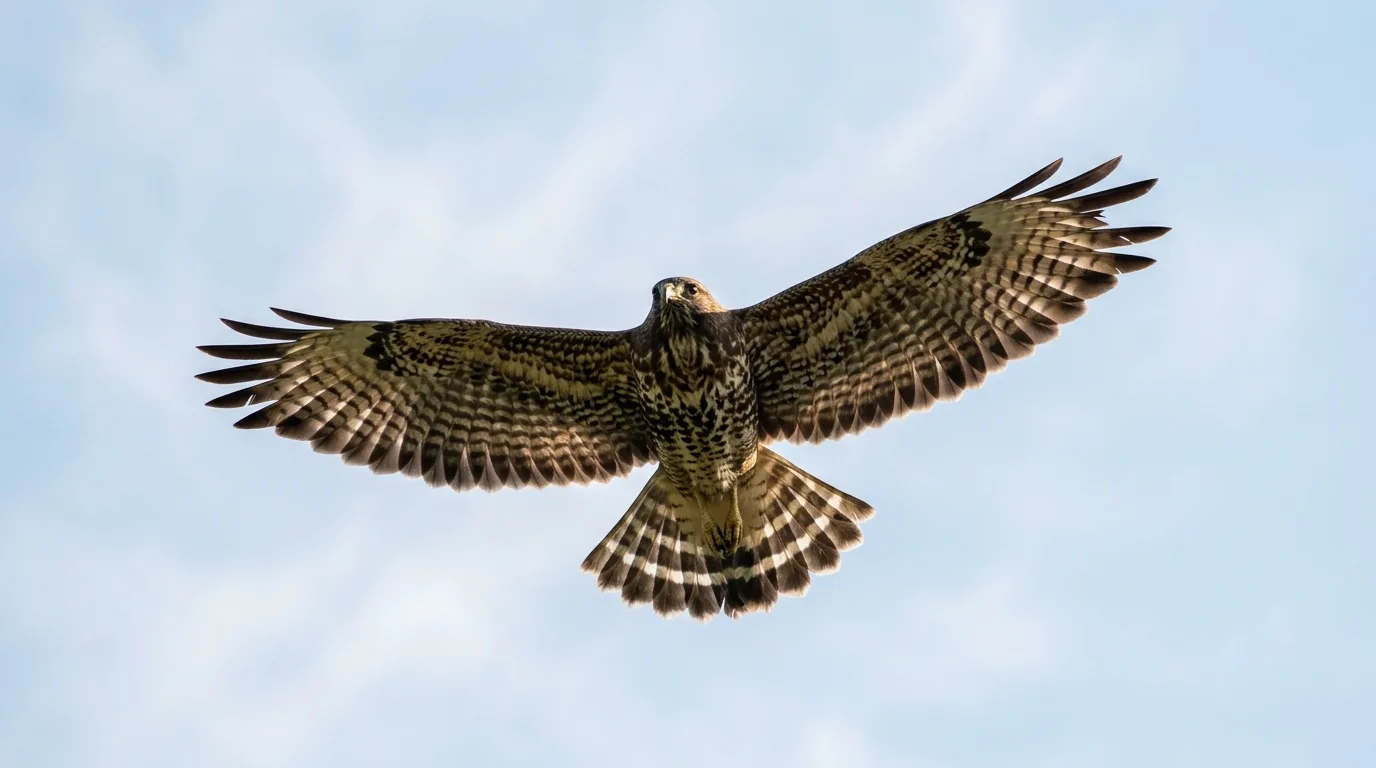
A hawk drops out of nowhere and the songbirds at your feeder scatter like someone fired a shotgun. By the time you reach the window, it's a brown-and-white blur banking into the neighbor's spruce. You got maybe a second and a half. So — what was it?
Welcome to raptor identification, the branch of birding where the bird almost never holds still and the field marks you trained yourself to look for go invisible the moment it's more than a few hundred feet up. If you learned to name birds by their colors, hawks will humble you. As the late Pete Dunne — one of the people who taught a generation how to read the sky — put it, distant raptor IDs "aren't made instantly — they're built, by piecing together multiple clues that favor one species over another".
Here's the good news buried in that frustration: you don't need a clean, close, sunlit view to make the call. You need a method. And the method starts not with color but with shape — the broad-winged, short-tailed silhouette of a soaring buteo reads at a distance long after its plumage has dissolved into a gray smudge. Get the group first, then narrow down. This guide walks you through that process, group by group, with a heavy focus on the species most people actually see: the hawks hunting your backyard, the falcon on the highway wire, the big buteo riding a thermal over the field.
One honest caveat before we start, because it shapes everything: there are more kinds of diurnal raptors than there are owls, and they're harder. The standard scientific reference counts "more than 300 Falconiformes versus about 200 Strigiformes," with far more plumage variation packed inside each species. So if you find this harder than telling a Barred Owl from a Great Horned, you're not imagining it. This is the genuinely difficult corner of bird ID. Let's make it tractable.
Start with shape, not color
If you take one thing from this guide, take this: when a raptor is in view, the first questions are about its build, not its plumage. "The combination of size and shape is one of the most powerful tools to identification," Cornell's bird-ID skills guide notes — "size and shape are the first pieces of information you should examine". Color is the reward you collect later, if the light cooperates.
There's a hard reason for that order. Light wrecks color. The same bird looks reddish in low-angle morning sun, washed-out and pale against bright snow, and nearly black silhouetted against an overcast sky. Many of our most common hawks are also genuinely polymorphic — the Red-tailed Hawk alone comes in light, rufous, and dark morphs, plus pale "Krider's" and dark "Harlan's" forms that can lack red in the tail entirely. Lean your whole ID on color and a dark-morph Red-tail will fool you every time. Shape doesn't change with the weather.
Shape doesn't change with the weather, and a silhouette reads at a distance long after color has dissolved into gray.
The second hard truth is about size, and it's the mistake almost everyone makes. You will look at a hawk crossing an empty sky and feel certain it's "big." Don't trust that feeling. With nothing nearby for scale, "humans are not capable of judging the size of singly flying raptors accurately. Thus, size of a raptor flying by itself is not a field mark". What does work: compare it to a second bird in the same frame — a crow mobbing it, a vulture sharing the thermal — because we judge relative size well even when absolute size defeats us. And when there's only one bird, measure it against itself: how far does the head project past the wings, how long is the tail compared to the wing width, where do the wingtips fall on the perched bird.
That single skill — using the bird as its own ruler — is what separates the hardest pairs in this whole guide, as you'll see when we get to the backyard accipiters.
The five groups you actually need
Most of the raptors you'll meet sort cleanly into five shapes. Learn these and you've done eighty percent of the work; the species-level details just confirm which member of the group you're looking at. (A few oddballs — ospreys, eagles, vultures — sit outside this scheme, and southern-hemisphere birders have extra groups again, which we'll get to.)
Buteos — the broad-winged soarers. Dunne calls them "the large, broad-winged, short-tailed lugs with spare and labored wing beats", and that's exactly the impression: a substantial bird on wide, rounded wings and a short, fanned tail, hanging in wide slow circles over open country and flapping only when it absolutely must. The North American Red-tailed Hawk is the archetype — "very broad, rounded wings and a short, wide tail" — and it's worth learning cold, because, as one hawkwatch leader advises, it's "your baseline buteo. Learn it in and out, then base other species off of it". Across the Atlantic the role is filled by the Common Buzzard, the most abundant raptor in Britain, soaring over farmland on the same broad-winged plan. In southern Africa it's the Jackal Buzzard and Steppe Buzzard occupying that niche — medium raptors that "usually hunt from perches". Different continents, same silhouette.
Accipiters — the short-winged ambushers. These are "small, narrow-tailed forest dwellers with short, rapid, bursting flaps, punctuated by a glide". The shape is built for threading through trees after songbirds: short rounded wings, a long tail acting as a rudder. The flap-flap-glide flight is so distinctive you can name the group on motion alone — even crossing a wide field, a Cooper's Hawk "rarely flap[s] continuously". This is also the group most likely to be terrorizing your feeder, which is why it gets a whole section below.
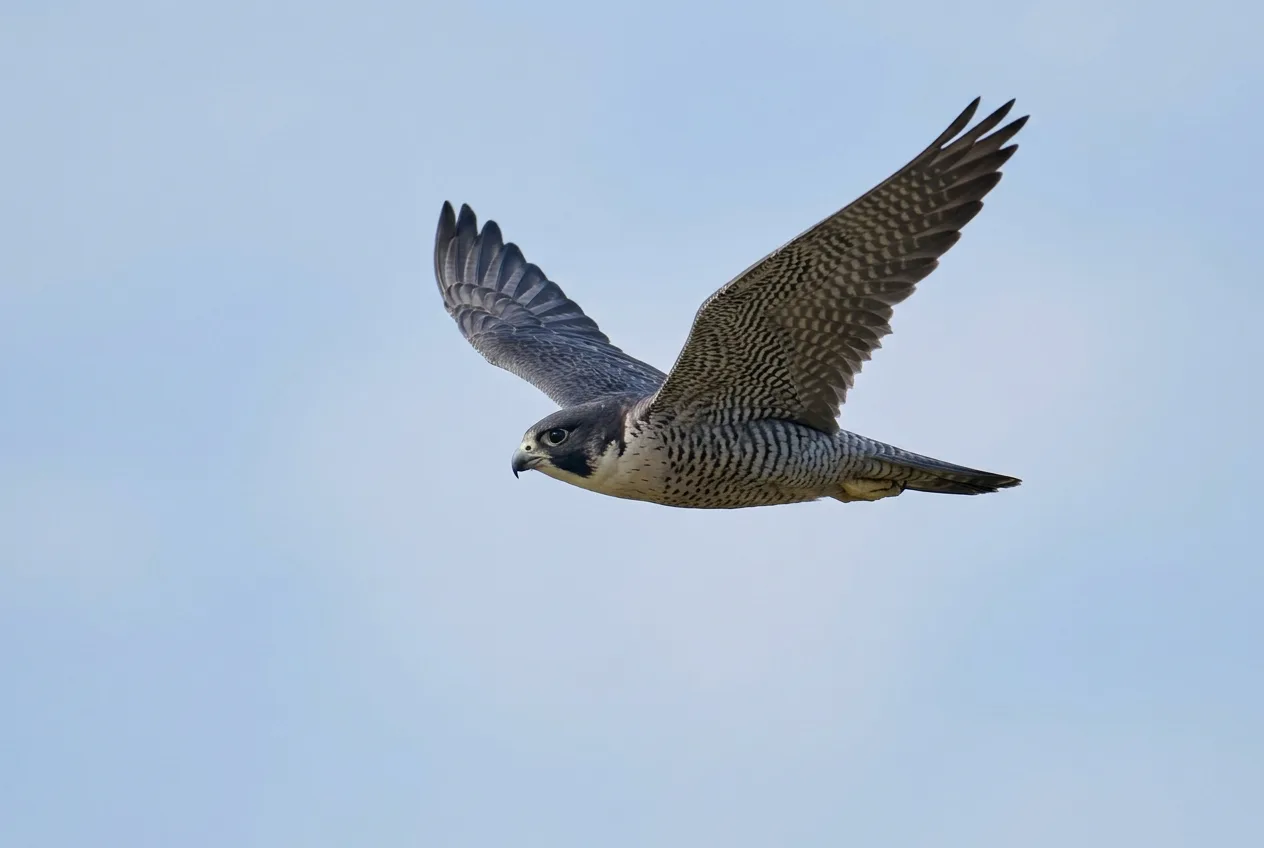
Falcons — the pointed-winged speedsters. "Slender- and pointy-winged speedsters with steadier wing flaps," in Dunne's phrase. Where an accipiter looks like it's rowing, a falcon looks like it's cutting. The long, tapered, swept-back wings and powered, rhythmic flight read as pure speed. The American Kestrel — the smallest North American falcon, dove-sized, with "longer, narrow wings and a long, square-tipped tail" — anchors the small end; the Peregrine, crossing the sky "like a jet" on a broad chest and extra-long wings, anchors the large end.
Harriers — the low, rocking quarterers. A harrier is unmistakable once you've seen the behavior: a slim, long-winged, long-tailed hawk coursing low over a marsh or field, tilting side to side, wings held up in a shallow V (a dihedral). The Northern Harrier wears a diagnostic white rump patch that flashes in flight and has a flat, "owl-like face" it uses to hunt partly by ear. Its southern-hemisphere cousin, the Swamp Harrier of New Zealand and Australia, does exactly the same thing — "slowly quartering the ground with its large wings held in a distinctive shallow V-shape".
Kites — the buoyant aerialists. The often-forgotten fifth group. Kites are slim and graceful with long wings, and they fly with a light, floating, buoyant ease — the Mississippi Kite catches insects, even dragonflies, on the wing and sails on the wind. Their pointed wings can suggest a falcon at a glance, but the airy, unhurried flight gives them away.
Get the group right and you've done eighty percent of the work — the species is just confirming which member you're looking at.
Reading the silhouette in flight
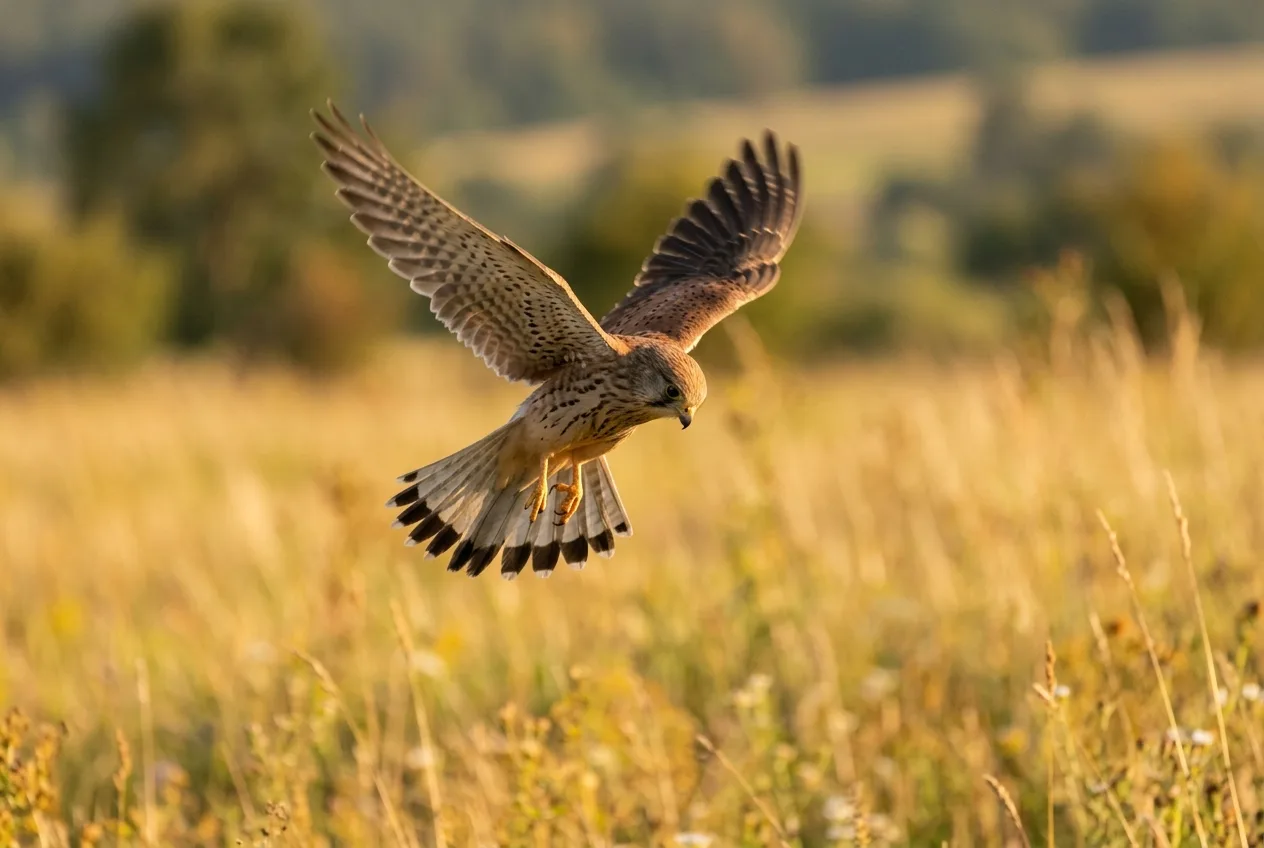
When raptors are streaming overhead at a hawkwatch — by the dozens, hundreds, sometimes thousands — color is simply gone, and you're working entirely from body-shape silhouettes and flight patterns. This is where the group shapes become precision tools. A few cues do most of the heavy lifting:
- Wing-to-tail proportion. Buteos: broad wings, short tail. Accipiters: shortish wings, long tail. Falcons: long pointed wings, medium tail. This one ratio usually nails the group.
- The dihedral. Some raptors "soar and glide with their wings raised above the horizontal, called a dihedral". A sharp dihedral on a low, rocking bird says harrier; a shallow one on a teetering Turkey Vulture (tippy, small-headed, long-tailed) is a classic. Most buteos hold their wings flatter.
- Head projection. How far the head sticks out in front of the wings is the single most useful accipiter cue, and we'll use it hard in a moment.
- Wrist marks and patagial bars. On a soaring Red-tail's underwing, look for the dark bar running from shoulder to wrist — the patagial mark — a reliable Red-tailed signature even on oddly-colored birds. An Osprey shows black "wrist" marks and glides with a distinctive kinked, M-shaped wing.
And know the four ways a raptor moves through the air, because the method is a clue:
| Flight method | What it looks like | Who does it |
|---|---|---|
| Soaring | Wings spread to the max, "fingers" splayed, circling to gain height | Buteos, eagles, vultures — the broad-winged soarers |
| Gliding | Wings pulled back, more pointed, traveling between thermals | All groups in transit; the migrant's cruise |
| Hover / kite | Holding position over one spot — flapping into the wind (hover) or wings locked and still (kite) | Kestrels and harriers hover; Red-tails kite in a stiff wind |
| Powered flapping | Steady wingbeats to get somewhere; beat rate hints at size | Falcons, accipiters between glides; bigger birds beat slower |
Powered flight even carries a species clue: a Northern Goshawk shows surprisingly pointed wingtips at the top and bottom of each stroke. The takeaway is that how a bird flies narrows the field before a single feather is visible — the floppy, batty flap of a kestrel versus the purposeful, piston-like drive of a Merlin tells them apart at a range where neither shows a field mark.
The backyard hawk: it's (almost) always an accipiter
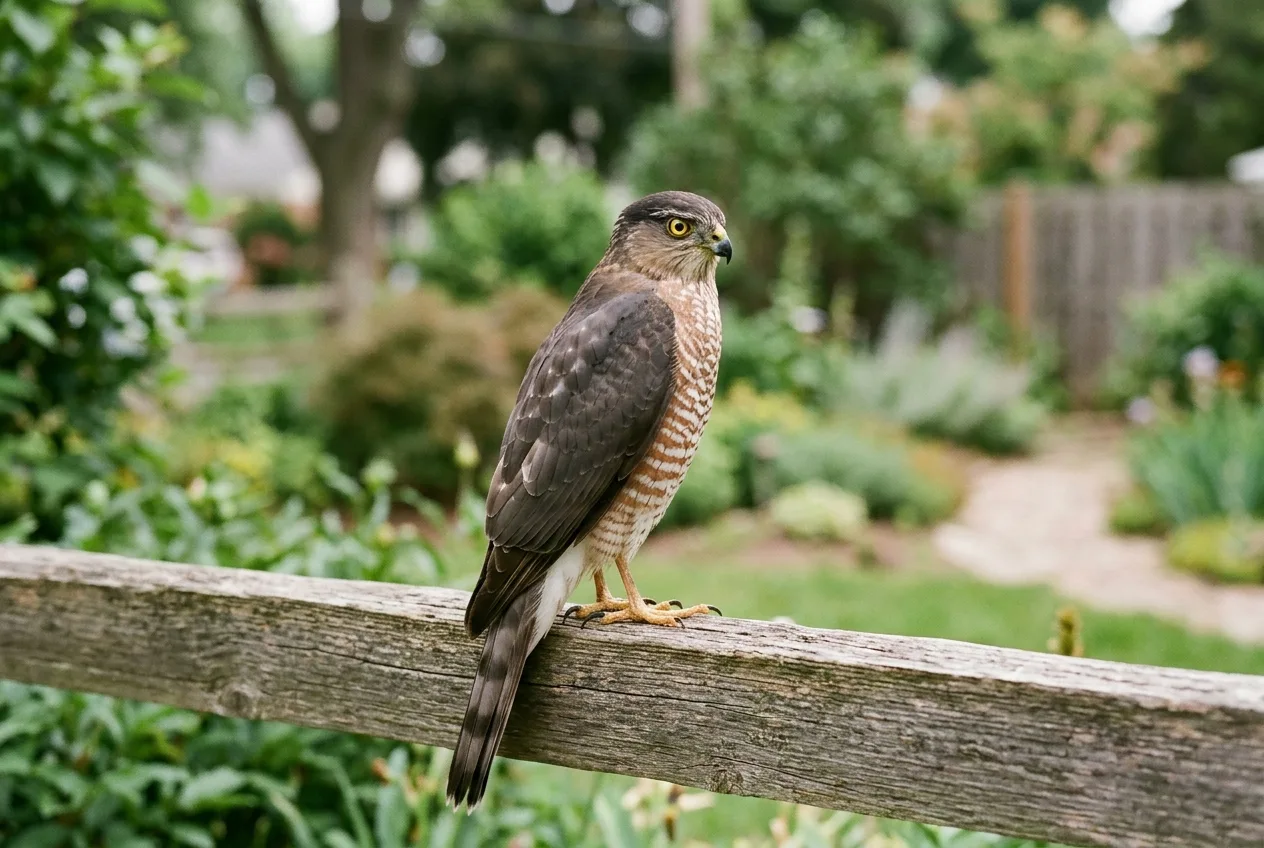
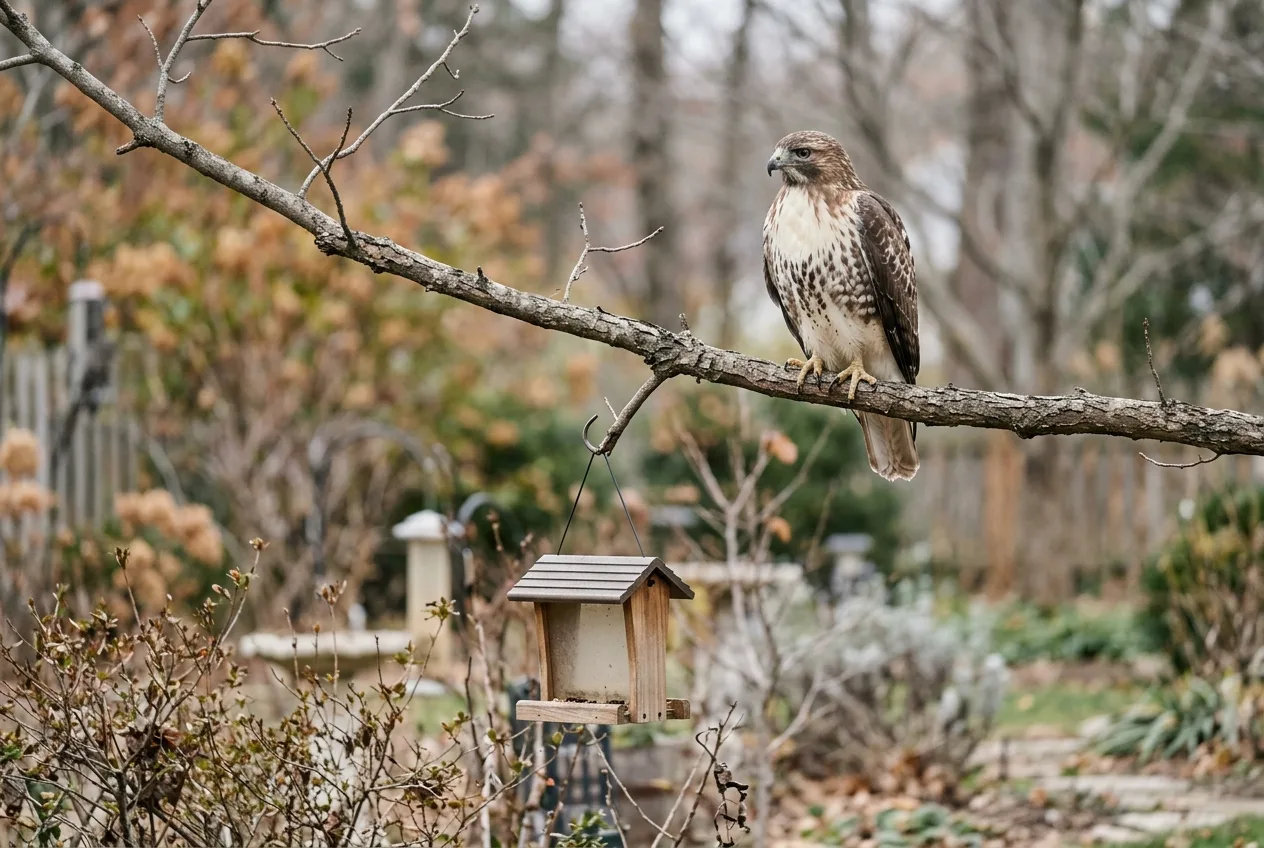
If a hawk is hunting your bird feeder, you've met an accipiter. In the Americas that means a Cooper's Hawk or a sharp-shinned hawk; in Europe and across much of the Old World it's the Eurasian sparrowhawk — a bird so at home in gardens that, like its American counterparts, it'll drop in "for an easy meal" and alert you only by the alarm calls and the sudden scattering of small birds. These are forest hawks built to ambush songbirds, and a feeder is just a very convenient gathering of songbirds.
The Cooper's-versus-sharp-shinned problem is the one that breaks beginners and experts alike, and here's the most liberating thing you'll read today: it's genuinely OK not to be sure. "Lots of birders — expert birders — have come away… jotting down 'Cooper's/Sharp-shinned' in their notebooks," Audubon notes, and Project FeederWatch makes it official policy: because "no single field mark is likely to distinguish one species from the other," if you're not certain, report the bird as "Sharp-shinned/Cooper's Hawk". Nobody is grading you.
No single field mark separates a Cooper's from a sharp-shinned — and the experts who know that are the ones who get it right.
When you do want to make the call, stack the clues rather than betting on one. First, age the bird: juveniles have brown backs and vertical brown streaks below; adults have blue-gray backs and horizontal orange barring (stripes run up and down, bars run side to side). Then work the structure:
| Feature | Sharp-shinned | Cooper's |
|---|---|---|
| Size | ~Jay or dove sized (10–14 in / 24–34 cm) | ~Crow sized (14–20 in / 37–45 cm) |
| Head | Small, smoothly rounded; barely projects past the wings | Large, blocky, "domed"; projects well in front of the wings |
| In-flight gestalt | Off-balance "T," small head in a valley between the wrists | Balanced "T," big head leading like a flying cross |
| Tail tip | Square, with corners (can look rounded when soaring) | Rounded, with a wider white terminal band |
| Nape (adult) | Dark hood, head and neck the same tone | Pale nape under a dark cap — "capped" look |
| Legs | Thin, pencil-like | Thicker, shorter |
| Flap | Quick, snappy, slightly erratic | Slower, stiffer, deliberate, countable |
The single most reliable cue across all of these is head projection in flight — sharpie's small head "sits within a valley between its wings," Cooper's "projects in front of the wings' leading edge". It's the same trick we built earlier: measuring the head against the body, using the bird as its own ruler. The maddening catch that keeps this hard is size overlap by sex — female raptors run up to a third larger than males, so a big female sharp-shinned closes most of the gap to a small male Cooper's. Which is exactly why you never lean on size alone.
The Old World has its own version of this headache, one notch up in difficulty: the Eurasian sparrowhawk versus the Northern goshawk. Sparrowhawks are "frequently misidentified as" goshawks, especially the larger female sparrowhawk, which "can sometimes appear strangely large". The fix, again, is structure over size. A goshawk is "larger headed, longer necked and heavier bodied," with a longer-armed wing whose bulging secondaries form a slight S-curve in the trailing edge, and — on a perched bird — "thick and powerful" legs against the sparrowhawk's "spindly" ones. The juveniles separate cleanly too: a young goshawk has bold vertical, drop-shaped streaks down the breast, while a juvenile sparrowhawk is barred across. Heavy build, S-curved wing, powerful presence in the air: goshawk. Small-headed, square-cornered tail, weak flappy flight: sparrowhawk.
Falcons and the marks that actually help
Falcons reward you with a couple of plumage marks reliable enough to lean on — a rarity in this group-first world. The mustache is the big one: most falcons wear a dark vertical slash below the eye. The Peregrine has a bold dark "moustache and mask"; the American Kestrel goes one better with two facial slashes, "a 'mustache' and a 'sideburn'". The New Zealand falcon shows "a distinct moustache or malar stripe running… vertically down the face" at every age. See a falcon-shaped bird with a clean facial stripe and you've confirmed the group from the markings alone.
The American Kestrel is also that rare raptor where color sexes the bird outright: males have slate-blue wings, females reddish-brown wings with black barring. Watch for the habit, too — kestrels "often bob/pump the tail while perched" on a wire and hover into the wind to hunt, head dead still. Their Old-World twin, the Common Kestrel, is so devoted to hovering it earned the folk name "windhover," and you tell it from a sparrowhawk by the speckled (not barred) underparts and the dark tear-mark below the eye.
The small falcons trip people up among themselves, and here motion saves you. A Merlin is superficially kestrel-like but flies with an entirely different attitude — "with a purpose," fast and direct, where the kestrel wanders and floats; "before you can say, 'It's a falcon,' it's gone". A Hobby is the aerial acrobat with long, scythe-like wings that make it "look like an over-sized swift," chasing insects and small birds on the wing. Across these, the rule holds: when the plumage is a blur, the manner of flight separates them.
When the groups blur: a global reality check
The five-group scheme is a scaffold, not a law, and it's worth knowing where it bends — both to avoid over-confidence and because the site's readers are watching skies on every continent.
Southern-hemisphere birders work with a richer set of groups. A comprehensive southern-African guide sorts the region's 83 raptors into eleven morphology-based groups, adding snake-eagles, fish-eagles, the secretarybird, and more to the familiar buzzards, accipiters, falcons, harriers, and kites. The core shapes still apply — buzzards hunt from perches, "kestrels hover before swooping," goshawks have "shorter wings… for greater manoeuvrability through tree canopy" — but the cast is larger.
And evolution doesn't always respect the categories. The endemic New Zealand falcon is one of only four forest-dwelling falcons in the world, and to live in the bush it evolved "short, relatively deep rounded wings, a long tail… and long legs and feet" — exactly the toolkit of an accipiter — while keeping the classic falcon stoop. It's a falcon wearing an accipiter's silhouette. The lesson isn't that the groups are wrong; it's that you hold them as strong priors and stay ready to be surprised.
That readiness is the actual mark of skill here. As the scientific literature is blunt about, raptors are hard precisely because "most species have a variety of plumages, including different plumages for immatures, sexes, and color morphs," many of them resembling other species. The discipline that beats it is simple and unglamorous: for most raptors, more than one field mark is needed for a confident ID, and the more marks you genuinely see, the more certain you are. Never hang a name on a single clue.
One more pair worth filing away, because it confuses people worldwide: falcon versus harrier. They overlap in size and open-country habitat but separate cleanly on behavior. The harrier quarters low in a "lazy" flight with wings in a shallow V and flashes a pale rump; the falcon is "more often seen in active chasing flights," glides "with its wings set flat rather than in a shallow V-shape," and shows no pale rump. Flat-winged active hunter: falcon. V-winged ground-hugging cruiser: harrier.
Frequently asked questions
What's the difference between a hawk and a falcon?
Shape and flight, mostly. Falcons have long, pointed, swept-back wings and fly with fast, powered, rhythmic beats — built for speed in the open. The hawks you'll see most (buteos and accipiters) have broader, more rounded wings; buteos soar on wide circles, accipiters do a flap-flap-glide through trees. Many falcons also wear a dark "mustache" mark below the eye that the hawks lack.
What kind of hawk hunts birds at my feeder?
Almost always an accipiter — a Cooper's Hawk or sharp-shinned hawk in North America, or a Eurasian sparrowhawk in Europe. They're forest hawks that specialize in ambushing songbirds, and a feeder is an easy target. If you can't tell Cooper's from sharp-shinned, you're in good company — it's fine to log it as "Cooper's/sharp-shinned".
How do you tell a Cooper's Hawk from a sharp-shinned hawk?
Stack several clues instead of trusting one. In flight, the best is head projection: a sharp-shinned's small head barely clears the wings, while a Cooper's larger head juts out in front like a flying cross. Cooper's is crow-sized with a rounded tail tip; sharp-shinned is jay-sized with a square tail. Size alone is unreliable because females of both run much larger than males.
Why can't I just judge the hawk by its size?
Because humans genuinely can't judge the size of a single bird against an empty sky — it's a documented blind spot, so "size of a raptor flying by itself is not a field mark". The fix is to compare it to a second bird in the same view, or to measure it against its own proportions: head-to-body, tail-to-wing.
Why does the same hawk look different every time I see it?
Two reasons. Light: the same bird looks reddish at dawn, pale over snow, and near-black against a gray sky. And real variation: many species, the Red-tailed Hawk especially, come in light, rufous, and dark color morphs, and juveniles look nothing like adults. That's exactly why experienced birders lead with shape and flight, which don't change, rather than color.
Are kites and harriers hawks?
They're all diurnal raptors — birds of prey that hunt by day — but they're distinct groups with distinct silhouettes. Kites are slim, long-winged, buoyant fliers that often catch insects on the wing; harriers are low-coursing, V-winged hunters with a giveaway pale rump and an owl-like face. Lumping them as "hawks" is fine in casual use, but treating them as their own shapes is what gets you to the right ID.