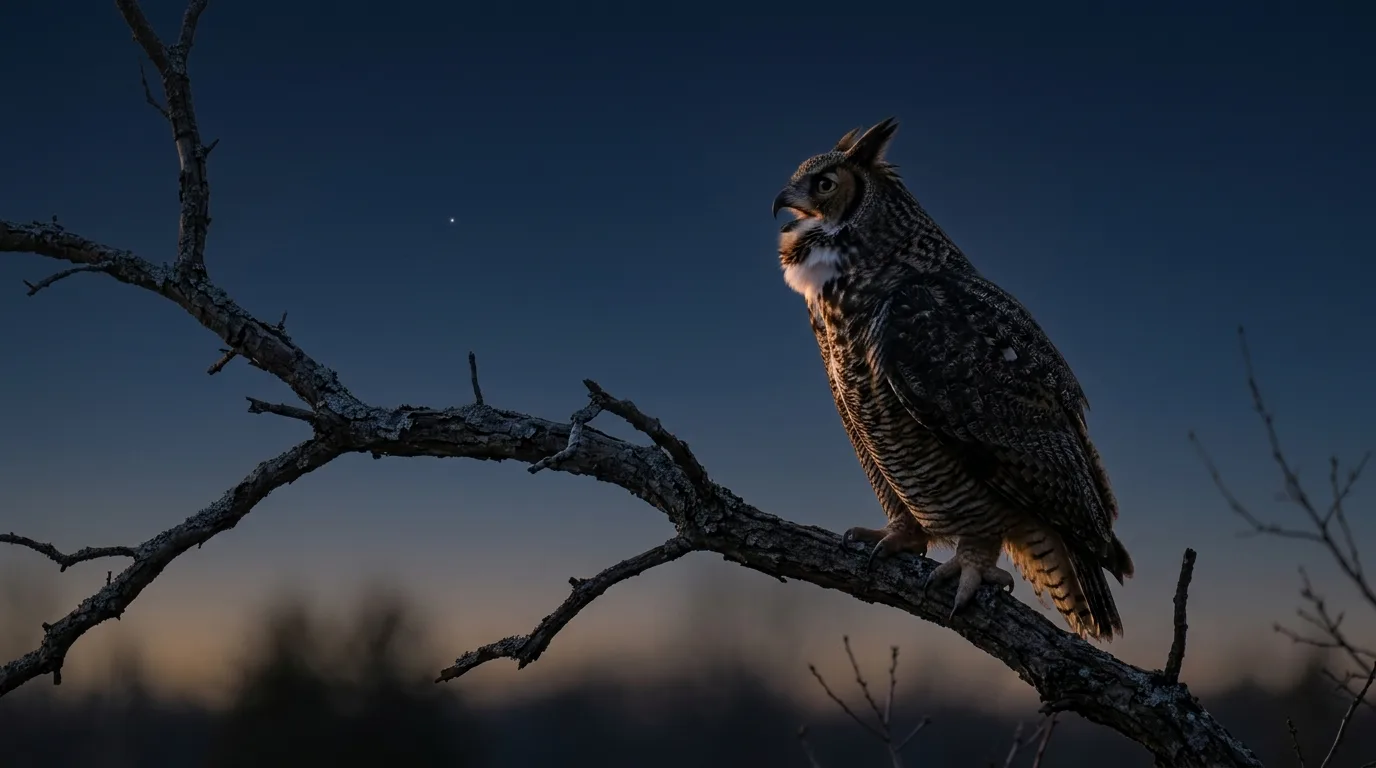
You don't see the owl. That's the whole problem, and the whole appeal. A sound comes out of the dark — a string of hoots, an unearthly shriek, a two-note cry that seems to say a word — and you stand at the window trying to put a face to it. Most of the time you never will. With owls, the voice is the bird. Learn the voices and you can census a whole woodland you'll never lay eyes on.
Here's the reassuring part: identifying an owl by ear is far more tractable than it feels at 2 a.m. There are more than 230 owl species worldwide, but in any one place you're usually choosing between a handful, and each of them carries a signature call that's surprisingly consistent and, once you know it, hard to mistake. The catch most beginners trip on is the assumption baked into the question itself — that owls hoot. Some do. Several of the most common ones absolutely do not. Sorting the hooters from the screechers is the first and most useful cut you can make, and it's where this guide starts.
One more myth worth retiring up front: owls are not strictly creatures of midnight. They "use their voices to establish territories and to attract mates, just like songbirds do," and you can hear them "at almost any time of the day or year". Some are loudest at dusk, a few call by daylight, and the big hooters often start up in fall and winter when every other bird has gone quiet. So the better question isn't only which owl — it's which owl, and when it's likely to be talking.
Why owls call at all
Strip away the romance and an owl's call is doing a job: real estate and dating. Territorial males announce ownership of a patch of woodland, advertise for or reassure a mate, and reinforce the pair bond — the same work a robin does at dawn, just pitched into the dark. The British Trust for Ornithology puts it plainly for the Tawny Owl: the bird is "reliant on vocalisations, using them to show ownership of a breeding territory, as well as attracting a mate and reinforcing a pair bond".
That function explains the timing. Calling peaks when there's a territory to defend and a mate to win — the breeding season — and it quiets down once eggs are in the nest and stealth matters more than noise. In a long-running study of Eurasian Scops Owls in Italy, spontaneous calls and replies to playback were "significantly more frequent during the breeding period, when paired birds defend territories," with roughly 97% of spontaneous calls recorded in the breeding-season months. The Barred Owl shows the same shape from the other side of the world: vocal activity "peaks during the breeding season," with a second, smaller surge in fall as young birds disperse and look for ground of their own.
With owls, the voice is the bird. Learn the voices and you can census a whole woodland you'll never lay eyes on.
The first cut: hooters, screechers, trillers, and two-note callers
Before you reach for a species name, sort the sound into a category. Four buckets cover most of what you'll hear at night:
- Deep hoots — measured, low, often in a rhythmic phrase. The classic owl sound, but only some owls make it.
- Shrieks and screams — harsh, drawn-out, distinctly un-musical, sometimes genuinely hair-raising.
- Trills and whinnies — soft, even, quavering or bouncing tremolos.
- Two-note cries — a repeated, word-like double note, the hallmark of one whole family of southern-hemisphere owls.
The single most useful fact in owl identification is that the screechers and the hooters are different birds. The Barn Owl — one of the most widespread owls on the planet — is the headline example. As the Barn Owl Trust states bluntly, "Barn Owls don't hoot! They shriek, hiss and snore," and they're "seen more than often heard". The Wildlife Trusts describe that voice as "eerie squeals and a shrieking 'shreeee'". If a pale, ghostly owl drifts across a field on silent wings and lets out a rasping scream, you can rule out every hooting species in one stroke.
The single most useful fact in owl identification is that the screechers and the hooters are different birds.
A field guide by ear: who makes which sound
Here's the scannable version — the common, well-documented owls grouped by the kind of sound they make, with the phrase to listen for. Match what you heard to the sound type first, then read down to the species.
| Owl | Where | The signature sound | How it's described |
|---|---|---|---|
| Great Horned Owl | Americas | Deep, soft, stuttered hoots | "hoo-h'HOO-hoo-hoo" — a stutter-step rhythm |
| Barred Owl | N. America | Rhythmic 8–9-note hoot | "Who cooks for you? Who cooks for you-all?" |
| Tawny Owl | Europe/UK | Quavering hoot + sharp contact note | male "hoo, hu-hooo"; female "ke-wik" |
| Eurasian Eagle-Owl | Europe/Asia | Deep, far-carrying low hoot | "oohu-oohu-oohu," monotonous |
| Eurasian Scops Owl | Europe/Mediterranean | Single whistled note, on repeat | a whistling "kiuu" / "kyoot," every 2–3 seconds |
| Little Owl | Europe | Yelping, nasal, doglike | shrill alarm yelp; "kiew kiew"; "gwooooohk" |
| Barn Owl | Near-global | Shriek, hiss, snore — no hoot | a shrieking "shreeee" |
| Eastern Screech-Owl | N. America | Soft trill + descending whinny | a "bounce song" tremolo, not a screech |
| Morepork / Boobook | NZ & Australia | Two-note, word-like cry | "more-pork" / "boo-book" / "mo-poke" |
| Long-eared Owl | Europe/N. America | Soft, evenly spaced single hoots | "deep, soft hoots with no inflection," every few seconds |
Now the detail that lets you tell the close ones apart.
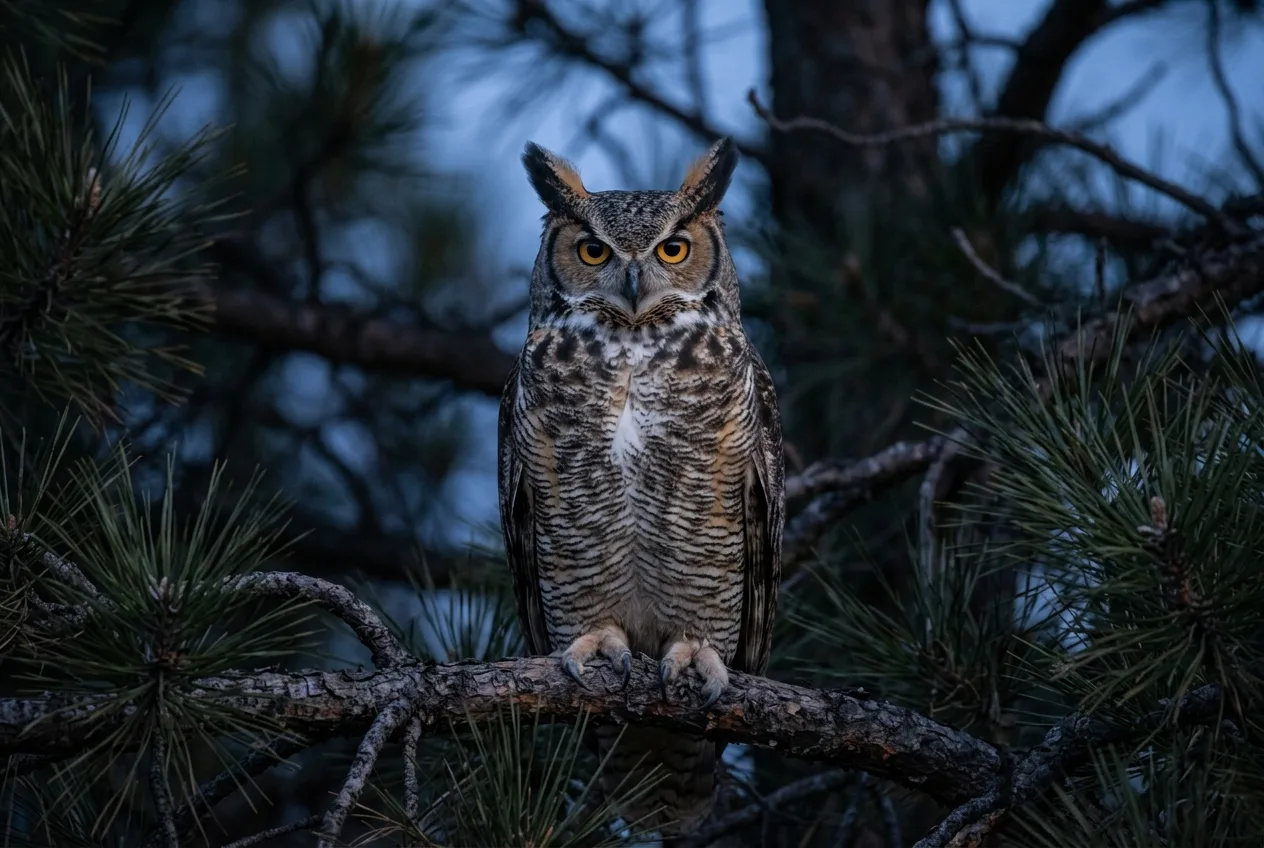
Great Horned Owl — the textbook hoot (Americas)
If you picture an owl hooting, you're probably picturing this bird. Great Horned Owls "advertise their territories with deep, soft hoots with a stuttering rhythm: hoo-h'HOO-hoo-hoo". Cornell's own shorthand for it is "a series of deep hoots with a stutter-step rhythm". The rhythm is the tell — not an even series but a stutter, with a couple of quick beats tucked into the middle. A breeding pair will duet, trading hoots, and the female's voice is "recognizably higher in pitch than the male's" — a useful, counterintuitive clue we'll come back to. Beyond the song, these owls keep a whole drawer of other noises: "whistles, barks, shrieks, hisses, coos, and wavering cries," plus piercing screams from hungry young.
Barred Owl — the one that asks a question (North America)
No owl call is easier to remember, because it sounds like a sentence. The Barred Owl delivers "a distinctive hooting call of 8–9 notes, described as 'Who cooks for you? Who cooks for you-all?'" — a phrase that "carries well through the woods and is fairly easy to imitate". Researchers who study it formally hear the same thing: the most common call is a "two-phrase hoot, consisting of two groups of four or five notes each, and commonly being phoneticized as Who cooks for you, who cooks for you all?". The Owl Research Institute offers a folksy second translation — "You cook today, I cook tomorrow".
Where Barred Owls get genuinely wild is in courtship. Forget the tidy question; a pair lights up the forest with a "riotous duet of cackles, hoots, caws and gurgles". The Owl Research Institute describes "the male's chimpanzee-like calls and the females' higher pitched responses," a racket of shrieks, cries, trills, grumbles and squeaks. First-time listeners regularly mistake it for a troop of monkeys.
No owl call is easier to remember, because it sounds like a sentence.
Eastern Screech-Owl — the bird that doesn't screech (North America)
This is the classic trap, and it's right there in the name. The Eastern Screech-Owl's two main songs are not screeches at all. They are "an even-pitched trill, often called a 'bounce song' or tremolo; and a shrill, descending whinny". The tremolo runs 3–6 seconds and works as a contact call to keep a pair or family in touch; the whinny is shorter, half a second to two seconds, and is used to defend territory. Both sexes sing, sometimes one song straight after the other, day or night. The bird can screech — adults do it defending a nest — but its everyday voice is that soft, descending, almost horse-like whinny. If you hear a gentle bouncing trill from a backyard tree in eastern North America, resist the name and trust your ears.
Tawny Owl — where "twit-twoo" actually comes from (Europe)
The most famous owl sound in Britain is a duet that people mistake for a solo. A male Tawny Owl's territorial hoot begins "with a drawn out 'hooo', followed by a brief pause, before a softer 'hu' and then a resonant final phrase of 'huhuhuhooo'" — that last phrase carrying "a strong vibrato quality". The female's usual call is a sharp "keewik" contact note. Put them together and you get the storybook "twit-twoo" — except it isn't one bird saying a word, it's two: the male hoots, and the female "dropping her contact call into the pauses" answers him. The BTO is precise about it: "the hooting or 'twoo' sound is usually made by the male… you can sometimes hear a female responding to a male's 'twoo' call with a sharp 'kee-wick'. Together this duet produces the classic 'twit twoo' sound". Hear a clean "twit-twoo" from a single throat and you've actually overheard a conversation.
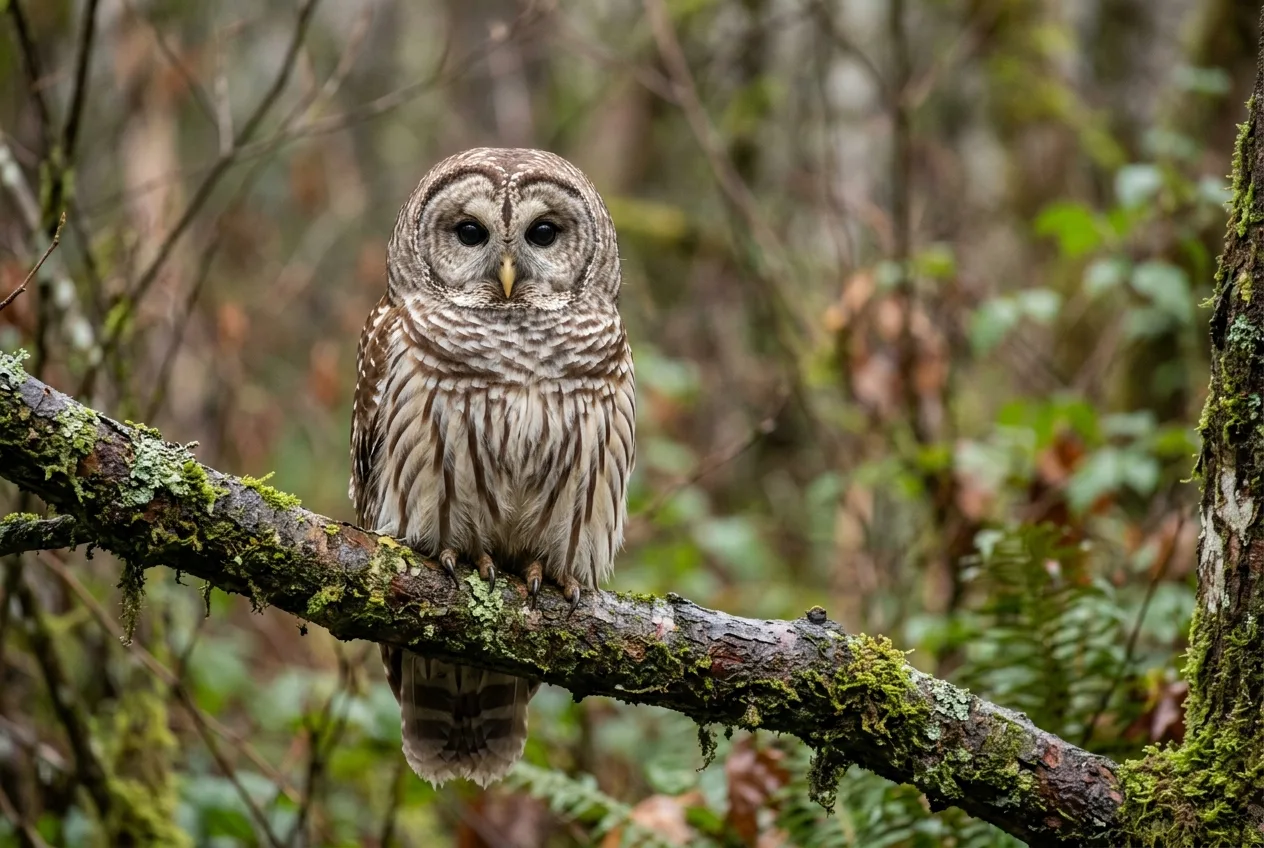
Eurasian Eagle-Owl — the deep one that travels (Europe & Asia)
The largest of the owls has a voice to match: not loud and varied so much as deep, simple, and astonishingly far-reaching. The male's territorial song is "a deep, monotonous 'oohu-oohu-oohu'," with the female's call "slightly higher than the male's". That low frequency is the point — it carries across valleys, which is exactly why researchers can census these birds by broadcasting recorded calls and listening for an answer from a hidden territory. When threatened the eagle-owl drops the dignified hoot and will "bark and growl".
Eurasian Scops Owl — a single whistled note, on a metronome (Europe)
Some owls give themselves away by repetition. The Scops Owl's advertising call is "a whistling 'kiuu'," a single short note, "rhythmically repeated by both sexes" through the breeding season. The Owl Pages renders it "kyoot kyoot kyoot," each note clipped to a fifth of a second and "separated by 2–3 seconds," like a soft electronic beep that won't stop. The remarkable thing is how alike the sexes sound: "the advertising call is similar in males and in females". During courtship the pair duets, the two voices stacking into "a two syllable song of higher and lower pitched notes". If you're somewhere warm in southern Europe on a still night and a tireless single whistle repeats from a tree, that's your bird.
Little Owl — the yelper that sounds like a small dog (Europe)
The Little Owl breaks the hooting mold in the other direction — not deep, but sharp, nasal and a bit comic. Its commonest call is "a rather shrill yelping alarm call," while the male's song is "a repeated series of rather nasal-sounding 'gwooooohk' calls, each of which has a slight upward inflection". The Barn Owl Trust describes a "plaintive 'kiew kiew' and a 'wherrow wherrow' (reminiscent of a small dog barking)," and notes the bird is "largely diurnal" — so don't write it off just because you heard it in daylight.
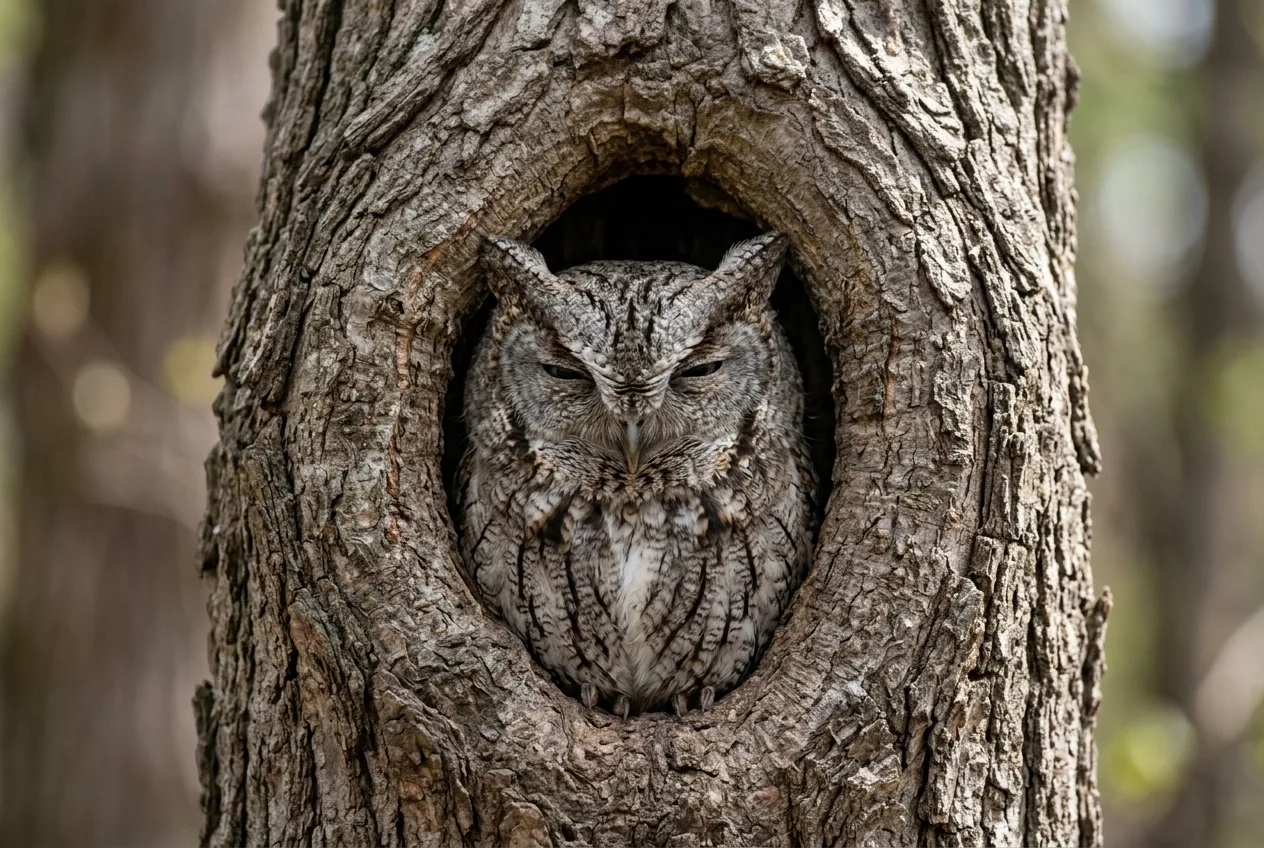
Barn Owl — the screech in the dark (near-global)
Worth saying twice because it overturns the default assumption: the Barn Owl does not hoot. It shrieks, hisses, and snores, and it calls relatively rarely, so you'll more often see its pale shape than hear it. The voice, when it comes, is unmistakable and a little chilling — "eerie squeals and a shrieking 'shreeee'". In much of the world this is the owl people actually have around their barns and fields, which is exactly why "what's screaming in my yard at night?" so often turns out to be an owl that never hoots.
Morepork and Boobook — the owls named after their own call (New Zealand & Australia)
In the southern hemisphere a whole group of owls is named, onomatopoeically, for a two-note cry. New Zealand's morepork, Australia's boobook, and the old country name "mopoke" all imitate the same two-pitched call — the English "morepork," the Māori "ruru," and the Australian "boobook" each "echo its two-part cry". New Zealand's Department of Conservation calls it "haunting, melancholic," heard "in the forest at dusk and throughout the night". The Australian Museum sums the Southern Boobook up in three words: "a distinctive 'boo-book'"; Birds in Backyards adds the variant "mo-poke". The morepork also has a second, separate voice worth knowing — "a high pitched, piercing 'yelp'" quite unlike the gentle double note, plus a rising "quee" that's so kiwi-like it's regularly mistaken for one.
The day-shift: owls that don't wait for dark
Finally, the exceptions that keep you honest. Several owls are most active and vocal in daylight, and their calls sound nothing like a hoot:
- Short-eared Owl — hunts low over open ground by day; its common call is "a harsh yelp or bark," given in rasping series when alarmed.
- Burrowing Owl — day-active, nests underground; gives "a short series of whooping notes that can sound like a quail".
- Northern Pygmy-Owl — robin-sized and active by day; "a slow and steady series of short, musical toots".
- Boreal Owl — a small northern owl whose song is "a mellow but quick series of up to 20 toots".
- Great Gray Owl — one of the world's largest owls, with "a subdued series of slow-paced, deep hoots".
The lesson: if you hear an owl in broad daylight, that's not a contradiction — it's a clue to species.
If you hear an owl in broad daylight, that's not a contradiction — it's a clue to species.
Telling male from female by pitch
Here's a clue that does a lot of work and runs against intuition. In most of these owls the female is the larger bird, yet hers is the higher voice. Cornell notes it for the Great Horned Owl duet: "the female's voice recognizably higher in pitch than the male's". The Owl Pages says the same for the Eagle-Owl — "the female's call is slightly higher than the male's" — and for the Scops Owl, where the unpaired female's song is "more drawn-out and higher pitched". The Barred Owl follows suit: in a duet, "the females' higher pitched responses" answer the male, and formal study confirms "females typically producing higher frequency calls compared to males".
So when you catch two owls of the same species answering each other — a duet — the higher voice is usually the female and the lower the male. The Tawny Owl is the everyday case: in the "twit-twoo," the lower hoot is the male and the sharp "keewik" is the female.
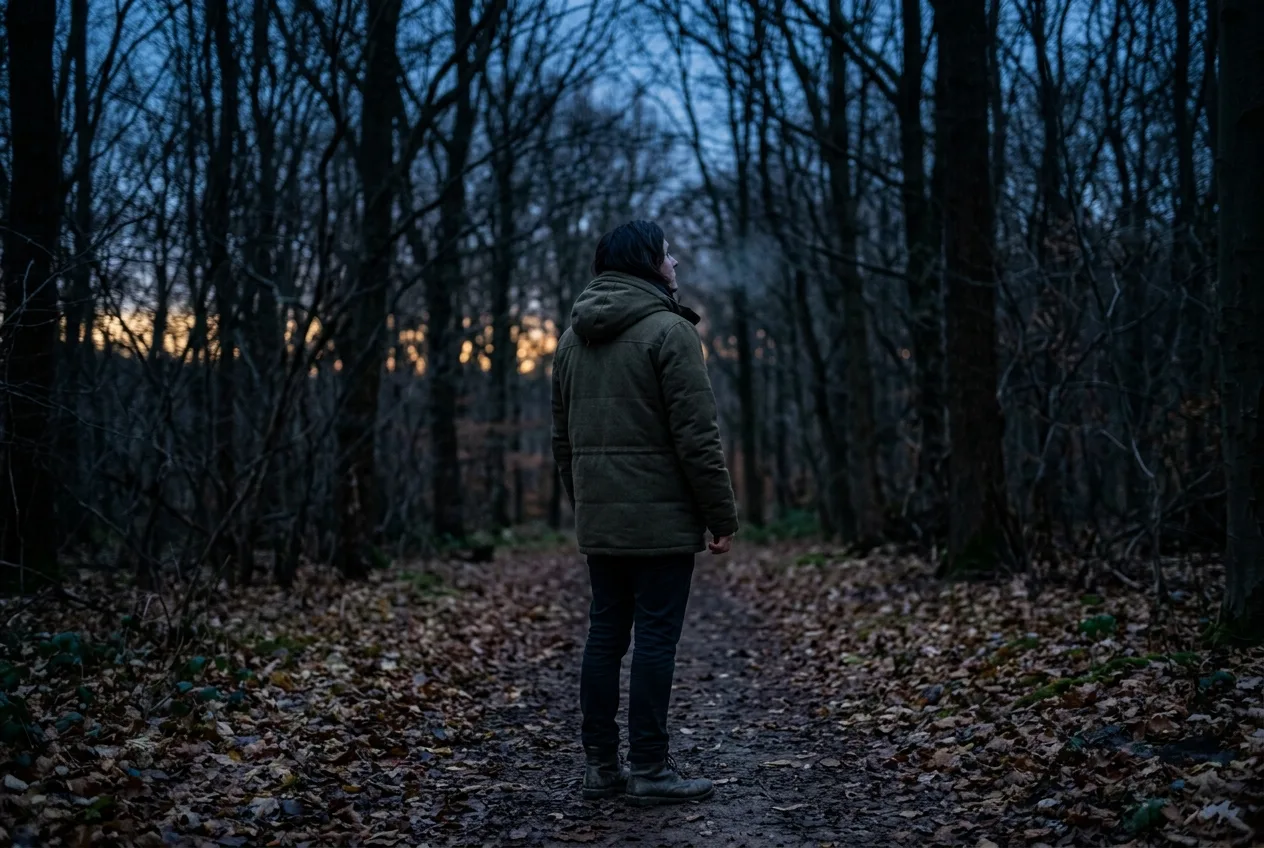
When — and where — owls are most worth listening for
Timing turns a frustrating night into a productive one. Three levers matter.
Season. Owls are loudest when they're holding territory and courting — the breeding season. Because that season is mirror-imaged between hemispheres, there's no universal "best month": pin it to your own location. North American Barred Owls peak in their late-winter-to-spring breeding window, with a fall echo; Eurasian Scops Owls do almost all their calling in their breeding-season summer; British Tawny Owls hoot most "from late autumn and through the winter months" as young birds contest territory and pairs reaffirm bonds. Different calendars, identical logic — listen when the local birds are breeding.
Time of night. For most nocturnal owls, the richest stretch is the first couple of hours after sunset. Studies of Barred Owls deliberately record in that window because it "aligned with the known peak in vocal activity… (0–2 hours after sunset)". The BTO's Tawny Owl survey simply asked volunteers to listen "between sunset and midnight". Dusk is prime time.
The moon. This one is a genuinely fun lever. Owls call more on bright nights. In the Scops Owl study, "the probability of spontaneous calls varied with moon phase, with a peak occurring during nights with a full moon". The BTO found the same factors at play for Tawny Owls, noting that "the time of day, the moon cycle, weather and distance to woodland impact the chances of hearing" one. If you want your best odds, pick a clear, calm evening near a full moon, close to woodland, in the local breeding season — and just listen. (Weather works against you: wind, rain, and running water all drown calls and cut your detection odds.)
Pick a clear, calm evening near a full moon, in the local breeding season — and just listen.
Every owl has its own voice
Here's a fact that elevates owl listening from a party trick to something close to science: individual owls can be told apart by voice. A male Tawny Owl's territorial call is individually distinctive enough that researchers in one South Korean study correctly assigned 122 of 128 calls to the right bird — about 95% — and the same male's voice stayed recognizable across years, all without ever catching or marking the bird. That's not a one-off. Vocal individuality has been documented across a long list of owls — Ural Owl, European Eagle-Owl, African Wood Owl, Tawny, Barred, Western and Eastern Screech-Owls, Ryukyu Scops, Northern Saw-whet, Great Horned, Pygmy, Sunda Scops and Great Gray Owl among them. In other words, the owl outside your window isn't just "a Tawny Owl." It may well be a specific, identifiable individual you could learn to recognize.
Researchers lean on this hard, because owls are so much easier to hear than to see. Passive acoustic monitoring — leaving recorders out night after night and reading the calls off the spectrograms — has become a standard way to survey them. One US Forest Service study set out 150 recorders across the forest and found that "the probability of detecting a Northern Spotted Owl when it was present… exceeded 0.95 after 3 weeks of recording," sifting target calls from roughly 160,000 hours of audio. The same logic powers citizen science: over 9,000 volunteers fed the BTO's Tawny Owl survey just by listening from their gardens for 20 minutes at a time. (If you want to put a name to a call in the moment, a phone app like Merlin can help, and the Macaulay Library — "a scientific archive for research, education, and conservation" — is the deep reference where the documented owl recordings live.)
Frequently asked questions
What owl says "Who cooks for you"?
That's the Barred Owl, a common woodland owl of North America. Its signature call is an 8–9-note hoot widely transcribed as "Who cooks for you? Who cooks for you-all?", a phrase that carries well and is easy to imitate.
Why does the owl I hear sound like two birds answering each other?
Because it often is. Many owls duet, and the famous British "twit-twoo" is two Tawny Owls — the male's lower hoot answered by the female's sharp "keewik" — not a single bird. Barred Owl pairs go further, breaking into a raucous duet of cackles and hoots during courtship.
Do all owls hoot?
No, and this is the most useful thing to know. Barn Owls "don't hoot" — they "shriek, hiss and snore". The Eastern Screech-Owl's main songs are a soft trill and a descending whinny, not a screech. Sorting hoots from screeches, trills and two-note cries is the fastest way to narrow down the species.
Why would I hear an owl during the day?
A few owls are genuinely day-active and vocal — Short-eared and Burrowing Owls and the pygmy-owls among them — and even the big nocturnal hooters may call in daylight, fall, and winter when other birds are silent. Daytime calling is a clue to species, not a contradiction.
Can you tell a male owl from a female by its call?
Usually yes, by pitch — and it runs opposite to what you'd guess. Although the female is often the larger bird, hers is typically the higher-pitched voice. In a Great Horned or Eagle-Owl duet, the higher call is the female's; in the Tawny Owl's "twit-twoo," the lower hoot is the male and the "keewik" is the female.
When are owls most likely to call?
In their local breeding season, in the first couple of hours after dark, and on bright nights — calling peaks around the full moon, and wind or rain suppresses it. Because breeding seasons are flipped between hemispheres, tie the timing to your own location rather than a fixed month.