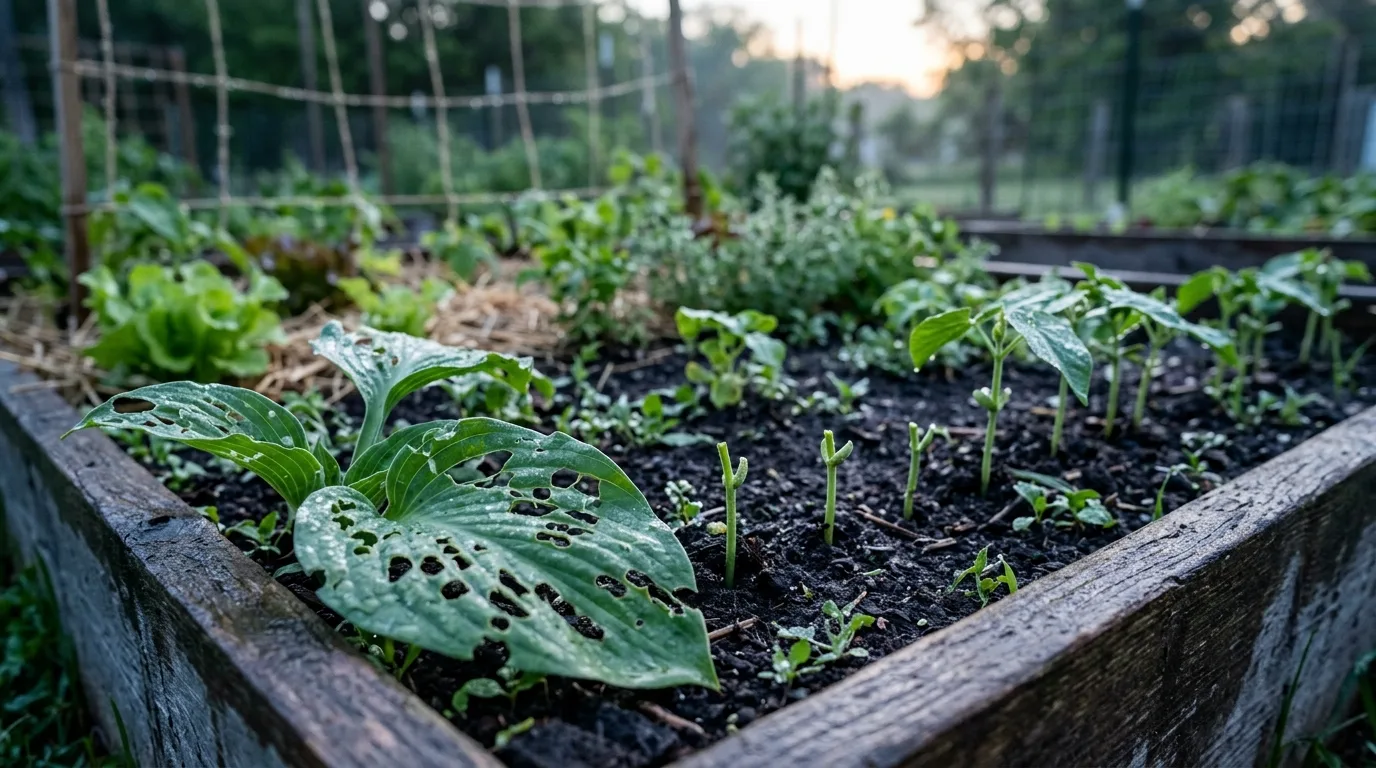
You planted the bed yourself. Last night it was fine. This morning the bean seedlings are gone—not nibbled, gone, clipped right off at the dirt—and three of your hostas look like someone went at them with a hole punch. Whatever did it left in the dark and didn't leave a name.
Here's the good news: it almost always leaves a signature. The single most useful thing you can do is stop staring at the empty spot and start reading the damage. The kind of cut, the height it happens at, what got eaten versus what got ignored, and the little calling cards left behind—droppings, tracks, a silver slime trail—narrow your suspect list fast. Most nighttime garden damage comes from a short roster: deer, rabbits, groundhogs, voles, raccoons, opossums, and squirrels among the mammals, and slugs and snails plus a few big nocturnal insects—cutworms, earwigs, hornworms—among the small stuff. Each one damages plants in a way the others mostly don't.
So before you buy a single repellent, play detective. This guide walks you through the tells.
Start with one question: clean cut or ragged tear?
If you remember nothing else, remember this fork in the road. It's the fastest way to split your suspects in half, and it works because of teeth.
Rabbits and rodents have sharp incisors top and bottom, so they bite straight through a stem and leave a clean cut at a 45-degree angle, like it was snipped with pruners. Deer don't have any upper incisors at all. They grasp a leaf or twig and tear it loose, which leaves a rough, jagged, shredded end. University of Minnesota Extension puts the mechanism plainly: deer "must grasp and tear leaves and buds from plants," while rabbit and rodent browsing "is characterized by a neat cut at a 45-degree angle and is concentrated lower to the ground than deer damage". UF/IFAS Extension says the same about height: rabbit damage stays low and clean; "deer damage will occur higher up on the plant than damage caused by rabbits".
That one observation—clean and low versus ragged and high—often does most of the work. The rest is confirming it.
That one observation—clean and low versus ragged and high—often does most of the work.
Read the height of the damage
Animals can only reach so far, and that ceiling is a fingerprint.
- Under about 6 inches, clean cuts: rabbit territory. Wildlife Illinois notes rabbit feeding is "usually confined to lower than six inches above ground," with stems "clipped at a 45-degree angle" that "look like they have been cut with pruners". UF/IFAS pins rabbit clipping to within 15 inches of the ground on stems usually less than a quarter inch thick.
- Right at the base of the plant, or vanished bulbs and roots: think voles. Vole damage tends to sit "at or near the base," typically under 4 to 6 inches, and they also work underground on bulbs and tubers—"hostas seem to be a favorite".
- From the ground up to roughly 6 feet, ragged: deer. UMD Extension says deer damage runs "from ground level to about 6'," and that height "often rules out other animal damage". Deer can also rear up on their hind legs to reach 6 to 8 feet.
- A clean "browse line" across a hedge, every leaf stripped below a sharp horizontal edge, is the classic deer signature in winter when food is scarce.
During snow, all of this shifts up. Rabbits stand on snowpack and reach bark and buds they normally couldn't, clipping "up to 2 inches above the height of the snow", and they'll climb drifts to gnaw sapling bark well above their usual six inches.
Look for the calling cards: droppings, tracks, slime
When the cut and the height leave you with two suspects, the sign breaks the tie.
Droppings are the most honest witness in the garden. Deer leave "piles of small jellybean-shaped droppings". Rabbits leave "distinctive round droppings," pea-sized with a rough texture, right where they fed. Voles drop "rice-sized greenish or brown scat" in their runways. Raccoon scat has blunt ends and is uniform in thickness, about an inch across, and raccoons tend to go in the same spot repeatedly. A quick tip from UF/IFAS on aging any scat you find: "fresh feces are usually moist and shiny whereas older feces tend to be dry, dull, and grayish".
Tracks help when the ground is soft. Deer leave the familiar split, heart-shaped hoofprint, "2 to 3 inches long, split in the middle, pointed at the front, and more rounded at the rear". If the soil is too hard to register anything, UF/IFAS suggests dusting a patch with baking flour at dusk so morning tracks show up.
A silvery, shiny trail is the one sign that points to a culprit with no teeth at all—slugs and snails. We'll get to them below, but file this away now: if the holes come with a dried silver streak across the leaf, you can stop suspecting mammals and insects entirely.
Droppings are the most honest witness in the garden.
The usual mammal suspects, one by one
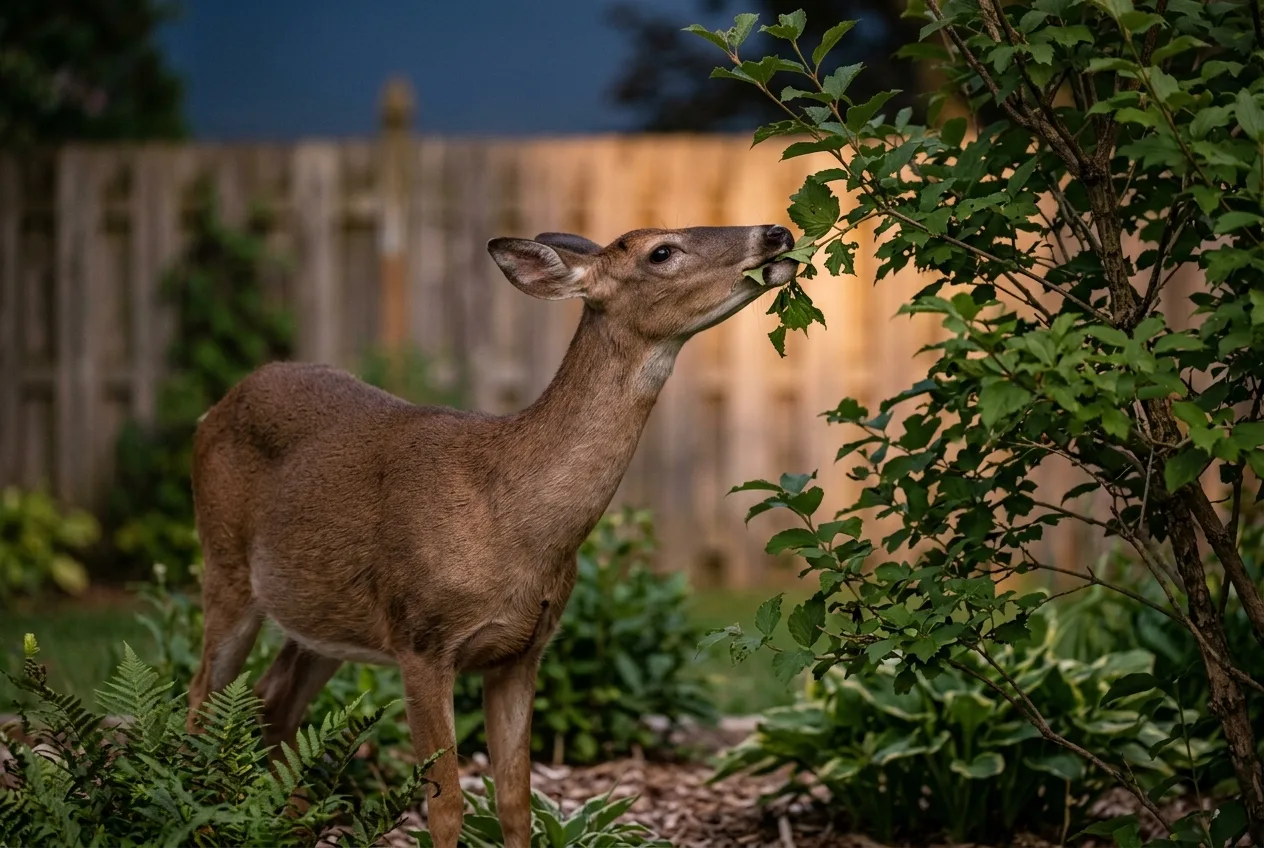
Deer: ragged edges, high reach, hoofprints
Deer are browsers, and they hit "shrubs, vines, fruit and nut trees, garden vegetables, grasses, and small flowering plants". They mostly feed "late in the evening and very early in the morning," which is exactly why you find the damage and not the animal. The signature is the torn, shredded edge on whatever's left—no clean cut, and notably "no tooth marks" left in bark, because they have nothing up top to scrape with. NC State Extension sums it: "vegetation damaged by deer has a jagged appearance," and they feed "at dawn, dusk, and nighttime".
One more deer-only clue, mostly late summer into fall: bucks rub their antlers on saplings and small trunks to strip the velvet, leaving "vertical scrapes and shredded areas with the underlying wood exposed". If a young tree's bark is shredded on one side at knee-to-chest height, that's a rub, not feeding.
A word on expectations, because the deer literature is refreshingly blunt here: you will not make deer damage disappear. UMN Extension says outright that "a 50 percent reduction in deer browse is very successful; a 30 percent reduction is a more likely result".
Rabbits: pruner-clean cuts, low to the ground, round pellets
If your pea, bean, or beet seedlings are sheared off cleanly near the soil and there are round droppings nearby, you've almost certainly got rabbits. They consume "peas, beans, beets, and other garden plants, often pruning them to the level of the ground", and they're partial to tulips—"especially the first shoots that appear in early spring". On woody plants they gnaw smooth, thin bark and can girdle young stems entirely; they tend to avoid the thick, rough bark of older trees. NC State notes rabbits feed "just before sunrise and just after sunset, but may be active during the day"—so dawn raids are typical.
Groundhogs (woodchucks): mowed-down plants near a big burrow
A groundhog is mostly a daytime feeder—"most active early in the morning and late in the afternoon"—so this one is often the exception that you actually catch in the act. The tell is wholesale removal: "grass that has been clipped down or vegetables in the garden with chunks missing," with the damage staying close to home because woodchucks "do not forage too far from their burrows". Find the burrow and you've found the suspect: entrances run a conspicuous 10 to 12 inches across with a substantial pile of excavated dirt, far bigger than anything a smaller digger leaves. They love "beans, peas, carrot greens, alfalfa, clover, and grasses," will eat cabbage, broccoli, and tomato, and as UNH Extension dryly notes, "there are few succulent plants that they won't eat"—though oddly, "they don't seem to prefer corn". One myth worth killing: woodchucks climb. UNH says so flatly—"Yes, they do climb!"—which is why a plain low fence often fails.
Voles: gnawed bases, surface runways, dead bulbs
Voles are small and secretive, and their damage is easy to misread as "my plant just died." Above ground they girdle stems right at the base; below ground they eat bulbs, tubers, and roots, which is why a hosta or a young tree can fail for no visible reason. The giveaway is the runway system: "an extensive surface runway system with several openings to burrows," the runs "1 to 2 inches wide," with grass clipped close and droppings scattered along them. These trails are "especially visible after snowmelt". If you look closely at a gnawed stem, vole marks are tiny and messy—"about 1/8 inch wide, 3/8 inch long," at "various angles and in irregular patches"—whereas rabbits "neatly clip branches at an oblique 45° angle" and leave bigger, cleaner marks. Meadow voles leave "paired grooves" from their chisel teeth, each groove only about 1/16 inch wide.
Raccoons: rolled-back sod, raided sweet corn, hand-like paws
Raccoons forage at night and use their front paws like hands, and that shows in the damage. In the lawn, hunting for grubs and worms, they "roll or lift up pieces of sod, leaving the removed grass in more discrete chunks"—Iowa State describes turf that "appears as if someone has neatly rolled it back with the intent of transplanting it elsewhere". In the garden their classic move on a melon is to "dig a small hole in the side of the melon and rake out the contents with one paw".
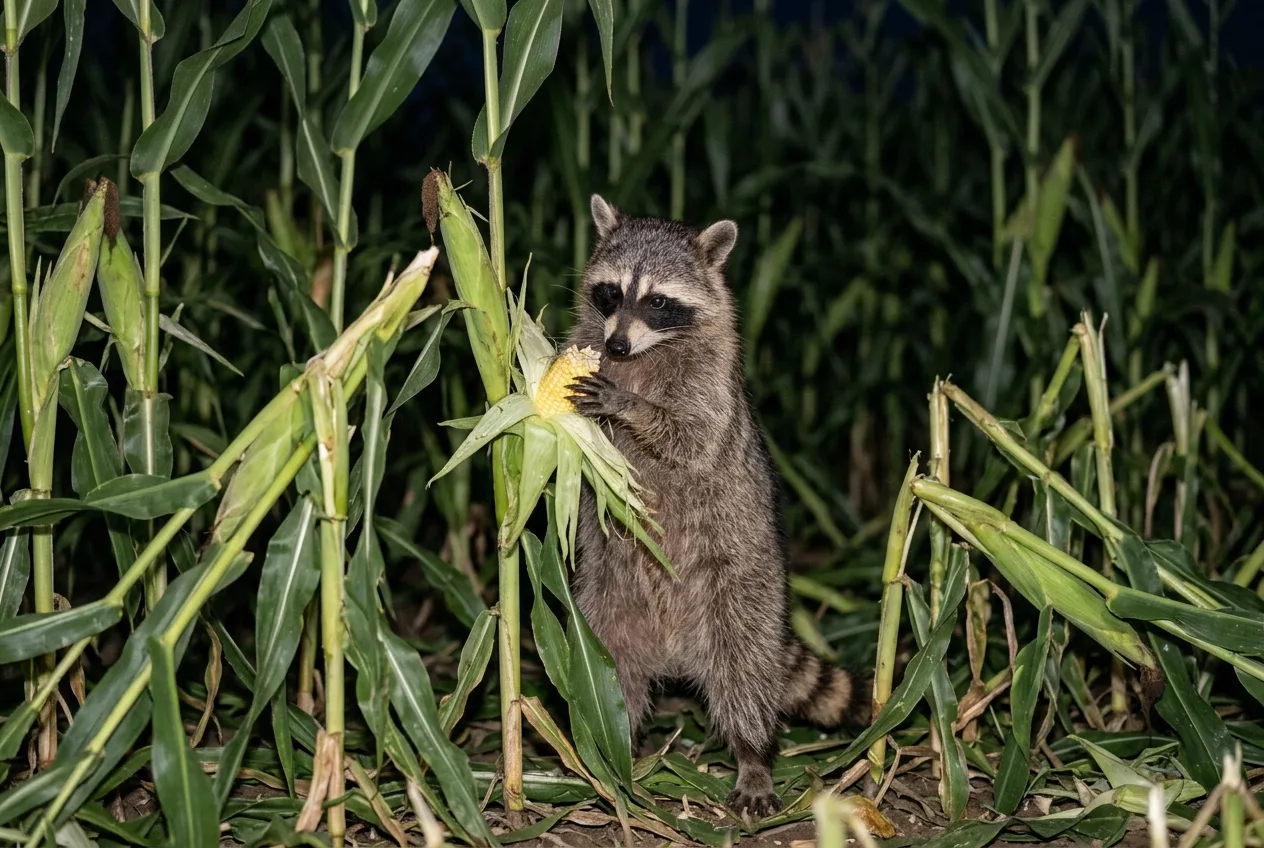
Sweet corn is where raccoons earn their reputation—and where they get away with crimes blamed on deer. A Purdue study that surveyed 160 Indiana fields found raccoons caused 87 percent of corn damage while only 10 percent was attributable to deer, the opposite of what most farmers assumed. The signs are distinct once you know them. Raccoons "do not bite through the husk, but rather pull the husks open with their teeth and claws," leaving husks with "a shredded appearance" and cobs that "appear masticated". They knock down a chaotic tangle of stalks "lying in different directions," versus deer, which knock down only a few stalks "all lying in the same direction". And they leave physical proof a deer never does: "raccoon tracks may be visible on the leaves and husks," plus claw marks on stalks and ears. Purdue's warning is worth tattooing on the barn: "Deer often frequent sites damaged by raccoons, and damage caused by raccoons often is incorrectly attributed to deer". A deer track in a trashed cornfield doesn't convict the deer.
Skunks: cone-shaped holes punched in the lawn
Skunks aren't usually after your vegetables—they're after grubs and worms in the turf, working at night. The signature is in the ground: "cone-shaped holes, about 3 inches wide and deep," often "an array of individual holes, often clustered close together". They make these by pushing their noses into the lawn and digging with their front paws, and they'll "revisit a foraging site repeatedly until the food source is gone". One reassurance from the grub angle: you don't need many grubs to attract a skunk. Iowa State notes "grub populations only typically have to be at five or more grubs per square foot to attract skunks and raccoons," well below the 20-plus it takes for grubs to actually injure the lawn—so digging animals are often a symptom, not proof of a grub crisis.
Squirrels: dug-up seed and pulled seedlings, soil flicked aside
Squirrels are mainly daytime animals—NC State lists them as "diurnal, with the greatest activity in the early morning or late afternoon hours" (the flying squirrel being the nocturnal exception). But they belong on the list because dawn damage gets blamed on the night shift. Their habit is to "dig up seed prior to emergence or pull seedlings shortly after emergence," then "feed only on the remaining seed and leave the rest of the plant". The tell is the soil: "when squirrel damage occurs, the soil will be dug to one side," and the damage clusters along field and bed edges near trees.
Quick honesty note on opossums: opossums are night-active omnivores that scavenge the same menu as skunks and raccoons — fallen fruit, vegetables, snails, slugs, insects, and eggs — rather than leaving a distinctive plant-damage signature of their own, which is why you're more likely to confirm one on camera than by its garden damage.
A deer track in a trashed cornfield doesn't convict the deer.
The small stuff: slugs, snails, and night-feeding insects
When the holes appear but no mammal-sized animal could've done it—and especially when the damage is on seedlings, soft foliage, or low fruit—turn your attention to the things you need a flashlight to find.
Slugs and snails: irregular holes with smooth edges, and that silver trail
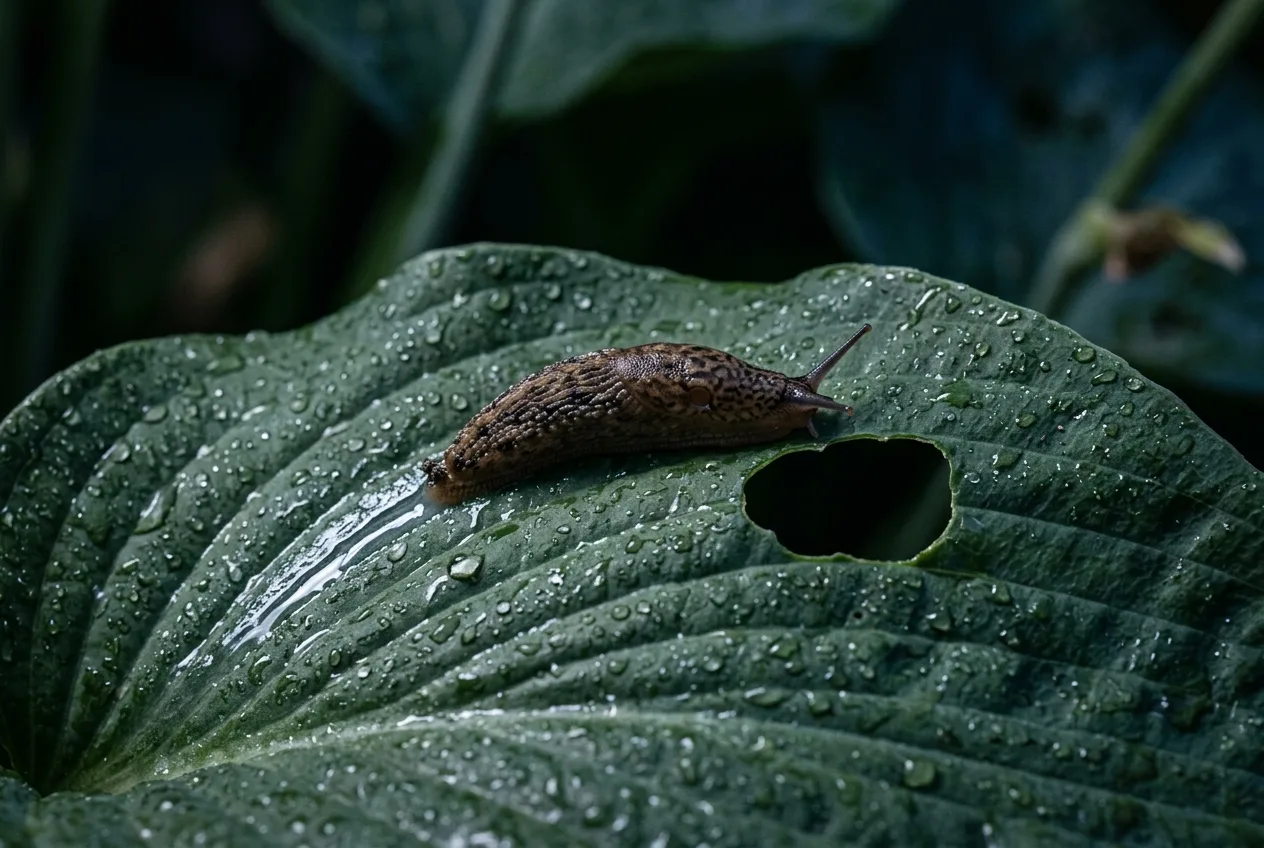
This is the one ID where a single clue is close to proof. Slugs and snails rasp "irregular holes with smooth edges on leaves and flowers" with their file-like tongues, and they leave behind "shiny slime trails". UC IPM is explicit that the trail is how you confirm them over other chewers: "Look for silvery mucous trails to confirm that slugs or snails caused the damage, rather than other pests". A dried, silvery streak on a leaf means slugs are active, full stop.
They're strictly creatures of the dark and damp—"most active at night and on cloudy or foggy days", surging "during and following damp, rainy weather" and nearly vanishing in dry spells. Iowa State puts the frustration well: "Slugs are nocturnal and feed at night when we can't see them". They favor seedlings and tender foliage, and they love hostas, plus basil, beans, cabbage, lettuce, dahlias, and ripening fruit that touches the soil like strawberries and tomatoes. In Wisconsin, tomatoes get hit "just as they ripen". To confirm, water late in the afternoon to draw them out, then "search them out using a flashlight" after dark.
Earwigs: ragged little holes, but no slime
Earwig damage looks a lot like slug damage—they "chew out numerous, small, irregular holes leaving the leaves with a ragged appearance"—which is exactly why the slime test matters. Wisconsin Horticulture draws the line cleanly: earwigs "don't leave behind a telltale slime trail as do slugs". UMN says the same: "earwig feeding may look like slug feeding. Slugs leave a slime trail but earwigs do not". Earwig damage can also be mistaken for cutworm or even rabbit feeding, so a nighttime check is the deciding move. They go after seedlings, soft fruit, and flowers—marigolds, dahlias, zinnias, hostas—and they'll feed on sweet corn silks. They feed at night and hide by day "beneath stones, boards, or debris on the soil surface," so the confirmation is the same as for slugs: "check your garden at night with a flashlight to be sure that earwigs really are the culprits".
Cutworms: seedlings clipped off at the soil line
If young transplants are toppling—severed cleanly "just above the soil surface," sometimes lying right there next to the stump—suspect cutworms. These dull brown caterpillars "curl their bodies around the stem and feed on it," cutting the plant off at ground level, and they "feed in the evening or night," hiding in the soil by day. It's "not uncommon to see damaged or clipped plants and no larvae," which is what makes them so maddening. The damage is worst early in the season on small, tender plants. To confirm, UMN says to "run your hand over the soil, rolling over soil clumps and other potential hiding places, within one foot of the damage"—a real cutworm will "curl up into a 'C'" when you disturb it. The C-curl is the signature. UC IPM's old-school field method still works best: "hand-picking at night with a flashlight is very effective".
Hornworms: defoliated tomatoes and unmistakable droppings
Tomato hornworms are camouflage masters—"up to four inches in length" but they "blend in with the leaves," so you usually spot the evidence before the animal. The evidence is twofold: stripped foliage on the upper plant, and droppings. UC IPM's diagnostic is the giveaway: "Large, black or green droppings on the ground beneath tomato plants usually indicate the presence of hornworms". UMN agrees—"as they feed, they create dark green or black droppings that are clearly visible". If your tomato is losing whole leaves from the top down and there's coarse dark frass underneath, look for a fat green caterpillar with a horn on its tail. The last larval stage "consumes nearly as much as all the younger stages combined," so they do real damage fast.
Japanese beetles: lacy, skeletonized leaves (mostly a daytime crew)
One honest correction, because it gets miscategorized: Japanese beetles are primarily daytime feeders, not nighttime ones. They earn a mention because their damage is so distinctive and so often discovered at dawn. Adults "skeletonize leaves by feeding on tissue between the major veins giving them a lace-like appearance," and damaged leaves "turn brown and may fall off". They swarm roses, grapes, lindens, raspberries, and basil among 300-plus host plants. If you find lacy, see-through leaves rather than clean holes or chewed edges, that's beetles—and in most cases "Japanese beetle damage is cosmetic only and will not kill plants". (Their grubs are a separate, underground story: they chew grass roots, and grub-damaged turf "pulls up easily from the soil, like a loose carpet"—which is also what lures the skunks and raccoons above.)
The C-curl is the signature.
Catch it in the act: confirming the culprit after dark
Every extension source above lands on the same advice when the signs are ambiguous: go out at night and look. UC IPM on slugs and snails—"Go out at night or in the early morning to view them in action". On cutworms—"hand-picking at night with a flashlight". On earwigs—"check your garden at night with a flashlight to be sure that earwigs really are the culprits". The principle is universal: the damage is a clue, but seeing the animal is proof.
The catch is that you can't stand in the bean patch every night at 2 a.m.—and for the mammals, your flashlight beam and footsteps will scare off the very animal you're trying to ID. A skunk or raccoon working a lawn is "rarely caught in the act of digging", and deer that have learned to live near people simply wait you out, feeding "late in the evening and very early in the morning" when no one's watching. That gap—between knowing something visits and knowing what—is exactly where a night-capable camera earns its place. Aim one at the wrecked bed, let it sit through a few nights, and the animal walks past and identifies itself.
A quick field cheat-sheet
- Clean 45° cut, under ~6 inches, round pellets nearby → rabbit
- Ragged, torn edges, ground level to ~6 ft, jellybean droppings → deer
- Plants mowed down near a 10–12-inch burrow → groundhog
- Stems gnawed at the base, surface runways, dead bulbs → vole
- Sod rolled back in chunks, or shredded corn husks → raccoon
- Cone-shaped 3-inch holes in the lawn → skunk
- Seed dug up, soil flicked to one side along bed edges → squirrel
- Irregular holes with smooth edges + silver slime trail → slug or snail
- Ragged little holes, no slime → earwig
- Seedlings clipped off at the soil line, C-curled caterpillar in the dirt → cutworm
- Tomato defoliated from the top, dark droppings underneath → hornworm
- Lacy, skeletonized leaves (usually daytime) → Japanese beetle
Frequently asked questions
How can I tell if a deer or a rabbit is eating my plants?
Look at the cut and the height. Rabbits bite cleanly through stems at a 45-degree angle and stay low, usually under six inches; deer have no upper teeth in front, so they tear and shred the edges, and their damage runs all the way up to about six feet. Round pellet droppings point to rabbits; jellybean-shaped piles point to deer.
What leaves small holes in my plant leaves overnight?
Most often slugs, snails, or earwigs. Slugs and snails rasp irregular holes with smooth edges and leave a shiny silver slime trail; earwigs chew similar ragged holes but leave no slime, which is the easiest way to tell them apart. Check after dark with a flashlight to confirm.
Something cut my seedlings off right at the ground—what was it?
That's the classic sign of cutworms, caterpillars that curl around a stem at night and sever the plant at the soil line, often leaving the toppled seedling behind. Sift the top inch of soil within a foot of the damage; a disturbed cutworm curls into a tight "C".
What's digging cone-shaped holes in my lawn at night?
Skunks. They punch neat cone-shaped holes about three inches wide and deep, often many clustered together, while hunting grubs and worms after dark. Raccoons hunting the same prey instead roll back chunks of sod like loose carpet.
Who's eating my sweet corn—deer or raccoons?
Usually raccoons, even when deer sign is everywhere. Raccoons pull husks open and leave them shredded with masticated cobs, knock down stalks every which way, and leave tracks and claw marks on the ears. A deer track in the field doesn't mean the deer did it — deer often just visit cornfields raccoons already tore up.
My hostas keep getting wrecked—what's the culprit?
Two very different suspects love hostas. If you see irregular holes with smooth edges and a slime trail, it's slugs. If the plant wilts or dies with little visible top damage and you find surface runways nearby, voles are eating the roots underground.