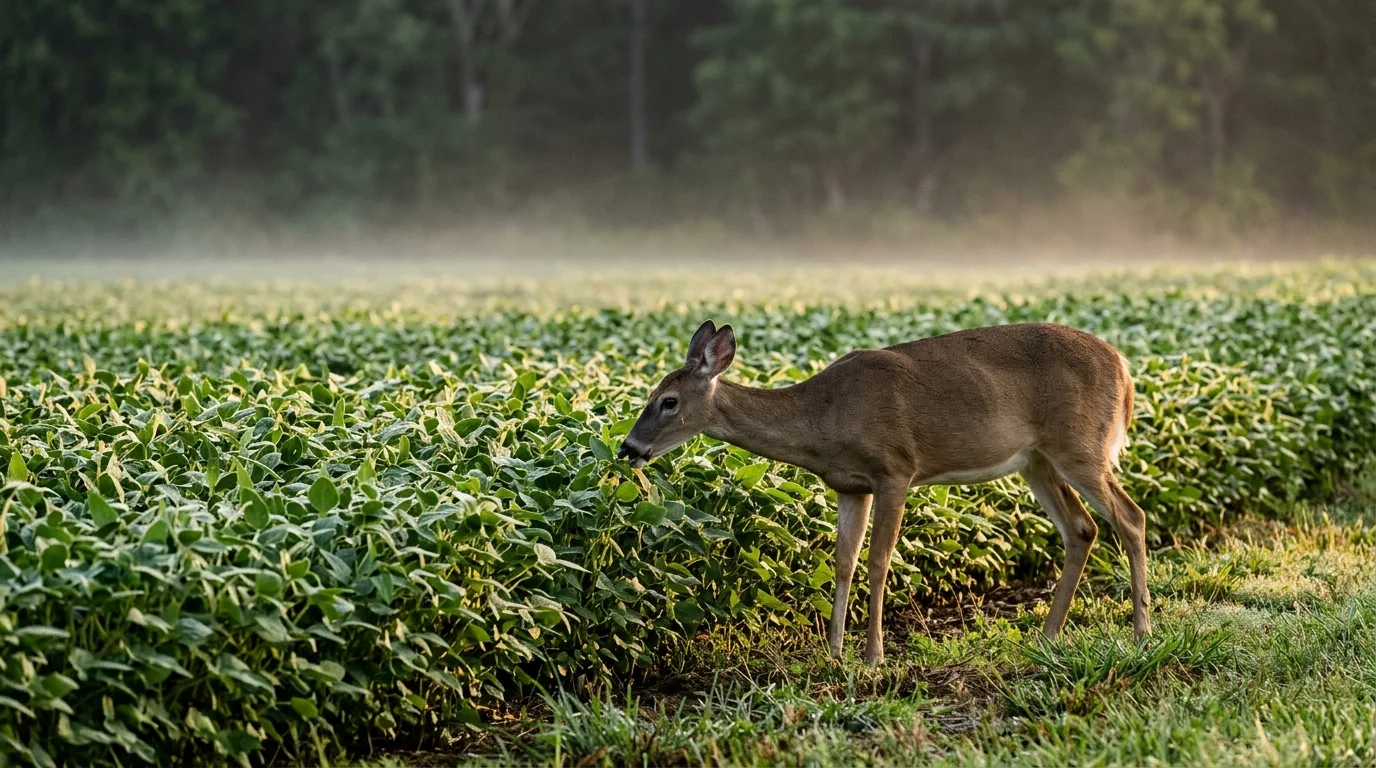
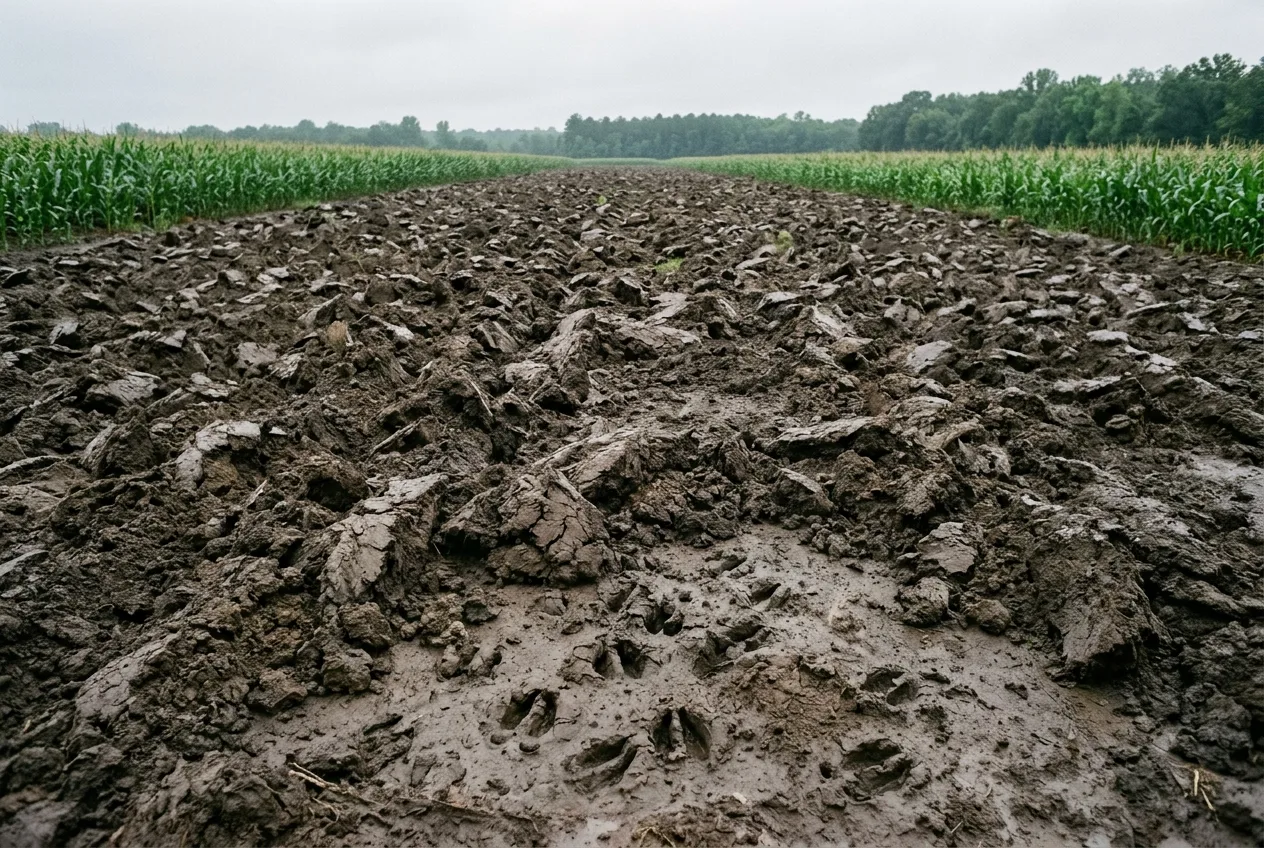
You walk a soybean field at dawn and the edge rows are gone — not nibbled, gone, cut off below the cotyledon where the plant can't recover. A week ago they were fine. Or you find a corner of a cornfield churned into a mud pit overnight, stalks knocked flat and dirt turned over like someone ran a rototiller through it in the dark. One of these is a deer problem. The other is a wild hog problem. And the single most expensive mistake a farmer can make is to treat them as the same problem, because almost nothing that stops deer will stop hogs, and almost nothing that controls hogs is necessary for deer.
Here's the short version of the strategy, and the rest of this article is the long version: before you spend a dollar on fence, repellent, or a trap, put cameras out to confirm what you're actually dealing with — which species, how many, where they enter, and when they move. Then match the response to the intel. For deer, that usually means an 8-foot fence or female-focused harvest, with repellents as a stopgap. For hogs, it means trapping whole family groups at once and never, ever just shooting at them. A camera is the cheapest tool on this list and the one that makes every other tool pay off. As one Texas landowner guide puts it, a trail camera is "an extra set of eyes on the landscape that works for no wage, never calls in sick and always tells the truth".
The stakes are real money. A 2016 USDA APHIS study pegged feral swine crop damage at roughly $190 million a year across just six crops in 10 states, and the most recent and comprehensive assessment puts total agricultural losses to wild pigs at over $1.6 billion a year across 13 states. Deer aren't far behind: a single 2024 Mississippi producer survey tallied $4.6 million in losses across corn, cotton, and soybeans on under 18,000 acres. And the dollar figures undercount the real toll: a Rutgers study of 27 New Jersey farmers — who together logged nearly $1.3 million in deer damage in a single year — documented a stack of hidden costs that never show up in a yield report, from abandoned fields and forced changes in crop rotation to extra herbicide passes, management time, and a genuine emotional toll. These aren't abstractions to a grower running on thin margins. So let's get the strategy right.
First, figure out which animal you're fighting
Deer and hogs leave different signatures, and learning to read them is free. You can often make the call from the damage alone, but cameras turn a guess into a fact — which matters because, as a Purdue field study found, farmers regularly misidentify the culprit. In that study of 160 Indiana corn and soybean fields, growers were convinced deer were eating their corn, when systematic surveys showed raccoons caused 87 percent of the corn damage — more than eight times what deer did. Misreading the offender leads to spending money on the wrong fix.
What deer damage looks like. Deer are browsers, so the damage is scattered through the field and concentrated near travel corridors and the woods' edge. They lack upper incisors, so a browsed soybean stem has a torn, ragged tip rather than the clean 45-degree cut a rabbit or groundhog leaves. On corn, deer target the newest green growth from the time the plant is a few inches tall, and they get especially determined once corn hits about 2.5 feet — a comfortable feeding height. Later they pull emerging kernels from the cob, and a damaged cob often shows a bitten-in-half look. Critically, deer feed higher on the plant and leave it standing; they don't knock corn over the way a raccoon does.
What hog damage looks like. Rooting is the giveaway — pigs use their snouts to turn over soil in search of roots, tubers, grubs, and seed, churning anywhere from a few square feet to several hundred. A single wild pig can disturb roughly 6.5 square feet of ground in one minute. Beyond rooting, hogs trample standing crops, wallow in low wet spots, and rub on fence posts hard enough to wreck a fence line. In Texas, trampling and rooting — not direct eating — account for 90 to 95 percent of crop damage in some cases. The scale is what stuns people: a group of 10 to 12 hogs "can destroy 10 to 20 acres overnight," and one pig can do at least $1,000 in damage in a single night. Their tracks are rounder than a deer's, with the toes rounder and the dewclaws set wider apart; the deer track is narrower, with a pointier toe, like an upside-down heart.
Misreading the offender leads to spending money on the wrong fix.
Use cameras to scout before you spend
A camera survey for crop protection isn't complicated, and it answers four questions that determine what you do next: which species, how many, where they enter, and when they move.
Where to put cameras. For hogs, the highest-value spots are active trails, wallows, and any area already showing fresh sign — researchers note that existing hog sign is one of the best predictors of how fast pigs will find a new site. For deer, mount cameras on well-used trails into the field; one study found that trail sets can be a practical alternative to baited camera sites for surveying deer. Put cameras where the animals enter the field, not in the middle of the damage — you want to learn the door they're using.
Motion mode versus time-lapse. Trail cameras give you two basic tools. Motion-activated mode fires when something trips the sensor, which is what you want on a trail or a trap site. Time-lapse mode shoots an image every one to five seconds and is built for watching a wide-open field over time. For confirming a culprit and timing activity, motion mode on the entry trail is usually the move.
Expect to be working at night. Both species lean nocturnal, and hogs especially so — they're frequently active mostly through the night, with their daytime movement squeezed into early morning and late evening, which makes in-person observation nearly useless. Hogs also turn more nocturnal once they've been disturbed or hunted. This is precisely why cameras beat eyeballs: they're watching the field at 2 a.m. when you're asleep and the animals are feeding.
Count what you can. Baited camera sites let you see how many hogs are using an area and their body sizes, which directly tells you whether you're dealing with a lone boar or a sounder — and that distinction decides your control method. The camera shows you the door, the schedule, and the head count. Now you can choose the right response, and the rest of this article is about choosing well.
The camera shows you the door, the schedule, and the head count.
Stopping deer: fences first, everything else second
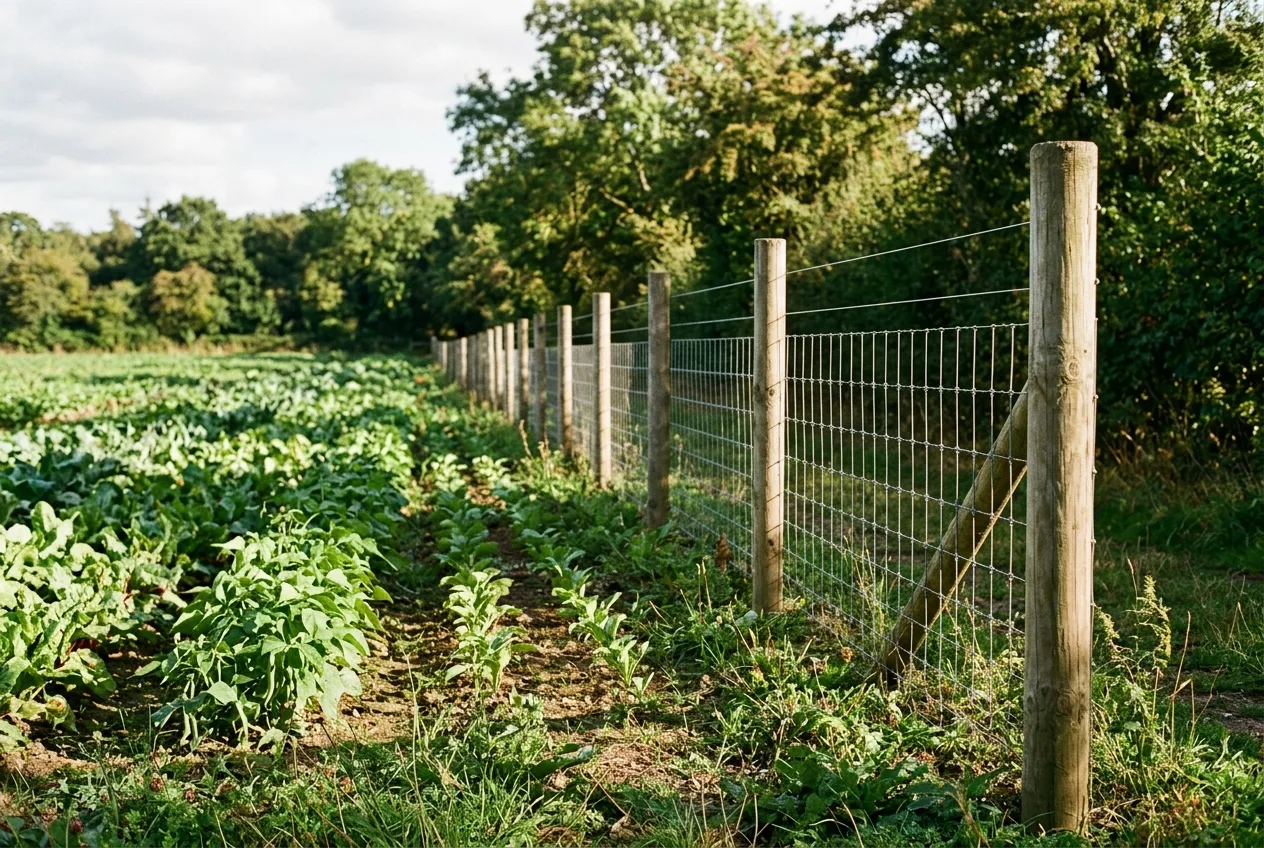
If you want a number to anchor on, here it is: an 8-foot fence works. In controlled research where deer were deliberately driven at fences of this height on multiple attempts, an 8-foot fence achieved 100 percent deterrence. Deer are discouraged by 7-foot fences and somewhat by 5-foot fences around small areas, but the lower you go below 8 feet, the more likely a deer clears it. So the gold standard for a high-value crop is straightforward in principle: build it tall.
Permanent fencing that actually stops deer
For long-term, near-total protection, 8- to 10-foot woven or welded wire is the most reliable barrier — and it's the most expensive. The fence has to extend to the ground so deer can't duck under it, and the classic build uses tall (16-foot) posts anchored 4 to 6 feet deep at about 40-foot intervals, with high-tensile woven wire and a couple of smooth strands up top to reach 9 to 10 feet. Done right, high-tensile woven wire lasts 20 to 30 years.
What does it cost? The Rutgers Snyder Farm, which has run deer-fence cost-share programs in New Jersey for over two decades, puts high-tensile woven wire — what they flatly call "the gold standard for reducing deer damage" — at around $10 per foot installed. That's the honest reason most farmers don't fence everything: at $10 a foot, only high-value crops like vegetables, nursery stock, and fruit generate enough return per acre to justify it. One real lever on that cost: farmers who install the fence themselves can cut out-of-pocket expense by roughly 35 percent. Over 20 years, New Jersey growers installed more than 1.2 million feet of this fencing through cost-share programs — and even that covered only a small fraction of the state's farmland.
Electric fences: cheaper, and they buy you the vulnerable weeks
You don't always need permanent woven wire. Multi-strand high-tensile electric fencing — permanent versions with at least five wires, or two-tiered designs — generally costs less to install than woven wire and can achieve near-full exclusion when it's properly maintained. A widely cited setup is the 5-foot vertical 5-strand high-tensile electric fence, which Iowa State calls the most effective permanent electric option. The University of Nebraska's wildlife-damage center details a 7-wire vertical design on 8-foot posts, 12½-gauge high-tensile wire at 200 pounds of tension, run off a high-voltage, low-impedance charger pushing at least 3,000 volts at the farthest point.
Temporary electric polytape is the budget option, and it has a real role: it's cheap, it goes up fast, and it can protect the few weeks when a crop is most vulnerable. A 5-strand polyrope fence was measured at 99 percent effective in one study — with the honest caveat that a single yearling doe learned to penetrate it repeatedly, a reminder that some individual deer will defeat any fence. Polytape and polywire can protect up to 40 acres under moderate deer pressure. For very small, high-value plots, Indiana DNR notes a single-strand polytape fence about 30 inches off the ground can be effective up to 40 acres, with a second strand at 6 inches to deter smaller animals.
One trick that punches above its weight on any electric fence: bait the wire. Smearing thinned peanut butter (or molasses) on the strand at deer nose height lures the deer into a nose-to-fence contact, and the shock teaches avoidance fast. The cheapest version of all, the "peanut butter fence" — 17-gauge wire on fiberglass rods with foil-and-peanut-butter tabs — runs about $0.11 per linear foot and works on gardens, nurseries, and orchards up to about 5 acres under moderate pressure. It is not a row-crop solution, but for a market garden it's nearly free.
A blunt caveat on electric fences: they only work if you maintain them. That means mowing or spraying the fence line so weeds don't short out the bottom wire, and on temporary fences, re-baiting every week or two. Skip the maintenance and you've built an expensive clothesline.
Repellents: a stopgap, not a season-long answer
This is where I'll push back on a common hope. Farmers want repellents to be the easy answer — spray it on, walk away. The data says manage your expectations. As Nebraska's damage center puts it, "success with repellents is measured in the reduction, not total elimination, of damage," and the best repellents only hold for about 4 to 6 weeks under moderate pressure. Indiana DNR is blunter: most commercial repellents have "limited effectiveness at deterring deer," and dew and humidity sap their potency.
The controlled trials tell a more interesting — and more cautionary — story. Michigan State tested two products on soybeans: one (putrescent egg solids) cut early defoliation by about 17 to 19 percent for roughly three weeks; the thiram product managed only 7 percent and lasted under a week. At two other Michigan sites, soap-based repellents and a blood-based product slashed early-season defoliation by 66 to 71 percent at one location — a great-looking number — and yet soybean yield was not significantly different between treated and untreated plots. Late-season pod feeding erased the early gains. The researchers' bottom line is one every grower should tattoo on the spray tank: "the economic cost of a third or fourth repellent application could outweigh the value of yield preserved in a commodity crop".
The University of Maryland's multi-year work adds the nuance that keeps repellents in the toolbox. On one heavily pressured farm, repellents were associated with a soybean yield jump from 17.2 bushels per acre in an untreated year to 48.8 the next year — a 183 percent increase. That's the headline number, and it's real, but the same researchers are careful to note that the within-year caged-versus-exposed comparison was not statistically significant, that the second year of the study (a drought) saw repellents fail badly, and that on a small 3.5-acre plot under heavy deer pressure the crop was a 100 percent loss in both years despite spraying. Repellent costs run anywhere from about $7.41 to $173.80 per acre per application depending on product, and many need three to four applications a season.
So where do repellents fit? As a bridge — protecting a crop through its few most vulnerable weeks (for soybeans, right after emergence; for corn, the silk-to-tassel stage), in fields where deer have other food nearby, ideally rotating products to slow habituation. They are not a substitute for a fence or for shooting does in a high-density situation. If crops are the only food around, even regular spraying won't hold the line.
Habitat, timing, and the female harvest
A few cheaper levers round out the deer toolkit. Diversion plantings — a sacrificial food plot or a strip of preferred forage placed between the woods and your cash crop — can pull deer off the crop during the vulnerable establishment window. Planting timing helps too: getting soybeans up and past the tender stage before the June-July fawning-and-lactation peak, or planting after neighbors so deer hammer the earlier-emerging fields instead of yours. And some crops simply aren't worth a deer's trouble — grain sorghum and grass hay are common alternatives deer largely leave alone.
But the lever that changes the actual population is harvest, and it has to be aimed correctly. Shoot does, not bucks. As Maryland's guide explains, killing a buck removes that one animal but barely dents future population growth, because other bucks will breed the available females; reducing the herd means focusing harvest on females. Iowa State, Indiana DNR, and Nebraska all land in the same place — consistent antlerless harvest is what controls deer numbers and the damage that follows. How Many Deer Are on Your Land? Running a Trail Camera Survey
But the lever that changes the actual population is harvest, and it has to be aimed correctly.
Stopping hogs: trap the whole sounder, or don't bother
Now flip to the other field, the churned-up one. Everything changes. The deer playbook — tall fence, repellents, doe harvest — mostly doesn't apply, and the one instinct most people have when they see hogs (grab a rifle) is actively counterproductive.
Start with why fencing usually isn't the answer for hogs and row crops. Hog-proof fence works, but it's heavy-duty and expensive: minimum 48 inches tall (60 inches is much better), wire mesh with 2-inch spacing near the bottom widening up the fence, posts 8 to 10 feet apart sunk 10 to 20 inches, and the bottom of the mesh buried 12 inches underground to stop pigs from rooting under it. Georgia's feral swine program says it plainly: fencing large fields, orchards, or vineyards against hogs "is unlikely to be cost effective" — it's for protecting small, high-value, defensible areas like feeders or food plots, not row-crop acreage. For the crop, you control the population instead.
Why shooting backfires — and the data behind it
This is the hardest idea for a lot of landowners to accept, so let me make the case with evidence rather than opinion. Recreational hunting and casual shooting of hogs don't reduce populations; they scatter and educate them. Shoot into a sounder and you might drop one, but the rest bolt, get warier, go more nocturnal, and become far harder to catch. Worse, the financial incentive of hog hunting has driven people to illegally haul live pigs into new areas to establish populations. The natural experiments are damning: when Tennessee opened a hog hunting season in 1999, its hog range exploded from about 15 counties to nearly 80, and the state later banned hog hunting and went to work eradicating them. California designated wild pigs a game animal in 1956; by 1999 they'd spread from a few coastal counties to 56 of the state's 58.
The math underneath this is brutal. To merely hold a hog population steady, you have to remove an estimated 66 to 70 percent of it every year; Louisiana's wildlife agency puts the control threshold at 70 to 75 percent. Texas, with all its hunting, achieves only about 29 percent annual reduction. You cannot shoot your way to that number one pig at a time, because hogs breed faster than you can pick them off — populations can double in four months under good conditions, sows produce two litters a year of 4 to 6 (sometimes up to 13) piglets, and females can breed by 6 months old. Dog hunting fares no better as control: it's good at locating hogs but typically captures only one or two at a time. Bounty programs often backfire, because they incentivize baiting and selectively taking trophy boars — and sometimes incentivize keeping pigs around for future profit.
Whole-sounder trapping is the method that works
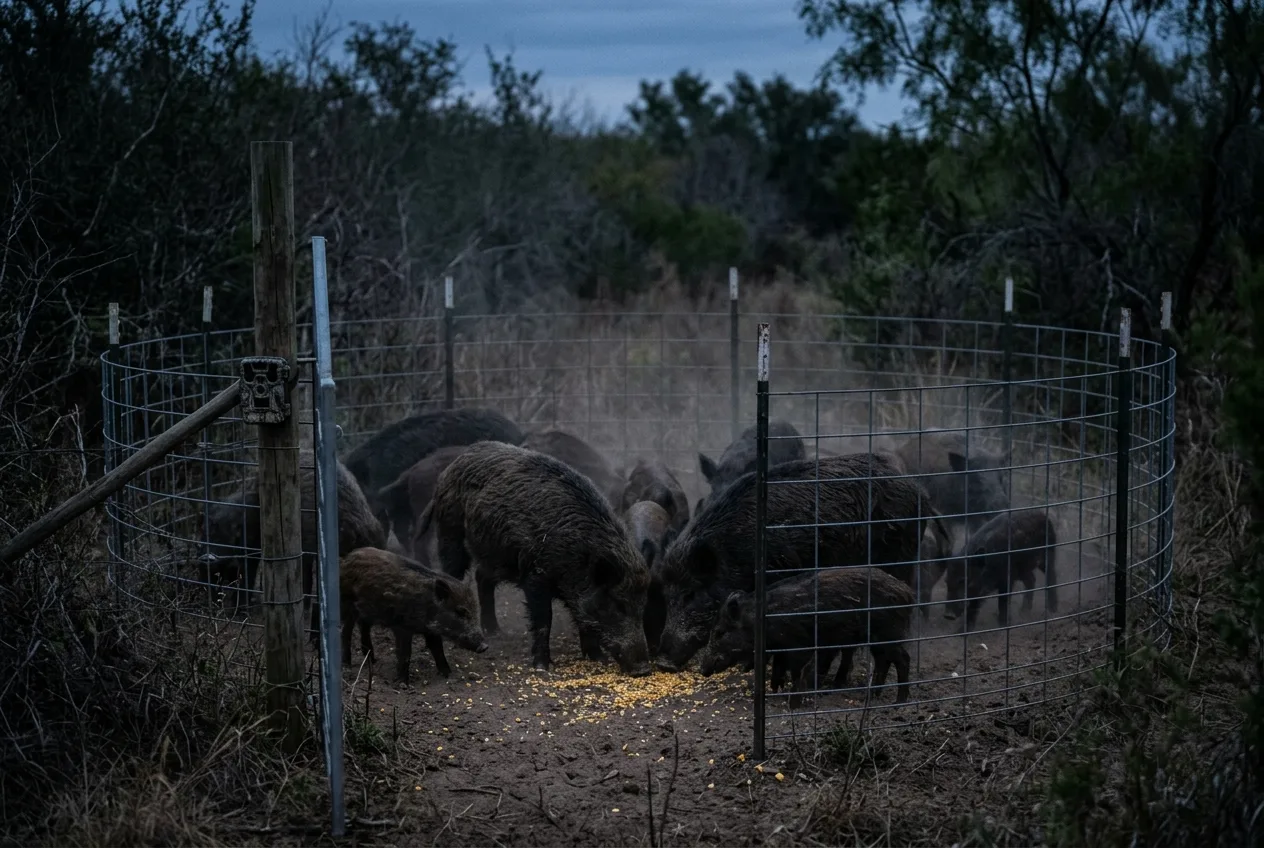
The thing that actually reduces hog numbers is corral trapping with whole-sounder removal — catching an entire family group at once and letting none escape. Georgia's program states it directly: "corral trapping and whole-sounder removal is the most effective method of reducing feral swine populations," and corral traps catch over four times as many pigs as box traps. Box (cage) traps still have a place for a lone, persistent boar — they're portable and easy to move — but they only take a few animals and risk educating the rest of the sounder.
The peer-reviewed trap comparison makes the case in hard numbers. In a three-year Oklahoma study that removed 601 pigs, suspended traps removed 88.1 percent of the estimated population and drop nets 85.7 percent, while conventional corral traps removed only 48.5 percent. The high-tech traps caught sounders 2 to 2.5 times larger than corral traps did, and a single suspended trap once caught as many as 30 pigs in one event. Efficiency followed the same pattern: the suspended trap needed just 0.64 person-hours per pig thanks to real-time alerts and remote triggering, versus 1.9 for drop nets and 2.3 for corral traps. The study's takeaway is exactly the one this article is built around: the limitation of old corral traps — false triggers and failing to capture whole sounders — can be fixed by adding "commercially available technology to corral traps to make them user-activated".
And there's an iron rule that goes with trapping: stop all hunting and shooting while you trap. Georgia's program is unambiguous — when running a trapping operation, halt all hunting, dog hunting, and shooting on the property, and on neighboring properties if you can, because a single disturbance scatters the sounder and ruins weeks of patient baiting. Pre-baiting matters too: hogs are cautious about anything new, so a corral trap typically needs several weeks of baiting before you spring it.
The thing that actually reduces hog numbers is corral trapping with whole-sounder removal — catching an entire family group at once and letting none escape.
Where the camera makes trapping work
This is the moment the whole strategy clicks together. Whole-sounder trapping lives or dies on knowing the exact moment every pig in the group is inside the trap — and that's a camera's job. During pre-baiting, the camera's video feature lets you watch the pigs interact with the trap and learn when the whole sounder is comfortable walking in. The footage also tells you which fix fits: a lone boar on camera is a candidate for targeted shooting, while a sounder calls for the corral trap.
Cellular cameras take it further. They transmit photos in real time to your phone and run for months on solar or battery packs without you disturbing the site — and they cost roughly double a standard camera. Pair one with a remotely triggered gate and you have the modern best practice that agencies now use: the camera texts or emails you the instant something hits the bait, you pull up the live feed, confirm the entire sounder is under the trap, and drop the gate from your phone — even from miles away. Missouri's wildlife agency, which removed 3,649 hogs in a single year with this approach, calls these remote drop-style traps "the most efficient and effective feral hog eradication tool used to date". The reason it beats a tripwire is simple: a tripwire fires when the first pig hits it and the rest escape; a camera-fed remote gate waits for the whole family.
One more piece of strategy from Missouri: hogs keep a home range — about 1,000 acres for a typical sounder — and if undisturbed they stay near it. So you don't trap everywhere there's a pig; you find where a sounder spends most of its time and set the trap there, working through sounders one at a time across the landscape. Cameras are how you map that.
When trapping can't reach them — rough, roadless country with high hog densities — aerial gunning is the agency tool, removing anywhere from 4 to nearly 24 hogs per hour depending on cover, and 31, 56, and 67 percent of a population over one, two, and three flights in a Texas study. But it's expensive (over $1,000 per hour of flight) and needs trained crews, big contiguous acreage, and open canopy. For most farmers, the realistic plan is: scout with cameras, trap whole sounders with a camera-triggered gate, and use targeted night shooting only to mop up the last wary individuals after the trap has done its work.

Don't forget the disease threat — it raises the stakes
There's a reason agencies treat hogs as a near-emergency rather than just a nuisance, and it's not only the crop bill. Wild pigs carry at least 45 parasites and diseases, including swine brucellosis, pseudorabies, leptospirosis, and trichinosis, several of which jump to livestock, pets, or people. They contaminate water with fecal coliforms and can pass disease to a hog operation through shared feed and water. If you handle a carcass, wear gloves, keep fluids out of your eyes and mouth, and cook wild pork to an internal 165 to 170°F — freezing won't kill trichina.
The nightmare scenario is African swine fever. It's not in the U.S. yet, there's no licensed vaccine for broad use, and the virus is present in essentially all secretions and tissues of an infected animal. If ASF ever established in feral pigs here, preliminary projections put losses to the U.S. pork industry at $15 billion over two years and up to $50 billion over ten — and an outbreak could halt the export market that took in $7.7 billion of U.S. pork in 2022. With an estimated 2.5 million-plus feral pigs in Texas alone serving as a potential reservoir, the case for driving hog numbers down now — before that bridge is ever crossed — is as much about the national herd as your own field. It's the strongest argument going for why hog control is worth doing right.
The single most expensive mistake a farmer can make is to treat them as the same problem.
Putting it together: one strategy, two playbooks
If you take nothing else from this, take the sequence. Scout first. Hang cameras on the trails into the damaged field and let them tell you the species, the head count, the entry point, and the schedule. Then split:
- If it's deer: for a high-value crop, an 8-foot fence is the durable answer (around $10/foot, less if you build it yourself); a 5-strand high-tensile or baited polytape electric fence is the cheaper near-equivalent for seasonal protection; repellents are a 4-to-6-week bridge through the vulnerable window, not a season; and over the long run, harvest does to bring the population down.
- If it's hogs: skip the rifle as a control tool — it scatters them and makes things worse — and trap whole sounders with a corral trap, ideally fed by a cellular camera and a remotely triggered gate so you drop the gate only when the entire family is inside; pre-bait for weeks, stop all shooting during trapping, and mop up stragglers with targeted night shooting.
The camera is the hinge between the two. It's the cheapest thing you'll buy, it tells you which playbook to open, and — for hogs especially — it's the difference between catching 9 pigs and catching one while the other eight learn to avoid you. Spend on the intel first. The rest of the money works a lot harder after that.
Frequently asked questions
How do I tell deer damage from wild hog damage in my field?
Deer browse the tops of plants and leave them standing — scattered damage near the woods' edge, ragged-tipped soybean stems (deer have no upper incisors), and cobs bitten in half. Hogs root: they turn over soil into mud-pit patches, trample and wallow standing crops, and leave rounder tracks with wider-set dewclaws than a deer's heart-shaped print. A camera on the entry trail confirms it within a night or two.
Will a fence keep deer out of my crops, and how tall does it need to be?
Yes, if it's tall enough. Research shows an 8-foot fence gives essentially 100 percent deer deterrence; 7-foot discourages them and 5-foot only helps on small plots. High-tensile woven wire (8–10 feet) is the gold-standard permanent option at about $10 per foot, and a 5-strand high-tensile or baited polytape electric fence is a cheaper choice for seasonal protection.
Why shouldn't I just shoot wild hogs to protect my crops?
Because shooting at a sounder scatters it, makes the survivors warier and more nocturnal, and rarely removes enough animals to matter — you need to take 66–75 percent of a hog population every year just to hold it steady. Trapping entire family groups at once is what actually reduces numbers.
What's the most effective way to trap wild hogs?
Whole-sounder removal with a corral trap, so no pigs escape to get "trap-shy." Catching the entire family group at once is what actually drives numbers down — the more pigs that escape, the warier the survivors become. A cellular trail camera plus a remotely triggered gate lets you watch the bait site on your phone and drop the gate only when the entire sounder is inside.
Do deer repellents actually protect a soybean or corn crop?
Only partially, and usually not enough to save final yield on a commodity crop. Repellents can sharply cut early-season defoliation yet produce no significant yield difference versus untreated plots, because late-season feeding erases the early gains. Use them as a 4-to-6-week bridge during the most vulnerable stage, rotate products, and don't count on a third or fourth application paying for itself.
How much do deer and wild hogs actually cost farmers?
A lot, and more than insurance shows. Wild pigs cause an estimated $1.6 billion in annual U.S. agricultural losses across 13 states in the most comprehensive recent assessment, and an older USDA study put crop damage alone at $190 million across six crops. For deer, one 2024 Mississippi survey found $4.6 million in losses on under 18,000 acres, averaging $188–$310 per acre by crop. Crop-insurance payments capture under 1.5 percent of wildlife damage, so the real toll is higher.