The cruelest thing about losing a fruit tree to wildlife is the timing. The damage that kills it usually happens in the dead of the dormant season, under snow or mulch, out of sight — and you don't find out until the following summer, when the tree leafs out weakly, sets a handful of stunted fruit, and then quietly gives up. By then the bark is already gone in a ring around the base, and there's nothing you can do. A vole did it in January. You found out in July.
That lag is why bark damage is so under-managed compared to, say, deer eating your lettuce. You can see a deer in the garden. You almost never see the animal that girdles a young apple tree. So the whole game here is prevention you put in place before anything happens, on the assumption that something will.
Three kinds of animals do the real harm to fruit trees, and they damage trees in three different ways. Deer browse the tender new growth and, in the case of bucks, rub their antlers against young trunks hard enough to strip the bark. Voles and mice gnaw the bark away at ground level — the classic girdling that kills young orchard trees from the base up. And rabbits and hares chew bark higher up the trunk, especially in winter when snow buries everything else they'd rather eat. The defenses overlap, but they aren't interchangeable: the wire that stops a vole won't stop a deer, and the tube that stops a deer rub may do nothing for a vole tunneling under the snow. Get the threat wrong and you'll buy the wrong guard.
A vole did it in January. You found out in July.
Here's the good news threaded through all of it: the trees most at risk are young trees. Once bark thickens and corks up — roughly when a trunk passes three to four inches in diameter — most of these animals lose interest or lose the ability to do real harm. You're protecting a window, not a forever. Get a tree through its first several seasons and the problem largely solves itself.
Know which animal you're fighting
You can't pick the right defense until you know what's doing the damage, and the animals leave surprisingly distinct signatures. The trick is to read three things together: the height of the damage, the texture of the cut or gnaw, and the sign around the tree.
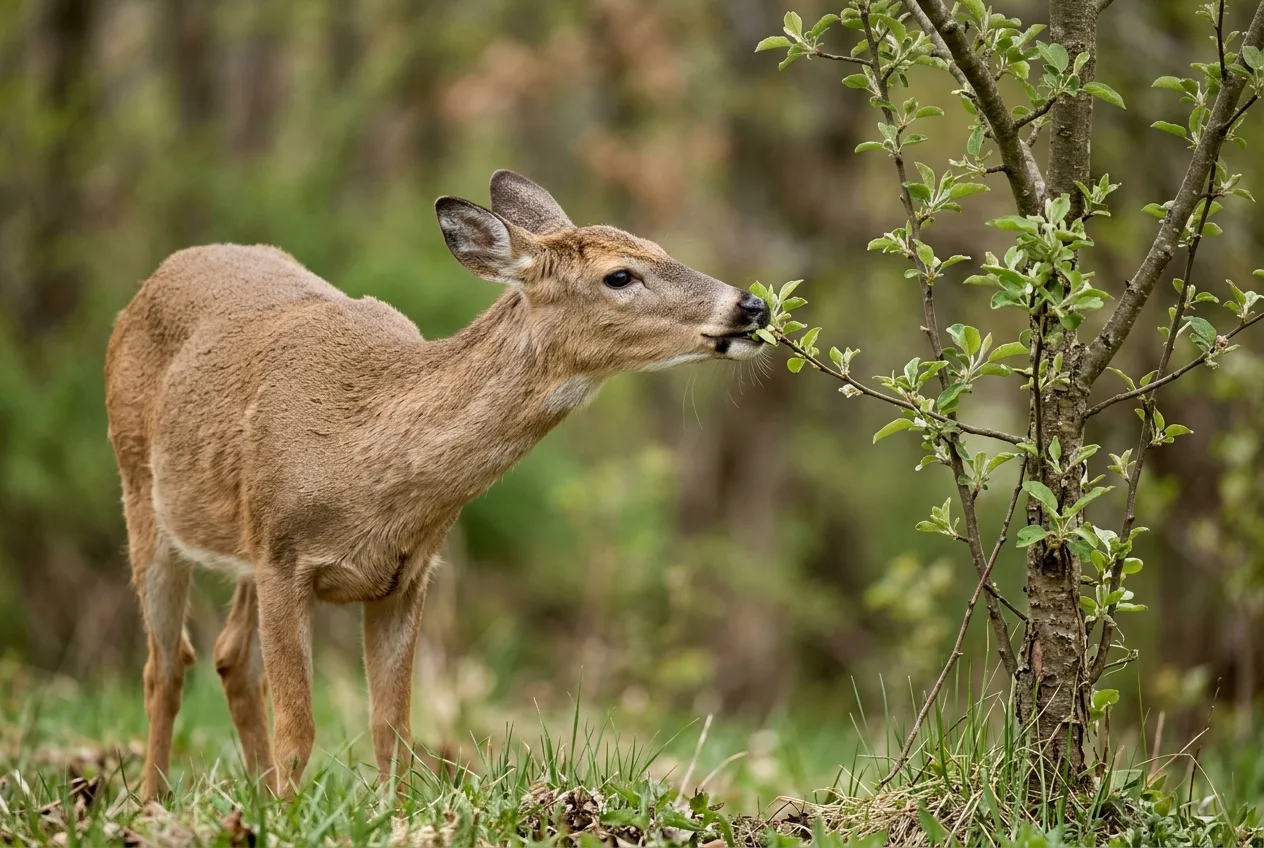
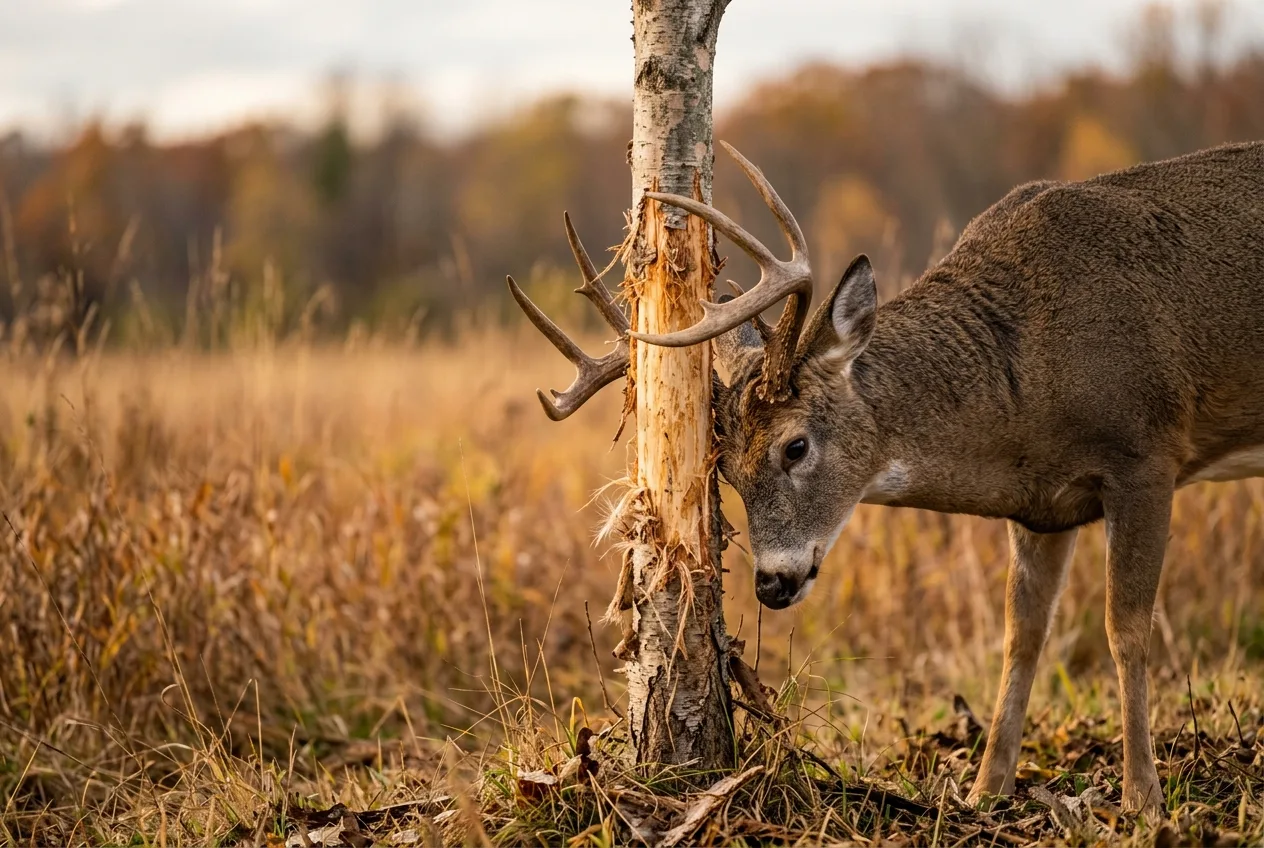
Deer are the easy one to read. They lack upper incisors, so they can't bite cleanly — they grip and tear, leaving a ragged, jagged end on a browsed twig rather than a knife-clean cut. On stems you'll often see a shoot bitten part-way through and then tugged off, frayed where it broke. Browsing happens high — generally from about six feet down — which alone rules out every smaller animal. And antler damage has its own look: vertical scrapes and torn strips of bark where a buck raked his antlers, typically a foot and a half to three and a half feet off the ground, sometimes with limbs broken in the process.
Rodents leave a clean cut; deer leave a torn one. That single tell sorts most of your damage at a glance.
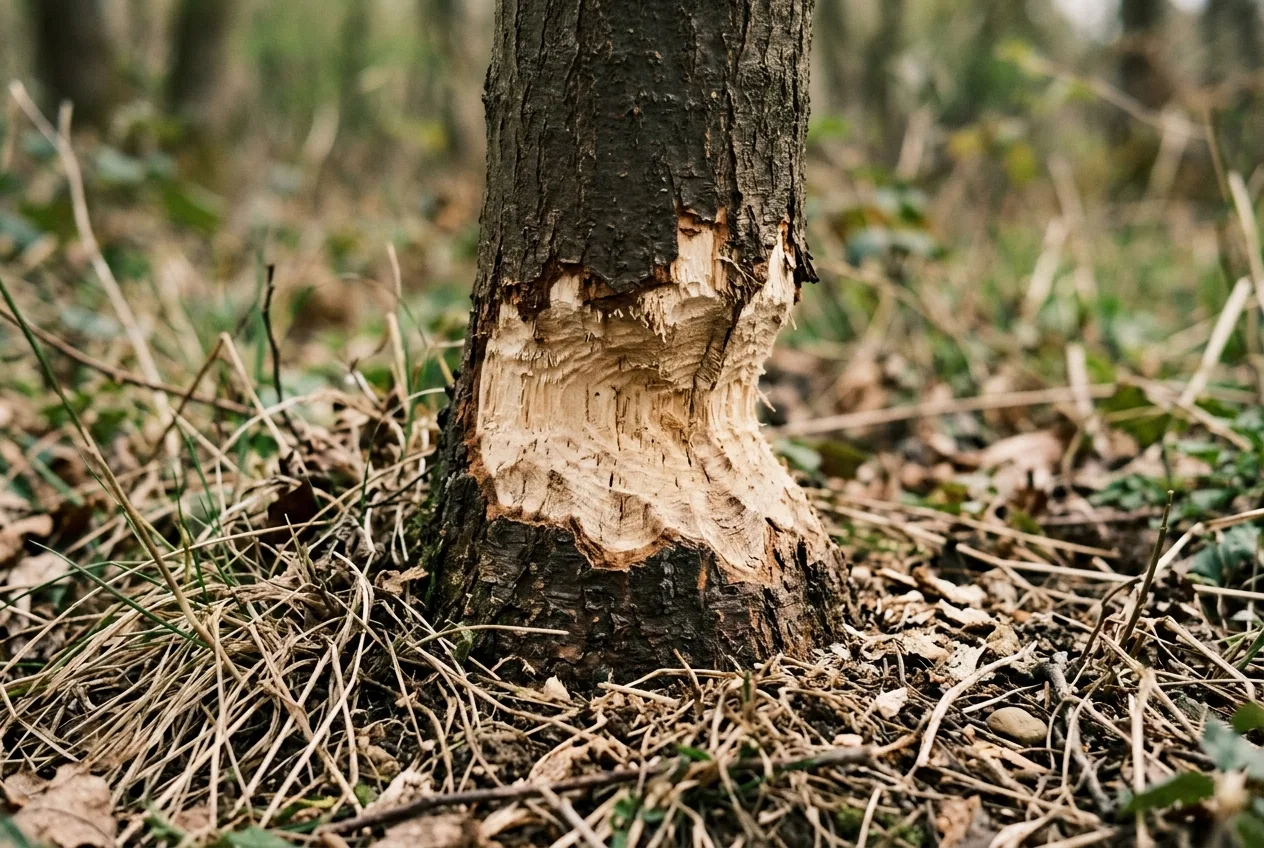
Voles work at and just below the soil line, and their gnawing is fine and patterned. Look for paired grooves left by their chisel-teeth, only about a sixteenth of an inch wide, in irregular patches running at various angles — individual marks roughly an eighth of an inch wide and three-eighths long. The surest sign isn't on the tree at all: it's the network of surface runways in the grass, about one to two inches wide, kept clear of vegetation, often with little piles of rice-grain droppings. After a close mow, those runways stand out plainly. There's a complication, though. Two kinds of vole cause trouble, and one of them you can't see. Meadow voles girdle aboveground where you can spot it; pine (woodland) voles work underground, eating roots and girdling below the surface, and their damage often goes unnoticed until the tree is already declining and can't be saved. If a young tree is failing for no obvious reason and you can rock it loose or push a finger easily into soft, tunneled soil at its base, suspect pine voles.
Rabbits and hares chew bark too, but bigger and rougher. Their incisors are much larger than a vole's, so the gnaw marks are correspondingly larger and less distinct, and rabbits tend to start a few inches above the soil line rather than right at it. They also clip small branches with a clean, angled, almost pruned-looking cut — a useful contrast with the deer's torn tug. Rabbit and hare bark-stripping is mostly a winter behavior, kicking in when snow or frost makes their usual greenery unavailable. One more wrinkle worth knowing: a vole isn't the only animal that girdles at ground level. Pocket gophers do too, but their damage is usually below ground while voles' is mostly above it, and the burrow openings differ — so check for runways and open holes before you commit to a control.
If you genuinely can't tell who's visiting — and at night, in winter, you often can't — this is the one spot where a camera earns its keep. A trail camera aimed at a row of young trees will tell you whether you're dealing with deer at dusk, rabbits at dawn, or something smaller, and that answer changes which guard you buy.
Stopping voles and mice: the bark damage you'll never see coming
Voles are, frankly, the threat most likely to kill a young fruit tree outright, and the one growers underestimate most. The numbers are sobering. North Carolina pegged annual vole losses to its apple growers at $2.5 million. In Washington apple orchards, a population of 1,700 voles per acre cut production by 35% — about $3,036 per acre in a single year, with two-year losses around $6,100 per acre. Pine voles in New York knocked McIntosh yield down 66%. These aren't freak events; vole populations swing on roughly three-to-four-year boom-and-bust cycles, and a peak year in an unprotected orchard is genuinely destructive.
What makes voles so dangerous to trees specifically is that they girdle — they gnaw the bark in a complete ring around the trunk, severing the tissue that moves food and water, and a fully girdled tree dies above the ring with nothing you can do to reverse it. Young trees are the targets: thin, succulent bark is easy to gnaw through, while older trees with thick, corky bark mostly shrug it off. Dwarf and semidwarf fruit trees on dwarfing rootstocks are especially vulnerable.
No single tactic stops voles. Every source that has actually fought them says the same thing: stack the defenses.
The single most repeated piece of advice across the orchard literature isn't a product — it's the orchard floor. Voles live and breed in dense ground cover; take away the cover and you take away the voles. Practically, that means three habits working together:
- Mow, and keep mowing. Maintain ground cover low — a few inches, mowed often enough that it never builds into a protective thatch. Close, regular mowing alone keeps meadow vole populations from establishing.
- Hold a vegetation-free strip around the trunk. Keep a band at least two feet wide on each side of the tree row clear of vegetation by mowing, cultivation, or careful herbicide. UC IPM frames it as a four-foot-diameter bare circle around each young tree, because voles simply prefer not to feed out in the open where predators can see them.
- Keep mulch away from the trunk. This is the one people get wrong. Mulch piled against the base is perfect vole habitat — it's cover and insulation in one. Pull wood mulch back at least six inches (15 cm) from small trunks, more if you can; some sources say keep it off the base entirely. A gravel or crushed-stone collar around the trunk works better than organic mulch precisely because it collapses vole runways instead of sheltering them.
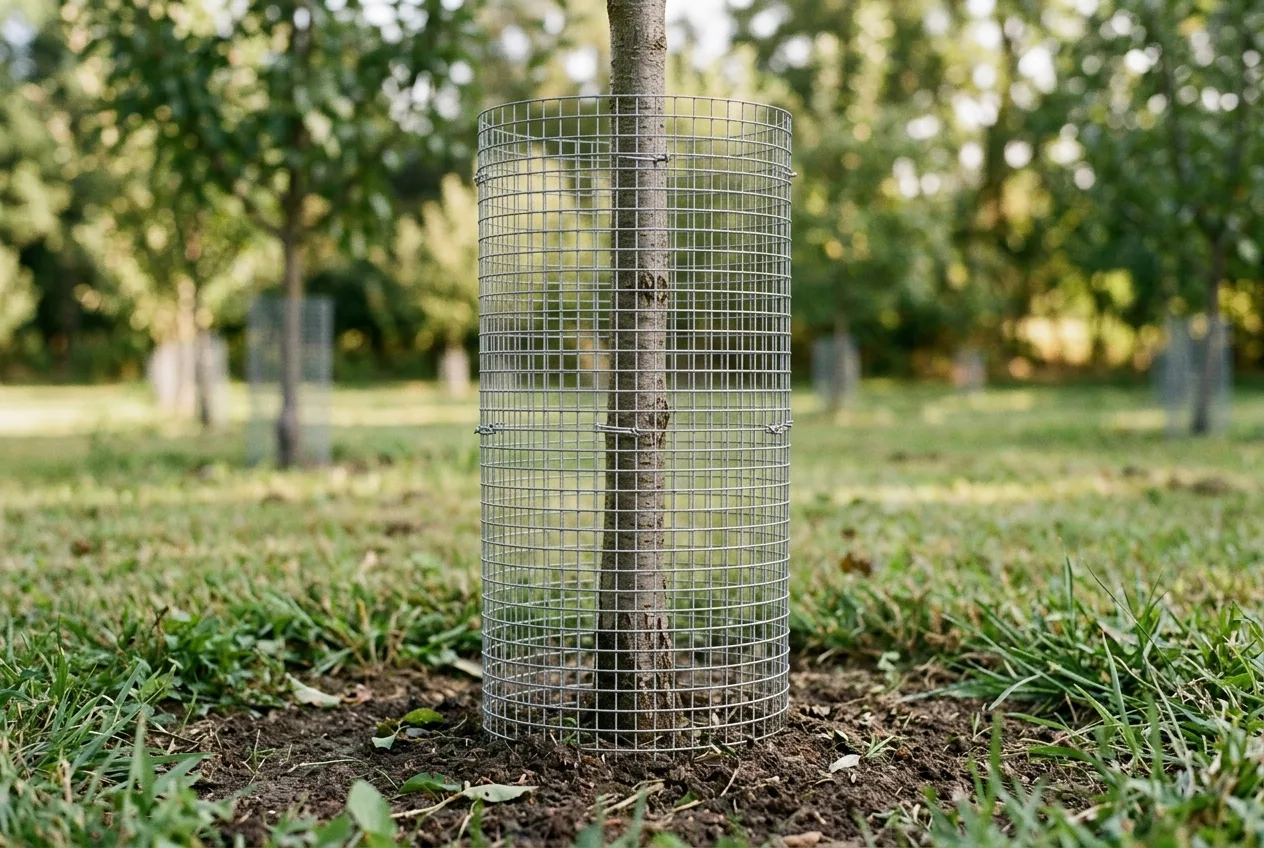
Then, on top of habitat work — not instead of it — comes the physical barrier. A cylinder of hardware cloth around the trunk is the standard, and the spec that matters most is mesh size: use ¼-inch mesh or smaller. That's the number to anchor on. You'll see ½-inch hardware cloth recommended in some guidance, but ¼-inch is the safer orchard standard because the gap on ½-inch is borderline for excluding small voles — when in doubt, go finer. The cylinder should stand roughly 18 to 24 inches (45–60 cm) high and — this is the part people skip — be buried a few inches into the soil, because voles tunnel. Different sources land between two and six inches (5–15 cm) of burial, with orchard guidance for pine voles pushing to a full six inches (15 cm) to stop them burrowing underneath. Leave space between the guard and the trunk for years of growth, and check periodically that a vole hasn't gnawed in or dug under and set up shop inside the guard, feeding in safety.
Two honest caveats. First, hardware-cloth cylinders are effective but labor-intensive and expensive at scale — practical around a few backyard trees, a real chore across a commercial block. Second, and importantly: a trunk guard does nothing against pine voles, which attack the roots underground entirely below where the cylinder sits. For pine voles, floor management and monitoring matter more than any wrap.
That points at the last piece: monitor, because vole damage is invisible until it's catastrophic. The orchard tool is the apple sign test — tuck a half-inch cube of apple under a shingle or board placed over a runway, check it after 24 hours, and a gnawed cube tells you voles are active there. Cheap, fast, and it tells you where to concentrate effort before you're reading about losses in July.
Stopping deer: browse and the antler rub
Deer hit fruit trees two ways, in two different seasons, and you defend against them differently.
The first is browsing. Deer feed on dormant shoots as readily as on growing trees, and in winter they'll strip dormant terminal buds off young trees — which on a standard tree under three years old leads to stunted, misshapen growth, and on dwarf and semidwarf trees can cut into the next season's fruit. Deer do the most damage in winter, when natural forage is scarce and the orchard is one of the few green-ish things around. Dwarf and young trees are most exposed simply because the whole tree sits within a deer's reach.
The second is the antler rub — and this one kills trees. In late summer and fall, bucks rub their antlers on saplings to strip velvet and mark territory, and the rubbing peels bark off in vertical strips. On a young, thin-barked, flexible trunk that can mean broken limbs, a girdled stem, and a dead tree if enough bark comes off. The vulnerability is specific: flexible trunks with thin, smooth bark get rubbed; once a trunk is corky and three to four inches across or more, the risk drops off sharply.
Deer browse is a winter problem; the antler rub is an autumn one — and the rub is the one that girdles trunks.
For an individual young tree, you have a few good options:
- A tube, wrap, wire cage, or cylinder around the trunk. Placed around each tree, these physically block both browse and rubbing. For deer, the barrier needs height — at least six feet (1.8 m) for an open-topped guard, though a shorter one works if it's closed on top. Plastic tubes, woven-wire mesh cylinders, and even a length of plastic drainpipe slit down one side and slipped over the trunk all do the job. Crucially for antler damage, the guard has to be in place before rut — get barriers on by late summer, since a guard installed after the rubbing starts protects nothing, and take them off in spring so they don't interfere with growth.
- The anti-rub stake trick. You don't always need to wrap the trunk. Driving three or four sturdy stakes or poles around a young tree — spaced so the gap between them is no more than about 18 inches (45 cm) — keeps a buck from getting his head close enough to rub the bark. It's quick, cheap, and one of the least labor-intensive options.
A caution from the field, though: with a small tree, a guard can backfire. Deer sometimes just push the whole protector — and the sapling with it — flat to the ground, and a tube so tight that the foliage and stem are trapped inside can stop the tree developing normally. Stake guards well, and size them to the tree.
For a whole orchard, the only thing that reliably excludes deer is a fence, and it has to be tall. The classic is an eight-foot (2.4 m) woven-wire fence — often built from two stacked four-foot widths on twelve-foot (3.7 m) posts — kept tight to the ground so deer can't crawl under. Some guidance goes to ten feet (3 m) for full reliability. In the UK, where the deer are smaller, the comparable specs are lower — roughly 1.5 m for muntjac and 1.8 m for other species, with the wire's bottom edge pegged down because roe deer will squeeze through a one-foot gap. There's one useful exception to the height rule: deer won't leap into a space they can't see room to land in, so for a small enclosure — under about 8 by 16 feet (2.4 by 4.9 m) — a fence as low as 50 inches (1.3 m) can exclude them.
Electric fencing is the other route, and it works by training behavior rather than forming a wall: deer learn to avoid the wires, often baited with peanut butter on foil so they get a shock on the nose. A five-strand high-tensile design is a common pattern — bottom wire about ten inches (25 cm) up, the others spaced twelve inches (30 cm) apart, stretched tight. Electric fences cost less but demand maintenance and regular checks that the current is live and the line isn't shorting out on weeds; you'll also want a mowed strip along the fence to keep vegetation off it.
Stopping rabbits and hares
Rabbits and hares are the in-between threat — bigger than voles, smaller than deer, and most dangerous in winter. They graze soft shoots and buds, and they strip bark from the base of young trunks when snow or frost takes their other food off the menu, which can ring-bark and kill a tree just as a vole can. Rabbits reach the bark by standing up on their hind legs, so they work a band from the ground up to about 50 cm (20 in); hares reach higher still and can be methodical, working straight down a freshly planted row.
The defenses are simpler than for the larger animals, mostly a matter of getting the guard height right for the species:
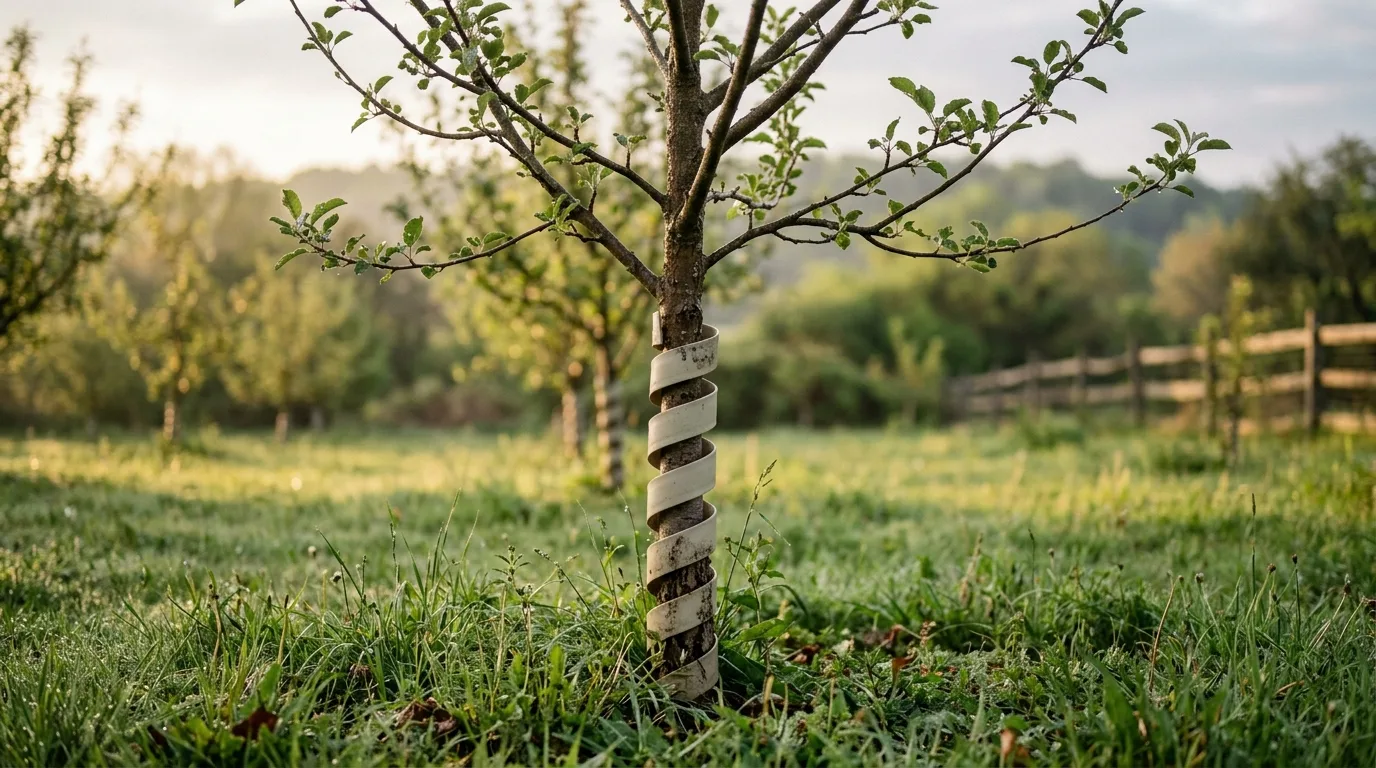
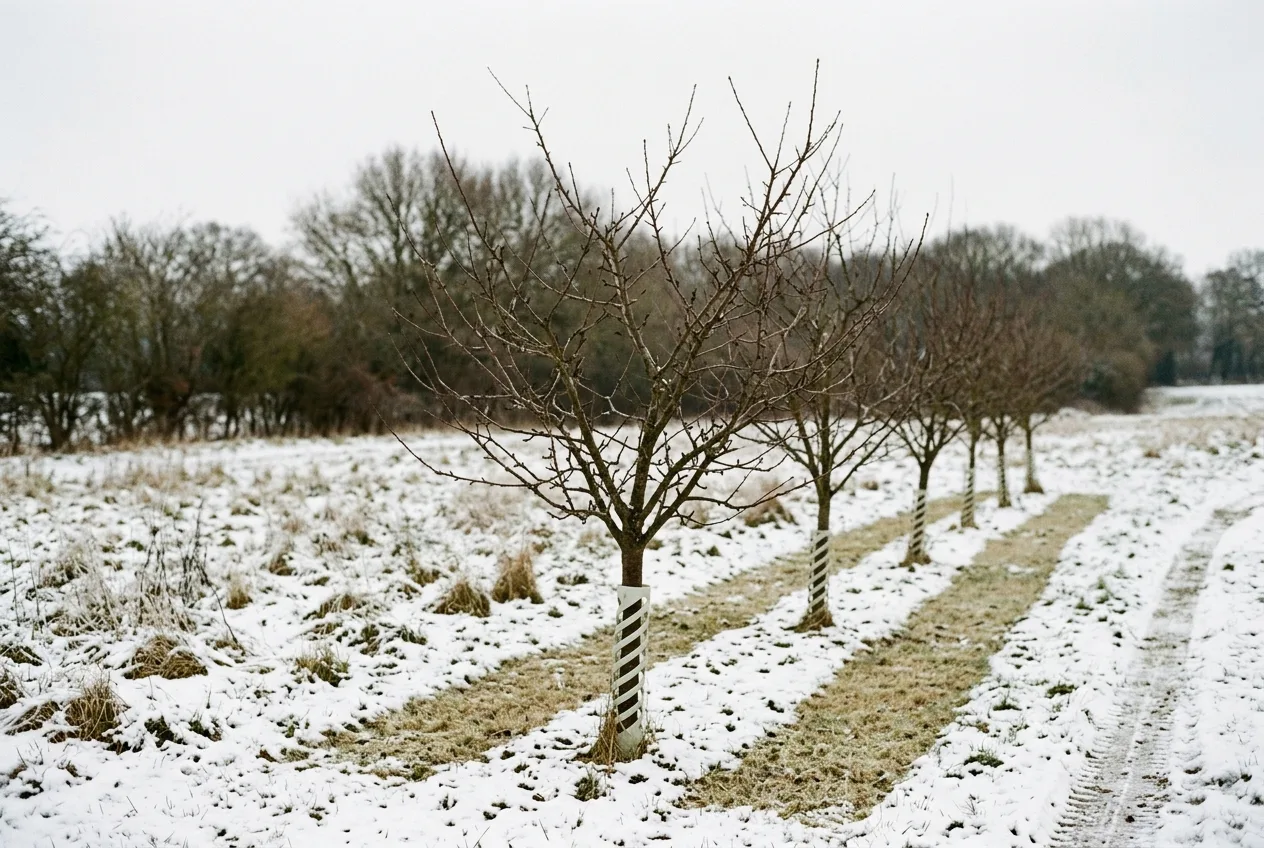
- Solid trunk guards and tubes are the workhorses. The split-plastic spiral and tube guards you wrap around a young trunk are made for exactly this. Heights from the schemes that fund this work: about 0.6 m for rabbits, 0.75 m for hares. There's a clear, repeated lesson on material, though: solid guards beat mesh and netting, because rabbits and rodents can simply chew through net-type guards, while a solid-wall tube they can't. If you use a guard, make it a solid one and push it firmly into the ground so nothing gets underneath.
- A low fence protects a bed or a few trees. A rabbit-proof fence runs about 24–36 inches (60–90 cm) tall — high enough that a rabbit can't reach over even after heavy snow — and the bottom needs to defeat tunneling: sink the lower portion below ground and bend the very bottom outward, or pin it down with anchor pins. Chicken wire or hardware cloth both work.
- Clear their cover. Same principle as voles: rabbits and mice rely on brush piles and dense vegetation for protection from predators, so removing junk piles and tall growth near the trees makes the area less attractive and any animals that do show up more exposed.
A simple low-budget version deserves a mention because it's genuinely clever: a habitat-restoration practitioner in Australia reports cutting old garden hose into short lengths, slitting each down the side, and sleeving it over the thin stems of young plants — claiming a "100% success rate," with the hose guards popping off on their own as the stems thicken past chewing size. It's not a measured spec, but it's a real, reusable trick for narrow-stemmed stock.
Solid versus mesh, plastic versus metal: choosing a guard
Once you've matched the guard's height and burial to the animal, the remaining question is what it's made of — and the sources have real, sometimes conflicting, things to say here.
On solid versus mesh, the verdict for small animals is one-sided: solid-wall tubes give better protection from voles, mice, and rabbits, because mesh and spiral guards leave gaps that rodents chew through, and any lateral growth poking out of a spiral can still be browsed. Spiral guards only work against voles at all if they're closed and pushed into the ground. So for the gnawing animals, solid wins. The catch is that solid tubes trap heat and humidity — useful in dry spells, a fungal-disease risk in damp ones — and they're plastic, which brings a disposal problem we'll get to.
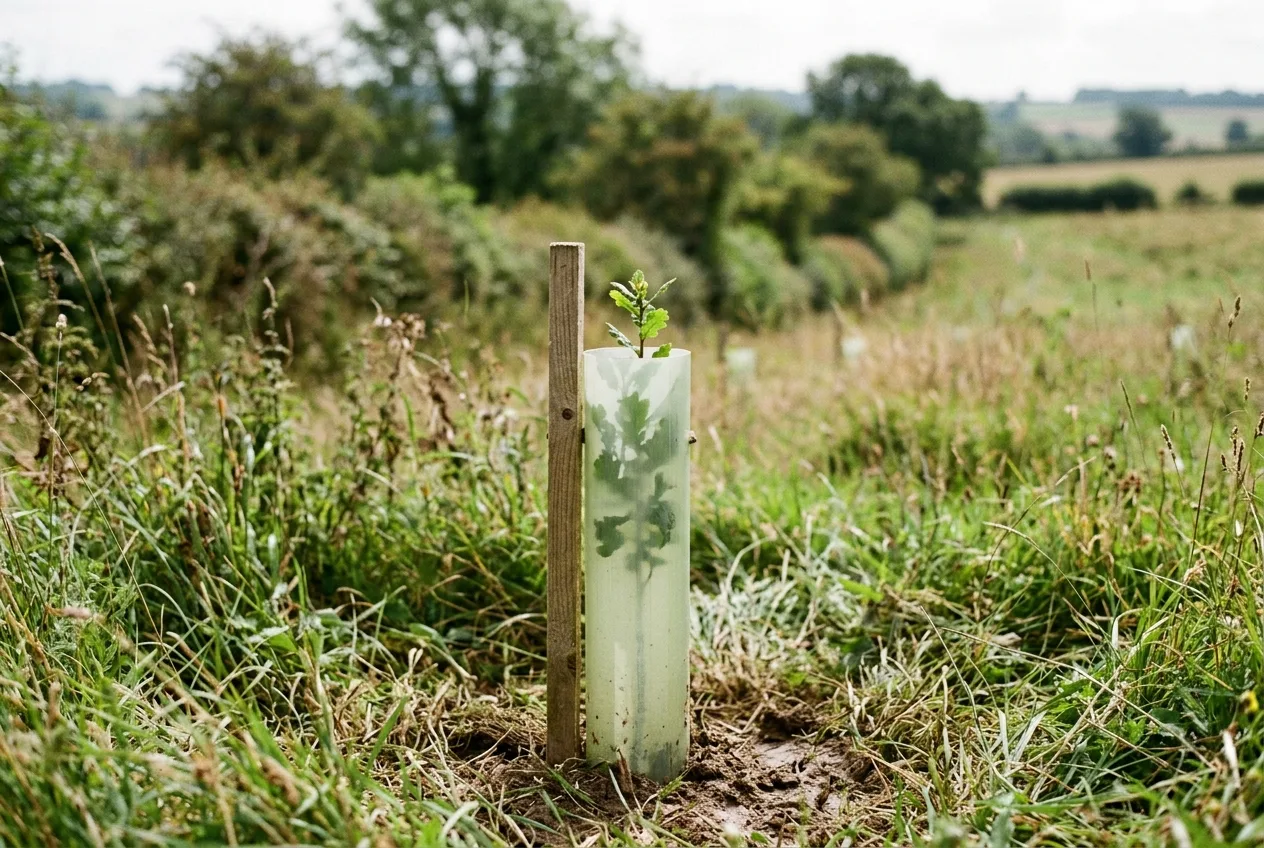
On plastic tubes versus metal cages for deer-sized protection, it's a genuine trade-off rather than a winner. Penn State lays it out plainly: plastic tree tubes run about $5–$7 apiece; metal cages cost roughly three to four times more, $15–$20. The tubes are lighter, cheaper, and shield the tree from herbicide drift when you spot-spray weeds at the base. The cages cost more and weigh more, but they give natural growing conditions and wind hardiness, are thought to reduce overwintering rodent stress, and stand up to bigger wildlife like bears. One real catch with tubes: a tube not pushed into the ground can act as a wind tunnel — or worse, an open invitation for a rodent to move in at the base, nest, and chew the tree from inside. Push tubes two to four inches into the soil to close that gap.
Now the evidence that should make you careful about treating "guard" as automatically good. The most rigorous single study in this pack — a replicated, randomized, controlled trial — found that shelter color and light transmission matter enormously. Light-colored plastic shelters gave 95–99% seedling survival; unsheltered controls came in at 70%; and dark brown shelters were a disaster at just 5% survival. Read that again: in that trial, the dark shelter was far worse than no shelter at all. The takeaway isn't "guards always help" — it's that a guard is a tool with specifications, and the wrong one (here, a dark, opaque tube on a light-needing seedling) can do real harm.
A guard is not automatically good. In one controlled trial, a dark-colored shelter dropped survival to 5% — worse than no shelter at all.
That said, the broader evidence on shelters is genuinely encouraging when they're used well. Conservation Evidence's synthesis finds tree shelters can improve early seedling survival and protect seedlings from mammal browsing. The UK Forestry Commission echoes both the upside — real micro-climate benefits — and the limits: shelters deter smaller mammals and low densities of deer, but larger deer can simply push them over and browse the tree inside.
There's a responsibility note that comes with all this plastic. Older tree-planting sites are littered with abandoned plastic shelters, and uncollected ones end up as litter and in landfill. If you use plastic, plan to collect it — and where a study compared options, recyclable polypropylene shelters came out ahead of bio-based alternatives.
Don't confuse winter sun damage with an animal
One last thing, because it sends people chasing the wrong culprit. Not every split or dead patch of bark on a young fruit tree is an animal's work. Sunscald — also called southwest winter injury — looks like bark damage but is purely physical: on a cold, sunny day, the trunk's sunlit side warms enough to wake the cells just under the bark, which then die when the temperature crashes after dark or when a cloud passes. The result is discolored, cracked, sunken, or sloughing bark, and it hits the same victims the animals do — young trees with thin bark, with the thin-, dark-barked cherries, peaches, and plums staying vulnerable even as they age. Related frost cracks can run several feet long up the trunk.
The reason it matters here is that the same wrap fixes it, so it's worth recognizing. A light-colored tree wrap reflects sunlight and keeps the bark cool enough to stay dormant — apply it before the coldest part of the dormant season and take it off in spring (left on through summer it can harbor pests), for the first two or three years after planting while the bark is thin. Some orchardists instead paint the lower trunk with diluted white interior latex paint to the same end.
One important caveat, because this site has readers in both hemispheres: the side of the trunk that needs protecting is the one facing the winter sun. In the Northern Hemisphere that's the south and southwest side — but that's a Northern-Hemisphere fact, and it flips to the north/northwest side south of the equator. Don't memorize a compass direction; protect the sun-facing side for your latitude, and the timing tracks your own dormant season, not a fixed month.
A practical sequence for a new tree
Pulling it together, here's the order of operations that the combined sources point to for a young fruit tree, before any animal has touched it:
- Prep the ground first. Clear vegetation and brush from around the planting spot; you want a bare, mowed-low zone, not a grassy nest. Good weed control before planting does double duty — it deters voles and removes competition.
- Set a vole guard at the base. A ¼-inch hardware-cloth cylinder, buried a few inches in, around the trunk. Keep mulch — if any — well back from the bark.
- Add a deer/rabbit barrier sized to your threat. A 5–6 ft tube or cage (or three stakes) if deer rub and browse; a 0.6–0.75 m solid guard if it's mostly rabbits and hares. Push tubes into the soil.
- Wrap for sun if your winters warrant it. Light-colored wrap on the trunk through the first few dormant seasons, removed each spring.
- Size everything for snow, and re-check after storms. Guards and wraps need to clear your deepest snow, because that's the platform animals stand on to reach higher; knock snow down around protected trees after a heavy fall so nothing can step up and over.
- Monitor, and take the seasonal stuff off in spring. Run an apple-sign check for voles if you've had trouble; pull tubes, wraps, and seasonal barriers when growth resumes so they don't choke the tree or shelter pests.
Do that, keep the floor clean, and you mostly just have to keep it up until the bark thickens. The trees that die are almost always the unprotected ones in a bad year — and a bad year always comes.
Frequently asked questions
How do I protect fruit trees from deer?
For a few trees, put a 5–6 ft tube, wire cage, or three stakes (gaps under ~18 in) around each trunk to block browsing and antler rubs, installed before fall and removed in spring. For a whole orchard, the reliable fix is an 8-ft woven-wire fence kept tight to the ground, or a trained electric fence.
What stops voles from girdling fruit-tree bark?
A combination, not one thing: keep grass short and a vegetation-free, mulch-free strip around the trunk, then add a ¼-inch hardware-cloth cylinder buried a few inches into the soil so voles can't tunnel under it. Habitat control matters more than any single guard, and a trunk guard won't stop root-feeding pine voles.
Why is my young apple tree dying when nothing looks wrong above ground?
Suspect pine (woodland) voles, which girdle roots and the trunk base entirely below ground — the damage stays hidden until the tree declines. If you can rock the tree loose or push a finger easily into soft, tunneled soil at its base, that's the likely cause.
Do I need to wrap fruit trees in winter?
If your winters bring cold, sunny days, yes — but for sunscald, not animals. A light-colored wrap on the trunk for the first two or three years after planting reflects sun and prevents bark cracking; put it on before hard freezes and take it off in spring. The same wrap also adds some bark protection.
Are plastic tree tubes or metal cages better?
It depends on the threat and budget. Plastic tubes are cheaper ($5–$7), lighter, and block herbicide drift; metal cages cost 3–4× more but give natural growing conditions and stand up to larger animals. Whatever you choose, push tubes into the soil so rodents can't nest at the base — and avoid dark, opaque shelters, which can hurt survival.
How tall does a guard need to be for rabbits versus deer?
Very different. Rabbits need roughly a 0.6 m solid guard, hares about 0.75 m, and a rabbit fence stands 24–36 inches (60–90 cm) with the bottom buried or pinned. Deer need far more — a 5–6 ft individual guard or an 8-ft (2.4 m) perimeter fence. Always size for snow depth, since animals stand on packed snow to reach higher.