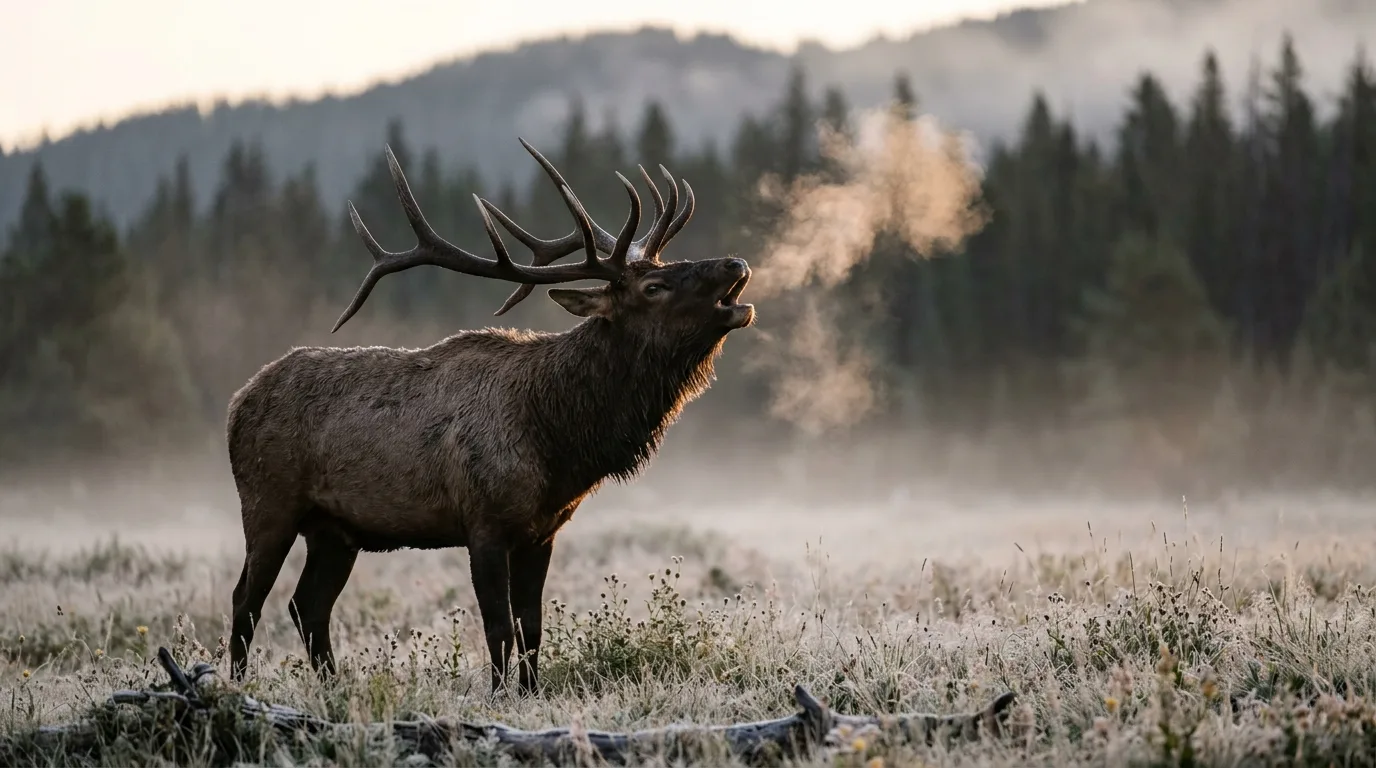
A bull elk is one of the largest animals on the continent, and for most of the year he is a ghost. Then, for a few weeks every September, he stands on a ridge in the dark and screams his location to anyone within earshot. That is the whole opportunity. The elk rut is the one stretch of the season when the hardest animal in the woods to find decides, on his own, to tell you exactly where he is.
The trick to locating elk in the rut is learning to read what he's actually saying — and to back that up with the sign on the ground and a working knowledge of where his herd needs to be at any given hour. A bugle tells you a bull is there right now. A fresh, reeking wallow tells you bulls are working an area even when it's silent. And the elk's daily rhythm — timber at midday, openings at dawn and dusk, water on the way between — tells you where to be standing when the next bugle rips. Put those three together and you stop wandering and start hunting.
This guide is about that. Not calling tactics or shot placement, but the upstream problem every elk hunter has to solve first: figuring out where the elk are.
The rut timeline: when bulls give themselves away
The single most useful thing to know is when this window opens, because outside it bulls are nearly silent and far harder to pin down.
Across most western states, peak rut activity falls between September 15 and 25, with the exact timing nudged by region, elevation, and weather. Bulls begin bugling as early as late August in some places — the velvet has just come off the antlers — but the genuine chaos usually hits in mid-September. One Texas Tech account of wapiti biology puts it cleanly: bugling "marks the onset of the breeding season, usually starts in the latter part of August," breeding activity "increase[s] until mid-September," and the whole thing winds down by November, running about six weeks.
It's worth thinking in three phases, because each one changes how findable elk are:
| Phase | Rough timing | What bulls are doing | How to find them |
|---|---|---|---|
| Pre-rut | Late Aug – early Sept | More patternable, less vocal; dominance still being sorted out | Glass feeding areas; check wallows; run cameras |
| Peak rut | ~Sept 10–25 | Most vocal and active; herd bulls locked onto cows | Locate off bugles at dawn/dusk; move on talking bulls |
| Post-rut | Late Sept – early Oct | Retreat to thicker cover; still answer subtle calls | Hunt secluded drainages and timbered bedding |
Regional differences are real and worth planning around. In the Rockies, expect early-September bugling and a mid-month peak. The Pacific Northwest tends to peak a bit later — the last two weeks of September, around the fall equinox — while the Southwest (Arizona, New Mexico) can start earlier, sometimes in late August. As a rule of thumb, higher-elevation herds rut slightly earlier and lowland herds peak later. Agencies describe the same general window: Rocky Mountain National Park calls the peak "mid-September to mid-October," with bugling sometimes heard into November; Yellowstone puts mating season at "September to mid-October"; and Montana State University Extension pins the Rockies' peak to "early October," noting most cows get bred in a roughly three-week window around that time.
The elk rut is the one stretch of the season when the hardest animal in the woods to find decides, on his own, to tell you exactly where he is.
Here's a subtler point that changes your odds: the age of the bulls running a herd shifts the timing of the whole rut. A five-year study at Oregon's Starkey Experimental Forest let a single cohort of bulls mature and watched what happened to breeding. When yearling bulls did the breeding, conception dragged out over 71 days and the average cow conceived around October 7. When five-year-old bulls were the principal sires, the rut tightened to 41 days and the average conception jumped forward to about September 21. In other words, a herd run by mature bulls ruts earlier and more intensely; a herd of young bulls smears the rut out over a longer, sloppier stretch. If the area you hunt is known for older bulls, lean earlier.
And the rut's timing isn't fixed in stone year to year. A 25-year study of red deer — the elk's close European cousin — in Doñana, Spain, found that drier autumns pushed the rut later and made it weaker, while "the more rain in autumn the earlier the next rutting season". Red deer aren't elk, but the principle travels: rut timing is environmentally modulated, so a dry, hot early September can run a little behind a wet, cool one.
What a bugle actually means
People treat the bugle like a single sound. It isn't. Research in Rocky Mountain National Park found that elk bugles "contain wide ranges of information". Some bugles simply announce that a bull is in the area with his harem. Others are aimed at his own cows — a warning that one is straying too far or otherwise displeasing him. Still others are directed at rival bulls: you're too close, and I'll defend these cows. The same study noted that calls with grunts at the end occur less often — about 16% of the time — than calls without them, and researchers still aren't sure what the grunts are for.
Practitioners sort the same sounds by function: a locator bugle in the early morning or evening to find other elk, a challenge bugle when bulls confront each other, and the estrus cow call that can pull a bull in fast during peak rut. For locating elk, the locator bugle is the one you're listening for and, often, the one you imitate — it's a bull broadcasting his position to the whole basin. You can also learn to read the delivery: experienced hunters describe short, raspy bugles with immediate answers as the mark of a defensive herd bull, while long, wavering bugles often come from lone roamers or less-dominant bulls.
The bugle itself is a small miracle of physics, and understanding it explains why it works so well as a beacon. Elk are among the biggest land mammals on earth — a bull can hit a body mass of 450–500 kg — and basic acoustics say big animals should make low sounds. Yet a bull elk's rutting call has a fundamental frequency of 2 kHz and higher. That's genuinely strange. As one comparative anatomy study put it, European red deer "produce low-pitched calls, whereas North American elk produce high-pitched calls, which is remarkable for one of the biggest land mammals". A red deer roar sits around 60–200 Hz; an elk bugle can climb to 2.3 kHz — a difference of about three octaves between close relatives. The elk pulls it off by cranking enormous tension onto short, stiff vocal folds, essentially singing at the edge of what the tissue can do.
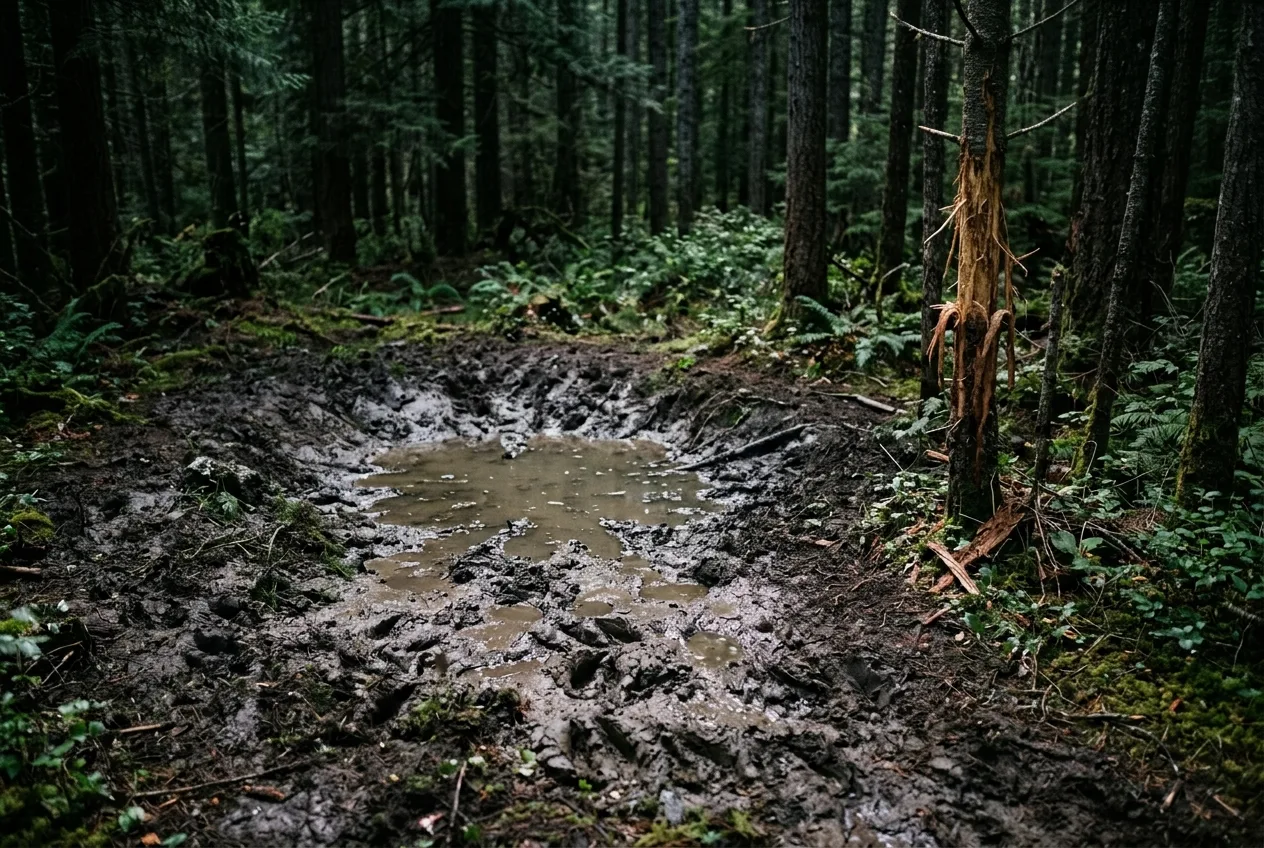
A bugle tells you a bull is there right now; a wallow tells you bulls are working the area even when the woods are silent.
Why scream instead of roar? Because the scream carries. A biomechanical model of the elk larynx found that high-frequency calls are simply more efficient at radiating sound: at the low end (around 100 Hz, the red deer's range) glottal efficiency was about 0.4%, but at 605–950 Hz it rose above 2%. In raw loudness, a 605 Hz call reached roughly 80 dB at 10 meters — about 10 dB louder than a 100 Hz call from the same animal. For a bull trying to be heard across drainages and over wind, a louder, higher signal that travels farther is exactly the tool he wants — which is the whole reason you can stand on a ridge at first light and hear bulls a basin away.
There's a deeper logic here that's useful at the listening post. What do elk themselves pay attention to in a call? Playback experiments on red deer are the best evidence we have, and they're consistent: rival males don't react to a roar's pitch so much as to its formants — resonance cues that honestly encode body size, because they scale with the length of the animal's vocal tract. Stags ignored re-synthesized roars when only the pitch changed, but "roars with lower formant frequencies (indicating larger individuals) provoked stronger responses". Females do the same: oestrous hinds "prefer roars simulating larger callers," stepping toward the deeper, bigger-sounding bull. They also assess fighting ability by roaring rate — how often a bull sounds off — not just the sound of a single call. The practical takeaway: a bull that's bugling hard and often is advertising dominance, and that's the bull holding cows. Frequency of bugling is a rut-intensity gauge you can read by ear.
One more thing the books sometimes miss: cows bugle too. Pennsylvania's wildlife agency notes plainly that "cows also bugle at times", and cows commonly bark and grunt to communicate with calves or to alert the herd to danger. Not every voice in the timber is a bull.
Reading the ground: wallows, rubs, and scent sign
Bulls go quiet — midday, midweek, mid-pressure. When the woods shut up, the sign on the ground keeps telling the story, and the loudest silent sign is the wallow.
A wallow is a urine-soaked mud pit a bull rolls in to coat himself in his own scent. Washington's wildlife agency calls it "probably the most easily identified elk sign": a bathtub-sized depression with low walls of displaced mud, reeking of urine and droppings. The behavior isn't grooming — it's advertising. Bulls "attract cows by wallowing and coating themselves in mud and their own urine," signaling fitness and availability. And it's a two-way sign: receptive cows, drawn by the odor, "will also roll and urinate in the wallow, indicating their willingness to mate". A working wallow in mid-September is one of the highest-value pieces of real estate in elk country.
That this self-scenting is a real signal, not a quirk, is backed up by the red deer work. Rutting red deer stags develop a dark patch of belly fur darkened by urine and "impregnated by strongly odoriferous compounds" tied to a male's age and competitive level. Stags with bigger patches roared more and "attained larger harem sizes," and the patch was "a better predictor of male behavior than antler tines or territory holding". A bull plastering himself in urine isn't being filthy — he's broadcasting his rut investment in a second channel, scent, alongside the bugle.
How to read a wallow you find:
- Fresh and active: wet, muddy, strong urine-and-musk smell, light-colored hairs in the mud, fresh tracks ringing the rim. Bulls are using it now — watch it, or hang a camera.
- Located right: wallows sit where the ground is wet and muddy, usually near water, and almost always in a secluded spot where elk relax enough to drop their guard.
- Abandoned: filled with standing water, grass growing around the edges, no fresh sign. Old news.
Rubs are the other big visual sign, and they show up early. As antler growth finishes in late summer and the velvet dies, bulls "vigorously rub their antlers on shrubs and trees" to strip it. That rubbing quickly becomes a rut behavior — it's noisy, it draws other elk, and it leaves mangled saplings behind. Washington's agency describes the aftermath vividly: "small saplings and shrubs are left looking like someone with a hedge trimmer went on an angry rampage," and "in areas where elk are abundant, mangled shrubs and small trees are extremely obvious signs of the presence of bulls and their preparation for breeding". A torn-up rub line is a billboard that bulls are working the area.
Round it out with the everyday sign that confirms an elk herd is using a place at all: trails several animals wide at the edge of timber, large clusters of tracks, and droppings — "elkpies" run 4 to 6 inches across, noticeably bigger than a deer's. None of that tells you the rut is on, but it tells you elk are home, which is where you start.
Herd structure: find the cows, find the bull
Here's the mental model that reorganizes everything: you don't hunt the bull, you hunt the cows, and the bull comes with them. A common picture has the herd bull roaming the country rounding up cows. The biology is closer to the reverse. As the Texas Tech account puts it, "the bulls do not actively seek out the cows, but rather the cows gravitate toward the larger, more virile bulls". So locate what the cows need — feed, water, security — and the harem, with its herd bull, won't be far.
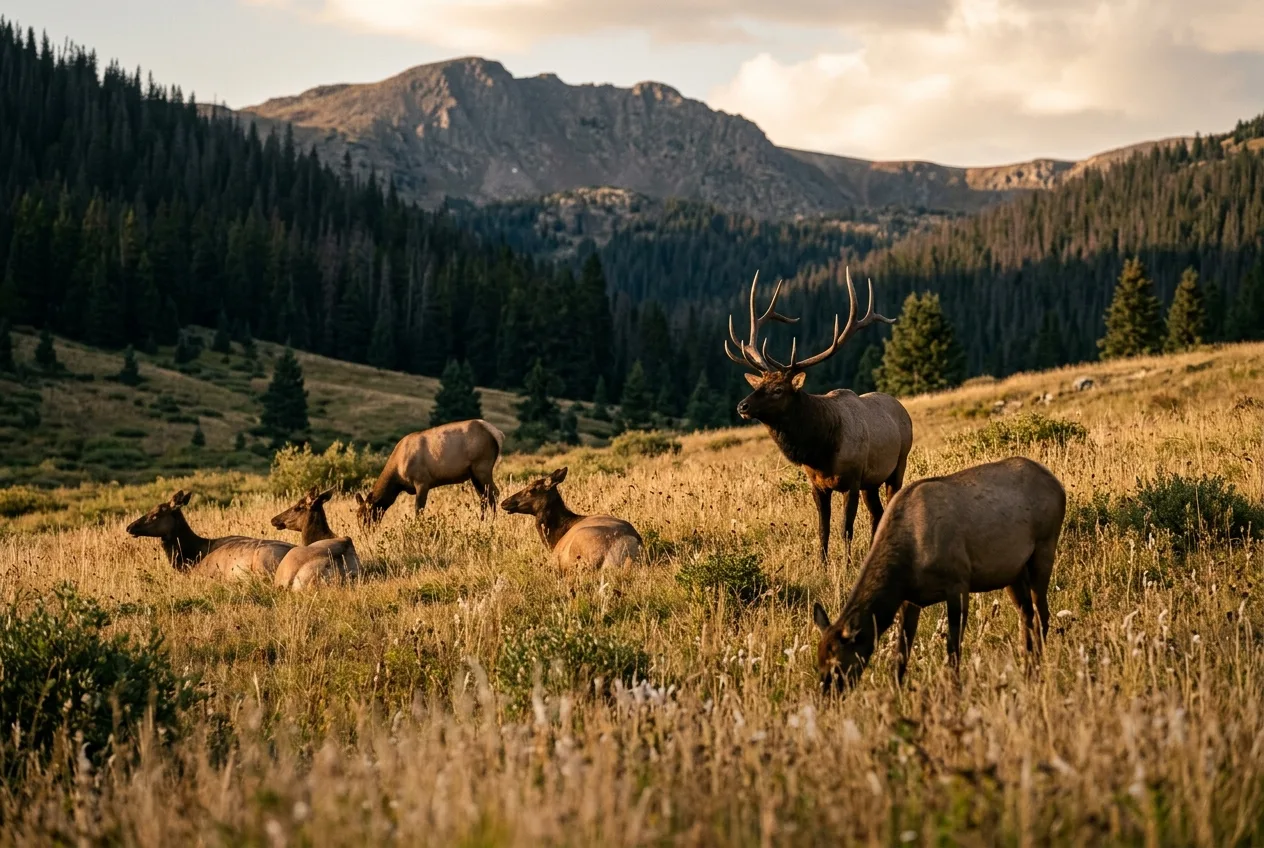
A typical rutting group is a harem: a bunch of cows and calves with one dominant herd bull who does most of the breeding and spends his energy defending the group. Harem size varies a lot — Washington reports anywhere from "3 to 4 cows to as many as 20 to 25 cows," Pennsylvania describes harems of 15 to 20, and the Texas account gives 5 to 15. Around the edges hang the satellite bulls — subordinate males shadowing the herd, waiting for a chance to slip in and breed a cow while the herd bull is distracted. Pennsylvania's agency describes them exactly: "younger males, which hang around on the fringes of the groups, may also share in the breeding". Montana Extension adds that the herd bull's constant chasing of these intruders, plus rounding up drifting cows, is a steady preoccupation — and "there is no doubt that the 'satellite' bulls breed some cows when the dominant bull is away".
That edge dynamic matters for locating catchable elk. Satellite bulls are often more responsive to calling and, on heavily pressured public land, frequently offer the better opportunity than a locked-down herd bull buried in his cows. A herd bull surrounded by twenty cows has little reason to leave them; the lonely satellite has every reason to investigate.
You don't hunt the bull, you hunt the cows — locate the feed and water, and the harem and its herd bull come with them.
Two more structural facts worth holding. First, despite all the bull noise, an older lead cow decides where the herd actually goes — Washington, Pennsylvania, and Montana all make the same point: the bull may control breeding, but the group's movements are dictated by an experienced cow watching for danger. Second, the herd bull doesn't hold a fixed patch of ground; California's agency describes bulls defending "movable breeding territories consisting of cow harems". The territory walks around with the cows. So if the herd moves overnight, the whole production — bull, bugles, and all — moves with it, and you relocate by relocating the cows.
It also helps to know what this costs the bull. Bulls enter the rut fat and "usually emerge in poor physical condition," because for those six weeks the dominant bull has "little time to eat or even sleep" while fending off younger bulls. Old bulls don't stay with one harem the whole time either — they move from one group to another, and a worn-down bull will sometimes retire to recuperate. That churn is why a basin can go from loud to quiet and back: bulls cycle in and out.
Where elk are, hour by hour: feed, bed, water, and elevation
Knowing the rut is on and learning to read sign still leaves the practical question of where to physically be at 6:15 a.m. The answer comes from the elk's daily rhythm, and the telemetry here is unusually clear.
Elk are crepuscular — most active at dawn and dusk — and they run a daily commute between open feeding areas and secure timber. A USGS-indexed study broke the elk's day into four windows and found a consistent pattern: at dawn and dusk elk select grassland; at midday they shift to greater canopy and forest cover; and at night they move to areas with more herbaceous biomass to feed. The six-year Starkey telemetry study adds the texture: elk daily-movement cycles were "most pronounced during spring and autumn," and the dawn and dusk transitions came with "sharp increases in velocity" — elk move fast when they swap between feeding and bedding. Those crepuscular velocity spikes were about twice as high for elk as for mule deer in the same study.
The shape of that daily movement is worth picturing, because it tells you which way a herd is traveling. At Starkey, elk tended to move uphill in the morning, away from water, and then work downslope toward streams through the afternoon, with the strongest push back upslope out of the drainages at dusk into open foraging ground. So a rough day looks like: feeding in openings around first light, drifting up and into timber to bed through midday, then back down and out to feed again toward dark — and bugling rings out hardest on those dawn and dusk transitions.
Elk feed in openings around first light, drift up into timber to bed through midday, then drop back down to feed toward dark — and the bugling rings out hardest on those transitions.
Water is a thread running through all of it, and it's tighter than most people assume. Montana Extension reports that 80% of elk summer habitat is within a quarter to a half mile of water, and lactating cows are especially tied to it. California's agency frames it as a spacing rule: open water sources should sit no more than about two miles apart for good elk habitat. In practical terms, water concentrates elk — and wallows, by their nature, sit in those same wet, secluded pockets. A spring seep with a fresh wallow and feed within a half mile is a textbook place to intercept rutting elk.
Elevation and habitat add the last layer. Good elk country is a mosaic — roughly "40 percent cover and 60 percent forage areas," forest stands interspersed with grassy openings that double as travel lanes. Elk push to higher elevations through the warm months following fresh green forage. And in fall specifically, a reintroduced Wisconsin herd showed its strongest avoidance of canopy cover of any season — bulls and cows alike favoring more open settings as autumn set in, with that canopy avoidance "most influential" in fall as elk prepared for winter. At the finer home-range scale, the same fall data showed elk selecting higher elevations. The general autumn picture across studies: more open, often higher ground, with timber close by for security.
One important caveat on the daily schedule: it bends under pressure. Once hunting seasons open, elk shift more heavily into cover and onto bigger, more remote blocks away from roads. A North Dakota GPS study found female elk "generally restricted themselves to cover during the day and entered open areas at night," with home ranges expanding during hunting season. So the dawn-openings rule is strongest in lightly pressured country and early; under pressure, push deeper and hunt the edges of security cover.
Using the wind: thermals or you're wasting your time
You can do everything else right — pinpoint the bull off a bugle, find the wallow, time the feed — and blow it in the last two hundred yards because the wind carried your scent uphill into his bedroom. Even rut-crazed bulls bust instantly on human scent. Elk lean on their nose above all; the old wapiti account notes you can "easily stalk them upwind as long as the animals do not scent the stalker".
In the mountains that means thermals — the daily up-and-down drift of air driven by temperature. As the sun warms the ground in the morning, the warmed air rises, so thermals generally rise in the morning; as the air cools in the evening, it sinks, so thermals fall in the evening. The rule that follows is simple and the practitioners repeat it like a mantra: approach from above in the morning and from below in the evening, so your scent drifts away from the elk rather than into them.
Two complications to plan around. First, prevailing weather winds usually kick in around 10 a.m. and, when they're strong — over about 15 mph — they override thermals entirely, so the cleanest thermal windows are early and late. Second, where several draws or drainages meet, you get thermal hubs with swirling, unpredictable air; elk know this, and big-game animals "will bed in areas where thermals swirl, allowing them to detect predators from multiple directions". That last point is a locating clue in disguise: a bull bedded in a swirl pocket is hard to approach precisely because he's covered downwind, so plan the stalk around the terrain, not just the bull.
Where a trail camera fits
Most of rut hunting is real-time — ears, eyes, wind. But the one place a camera earns its keep is the pre-rut, when bulls are quiet and patternable and you're trying to inventory who's around and when they're moving. Practitioners specifically call out "trail cameras and wallow monitoring" as effective pre-rut tactics. A camera on a fresh wallow, a water source, or a pinch-point trail between feed and bedding can tell you which bulls are working the area and what hours they hit it — without you sitting there leaking scent into the basin every evening.
Putting it together
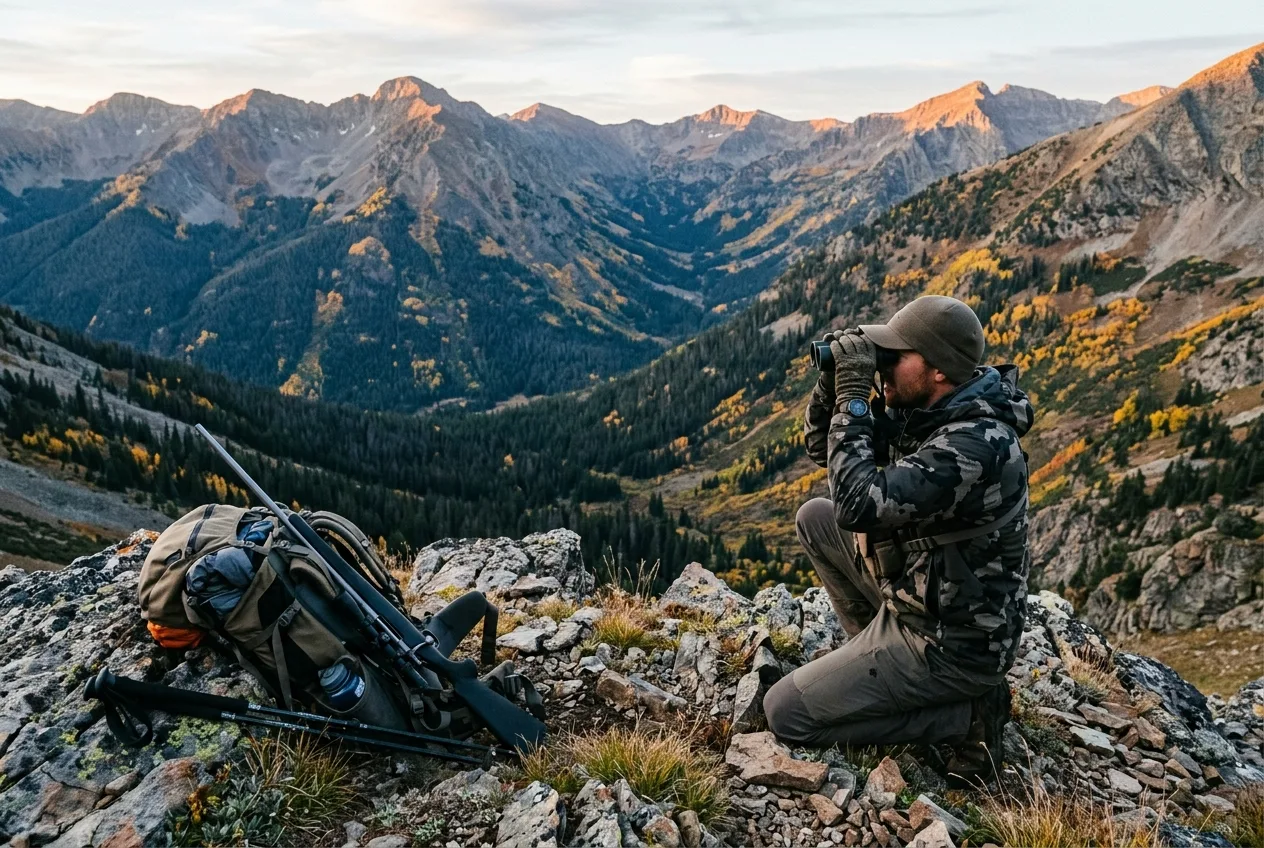
Locating elk in the rut is less about one magic call and more about stacking probabilities. Get the timing right — late August into mid-October, peaking around September 15–25 — so you're in the woods when bulls are talking. Learn to read the bugle: it's a bull broadcasting his position and his dominance, and frequency of bugling tells you who's serious. When it goes quiet, let the ground talk — a reeking wallow and a torn-up rub line say bulls are here even when you can't hear them. Find the cows, because the herd bull lives with them, and watch the satellites on the edges for your real opportunity. Then play the schedule and the wind — openings at dawn and dusk, timber midday, water in between, thermals uphill in the morning and downhill at night. Do that, and the hardest animal in the woods to find will, for a few golden weeks, keep telling you where he is.
Frequently asked questions
When is the elk rut, and when does bugling peak?
The rut runs roughly from late August through mid-October. Bugling starts in late August in many areas, peak activity falls around September 15–25 in most western states, and breeding tails off by mid-October. Higher-elevation herds tend to rut a little earlier and lowland herds a little later.
How do I locate a bull elk by his bugle?
Listen at dawn and dusk from high vantage points and you'll hear locator bugles carrying across basins — the high pitch is built to travel far and loud. A bull bugling hard and often is advertising dominance and is likely holding cows, so a frequently sounding bull is a herd bull worth moving on.
What does an elk wallow look like, and how do I know it's fresh?
A wallow is a bathtub-sized mud pit reeking of urine, where bulls roll to scent themselves. Fresh ones are wet and muddy with a strong musky-urine smell, light hairs in the mud, and fresh tracks around the rim; abandoned ones fill with clear water and grow grass at the edges.
What's the difference between a herd bull and a satellite bull?
The herd bull is the dominant male holding and defending a harem of cows and doing most of the breeding; satellite bulls are subordinate males shadowing the herd's edges, hoping to slip in when he's distracted. Satellites are often more responsive to calling and frequently your better chance on pressured ground.
Where do elk go during the day in the rut?
Elk feed in open grasslands and meadows at dawn and dusk, then retreat to timber and heavier canopy through midday before feeding again at night. Water is central — about 80% of summer elk habitat sits within a quarter to a half mile of it — so feed, bedding timber, and water within a short radius is prime.
Why do elk bugle so high when they're such big animals?
Big animals usually make low sounds, but a bull elk's bugle runs 2 kHz and higher — about three octaves above a red deer's roar. The high, loud call is more efficient at radiating sound and carries farther across mountain terrain, and it likely signals a bull's muscular strength and condition.