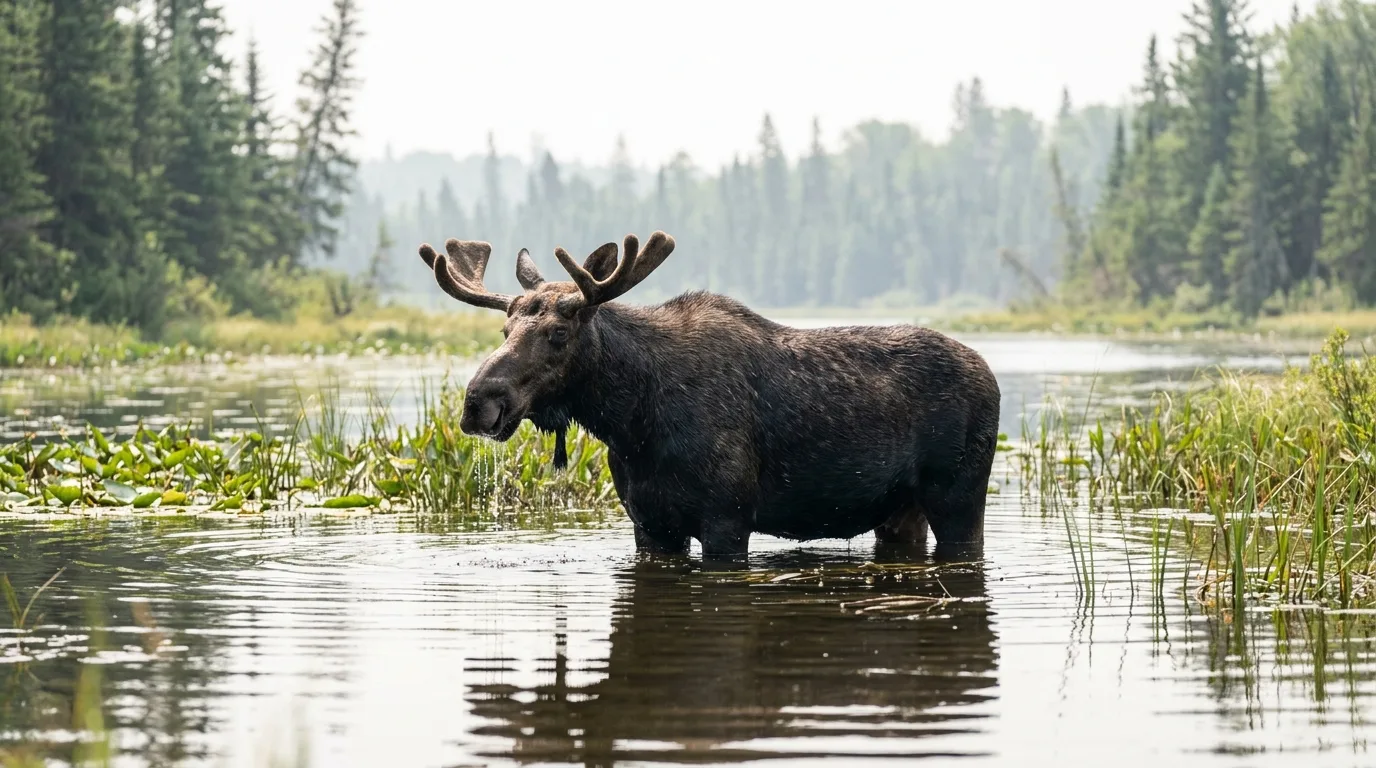
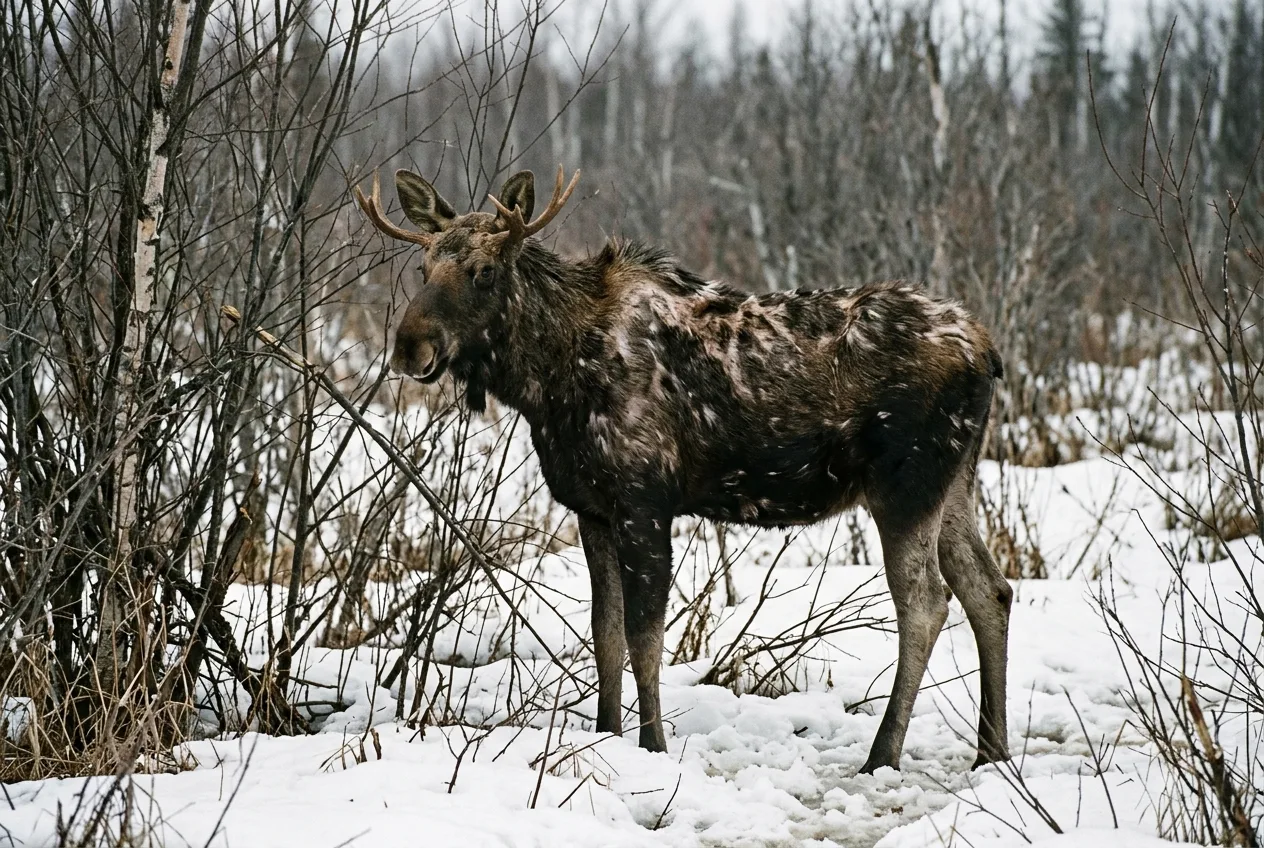
Spend a March morning in northern New Hampshire and you might find a yearling moose that looks like it has been dipped in flour. Bald gray patches where the dark winter coat should be. Ribs you can count from a distance. Biologists call them ghost moose, and the ghost is not snow or frost — it is the animal grooming so frantically against tens of thousands of biting ticks that it scrapes its own hair off. A lot of those calves do not see April.
That image is real, it is well documented, and it is exactly why "moose are dying off" has become a familiar headline. But here is the thing the headline almost never says: it depends entirely on where you stand. Drive a few hundred miles north or west and the story flips. Across most of Canada and the northern and western United States, moose are stable or increasing. In Fennoscandia — Sweden, Norway, Finland — they are so abundant that managers spend their energy holding numbers down to limit browsing damage, harvesting tens of thousands a year. A recent multi-jurisdiction survey put it plainly: moose populations are "stable or increasing in the majority of Canadian and American jurisdictions but decreasing in the majority of European jurisdictions".
So if you came here asking why are moose declining, the honest first answer is a correction to the question. Moose are not declining everywhere. They are crashing hard at the southern fringe of their North American range — northern New England, and the Upper Midwest — and slipping in much of Europe for partly different reasons. Everywhere in between, the big deer is doing fine. Get the geography right and the causes start to make sense, because the same warming climate that barely registers in the boreal core is wreaking havoc at the warm, deer-rich, tick-friendly edge.
This piece walks through the real drivers — winter tick, heat, brainworm, predation, habitat, and range shifts — with the numbers behind each, and is careful to keep every figure attached to the place it actually came from. A calf-mortality rate from Vermont is not a verdict on moose in Alaska.
First, is it really a decline? The map matters more than the trend
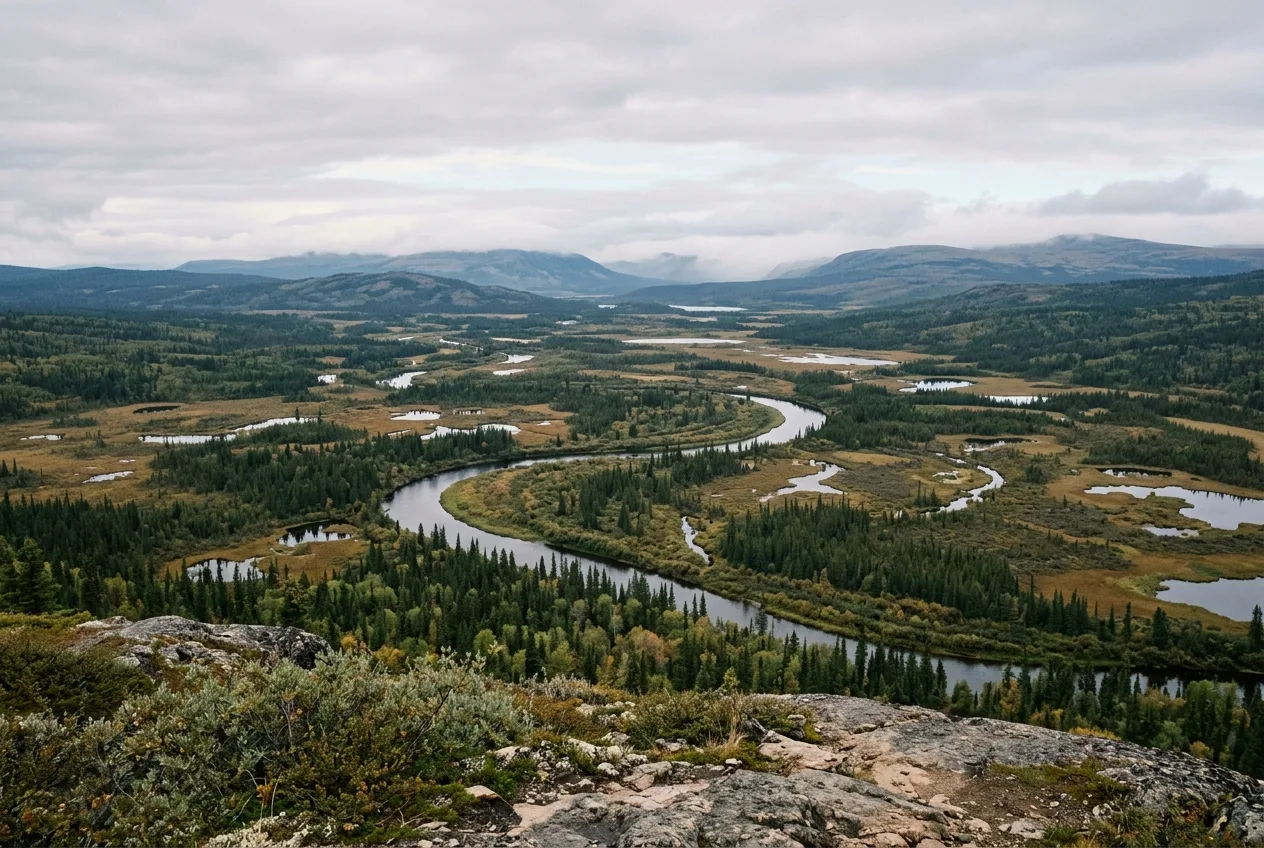
Step back to the continent scale and the panic eases. A long-running GIS synthesis of North American moose, built from management-unit data across four decades, found that as of 2010 the animal occupied more than 9.4 million square kilometers and numbered around a million. Most of that population sits in the boreal core: only about 30% of the occupied range — the good boreal habitat — holds roughly 89% of the moose. And critically, that core is not what is in trouble.
The same analysis describes "a narrow band of relatively stable and high-density moose populations" running "from central Alaska across the Prairie Provinces and east to the Maritime Provinces and upper northeastern states". Moose have "both expanded and contracted along their southern range boundary in recent decades". Expanded and contracted. That is the signature of a range edge under pressure, not a species in collapse.
Moose are not vanishing from the continent. They are being squeezed off the warm, southern lip of a range that is otherwise broad and full.
Where the contraction is real, it is real with a vengeance. In Vermont, the population "declined 45% from 2010 to 2017 despite minimal hunter harvest and adequate habitat". In northeastern Minnesota, surveys showed a 55% drop over a decade — and a 66% fall since 2006, from an estimated 8,840 animals. Those are not rounding errors. But even there, the trajectory is more interesting than a straight line down. Minnesota's annual aerial survey now describes a population that "declined steeply between 2009 and 2013 and has since more-or-less stabilized at around 3,700–3,800 moose". The 2026 survey estimated 4,470 moose, up 11% on the previous year's point estimate, though the survey team is careful to note that swing sits inside the sampling uncertainty. A crash, then a bumpy plateau — not a free fall to zero.
Hold both facts at once: the southern-edge declines are severe and well-measured, and they are local. That is the frame for everything that follows.
The winter tick: how one parasite makes a ghost
If you only remember one driver, remember this one. In the worst-hit northeastern and Upper Midwest regions, the winter tick is the engine of the decline, and the way it works is grimly simple.
Unlike the ticks that worry hikers, Dermacentor albipictus spends its whole life on a single host. Larvae climb onto autumn vegetation and quest for a passing animal from mid-September until the first lasting snow; once aboard a moose, they feed, molt through nymph and adult stages over the winter, and the engorged females drop off in spring to lay eggs. A deer grooms most of them off. A moose — which did not evolve alongside heavy tick loads — largely does not. So they accumulate. The counts are almost hard to believe: whole-hide tallies on dead New Hampshire calves ran from roughly 20,000 to 95,000 ticks on a single animal. Reports as high as 90,000 on one moose are on record.
A single calf can carry the weight of ninety thousand small wounds, each one drinking, through the leanest weeks of the year.
Do the blood math and the deaths stop being mysterious. Modeling a calf carrying 90,000 ticks (half of them blood-feeding adult females), researchers estimated blood loss on the order of 42,000 to 84,000 milliliters over the season and an energy drain in the hundreds of thousands of kilojoules. That bleeding peaks in late winter and early spring — exactly when a calf has the least fat left and pregnant cows are deepest into the costs of gestation. The animals don't simply "get sick." They are bled and starved at the worst possible moment, and they groom themselves bald trying to relieve the irritation, which is where the ghost-moose look comes from.
The field numbers match the model. In New Hampshire and Maine, a study of radio-collared calves found that 88% of mortalities were "associated with moderate to severe infestations of winter ticks," with necropsies showing "high tick infestations, emaciation, anemia, and endoparasitism". Calf carcasses came in emaciated, anemic, with femur marrow nearly drained of fat. Three consecutive epizootic years (2014–2016) in that region were called "unprecedented" and "rare in North America" — a sign that the host–parasite balance was tipping.
How many calves die in a bad year? In a true epizootic, more than half — that is the working definition. New Hampshire's collared calves saw 61–77% mortality in the epizootic years of 2014, 2015, 2016, and 2018. Maine's seven-year study recorded a stark internal contrast: overwinter calf survival averaged just 38% in the heavily-infested Wildlife Management District 8 versus 63% in District 2, where tick loads were lower. Vermont's calf survival fell from 60% to 50% to 37% across 2017–2019, and winter tick was "the primary cause of mortality (91% of calves, 25% of adults)".
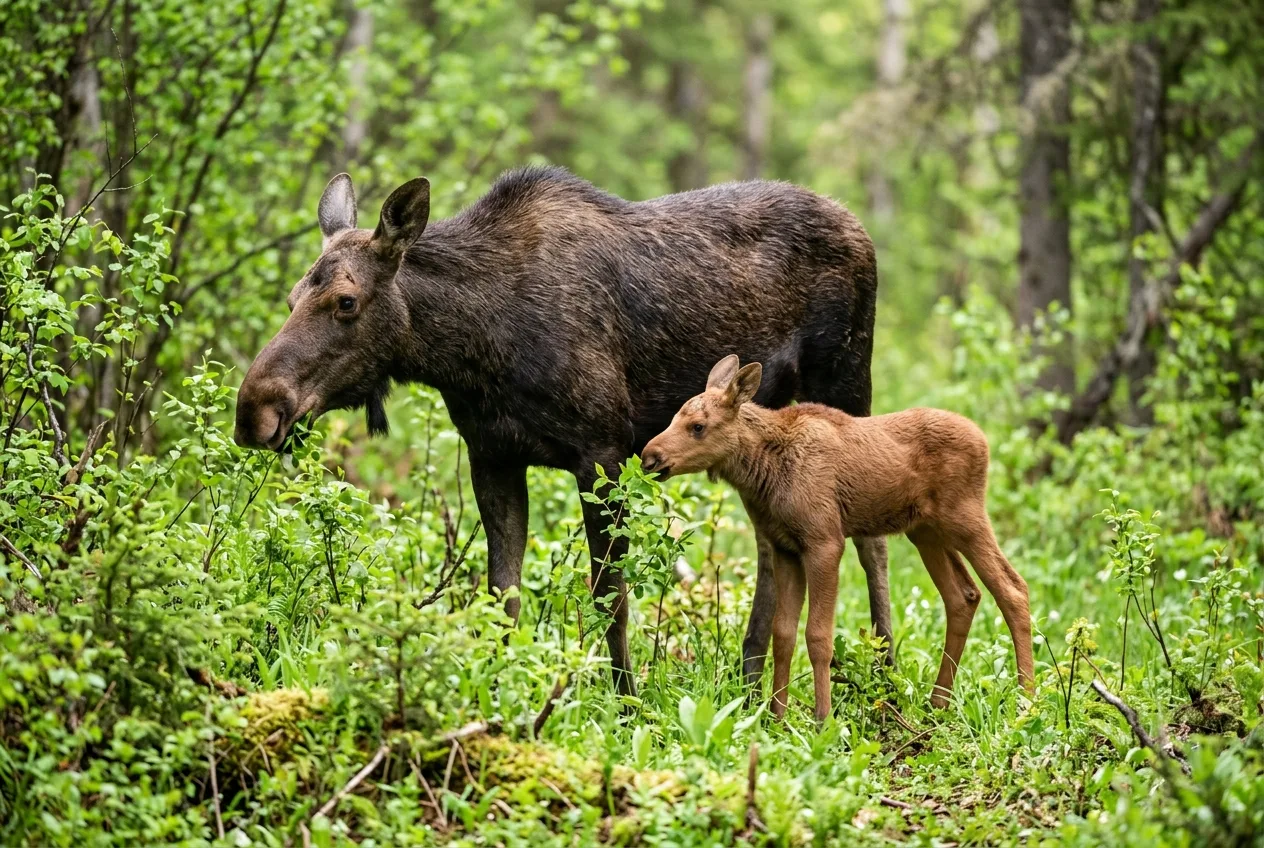
And it is not only the calves that die that drag the population down. The cows that survive a heavy tick winter enter summer depleted, with less time to rebuild before the next breeding season — a lag effect that shows up as collapsed reproduction. Maine's twinning rate, which topped 50% during the recolonization boom of the late 1980s, has run below 25% in recent years. Vermont measured a pregnancy rate of just 0.67 and a birth rate of fewer than one calf per adult female. Fewer calves born, and most of those bled out by April: that is how a tick reshapes a population. Pekins, the lead New Hampshire researcher, modeled a "potential halving of the population in as few as 10 years" if epizootics stay frequent.
Why ticks now? The climate connection
A reasonable question: winter ticks aren't new, so why the carnage now? The answer is that the tick's calendar is exquisitely sensitive to weather at two pinch points — autumn questing and spring drop-off — and a warming climate has been kind to the tick at both.
The cleanest evidence comes from a study of 750 moose across 16 study areas in the western United States. Across all of it, "warm climatic regions, warm seasonal periods … and warm years relative to long-term averages each contributed to increased tick loads". Snow is the brake: "snow cover during both spring drop-off and autumn questing periods strongly depressed subsequent tick loads," and year-to-year variation tracked spring snowpack more than anything else. A snowy autumn buries the questing larvae before they can grab a host; an early, snowless fall leaves the welcome mat out. The heaviest loads in that western dataset showed up in the Colorado study areas — the warmest, most range-edge sites.
The long-term wolf–moose record on Isle Royale tells the same story from a different angle. There, July temperature alone "explain[ed] nearly half the interannual variation in hair loss" — the standard index of tick burden — and a model combining July temperature with predation rate explained 75% of the variance. Warmer summers, more ticks. It is one of the most direct climate-to-parasite links anyone has put numbers on.
Snow is the moose's quiet ally. Take away the early-autumn snow and the late-spring snow, and you have handed the tick two extra weeks at both ends of its year.
This is why the geography lines up so neatly. The boreal core still gets long, snowy winters, so tick epizootics stay rare and local. The southern edge — New England, the southern Great Lakes, the Colorado fringe — is where winters have shortened most, and it is precisely there that ticks have gone from a periodic nuisance to a population-level force.
Heat: a cold animal in a warming world
The tick is not the only way warmth kills a moose. The animal is built for cold — dense coat, big body, small surface-area-to-volume ratio — and that engineering becomes a liability when the thermometer climbs.
The legacy textbook figures put warm-season heat-stress thresholds at 14 and 20°C, meaning moose start ramping up respiration and oxygen consumption somewhere in that band. Work on zoo-managed moose refined the picture: heat-stress onset at about 17°C in calm, bedded conditions and 24°C with wind, which tells you wind and shade matter as much as the raw air temperature. Either way, these are not extreme numbers. They are a pleasant spring afternoon. A moose can be working to dump heat on a day a person would call perfect.
Does that actually cost moose their lives, or do they just bed down in the shade and wait it out? Minnesota gives the first hard answer from wild animals. Researchers logged continuous internal body temperature from 41 free-ranging moose and found they exceeded reported upper thresholds on roughly half their summer days and a large share of winter days, too. They defined a "hot moose event," and the link to survival was direct: the moose that died had 2.0 to 2.8 times more hot-moose events per day, on average, than the ones that lived. Body temperature ran above normal most often once daily highs passed 25°C.
Heat and parasites also gang up. The same New Hampshire–style picture — a tick-bled, anemic animal — is an animal with less margin for thermal stress, and the heat-stress work noted that moose with signs of gastrointestinal illness sought wind at lower temperatures than healthy ones, hinting that "the effects of climate change will be compounded for health-compromised moose". A warming world does not pick one weapon. It loads several at once on the same animal.
There is a behavioral cost even when heat doesn't kill outright. Range-wide GPS data show that in the warmest regions, moose essentially shut down in the heat — the warmest study population was "encamped at 90% of observed locations," barely moving — and at high temperatures southern Wyoming moose were "twice as likely to avoid areas close to forage". A moose that won't walk to the good food in summer is a moose that goes into winter thinner. That trade-off, heat versus nutrition, is a quiet driver of the southern-edge squeeze.
Brainworm and the deer moving north
Here is a driver that has nothing to do with ticks or heat directly, and everything to do with another animal: the white-tailed deer.
Deer carry a parasite called brainworm, or meningeal worm (Parelaphostrongylus tenuis). In deer it is almost a non-event — roughly 80% of white-tailed deer in endemic areas are infected, and they rarely show a thing. But the larvae, picked up by a grazing animal via tiny snails and slugs, behave very differently in a moose. They migrate to the brain and spinal cord and cause neurological wreckage: "single-limb lameness or rear limb weakness, stumbling, circling, head tilt, apparent blindness," typically 30 to 60 days after ingestion. In a moose, this worm is frequently fatal, and it "may … be contributing to moose population declines in certain areas of the US and Canada".
What is a harmless passenger in a deer is often a death sentence in a moose — and the deer are moving into moose country.
The catch is host density. Brainworm becomes a serious force where white-tailed deer density climbs above about 5 per square kilometer. And deer are pushing north as the climate warms. In Saskatchewan, researchers documented the parasite as "newly endemic" in white-tailed deer across 16 Wildlife Management Zones in the central and northeastern part of the province — "much further west than previously recorded" — finding it in 10.6% of sampled deer and tying it to 90 confirmed or suspected cases in moose, elk, and mule deer. The plain-language version from the same research group is blunter: "you put one of those worms in a moose or a caribou or a llama, and it can basically kill the animal," and "the northward expansion of white-tailed deer could bring brain worm along for the ride," threatening moose and woodland caribou in the southern boreal. As deer follow the warming north, they bring a parasite the moose has no defense against.
Minnesota shows what a parasite-heavy mortality picture looks like up close. In a study of collared adult moose, fully 65% of deaths were health-related, with parasites — winter ticks, brainworm, and liver flukes together — accounting for about 30%. Brainworm turned up in 42% of necropsied non-collared moose deaths there, nearly double the rate in the collared sample.
Predation: real, but usually not the root cause
Wolves and bears kill moose. That is not in dispute, and where large carnivores are recovering it is a genuine pressure. But the data keep delivering two nuances that matter for understanding decline.
First, predation falls overwhelmingly on calves. In Scandinavia, wolves took moose calves as "90% of all moose killed" in summer and 70% in winter; across the broader analysis calves made up 75–80% of predation kills. A predator pulling down calves chips at recruitment, the same place ticks do their damage.
Second, in well-studied managed systems, predators are not the dominant mortality source — hunting is. The Scandinavian work found wolf predation averaging 8.6% and brown bear 2.3%, against a human harvest rate of 17.5%; "harvest was … on average 2.4 … times higher than wolf predation". That is a managed landscape doing what managed landscapes do, with recolonizing carnivores layered on as a newer factor.
And where predation does coincide with decline, it is often a finish, not a cause. Minnesota attributed 30% of collared-moose deaths to wolves — but found "predisposing health conditions" in nearly half of those wolf-killed animals. A moose already bled thin by ticks or carrying a parasite load is an easier kill. The wolf is frequently the proximate cause on top of an ultimate cause that was already lethal. That same Isle Royale model that tied tick burden to summer heat also tied it to predation rate, a reminder that these drivers are tangled, not stacked in neat columns.
Habitat, forestry, and where the ticks live
Habitat doesn't usually make headlines in the decline story, but it shapes the board the other drivers play on — and it cuts both ways.
In Fennoscandia, modern clear-cut forestry was a boon to moose: it created vast early-succession habitat, prime browse, and helped drive the population to the high densities the region now manages down. Carrying capacity there is likely far higher than it was a century ago — though managers note that as forestry activity declines and fewer stands sit at that young, productive stage, food limitation is creeping back, and body mass and recruitment already fall as density rises.
In the tick-stressed Northeast, habitat works at a finer grain. Tracking cow–calf pairs in Vermont, researchers found that the cows whose calves survived tended to select mature evergreen forest and wetlands at lower elevations, while the cows whose calves died were more often in young, mixed forest at higher elevations during the fall tick-questing window. Young, brushy regenerating cuts are exactly where questing larvae cluster. So the same early-succession habitat that feeds moose can also be where they pick up their tick loads — a real tension for anyone managing land for moose at the warm edge of the range.
The Fennoscandia contrast — and why Europe is a different story
It is worth dwelling on Sweden, Norway, and Finland, because they are the cleanest proof that "moose are declining" is not a law of nature.
Fennoscandian moose are among "the most productive and heavily harvested moose populations in the world". Annual harvest grew from under 10,000 a century ago to around 200,000 by 2000, against a winter population near half a million. Sweden alone harvested 56,000 in 2024. This is the opposite problem from New England: not too few moose, but managing an abundant animal to limit traffic collisions and browsing damage to forestry and agriculture.
And yet Europe overall is sliding, which is the final twist in the regional picture — and it is sliding for partly different reasons than New England. The driver in Scandinavia is less winter tick and more a combination of deliberate harvest policy and climate-via-nutrition. A 20-year analysis of Swedish hunter data found that "early calf recruitment has declined throughout Sweden and calf mass has also declined, particularly in central and southern Sweden" — the warmer south. The mechanism runs through forage: hot, dry springs and more very-hot days lowered calf mass, while cold winters and deep snow hit it from the other side. The authors frame their results as "an early warning that Eurasian moose may suffer from climate change in similar ways to North American moose" — a different pathway to the same worry. Layer on recolonizing wolves and bears across the region, and an emerging concern about chronic wasting disease, and Europe's decline is its own animal.
So the global picture is genuinely split: stable-to-increasing across most of North America, a managed superabundance turning slowly downward in Fennoscandia, severe parasite-and-heat-driven crashes at the North American southern edge, and a climate-and-nutrition decline across much of the rest of Europe. One word — "declining" — covers four different stories.
The drivers at a glance
The table below is the short version. Read it with the geography in mind: almost every figure belongs to a specific region, and none of them generalizes to "all moose."
| Driver | Where it bites hardest | What the data show |
|---|---|---|
| Winter tick (D. albipictus) | US Northeast (NH, ME, VT), Upper Midwest, warm western edges | 20,000–95,000 ticks on a single calf; 61–77% calf mortality in NH epizootic years; 91% of VT calf deaths |
| Climate (tick driver) | Southern range edge, warm years | Warm regions/years and low snow raise tick loads; warmer summers track higher tick burdens |
| Direct heat stress | Southern edge, Upper Midwest summers | Heat-stress onset ~17–24°C; in Minnesota, heat exposure is linked to lower survival |
| Brainworm (P. tenuis) | Where white-tailed deer density is high and rising (incl. expanding north) | ~80% of WTD infected; often fatal in moose; newly endemic across 16 zones in Saskatchewan |
| Predation (wolves/bears) | Boreal & Scandinavia; mostly on calves | Calves 75–80% of kills; in Scandinavia harvest is 2.4× wolf predation; ~half of MN wolf-kills were already sick |
| Habitat / forestry | Range-wide, both helpful and harmful | Clear-cuts boosted Fennoscandian moose; young brushy cuts concentrate questing ticks in VT |
| Range / nutrition shift | Southern North America; central/southern Sweden | Southern moose avoid forage in heat; Swedish calf mass falls with hot, dry springs |
What this means for monitoring
For wildlife managers and engaged landowners, the practical upshot is that the questions worth tracking are local and seasonal: how heavy are tick loads going into winter, how is calf body condition holding through late winter, where are white-tailed deer expanding, and how often do summer days cross the heat thresholds in a given area. Those are exactly the signals that decide whether a southern-edge population bumps along a plateau or slides further. The hard part has always been getting enough eyes on enough animals through the seasons that matter — and that is where steady, season-long camera monitoring earns its keep, flagging the bald-flanked "ghost" calves and the cow-with-calf-or-not counts that tell you how recruitment is really going.
The big-picture reassurance and the local alarm are both true. Moose are not leaving the continent. But at the warm, deer-rich, increasingly snow-poor southern lip of their range, the math has turned against them — and watching that edge closely is how we'll know whether it stabilizes or keeps giving ground.
Frequently asked questions
Are moose going extinct?
No. Across most of North America moose are stable or increasing, and the global population numbers around a million. The declines are real but regional — concentrated at the southern edge of the range (the US Northeast and Upper Midwest) and across much of Europe — not a continent-wide collapse.
What is a "ghost moose"?
It's a moose, usually a calf in late winter, that has groomed off so much of its dark coat fighting tens of thousands of winter ticks that it looks pale or gray. The hair loss goes hand in hand with the blood loss and anemia that often kill these animals before spring.
How many ticks can one moose carry?
A staggering number. Whole-hide counts on dead New Hampshire calves ranged from roughly 20,000 to 95,000 ticks, with individual reports as high as 90,000 — enough blood loss to bleed and starve a calf through late winter.
Why are winter ticks worse now than in the past?
Climate. Tick survival hinges on autumn and spring snow cover, and warmer, less snowy shoulder seasons let more larvae find hosts and more engorged females survive. Across western US study areas, warm regions, warm years, and low spring snowpack all drove higher tick loads.
Do wolves cause moose declines?
Rarely on their own. Predation falls mostly on calves, and in well-studied systems hunting outweighs wolf predation — in Scandinavia by about 2.4 times. Where wolves coincide with decline, the killed moose are often already weakened: nearly half of Minnesota's wolf-killed moose had predisposing health conditions.
Is brainworm a growing threat to moose?
Yes, and it's tied to deer expansion. White-tailed deer carry the parasite harmlessly, but it is frequently fatal in moose, and as deer push north with the warming climate they bring it into new moose country — recently documented spreading west across Saskatchewan into the southern boreal.