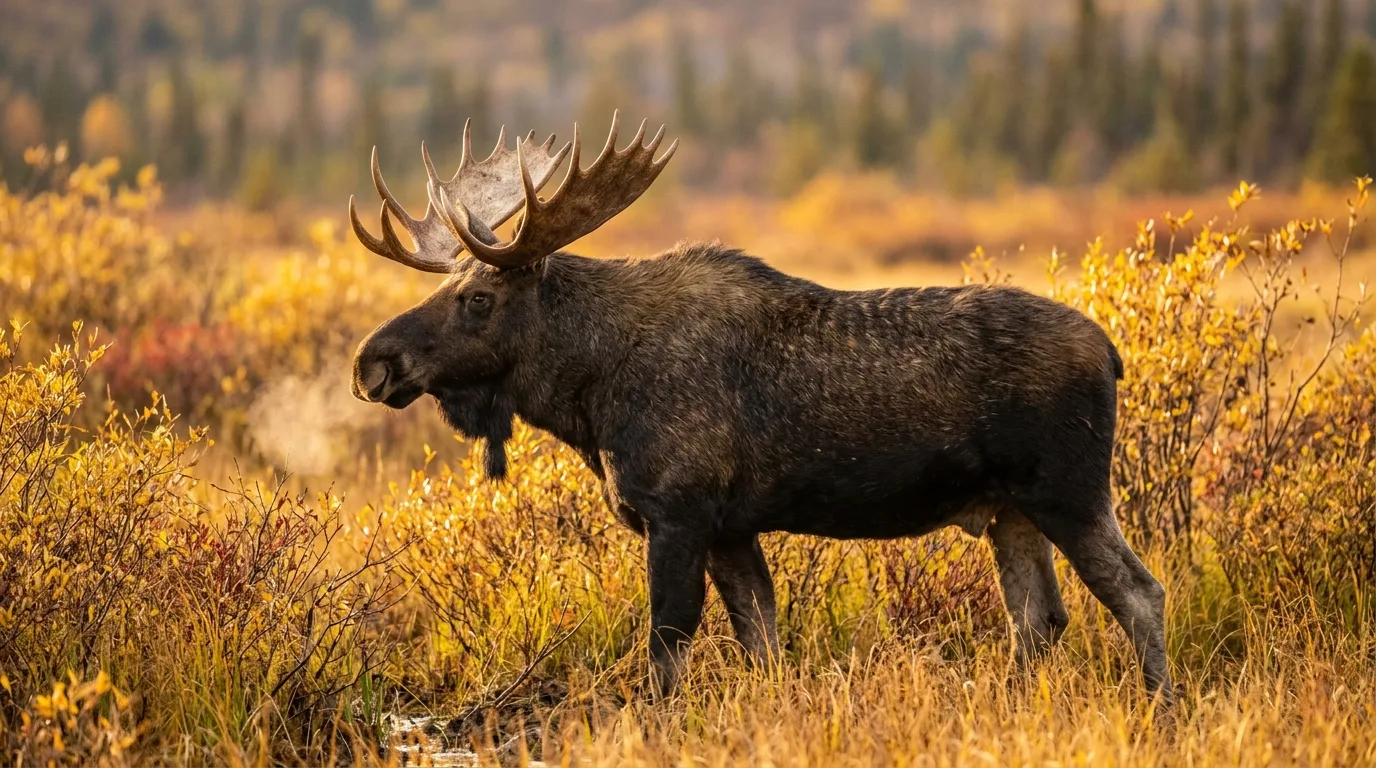
For most of the year, a bull moose is a ghost. He spends his days feeding, resting, and moving from place to place, and he goes out of his way to avoid other moose — they're the least social animal in the deer family, more solitary than caribou or sheep, content to vanish into willow and spruce like smoke. Then the days get short, and something flips. For a few explosive weeks in autumn, the hermit becomes a brawler. He stops eating, his neck swells to twice its size, he digs reeking pits and rolls in his own urine, and he starts answering — and looking for a fight.
That's the rut, and the single question everyone wants answered is when. The moose rut peaks in late September and early October across most of its range, with mating concentrated into a remarkably short window — peak mating centers on about October 1, and more than 85% of all pregnancies happen inside a 10-day stretch. The whole production — the grunting, the antler-thrashing, the rut pits, the cow moans that carry for miles — is built around getting bulls and widely scattered cows together fast, during those few days when a cow will actually breed.
This is a field guide to that window: when it hits and how far it shifts with latitude, what the bulls are actually doing and why, the sounds you'll hear from both sexes and what each one means, what that strange flap of skin under the chin is for, and how hunters and photographers use all of it to put themselves in the right place. It's about reading the rut — not the law around it.
When the moose rut peaks — and why it barely moves
If you want one date to circle, circle the turn of October. Alaska's Department of Fish and Game puts the peak of rut activity squarely in "late September and early October," and the agency's notebook repeats it: moose "breed in the fall with the peak of the 'rut' activities coming in late September and early October". Wildlife agencies from Maine to Wyoming say the same thing in nearly identical words — Maine's breeding season "begins in late September and lasts into early October," and Wyoming's Shiras moose breed "during late September – early October".
The most precise picture comes from Denali National Park, where biologist Vic Van Ballenberghe spent more than a decade watching the rut on the ground. Over a 12-year span his team observed mating 86 times. The first matings came as early as September 24, the last as late as October 8 — and, as in the rest of North America, "the peak mating for moose was centered on October 1". The window is narrow because the cow's window is narrow: most cows conceive in a single tight pulse. Charles Schwartz's review of North American moose reproduction found that "breeding season is relatively short, with >85% of all pregnancies occurring in <10 days".
Here's the part that makes moose so plannable. The rut isn't triggered by a cold snap or a full moon — it's triggered by daylight. At Denali, the rut "occurred at the same time each year, evidently independent of differences in temperature or snowfall, suggesting that it was controlled by changes in day length, which remained constant from year to year". That photoperiod clock is why a bull's calendar is so reliable: shortening days drive the hormonal cascade, and the same dates come around every fall.
The rut isn't triggered by a cold snap or a full moon — it's triggered by daylight, which is why the same dates come around every single year.
The rut runs longer than the peak — and shifts with latitude
The peak is short, but the season around it is longer than the textbook "late September" line suggests, and it slides a little with geography. A Swedish study of 250 cows across four provinces found the oestrous and mating period "lasted from about mid September to the beginning of November" — longer than the late-September/early-October peak previously reported there, with the earliest conception dates in mid-September. In a Norwegian population, the main rutting period was pinned to October 2–9. And a photographer's field guide built on years in moose country breaks the North American timing down by region: interior Alaska's rut "begins in earnest by September 7th and peaks between September 20th and October 5th, with scattered activity continuing into early November," while farther south in Montana and Wyoming it runs "mid-September through early October," peaking around the first week of October.
So the working model is a long pre-rut ramp, a hard peak around the turn of the month, and a tail that runs into November — with the whole thing nudged earlier or later by where you are.
| Phase | Rough timing | What's happening | What you'll see and hear |
|---|---|---|---|
| Pre-rut | Early–mid Sept | Velvet shed; bulls quit feeding; rut pits dug; sparring begins | Rubbed and thrashed shrubs, fresh pits, soft "glucks," light sparring |
| Peak rut | ~Sept 24 – Oct 8 (centers ~Oct 1) | Cows enter estrus; most breeding happens; serious fights | Grunting bulls, cow moans, clashing antlers, wallowing in pits |
| Post-rut | Mid-Oct into Nov | Main mating ends abruptly; bulls resume feeding; a smaller second estrus | Bulls feeding hard, fading vocal activity; scattered late activity |
There's even a second, quieter rut. A cow that isn't bred recycles — Schwartz notes the estrous cycle "averages 24 days and ranges from 22-28 days," and "if not bred, moose have up to 6 recurrent estrous cycles". So cows that miss the first window come back into heat roughly three weeks later, producing a secondary rut "around October 20th, approximately three weeks after the primary mating period". It lacks the intensity of the main event, but it's real, and it's a second chance.
What happens to a bull: the physical rut
The bull you see in October is, almost literally, a different animal than the one you saw in August. As summer ends, rising testosterone hardens the antlers and the velvet is shed — usually rubbed off against shrubs and saplings in a matter of hours. From there the changes are dramatic. By Denali's accounting, a bull may put on "up to 250 pounds of fat and muscle" over the summer, then spend it all: the neck muscles "expand to twice their normal size," and the shoulders thicken into the frame of a fighter.
That swollen neck isn't vanity — it's armor and leverage for combat, and it comes packaged with the rest of the bull's fighting kit. As the NPS describes it, "at up to 1,600 pounds they are enormously powerful," the skin on the forehead thickens "like armor against punctures," and the antlers themselves are "large, strong organs specifically designed for fighting," with sharp points on broad palms that can puncture a body or injure an eye.
A bull may gain 250 pounds over the summer and then spend every ounce of it — quitting food for weeks and living off fat while he fights and breeds.
The most striking thing a bull does is stop eating. At Denali, "large bulls cease feeding for two weeks prior to mating"; in another account from the same park, big bulls "feed intensively until the end of the first week in September, when they stop feeding for about three weeks". A bull that spent the summer eating something like 60 pounds of vegetation a day will "live entirely off stored fat reserves through the rut". He's burning the bank account he built all summer, and it shows: by late October, Alaska's biologists note, "adult males have exhausted their summer accumulation of fat and their desire for female company. Once again they begin feeding". Bulls come out of the rut gaunt and often wounded, which is exactly why they have to feed heavily through late fall to face winter.
Antler work, rut pits, and wallows
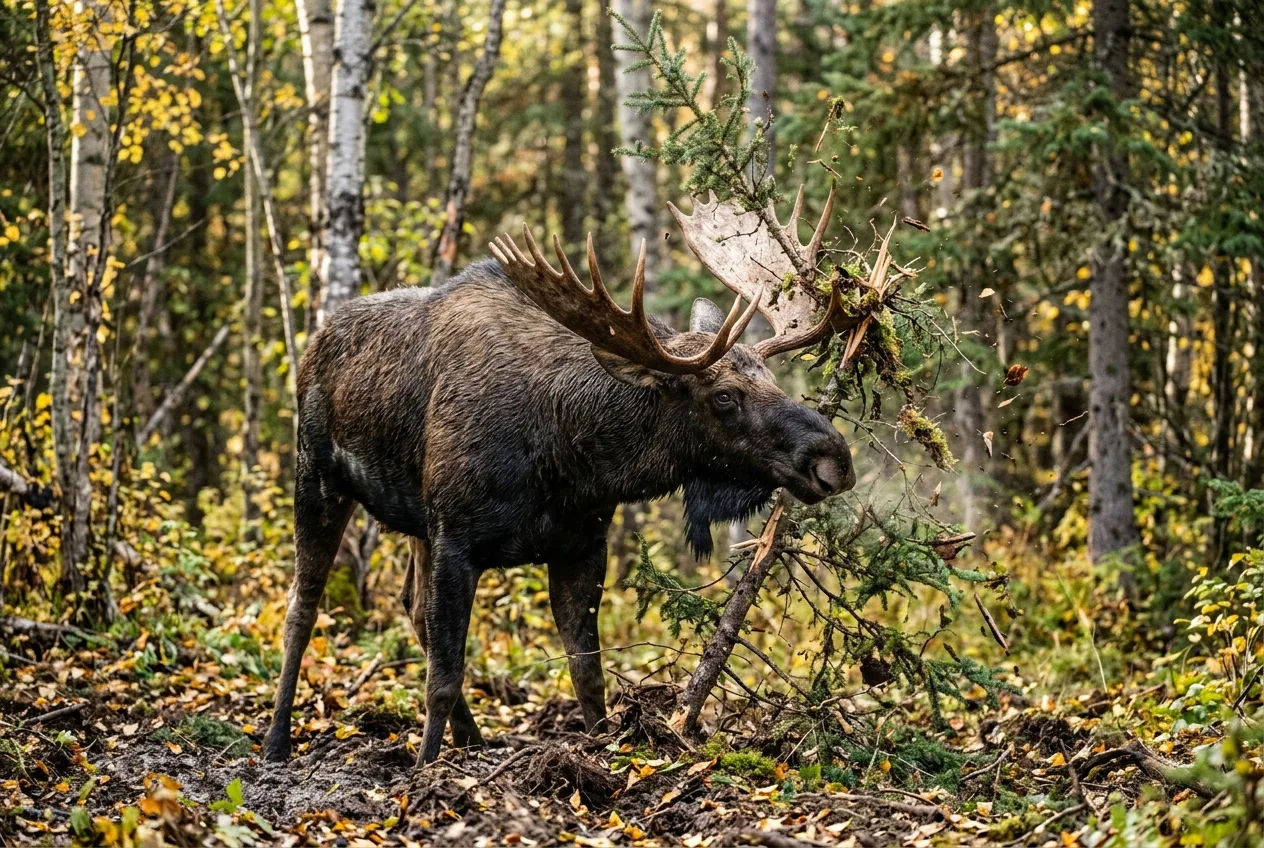
Long before the fighting starts, bulls are leaving sign. Rubbing begins in early September to clean off velvet, and "later in September they continue thrashing trees as a display of dominance" — so a torn-up shrub is both grooming and a billboard. Moose "rub their antlers against trees to scrape off the velvet," then thrash them against brush in displays that can escalate to flinging branches across a clearing.
Then there are the rut pits — the single most evocative piece of moose sign. A bull paws a shallow depression in the ground with his front hooves, urinates into it, and splashes the mud-and-urine mixture onto his antlers and neck before lying down in it. Northern Woodlands gives the dimensions: these pits are "typically 1½ to 3½ feet long, 1 to 3 feet wide, and 3 to 6 inches deep," and "bulls wallow in their rut pits, anointing themselves with their musky odor". SUNY ESF describes the same behavior as a wallow "in which both sexes roll" — and that detail matters, because the pit isn't just for him.
The urine is doing chemical work. Denali's biologists note that the bulls' urine "contains chemicals that help coordinate the fertility of cows that also wallow vigorously in the pits," and cows will compete — even fight — "in order to label themselves with the contents of the rutting pits". Maine's agency frames the bull's side plainly: he splashes his antlers with urine, "a scent that entices cows to breed". So a fresh, reeking rut pit in early October is a hub: a bull made it, and cows are drawn to it. If you're going to point a camera anywhere in the rut, a rut pit or wallow is the spot.
Sparring versus fighting: two very different things
Watch moose in late September and you'll see two bulls shove their antlers together and push. It's tempting to call that a fight. Usually it isn't. Sparring and fighting are distinct behaviors, and telling them apart tells you a lot about what's actually going on.
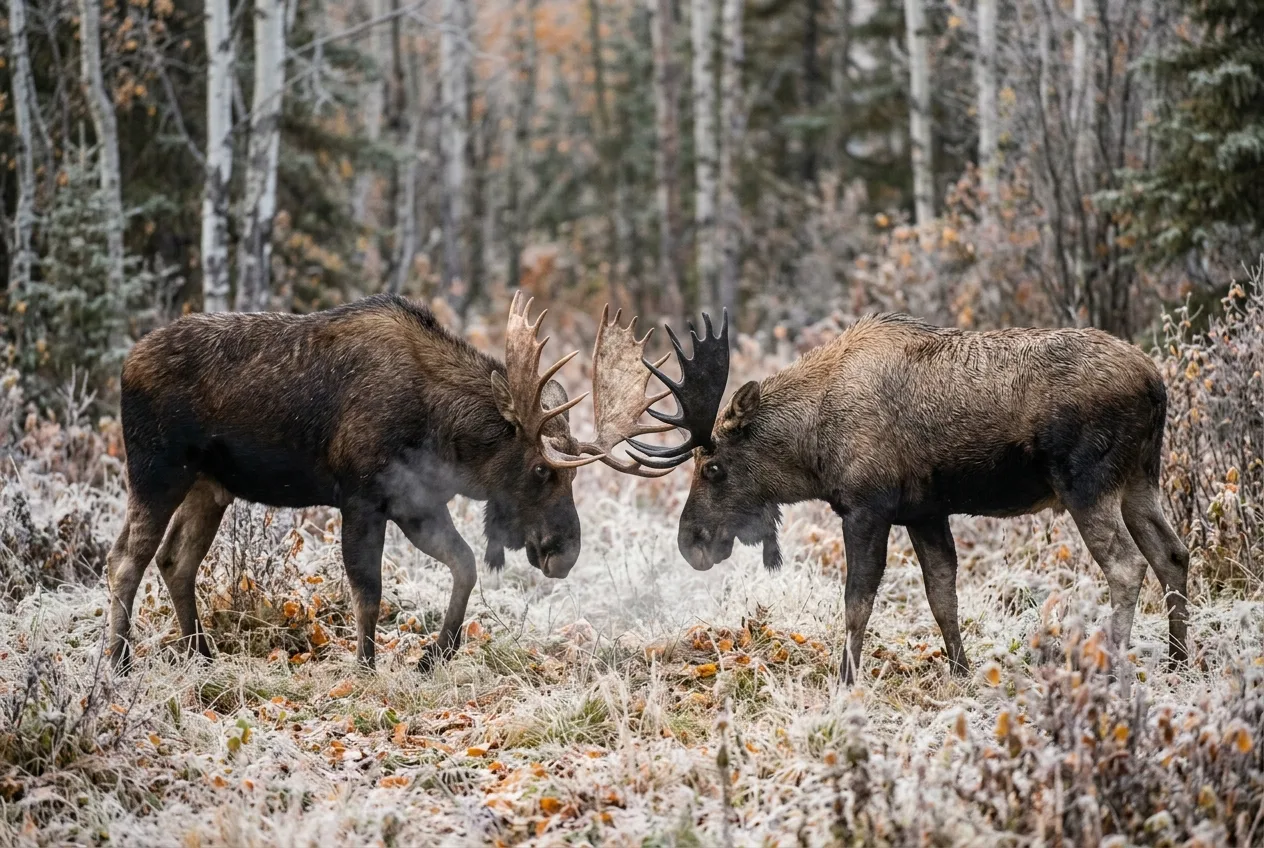
Sparring is practice. As the NPS puts it, "sparring is practice fighting that bulls use to gain experience," superficially resembling a fight as two bulls lock antlers and push back and forth, but with no real attempt to hurt each other. It starts early — "sparring begins in late August and continues during the entire rut and beyond, well into early winter" — and it's overwhelmingly a young-bull activity. At Denali, "younger bulls sparred to excess at times, and older bulls rarely sparred," sometimes going at it for several hours a day. Crucially, sparring "did not escalate to fighting and did not determine dominance or rank" — it's two animals learning, not settling anything.
Fighting is the other thing entirely. "Fighting is far more serious and violent," and where sparring at worst leaves a minor wound, "fights often result in serious injuries, and at worst, result in death". Real fights are almost always between two mature bulls of roughly equal size — when one bull clearly outmatches another, the smaller one reads the situation and leaves. Before the antlers clash, fighting bulls put on intense displays: pawing the ground, thrashing antlers against shrubs, turning broadside to show off body and rack. Then comes the collision. The clashes are "extraordinarily violent," each bull trying to twist the other's head, shove him backward, knock him down, and gore him, with both angling for the uphill position to add force. Denali notes you can hear it coming: during fights, "the sound of clashing antlers can be heard up to a mile away".
The stakes are exactly what they look like. Across agency sources the refrain is the same — serious battles are rare, but bulls "regularly receive a few punctures, sometimes break ribs, and occasionally die from their wounds". There's a darker failure mode too: antlers can lock together and fail to release, and a New Hampshire account notes such fights "rarely get too serious because the antlers might catch together, and both moose could die from starvation". A dominant bull risks all of this for one reason — it's the only way he gets to control cows, breed, and pass on his genes, which, as the NPS dryly puts it, is his "evolutionary task, which they take very seriously".
Who actually breeds: dominance, tending bonds, and the "harem" question
Here's a fact that reshapes how you think about the rut: a very small number of bulls do almost all the breeding. At Denali, "large males performed 88% of all mating, and yearling males accounted for less than two percent". And cows are overwhelmingly faithful to a single partner per season — "ninety-eight percent of observed mating involved females mating with only one male," with the rare exception breeding twice and none more than that. The top bulls earn that share by defending cows, chasing off rivals, and winning fights; the lowest-ranking animals, yearlings included, "had very little success".
A dominant bull holding a group can breed a lot — bulls were observed "mating up to three times per day," and a bull with a big group of cows might "mate up to 25 times per year". But almost no bull holds a group for the whole rut. Some groups "had five or more dominant males by the time the rut was over, each in control for only a few days" — control turns over as bulls wear down and challengers win.
A handful of big bulls do nearly all the breeding — large males accounted for 88% of matings, while yearlings managed less than two percent.
Which brings up the word "harem," and the need to use it carefully. Two broad mating systems show up in the sources. On open ground — classically the Alaskan tundra — moose form harems: as Animal Diversity Web describes it, "the largest, most dominant male attempts to herd a group of females together, which he defends from all other males". In forest — the taiga of the boreal North, Scandinavia, and Russia — moose form "transient pair bonds," where "a dominant bull stays with and defends just one cow until he can mate with her," then moves on to find another. Schwartz frames the split the same way: "the open tundra moose forming harems and the taiga moose breeding in pairs". Canada's Hinterland Who's Who captures the forest pattern from the field: moose "sometimes take more than one mate, but usually a bull stays with a particular cow during most of the breeding season".
But the Denali work adds an important caveat that's easy to miss. Even in Alaska, the careful conclusion is that "moose do not form true harems." Yes, dominant males defend running aggregations and herd cows — the system is "highly polygynous… with dominant males responsible for most of the copulations" — but it's a tending and defending arrangement, not the tight, stable harem of, say, elk. Wyoming's biologists say it more bluntly for the southern Shiras moose: "unlike other cervids, Moose generally does not collect harems or associate in large groups during the breeding season," and because the breeding season is so short, "males likely breed only a few females each year". The honest summary: think loose, shifting, defended groups on the tundra and one-cow-at-a-time pairings in the forest — and treat "harem" as a useful shorthand, not a literal description.
Group sizes back that up. At Denali, median rutting-group size grew as the rut built — 4 in the early period, 6 at mid-rut, 7 at peak — with the largest single aggregation seen being 37 animals; cow groups could hold "up to twenty-five females". These aren't permanent herds. They assemble for the rut and dissolve the moment it ends.
The sounds of the rut: what bulls and cows are saying
Moose aren't as vocal as some deer, and most of what they do say, they say during the rut. For a hunter or photographer, that soundtrack is the most useful tool you have — in dense moose country you'll almost always hear a bull before you see one. There are two basic voices, and they mean different things.
The bull's voice is low and guttural. Denali sums it up: "bulls emit low-frequency croaks". The same sound gets described as a grunt, a croak, or a moan depending on who's writing — it's "a low-frequency sound produced by forcing air through enlarged nasal passages," typically lasting one to three seconds and repeated every three to ten seconds when a bull is actively searching. SUNY ESF catalogs the bull's fuller repertoire: "roar-bellows," "croaks," and "barking-like" sounds "during agonistic and sexual encounters". Both sexes can also produce a loud, guttural "roaring" sound purely as a threat. There's information packed into these calls — larger bulls produce "calls of lower frequency and longer duration," so a deep, drawn-out grunt advertises a big animal, and bulls can size each other up by voice alone before anyone commits to a fight.
The cow's voice is the long moan — and it's the loud one. A cow in estrus "make[s] a long, quavering moaning call… which attracts males and can be heard up to 3.2 km away". Denali clocks it at a mile: "cows produce wavering moans that can be loud enough to be heard a mile away". The photographer's guide times it at "eight to twelve seconds," a wavering moan that advertises receptivity and location to bulls that may be miles off. Different sources reach for different words for it — Hinterland calls it the cow "entic[ing] a mate with a nasal-toned bawling," to which "the bull responds with a coughing bellow" — but it's the same long, carrying, distance-closing call.
There's a subtler cow call worth knowing: the protest moan. Researchers at Denali described a vocalization a cow gives "only when cows are being courted by smaller or less desirable bulls" — essentially a distress signal that draws in larger, dominant bulls to drive the inferior suitor off. It reframes the cow as an active player, not a passive prize: through that call she effectively auctions herself to the most dominant bull in earshot. For a photographer, it's a cue to get ready — when the protest moans start, bigger bulls are about to arrive and things are about to get violent.
One regional wrinkle hunters should know: North American cows have evolved to be more vocal than European moose, an adaptation to make sure bulls and cows actually find each other "given the extremely low densities of some moose populations here". Where animals are scattered thin across enormous country, sound has to do the work that sight can't.
Why the bull has a beard: the bell (dewlap)
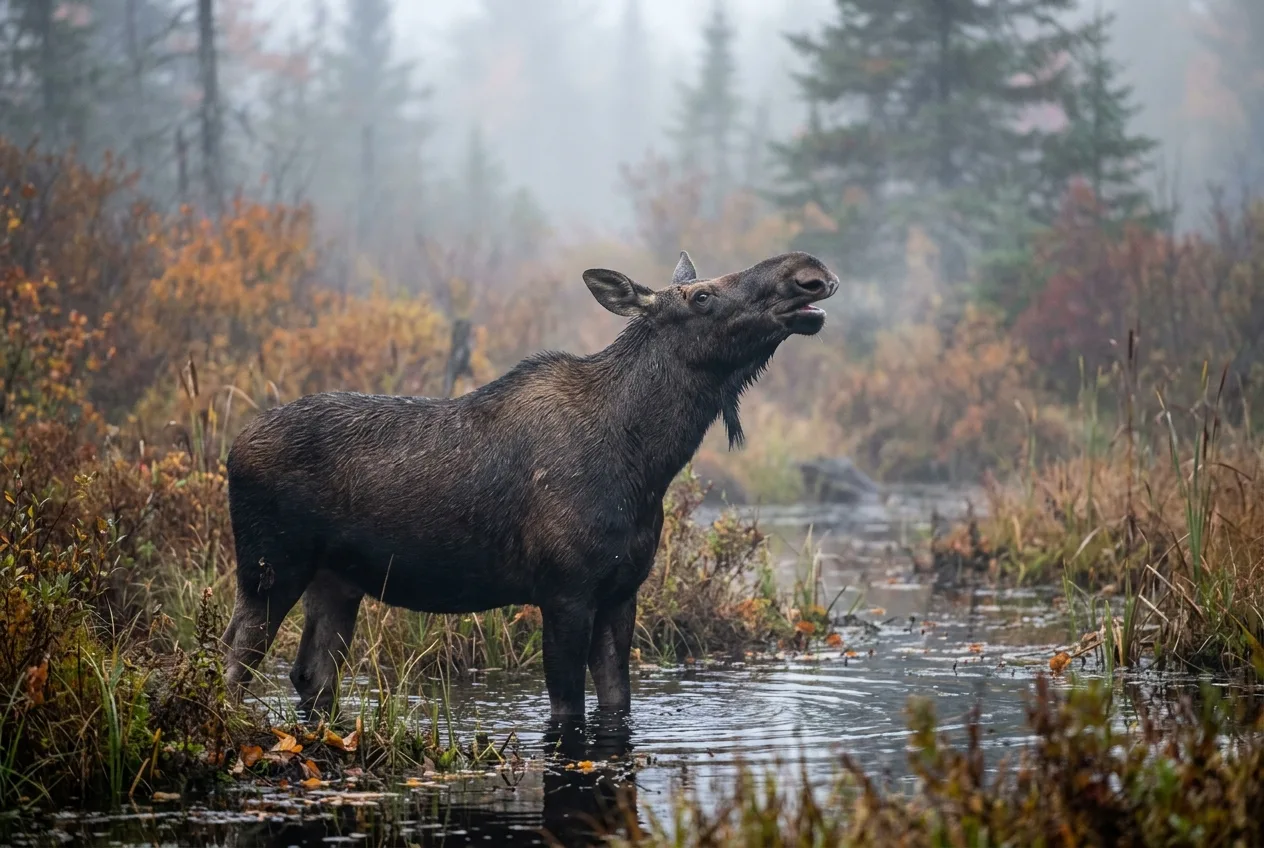
That dangling flap of fur-covered skin under a moose's chin has a name — the dewlap, or bell. Alaska's notebook describes it simply as "a fold of hair-covered skin called a 'dewlap' or 'bell' under the chin," and Hinterland measures it: "a pendant of fur-covered skin, about 30 cm long". In Maine, biologists note a cow's bell "looks more like a tuft of hair, whereas a bull's bell is larger and rounder," and some bulls grow an extra tab below it that "is believed to freeze off" in winter.
What's it for? The definitive study is Miquelle and Van Ballenberghe's 1985 work, which tested two hypotheses: that "during the rut the male bell transfers urine onto the cow," and that "the bell acts as a visual cue that relates to sex and age". Their wallowing observations "supported the hypothesis that the bell acts as a carrier of olfactory cues" — in other words, it's partly a scent applicator, picking up and broadcasting the urine-borne chemistry of the rut. But they found no link between bell shape and dominance during the antlerless period, and concluded that bell shape is "a secondary sexual characteristic most important during the rut," with moose possibly using it to "assess social status". The two ideas aren't mutually exclusive: the modern reading is that the dewlap "functions as a scent disperser," used to "broadcast pheromone-laden messages across the landscape". So the bell is part billboard, part perfume bottle — and it does its real job in autumn.
Calling moose: turning the rut's language against the bull
Because moose advertise so heavily by sound, calling works — and it's one of the most exciting ways to hunt them. The trick is matching the call to the phase of the rut. Alaska's hunting guidance lays out four basic sounds hunters cycle through: "antler scraping on trees and shrubs in early September," a "pre-rut bull 'gluck' in early September," a "bull challenge, or 'mu-wah' in mid-September," and a "cow call, a nasal melodic whine, late in September".
The sequence follows the bulls' rising aggression. In early September, before the rut, bulls group up but aren't fighting yet — soft "glucks" (a nonthreatening bull sound) and light antler scrapes on brush work best, and a bull may either drift in or answer with scrapes of his own. By mid-September, "usually after the 10th and often not until at least the 17th, mature bulls become more aggressive toward each other," antlers hardened and testosterone climbing. Now a full bull challenge can be deadly: "a deep 'mu-wah' from deep in your belly, issued three or four times in succession." But there's a caveat from the experts — make sure you actually hear bulls challenging each other before you throw a challenge call, or you'll intimidate them and run them off. Late in the month, the cow call comes into its own: "a melodic, nasal 'mo-ooo-ah' which starts high, goes low, and ends high," and many hunters use it almost exclusively to pull lone bulls without cows of their own.
A bull with cows won't leave them to come to you — so you go to him; a lonesome bull will come looking, thinking your call might be a rival who has what he doesn't.
Two tactical truths fall out of the biology. First, "a bull with cows a long way off will usually not leave the cows to come to you, so you go to him, scraping and challenging" — whereas "a bull without cows of his own is more likely to come to your call, thinking you may be a bull with cows". Second, patience and distance go together: spend at least a half hour at a calling spot, because bulls can be called in from over a quarter mile away, and when working a cow call, give a distant bull time to cover ground. The photographer's guide makes the same point from the camera side — after imitating a cow, wait at least twenty minutes (some wait an hour) before calling again, "because it takes time for distant bulls to cover the ground between where they heard the call and where it originated". A bull a mile out heard you; he's just not there yet.
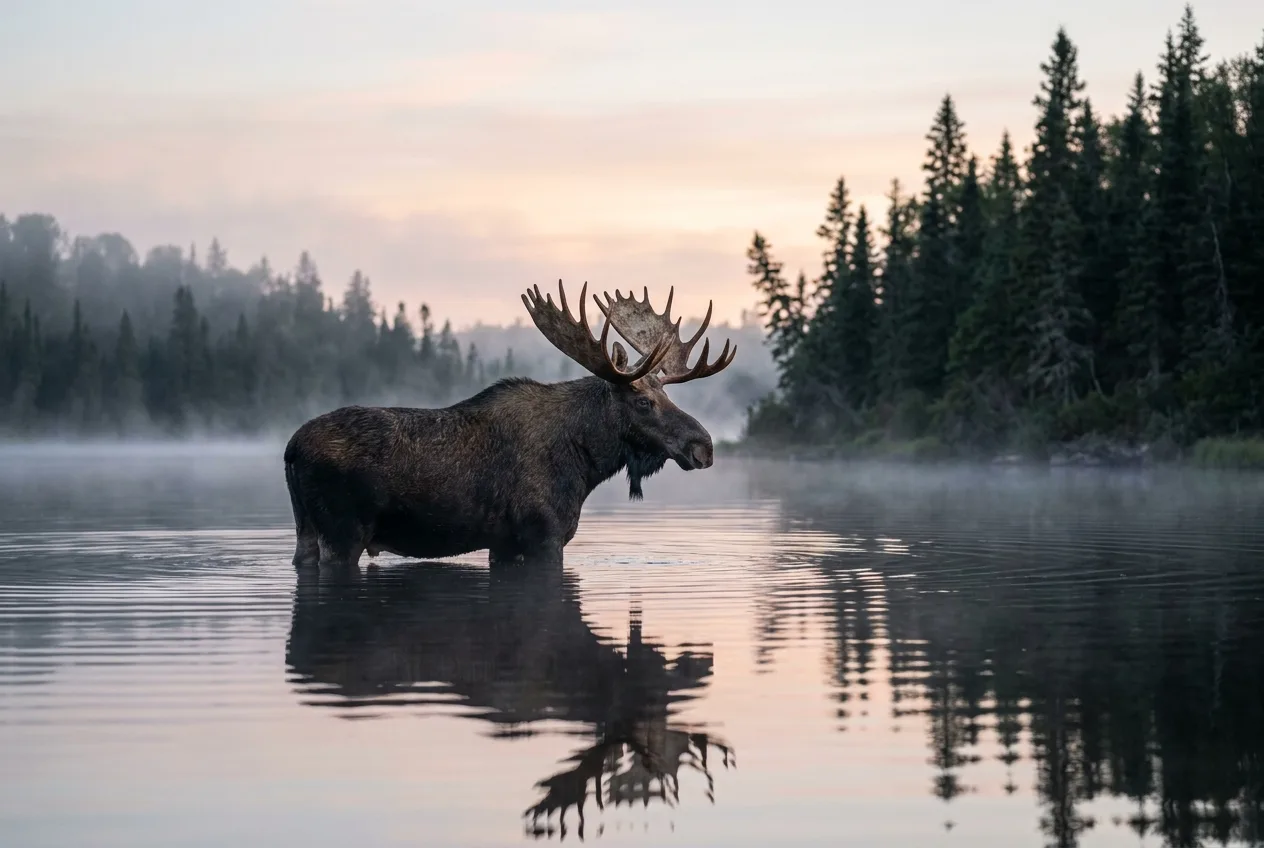
Photographing and patterning the rut: hours, weather, and where to be
Whether you're carrying a rifle or a 600mm lens, the same field logic applies — the rut compresses moose activity into narrow windows, and knowing them is half the game.
Hunt the edges of the day. Moose are crepuscular, most active at sunrise and sunset, and the dawn window is the richest of all — not just for movement but for sound, since "bulls grunt, cows moan, and the acoustic landscape… reaches its highest intensity between first light and approximately 9 AM". Activity climbs again "around 4 or 5 PM" toward dusk. Alaska's hunters put it bluntly: hunt very early and very late, eat breakfast before sunup and dinner after sundown, and listen "for antler clashes, mating grunts or breaking branches" that give a bull away.
Watch the thermometer. Moose carry the heat poorly, and temperature acts like a master switch on rut activity. Research has documented that moose "significantly reduce travel and increase resting at temperatures above 57 degrees Fahrenheit" — and Wyoming's biologists independently note that in summer moose may be stressed "when temperatures exceed 57° F (14° C)". When a warm spell settles in, activity collapses into brief dawn and dusk slivers; a cold front does the opposite and can light an area up. Check the forecast for temperature, not just rain.
Find the cows, and find the sign. A receptive, vocalizing cow is a magnet — stay with her, because bulls may be hearing her from distances that seem impossible, and they will come if you give them time. On the ground, the highest-value real estate is a fresh rut pit and a torn-up line of thrashed shrubs near the wet, brushy transition zones moose favor — beaver ponds, willow flats, marsh edges with timber close by. And remember the seasonal shuffle: many moose move to specific fall ranges for the rut, so the bull you glassed on a summer meadow may not be there in October — in some country, large bulls move to timberline rutting areas first, with cows and young bulls following as September wears on.
A note on respect, because the rut makes moose dangerous. Bulls run hot on testosterone and competitive stress, cows are protective, and more people are injured by moose than by bears in parts of Alaska each year. A moose that stares, pins its ears, raises its hackles, or licks its lips is telling you to back off — heed it, put a tree between you and the animal, and give a rutting bull or a cow the room they're demanding.
Frequently asked questions
When is the moose rut, and when does it peak?
The rut runs from roughly mid-September into early November, but it peaks hard in late September and early October — peak mating centers on about October 1. Because it's triggered by day length rather than weather, the peak lands at nearly the same date every year in a given area, sliding only slightly with latitude.
What sound does a bull moose make during the rut?
A low grunt, croak, or moan — produced by forcing air through enlarged nasal passages, lasting one to three seconds and repeated every few seconds when a bull is searching. Bulls also make roar-bellows and barking sounds during aggressive and sexual encounters, and a deeper, longer call signals a larger animal.
What is the cow's call, and how far does it carry?
A long, wavering moan, eight to twelve seconds long, that advertises a cow's receptivity and location. It's the loudest signal of the rut, audible up to about 3.2 km — roughly two miles — and it's the call hunters most often imitate to draw a lonely bull.
What is a moose rut pit?
A shallow pit a bull paws into the ground with his hooves, typically 1½–3½ feet long and a few inches deep, that he urinates into and then wallows in to coat himself in scent. Cows are drawn to the pits and wallow in them too, and the urine carries chemicals thought to help coordinate cows' fertility.
Do moose form harems like elk?
Not really. Open-tundra moose herd loose, shifting groups of cows that a dominant bull defends, while forest (taiga) moose pair off with one cow at a time — but even the Alaskan groups "do not form true harems," and southern Shiras moose generally don't gather harems at all.
What's that flap of skin under a moose's chin?
It's the dewlap, or bell — a fur-covered flap about 30 cm long. Evidence points to it working as a scent carrier during the rut, spreading urine-borne chemical signals, and as a visual cue to a moose's sex, age, and social status.
Why do bulls stop eating during the rut?
Big bulls quit feeding for about two to three weeks around mating and live off the fat they built all summer, devoting all their time to breeding and fighting. By late October they've burned through it and start feeding again to recover before winter.