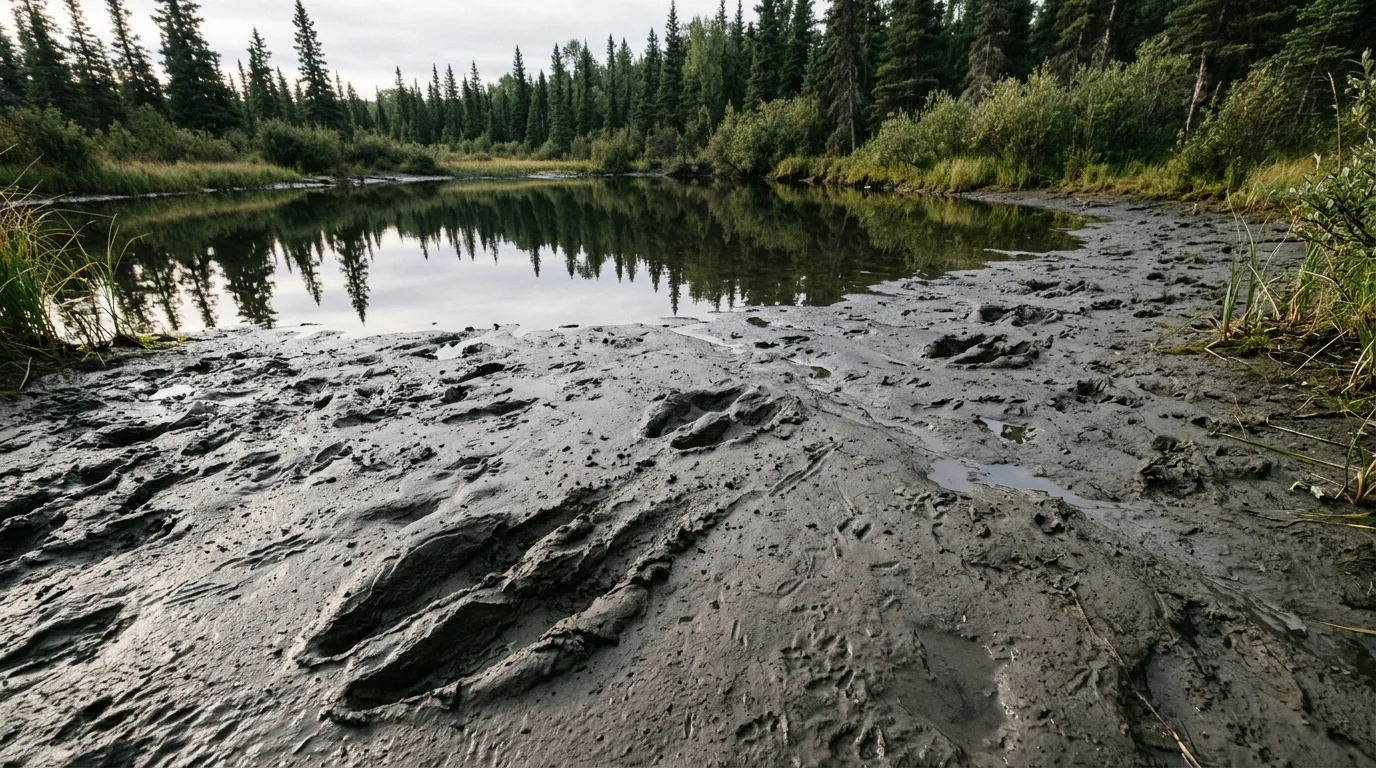
The thing about a moose is that it almost never lets you forget how big it is. A bull can stand close to seven feet at the shoulder and weigh well over half a ton, and every piece of sign it leaves carries that weight in it. A deer track is a tidy little heart you could cover with two fingers. A moose track is a hoof the length of your hand, punched deep into mud that a deer would have skated across. Once you've seen one, you stop second-guessing.
So here's the short answer, the one most people are really after: a moose track is a huge, cloven, two-toed print shaped like a heart or a teardrop, roughly 5 to 7 inches (12–16 cm) long, far bigger than any deer and broader and more splayed than an elk's. The animal is so heavy that the two big toes spread apart in soft ground, and the two dewclaws — the small paired points behind the hoof — print right into the track even when the moose is just walking. Pair that track with the right surroundings — wetland edges, willow thickets, regenerating burns — and a scattering of other sign, and you can say "moose" with real confidence. Everything below is how to read the rest of the story: the scat, the beds, the chewed and broken shrubs, and the violence a rutting bull does to a sapling.
Start with the track, because it's the one that settles it
Most cervid confusion evaporates the moment you get a ruler near a clear print. Deer, elk, and moose all leave a two-part cloven hoof, but the sizes don't overlap in any way that matters. A white-tailed deer track runs about 2 to 3 inches long. An elk is bigger and rounder, 4 to 5 inches. A moose is bigger again — 5 to 7 inches long and 4 to 6 inches wide, "wide, almost rectangular, with splayed cloves due to the moose's massive size," as one hunter-education guide puts it. Finland's wildlife agency pins the adult hoof at 12 to 16 cm and offers a clean rule of thumb: a white-tailed deer's hoof-pair can span about 9 cm, and a moose's is "clearly larger". By the time the first snow falls, even a calf's hoof has already reached the size of an adult deer's.
Shape matters too, but it's secondary to size. A deer print is a crisp heart with the two halves tapering to sharp points. A moose toe is longer and more teardrop-shaped, and — this is the part people miss — the two toes splay outward under the animal's weight, especially in wet or marshy ground. Look closely and you'll notice the print is slightly asymmetrical: the inner toe is a touch smaller than the outer one, which is how experienced trackers call left foot from right.
A deer track is a tidy little heart you could cover with two fingers; a moose track is a hoof the length of your hand, punched deep into mud a deer would have skated across.
Then there are the dewclaws. Every deer-family animal has them — two vestigial toes set higher on the leg — but on lighter animals they only print in soft mud or snow. A moose is heavy enough that the dewclaws "sit relatively low, and even at a walk the heavy animal presses so hard that the dewclaws print into the track". In snow you'll often see them as two dots behind the hoof tracks, a detail a Canadian parks tracking booklet calls out specifically. They're worth reading carefully: on a front foot the dewclaws angle out and sit closer to the toes, while on a rear foot they're farther back and point straighter, which tells you front from rear.
Gait, stride, and what deep snow does
Moose are walkers. Left to their own pace they don't even like to trot, let alone run. At a calm walk the stride — heel of one print to the next — is nearly two meters, and even on firm ground the hind foot lands in or just behind the front track. A hunter-education reference puts it more simply: deer steps run 18 to 24 inches, elk 24 to 36, and moose strides exceed 40 inches. When a moose does break into a trot the dewclaws print clearly and the stride stretches to over 3 meters.
Deep snow rewrites all of it. A moose doesn't lift its long legs clear of soft snow; it plows through, leaving a drag furrow, so a deep-snow trail becomes two parallel troughs rather than neat individual prints. If you can find one clean print at the bottom of a furrow, read it there; otherwise the straddle width and the sheer size of the disturbance will carry the ID.
| Sign | White-tailed deer | Elk | Moose |
|---|---|---|---|
| Track length | 2–3 in | 4–5 in | 5–7 in (12–16 cm) |
| Track shape | Heart, sharp points | Rounder, broader cloves | Teardrop, toes splay |
| Dewclaws | Rarely, soft ground only | Often in mud/snow | Usually print, even at a walk |
| Walking stride | 18–24 in | 24–36 in | 40+ in / ~2 m |
| Typical setting | Forests, fields, edges | Mountains, open meadows | Wetlands, willow, boreal forest |
Habitat is the quiet tiebreaker. Deer favor mixed woods and field edges; elk lean toward mountains and open meadows; moose belong to wetlands, willow flats, lakeshores, and boreal forest near water. A big cloven track in a marsh or a streamside alder thicket is far more likely moose than anything else.
Scat: let the season do half the work
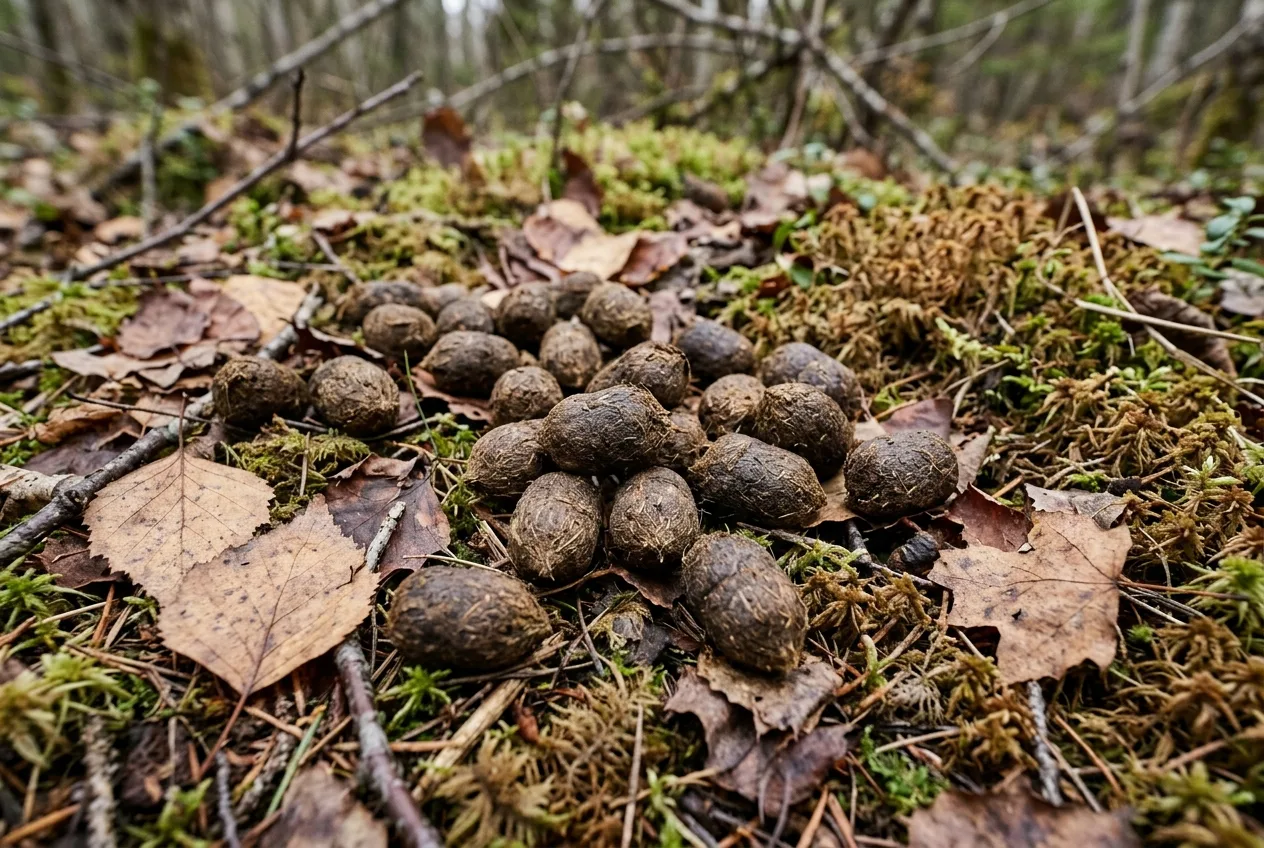
New trackers expect one tidy "moose pellet" and get thrown when the sign doesn't match the photo in the book. The trick is to stop thinking of moose scat as one thing. As Alaska's wildlife agency puts it, scat "depends on the season and food source. Pellet shape is directly related to the moisture content in the food. In winter, pellets are hard and dry". That single sentence is most of what you need.
On a winter diet of twigs, bark, and woody browse, the droppings come out as firm, dry, oval pellets — Finland's agency measures them at 2 to 3 cm long, often fairly round and tapering to a point at one end. They look, as a tracking instructor describes it, "more like pellets, similar to Deer scat, but much larger". Because they're so fibrous, winter pellets hold their shape and persist well into summer, so you'll sometimes find a tidy pile of hard pellets in August that was actually dropped in February.
Switch to summer, when the moose is eating succulent leaves, forbs, and dripping aquatic plants, and the output changes completely: "softer amorphous plops, similar to Cattle patties, or as blobs made up of compressed pellets". Norway's national encyclopedia draws the same seasonal line — the characteristic pellet-balls "mostly come from winter," while summer droppings "more often resemble a loose cow-pat". Finland notes the color shift too: dark in winter, greenish and looser in summer. None of this is a contradiction; it's the same animal, read through what it's been eating.
Stop thinking of moose scat as one thing — read it as a record of what the animal has been eating, and the season tells you half the answer before you look.
Can you sex a moose from its pellets? Roughly, and with care. The field lore is that cow pellets tend to be narrower and longer, while bull scat is "blockier, squatter and fatter," with calf pellets notably smaller. There's even a published rule of thumb: pellets wider than about 1.64 cm are not from a yearling, and pellets narrower than about 1.63 cm are not from an adult bull. Treat these as suggestive, not gospel — the people who use them say as much.
Beds: read them conservatively
Honesty matters here, because beds are the one piece of moose sign the freely available field references treat lightly. A moose bed is essentially what it sounds like: a body-sized depression pressed into snow or leaf litter where the animal lay down. A Canadian parks booklet puts it plainly — "sometimes you can see a depression in the snow where a moose may have made their bed". That's about as far as the dependable sources will commit on dimensions, so I won't invent any.
What you can say with confidence is why beds are there and where to expect them. Moose are ruminants. They feed hard for a stretch — often out in the open where new growth is, which exposes them — then move to a less conspicuous spot to bed down and chew their cud, regurgitating the tougher plant material to work it over again. So beds cluster near good cover and near feeding sign. A vivid field account from an Ontario tracking group describes watching a young bull do exactly this: he browsed balsam fir, then "pawed the ground and then lay right down… He had made a moose-bed" — and on a nearby south-facing hillside the group found a pair of beds where moose had rested above their feeding area. South-facing slopes, thermal cover, the edge of a browse patch: that's bed country. You may also find a few shed hairs in or around a bed — moose guard hairs are coarse, hollow, and can run anywhere from 2 to 10 inches long, the thickest of any hoofed animal in their range.
Browse sign: the chewed, stripped, and broken shrubs
If tracks settle the ID, browse tells you a moose has been living here — and browse sign is everywhere a moose goes, because an adult eats a staggering amount of it. New York's environmental agency puts daily intake at 40 to 60 pounds of browse; a university account in the Adirondacks gives 16–27 kg (35–60 lb) a day. A peer-reviewed Minnesota study translates that appetite into bites: for a 1,000-pound moose, daily intake "equates to at least 13,000 bites in summer and 4,000 bites in winter". That is a lot of nipped twigs to stumble across.
Torn twigs, not clean cuts
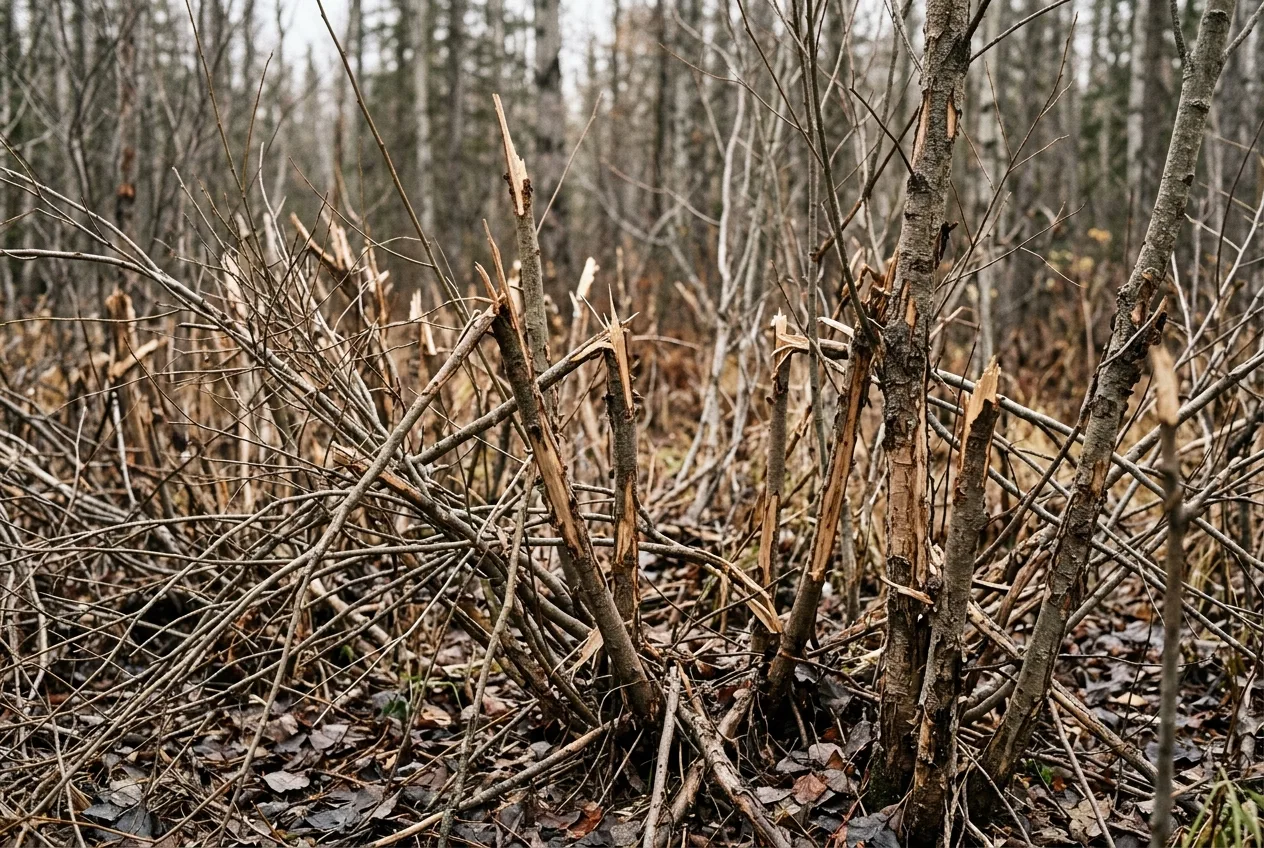
Here's the diagnostic that trips up beginners, so get it straight. Moose — like deer and elk — have no upper incisors. They bite against a hard pad on the upper gum, which means they can't make a clean snip; they tear the twig, "leaving ragged ends". So a moose-browsed twig ends in a frayed, squared-off, splintered stub, never the clean 45-degree cut you'd get from a rabbit or hare.
The catch: deer and elk leave that same ragged tear, because they share the same dental setup. So the torn end alone doesn't separate moose from deer. Height and twig diameter do. A moose reaches far higher than a deer, and bites through much thicker twigs. The naturalist who filmed a moose tearing a sapling makes the point with a real example: browse sign on a red maple "about 5 feet above ground," made in a low-snow winter — "both deer and moose will eat red maple, but deer could not have reached that high in the absence of snow pack". The favored browse, season after season and across two continents, is remarkably consistent: willow, aspen, birch, plus maple, pin cherry, mountain ash, and red osier dogwood, with balsam fir becoming a winter staple in the Northeast. On Isle Royale, moose lean on balsam fir so hard in winter that the trees end up "severely over browsed; some specimens even suffer stunted growth" — a stunted, heavily clipped fir is itself a sign you're on well-used moose range.
The hedge line
Where moose work the same shrubs and saplings year after year, they sculpt the vegetation. Alaska's agency describes moose establishing "a 'hedge' or browse line 6–8 feet above the ground" by clipping the terminal shoots of favored species. Sweden's national forest inventory, which tracks moose browsing across the country, records the same signature on young pines from the tree's point of view: the top shoot browsed off, the leader broken — in the hardest-hit region, an average of 15 percent of young pines carried serious browsing damage, and about 18 percent had the leading shoot nipped. A browse line at moose height, a thicket of hedged and broken-topped saplings: that's a moose neighborhood, not a one-night visit.
A moose-browsed twig ends in a frayed, squared-off stub — but so does a deer's; it's the height and the thickness of what got bitten that name the animal.
Broken saplings and bark stripping
A moose doesn't only nip tips. To reach buds and tender growth otherwise out of range, it will break branches and whole saplings — either grabbing a stem in its mouth and pulling until it snaps, or simply straddling a small tree and walking forward, bending it down under its weight until it bends or breaks. If a moose walked over a sapling you may find almost no other sign, "though you may find a few hairs if you look carefully"; if it pulled the stem down with its mouth, look for tooth marks a foot or so past the break.
Then there's bark. In late winter and early spring, when food runs short, moose strip bark from larger trees. The signature here is specific and worth knowing: the incisor scrape. Lacking upper teeth, a moose grabs a strip of bark between its lower incisors and that hard upper pad and drags its head upward, peeling a vertical strip off the trunk. The naturalist Mary Holland describes finding these scrapes "as low as ten inches from the ground" and as high as "eight feet" — the tall ones made by a moose standing on packed snow. A telling detail separates a fresh moose scrape from random bark damage: because the animal scrapes upward, the strip frays only at the top, never the bottom; fresh scrapes look yellowish and gray and scar over the years. Look for them on red and striped maple (striped maple is even nicknamed "moosewood"), aspen, willow, and balsam fir.
Rut sign: rubs, pits, and wallows
For a few weeks in late September and early October, a bull moose stops being subtle and starts redecorating the forest. Two kinds of sign show up.
First, antler rubs. A rutting bull thrashes pliant shrubs and rubs larger trees, deliberately clonking his antlers against them as an auditory and scent advertisement. On the smaller trees he destroys during the September–October rut, expect "bark removed, xylem exposed, and limbs twisted and broken," with "gouges and scratches" where the antler surfaces dragged up and down and the tines "penetrated and scored the bark". Later in the fall, as he gets ready to drop his rack, he makes large-diameter rubs on balsam fir and white birch — and if you're lucky you might find a shed antler at the base. The detail that clinches a moose rub over a deer rub is what's stuck to the tree: facial hair where he rubbed his forehead, and mud and neck hairs smeared on where he rubbed his wallow-soaked neck and bell. Hair plus mud on a gouged trunk is a moose's signature, not a deer's.
Second, the rutting pit, or wallow. This one is unmistakable once you know it. A bull "digs a shallow pit into the soil with his front feet," then "urinates in the pit and splashes the mud/urine mixture onto his antlers and neck," and "finally lays in the pit". The smell does the advertising: cows are drawn to it and "wallow vigorously in the pits," even fighting each other "to label themselves with the contents". So a fresh, churned-up depression that reeks of urine, ringed by big tracks and often near torn-up shrubs, is a rut pit — among the most diagnostic moose sign there is. (Oddly, trackers report moose urine in winter smells sweet, "similar to sweet coconut or Hawaiian Tropic sunscreen" — and the spray pattern even hints at sex, since bulls tend to urinate ahead of the rear feet and cows straight down.)
Hair plus mud on a gouged, broken-limbed trunk is a bull's signature — a deer rub never comes with the wallow smeared into it.
Putting it together in the field
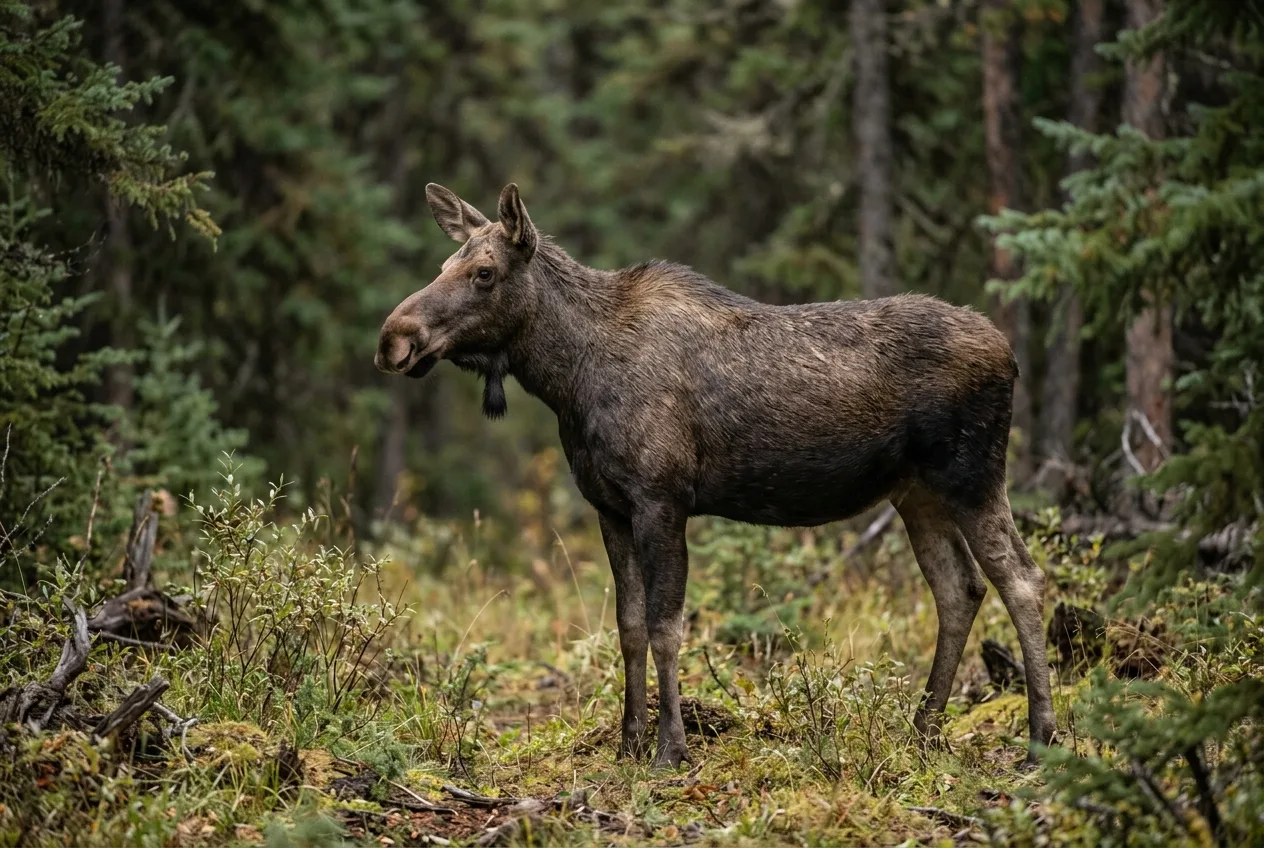
No single sign is a confession. A track says "a big cervid came through." Add splayed toes and registering dewclaws in a marshy willow flat, and it's almost certainly a moose. Add hard oval pellets and ragged-torn browse at five or six feet, and you're sure. Add an incisor scrape frayed at the top, a hedged stand of saplings, a bed on a south-facing slope with a coarse hollow hair in it — now you're not just identifying an animal, you're reading how it's using the place. That's the real reward: the sign stops being a quiz and starts being a story.
Frequently asked questions
How big is a moose track compared to a deer track?
A lot bigger. A moose hoof print is about 5–7 inches (12–16 cm) long; a white-tailed deer's is 2–3 inches. Even a moose calf's hoof reaches adult-deer size by its first winter, so size alone usually settles it.
Do moose tracks show dewclaws?
Yes, far more reliably than deer. A moose is heavy enough that the two dewclaws print behind the hoof even at a walk, often as two dots in snow or mud — on a deer they usually show only in soft ground.
Why does moose scat look different in summer and winter?
Because the moisture in the diet changes. A winter woody diet makes hard, dry, oval pellets about 2–3 cm long, pointed at one end; summer's succulent and aquatic plants make soft, shapeless "cow-pat" blobs.
How can I tell moose browse from deer browse?
Both tear twigs into ragged ends — neither has upper incisors — so the cut alone won't do it. Judge by height and twig thickness: a moose reaches and bites far higher than a deer, and works much thicker stems, often clipping a hedge line up to 6–8 feet. Mind the snowpack, which lets smaller animals reach higher than usual.
What is a moose incisor scrape?
A vertical strip of bark a moose peels off a tree by gripping it between its lower teeth and upper pad and pulling upward. The strips run from about 10 inches to 8 feet up, fray only at the top, and turn up on maples, aspen, and willow.
What does a moose rut pit look like?
A shallow, churned-up depression a bull digs with his front feet, urinates in, and lies in — so it reeks of urine and is usually ringed by big tracks and torn shrubs. Cows wallow in it too, which keeps it fresh and obvious through the rut.