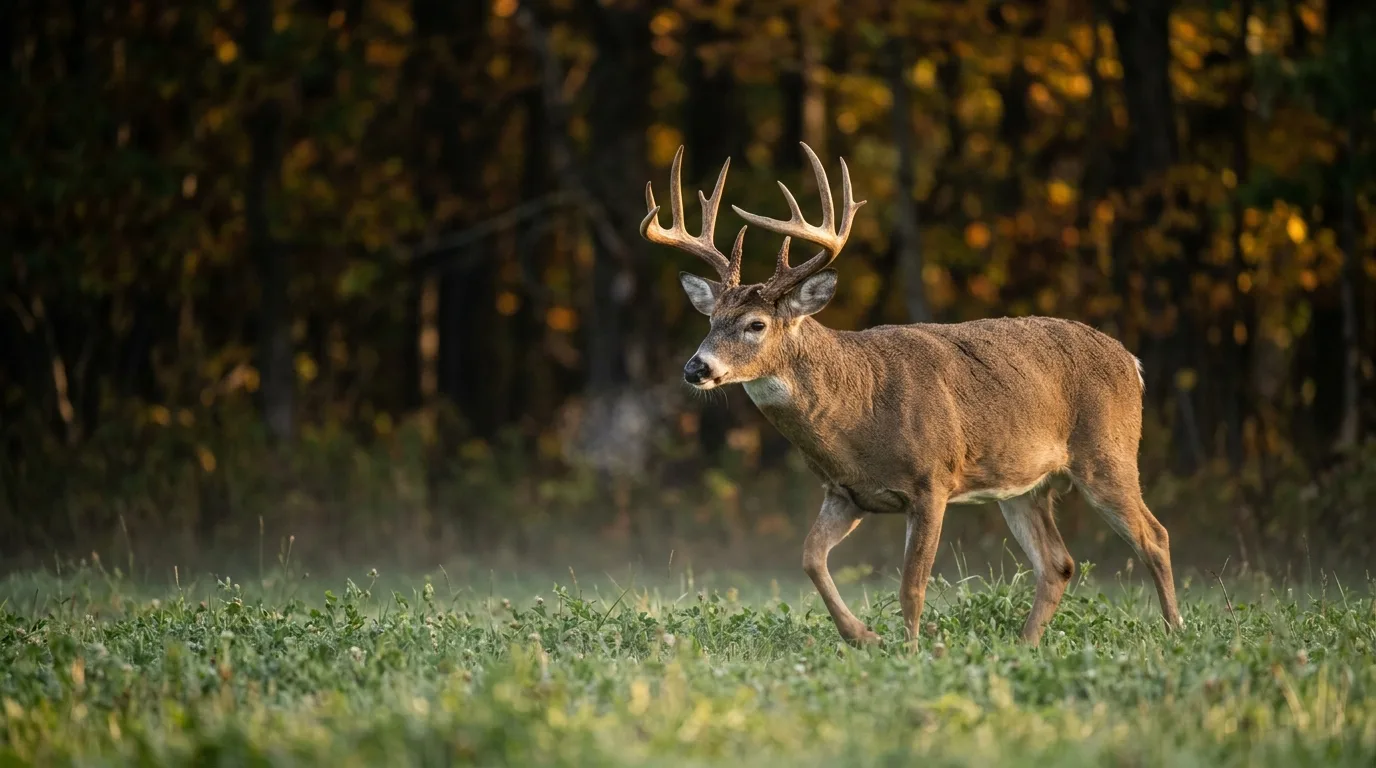
Every season it happens to someone. A buck shows up on your cameras all summer — velvet, daylight, standing in the food plot like he owns it. You build your season around him. Then opening week comes and he's a ghost: still on the camera, but now every photo is stamped 11:42 p.m. or 4:55 a.m. He went nocturnal, you tell yourself. He's only moving at night.
He almost certainly didn't, and he almost certainly isn't. The most useful thing GPS research has taught us in the last decade is that there is essentially no such thing as a nocturnal buck — even mature bucks move in daylight, "almost without exception". What changed isn't the deer's clock. It's where he's doing his daylight moving, and whether your camera happens to be pointed at that spot. As one National Deer Association writer put it after killing a buck he had zero daylight photos of: a so-called nocturnal buck is "simply one whose daylight movements you aren't seeing".
So patterning a specific mature buck isn't about waiting for him to start tripping your camera in daylight. It's about reading the photos you already have — the timestamps, the locations, the gaps — and using them to figure out where his daylight movement is happening so you can move to meet it. This is a strategy piece, not a survey piece: the goal is one deer, one plan, one good sit. Let's get into how the data actually reads, and where it lies to you.
Why your camera makes a daylight buck look nocturnal
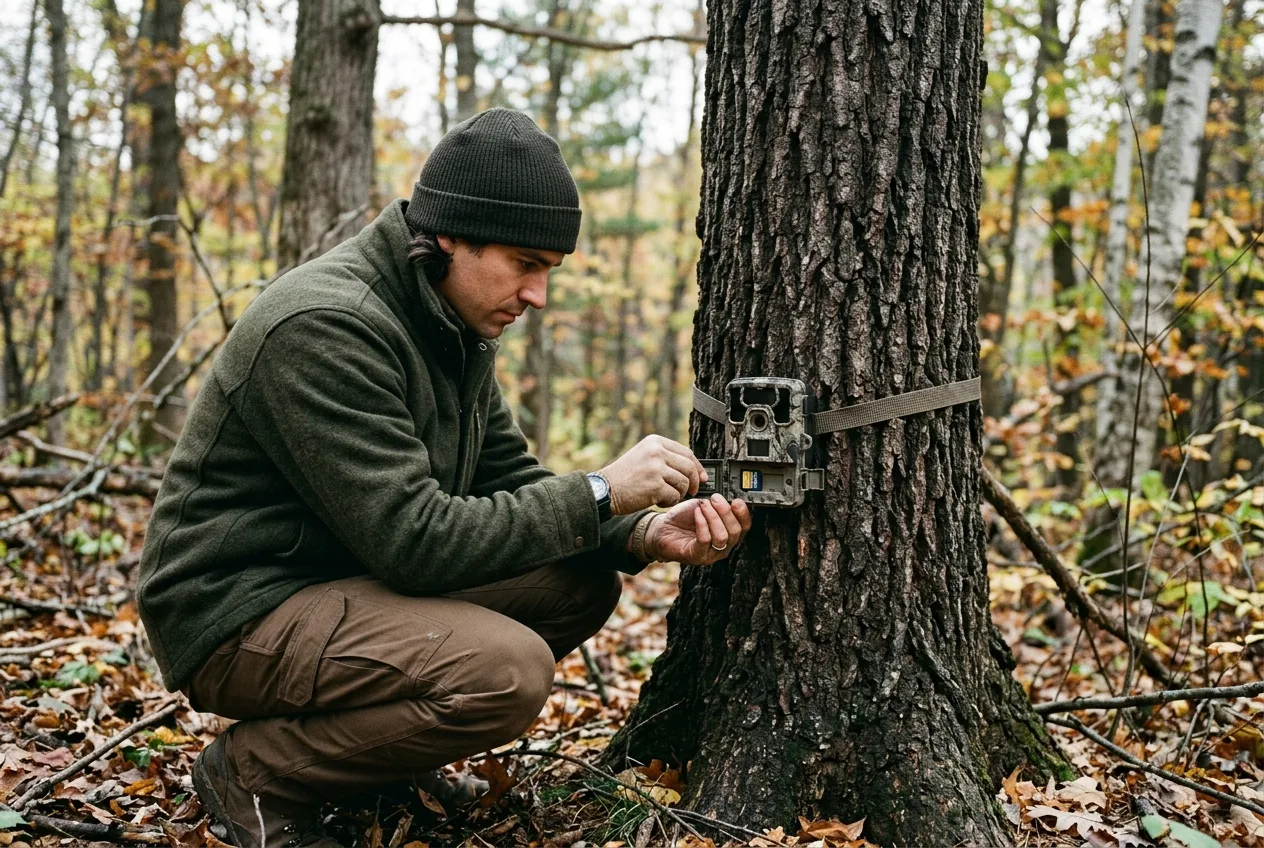
Start with what a trail camera actually is: a motion sensor watching maybe sixty feet of one trail, one scrape, or one food-plot corner. Everything outside that cone is invisible to it. So when a buck trips it at midnight, all you've truly learned is that he was at that spot at midnight — not that he was asleep at noon. He may have been on his feet and moving for hours beforehand, just doing it three hundred yards away in a stand of pines you don't have a camera on.
That's the core of the "nocturnal buck" myth, and the people who study collared deer are blunt about it. The NDA's Cole Gander lists three reasons a buck shows up only after dark, and the first is simply "deceptive trail cameras": they "capture only a small picture" and "can't see thick bedding cover where deer spend much of their time". The onX/Land & Legacy habitat consultants say the same thing from the management side — "most bucks never become nocturnal, rather they just use certain areas more than others in daylight hours," and sometimes that daylight movement is confined to a few acres of cover you'd never put a camera in.
A buck that only shows up at midnight hasn't changed his schedule — he's changed his address for the daylight hours, and your camera didn't get the memo.
The second reason is pressure, which gets its own section below. The third is food. When the woods are full of acorns, a buck doesn't need your food plot — he can fill his belly anywhere, so he stops visiting the predictable, camera-covered feeding spots and spreads out across the landscape. Mark Kenyon makes the same point about the mid-October slump: the dip in sightings "is not caused by a decrease in deer movement, but a change in deer movement," driven by acorns dropping, crops coming off, leaves thinning, and pressure rising all at once. The deer didn't disappear. Your camera's view of him did.
Here's the practical upshot: a wall of nighttime photos is not a verdict. It's an incomplete map. Your job is to fill in the daylight part of the map by reading the clues the camera does give you — and the richest clue is the timestamp.
Read the timestamps like a logbook
If you take one habit from this article, make it this: get the date and time right on every camera, and then actually read the time on every daylight photo of your buck.
Why the hour matters so much: the night-vs-day split at feeding sites is dramatic, and knowing it tells you how meaningful a single daylight photo really is. On the Mississippi State Deer Lab's 50,000-acre study, two-thirds of buck visits to feeders happened between 6 p.m. and 6 a.m., and the bucks used winter food plots "five times more at night than during the daytime hours". So a daylight photo of a mature buck anywhere is a relatively rare, high-value event — it's the camera catching the edge of his real daylight movement, and you should treat it like a pin on the map.
Honeycutt pushes the timestamp read one level deeper, into wind. Reviewing years of daylight photos, he noticed some bucks "only move outside their bedding areas when the wind was in their favor" — quartering or blowing toward them from the direction they expect danger. So don't just log when a daylight photo happened; log the wind that day. If three of your buck's four daylight appearances at a given camera share a wind direction, you haven't just patterned a time, you've patterned a condition — and that's the kind of detail that puts you in the right tree on the right afternoon.
A few things worth logging for every daylight photo of your target:
- Exact time, to spot whether he favors the first or last hour of light, or genuinely moves midday.
- Wind direction and speed that day — the single most overlooked variable in patterning.
- Direction of travel if you can tell. Video helps here; the first and last frames show where a deer came from and where he went, which points you toward his bedding and his food.
- Camera location, obviously, so that a string of daylight hits starts to draw a line across your property.
What you're building toward is a simple question with an actionable answer: where on this property does this buck still feel safe enough to move in daylight, and how do I get between him and where he's going?
Where daylight movement actually happens: hunt the transition
This is where the GPS collar data turns abstract behavior into a stand location, and it's the most important tactical lesson in the whole topic.
When researchers tracked 54 bucks and 57 does for nearly a decade on a South Carolina property, the daytime-versus-nighttime pattern was clean. Both bucks and does selected for hardwood drains and planted pines during daylight, and used the open food plots mostly at night. More than that, their speed flipped depending on where they were: a buck moved about 250 yards per hour through a food plot — but only ~50 yards per hour in the hardwood drains where he spent his daylight hours, "where movement rates are lowest". He's in the cover during the day, but he's barely moving in it. He's loafing, browsing, bedding.
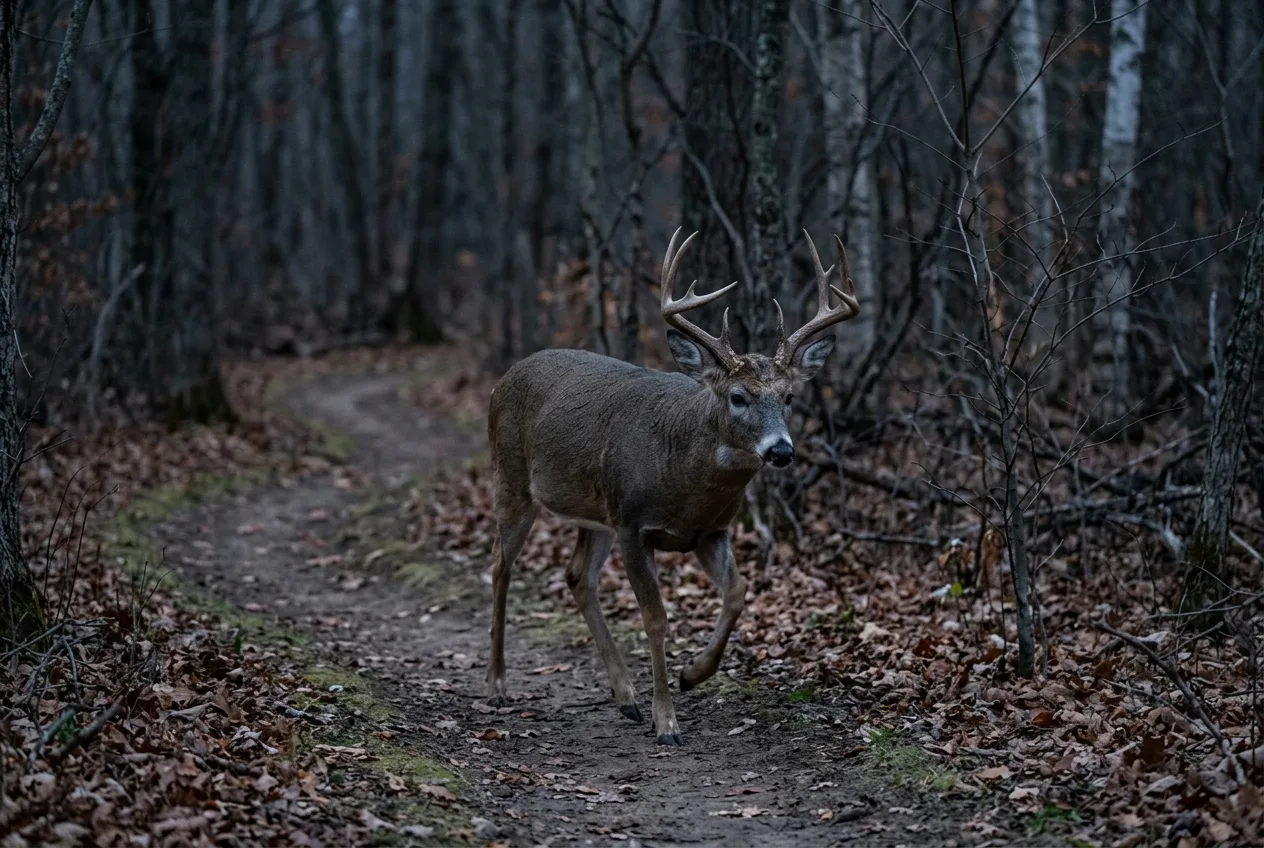
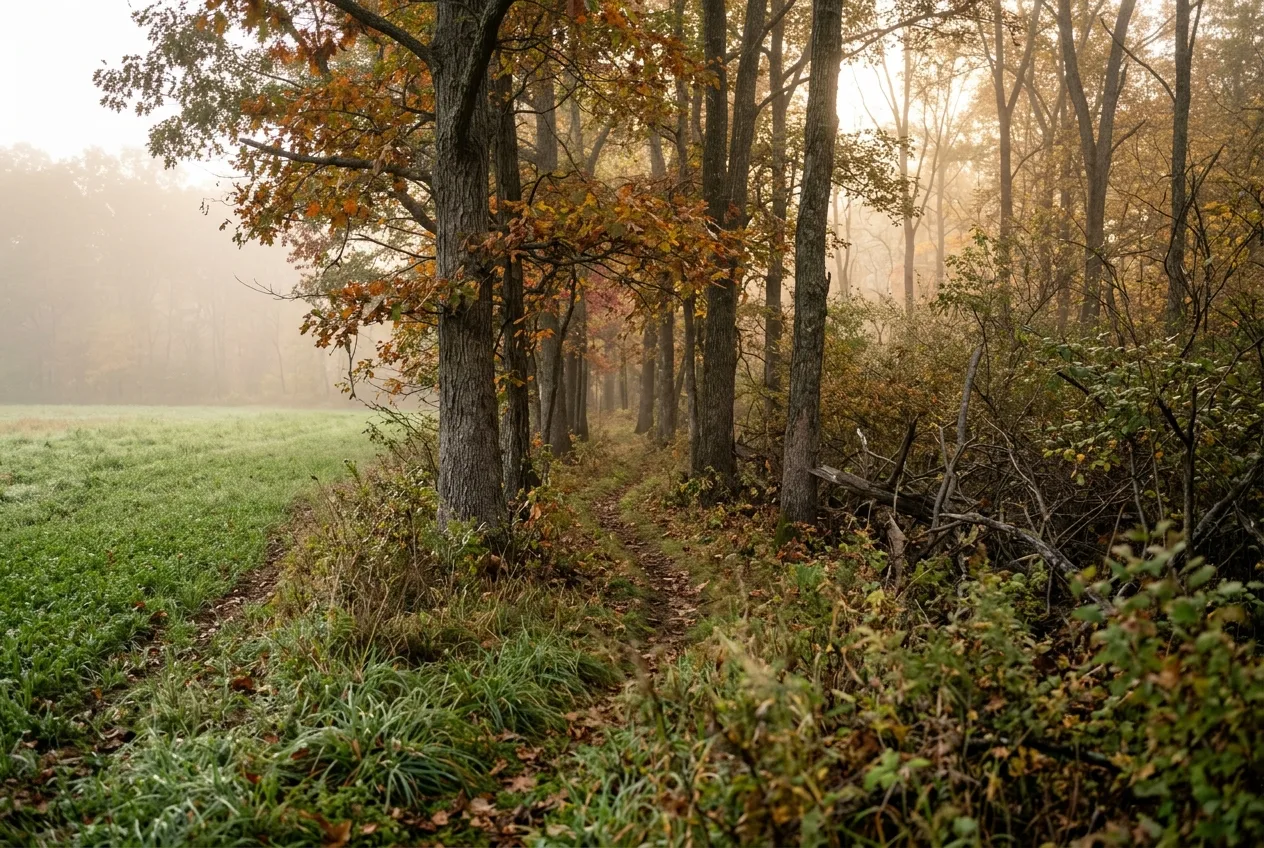
So the field edge — the spot that's collecting all your night photos — is exactly the wrong place to sit for a daylight buck. He's not getting there until after dark. The right place is the travel corridor between his bedding cover and that food source, the natural pine or the pinch of timber his GPS lines overlap in as he leaves cover in the evening or returns in the morning. The Mississippi State extension guide lands in the same spot from a different study: bucks "entered food plots at greater rates right around sunset, so the best opportunity for a daylight shot at these animals is by hunting them along travel corridors between daytime bedding sites and these feeding areas".
Stop hunting the food. Hunt the hundred yards of cover the buck has to walk through to reach it before dark.
Cole Gander's hunt is the textbook example of this in action. He had a Missouri buck that only showed at night on a food-plot camera. Instead of sitting the clover edge again, he moved about 250 yards to a stand on the edge of a thick bedding area, used rain to cover his entry, played the wind — and killed the buck at 3:00 p.m., two hours before last light, "despite having no daylight photos of the deer all season". The camera said nocturnal. The cover edge said otherwise.
Land & Legacy adds the habitat logic underneath all of this, and it's worth knowing even if you don't own the dirt. Bucks move in daylight where their body is hidden but their senses aren't — "vegetation growing from four feet and lower is the key for daylight movement". If bedding and food are too far apart, "deer may leave the bedding area before dusk, but by the time they travel 500 yards to the food plot, dark has settled" — which is why so many food-plot cameras fill up with night photos. The fix on managed ground is to put secure bedding and food close together (they suggest no more than 200 yards) and connect them with a brushy travel corridor. The fix on ground you don't manage is to find where that arrangement already exists and hunt the seam.
Pressure shrinks a buck before it ever moves him
Here's the piece that reframes a "disappearing" buck. When hunting pressure shows up, the instinct is to assume the buck left — packed up and moved to the neighbor's. Usually he didn't. He shrank.
A Penn State graduate study put the shift-or-shrink question to a real test, running Hidden Markov models on 38 deer across 54 deer-years against distance-to-road, slope, and hunting dates. The finding: "Most deer exhibited some kind of home-range contraction" during rifle season, and shifting to a new location "occurred less often." The winning bet, as the researcher put it, was shrink — though honestly, only "less than half (43%) of deer exhibited evidence of home-range contraction due to hunting pressure," so plenty of deer barely reacted at all. The headline is the direction: when bucks respond to pressure, they compress into security cover far more often than they leave the country.
And — this is the counterintuitive part — they don't necessarily move less. The Mississippi State work, summarized by Land & Legacy, found "hunting pressure did not reduce the amount of daylight movement of the bucks. Rather, bucks just restricted their movements to smaller areas". Picture two bucks each walking a thousand yards before dark: one strolls a straight line across an open field, the other zig-zags every five-yard line inside a one-acre thicket. Same distance, but the second buck never leaves cover — so he never trips your field camera, and to you he's "nocturnal". The Mississippi State extension data shows the same animals "selected for food plots even on days with the highest level of risk," but did it "primarily during nighttime," and recommends hunting the corridors between bedding and food for daylight success.
Under pressure a buck usually doesn't run — he shrinks into cover and keeps moving where you can't see him.
That same study found bucks adjust shockingly fast. An associated Oklahoma study saw deer "increased their daytime use of cover by 240 percent by the second weekend of gun season," and hunter observations of collared bucks known to be in the area "declined 62 percent by the second weekend". The deer were still right there. The hunters just couldn't see them anymore — the exact same illusion your camera is feeding you, on a property-wide scale.
The data points hunters love to repeat — "two intrusions turn a buck nocturnal for two weeks," precise percentages of lost daylight photos — mostly trace to sources nobody can verify, so we're leaving those specific numbers out. What the solid research supports is plainer and more useful: pressure pushes a buck's daylight movement deeper into cover and tightens the area he uses, but it rarely shuts the movement off and often doesn't even reduce it. Which means the answer to a buck "going nocturnal" after opening day usually isn't to wait him out. It's to get tighter to his bedding cover, and to stop adding the pressure that's compressing him in the first place.
How much checking is too much
Which raises the uncomfortable question: every time you walk in to pull a card, are you the pressure?
Sometimes, yes — and how much depends on the individual deer. Honeycutt's most useful observation across thousands of bucks is that "each whitetail tolerates human intrusion at different levels." Some don't care if you hang a stand and fill a feeder; others "shift to the neighbor's property at one whiff of ground scent." Over time, cameras reveal which is which — and his advice is to "focus on hunting the tolerant bucks" and stop burning your season on the one that won't forgive a single intrusion. Land & Legacy is blunt that "human intrusion into bedding areas disrupts security and reduces reliable deer usage" — security "is the anchor" that keeps a buck using an area in daylight, and once you break it, the daylight use goes with it.
This is the real argument for low-impact cameras and disciplined card-pulling. Deer are "instinctive, not calculating," as Honeycutt puts it — a buck can't reason out that you're a camera-checker, but if he repeatedly smells you or sees you at the same spot, he learns to avoid it. A cellular camera that never makes you walk to the bedding edge, cards pulled only with the right wind and a real reason, an approach route that doesn't cross his core area — these aren't fussiness, they're the difference between patterning a buck and educating him. The closer your camera sits to the cover where he spends daylight, the more careful you have to be that checking it doesn't cost you the very behavior you're trying to find.
The seasonal calendar: when patterns hold and when they shatter
A pattern is only as good as the window it lives in. A mature buck's movement rebuilds itself several times between August and January, and knowing the calendar keeps you from trusting a July pattern in November.
Late summer (the velvet trap). This is when the daylight photos are easiest and most misleading. Bucks run in bachelor groups — Penn State logged a reader's sighting of eleven bucks in one field — and they're loosely social and patternable on summer food. But that arrangement is about to detonate. As velvet sheds and testosterone climbs, "these bachelor groups are going to break up," and to a hunter watching cameras "it will seem like they all disappeared". The summer feeding pattern you so carefully built has roughly a September expiration date.
The October shift (not a lull). Then comes the part everyone misreads. GPS research from North Carolina State, Texas A&M, and Georgia has "consistently shown that bucks move more as October progresses" — movement rises through the month. Yet hunters see fewer deer, because movement shifts toward cover as pressure, acorns, crop harvest, and leaf-drop all hit together. "The hunter who sticks to the same strategies on October 15 that he tried on October 1 is going to see fewer deer. Hence, the perceived lull". Read your cameras accordingly: fewer daylight field photos in mid-October is a location change, not a movement shutdown — the cue to slide tighter to bedding, not to give up.
The rut (patterns off, odds on). Now the home range itself blows up. Penn State found that during the rut a buck's range "will increase by 2-5 times" — a square-mile buck suddenly roaming two to five square miles. Mississippi State clocked peak-rut bucks moving "over 7,500 yards (4 miles) total per day," with their hourly day and night movement rates equalizing as they abandon caution to find does. Denny Quaiff, a Virginia hunter with 25-plus years of camera study, says it plainly: "When the whitetail rut is in full swing, all bets are off with regards to patterning bucks" — one of his target bucks turned up "over a mile" from where he'd last had him. The paradox: you've lost the pattern, but this is statistically your best chance, because "the best chance to harvest an adult buck is when they move the most" — early and peak rut. Stop patterning the individual and start hunting the does he's looking for.
Post-rut. When the chasing winds down, "buck activity is much like turning off a light switch," and seeing a mature buck walk in daylight gets rare. A survivor reappearing on camera tells you he's back in his home range; the play is to relocate his main food source and, again, hunt the wind.
The limits — pattern several bucks, not one
A trail camera is, as Honeycutt says, "your best scouting tool" — but it "won't replace e-scouting, boots-on-the-ground, and glassing". And some limits no amount of camera discipline can fix. It's worth being honest about them, because they're exactly the things that turn a "patterned" buck into a season-long heartbreak.
Roughly one buck in three lives on two addresses. This is the big one. The Mississippi State Deer Lab found that "about one-third" of adult bucks are "mobile" — they keep two distinct seasonal home ranges and shuttle between them, staying in one for an average of about 79 days before moving. The peer-reviewed version of that study put 33% of bucks in the mobile category, with home-range segments separated by a mean of 7.1 km. One extreme buck "traveled 18 miles from Mississippi to Louisiana (crossing the Mississippi River)" and came back weeks later. The researchers say this directly explains "why some bucks vanish from a property around the same time each year": they're simply on their other range. You cannot pattern your way around this — a mobile buck will leave on his own schedule no matter how perfectly you've read him. The defense, per the extension authors, is to "attempt to pattern several" bucks so at least one is a stay-at-home sedentary deer.
Your "five shooters" might be three deer. Identifying individual bucks by their antlers feels precise. It isn't. A controlled study where observers identified individually marked animals from photos found they "misclassified 12.5% of all capture occasions, resulting in systematically inflated population abundance estimates on average by one third" — and most errors were splitting errors, counting one animal as two. That study used snow leopards, not deer, so read it as the general principle it is: ID-by-markings reliably over-counts. The hunter convinced his property holds five distinct shooters may be looking at three bucks photographed from different angles on different days. Antler-based ID is genuinely good enough to found a whole survey method on, but it drifts toward seeing more bucks than are really there — worth remembering before you build a season around a "new" deer.
Bait skews where he shows up. If you're running cameras over corn or a feeder, know what that does to the picture. Bucks were "19.6 times more likely to be encountered at a baited site within their home range than passive sites during the summer survey" — bait concentrates where within his range a buck appears without actually relocating his range. And it mostly amplifies night visitation, so a bait-site timestamp is a poor read on a buck's natural daylight pattern. Great for inventory and getting a clean look at his rack; weaker for figuring out where he genuinely moves in daylight.
Some bucks were never yours to pattern. A young buck on your summer cameras may not be a resident at all — among juvenile males in a Wisconsin study, "64.2% dispersed," permanently leaving their natal range, usually in spring or fall. Up to 80% of yearling bucks leave the area they were born in. So a promising young deer can simply move away for good, and a new one can appear in fall having dispersed in from elsewhere — neither is a pattern you can hunt.
You're not cracking a buck's code. You're stacking the odds — and accepting that some bucks will break the pattern no matter how well you read them.
None of this means patterning is futile. It means patterning is probabilistic. You're not finding a buck's unbreakable routine; you're stacking the odds — reading his daylight hits, his wind preferences, his transition routes, and his tolerance for you — while accepting that a meaningful fraction of bucks will break the pattern through no fault of your reading. Pattern several deer, hunt the transitions, keep your pressure low, and treat every daylight photo as the gift it is.
Frequently asked questions
Why does my buck only show up on camera at night?
Almost always because your camera is watching the wrong patch of ground for his daylight hours, not because he's truly nocturnal. Mature bucks move in daylight nearly every day — just often inside thick cover a field-edge camera can't see. Hunting pressure and abundant acorns both push that daylight movement deeper into cover and away from predictable, camera-covered food.
How do I use trail camera timestamps to pattern a buck?
Set the camera's date and time correctly, then log the exact time of every daylight photo of your target — daylight hits are rare and valuable because two-thirds or more of buck feeding traffic happens at night. Look for repeats in time of day and, critically, in wind direction; some bucks only leave bed when the wind favors them. Those repeats tell you when and under what conditions to be in the stand.
Where should I hunt a buck that's nocturnal on camera?
In the travel corridor between his bedding cover and the food source, not on the field edge where the night photos pile up. GPS-collared bucks spend daylight in cover and reach open food only after dark, so the seam of cover he walks through at dusk and dawn is where you'll catch him in legal light. One hunter killed an all-night buck at 3 p.m. by moving 250 yards off the food plot to the edge of thick bedding.
Did the buck leave my property when hunting season started, or is he hiding?
Usually hiding. Most bucks respond to pressure by contracting into security cover rather than relocating — and they often keep moving the same amount, just confined to a small thicket where your cameras don't see them, sharply increasing their daytime use of cover while staying right where they'd been.
Why does a buck disappear from my cameras for weeks, then come back?
The likeliest reason is that he's a "mobile" buck — about one in three adult bucks keeps two separate home ranges and shuttles between them, staying in one for roughly 79 days at a time. Researchers point to this as the direct explanation for bucks that vanish around the same date each year and later reappear. The rut also expands ranges two-to-five-fold, scattering bucks far from their core.
Can I really pattern one specific mature buck?
Sometimes, within a season and a stable stretch of conditions — but treat it as stacking odds, not cracking a code. A mobile buck will leave on his own clock, the rut erases routines, antler-based ID tends to over-count how many bucks you actually have, and some young bucks disperse for good. The pros pattern several bucks at once so at least one is a homebody.