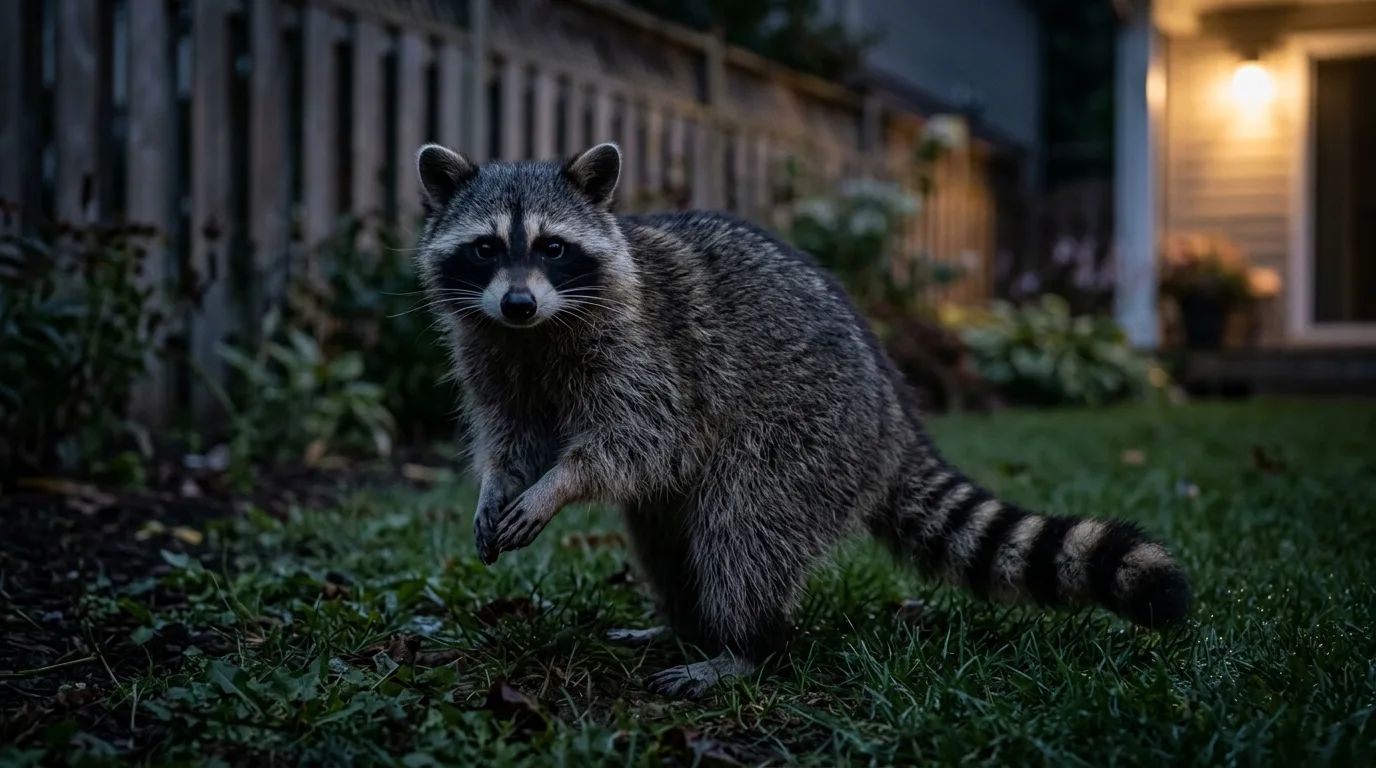
Something tipped over the trash again. The lawn has fresh little divots in it. And the camera you finally put up by the back fence caught a gray, cat-sized shape ambling across the frame at 1:40 a.m. — eyes glowing, no clear face, gone in two seconds.
If you're trying to figure out what's been visiting after dark, the odds are very good it's one of three animals: a raccoon, an opossum, or a striped skunk. They're the three most common backyard night mammals across much of North America, they all show up at the same trash cans and feeders, and on a grainy infrared clip they can look maddeningly alike. The good news is that once you know what to look at — and, just as important, what not to trust — they're genuinely easy to tell apart.
Here's the short version. Look at the tail and the face first. A raccoon has a black "bandit" mask and a bushy tail with dark rings. A skunk is black with a white stripe (or V) down its back and a bushy black-and-white tail. An opossum has a pale, pointy face, a pink nose, and a naked, rat-like tail that often drags a line in the dirt behind it. Everything else — eyeshine color, tracks, the holes in your lawn — is supporting evidence. Get the tail and face, and you've usually got your answer.
The three usual suspects (and why they all look the same at night)
Start with what these animals have in common, because that's exactly what makes them confusing. All three are overwhelmingly nocturnal. In a camera-trap study around Corvallis, Oregon, striped skunk and opossum were "the least likely to be detected during these hours with fewer than 2% of detections from 0800–1800" — in plain terms, you almost never see them in daylight. Raccoons are the same; one agency profile calls them "almost exclusively nocturnal". Across ten U.S. cities, raccoon, striped skunk, and opossum all "selected for nighttime hours" in the most developed, paved-over areas. So if it's the middle of the night and you're in a neighborhood, you're already looking at the right shortlist.
They're also all roughly the same size — about that of an ordinary house cat. A raccoon is the chunkiest, typically 15 to 40 pounds, occasionally more for a well-fed urban one. An opossum is leaner and lankier, usually around 4 to 15 pounds. A skunk sits lowest to the ground, also in the rough 3-to-12-pound range. On a black-and-white clip at night, a "medium, low-slung mammal" describes all three. Build helps a little — the raccoon looks stocky and hunched, the opossum looks rangy with a long naked tail, the skunk looks like a low black loaf — but you'll rarely close the case on size alone.
On a grainy infrared clip, "nocturnal and cat-sized" describes all three — so the markings, not the size, are what give them away.
What gives them away is the marking package on the head and tail. That's where we'll spend most of our time.
Read the tail and the face
If you remember nothing else, remember this section.
Raccoon — the mask and the rings. The two most reliable raccoon features are "its black mask across the eyes and bushy tail with anywhere from four to ten black rings". Even on a washed-out night image, the dark mask usually reads as a distinct band across the face, and the alternating light-and-dark tail rings are hard to mistake for anything else in the yard. The coat is grizzled gray to brown, the body stocky.
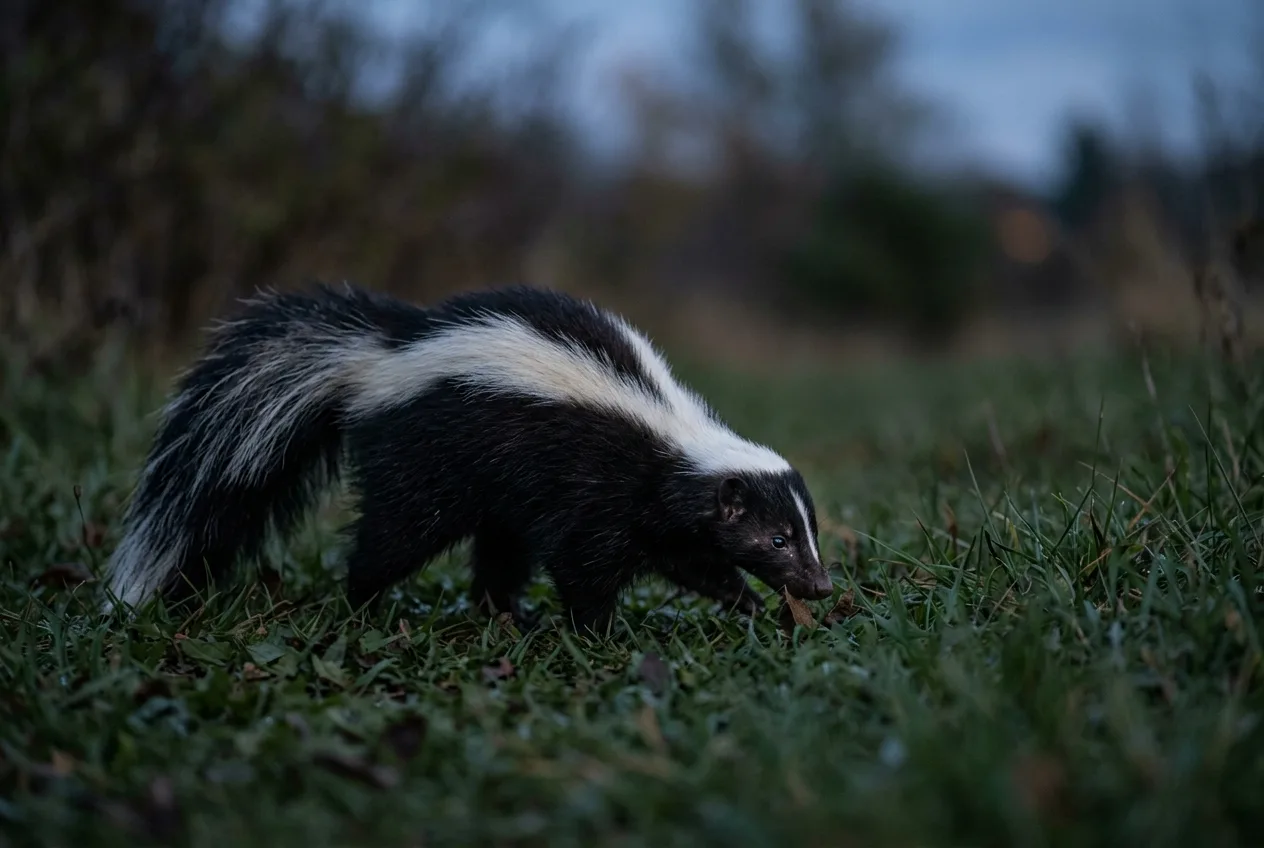
Skunk — the stripe. A striped skunk is jet black with a white pattern that starts as a thin stripe up the snout and forehead, broadens into a patch on the back of the head, and typically "[runs] along the dorsum, splitting into a thick, V-shape as it approaches their rump". The tail is bushy, black, and often white-tipped. Even in monochrome, that bold light-on-dark contrast down a low-slung body is unmistakable. One nice detail for camera watchers: each skunk's stripe pattern is a little different, so if you've got a regular visitor, you can often tell it's the same individual coming back.
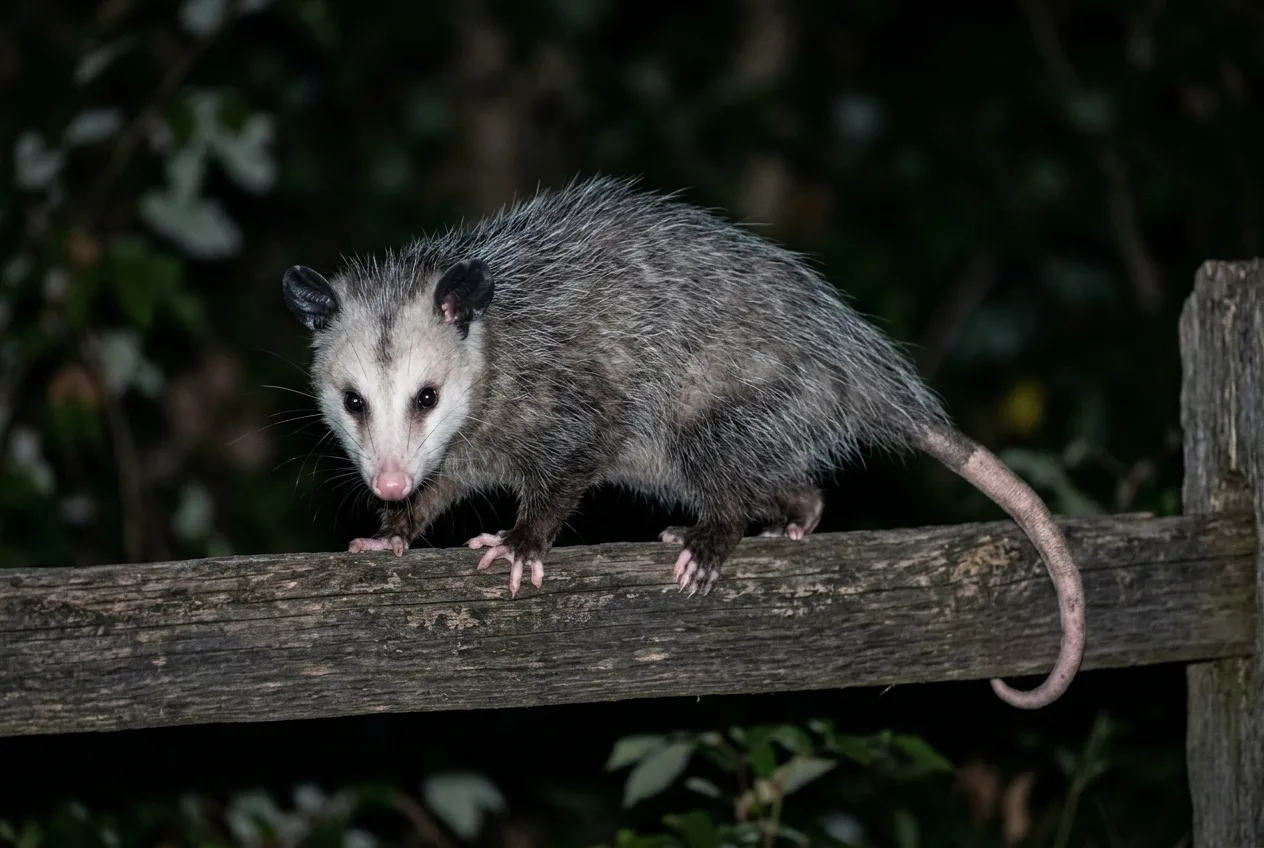
Opossum — the pale face and the naked tail. An opossum reads completely differently. Its face is "white with a pink nose and black eyes," set on a long, pointed snout, with large bare black ears. The body is dull grayish, often a bit unkempt-looking. And the giveaway is the tail: long, scaly, and almost hairless — "a nearly hairless tail adapted to grasping objects". It's a prehensile tail the animal uses like a fifth limb. Nothing else in the average backyard has that ratty, naked tail.
A quick at-a-glance comparison:
| Cue | Raccoon | Striped skunk | Opossum |
|---|---|---|---|
| Face | Black "bandit" mask across the eyes | White stripe up a small triangular head | Pale/white, pink nose, long pointed snout |
| Tail | Bushy with 4–10 dark rings | Bushy, black, often white-tipped | Long, naked, scaly, often drags a line |
| Body | Stocky, grizzled gray-brown, hunched | Black with white stripe/V, low to the ground | Lanky, dull gray, unkempt |
| Typical weight | ~15–40 lb (sometimes more) | ~3–12 lb | ~4–15 lb |
| Front feet | Hand-like, very dexterous, 5 toes | 5 toes, long digging claws | 5 toes, opposable "thumb" on hind foot |
Gait: how they move across the frame
When the markings are too washed out to call, the way an animal moves across your clip can break the tie — and the three have distinct styles.
A raccoon walks with a hunched, humpbacked look because "their hind legs are longer than the front legs," giving it a sloping, shuffling, busy-pawed gait. An opossum moves at "a relatively slow and deliberate pace," often nose-down, with that long bare tail trailing — and on soft ground the tail frequently leaves a drag mark between the footprints. A skunk is "rather slow-moving and deliberate" too, a low, unhurried waddle that rarely seems in any rush — which fits an animal that, as we'll see, doesn't need to hurry away from much.
Eyeshine: a hint, not an answer
This is the cue people most want to rely on and the one most likely to mislead you, so it's worth being blunt about it.
Yes, animal eyes glow at night because of a reflective layer behind the retina called the tapetum lucidum, which "acts like a mirror, reflecting light back through the retina" — and yes, the color varies by species. By one conservation reference, raccoon eyeshine tends toward yellow and opossum eyeshine toward red/orange, while deer shine white. That last one is genuinely useful: the most common thing people mistake for a yard prowler is a deer, and white eyeshine well off the ground is a strong tell that you're looking at a deer, not one of our three.
But here's the catch. Eyeshine "is a type of iridescence, [so] color will vary with the angle at which you view it, the color of the light source, and the mineral content of the tapetum lucidum". Two animals of the same species can shine different colors depending on where they're standing relative to your camera. And there's a second problem specific to trail cameras: most night clips are shot under infrared illumination and recorded in grayscale, so there's often no color at all — every animal's eyes read as bright white dots. Lean on color and infrared will happily lie to you.
Eyeshine is the cue people most want to trust and the one most likely to fool them — read the tail and the body first, and let the glow only confirm.
So use eyeshine the way an experienced reviewer does: as one input among several. A wilderness ranger quoted in one outdoor piece runs through the factors that actually matter — the height of the eyes above the ground, how the animal moves (hopping, weaving, climbing?), and the eye shape and spacing — not color alone. Read the body first. Let the glow confirm.
Tracks: all five-toed, but not alike
If the camera didn't give you a clean look, the ground might. All three animals have five toes on each foot — but the prints are distinct enough to separate once you know the trick.
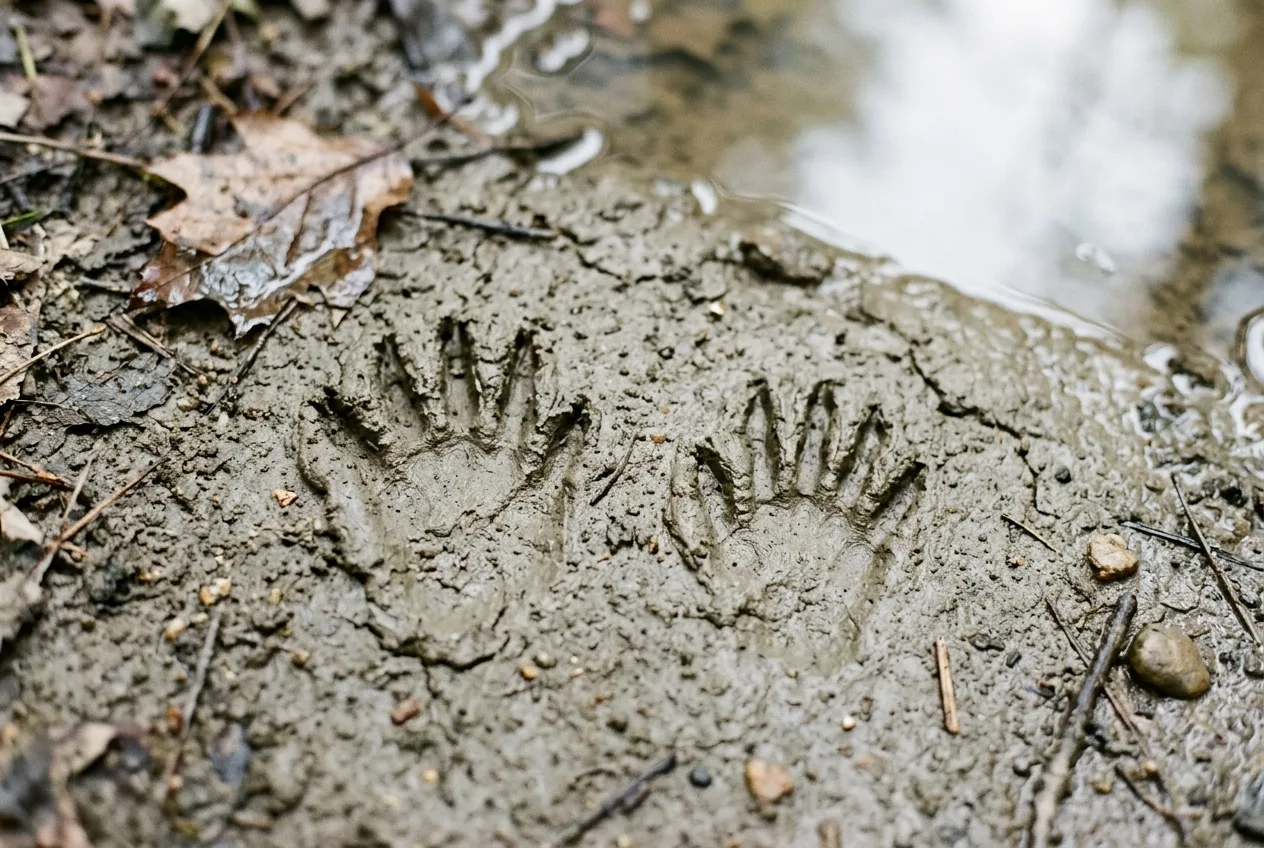
A raccoon's tracks are the most human-looking: the front foot "looks somewhat like a small human hand, while the print of its hind foot resembles a small human footprint," with the hind foot about an inch longer than the front. Prints run roughly 2 to 3 inches, all toes pointing forward, sometimes with small claw marks, and raccoons tend to walk so that a front foot lands next to the opposite hind foot.
An opossum's hind track is the oddball, and it's the easiest of the three to confirm. The hind foot has "a very large, opposable, thumb-like toe" that sticks out sideways, so the print looks like a strange little hand with the thumb splayed wide. Field guides describe the front print nestling into the "V" between that thumb and the rest of the foot. Add the tail-drag line that often runs between the prints and you've got an unambiguous opossum.
A skunk's tracks are smaller than you'd expect for the animal, with front and hind feet "similar in size, but the front feet have noticeably longer nails". Those long fore-claws — built for digging — often print as distinct marks well ahead of the toe pads, and the heels of the front feet usually don't register. Don't confuse them with a house cat's, which shows four toes and no claw marks.
The sign in your yard often tells the story
Half the time you'll never catch the culprit in the act — but the damage pattern points straight at one animal.
Neat little cone-shaped holes in the lawn? That's a skunk. Skunks dig for grubs and soil insects, and their digging "normally appears as small cone-shaped holes or patches of upturned earth, up to 3 to 4 inches in diameter". They're methodical about it, working "section-by-section" across the turf, and the disturbance shows up overnight because they work in the dark.
Sod rolled back in sheets, and a ransacked trash can? That's a raccoon. Raccoons use those dexterous front paws "like hands to pull up and flip pieces of sod" — a very different look from a skunk's tidy cones — and they're the classic garbage-can raider, using their fingers "to open containers and garbage cans".
A communal toilet of dark, tubular droppings? Raccoon again — and worth respecting. Raccoons create "toilet areas" called latrines, returning to the same spot — "the base and at forks" of trees, on logs, woodpiles, decks, even in attics. The droppings are dark, tubular, segmented, and about as thick as the end of your little finger. There's a genuine health note here: raccoons are the primary host of Baylisascaris procyonis, a roundworm that can infect people, so don't handle raccoon droppings — and if you find a latrine near the house, clean it up carefully. (Eggs in fresh feces aren't immediately infectious; they take at least two to four weeks to become so, which is exactly why prompt cleanup matters.) This isn't a North-America-only worry, either — in one survey of raccoons in southwest Germany, Baylisascaris procyonis was found in nearly 29% of the animals examined.
Skunk droppings are a giveaway of a different kind: about a quarter to a half inch across and an inch or two long, and "often can be identified by the undigested insect parts they contain".
Half the time you never see the animal — but neat cone holes mean skunk, rolled-back sod and a raided can mean raccoon, and a communal latrine of tubular droppings means raccoon too.
When it really matters who's been digging, the cleanest move is to point a camera at the spot and let it settle the argument. One extension service recommends exactly that — set up "a wildlife camera or [point] a security camera at the spot" to identify the culprit for certain.
The skunk question everyone asks: how close is too close?
If your night visitor is a skunk, the practical worry isn't your lawn — it's the spray. A striped skunk would much rather warn you than waste its musk: before spraying, it stamps its forefeet, snarls, arches its back, raises its tail, and turns its rear toward the threat. Heed that display and back off, and you'll almost always be fine.
How far can it actually spray? Sources put it somewhere in the range of about 3.7 to 6 meters — roughly 12 to 20 feet. Several agency pages cite "about twelve feet"; a university account gives "up to 6.0 meters"; another says about four. So treat anything inside roughly 10 to 20 feet as within range, and remember the skunk can aim in almost any direction by twisting its rump — including back over its own head. The honest takeaway: give a skunk a wide, unhurried berth and let it leave on its own.
The opossum's good press — and one claim to retire
Opossums get a lot of love online as backyard tick vacuums, and they do plenty of genuine good: they eat insects, slugs, snails, carrion, and rodents, and they're remarkably resistant to snake venom. But the specific viral claim — that an opossum eats thousands of ticks a week — deserves a hard look, because the science has actually walked it back.
That figure traces to a 2009 lab study in which five captive opossums were dosed with ticks; researchers counted how many fell off and assumed the rest had been groomed away and eaten — which is where the famous "over 90%" number came from. The trouble is the assumption was never checked: the opossums "were not checked for ticks before being released back into the wild". A 2021 follow-up study from central Illinois went looking for the proof and didn't find it. Examining the gut contents of 32 wild opossum carcasses, "ticks were found on the carcasses, but no tick parts were found in the gut contents of the animals" — and a review of 23 other diet studies turned up no evidence of opossums eating ticks at all. As the author put it, "it seems opossums aren't as voracious eaters of ticks as we thought".
None of which makes an opossum a bad neighbor — it's harmless, generally beneficial, and its famous "playing dead" act (it'll keel over, drool, and emit a foul smell when truly cornered) is a bluff, not aggression. Just don't invite one over expecting a tick-control service, and don't repeat the 5,000-a-week number as fact.
The opossum is a good neighbor for plenty of real reasons — just not the tick-vacuum the internet made it out to be.
A note on where you live
Almost everything above is written for North America, where all three animals are native. But the raccoon has become a genuinely global animal, so the raccoon half of this guide travels further than you might think.
Raccoons were released and escaped into central Europe starting in the 1930s — the first documented German release was near Lake Edersee in 1934, followed by fur-farm escapes in the 1940s. They've since spread across the continent; Germany's annual raccoon harvest climbed "from just over 3,000 harvested individuals in 1995 to around 100,000 in 2014", and the species is now established across all 16 German federal states and is listed as an invasive alien species across the EU. A parallel story played out in Japan, where raccoons "entered Japan as pets" in the 1970s, were released, and "spread rapidly to almost the entire area of Japan". So a European or Japanese reader really can catch a raccoon on a trail camera. Opossums and striped skunks, though, remain North American animals — if you're outside the Americas, those two aren't on your list, and your masked nighttime visitor is the one to focus on.
One regional wrinkle worth knowing: where raccoons are invasive abroad, the look-alike problem changes. In Japan, the animal raccoons get confused with isn't an opossum or a skunk at all — it's the native raccoon dog, or tanuki. Your local confusion set depends entirely on what shares your patch.
Letting the camera do the sorting
A single well-placed trail camera is genuinely the right tool for this question — it watches the trash cans, the feeder, or the freshly dug lawn all night without you losing sleep over it, and it captures the tail and face you need for a confident ID. The one downside is volume: point a camera at a busy backyard and you can come back to hundreds of clips of swaying branches, the neighbor's cat, and a moth doing laps in front of the lens.
Frequently asked questions
What's the easiest way to tell a raccoon from an opossum on a night camera?
Look at the tail and face. A raccoon has a ringed bushy tail and a dark mask across the eyes; an opossum has a naked, scaly tail and a pale, pointy face with a pink nose. That pair of cues separates them almost every time, even on a grainy infrared clip.
What animal digs small cone-shaped holes in my lawn at night?
Almost certainly a skunk. Skunks dig for grubs and insects, leaving small cone-shaped holes 3 to 4 inches across, and they do it overnight. Raccoons also dig, but they roll back sod in sheets rather than leaving neat cones.
What color is raccoon eyeshine versus opossum and deer?
By one reference, raccoon eyeshine tends yellowish and opossum eyeshine reddish/orange, while deer shine white. But color shifts with the viewing angle and light source, and most trail-camera night clips are grayscale infrared with no color at all — so use eyeshine only as a hint, never as your sole ID.
Do opossums really eat thousands of ticks a week?
Probably not. That claim came from a small 2009 lab study that assumed (but never confirmed) the opossums ate the ticks; a 2021 field study found no tick parts in the guts of 32 wild opossums. They're still beneficial animals — just not the tick vacuums the internet claims.
How far can a skunk spray, and how much warning do I get?
Roughly 10 to 20 feet (about 3.7 to 6 meters), depending on the source, and it can aim in nearly any direction. You usually get a clear warning first — foot-stamping, an arched back, a raised tail — so back off when you see it.
Can I get raccoons or opossums on a trail camera outside North America?
Raccoons, yes — they're established across much of Europe and Japan after 20th-century introductions. Opossums and striped skunks, no — both are native only to the Americas, so outside that range your masked or striped night visitor will be a different animal entirely.