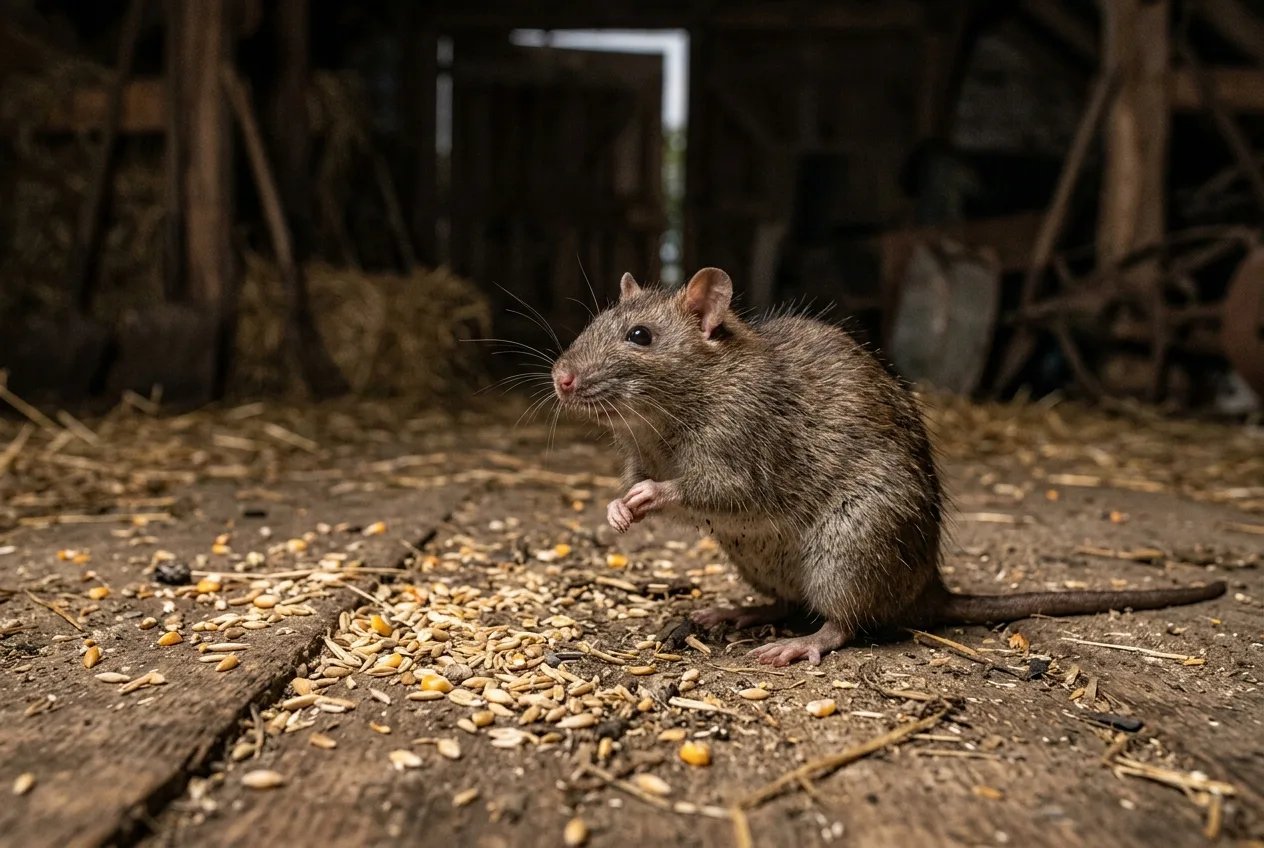
Here is the number that should bother you. For every rat or mouse you actually see, there are roughly twenty-five you don't. So if you've spotted one bold rat trotting along a feed-room wall in daylight, you don't have a rat. You have a colony, and the daylight sighting is the tell — the population and the competition for food are high enough that juveniles are being pushed out to forage in the open.
That's the real problem with rodents in a barn or coop. By the time they're obvious, they've been there a while, eating and fouling your feed, gnawing your wiring, and quietly breeding at a rate that's genuinely hard to picture. The good news is that none of this requires exotic tactics. The farms that stay on top of rodents do four unglamorous things in order: they seal the building, lock up the feed, strip out the hiding places, and only then trap and bait what's left. Skip the first three and you're just running a very expensive rodent feeding station with a few traps in it.
This piece is specifically about rodents in structures and stored feed — the barn, the coop, the feed room, the grain bin, the tack room. It's not about protecting your garden rows or your lawn, and it's not about hawks and foxes hitting your flock from outside. It's about the mice and rats that move in.
Why your barn is rodent heaven
Mice and rats are commensal animals — the word literally means living alongside people. The house mouse and the Norway rat aren't native wildlife that occasionally wanders in; they're species that have hitched along with human grain stores for thousands of years and now depend on us. A barn gives them everything they're built to want: a reliable food source, water, warmth, and a maze of wall voids and clutter to hide and nest in.
Food is the obvious draw, and it's not just the feed bin. It's spilled grain under a mis-adjusted feeder, the open sack in the corner, the bird seed, the bag of dog food, the gravity feeder that tops itself up all night. Water can be almost nothing — a leaky tap, a livestock trough, condensation on a cold pipe. A mouse can get by on the dew that forms on a water line.
Then there's the calendar. As the first cold weather arrives in autumn, mice that have been living out in the fields start hunting for shelter, and your buildings are the warmest, best-stocked option for a long way around. This is why a barn that seemed clean all summer can suddenly have a rodent problem in October — most of your rodents walk in from the surrounding land rather than appearing from nowhere. (If you keep stored hay or fodder, the same logic applies and then some: in one Australian survey during a mouse plague, growers were feeding fodder to their stock at twice the normal rate because mice had eaten and fouled so much of it, and damaged bales so badly that whole stacks had to be destroyed.)
And once they're in, they multiply fast enough to outrun casual control. A single female mouse can raise on the order of sixty offspring in a year; rats aren't far behind, weaning fifty or more annually. Females can breed again within a day of giving birth. This is the core reason a few snap traps never "solve" a barn rodent problem on their own — you cannot out-trap that reproductive rate if the food and shelter that support it are still sitting there.
By the time rodents are obvious, they've already been eating your feed, fouling it, and breeding for weeks.
What it actually costs you
It's easy to wave off "a few mice." The bill, when you add it up, is not small.
Feed — eaten and ruined. A single rat eats roughly 20 to 40 pounds of feed a year, and — this is the part people miss — contaminates about ten times that much with its urine, droppings, and hair. A rat produces around 25,000 droppings a year; a mouse around 17,000. A colony of a hundred rats will go through more than a tonne of feed in a year. Old USDA figures put the feed destroyed by rodents in the US at the equivalent of more than two billion dollars annually, and a Cornell estimate of rat damage to US grain crops runs to nineteen billion. The contamination matters as much as the consumption: a small colony of Norway rats was shown to foul 70% of a wheat store within a few months of getting access.
Disease — to your animals and to you. Rodents are reservoirs for an alarming list of pathogens — commonly cited as at least 45 diseases for rats and mice, and federal sources put the count of rodent-transmissible diseases above sixty. The ones that matter on a farm include salmonellosis (a constant poultry concern), leptospirosis, murine typhus, trichinosis, and rat-bite fever. Two are worth singling out because they put you, not just your stock, in the hospital:
- Hantavirus. People catch it from contact with rodent urine, droppings, and saliva — exactly the dust you stir up sweeping out a mouse-infested feed room or shed. In the Americas it causes hantavirus pulmonary syndrome, and the CDC's own figure is blunt: of people who develop respiratory symptoms, about 38% die. This is the single best reason to wear a proper mask and gloves — not a dust mask pulled down under your nose — and to damp down droppings before you disturb them, rather than dry-sweeping them into the air.
- Leptospirosis. Spread through infected urine and urine-contaminated water, soil, and feed, lepto is still the most common work-related infectious disease in New Zealand, and rodent-contaminated food and water is one recognized route. Heavy rain and flooding spike the risk, because the bacteria survive for weeks or months in wet ground.
Fire and structure. Rodents gnaw constantly — their incisors never stop growing, so they have to wear them down on something. All too often that something is electrical wiring, and chewed insulation on a live wire is a genuine barn-fire risk. They also shred building insulation for nesting, undermine foundations and concrete with their burrows, and wreck the soft parts of poultry equipment — curtains, egg belts, ventilation systems. Insulation damage alone can leave a livestock building seriously deteriorated within about five years, which then shows up as higher energy bills and poorer feed conversion.
A rat ruins roughly ten times more feed than it eats — the contamination, not the appetite, is the real loss.
Step one: build them out
If you do one thing well, make it this. Exclusion — "building them out," in the trade — is the most effective and longest-lasting form of rodent control there is, because it attacks the problem permanently instead of fighting it nightly. Every hour spent sealing a building pays off for years.
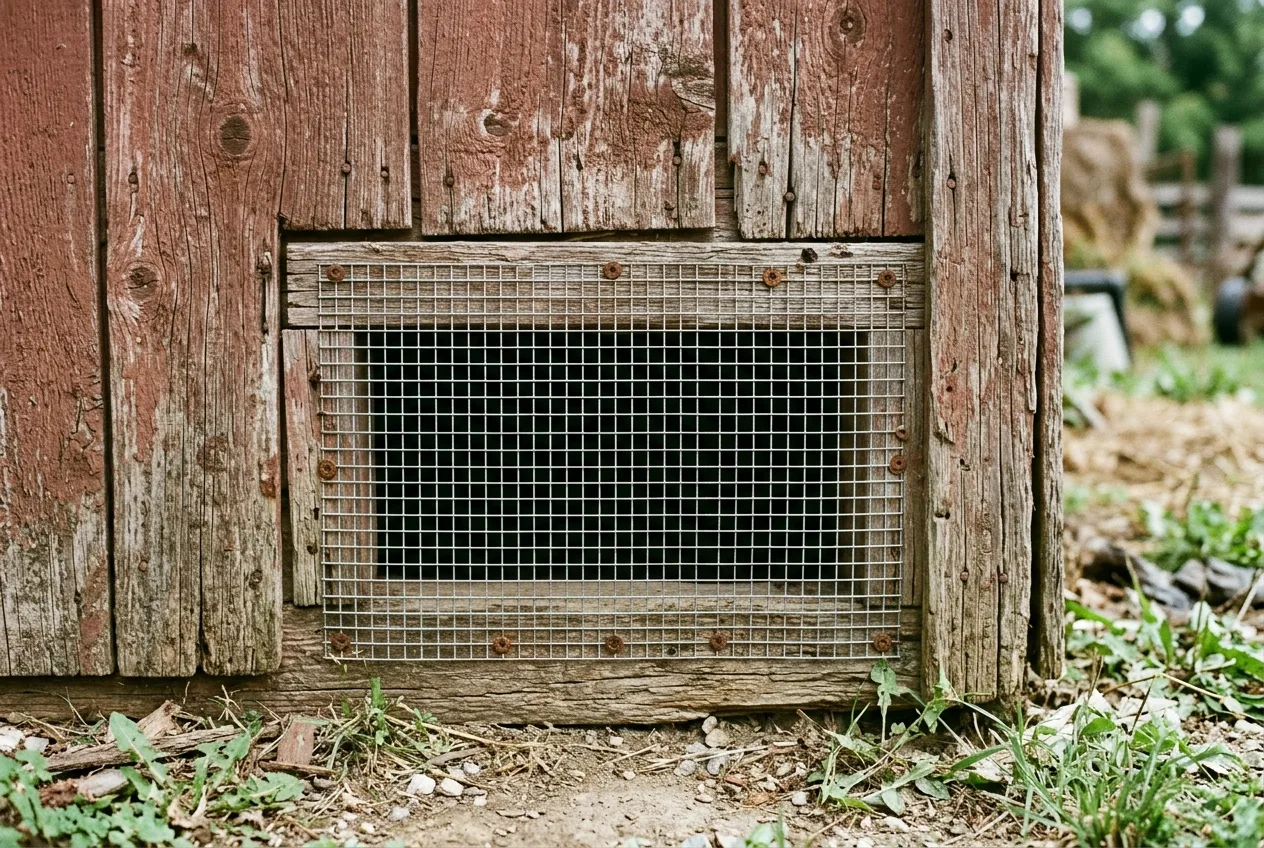
Start by walking the structure like a rodent would, low and along the walls, looking for any gap a body can squeeze through. The thresholds are smaller than people expect. A rat needs only about a ½-inch (1 cm) opening — roughly the size of your thumb — and a mouse about ¼ inch (6 mm), the size of your little finger. Because young rats can use a gap as small as ¼ inch, the practical rule is simple: seal everything larger than ¼ inch (6 mm) and you exclude both rats and mice. Pay special attention to the places gaps hide — around water and utility lines where they enter the wall, under doors, broken vents, the open ribbed ends of corrugated metal siding (a classic mouse door), and the holes around feed augers.
What you seal with matters as much as finding the gap, because rodents will simply chew back through the wrong material. They gnaw through plastic, foam, wood, caulk on its own — and yes, expanding foam, which is not a rodent barrier no matter how satisfying it is to apply. Use materials that defeat teeth:
| Job | What works | Notes |
|---|---|---|
| Small holes and cracks | Coarse (00-grade) steel wool or copper mesh, packed tight | Steel wool rusts and is flammable — caulk over it to lock it in; rodents otherwise push it aside |
| Larger holes and voids | Galvanized sheet metal, or hardware cloth over the gap | Secure all edges; foam or wood alone won't hold |
| Excluding rats only | 19-gauge, ½-inch hardware cloth | Standard for vents/grilles against rats |
| Excluding rats and mice | 24-gauge, ¼-inch hardware cloth | The finer mesh is what stops mice |
| Vent grilles | 16- or 18-gauge, ½-inch galvanized mesh | Never "chicken wire" — rodents pass straight through it |
Doors are the weak point in almost every barn and coop. A young rat will slip under a door with just a ½-inch gap, and gnaw a wooden door's edge to enlarge it if needed. Fit exterior doors with metal kick plates, metal thresholds, or rodent-proof door sweeps that leave no more than ¼ inch of clearance — and know that a rodent-proof sweep is not the same thing as weather stripping; the real ones are filled with metal mesh. Make sure doors and windows actually close tight, and back the edges with sheet metal where gnawing is a problem.
Two structural touches earn their keep if you're building or repairing. Run footings down into the ground with an outward apron, or lay a buried curtain of ¼-to-½-inch mesh angled down and out from the foundation, to stop rats tunneling underneath. And around a grain bin or feed shed, a band of coarse gravel (at least an inch in size, a couple of feet wide) discourages burrowing, because rats can't tunnel through it.
Step two: lock up the feed
Rodents come for the food. Take away easy access to it and you've removed the single biggest reason they tolerate the risk of living in your barn.
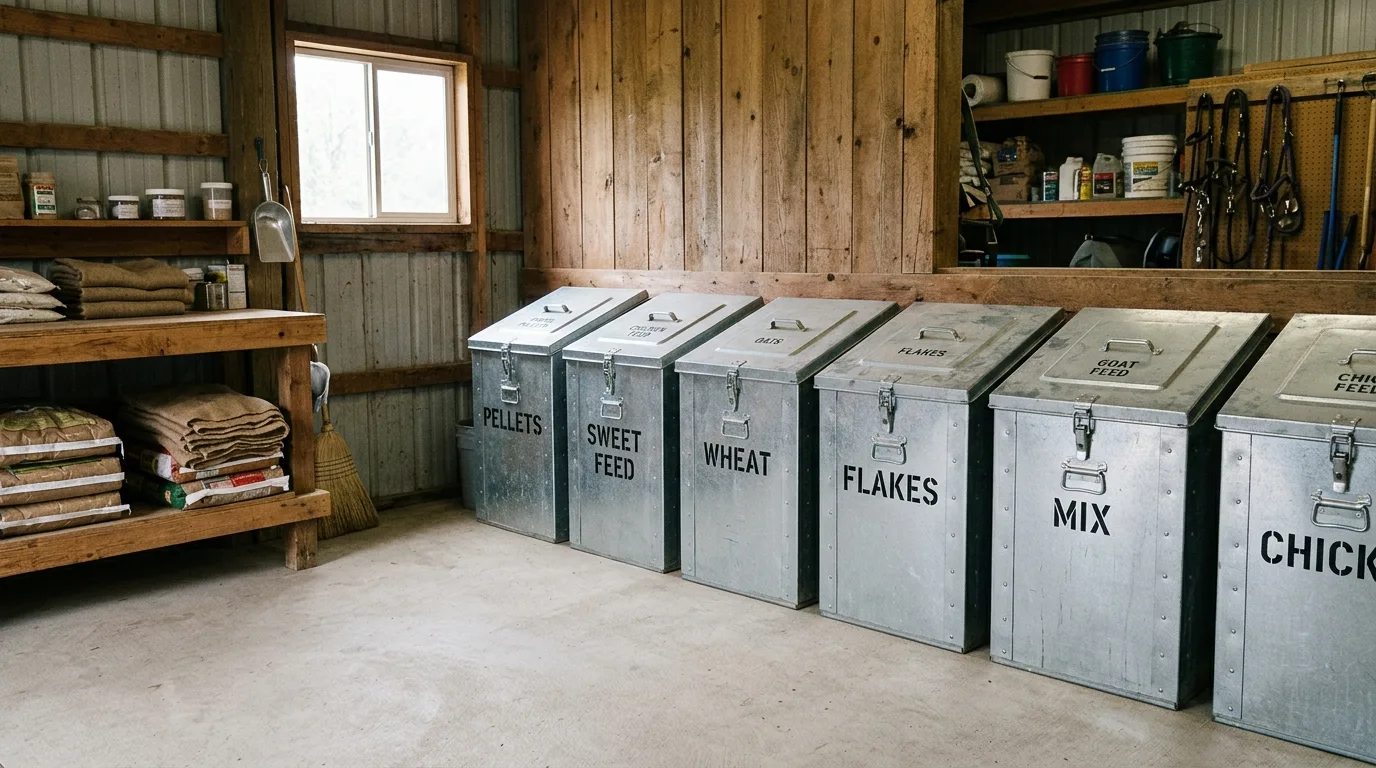
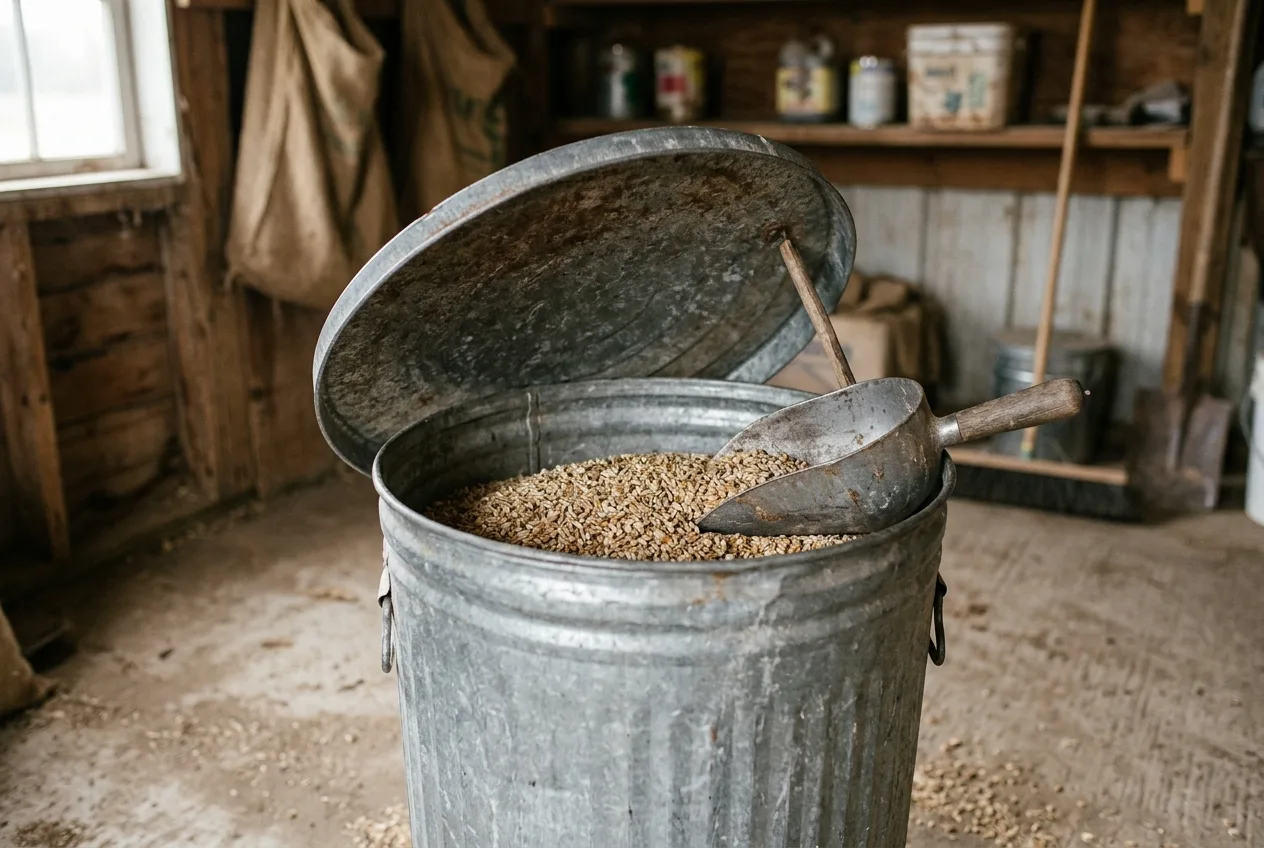
The rule here is unambiguous, and it's worth tattooing on the feed-room wall: the only reliable rat-proof storage is a solid metal container with a tight-fitting lid. Not the original paper or woven sack — rats gnaw into bags readily. Not a plastic tote, however heavy-duty — rats and mice chew through plastic, and a cracked plastic bin is an open invitation. Galvanized steel cans and bins resist gnawing in a way vinyl and plastic simply don't. Metal hoppers, covered metal cans, or proper steel feed bins are the standard answer across poultry, swine, and livestock guidance alike.
A few details separate feed rooms that stay clean from ones that don't:
- Clean up spills the same day. Adjust feeders so they stop wasting and scattering feed in the first place, then sweep up what does spill — daily, not weekly. Spilled grain is a free meal that undoes everything else.
- Mind the feeders themselves. Gravity feeders and bucket feeders that stay topped up overnight become rodent feeding stations; rats sometimes leave them alone because of the animals using them, but don't count on it — limit access where you can.
- Store off the floor and away from the wall. Stack sacked feed on pallets, in rows, with space around and under so you can actually see droppings and gnaw marks when you inspect. A 12-inch white band painted on the floor along the wall makes fresh droppings jump out.
- Dry up the water. Fix leaky taps and sweating pipes, cover troughs where practical, and consider nipple waterers in the coop — deny rodents easy water and a colony can't build.
The only feed store a rat respects is solid metal with a lid that actually closes.
Step three: take away the hiding places
A rodent that can't find cover is an exposed rodent, and exposed rodents don't thrive — they nest less, breed less, and fall to predators more. Sanitation and harborage removal are the quiet half of rodent control, and they're the half people skip.
Outside the building, keep a cleared strip around the whole structure — most guidance lands on about three feet (roughly a metre) of mowed, weed-free, clutter-free ground, ideally replaced with crushed rock or gravel that rodents can't tunnel through. Mow back tall grass so it can't seed (seed is food) and so you can see runways. Pull brush, weeds, and shrubs back from the walls; trim the bottoms of hedges up off the ground; and if there are trees overhanging the roof, cut the limbs back several feet so roof rats can't bridge across.
Inside and around the yard, it's about denying nesting material and shelter:
- Clear out the loose clutter rodents nest in and under — old feed bags, piled lumber, junk, abandoned equipment.
- Keep what you do store off the floor on racks or pallets and away from the walls (the same rule as feed: visibility plus no cozy void to nest in).
- Block off entrances into double-wall construction and pull out any nesting material you find — wall voids are prime rat and mouse real estate.
- Manage the surrounding mess too: don't let manure or waste pile up against animal housing, and keep refuse in rodent-proof containers.
This is the logic behind the move toward what agencies call ecologically-based rodent management: reduce the food and the nesting sites at the times of year rodents need them most, and you lean far less on poison to do the job. It's also simply cheaper. A clean, sealed barn needs a handful of monitoring traps; a cluttered, open one needs an endless bait program that never quite wins.
Step four: now trap and bait
Only after the building is sealed, the feed is locked up, and the harborage is gone does it make sense to knock down the rodents already inside. Do it first, with food still everywhere, and your traps and bait compete with an all-you-can-eat buffet — and lose.
Traps come first, and snap traps lead. Across the IPM guidance, the humble snap trap is rated the safest, most effective, and most economical way to take rats and mice. A few things make the difference between a trap line that works and one that sits empty:
- Match the trap to the animal. Rat snap traps and rat glue boards for rats; mouse traps generally won't kill a rat and are a waste of effort on them.
- Respect neophobia. Rats are deeply suspicious of anything new in their environment and will dodge a fresh trap for days, sometimes weeks. The classic fix: set baited but unset traps for four or five days until the rodents feed confidently, then set them.
- Place them where rodents travel. Rats and mice run along walls and edges, so set traps tight against the wall with the trigger nearest it, behind objects, in dark corners, and right where you've found droppings or gnaw marks. For roof rats, which travel high, fasten traps up on beams, rafters, and pipes.
- Tie traps down and box them. Secure a trap so a wounded rodent can't drag it off into a wall void, and put traps in boxes or behind barriers where poultry, pets, and children can't reach them. A rat snap trap is powerful enough to break a curious finger.
- Check daily. Clear and reset traps every day; a sprung-and-ignored trap teaches the colony to avoid them, and a mouse left on a glue board can become food for a rat.
Glue boards and multiple-catch traps (the wind-up box traps that take several mice per setting) have their place, especially in coops where you must avoid catching the birds — but glue boards lose their grip in dusty barns and are slow to kill, which many keepers find inhumane.
Bait is a tool, not the plan. The clearest message across the modern stewardship guidance — from US poultry extension to the UK's CRRU code to Australian Pork — is the same: do not rely on rodenticides alone. Bait kills rodents but doesn't fix the conditions that brought them, so the population simply rebuilds. The UK code goes further and asks you to treat poison as a temporary step, used only after the obvious exclusion-and-sanitation measures are in place, and it's frank about why: rodenticide leaks out of the food web and poisons the very predators that hunt your rats. Some of the most contaminated non-target animals in Britain are barn owls and kestrels — birds that eat almost nothing but small mammals — partly because non-target wildlife gets into bait boxes.
So if you do bait, do it responsibly:
- Always use tamper-resistant, secured bait stations. A good station resists children and pets, holds the bait at a right angle so small fingers can't reach it, keeps the bait dry, and is anchored down so it can't be tipped or carried off. Steel stations where livestock or equipment could crush a plastic one. Many rodenticide labels require tamper-resistant stations outdoors — and the label is the law.
- Keep bait away from your animals entirely. Never place bait where poultry, livestock, pets, or children can contact it; rodents can also drag loose bait to where a non-target animal finds it.
- Know your product. Anticoagulants make up the large majority of baits; second-generation types (brodifacoum, bromadiolone, difethialone) are potent and often kill on a single feed, but they also persist and carry the greatest secondary-poisoning risk to predators and scavengers. Vitamin K1 is the antidote to anticoagulant poisoning — worth knowing if you keep dogs. Where you want to avoid secondary poisoning of raptors and pets, a cholecalciferol (vitamin D3) bait breaks down without poisoning the animal that eats the dead rodent, though it has no antidote, so it still belongs in a protected station.
- Mind bait-station spacing if you go that route. Because mice keep tiny home ranges (10–20 feet) and rats larger ones, stations are placed closer for mice than for rats — commonly mouse stations within about 10 feet of each other and rat stations spaced further apart.
Cats, dogs, and barn owls: useful allies, not a strategy
Every farm has a story about a great mouser. Predators do help — but the evidence says lean on them as a supplement, never as the plan.
Cats are the classic example, and the honest read of the research is mixed. A good cat can hold down a low-level mouse population, but once conditions favor rodents, cats can't catch them faster than they breed, and a barn cat that hunts the fields can carry rodent-borne disease into your buildings. One organic-poultry review puts it bluntly: there's no sound evidence that cats by themselves regulate rodent populations, and they bring health risks of their own.
Here's a more useful finding. A study across rural homesteads found that cats and dogs together significantly suppressed rodent activity and made rodents forage far more cautiously — but either one alone made no measurable difference. Where both were present, rodents marked less than half as many monitoring tiles as where neither was. The likely reason is that a rat has to solve two different predator problems at once — an ambush cat and a pursuit dog — and the combined "landscape of fear" makes your barn feel too dangerous to relax in. So the practical takeaway isn't "get a cat," it's that a working dog and a cat together change rodent behavior in a way one animal can't.
Birds of prey are the other natural ally, and barn owls in particular are encouraged with nest boxes on farms worldwide. Again, the evidence is genuinely useful precisely because it's honest. In a Napa Valley vineyard study, gopher activity dropped where occupied owl boxes were present and rose where they weren't — a real effect — but the same study found owl presence did not significantly change mouse numbers and was inconclusive for voles. Owls clearly hunt and dent rodent populations, but even high owl densities may not control a fast-breeding pest on their own. A nest box is a low-cost, low-risk thing to add — and it's a strong reason to keep rodenticide use down, since poisoned rodents are exactly what kill the owls you're trying to recruit. Just don't expect a box to do the job your feed bins and door sweeps should be doing.
Predators tip the odds; they don't seal a gap, empty a bin, or clear a clutter pile for you.
Keep watching after you win
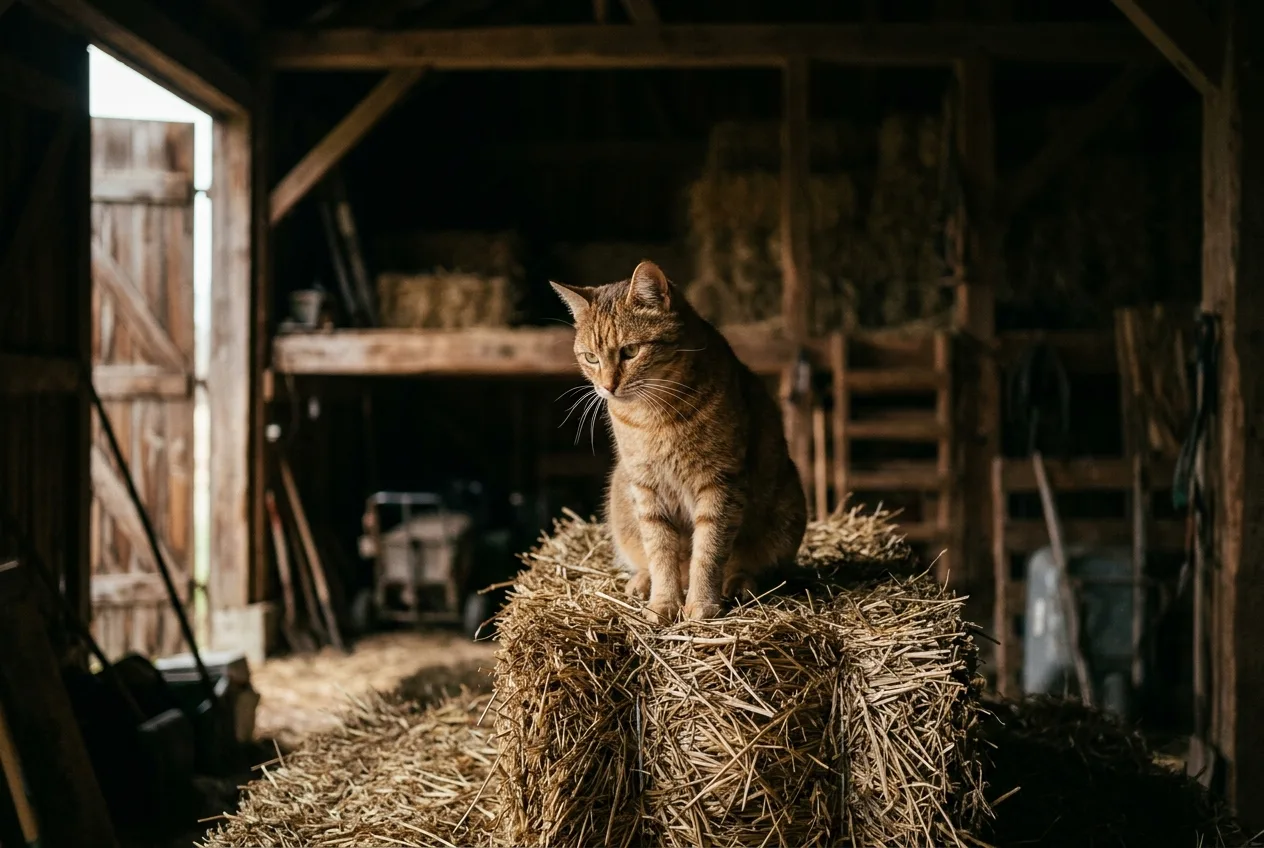
Rodent control isn't a project you finish; it's a level you maintain. Even a clean, sealed barn sits in a landscape full of rodents looking for a way in, especially each autumn. Once you've knocked a population down, keep a few monitoring traps or stations running, walk the building a couple of times a year looking for fresh gaps and droppings, and check at night with a flashlight now and then — rats' eyes reflect the beam, and a night count tells you fast whether you're holding the line.
This is one place a trail camera earns its keep indoors. If you can hear something in the feed room at night but can't tell what — or how much — a small camera aimed at the feed bins or a suspected runway will show you exactly what's moving, when, and roughly how many, so you're reacting to evidence instead of guesswork.
Get the order right — seal, store, strip, then trap — keep the predators around as backup, and stay watchful, and the barn stops being rodent heaven. That's the whole game.
Frequently asked questions
How do I keep rodents out of my chicken coop specifically?
Same four steps, coop-scaled: seal every gap larger than ¼ inch with hardware cloth or sheet metal (mice need only a ¼-inch hole), store feed in metal cans with tight lids rather than bags or plastic, clean up spilled feed daily and keep a cleared strip around the coop, then use covered snap traps or multiple-catch traps placed where birds can't reach them. Avoid loose bait inside a coop where free-ranging birds could eat it.
What size gap can a mouse or rat actually get through?
A mouse can squeeze through an opening about ¼ inch across — roughly the size of your little finger — and a rat through about ½ inch, the size of your thumb. Since young rats also use ¼-inch gaps, sealing everything larger than ¼ inch keeps out both.
Are plastic feed bins rodent-proof?
No. Rats and mice gnaw through plastic and heavy-duty totes, and a cracked plastic bin lets them in. The only reliably rat-proof storage is solid metal with a tight-fitting lid; galvanized steel resists gnawing where plastic and vinyl don't.
Will a barn cat solve my rat problem?
Not on its own. A cat can suppress a small mouse population but can't outpace breeding rodents once food and shelter are plentiful, and may carry disease in from the field. Interestingly, a cat and a dog together suppress rodents far more than either alone, by creating two different threats at once — but predators are a supplement to sealing and sanitation, never a replacement.
Is it dangerous to clean up mouse droppings in the feed room?
It can be. Rodent urine, droppings, and saliva spread hantavirus, which is fatal in roughly 38% of people who develop respiratory symptoms in the Americas, and rodent-contaminated feed and water can spread leptospirosis. Wear gloves and a proper mask, dampen droppings (a 10% bleach solution works) before disturbing them rather than dry-sweeping, and bag the waste.
Do I have to use poison at all?
Often, no — and the guidance increasingly says don't lead with it. If you seal the building, store feed in metal, remove harborage, and trap, you can control most barn and coop rodent problems without rodenticide. If you do bait, treat it as a temporary, last step in tamper-resistant secured stations, and keep it well away from your animals and from the owls and pets that eat poisoned rodents.