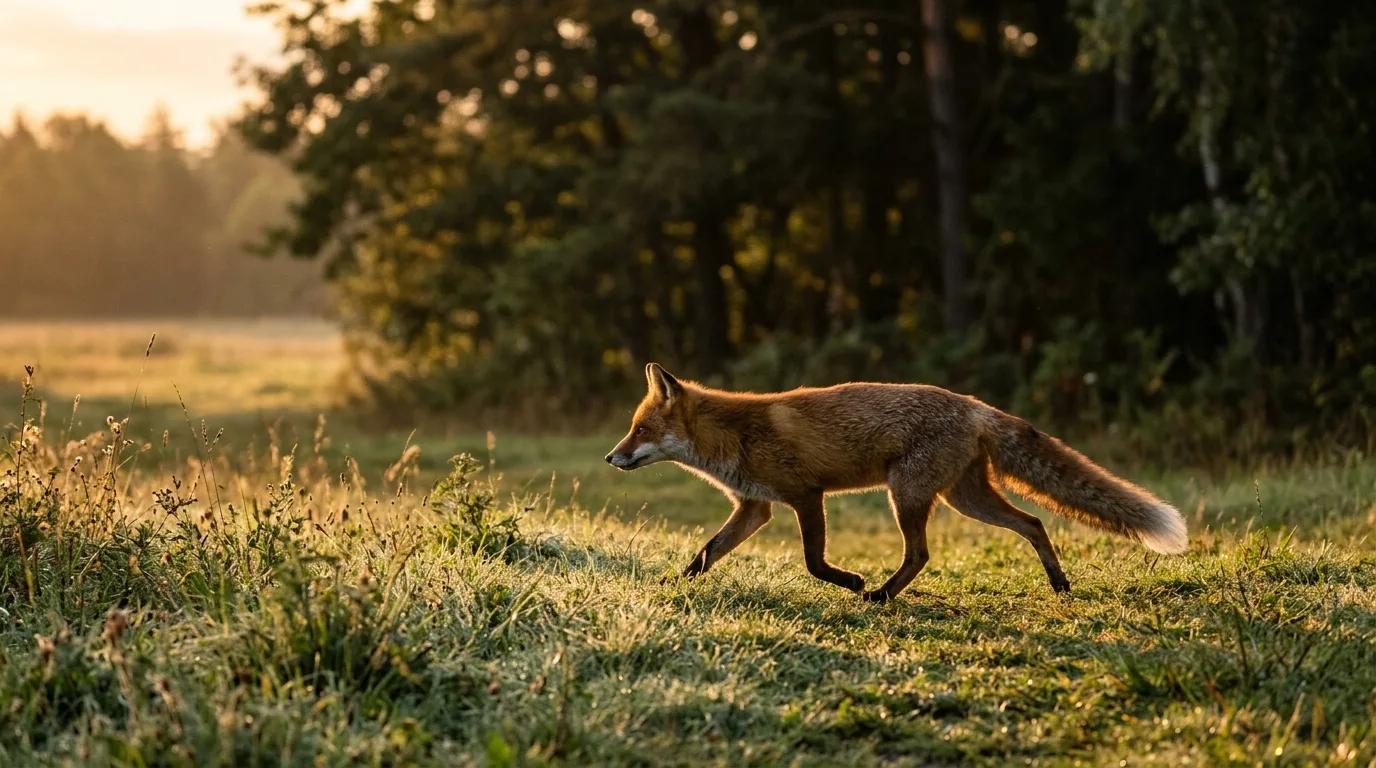
Here's the uncomfortable truth that no lens upgrade will fix: across 844 camera stations run for 120 days in Alberta, a bobcat triggered the shutter exactly once. So did a wild boar. Two of the most photographed predators in North America, and a small army of cameras left out for four months caught one frame of each. That is what "elusive" actually means in the field, and it's why the honest answer to how to photograph foxes — or owls, or bobcats — has very little to do with your gear and almost everything to do with knowing the animal.
If you want a single principle to organize everything below, it's this: patience and fieldcraft beat focal length, every time. A natural-looking photo of a fox kit sitting in good light isn't luck. It's the payoff of many hours spent watching the family from a distance and learning their habits — interest and respect for the animal, not just showing up and pressing the shutter. The photographers who consistently get these species don't out-spend everyone. They out-learn the animal: where it lives, when it moves, what its sign looks like, and how close they can get before it vanishes.
So that's the shape of this guide. We'll start with why these animals are so hard to see in the first place, then work through reading habitat and sign, timing the light, hiding and stalking, the ethics you can't skip, and finally where camera traps quietly earn their keep on the truly nocturnal subjects. Foxes lead the way, but the same playbook carries you to owls and bobcats.
Why foxes, owls, and bobcats are so hard to photograph
These animals aren't rare so much as cryptic — built and behaviorally tuned to avoid being seen, often by us specifically. Three things stack up against you.
They're awake when you're not. Red foxes are most active during the crepuscular hours, dusk to dawn, though they'll hunt at any time when food demands it. Gray foxes are "primarily crepuscular and nocturnal, occasionally active in daytime", and one GPS study described them as most active across the nocturnal and twilight periods. Bobcats are "mostly nocturnal and crepuscular, [with] some diurnal activity". Barn owls are strictly night birds, beginning to hunt alone after sunset and roosting away the day in cavities and buildings. Great horned owls are usually nocturnal "perch-and-wait" predators. Your best windows are the edges of the day and the dark — exactly when light is hardest.
They actively avoid people. Foxes are "naturally fearful and skittish around people, and they tend to stay hidden from view". There's a useful concept here from veteran photographer David Plummer: every animal except the ones that can eat you has a "fear circle" — how close it will let you get before it flushes. Because humans have been merciless predators for millennia, wildlife is, unsurprisingly, very nervous of us. Just compare a rural fox, where they're still persecuted, with a bold urban one. Gray foxes even lean on us as cover, using "developed roads and areas near human dwellings to minimize spatial overlap" with the coyotes and bobcats that would harass them.
They use the landscape to disappear. A bobcat's home range in the Adirondacks — the largest known for the species — runs to 325 square kilometers for a male, with population densities usually below one bobcat per 52 square kilometers. Red fox ranges span roughly 2 to 8 square miles depending on food, and a single bobcat may cover 4.8 to 11.3 km in one night. You are looking for a handful of secretive animals spread thin across a lot of country. Find where they concentrate their movement, or you're playing a losing lottery.
None of this is cause for despair. It's the brief. The animal has a routine; your job is to learn it.
Read the habitat and the sign before you read the camera manual
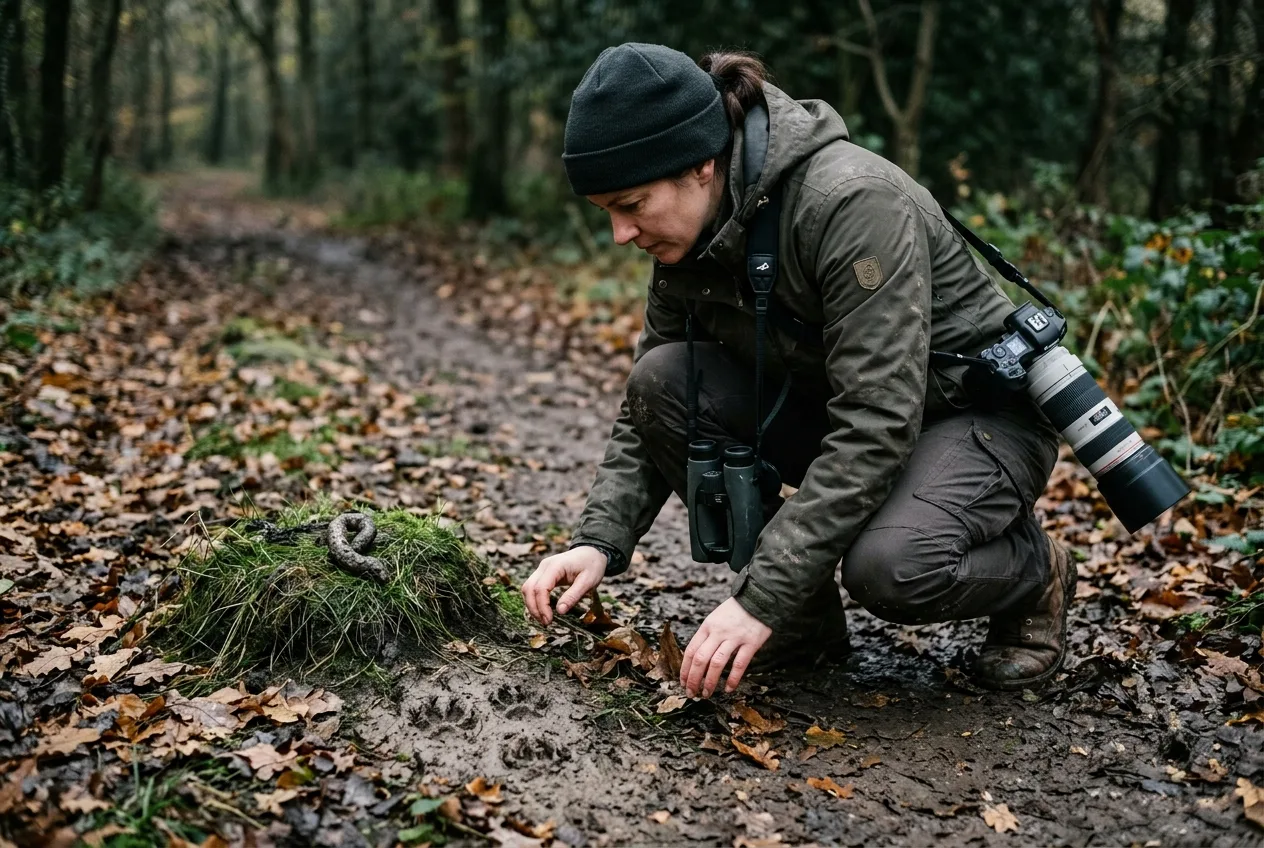
The single most productive thing you can do is learn to read the ground. Sign tells you an animal is here, where it travels, and where it rests — without your ever seeing it. Plummer's whole approach to mammals is built on this: time spent observing behavior and "the recognition of tracks and signs" before you ever choose a spot to wait.
Start with the species' habitat preferences, then narrow to edges. Red foxes prefer a mixture of forest and open fields and hunt the transition zone — the "edge" — between the two, favoring "mixed vegetation such as scrubland and the forest edge". Gray foxes are, in the words of one GPS study, "an edge species" tied to hardwood forests near roads and human use, and they need permanent water nearby. Bobcats key on "brushy stages" of low- and mid-elevation forest and chaparral, broken rocky terrain with clearings and ledges. Barn owls want open hunting ground — "large areas of pasture, hayfields, grasslands or wet meadows" full of meadow voles, their favorite food — with a cavity or building to nest in nearby. Edges, water, and the meeting of cover and open ground: that's where to look.
Then find the physical sign. This is where the work pays off:
- Owl pellets and whitewash. Barn owls are "secretive and the best way to detect them is to find their distinctive pellets" — compact masses of hair, feathers, and bone. A roosting barn owl typically coughs up one or two a night, black and 30–70 mm long; find a pellet or two under a beam in an old farm building and you've found a roost. For other owls, add whitewash — droppings that leave a white splatter on trees, rocks, and surfaces beneath a roost. As one pro puts it, "become skilled at spotting sign and you'll dramatically increase how frequently you photograph owls".
- Fox dens and scent marks. Foxes scent-mark and use excrement to denote territory boundaries, and they cache excess food, marking it with urine. Red fox dens persist for decades in stable locations, dug into well-drained hills and bluffs — and in suburbia, under porches, decks, and sheds. Look for well-trodden paths running from a den to hunting grounds. One caution worth stating up front: most foxes keep more than one den and "will readily move their young if disturbed". We'll come back to that.
- Bobcat scrapes. Bobcats — like many cats — build "scrapes" by scratching the substrate with their hind feet after scent-marking, advertising occupancy of a territory. These turn out to be gold. In the Santa Cruz Mountains, researchers used motion-triggered video to monitor 48 of these "community scrape" areas and logged 496 bobcat visits over two years. The kicker: the scrapes weren't bobcat-only. Pumas, coyotes, gray foxes, striped skunks, and raccoons all visited the same spots — the whole carnivore guild. If you can recognize a community scrape, you've found a place several shy species reliably return to.
If track and scat ID is new to you, it's worth building that vocabulary deliberately — Animal Tracks Identification: A Field Guide to Common Footprints and Whose Poop Is That? A Field Guide to Animal Scat Identification pair naturally with this kind of fieldwork.
The single most productive thing you can do is learn to read the ground.
Time it: light, season, and the rhythm of the day
You can be in exactly the right place and still go home empty if your timing is off. Two clocks matter — the daily one and the seasonal one.
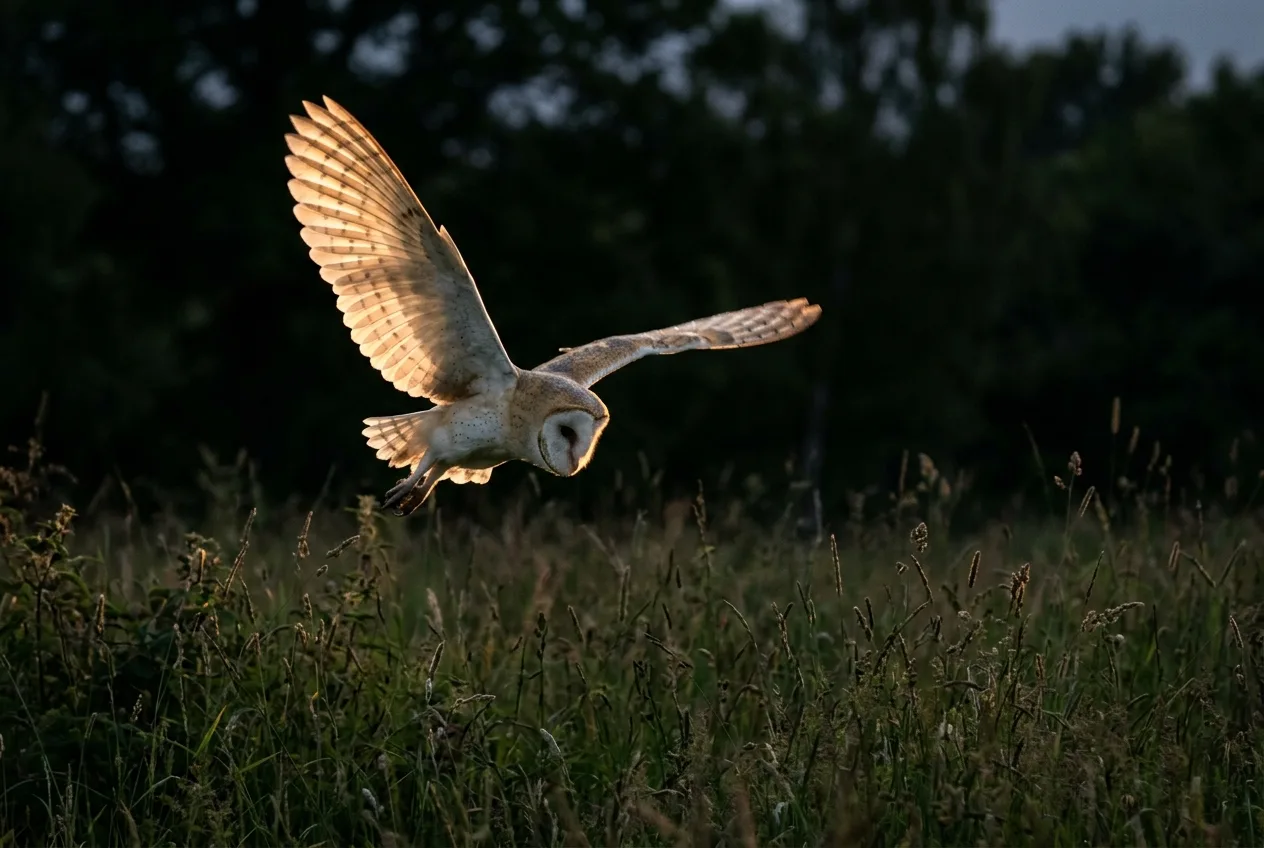
The daily clock. Because foxes, bobcats, and owls all skew crepuscular and nocturnal, your shooting windows cluster at dawn and dusk. That's a gift as much as a constraint: it puts your subject in the open during golden hour, "when light is at its best," in the words of barn-owl specialist Ben Hall. He prizes backlighting for owls — golden light streaming through the wings of a bird in flight against a dark background "creates a wonderful effect". The lesson generalizes. The same low, warm light that flatters a fox trotting across a field is available precisely when the fox is most likely to be out.
There's a subtler timing trick hiding in the bobcat data, and it's worth knowing. A study of bobcat movement found temperature was "the best predictor of bobcat movement rates" — they barely moved (under 10 m/hr) below 14°C, and moved most (over 50 m/hr) between 15 and 25°C. And the moon matters: bobcats moved fastest during crepuscular (153 m/hr) and daytime (144 m/hr) periods and slowest in full dark (120 m/hr), shifting their activity to nighttime when the moon was bright and to daytime around the new moon, when dark nights left them half-blind. Practical upshot: a mild evening near a partial-to-full moon stacks the odds in your favor; a freezing new-moon night is the worst draw you can get. (If moon-and-movement is your thing, the same logic shows up in deer — see Does the Moon Phase Affect Deer Movement? What the Data Shows.)
The seasonal clock. Denning and nesting seasons concentrate activity and create photo opportunities — and the heaviest ethical landmines. Roughly:
| Species | Breeding window | What it means for you |
|---|---|---|
| Red fox | Breeds Jan–Feb (through March in places); kits emerge ~4–5 weeks after birth, in spring; disperse by Sept–Oct | Late spring means kits playing outside the den — and males hunting in daylight to feed them |
| Gray fox | Mates Feb–March; most births in April; one litter a year | Same spring-kit window; remember the water-and-edge habitat |
| Bobcat | Breeds late Feb–March; young born in spring; visitation to scrapes peaks in January | January scrape activity and winter twilight are prime; kittens disperse in fall |
| Great horned owl | Among the earliest nesters — eggs as early as February; breeding season Feb–July | Winter hooting and early nesting; pairs reuse traditional sites |
| Barn owl | Long season, March–October; may nest more than once a year | Active well into summer nights; tied to its roost building |
That spring kit-and-fledgling season is the most tempting and the most fraught. A fox that feels safe will let its young play in the open; a fox that feels watched will move them. Photograph the season, don't intrude on it.
Photograph the season, don't intrude on it.
Hide, stalk, and wait: the fieldcraft that actually gets you close
Once you know where and when, the question becomes how to be there without blowing it. There are three moves: conceal, stalk, or — often best — sit still and let the animal come to you.
Conceal yourself, and respect the senses you're up against. Camouflage works, but only if you commit. Plummer notes that a camouflage jacket helps, but going further — gloves, a bush hat, a balaclava over the face — works dramatically better. In full camo he's had barn owls land within a meter of him: too close to photograph, but proof the principle holds. For owls especially, sound is the giveaway. They "possess exceptional hearing," so wear natural, muted colors in quiet fabrics and avoid crinkly waterproofs. (Plummer prefers a soft army-surplus jacket to noisy breathable shells for exactly this reason.)
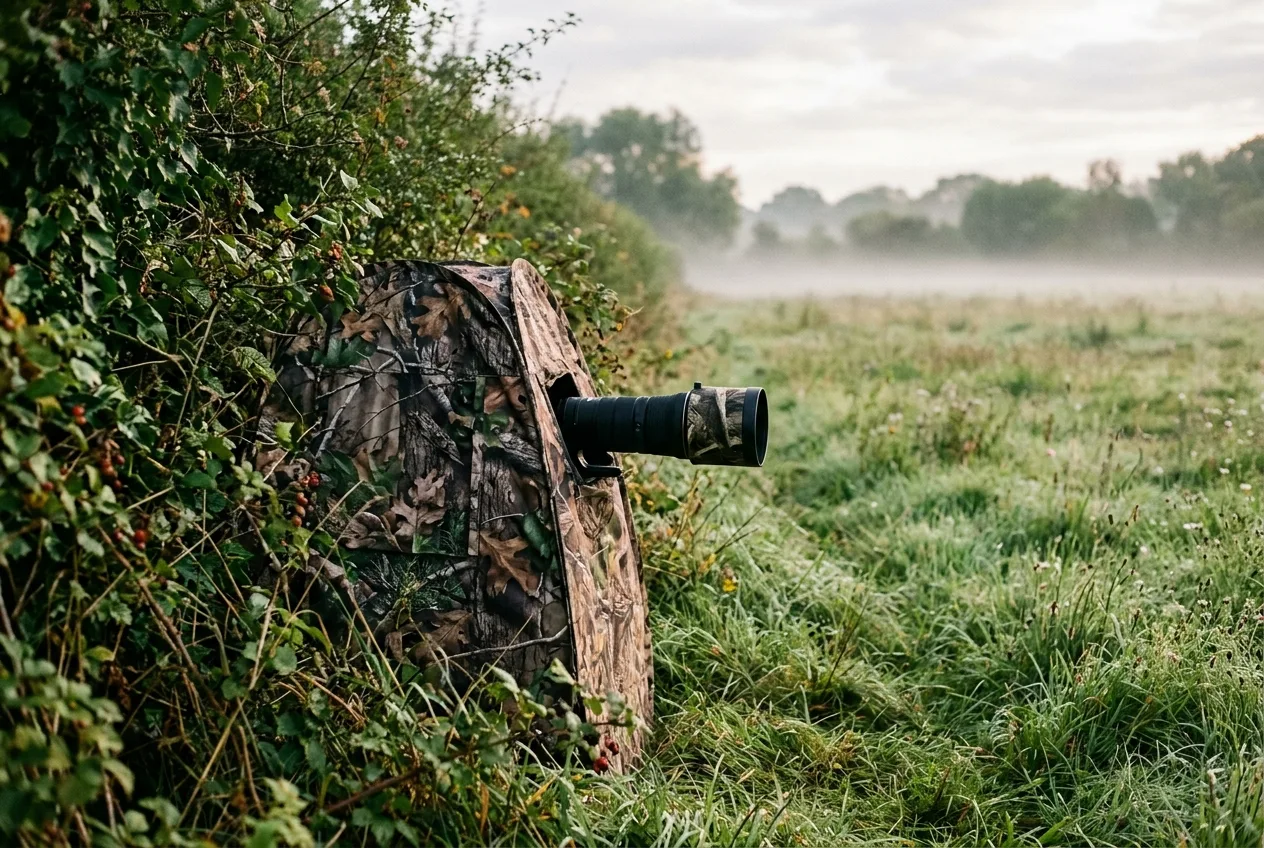
The most underrated hide is the one with wheels. "My car makes the perfect hide," Hall writes — most birds don't perceive a vehicle as a threat and will come close, but "step out, however, and your photography opportunity will likely come to a very abrupt end". A beanbag on the window sill steadies the lens; camo netting over the glass hides your movement. For a fixed spot, a pop-up blind works best tucked against a tree line or hedgerow so it doesn't stand alone in an open field, and matched to its surroundings — a woodland-print blind in a snowy field "stick[s] out like a sore thumb".
Stalk like a cat. If you must move on foot, slow everything down. Place each foot heel-to-toe so you can feel a twig before it snaps and pull back. Watch how a house cat stalks — that slow, tentative, weight-testing tread is the model. If your subject is feeding with its head down, advance; the instant it raises its head, freeze. Use ditches, hedges, and tree lines as cover, stay low, and crucially, don't look straight at the animal — even at 100 meters, a prey animal can read a direct stare as a threat, so glance sideways or watch through the viewfinder. And mind the wind: never let your scent drift toward a mammal. "Always feel the wind," Plummer warns; if it shifts, move — "if a badger can smell you, it's game over".
Often, don't stalk at all — wait. The single highest-percentage tactic in the sources is to observe an animal's routine, predict it, and pre-position. Hall parks near a barn owl site and watches with binoculars until he learns its hunting habits; owls "usually stick to a fairly regular routine," so once you've kept a notebook of times and places, you can start predicting where the bird will be. Plummer agrees: spotting a fox approaching from a distance lets him pick a spot to wait — seated against a tree trunk, camouflaged and motionless — which he calls "preferable to stalking as you just let the animal come to you". Same idea from the owl side: when you find one actively hunting, pause and watch — a short-eared owl may quarter the same patch over and over, and reading that flight pattern lets you set up for the shot without disturbing the hunt.
This is also where you learn to read the animal's mood, which keeps your shots natural and keeps you ethical. A relaxed animal hunts, grooms, or naps; a relaxed owl shows fluffed feathers and half-closed eyes. Stress shows early and subtly — long before flight: a bobcat about to bolt first flattens to the ground to hide; an owl widens its eyes; a gray fox barks at a perceived threat to its kits; an alert owl flattens its feathers and shifts foot to foot. Other species will tip you off, too — a scrub jay's alarm call can announce a fox or bobcat arriving, and small songbirds "mobbing" an owl will lead you straight to it. Learn these cues and you'll know both when to lift the camera and when to back off.
On gear, the sources are refreshingly consistent and unfussy: a long lens (Hall recommends at least 400 mm for wary owls, and often shoots a 500 mm f/4); for owls in low light, a fast lens at f/4 or f/2.8, ISO starting around 3200, and exposing to the right to keep noise down; and for flight, a fast shutter — at least 1/1000 s, predictive autofocus, and burst mode to catch wing position. Good glass helps. But notice that none of it substitutes for being in the right place at the right moment.
None of it substitutes for being in the right place at the right moment.
The ethics you don't get to skip
With shy, sensitive species, ethics isn't a footnote — it's part of the craft, and the sources are blunt about it. Audubon's guiding line: "The well-being of the birds and their habitats must come before the ambitions of the photographer". Three rules carry most of the weight.
Don't bait, and don't call. This one is firm. Audubon says never lure predatory birds — "hawks, owls, eagles, ospreys, roadrunners" — with bait, where "bait" includes live or dead animals and even fake mice, because it changes their behavior in harmful ways. Practitioners echo it: "Never bait an owl with live or dead prey," because a fed owl may grow dependent on people or drift toward roads and danger. The deeper hazard, from a conservation photographer who sits on a photo-ethics committee: predators like owls and foxes that learn to associate humans with food "become vulnerable to traffic, predation, or even human persecution". Recorded calls are out for the same reason — an owl will burn "precious energy and time" investigating a rival that isn't there, and a bird drawn off its nest by playback leaves eggs and chicks exposed to predators and weather.
Keep your distance, especially from dens and nests. If your approach makes a bird flush or change its behavior, "you're too close". Audubon recommends telephoto lenses of at least 500 mm for nesting birds and says not to move or cut anything around a nest — that vegetation is camouflage and shelter. The reasons are concrete. Repeatedly walking to a nest or den "can leave both a foot trail and scent trail for predators," and human presence near sensitive dens and nests "may also provoke relocation" to a worse site. Remember, foxes will move their kits if disturbed. If a parent circles but won't come in to feed its young, you are the problem — move away. Watch from afar; let the family relax.
Protect the location. The owl world has a hard-won norm: "Never reveal the location" of an owl, and many photographers delay posting their shots by weeks or months to keep crowds away. Strip GPS data from images of rare or sensitive species like owls before sharing. A photographer "jam" doesn't just stress the bird in the moment; it can habituate it to people and, again, nudge it toward traffic. None of this costs you a good photo. As the ethics-first crowd argues, the patient, respectful approach is what produces the memorable, natural image in the first place.
None of this costs you a good photo.
Where camera traps earn their place
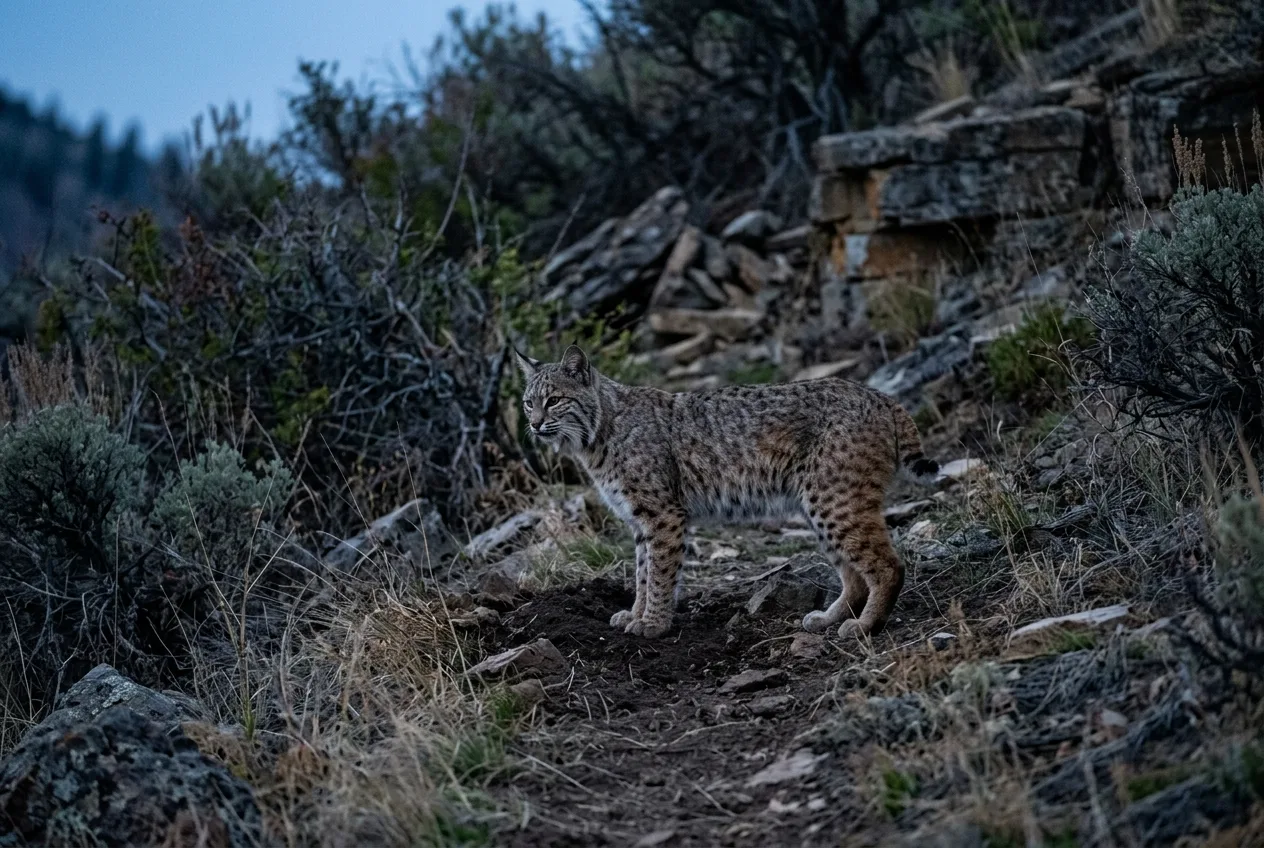
For the most nocturnal and secretive subjects, there comes a point where stalking and waiting simply can't reach — a bobcat that only crosses a ridge at 2 a.m., an owl hunting a field on a moonless night. This is where a remotely triggered camera left in the right spot does what you can't: it's there every night, it doesn't get cold, and it doesn't spook the animal. Remember that lone bobcat across 844 stations? Cameras are how you photograph the animal you'll otherwise never lay eyes on.
The research points to two ways to dramatically raise your hit rate.
Put the camera on a trail. Elusive carnivores "exploit linear features to minimize energy expenditure" as they move, so they show up far more on trails than off them. In an Italian national park study that ran trail and off-trail cameras side by side, site species richness was higher on trails, and elusive carnivores were "mainly detected on trails," with on-trail cameras more efficient overall for monitoring mammals. The nuance worth knowing: trails are for movement, while animals use off-trail areas for resting and foraging — and some species (notably deer/ungulates) actually skew off-trail — so a mix of placements captures the fullest picture. For a shy predator, though, the well-used game trail, road, or that community scrape is your highest-percentage set.
Consider a scent lure — with eyes open about the trade-offs. Scent lures can boost detections of predators specifically. In the Alberta study, a skunk-and-musk lure (O'Gorman's Long Distance Call, set in a PVC tube about 5 m from the camera) significantly increased predator detections — though notably it did nothing for prey species, and nothing for wolves. But lures are not free of consequence, and this is where the science gets honest. A Ugandan study found that while several small carnivores were detected most "immediately after attractant placement," the target cat actually showed decreased site use within 24 hours — possibly recoiling from the human scent — and prey species avoided fresh attractant entirely. Attractants create "short-term biases," nudging some animals in and others away. They're a tool, not a cheat code.
And here the ethics from earlier still apply: a remotely triggered camera at a natural scrape or trail is a different thing from baiting. Audubon draws the line cleanly — setting a camera around a fresh kill or cache "is generally acceptable, but supplying bait or other lure in order to attract an animal is not," and you should "be cautious with remotely triggered cameras" generally. A scent lure occupies a genuine gray area; if your goal is an honest photo of a wild animal behaving naturally, the trail set wins on every count.
One more reason camera traps shine on these species: the flash problem. You should never fire a direct flash at a nocturnal bird — Audubon warns it "may temporarily limit their ability to hunt for food or avoid obstacles," and practitioners report owls spooking and flying off the instant a flash pops. But Audubon notes the workaround explicitly: "a flash with a filter that lets only infrared light through is acceptable" — which is exactly how trail cameras shoot in the dark, and how one acclaimed series on northern spotted owls was made entirely in infrared, capturing natural moments in near-darkness without a single visible flash. For the truly dark hours, infrared isn't a compromise; it's the ethical way in. (If you're choosing or building one, start with How to Set Up a DSLR Camera Trap: Flash, Focus, and Triggers and DSLR Camera Trap vs. Trail Camera: Which Is Worth It for Wildlife Photography?.)
A quick word on each species
- Red fox. The most catchable of the group, because it's the boldest around people and often urban. Work field edges at dawn and dusk; late spring puts kits outside dens and males hunting in daylight. They're wary but adaptable, living "almost any setting with adequate food resources".
- Gray fox. Shyer than the red, an edge species tied to hardwoods and water, and the only North American canid that climbs trees. Worth knowing: despite the climbing reputation, a GPS study found "no evidence of gray foxes diurnally resting in trees" — by day they rest on the ground in hardwood and brushy cover, often near roads and human use.
- Bobcat. The hardest to simply see — spread thin, mostly nocturnal/crepuscular, and a single-glimpse animal. Time mild, moonlit evenings; hunt community scrapes and game trails; and accept that a camera trap may be your realistic route.
- Great horned owl. An early nester (eggs by February) and a "perch-and-wait" hunter whose territorial "hoo-hoo hoooo hoo-hoo" carries for miles — listen for it to locate birds, and look for traditional reused nests. Find the perch, and you've found the show.
- Barn owl. A ghost over the meadow at dusk. Search old farm buildings for pellets to find roosts, hunt the open grasslands it favors at dawn and dusk (and into daylight in winter), and shoot it backlit in golden light. Its nightly active window runs a median of about 6.8 hours, mostly spent perched and watching — patience, again, is the whole game.
The thread running through every one of these: the photo is downstream of the knowledge. Learn the animal first, and the picture follows.
Frequently asked questions
What is the best time of day to photograph foxes?
Dawn and dusk. Red foxes are most active during these crepuscular hours, though they'll hunt anytime food demands it, and you'll see the most daytime fox activity in late spring when males hunt to feed growing kits. The low golden light at those hours is a bonus.
How do you find a fox or owl to photograph without baiting it?
Read the sign. For owls, search likely roosts (old farm buildings, dense trees) for pellets and whitewash splatter beneath them. For foxes, look for dens on well-drained hills or under decks, scent marks, and well-worn trails between den and hunting grounds. Then watch from a distance and learn the routine — no bait or calls required.
Is it safe to use flash to photograph owls at night?
No — avoid direct flash on nocturnal birds. It can temporarily impair an owl's ability to hunt and avoid obstacles, and owls are known to spook and flee from it. The accepted alternative is infrared light, which is how trail cameras shoot in the dark and how natural owl images have been made in near-total darkness.
Where should I place a camera trap to catch a bobcat?
On a well-used game trail, dirt road, or a bobcat "community scrape." Elusive carnivores travel linear features to save energy and are mainly detected on trails, and scrapes draw repeat visits from bobcats and other carnivores alike. Bobcats are otherwise extremely hard to capture: across 844 camera stations run for four months in one study, a bobcat triggered the shutter just once.
Is it ever okay to photograph a den or nest?
Only from a real distance, briefly, and never by revealing its location. Approaching repeatedly lays a scent and foot trail that leads predators in and can make parents abandon or relocate the young. Use a long lens (Audubon recommends at least 500 mm for nests), don't alter the surrounding cover, and back off the moment a parent looks agitated.
Does the moon really affect when bobcats move?
Yes. Bobcats shift their activity to nighttime when the moon is bright and to daytime around the new moon, when dark nights limit their vision — and they move most overall during crepuscular periods and in mild temperatures (15–25°C). A mild, moonlit evening is a better bet than a cold, dark, new-moon night.