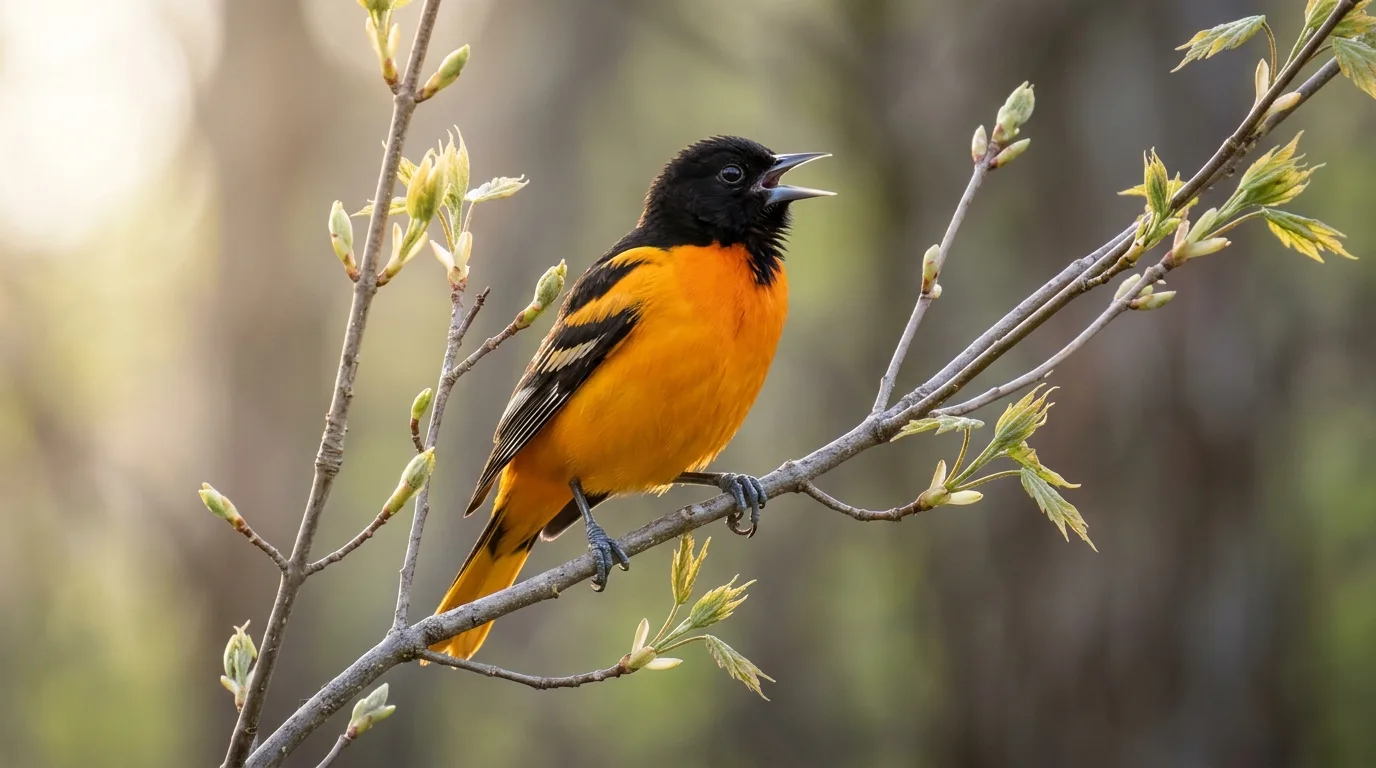
The first one back is almost always a sound before it's a bird. A snatch of song from the top of a bare maple, two weeks before the leaves — and there's a male Ruby-throated Hummingbird at the feeder you hung on a hunch the day before, looking faintly annoyed that breakfast wasn't already out. That little jolt of recognition is what spring bird migration is really about for a backyard watcher. The continental story is staggering, but the personal one is a single bird showing up on a particular morning, having flown a very long way to get to your yard.
Here's the short version, the part you came for. Across North America, spring migration runs roughly from mid-March to mid-June, and in the contiguous U.S. the heaviest movement — the part worth planning around — falls mid-April to mid-May. The great northward flood of songbirds that wintered in the tropics, the warblers and tanagers and orioles and grosbeaks, pours through mostly in April and May. Most of it happens in the dark: in the U.S., at least 80% of migratory bird species migrate at night. And it's not a steady trickle — it comes in pulses, with huge numbers riding the right weather and almost nothing in between. So the trick to catching it isn't watching constantly. It's knowing when to look.
Below, what's moving and why, how to read the waves, the species to actually watch for in a backyard, and how to be ready — with the honest caveat that timing shifts by latitude and region, and a calendar that fits the Gulf Coast will be weeks off for New England.
Why they come back, and why timing is everything
Strip away the romance and spring migration is a food run. Birds that spent the winter in Central or South America head north because the temperate and boreal woods are about to explode with insects — the protein that fuels building nests and raising young. The southbound trip in fall and the northbound trip in spring bracket that brief, rich window.
What makes the timing fascinating, and a little fragile, is that birds and the spring they're chasing run on different clocks. The start of long-distance migration is cued mainly by photoperiod — day length — which is rock-steady year to year. But conditions waiting at the breeding grounds depend on weather and climate, which are anything but steady. A bird leaving the tropics is essentially betting that the calendar in its body still matches the season up north. As the climate warms, that bet is getting harder to win: across 48 songbird species studied, the gap between when birds arrive and when the woods green up has been widening by more than half a day per year, and 9 of those 48 species simply aren't keeping pace with how fast green-up is shifting. The worry is a mismatch — showing up after the peak flush of caterpillars has already passed.
You can see the same fingerprint in arrival dates. Pull a decade of citizen-science records for 18 common species and they've shifted their arrival 0.8 days earlier for every degree Celsius of spring warming, with some species in some places moving 3 to 6 days earlier per degree. Slower, shorter-distance migrants adjust the most; long-haul birds, locked to day length, adjust least. Spring itself is arriving earlier across most of the continent — earlier in 76% of national wildlife refuges, and "extremely early" in nearly half of them. None of this means migration is broken. It means the precise dates drift, and the old rule of thumb your grandfather used may run a touch early now.
The four flyways: which birds pass over you
Birds don't scatter randomly across the map. They funnel along broad corridors — the Atlantic, Mississippi, Central, and Pacific flyways — gravitating toward efficient routes with good places to rest and refuel. It helps to know yours, because it tells you which species to expect. Just don't treat the lines as fences. Flyways are "broad, generalized pathways; they are not rigid or narrowly defined routes," and for songbirds especially the boundaries get fuzzy.
- Atlantic — Florida to Greenland, hemmed by the ocean on the east and the Appalachians on the west. Famous for shorebirds and waterfowl crowding the coastal marshes (Red Knots refueling on horseshoe-crab eggs in Delaware Bay), but inland it carries songbirds that winter in Central America — Cerulean Warbler, Wood Thrush — into forested yards and city parks alike.
- Mississippi — birds ride up the Gulf, then follow the Mississippi, Missouri, and Ohio Rivers north. An "ideal route for ducks, geese, shorebirds," it also delivers the Prothonotary Warbler and Yellow-billed Cuckoo through the river bottoms.
- Central — the Gulf coastline is the first U.S. stop for northbound tropical migrants here, who then push through the interior toward the Great Plains. More than half of North America's migratory waterfowl use it, and its showpiece is the Sandhill Crane spectacle — hundreds of thousands staging along an 80-mile stretch of Nebraska's Platte River.
- Pacific — coast-hugging from Alaska and the Aleutians down to Patagonia. Some Rufous Hummingbirds make 3,000-mile journeys along it between Mexico and British Columbia, alongside Western Tanagers and Townsend's Warblers.
Those tropical-wintering songbirds — most warblers, orioles, and tanagers — are exactly the birds that cross the southern U.S. border each spring, and exactly the ones that have farther to go and more to lose.
So the trick to catching it isn't watching constantly. It's knowing when to look.
Reading the waves: how migration actually arrives
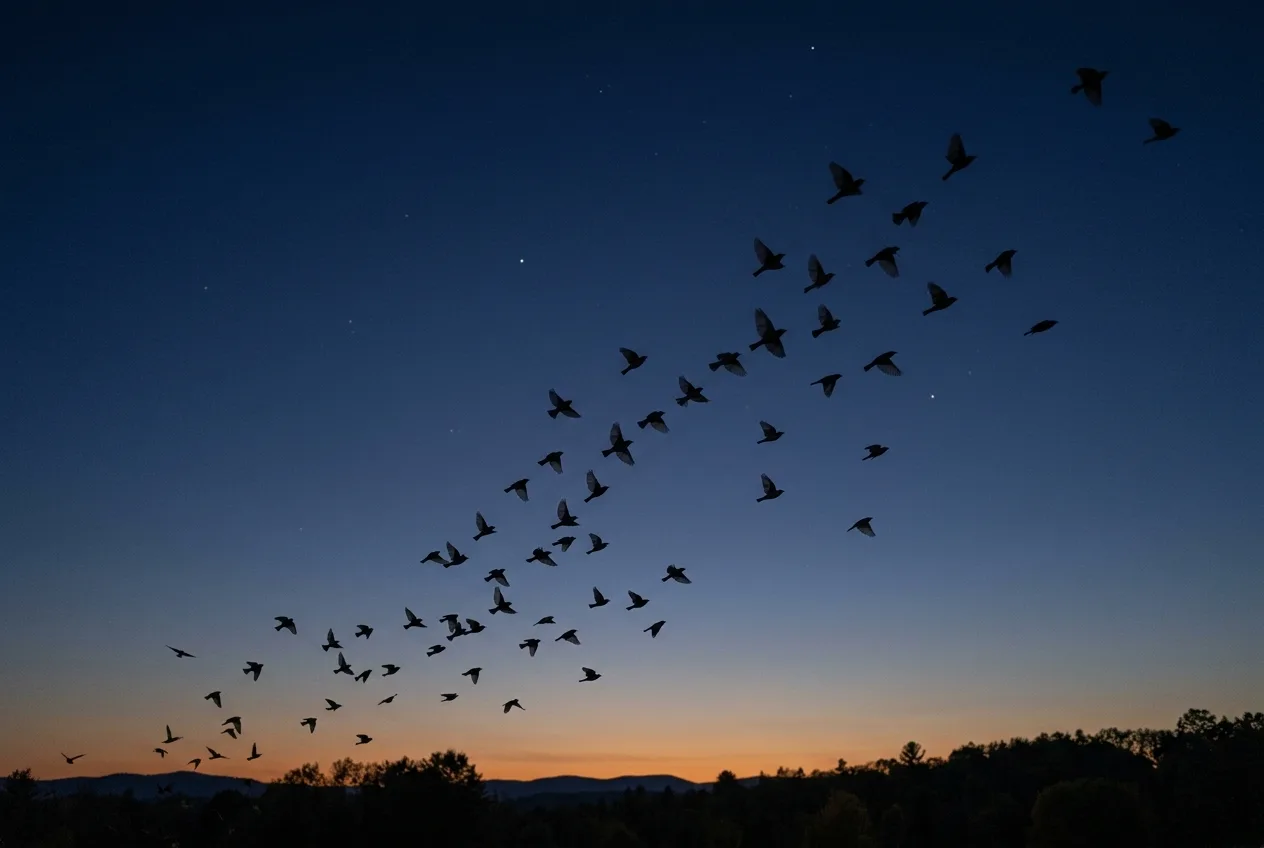
This is the part that separates a frustrating spring from a great one. Migration is not a smooth curve; it's pulsed. In one striking analysis of radar data, the majority of birds — 54.3% — moved on just 10% of a season's nights. Most nights, not much. A handful of nights, a deluge. Picture the cumulative count for your area as a line on a graph: flat for a long while, then rising steeply through the peak weeks, then leveling off — and the steep part is built from a few enormous nights.
What flips the switch is weather, specifically wind. Birds wait for supportive tailwinds and pile up behind weather that blocks them. In spring that means southerly winds on the back of a warm front are the green light; a passing cold front with north winds and rain is the brake. When a strong front stalls a big push of birds, they drop out of the sky in numbers the next morning — a fallout. It's the most thrilling thing in backyard birding: trees suddenly dripping with warblers that weren't there yesterday.
We have a real-time window into all of this now. BirdCast turns the national weather-radar network into a live migration map, and the patterns it shows are remarkably consistent: the heaviest flight usually comes in the first half of the night, two to four hours after local sunset, with birds cruising anywhere from 100 to 10,000 feet up. On a big night, more than a billion birds can be aloft over the U.S. at once. This past spring set a record — on the night of May 3–4, 2026, BirdCast's maps showed 857 million birds in flight across the Lower 48, driven by peak timing colliding with intense, bird-concentrating weather; Missouri alone had more than 75 million birds crossing.
Two free tools make this actionable. BirdCast's Migration Dashboard reports, for your county or state, how many birds crossed overnight, which direction they're heading, and a weekly list of the nocturnal migrants most likely to be arriving — drawn from eBird sightings. And email alerts, now covering 216 cities across the contiguous states, ping you when the next night is forecast to rank in the top 10% for the season. If your town isn't listed, subscribe to the nearest one; big waves are broad, so a city within about 100 miles is usually representative. Get an alert in early May, and there's a good chance the next morning is the one to be out in the yard at dawn.
The same data is how we know what's at stake. Run independently of the bird counts, that radar record shows the volume of spring migration has dropped about 14% in a single decade — a quieter sky, measured from above.
It's the most thrilling thing in backyard birding: trees suddenly dripping with warblers that weren't there yesterday.
The species to watch in your backyard
Migration arrives in a rough order, and knowing the running order is half the fun. Here's the sequence to expect, early to late.
Late winter into March — the vanguard. Waterfowl move first, ducks and geese pushing north as soon as the ice starts to give, sometimes into the northern states by late February. Right behind them come the hardy short-haul migrants that wintered as far north as they could: Killdeer, Red-winged Blackbirds, and a few birds of prey — Bald Eagles and rough-legged hawks moving north while it's still plainly winter. The surprise early bird is the Purple Martin, back from South America and reaching Florida and Texas by late January, the northern states by the end of March.
March into April — the build. Native sparrows are classic early movers, in big numbers through southern states in March and into the north by early April, with kinglets and sapsuckers in the same moderately early wave; most blackbirds clear through in the first half of spring. This is the stretch where the yard slowly fills in and you start checking the brush piles.
April and May — the main event. This is what birders wait all year for: "the great northward flood of songbirds that have wintered in the Tropics — including warblers, tanagers, buntings, grosbeaks, orioles, vireos and thrushes". Warblers are the headliners, and the diversity is real — there are places where you can see more than 30 species of these tiny, restless gems over a single season. A Baltimore Oriole flashing orange in a budding tree, a Rose-breasted Grosbeak at the feeder, a Scarlet Tanager glowing in the canopy — these are the late-April-into-May birds, and they don't linger long. Watch how tied they are to the waves: the first Baltimore Orioles of the 2026 season showed up the very night a big migration pulse rolled through.
Late May into early June — the stragglers. A few shorebirds and trailing songbirds round it out; some long-haul shorebirds like White-rumped Sandpipers don't peak in the central U.S. until late May or early June. By early June, across most of the continent, spring migration is essentially over and the birds that stayed get down to nesting.
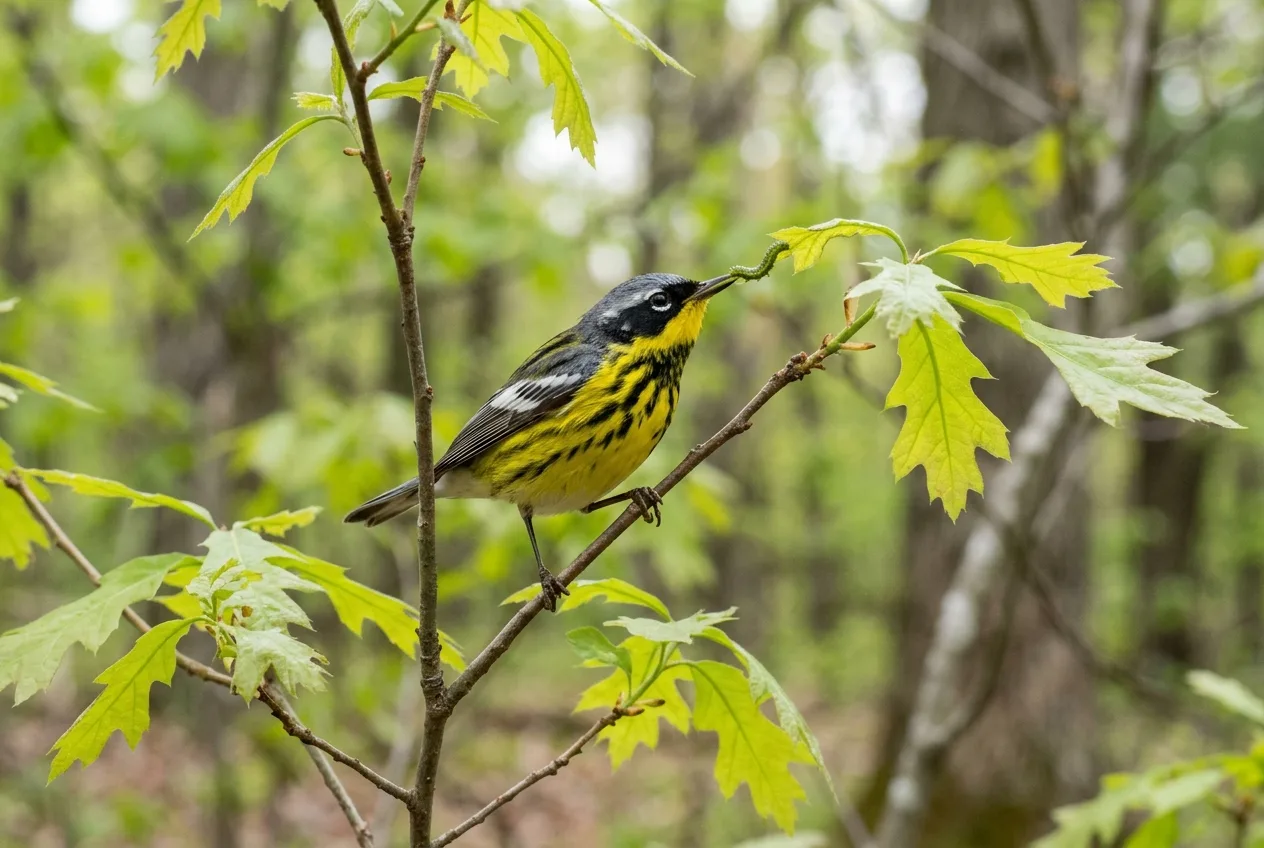
A word on the warblers, because they capture what's wild about all of this. The Blackpoll Warbler weighs about 12 grams — half an ounce — and is one of the fastest-declining songbirds on the continent, yet it pulls off one of the great feats in the animal world: a southbound nonstop flight over the Atlantic of up to three days and 2,770 km, part of a round trip near 20,000 km. Geolocators small enough to ride on a warbler's back are how we finally proved it. The bird hopping through your shrubs in May is carrying a passport most travelers would envy.
The bird hopping through your shrubs in May is carrying a passport most travelers would envy.
Hummingbirds and orioles: the feeder birds you can court
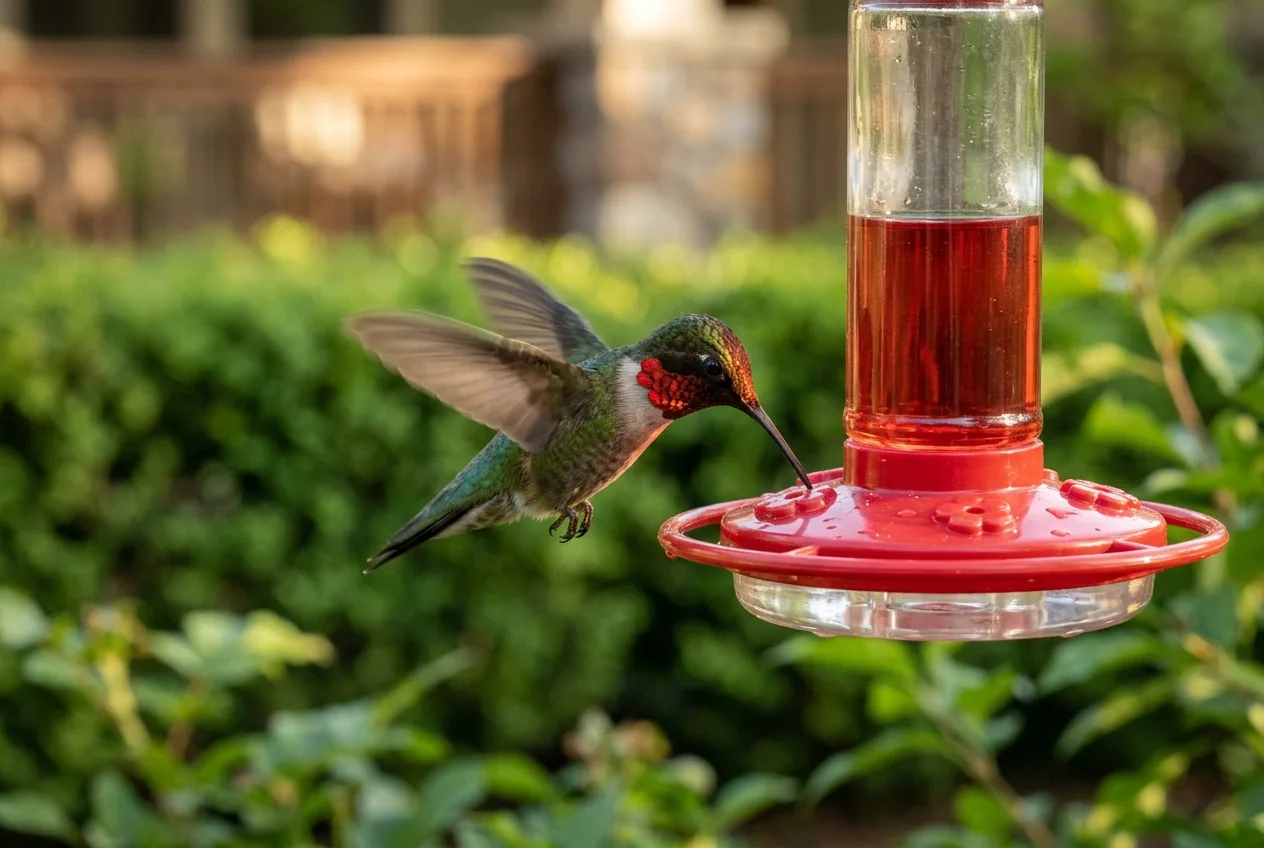
Two groups are worth singling out, because you can do something about them.
Hummingbirds. East of the Rockies, the Ruby-throated rules. It reaches the Gulf Coast by early March and filters north over the next two months, arriving in the northern states and southern Canada by late April or early May — and the males show up about a week ahead of the females. So the timing of your feeder matters: hang nectar by early March if you're in the Southeast, by late April if you're in the Northeast. Out West it's a richer cast — Broad-tailed, Black-chinned, and Calliope arriving as the first flowers open, plus Rufous Hummingbirds passing through, reaching the Northern Rockies by early to mid-May; on the West Coast, migrant Rufous can hit Oregon by the end of February. These are extraordinary little engines: during migration a hummingbird's heart can beat up to 1,260 times a minute, it can cover about 23 miles in a day, and it fattens by 25–40% of its body weight before a long crossing. First arrivals are almost always males.
Orioles. Baltimore Orioles are an April-into-May bird across the East, part of that neotropical flood, and like the warblers they ride the pulses in. A halved orange or a dish of grape jelly set out in late April is a genuinely effective way to pull one down into view.
When it peaks near you (don't use someone else's calendar)
This is where I'll be blunt: the single most common mistake is borrowing a timing chart from the wrong latitude. Peak migration sweeps northward, so a date that's perfect in Texas is early in Ohio and flat-out wrong in Maine.
BirdCast pins this down by defining a city's "peak period" as the window during which 50% of the season's nocturnal migration traffic historically passes, from radar data spanning 1995–2018. The spread is striking. A sampling of those 50% windows:
| City | Spring peak window |
|---|---|
| Houston, TX | Apr 23 – May 10 |
| New Orleans, LA | Apr 24 – May 10 |
| Atlanta, GA | Apr 21 – May 10 |
| Los Angeles, CA | Apr 23 – May 16 |
| Chicago, IL | May 2 – May 21 |
| Denver, CO | May 4 – May 18 |
| New York, NY | May 7 – May 22 |
| Minneapolis, MN | May 6 – May 24 |
| Boston, MA | May 10 – May 22 |
| Portland, ME | May 10 – May 29 |
Notice the pattern: Gulf cities peak in the last week of April, the Upper Midwest and Northeast not until the back half of May — a swing of roughly three weeks across the country. Look up your own city, mark that window, and aim your attention there. And remember the climate caveat: those are historical averages, and spring has been creeping earlier, faster at higher latitudes. If anything, hedge a few days early.
How to be ready — and help them through
A migrating bird needs three things from your yard: food, water, and a safe place to rest. The good news is that 86% of U.S. land is privately owned, which means backyards add up to real habitat.
The most effective thing you can do isn't a feeder — it's native plants. Native trees and shrubs evolved alongside local insects, so they're loaded with the caterpillars migrants and their chicks depend on. In one suburban study, native trees turned up 20 or more caterpillars in five minutes, while non-native plants yielded one or fewer. Oaks are the champions, supporting up to 557 species of moths and butterflies; native cherries and plums up to 456; maples up to 297. Even seed-eating birds feed insects to their young — nestlings need protein-rich caterpillars to thrive — which is why a yard full of natives quietly out-feeds any feeder. As the researcher who ran that chickadee study put it, the native trees her birds favored "were covered in warblers, tanagers, and orioles".
The rest is straightforward:
- Put feeders out on time, and keep them clean. For hummingbirds, mix nectar at four parts water to one part sugar, skip the red dye, and wash the feeder regularly. A halved orange or jelly will bring in orioles.
- Let part of the yard go a little wild. Leaf litter and downed wood shelter the insects birds forage for; a messy corner is a feature, not a flaw.
- Make your glass visible. Up to a billion birds a year die hitting glass in the U.S., nearly half of them at home windows — and migration season is the worst of it. Patterns of tempera paint on the outside of the glass, lines no more than two inches apart, are cheap, removable, and surprisingly durable.
- Turn off the lights on the big nights. Night-migrating birds get disoriented by bright artificial light, burning energy circling in confusion; turning lights off lets them move on within minutes. The damage is real — one Texas skyscraper's floodlights killed nearly 400 songbirds in a single week. Switch off non-essential lights by 11 p.m. during peak migration, and check your BirdCast alert for which nights matter most.
- Keep cats in. A single outdoor cat can kill dozens of birds a year, and exhausted migrants on the ground are easy targets.
Your own watching helps the science, too. The migration maps you rely on are built from millions of ordinary sightings — the eBird records that let researchers trace the routes of bird populations across an entire hemisphere, and that feed BirdCast's daily forecasts. Log what shows up in your yard and you're not just keeping a list; you're a data point in the picture everyone else is using to find birds.
How to Identify Birds by Sound: A Beginner's Guide to Songs and Calls
How to Attract More Birds to Your Yard (and Catch Them on Camera)
Frequently asked questions
When does spring bird migration start and peak?
Across North America, nocturnal spring migration runs roughly mid-March to mid-June, and in the contiguous U.S. the peak is typically mid-April to mid-May. The exact peak sweeps north over the season — late April on the Gulf Coast, the second half of May in the Upper Midwest and Northeast — so look up your own city's window rather than using a national date.
Why do birds migrate at night?
At least 80% of migratory bird species in the U.S. fly at night. Darkness offers cooler, calmer air, fewer predators, and lets daytime feeders spend daylight refueling. The heaviest movement comes in the first half of the night, usually two to four hours after sunset.
What is a fallout, and how do I catch one?
A fallout is when migrating birds, often stalled by a cold front with north winds and rain, drop out of the sky in large numbers — so a yard or woodlot can fill with warblers overnight. Watch the weather for a southerly push of birds meeting a front, and use BirdCast's forecasts and alerts to flag the big nights ahead.
What backyard birds should I watch for in spring?
Early on: waterfowl, Killdeer, Red-winged Blackbirds, and Purple Martins, then native sparrows and kinglets. The main event in April and May is the tropical-wintering songbirds — warblers, tanagers, buntings, grosbeaks, orioles, vireos, and thrushes — with warbler diversity the headline.
When should I put my hummingbird feeder out?
Time it to local arrivals. Ruby-throated Hummingbirds reach the Gulf Coast by early March and the northern states by late April or early May, so hang nectar by early March in the Southeast and by late April in the Northeast; males arrive about a week before females. Use a four-to-one water-to-sugar mix, no dye, and clean it often.
Does climate change affect when birds arrive?
Yes. Common migrants have shifted arrival about 0.8 days earlier per degree Celsius of spring warming, and some 3–6 days earlier. Spring now arrives earlier across most of the continent, advancing faster at higher latitudes, which can leave birds out of step with the peak flush of insects they depend on.