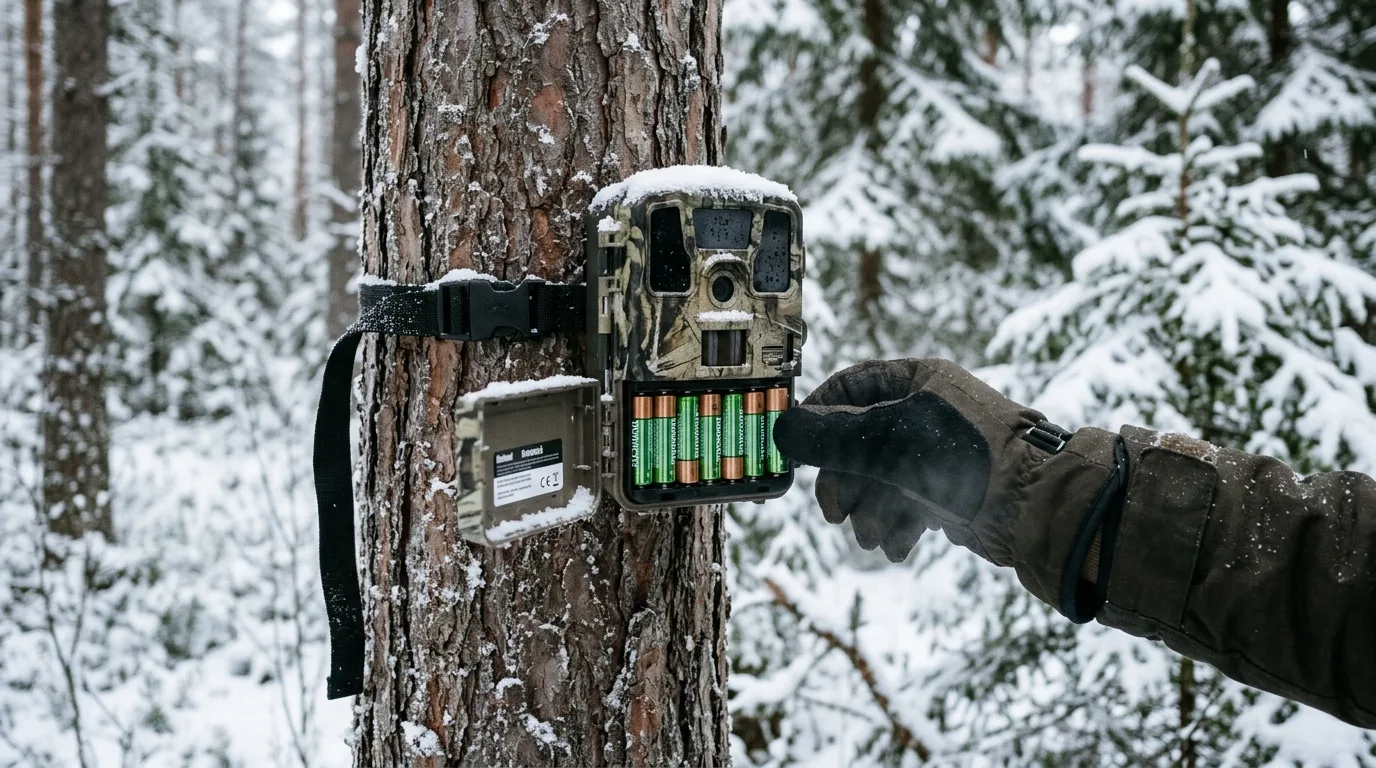
Here's the short version, because it's the question that brought you here: a good set of lithium AAs will run a standard trail camera roughly 6 to 12 months, while alkalines tend to tap out in 1 to 3 months — sometimes a lot less in the cold. So if you want the single answer, it's lithium, and it isn't close.
But "how long do trail camera batteries last" is one of those questions where the honest answer is it depends — and the things it depends on are worth understanding, because they're the difference between swapping batteries twice a year and hiking out to a dead camera in January with a cold SD card and nothing on it. Your runtime is set by three things: the chemistry you put in, the temperature outside, and what you've asked the camera to do. Get all three right and a non-cellular camera can run well over a year on one set of cells. Get them wrong and you'll be feeding it batteries every few weeks.
Let me walk through it the way I'd explain it to a buddy setting up his first camera.
Three chemistries, three completely different batteries
When people say "lithium vs. alkaline vs. rechargeable," they're really talking about three distinct AA chemistries, and the names hide some traps.
Alkaline is the everyday AA — Energizer E91, Duracell Coppertop. The chemistry is zinc–manganese dioxide, it puts out a nominal 1.5 volts, and it's cheap and everywhere. It's also the one that disappoints in a trail camera, for reasons we'll get to.
Lithium, in AA form, means lithium iron disulfide — Li/FeS₂, the chemistry in Energizer's Ultimate Lithium. This is a single-use battery, also 1.5 volts, and it is not the same thing as a "lithium-ion" rechargeable pack. That distinction matters: Li/FeS₂ AAs drop straight into any device that takes alkalines, whereas lithium-ion is a different animal entirely. Energizer made the first 1.5-volt AA lithium back in 1989 specifically so it could be a drop-in upgrade.
Rechargeable, in this comparison, almost always means NiMH (nickel-metal hydride) — your Panasonic Eneloops and the like. And here's the trap that catches every beginner: NiMH is a 1.2-volt battery, not 1.5. That three-tenths-of-a-volt gap sounds trivial. In a trail camera it's the whole story.
If you remember nothing else from this article, remember that lithium and alkaline are 1.5 V and NiMH is 1.2 V. Almost every "why won't my camera work with rechargeables" headache traces back to that number.
Almost every "why won't my camera work with rechargeables" headache traces back to that number.
The 1.2-volt problem (why rechargeables get a bad rap)
A trail camera doesn't measure each cell. It reads the total voltage of the whole pack and decides whether it has enough to run. That logic is designed around 1.5-volt cells. Put in eight fresh alkalines or lithiums and the camera sees about 12 volts and is happy.
Now swap in NiMH. The trail-camera retailer TrailCamPro lays out the math cleanly: four NiMH cells at 1.2 volts each give you "an aggregate voltage of only 4.8 volts," and plenty of cameras want at least 5 volts to function. The pack reads low before the batteries are anywhere near empty, so the camera either refuses to start, throws a false "low battery" warning, or shuts down early. The energy is still in there — the camera just can't see it.
It gets a little worse on insertion. NiMH actually reads about 1.4 volts fresh, then "quickly drop[s] to a working level of 1.2 V" and holds there for the rest of the discharge. That flat 1.2-volt plateau is wonderful for your flashlight and lousy for a device that was told to expect 1.5. This is why several manufacturers simply tell beginners to skip standard rechargeable AAs. Spypoint recommends running batteries that are "non-rechargeable, from a premium brand, that are either lithium or alkaline," and goes as far as warning that off-brand or low-voltage cells can cause unreliable behavior.
So is the popular advice — "rechargeables don't work in trail cameras" — correct? Mostly, but it's an oversimplification, and the nuance is worth your time.
When rechargeables actually do work
Two things rescue NiMH from the "never" pile.
First, not every camera has a high cutoff. Some tolerate 1.2-volt cells just fine. The only way to know is to check your camera's manual — if it lists NiMH as supported, you're clear.
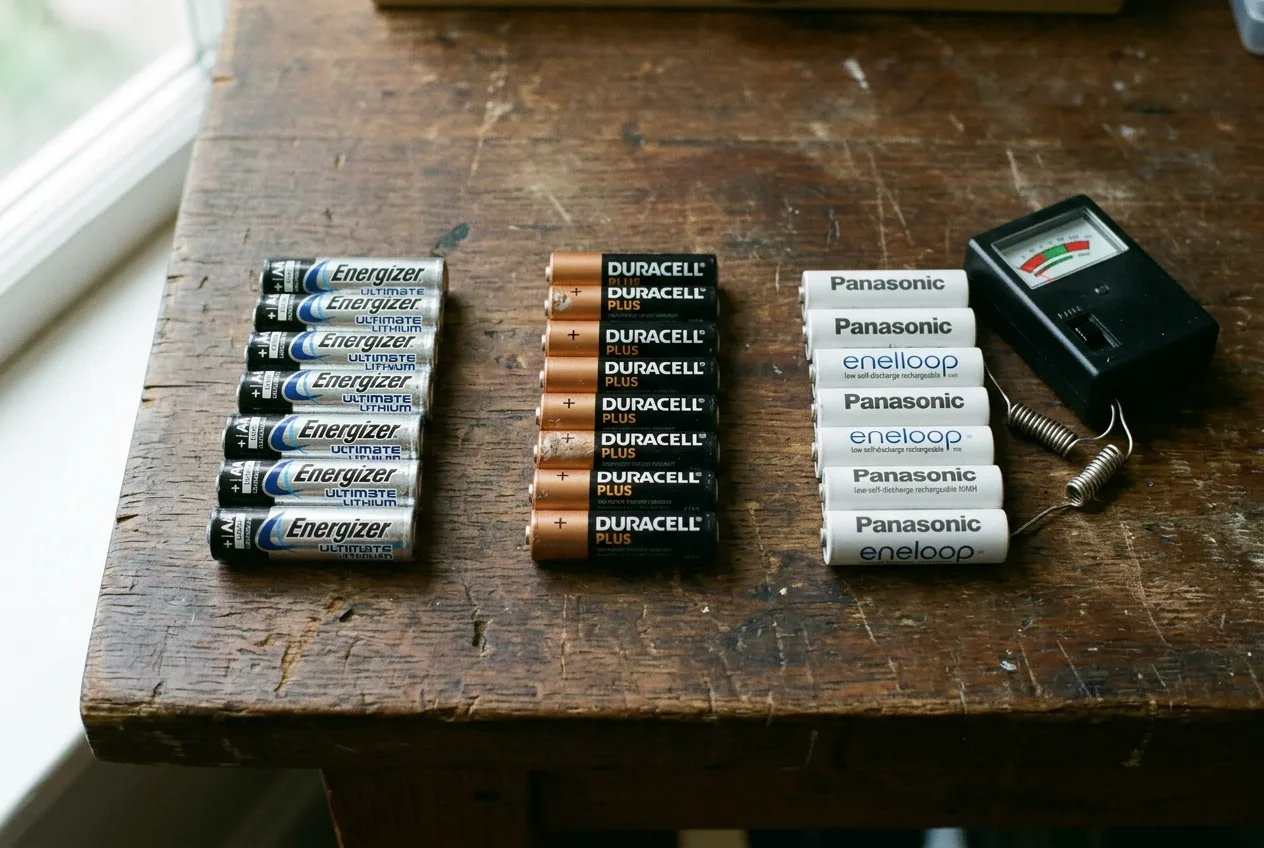
Second, and more important, not all NiMH is the same. The Eneloop-style cells you want are low-self-discharge NiMH, and the wildlife-camera specialists at NatureSpy are blunt about it: ordinary rechargeables often can't power a trail camera because their voltage "simply isn't sufficient," but Panasonic Eneloop Pro cells are "designed for higher energy consumption technology, such as trail cameras". In other words, the right rechargeable in a compatible camera is a legitimate, economical choice — not a compromise.
There's a real performance case for them, too. NiMH holds its capacity remarkably well as you draw harder on it. In independent testing, a standard Eneloop measured about 1809 mAh at a gentle 0.5-amp draw and still delivered 1760 mAh at a punishing 2 amps — barely a dip. Alkaline does the opposite: it sags badly under load. When SLR Lounge ran AA cells through 75 back-to-back camera-flash cycles, standard Eneloops kept recycling fast while a standard alkaline's recycle time ballooned from 7.3 seconds on the first flash to 14.1 on the seventy-fifth. For the rapid, repeated power demands a trail camera makes — fire the IR array, wake the sensor, write to the card — that high-drain composure is exactly what you want.
My honest take: for most beginners, single-use lithium is still the simplest path and the longest runtime. But if you're running several cameras, hate buying batteries, and your camera supports 1.2-volt cells, good low-self-discharge NiMH (Eneloop or Eneloop Pro) is a smart, reusable, cold-tolerant option — and you can recharge them hundreds of times before they wear out. Just don't grab the cheapest rechargeables off the rack and expect them to behave.
Why lithium runs so much longer
Beyond the voltage question, lithium's edge comes down to how steadily it delivers power and how much of it there is.
Alkaline starts strong and fades the moment you install it. As TrailCamPro puts it, alkalines "are shipped measuring about 1.5 volts, but their voltage drops immediately upon insertion". Moultrie says the same thing from the manufacturer side: lithium "will maintain their peak strength for the entire life of the battery, whereas alkaline batteries begin declining immediately after they are installed". Lithium holds a high, flat voltage almost all the way to the end, then drops off a cliff.
That flatness translates directly into runtime, especially because trail cameras have a relatively high voltage cutoff. Here's a number that makes it concrete. Energizer's own alkaline handbook works the math on a single AA: under a 100 mA draw, that cell delivers 2500 mAh if you discharge it all the way down to 0.8 volts — but only 1500 mAh if the device stops drawing at a 1.2-volt cutoff. Same battery, 40% of its capacity stranded, simply because the device quit early. A camera with a conservative cutoff does exactly this to alkalines. Lithium, sitting at a higher voltage the whole time, hands over far more of its capacity before tripping that same threshold.
There's just more energy in a lithium AA to begin with, too. Energizer rates the Li/FeS₂ AA at roughly 297 watt-hours per kilogram against about 143 for a comparable alkaline — and it weighs about a third less while doing it. The advantage widens the harder you push: in light-drain toys the gap is modest, but in demanding devices lithium pulls away.
What does that buy you in the field? TrailCamPro ran a Reconyx HyperFire 2 taking 35 day and 35 night photos every 24 hours on twelve Energizer Ultimate Lithium AAs and projected 16.6 months of runtime. That's the ceiling for a busy non-cellular camera on premium lithium. You won't always hit it, but it shows the headroom.
Chemistry sets the size of the tank. Your settings set how fast you burn through it.
What actually drains the battery: video, night IR, and cellular
Chemistry sets the size of the tank. Your settings set how fast you burn through it — and this is where most people's runtime quietly evaporates.
Video is expensive. When a camera records video it stays fully awake the entire clip, and Moultrie doesn't mince words: "Recording video is a major power consumer. The camera is on the entire time it's recording, and if it's nighttime, the flash is continuously running too — burning even more power". The numbers back it up brutally. On that same HyperFire 2, a daytime photo cost about 1.2 watt-seconds of energy; a nighttime video cost 108.2 watt-seconds. That's roughly ninety times the drain of a daytime still, for a single trigger. Shoot a lot of night video and even lithium won't save you. NatureSpy's fix is the obvious one — keep clips short, around 10 seconds, and trim how many photos each trigger fires.
Night work costs more than day. Every time the camera fires its infrared illuminator after dark, it's pulling hard on the pack. On the HyperFire 2, even a night photo (6.5 watt-seconds) cost several times what a day photo did. A camera staring at a deer trail that's busy at 2 a.m. will go through batteries faster than one watching a midday field, all else equal.
Cellular is the real battery killer. This surprises people, so it's worth dwelling on. Take the same Reconyx HyperFire 2 and compare the plain version to the cellular one. The non-cellular camera projected 16.6 months on lithium. The cellular version, on the same lithium AAs and an even lighter schedule of 15 day and 15 night photos a day, projected just 4.2 months. And here's the counterintuitive part Moultrie flags: it's not really the photo upload that hurts — "It's the actual connecting with the server that is using the most power, not the transmission of images". Every time the camera wakes up its modem and reaches for a tower, that handshake costs you. The fix is to batch: Moultrie recommends setting upload frequency to about six times a day rather than instantly, so the camera makes a few efficient connections instead of dozens of expensive ones.
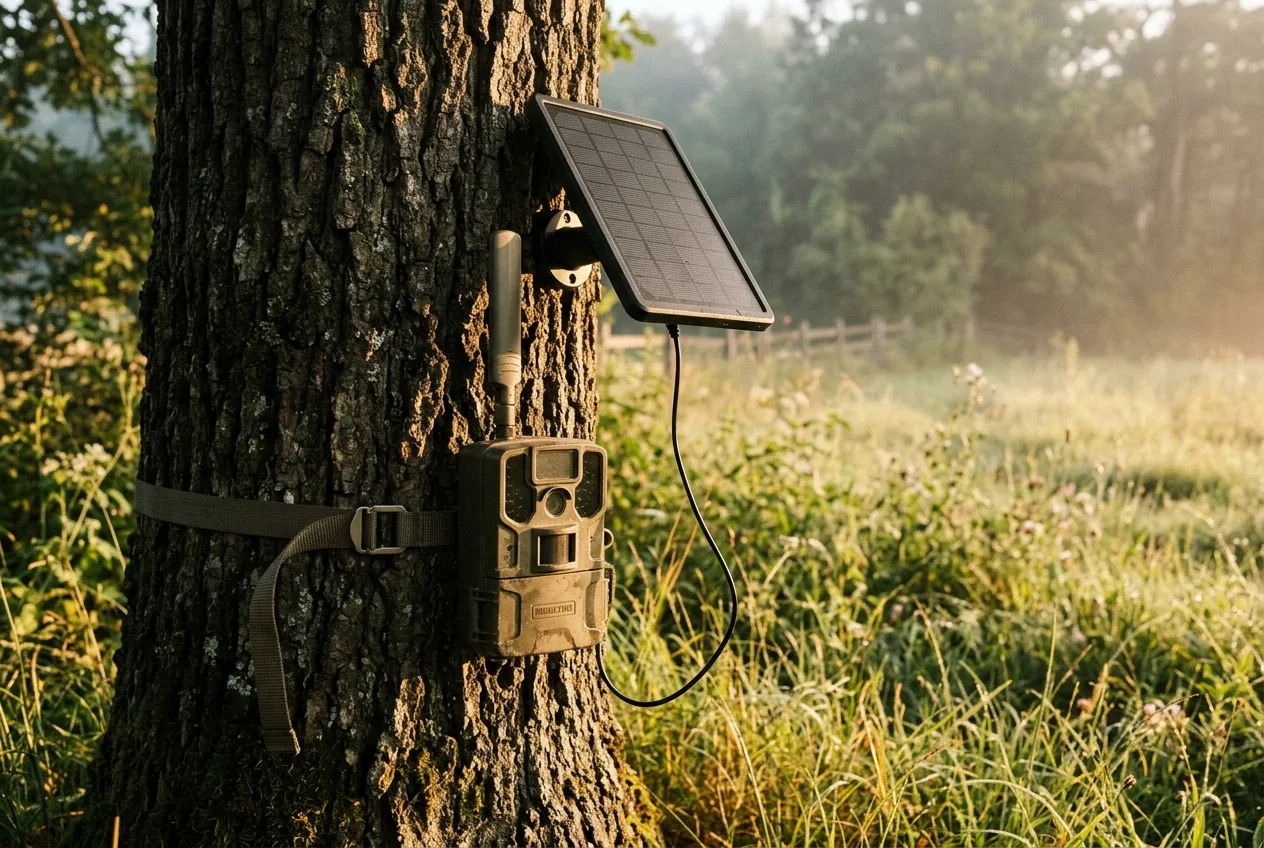
If you run cellular, plan on feeding it more often, or pair it with solar — a panel can give a camera "at least six months of autonomy" on its own. A few more high-mileage settings worth knowing: a longer detection delay (a minute or more) cuts redundant triggers, single-shot instead of burst saves power, and lower-resolution images are lighter to handle.
Cold weather changes everything
Batteries are chemistry, and chemistry slows down when it's cold. But the three types do not slow down equally — and this is where alkaline goes from "mediocre" to "don't bother."
The headline rule of thumb from Battery University: a cell that delivers 100% of its capacity at a comfortable 27°C "will typically deliver only 50 percent at –18°C," and at –20°C "most batteries are at about 50 percent performance level". Cold isn't destroying the battery, to be clear — the capacity isn't gone, it's just locked up. The electrochemical reactions slow, voltage sags, and a warm battery recovers fully once it's brought back to room temperature. But in the field, "locked up" and "dead" feel identical.
Alkaline takes this the hardest. NatureSpy puts the cliff at just 5°C — above freezing — below which alkaline outputs "only one-fifth of their power". TrailCamPro is gentler but agrees on direction: alkalines "lose up to half their capacity in sub-freezing weather". Either way, a fall camera on alkalines can give you a nasty surprise the first hard cold snap.
Lithium is the cold-weather champion, by design. Energizer's handbook says Li/FeS₂ has "a much lower sensitivity to temperature compared to other chemical systems," runs from –40°C to +60°C, and at gentle draw rates "can deliver approximately full rated capacity at –40°C". NatureSpy reports it working normally down to about –15°C in real use. This is exactly why Browning tells users to change to lithium before the cold season — its cameras specifically recommend lithium because the cells "stand up to cold temperatures better than alkaline," and a fresh set going into winter avoids a mid-season failure. Browning adds a clever trick: a longer picture-delay setting "allows the batteries a bit of a recovery period," which squeezes more out of them when it's frigid.
NiMH, interestingly, holds up in the cold better than alkaline. TrailCamPro notes "longer battery life in winter months" for NiMH than alkaline, and the better Eneloop Pro cells are rated to function down to around –20°C. So in winter the ranking flips a little: lithium first, then quality NiMH, with alkaline a distant third.
One cold-weather caveat people miss: heat is NiMH's weakness, not cold. TrailCamPro saw NiMH cells that normally lasted ten weeks survive "only a week or two" during a stretch of 100-degree days. And lithium has its own hot-weather quirk — under extreme sustained drain, Li/FeS₂ AAs have a built-in thermal cutoff (a PTC device that trips around 85°C) that can briefly shut the cell down. That rarely matters for a trail camera's short bursts, but it's real.
But in the field, "locked up" and "dead" feel identical.
Shelf life, self-discharge, and leakage
Two more practical pieces, because batteries also age sitting in a drawer or sitting in your camera.
Shelf life — the spare set in your closet. This is one of lithium's quietest advantages. A Li/FeS₂ AA holds roughly 95% of its capacity after 20 or more years of storage, per Energizer's handbook. (Worth a flag: Energizer's figures aren't perfectly consistent — the L91 product sheet claims up to 25 years, the EU sheet and handbook say 20, and Battery University independently puts Li/FeS₂ around 15 years. Call it up to ~20 years and you're on safe ground either way — it dwarfs the alternatives.) Alkaline runs about a 10-year shelf life, losing roughly 2–3% of capacity a year in storage.
NiMH is the one to watch here, and it's the other reason the "rechargeables are bad" reputation stuck. Standard NiMH self-discharges fast — it can shed 50 to 80% of its charge in just 12 months sitting idle, and faster when warm. Wikipedia's range for ordinary NiMH is a startling 13.9 to 70.6% per month. That's why a rechargeable you charged in spring can be half-dead by the time you deploy it. But low-self-discharge cells — the Eneloop family — solve exactly this: their loss rate is more like 0.08 to 2.9% per month, and tested Eneloops pulled from storage after nearly 13 years still held about 60% of their charge. If you go rechargeable, low-self-discharge is non-negotiable.
One temperature rule ties it all together: self-discharge "typically doubles with every 10°C," so a camera baking in the summer sun loses idle charge faster than the spec sheet suggests.
Leakage — the one that ruins the camera, not just the season. Alkalines generate hydrogen gas as they discharge, and extreme temperature swings can compromise the seal and let them leak. Leaked alkaline electrolyte corrodes the battery contacts and can kill a camera. Lithium is far better here — Energizer rates Li/FeS₂ as having "superior leakage resistance" and notes there's "no risk of hydrogen generation" with the chemistry. Either way, do what Energizer's own handbook advises: "inspect [the] device's battery compartment every few months to be sure batteries are not leaking". Pull the batteries if a camera's going into long storage.
So what should you actually run?
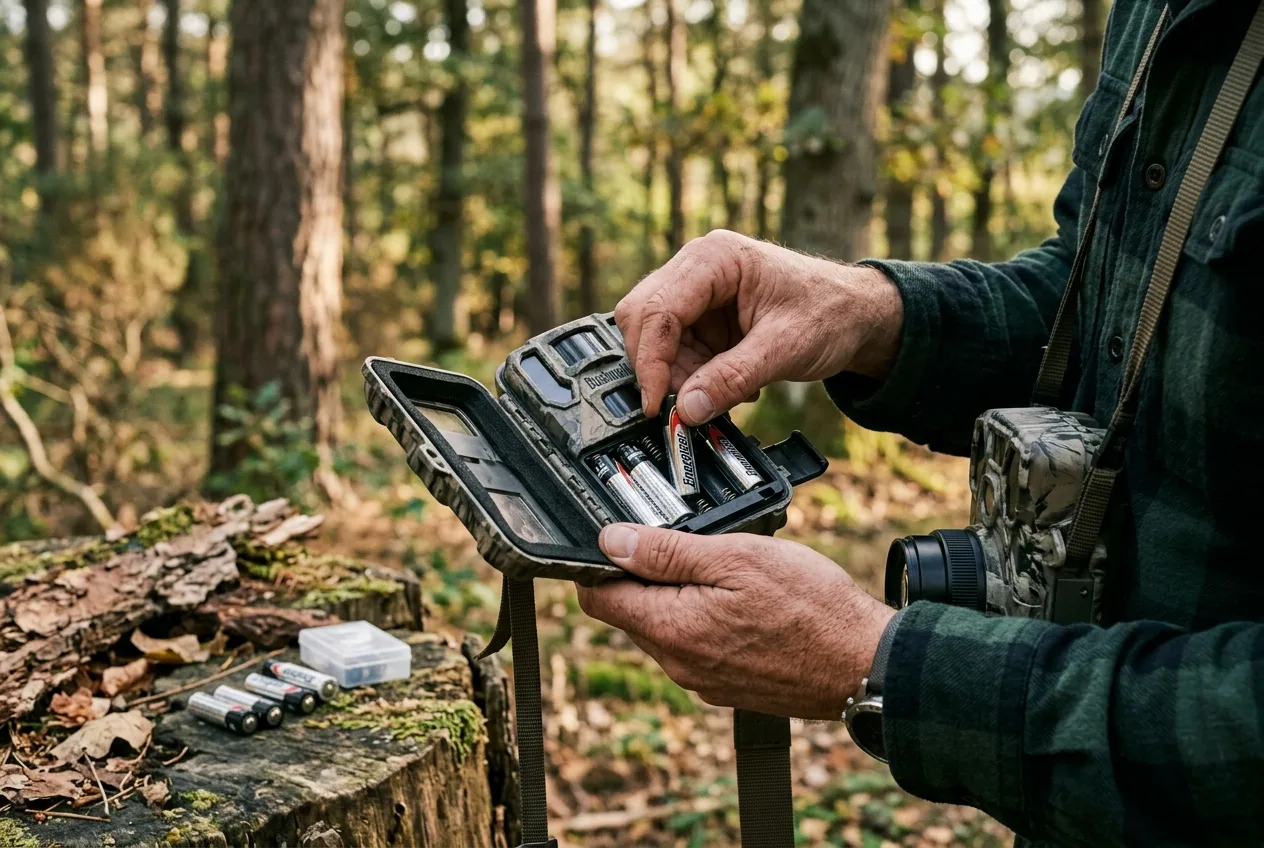
For most people, most of the time: single-use lithium AAs. They run longest, dominate in the cold, store for decades, barely leak, and they're the safe default every manufacturer here points to. Yes, they cost more per battery — but spread over a 6-to-12-month deployment, you're swapping them half as often, and the field tests show why.
Choose good low-self-discharge NiMH (Eneloop / Eneloop Pro) if you run several cameras, want to stop buying batteries, and you've confirmed your camera supports 1.2-volt cells. They're reusable hundreds of times, excellent in the cold, and strong under the high-drain bursts a camera demands. Just keep them away from summer heat and recharge before deployment.
Reach for alkaline only as a short-term or warm-weather stopgap — a quick redeploy in summer, a camera you check often. Skip it for winter and skip it for anything remote.
Get the chemistry, the cold, and the settings right, and "how long do trail camera batteries last" stops being a worry you check on and becomes a number you can plan a season around.
Frequently asked questions
What is the best battery for a trail camera?
For runtime, cold tolerance, shelf life, and leakage resistance, single-use lithium (lithium iron disulfide AAs, like Energizer Ultimate Lithium) is the best all-around choice and the one manufacturers consistently recommend. Good low-self-discharge NiMH rechargeables (Eneloop Pro) are an excellent reusable alternative if your camera supports 1.2-volt cells.
Can I use rechargeable batteries in a trail camera?
Sometimes. Standard NiMH AAs run at 1.2 volts instead of 1.5, so a pack can read "low" to the camera before it's actually empty, and many cameras reject them. But quality low-self-discharge NiMH like Eneloop Pro is purpose-built for trail cameras and works well in models that support it — check your manual first.
How long do lithium trail camera batteries last?
Roughly 6 to 12 months in a typical camera, depending on settings and weather. A non-cellular camera on a light schedule and premium lithium can stretch well past a year — one field test projected 16.6 months — while heavy night video or cellular use shortens it dramatically.
Why do my trail camera batteries die so fast in winter?
Cold slows the battery's chemistry, so it can't deliver its full capacity until it warms back up. Alkalines are hit hardest, dropping to around one-fifth of their power below 5°C; lithium handles cold far better and is the recommended winter choice.
Does cellular or video really use that much more battery?
Yes, a lot. On one camera, a nighttime video used about 90 times the energy of a daytime photo, and the cellular version of a camera lasted 4.2 months versus 16.6 for the non-cellular twin — largely because connecting to the network, not sending the photo, is the big drain.
Do trail camera batteries leak, and can it damage the camera?
Alkalines can leak — they produce hydrogen gas and their seals can fail under temperature swings, and leaked electrolyte corrodes contacts. Lithium resists leakage far better. Inspect the battery compartment every few months and pull the cells before long-term storage.