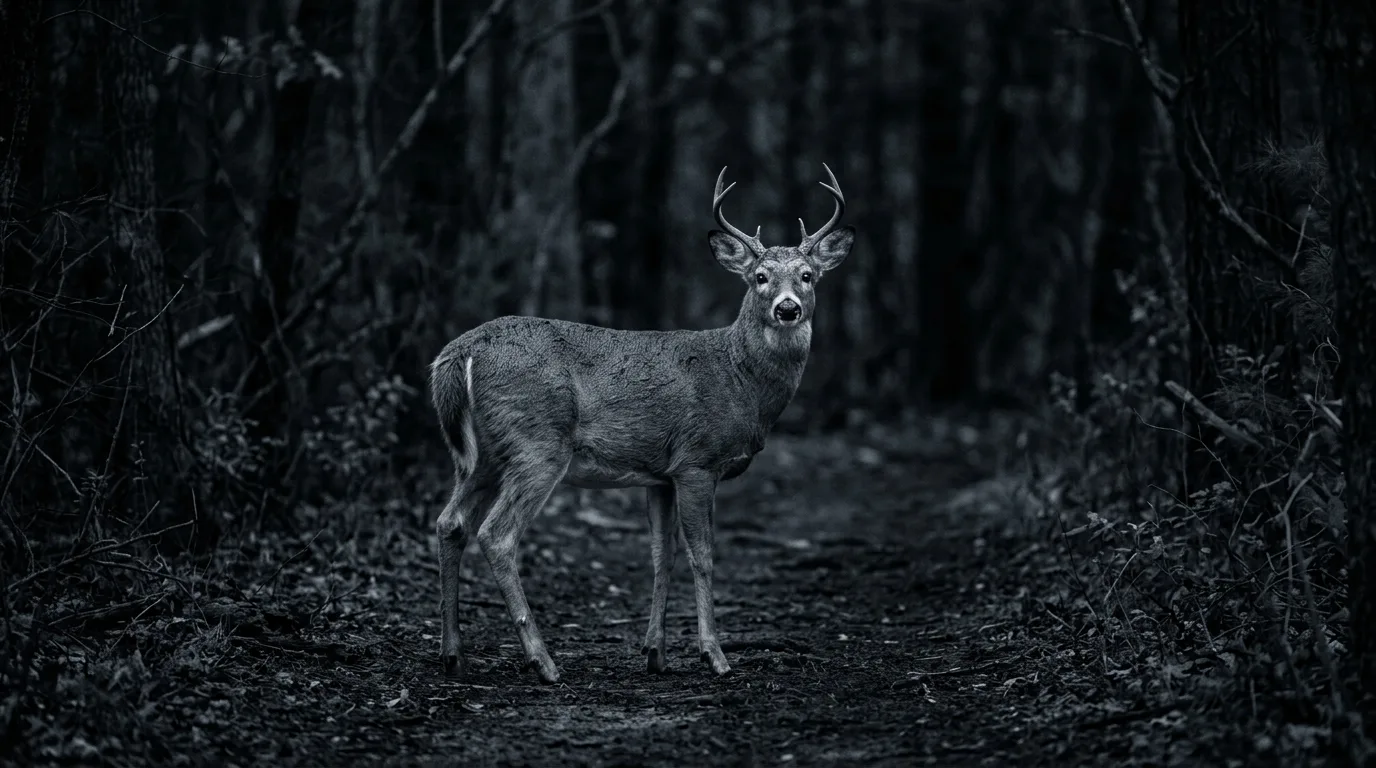
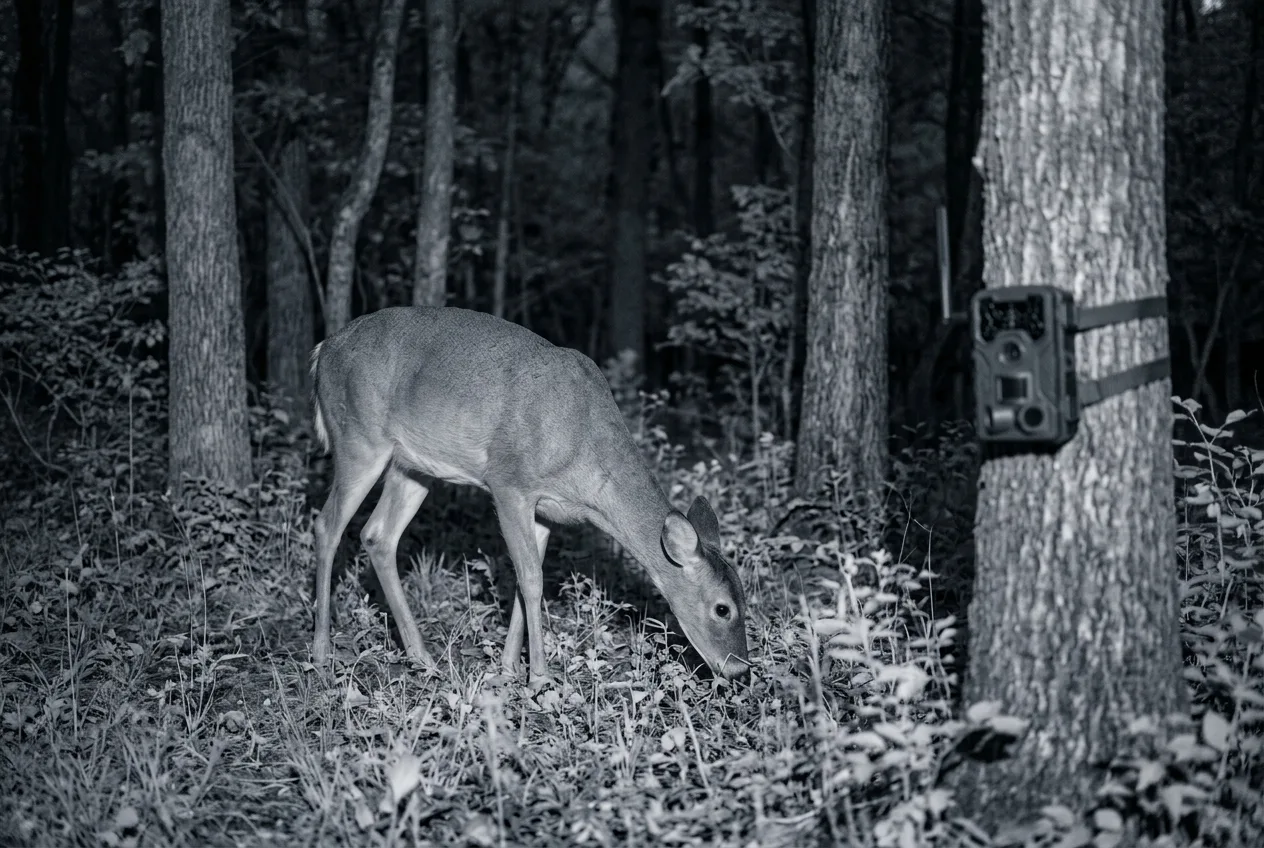
You've seen the photo. A buck, mid-stride at 2 a.m., frozen with its head snapped toward the camera and its eyes glowing back at you like two coins. It's the picture that launched a thousand forum arguments, and it feels like proof of something: he saw it. The flash gave me away. So you go looking for a stealthier camera, and you walk straight into an alphabet soup of marketing — no-glow, low-glow, black flash, 850 versus 940 nanometers, "completely invisible to wildlife" — each promising the animals will never know you were there.
Here's the short version, and it's not what most of those product pages will tell you. Yes, many animals can detect a trail camera at night — but the flash is rarely the part that changes their behavior, and "invisible to wildlife" oversells what no-glow actually buys you. The best controlled field studies, across deer, feral cats, possums, and even bats, keep landing on the same uncomfortable answer: flash type makes surprisingly little difference to whether animals keep showing up. The thing in that 2 a.m. photo that actually spooks game — the scent you left, how often you visit, the camera's silhouette on the tree — usually has nothing to do with which LED fired.
That doesn't mean flash type is irrelevant. It means the real trade-off isn't "stealth versus getting busted." It's image quality, range, and battery life versus how invisible the camera is to other people. Once you see it that way, the buying decision gets a lot simpler. Let's walk through what the eyeball physics, the field data, and the people who've burned through hundreds of thousands of night photos actually say.
First, what the camera is actually doing in the dark
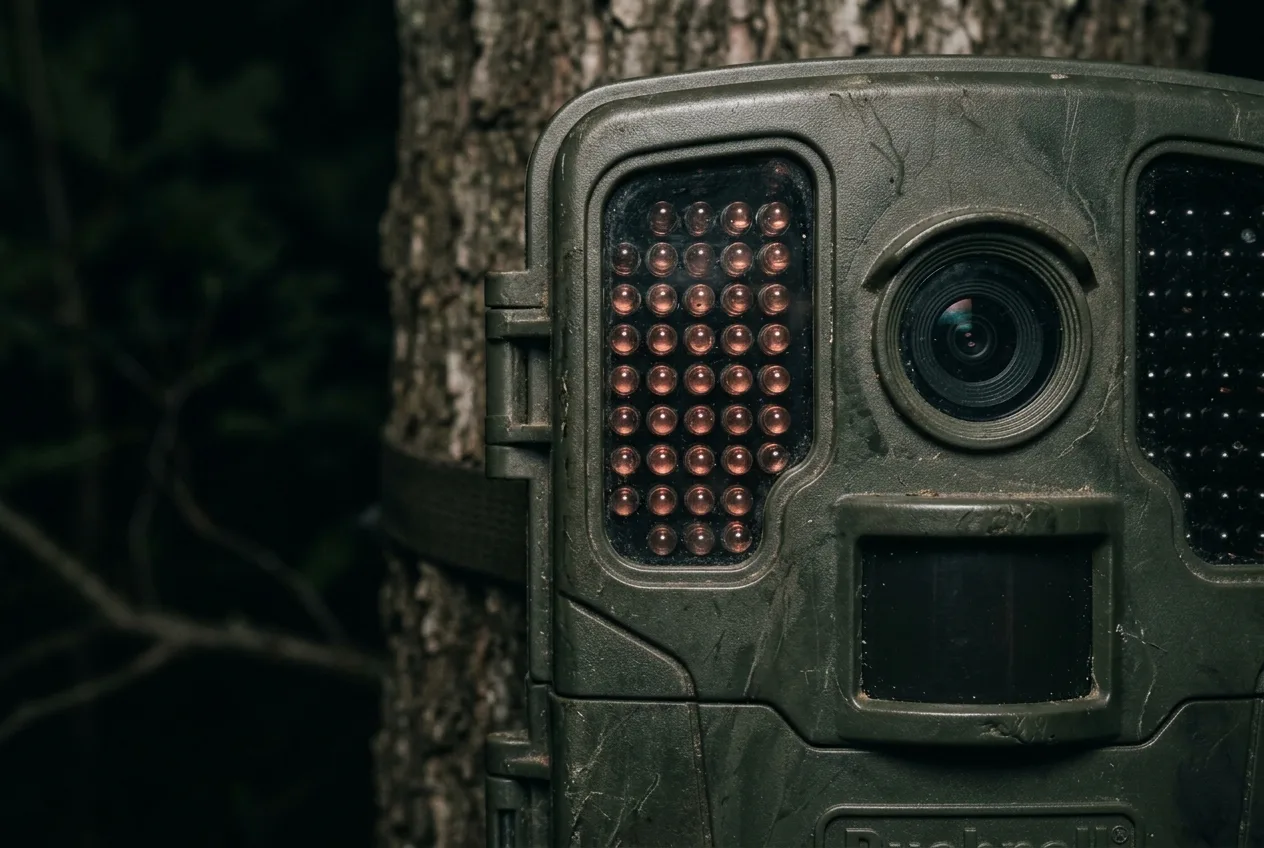
Two completely different infrared systems live inside most trail cameras, and confusing them is where half the myths start. The PIR (passive infrared) sensor is the motion detector — it senses the heat an animal radiates against the cooler background and trips the shutter. It's running day and night, and it emits nothing; the animal can't "see" it. The infrared illuminator is the flash: a bank of LEDs that only fire in low light to light up the scene for a black-and-white photo. When people argue about whether animals "see the flash," it's the illuminator they mean.
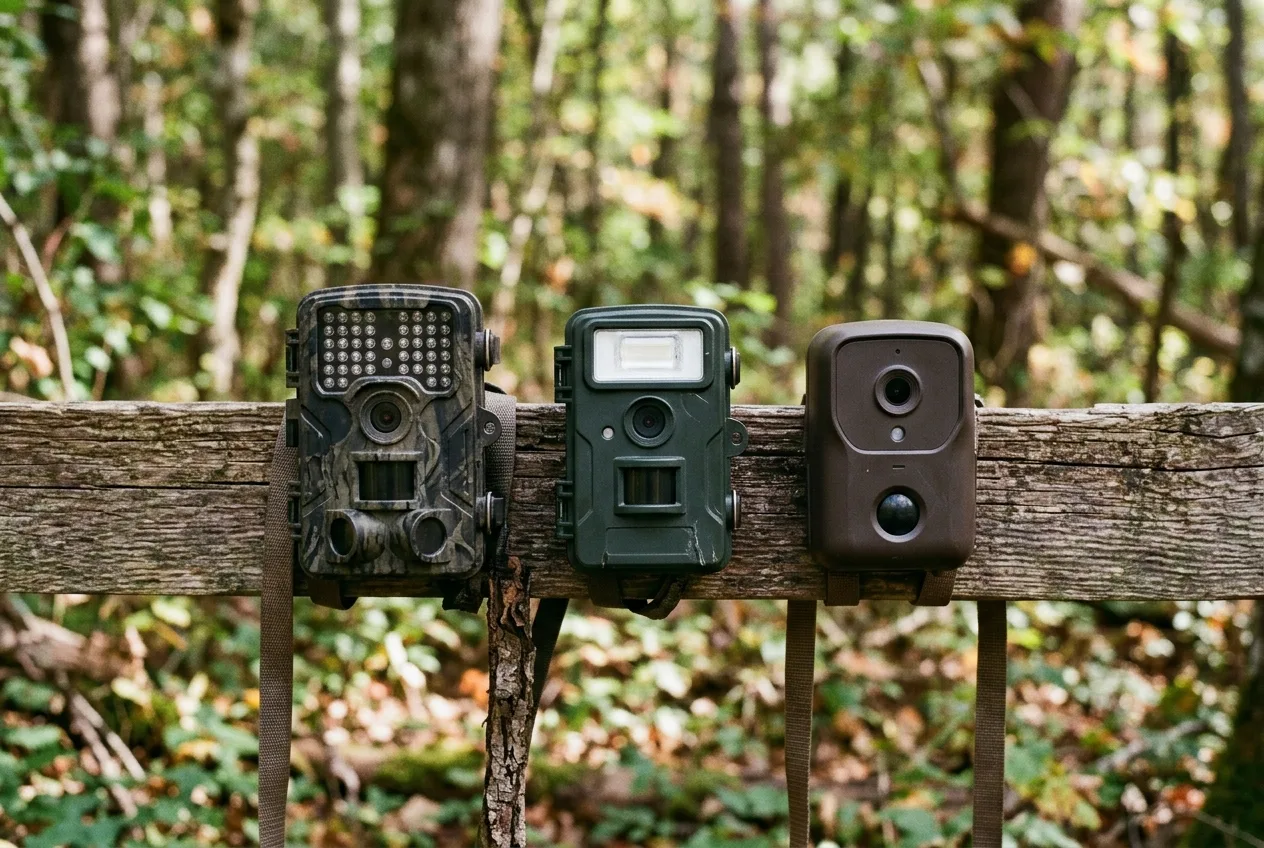
That illuminator comes in three flavors, and the names are a mess because every manufacturer brands them differently. Here's the honest translation:
| Flash type | Wavelength | What a human sees | Night image | Range | Other names |
|---|---|---|---|---|---|
| Low-glow | 850 nm | A faint red glow when it fires, like dying embers or a TV standby light | Brighter, sharper black-and-white, less grain | Longest | "Standard," "Red Glow," "Clear" |
| No-glow | 940 nm | Nothing — effectively invisible | Darker, softer, grainier B&W; more motion blur | ~30% shorter | "Black Flash," "Covert" |
| White flash | Visible light (xenon or white LED) | A bright white flash, like a phone camera | Full color | Varies | "Flash," "color" |
The single most useful fact in that table: only white flash gives you color at night. Infrared — at either wavelength — produces grayscale, because the light is outside the color spectrum. Everything else is a trade-off around one piece of physics: 940 nm light sits farther from visible light than 850 nm does, so it's harder to see — but camera sensors are also less sensitive to it, which is why no-glow images come out dimmer and grainier and the range drops by roughly a third. NatureSpy, a UK wildlife-camera outfit, puts the 850 nm advantage at about 30% more illumination and faster shutter speeds, which means less blur on a moving animal.
That's the gear. Now the question you actually came here for.
Two infrared systems live in your camera, and only one of them emits anything an animal could notice.
Can animals actually see the infrared glow?
Short answer: many of them can — and the manufacturers who say otherwise are overstating it.
The foundational work here is a 2014 lab study by Paul Meek and colleagues in Australia, who measured the sound and infrared output of twelve camera models and compared it against what 21 mammal species can hear and see. Their conclusion was blunt: camera traps "produce sounds that are well within the perceptive range of most mammals' hearing and produce illumination that can be seen by many species". One of the authors could see the faint red glow of an 850 nm Reconyx with his own eyes in absolute darkness. A later review by Caravaggi and colleagues said it even more directly, taking aim at the marketing head-on: "contrary to the claims of some manufacturers that animals cannot see infrared light, many animals are in fact able to see the infrared illumination used by many [camera traps] in low light".
But — and this matters for keeping us honest — the evidence on exactly which animals see which wavelengths is thinner than anyone would like. Meek's team noted that the data on infrared vision come from behavioral experiments, not direct physiological measurement, and they cover only a handful of species: ferrets can detect light out to around 870 nm, for instance, but for most animals the precise cutoff simply isn't known. They were careful not to claim more than they could prove. So the responsible statement is this: the faint red glow of an 850 nm camera is visible to humans and to many nocturnal mammals, while 940 nm light is much harder to see and likely invisible to most — but "invisible to all wildlife" is a marketing claim, not an established fact. Some animals, including many snakes and fish, can see well into the infrared regardless.
There's a related myth worth killing while we're here: eyeshine doesn't mean the animal saw a flash. That coin-glow in night photos comes from the tapetum lucidum, a mirror-like layer behind the retina that bounces light back through the eye to help nocturnal animals see in the dark. It reflects whatever light reaches it — including invisible 940 nm infrared. So you'll get glowing eyes even on a no-glow camera the animal never noticed. Eyeshine is a property of the eye, not evidence of a spook.
"Invisible to wildlife" is a marketing claim, not a finding. No-glow's real edge is hiding the camera from people.
So does seeing it actually spook them? Here's where it gets interesting
This is the crux, and it's where the data diverge sharply from the campfire wisdom. You'd assume that if animals can see a flash, a brighter or more visible flash means fewer photos over time as they learn to avoid the spot. The field studies — and there are a lot of them now — mostly don't bear that out.
Start with deer, since that's where most readers are coming from. A German study by Henrich and colleagues ran the cleanest test we have: about 900 camera deployments on red deer and roe deer, swapping only the flash module between white, 850 nm, and 940 nm. Deer were more likely to look at the camera and flee in response to the 850 nm "standard" infrared than to the 940 nm black flash — in fact, the 940 nm flash provoked no more reaction than no flash at all during daylight, suggesting deer essentially can't see it. So far that supports the no-glow case. But here's the twist that should reset your expectations: none of it translated into fewer photos. Capture rates didn't decline over time for any flash type or either species — no avoidance, no learned shyness. Roe deer detections actually rose slightly over the study. The deer noticed the 850 nm glow and looked at it; they just didn't stop coming.
That pattern — animals notice but don't avoid — repeats almost everywhere researchers have looked:
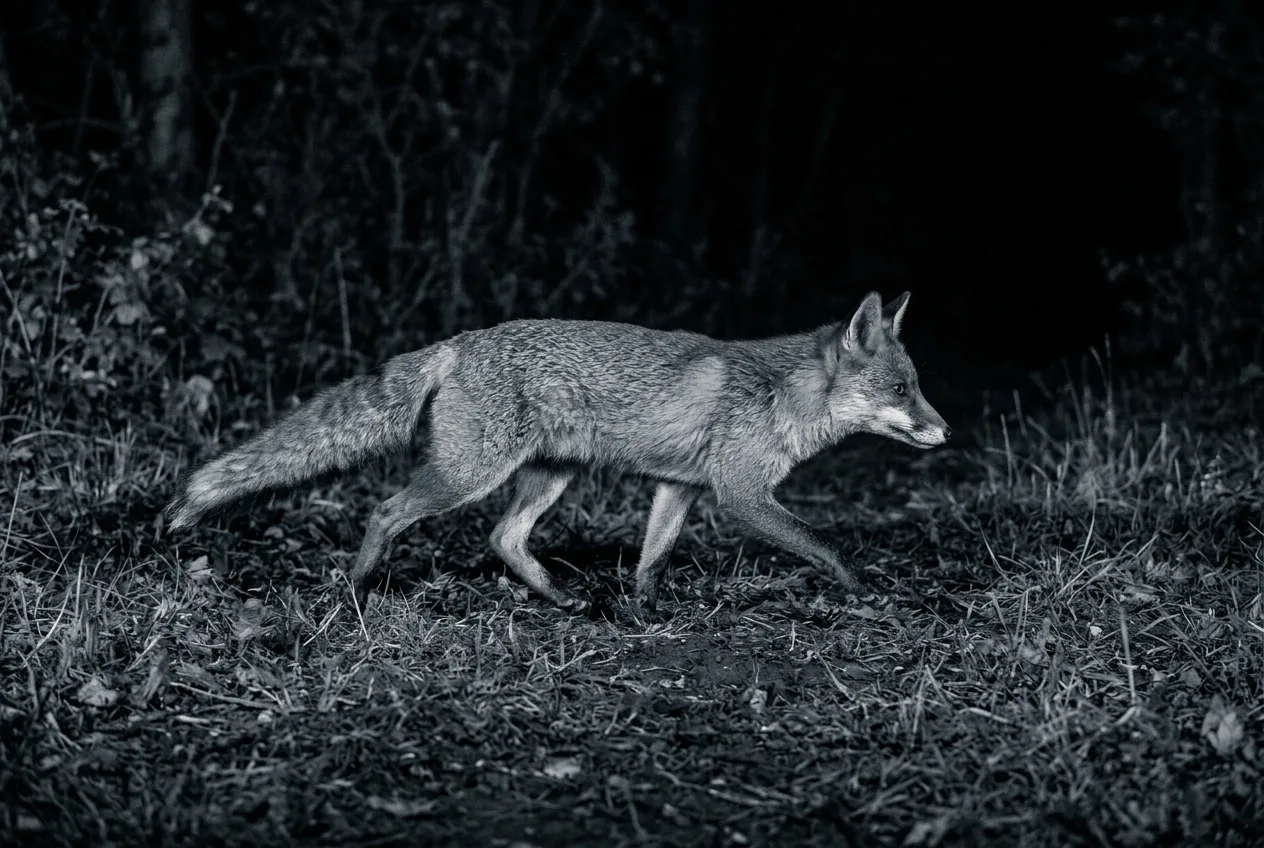
- Feral cats, the species hunters most often assume are camera-wise: the largest study to date (Paton and colleagues, 11,389 cat images across 62 white-flash and 62 infrared cameras in Tasmania) found no difference in activity between flash types, no drop in re-detection after a cat was first photographed, and no sign of trap-shyness developing. An earlier study from the same region reached the same conclusion. Tellingly, cats were more likely to notice the cameras during the day — when flash is irrelevant — than at night.
- Brushtail possums at bait stations in New Zealand: no significant difference between white-flash and infrared cameras in visits, time spent, or even the amount of bait taken.
- Eld's deer in Cambodia: deer were more likely to observe and startle at white flash than infrared, but detection rates didn't decline for either, repulsion responses were rare (~3% of detections), and only 1.3% of individuals ever actually fled.
- Bats, which barely use vision and react strongly to constant light: white flash didn't change their activity, flight direction, or echolocation at all.
- Scandinavian carnivores (red fox, badger, pine marten) in Norway: neither the presence of a flash nor its type significantly affected detection behavior.
Read those together and a clear signal emerges. Across cats, possums, deer, bats, and small carnivores — different continents, different eyes, white versus 850 versus 940 nm — flash type is a weak lever on whether animals keep using a spot. The strongest behavioral difference anyone reliably found is that 850 nm makes deer glance over more than 940 nm does. A glance is not avoidance.
A fair caveat: most of these are population-monitoring studies, and a couple of older anecdotes do point the other way — a tiger study where white-flash captures dropped by more than half after a few days, kinkajous abandoning a flashed branch. But the kinkajou is genuinely an outlier (it's the one species welfare reviewers cite for clear flash avoidance), and the Tasmania cat team makes a sharp point about the tiger study: those cameras were serviced daily, with human scent reinforced at the site every single day, which is a far better explanation for the decline than the flash itself. Which brings us to the thing that actually matters.
The strongest behavioral difference anyone reliably measured was deer glancing at an 850 nm glow. A glance is not avoidance.
The factors that actually move the needle
If flash type is a weak lever, what's a strong one? The practitioners who've shot the most film are unanimous, and the research backs them: it's you, not the camera.
Kip Adams of the National Deer Association has been running cameras since 1995 across white, black, and infrared flash. His verdict: "I've had far more deer react negatively to IR cameras than anything else. However, I feel human scent has a larger impact than any specific type of camera". Notice that he finds infrared — not white flash — draws the worst reactions, the opposite of the usual assumption, and that he still thinks scent outweighs all of it. A Wisconsin DNR deer biologist quoted in the same piece is even more pointed: "Visiting any camera location too frequently, no matter the brand or type of flash it uses, will have a much more negative effect on deer behavior than deploying even the cheapest camera but monitoring it wisely". And here's the detail that should end the flash debate for most people: deer "stare daggers" into cameras just as often in broad daylight, when no flash fires at all, as they do at night.
So before you spend a dime on a stealthier flash, spend your effort on the things that genuinely disturb animals:
- Scent. Wear gloves, handle the camera as little as possible, and let it air out before deploying. Your smell at the site outlasts any flash.
- Visit frequency. Every trip leaves scent and disturbance. Run bigger SD cards, longer-lasting batteries, or a cellular camera so you can leave a set to "soak" for weeks instead of checking it constantly.
- The camera's profile. Animals notice the silhouette of a foreign object far more reliably than they notice a flash, day or night. Break up the outline with branches, tuck it into a tree crevice, and let the camo do its job.
- Noise. Some cameras click and whir audibly when they fire; if you can hear it, so can the deer. Cats can hear the brief hum an infrared camera makes before it triggers.
Before you buy a stealthier flash, fix the scent and stop checking the camera every weekend.
A trick worth more than any flash upgrade: mount it high
If you're convinced a particular spot has camera-wise deer, the most effective fix isn't a different LED — it's geometry. Hang the camera high, around 6 to 7 feet (roughly 2 m) up, and angle it down toward where animals will pass. As Mossy Oak puts it, "Whitetails aren't accustomed to looking up and seldom react to an infrared flash coming from that high". An independent optics review makes the same point: keeping the camera above the animal's eye level means they're far less likely to notice the glow, which is exactly why hunters use the trick around feeders where animals are too preoccupied to look up. As a bonus, a downward angle cuts the chance of a low sun triggering false frames. This one placement habit does more to keep a camera unnoticed than swapping 850 nm for 940 nm ever will.
It's worth being honest that not everyone agrees the flash is a non-issue. Some experienced whitetail managers are adamant that the 850 nm red glow is visible to deer and that local animals start skirting an infrared camera by 20 to 30 yards (roughly 20–30 m), and they recommend no-glow or white flash plus a high, concealed mount as the low-impact answer. That field experience is real and worth respecting — but it runs ahead of what the controlled studies have been able to measure, where reactions showed up but avoidance and capture-rate declines mostly did not. The sensible read: individual animals vary enormously (some bucks ignore everything, others "jump out of their skin"), so if a specific camera keeps producing spooked deer, mounting it higher and concealing it better is a smarter first move than assuming the flash is the culprit.
If one camera keeps catching spooked deer, raise it and hide it better before you blame the LED.
What about the welfare question — does the flash hurt them?
A reasonable thing to wonder, and the honest answer is that the science is thin. A 2025 review of 267 camera-trap studies found only 7.5% of them even considered the welfare impact on the animals being studied, so the evidence base is genuinely under-developed. Will Nicholls, a professional wildlife photographer who dug into the research on flash and animals, concluded much the same: "There is a real lack of scientific research into the effect of artificial light on animals," and most confident claims either way are speculation.
What we can say is reassuring. Flash is very unlikely to cause permanent eye damage — strobe lighting is even used clinically to test for retinal disease — and the realistic concern is brief, temporary dazzle, most relevant for nocturnal birds caught mid-hunt. Several studies found no behavioral response to flash at all in the species they looked at. For the infrared cameras most people run, there's even less to worry about: the light is dim and, at 940 nm, mostly imperceptible. If welfare is your concern, the practical takeaway is the same as the spook takeaway — minimize disturbance overall (scent, visits, repeated startling) rather than fixating on the LED.
So which flash should you actually buy?
Strip away the "stealth" marketing and the decision comes down to a clean three-way trade between image quality, range, and concealment from people. Here's how the three options actually stack up:
| If your priority is… | Buy | Why |
|---|---|---|
| Sharpest night images, longest range, best value | Low-glow (850 nm) | ~30% more range, faster shutter (less blur), brighter and cleaner B&W. Most younger deer and other game are indifferent to the faint glow. |
| Concealment from people / theft, public-land use, a slightly stealthier look | No-glow (940 nm) | No visible glow gives away the camera's location to passersby. Accept dimmer, grainier images and shorter range as the cost. |
| Color night photos for ID — antler scoring, herd surveys, telling individuals apart | White flash | The only way to get color at night. Worth the bulkier setup when you truly need to identify specific animals. |
| Sensitive, heavily pressured target where you're genuinely worried about the glow | No-glow (940 nm), mounted high | Belt-and-suspenders: the least-visible flash plus a placement deer rarely look up at. |
Two real-world cautions that have nothing to do with whether animals "see" the flash:
Keep white flash away from roads. A bright flash firing at a passing vehicle can dazzle or distract the driver — a genuine safety hazard. Urban camera researchers flag this explicitly and advise against white flash anywhere people will be driving. The same study found white-flash cameras get vandalized more often (they're conspicuous), while infrared cameras more often get hit by vehicles — so cable-lock everything and place it thoughtfully.
Don't expect "no single best." Even the manufacturers admit it. As one camera maker puts it, your choice has trade-offs and "there is no 'perfect' flash type, only the right tool for the job". A camera maker claiming white flash "will almost certainly spook deer and cause them to bolt" is stating the common belief, not the field evidence — which, as we've seen, found white flash didn't reduce detections of deer, cats, possums, or bats over time. Buy on image quality, range, battery, and how hidden you need the camera to be from people. The animals, by and large, will keep walking past either way.
Frequently asked questions
Can deer see trail camera flash?
They can see white flash and the faint red glow of an 850 nm low-glow camera, but they almost certainly can't see 940 nm no-glow infrared. Deer are dichromatic — strong on blue and green, weak on red — so the red-shifted glow is at the edge of their vision, and in controlled tests they noticed the 850 nm glow but did not avoid the camera or stop showing up.
Is no-glow really invisible to animals?
No-glow (940 nm) is essentially invisible to humans and likely imperceptible to most mammals, but "invisible to all wildlife" overstates it — many nocturnal animals can perceive some infrared, and a few (certain snakes and fish) see well into it. The bigger, more reliable benefit of no-glow is hiding the camera from people and would-be thieves.
Will a trail camera flash spook deer away for good?
The controlled studies say no. Across roe and red deer, Eld's deer, and other species, animals sometimes glanced or startled but capture rates didn't decline over time with any flash type — no lasting avoidance. Human scent and visiting the camera too often disturb deer far more than the flash does.
No-glow vs low-glow — which is better?
Low-glow (850 nm) wins on image quality and range — sharper night photos, less motion blur, roughly 30% farther reach — at the cost of a faint red glow. No-glow (940 nm) wins on concealment from people and security, at the cost of dimmer, grainier images and shorter range. For most wildlife watching on your own land, low-glow is the better all-rounder; for public land or security, choose no-glow.
Does white flash work better than infrared for trail cameras?
For image quality at night, yes — white flash is the only type that produces color, which makes identifying individual animals far easier. It does not meaningfully reduce how often animals are detected, despite the common belief, but it's more visible to people (theft) and unsafe near roads, so reserve it for situations where color ID is the goal.
Why do animals' eyes glow in my night photos even with a no-glow camera?
That's eyeshine, caused by the tapetum lucidum — a reflective layer behind the eye that bounces light back to help nocturnal animals see in the dark. It reflects even invisible 940 nm infrared, so glowing eyes are normal on a no-glow camera and don't mean the animal saw a flash.