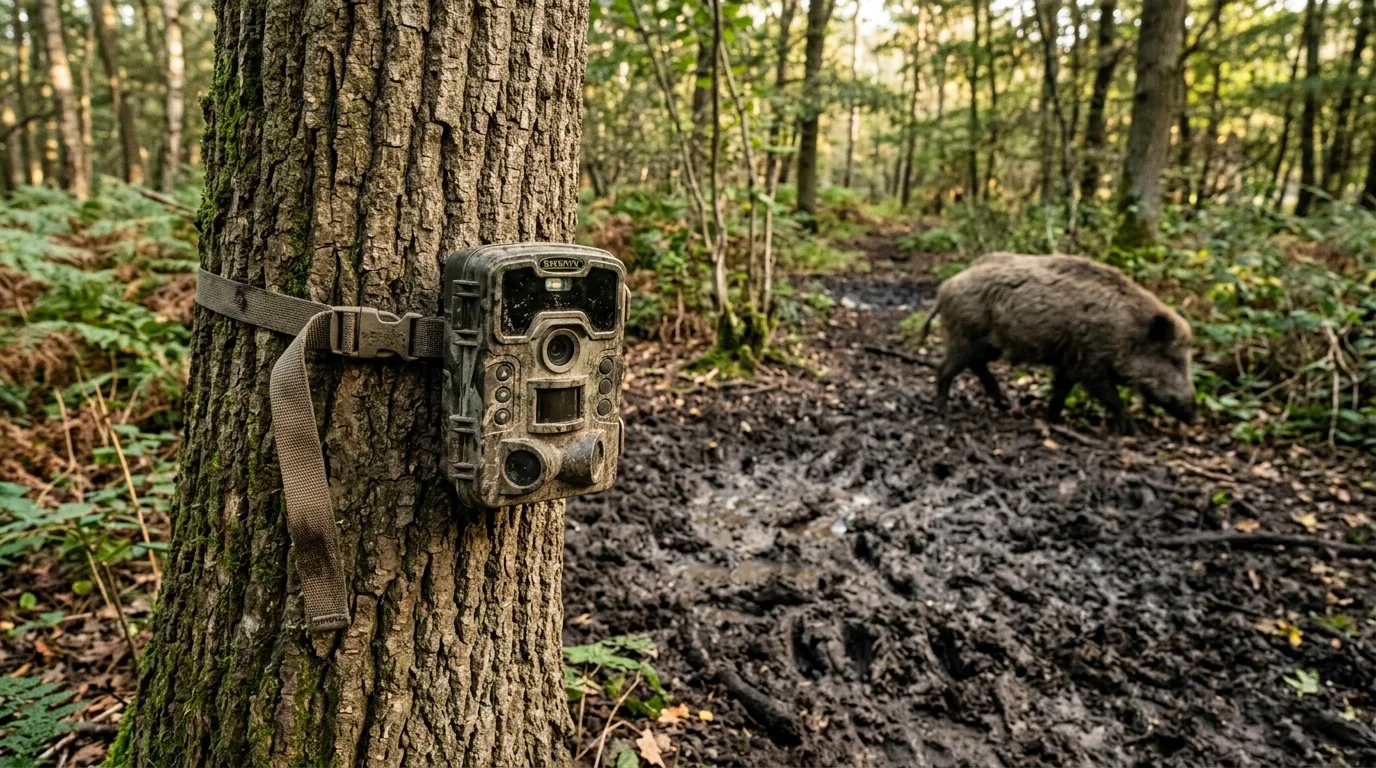
A hog is the hardest animal most of us will ever try to photograph well. Not because it's rare — because of how it moves. A sounder hits a bait pile at a dead trot in the dark, twelve animals shoulder to shoulder, the whole group churning through your camera's field of view in the time it takes a deer to take one step. A camera tuned for a buck ambling down a trail will hand you a memory card full of pig butts, blurred snouts, and a half-empty frame where the rest of the group already was. Then it'll do something almost as bad: it'll spook the smart old sow that decides she doesn't like the little red light, and she'll take the group somewhere else.
So here's the short version, because it's most of the battle. For wild boar you want a camera with a fast trigger (0.5 seconds or quicker), a no-glow (black) infrared flash to keep wary pigs from clocking it, mounted around the pig's shoulder height and angled down from a bracket so you catch the body and see over the front of the sounder rather than going eye-to-eye with a wary hog — with the bait set back from the camera as far as it'll still reliably fire, and burst mode running so you catch the whole group, not the first pig through. Face it toward the nearer pole — north in the northern hemisphere, south in the southern, never due east or west — lock it down hard, and run lithium batteries if it's cold. That's the recipe. Everything below is the why, plus the parts of hog behavior that make a pig camera different from a deer camera — and how to turn that card full of night pictures into a trapping plan that actually clears the property.
Why a hog camera is a different animal
Almost every trail camera you can buy is built around a deer. The passive infrared sensor — the thing that actually fires the shutter — is tuned to catch a deer-sized heat signature moving at a deer's pace, because that's the market these cameras grew up in. Hogs break two of those assumptions at once. They're lower to the ground, and they move quicker and in tighter knots than deer do. Get the settings wrong and the camera doesn't fail loudly; it just quietly under-reports, and you make decisions off a picture of your property that's missing half the pigs.
It helps to know how the detection actually works, because three separate things have to go right for a pig to end up in a usable photo. First the animal has to walk into the zone the sensor watches. Then its heat-in-motion has to trip the PIR. Then the camera has to fire fast enough to catch it before it's gone. Researchers who ran cameras against a continuous control video — so they knew every animal that should have been caught — found that detection probability rises and falls with the period of day, the distance to the camera, the model, the species, the height, and the sensitivity setting, all at once. The encouraging part, if you're after pigs: in that same study, wild boar had the highest detection probability of any species group, over 0.9 — higher than carnivores, far higher than birds. A boar is a big, hot, broad target. The sensor likes pigs. Your job is mostly to not waste that advantage.
A boar is a big, hot, broad target. The sensor likes pigs — your job is mostly to not waste that advantage.
The settings below are where you either keep that edge or throw it away.
The settings that matter, at a glance
Here's the whole setup in one place. The rest of the article walks through each line and the evidence behind it.
| Setting | Recommendation for hogs | Why |
|---|---|---|
| Trigger speed | 0.5 s or faster; 0.1–0.2 s if you can | Pigs move fast and in groups; slow triggers fire after the animal has crossed the frame. |
| Flash type | No-glow (black) IR | Least visible to wary pigs; white flash suppresses captures; no-glow is the camera-shy choice. |
| Mode | Still photos, burst of 3–5 | Stills save battery and card vs. video; a burst catches multiple pigs in a moving group. |
| Delay between triggers | Short (≤1 s); lengthen if the card floods | A short recovery time photographs each animal in a single-file group; a flood of empty frames means back it off. |
| Camera height | ~80 cm–1 m, angled down from a bracket | Low mounting at the pig's body detects more; angling down keeps front pigs from blocking the group. |
| Bait distance | As far from the camera as it'll still fire | Pulls the group into frame and gets several pigs in one shot. |
| Direction | Face toward the nearer pole — north in the northern hemisphere, south below the equator | Keeps the rising/setting sun out of the lens — fewer false triggers, cleaner night shots. |
| Batteries | Lithium, especially in cold | Lithium holds power in extreme cold; alkalines lose up to half their capacity sub-zero. |
| Security | Cable lock + steel box; off human trails | Pigs displace gear; theft is real on accessible land. |
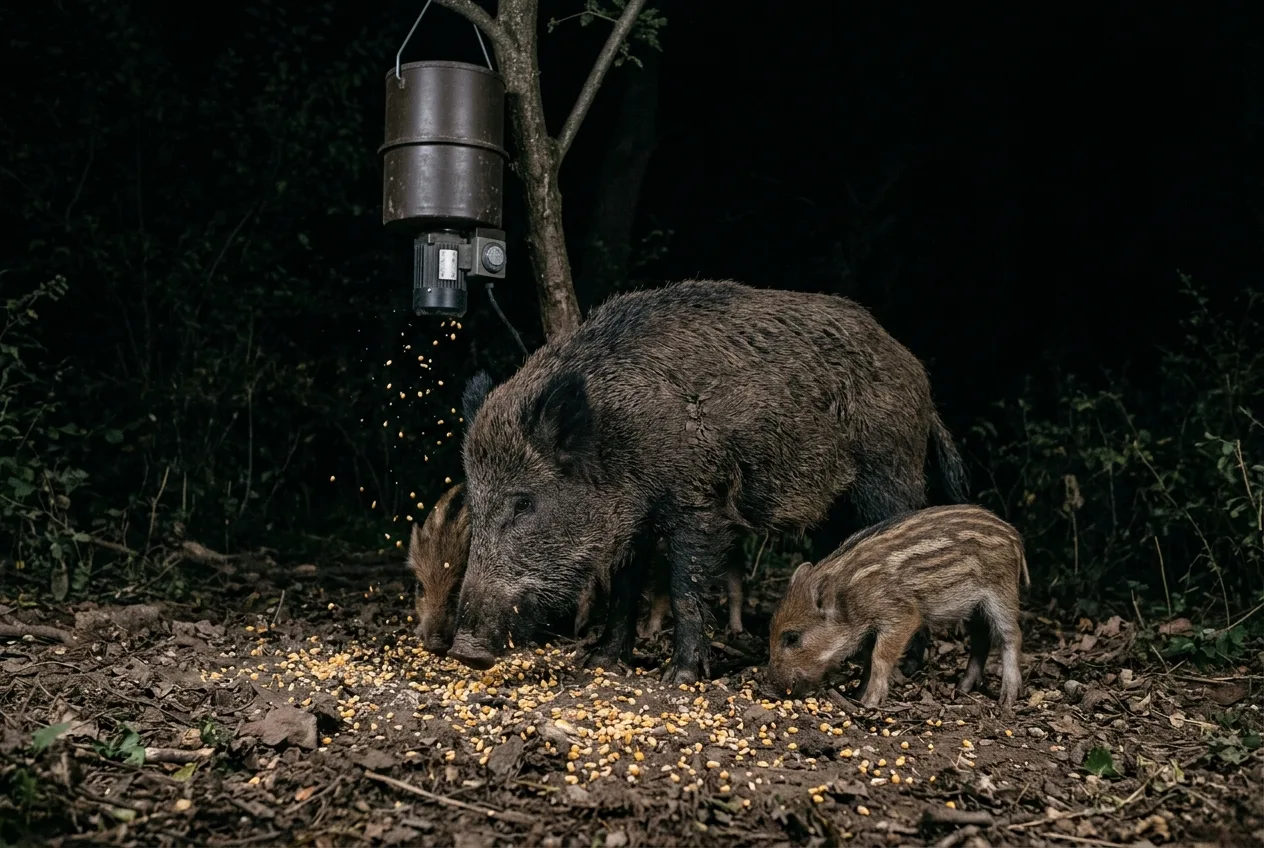
Trigger speed: the one to get right
If you fix one thing on a hog camera, fix the trigger speed. Everything about a pig — the pace, the group, the dark — punishes a slow shutter.
The clearest evidence doesn't come from pigs at all; it comes from a Scottish study that pitted three cameras against each other in open country: a current high-end model, a budget model, and an older "vintage" one. The high-end camera's trigger was rated at 0.1 seconds, the budget at 0.5, the vintage at 0.6 — and on paper the budget didn't look that far behind. In the field it wasn't close. For fast-moving predators, the high-end camera's capture success was 1.8%, the budget 1%, and the vintage 0% — the dated camera caught none at all. Across the whole study, the cheaper and older cameras racked up 192 and 274 missed animals against just 8 for the good one. And when the researchers dug into why the budget camera missed, the answer is the exact trap a hog hunter falls into: the budget cameras were "sometimes triggered by a predator, but the image was taken before or after the animal had entered or left the frame," because the detection zone was too narrow and the animal "moved through the frame before a photo is taken". Their bottom line is worth pinning up: where accuracy matters, "budget and even high-quality camera traps that are dated more than 2–3 years may not be suitable, even when the specifications appear to closely match current high-end models … especially … where the subjects are fast-moving or nocturnal animals". Fast-moving and nocturnal — that's a hog in two words.
What number should you actually look for? The most direct pig guidance, the Ontario wild-pig camera protocol, says cameras with a fast trigger speed are ideal, "preferably at 0.5 seconds or less". An Arkansas hog-trapping guide goes a step further, listing trigger speeds that range "from 0.13 seconds to over 1.3 seconds" and recommending "1/5 second (or faster)". If you can afford a camera in the 0.1–0.2 second class, it's the single best money you'll spend on a pig setup.
There's a nuance that lets you off the hook in one specific case. Trigger speed matters most when the animal is just passing through. A camera-trapping manual puts it plainly: fast trigger speeds may be unnecessary "if your target will be within the field of view for some time (eg at a feeding station) and you only require presence-absence information," but if the target is only in frame briefly, "faster trigger speeds will likely increase your probability of detection". So a camera staring at a feeder where pigs stop and root for ten minutes can get away with a slower trigger. A camera watching a trail or the approach to bait, where the group is moving, cannot. And here's the catch that ties it back to the study above: there's also evidence that the closer an animal enters the zone, the faster the camera has to react to catch it in the right spot — fast movement and close range compound each other. If you can't afford a quick camera, the researchers' own workaround is one hog hunters already use: lean on bait to slow the animals down, and run more cheap cameras to cover the gaps.
Flash and the wary pig: go no-glow
Hogs are smart and they get educated fast, so the flash question is really a behavior question. Will the light spook the animal you're trying to pattern? With pigs, often yes — and the fix is the no-glow (black) infrared flash.
Start with what the light actually does, because the marketing oversells it. A foundational study measured the infrared output of real cameras and compared it to what animals can see. The headline: "most mammals can see the infra-red illumination used in camera traps". Even cameras sold as "no glow" are still emitting light — the tested no-glow unit peaked at 940 nm, a low-glow unit at about 828 nm — and the only reason no-glow leaks less visible red is that its wavelength sits higher up the spectrum. The claim that infrared reduces an animal's flight response holds best, the authors note, "where infrared wavelengths exceed ∼870 nm" — which is exactly where 940 nm no-glow lives and 850 nm low-glow does not. In their own field trials, cats, dogs, and foxes all reacted to a 940 nm camera anyway. So no flash is truly invisible to a pig. The question is which one disturbs it least.
No flash is truly invisible to a pig. The question is which one disturbs it least — and that's no-glow.
White flash is the one to avoid for wary hogs. The same body of work documents that a white (xenon) flash "decreased [tiger] capture rates in Nepal by 50% over 5 nights" and has been tied to avoidance behavior in other species. A camera-trapping manual is blunt that white-flash cameras are unsuitable "for surveys where it is important not to influence the behaviour of animals" — even though they give you sharp, full-color night images that infrared can't. For counting demographics where you don't care if an animal flinches, white or standard IR are fine; for a study where you need the animal to keep coming back, you want the gentlest option.
Between the two infrared types, a German study settled it cleanly. Across 900 camera deployments, both red deer and roe deer "were more likely to react to standard infrared than to black flash" — meaning no-glow black IR provoked fewer reactions than low-glow. The reassuring footnote for anyone worried about long-term avoidance: trapping rates "did not significantly decline over time for any flash type," so even when individual animals react, the camera keeps catching them over a survey. The authors' recommendation lines up with everything else here — use black (no-glow) flash "for behavioural studies … to minimize the risk of introducing a source of disturbance".
For pigs specifically, the practitioners agree. The Ontario protocol calls cameras with infrared and red-light filters "ideal for wild pig monitoring … for their effectiveness in low light conditions and their reduced detection by animals and humans". The Arkansas hog guide is the most direct: low-glow IR has "visible red glow if looking straight into camera" and a range of about 100 feet, while no-glow ("black flash") gives "no visible glow, but less range and grainier image" — and it flags no-glow as "recommended if feral hogs are camera shy". That's the trade. No-glow costs you a little range and a little image quality at night, and buys you stealth. For an educated sounder, take the trade.
The exception, and it's a useful one: at a big corral trap, the flash stops mattering. An experienced Mississippi trapper put it this way — "the flash is not a deterrent on the larger traps that I employ. However, on a smaller trap, the camera should be positioned a comfortable distance away, yet close enough to be triggered reliably … so that the flash does not scare the pigs". By the time pigs are committed to feeding inside a large trap, they've made peace with the setup; a flash isn't going to unwind that. On a small box trap, or out on a fresh bait site where the group is still deciding whether to trust the spot, keep the camera back and keep it dark.
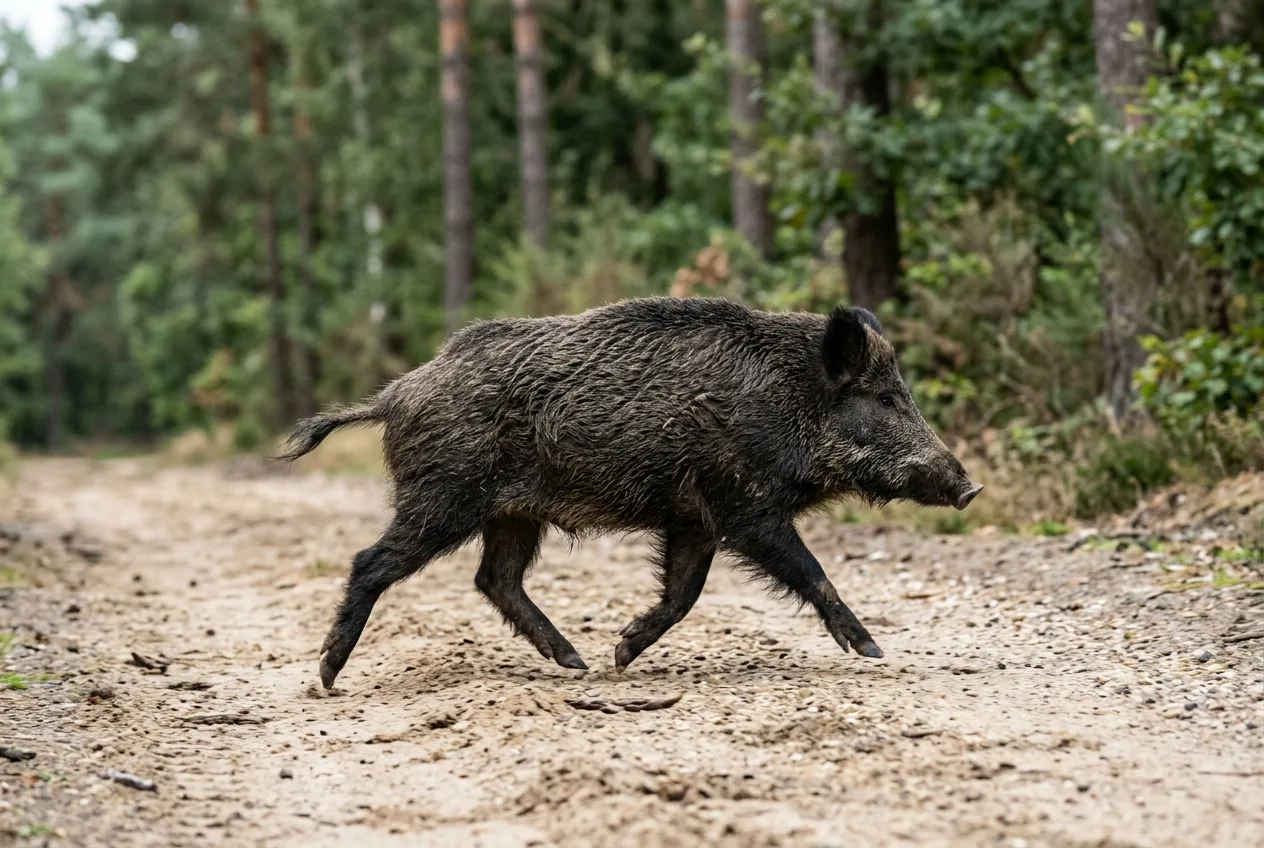
Height, angle, and the line of sight
Mount a pig camera low. The rule of thumb across the literature is to set the camera "similar to the core mass of the animals you are attempting to detect" — and a hog's core mass is low. One manual spells out the range for exactly this animal: cameras are deployed "from 20–90 cm above the ground for animals ranging in size from quolls … up to feral pigs". The boar studies bear that out in practice — researchers in Italy fixed cameras "50 cm above the ground," a Belgian diel-activity study used "∼50 cm above ground," and a Chilean density study set theirs at 1 m, but only because up to 0.9 m of snow forced them higher than the 80 cm "shoulder height" they'd otherwise have picked for a boar. That last detail is a good reminder that the right height is the animal's height, adjusted for your conditions.
And low genuinely beats high — this has been tested. When researchers paired cameras on the same trees, one at about 90 cm and one up at 300 cm, the low set recorded roughly 40% more events and species detections than the high one. Set the camera at the pig's body and the sensor stares at the warmest, broadest part of the animal; lift it up and aimed over their backs and you bleed detections. Keep the view roughly parallel to the ground rather than tilted steeply down, so you're not shrinking the detection zone into a patch of dirt right in front of the lens.
There's a tension here special to wary hogs, though, and it's worth naming. Drop the camera to hog-body height and you've also put it right in a pig's line of sight — where, as the Arkansas guide warns, "visible flash, light or noises may alert wary feral hogs". That guide actually recommends mounting "at least 5 feet, but preferably higher, out of a hog's line of sight," on a bracket angled down for a bird's-eye view, and notes that "cameras set at 3 feet will capture images of a few hogs directly in the camera's line of sight and miss others in the group". So which is it — low for detection, or high to stay hidden?
Read honestly, the sources don't fully agree, and it's better to say so than to fake a consensus. S20's data favors low. S09 pulls the other way — it recommends mounting "at least 5 feet, but preferably higher," angled down from a bracket for a bird's-eye view, precisely so the front pigs don't block the rest of the group and the camera stays off a wary hog's sightline. There's no settled number. The workable compromise most hog trappers land on borrows from both: mount around the pig's shoulder to 1 m — boar shoulder runs about 80 cm, and the Ontario protocol puts cameras at roughly 1 m — angle it down from a bracket the way S09 recommends so you're looking over the front of the sounder rather than through it, run no-glow so there's less to spook on, and set the bait back so the group is working at a distance rather than rooting directly under the lens. You give up a little of S20's raw detection edge for S09's group-visibility and concealment — a trade most people running wary, educated pigs will take.
Finally, point it north (or south). Both the Ontario pig protocol and the Arkansas hog guide say to face infrared cameras away from where the sun rises and sets, to avoid false triggers and washed-out shots from sun and backlighting. Southern-hemisphere readers flip it — face south, south-east, or south-west — but the logic is identical: keep the sun off the lens.
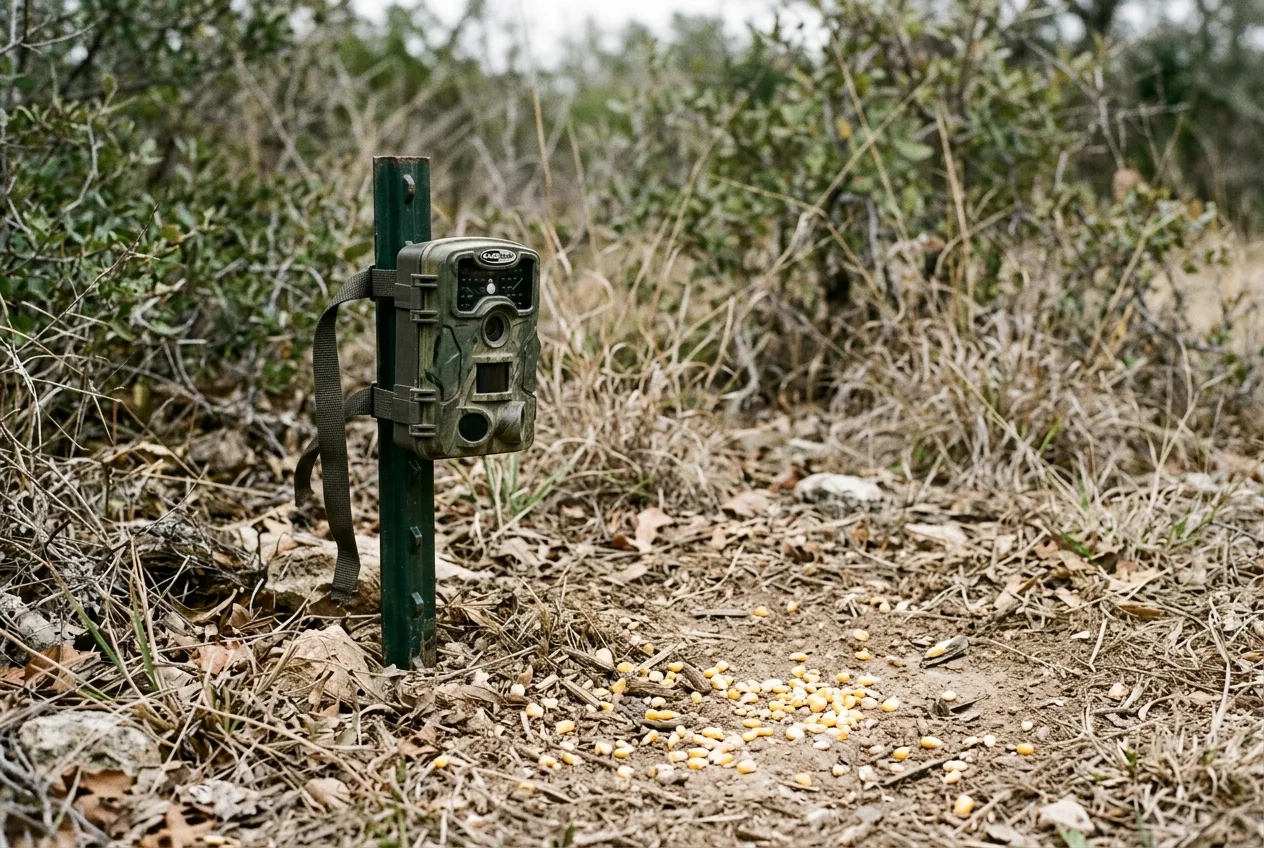
Bait distance, feeders, and reading the sounder
This is where a pig camera earns its keep, and where the single most useful setting isn't on the camera at all — it's where you put the food.
Set the bait back. The Ontario protocol says it best: "Set the bait as far away from the camera as possible while still allowing the camera to trigger reliably. This will increase the chance of clear pictures of multiple pigs if they are present". Detection range varies a lot model to model, so do a walk-test before you leave — wave a hand across the zone at the bait and confirm the camera fires — and adjust. A pile dumped right under the lens gives you a close-up of one pig's shoulder; bait set at the edge of your detection range pulls the whole group into frame. For reference, the boar studies were resolving animals out to 8–15 meters, so there's room to work with.
Spread the bait, don't dump it. "Spreadable baits should be distributed across the site rather than dumped into a single pile," which keeps pigs spread across the frame instead of stacked on one spot. Corn is the accessible standard — the "gold standard of pig baits" — but with a catch every hog hunter learns: "practically every species of critter out there also eats corn". Souring the grain (fermenting whole-kernel corn in water) cuts the non-target draw from deer and the like. One hard rule from the north: straight whole-kernel corn is "strongly discouraged during the winter months due to its potentially harmful or even fatal effects on non-target deer" — mix it with whole oats at least 1:1, or sour it, when deer are wintering. And place the bait so the prevailing wind carries its scent toward the pigs' bedding.
A timed feeder buys you time and a tighter pattern. A spin-cast feeder set to drop corn on a schedule, paired with a camera, "can save you considerable time and effort by reducing the frequency of your visits" — feed every couple of days instead of daily. One experienced trapper sets the feeder "to go off shortly after dusk and then again after midnight — in other words when pigs are likely to be the most active," which both delivers the bait on the pigs' clock and concentrates the group for the camera.
Now the part that makes a pig camera genuinely strategic. A bait site doesn't just attract the local sounder — concentrated food pulls in groups that otherwise keep to their own ground. Pigs are broadly territorial; neighboring sounders overlap in space but mostly avoid each other. Put out a rich, reliable resource, though, and that breaks down. In one study, four different sounders were captured at a single trap location within 125 meters of a landfill over 9.5 weeks. The lesson the authors draw is one to keep in mind before you assume you've cleaned out a property: "removal of one sounder would not necessarily render that territory free of pigs," because several groups may be using the same high-value spot. Your camera is how you find that out — it'll show you the second and third sounders you didn't know were there.
A bait site doesn't just feed the local sounder — a rich, reliable resource pulls in groups from well beyond it.
So before you build a trap, let the camera answer three questions. How many pigs? The camera "will also reveal the approximate number of pigs in the sounder," which tells you how big a trap to build. Sounders run "from just a few pigs to 25 or more," so this isn't a number to guess — one guide's photo caption flatly notes, "There are 16 pigs in this photo". How many groups? "Game camera photographs will show you how many different groups of pigs are on the property and the number of pigs you will need to remove". When do they come? A camera "records the times and dates as well as the number of pigs visiting a bait site," which lets a hunter "narrow down the time window and be much more efficient". Get those three numbers and you have a plan instead of a guess. As one Texas specialist puts it, he prefers a camera over raking the ground for tracks "since it also records the number of pigs as well as times and dates that pigs are present".
Mounting and durability: hogs are hard on gear
Pigs are strong, curious, and built to push, root, and rub. Anything you hang low and leave out, they'll test. Two failure modes to design against.
Theft and the elements. On any land people can reach, place cameras "away from primary human trails, secured … using a lock, or even put into a security box made specifically for trail cameras". Make sure the housing is properly waterproof, and drop a silica desiccant packet or two inside to fight the moisture that builds up in the housing over a season. The boar researchers in Italy didn't mess around — they fixed every camera "to the tree with a steel cable for security reasons".
The pigs themselves. This is the part deer hunters underestimate. Stake your feeders down: "be sure and stake the feeder legs in place, otherwise pigs can and will overturn the feeder and damage the mechanism". Wiring "each leg of the feeder to a steel T-post driven into the ground next to it will prevent large pigs from tipping over and damaging your feeder". The same instinct that makes them tip a feeder makes them worth keeping your camera out of easy reach and snout range — low enough to detect, but braced, cabled, and angled so a curious pig can't easily nose it off the tree. On a fence-line setup, the Scottish biosecurity project simply mounted cameras "facing outside of livestock fences," using the fence as the structure and the camera as the watcher.
Anything you hang low and leave out, they'll test.
Night image quality, batteries, and the cold
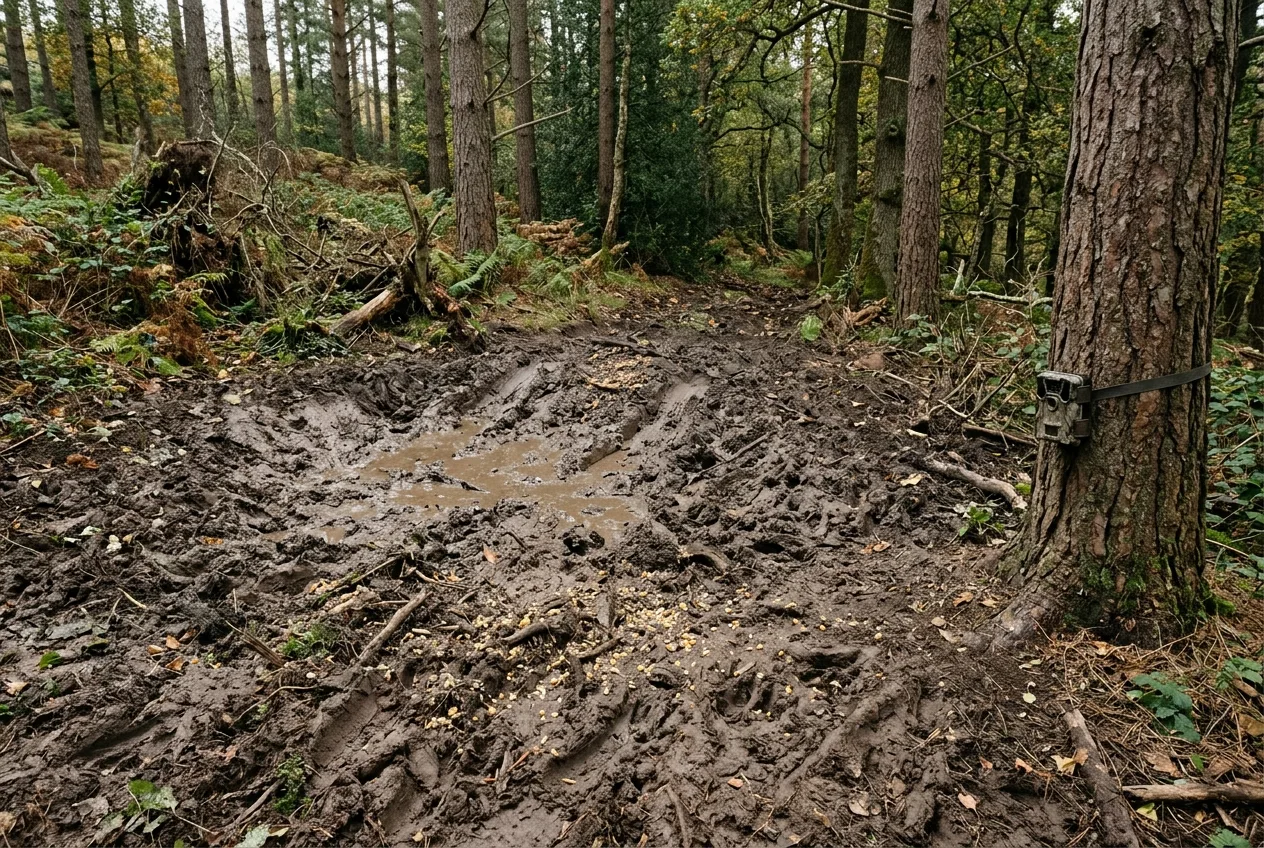
Most of your pig pictures will be night pictures, so plan for the dark. Hogs are largely nocturnal — more on the why below — and the imaging compromises follow from that.
No-glow infrared is the stealthy choice, but be honest about what it costs: "less range and grainier image" than low-glow, and black-and-white only at night. That's usually a fine trade for a wary sounder, but it means you won't always nail the fine detail you'd want for telling individual pigs apart. Watch out for IR "white-out," too — at close range, or off a reflective surface, the infrared flash can flood the frame and blow out the animal. In the Scottish study, the high-end camera produced an overexposed, washed-out image in 14 cases, mostly off a bright snowbank. It's another reason to set bait back from the lens rather than right under it. One small mercy when you're identifying hogs at night: unlike deer, pigs "lack the reflective layer in the eye that produces 'eye shine,'" so you won't get the glowing-eyes effect that sometimes ruins a deer photo.
Batteries are where cold weather bites, and the fix is simple: run lithium. Lithium cells deliver near-full power until they're nearly dead and are "unaffected by extreme cold weather," while ordinary alkalines "suffer in extreme cold weather, losing up to half their capacity in sub-zero conditions". Lithium AA cells are the standard recommendation to reduce site visits and keep the camera alive through a cold snap.
A couple of settings choices also feed straight into battery and card life. Run stills, not video. For pig monitoring, "still-photo cameras are much preferred over video cameras, primarily due to their improved memory and battery capacities". Use burst, not a marathon delay. A burst of 3–5 photos per trigger is the pig standard — enough to catch a moving group, not so many you drown the card. Set a short delay between triggers (a second or less) so you photograph each animal in a single-file group, but if the card is filling with empty frames from sun or grass, lengthen it. And cut back any vegetation that blocks the view or throws false triggers in the wind — every empty frame is wasted battery.
Using the camera to time your control
Patterning hogs on a camera isn't the end of the job — it's the start of a removal plan. The cameras and the trapping work as one system, and the camera's whole purpose is to tell you when to act.
The core principle of hog control is whole-sounder removal: catch every pig in the group at once. Miss a few and you "educate those left outside the trap," and "uneducated hogs are easier to capture" than ones that have learned to fear a trap. That's why you never set the trap on the first night pigs show up. You pre-bait — feed the group at the trap site, gate tied open, until the camera shows the entire sounder walking in and out comfortably. How long? Often "1–2 weeks of conditioning is necessary before an entire sounder will enter the trap," because some pigs, "mostly adults," hang back at first. A rigorous study put concrete numbers on it: bait the site for seven days, and only install the trap once pigs visit "for ≥3 consecutive days". Then keep feeding and watching until they're patterned "consistently (meaning nightly)" before you set it to catch. As one guide says flatly, "the trigger is set only when all hogs in a sounder or bachelor group are entering the trap".
This patience pays off, and the camera is what makes it possible. In a three-year comparison, whole-sounder methods removed the most pigs by far: a suspended trap took out 88.1% of the estimated population, drop nets 85.7%, against just 48.5% for a conventional corral trap that didn't reliably catch whole groups. The most efficient setup used "real-time notifications" so the operator could watch "an attached webcam" and drop the trap only after confirming the pigs were inside. That camera-in-the-loop trigger is now common — cellular systems "transmit still photos or live video" to your phone, and "the operator determines whether to trigger the gate," which lets you "see exactly how many pigs are present before closing the gate". Be clear-eyed about the cost, though: these systems can run a monthly fee of "$20 to $70," need cellular coverage that may not exist on your property "even with a booster antenna hoisted 10 or 15 feet above ground," and the full rigs can cost thousands.
The camera also tells you when you're done — or not. Keep baiting after a catch: "continued baiting will allow you to determine if all of the pigs from the original sounder were successfully captured, or if any additional sounders are in the area". If the card shows AWOL pigs, lock the gate open and start over. And remember the territoriality lesson — near a rich resource, more sounders may keep arriving, so don't declare victory until the camera says no more pigs are coming.
Zoom out, and cameras do one more thing: they measure whether your whole control program is working. Researchers use baited camera grids to index pig abundance and track it over time — one method spaced cameras "approximately 500 or 750 m apart" on 10-day grids and detected changes in occupancy and abundance "following removal operations and between seasons," with the camera estimates tracking true density well enough to gauge whether control was working. Density methods that need no individual ID, like the Random Encounter Model, can turn camera images into a pigs-per-square-kilometer number — one such study in Chile pegged a population at 1.4 individuals/km² purely from camera data. You don't need to run the statistics yourself, but the principle is one you can use directly: if your camera sites show fewer pigs, over fewer nights, after a season of trapping, your program is working. Control "should be monitored using numbers of pigs harvested annually … and/or camera trap surveys".
You never set the trap on the first night pigs show up.
When to expect hogs — and why it's the dark
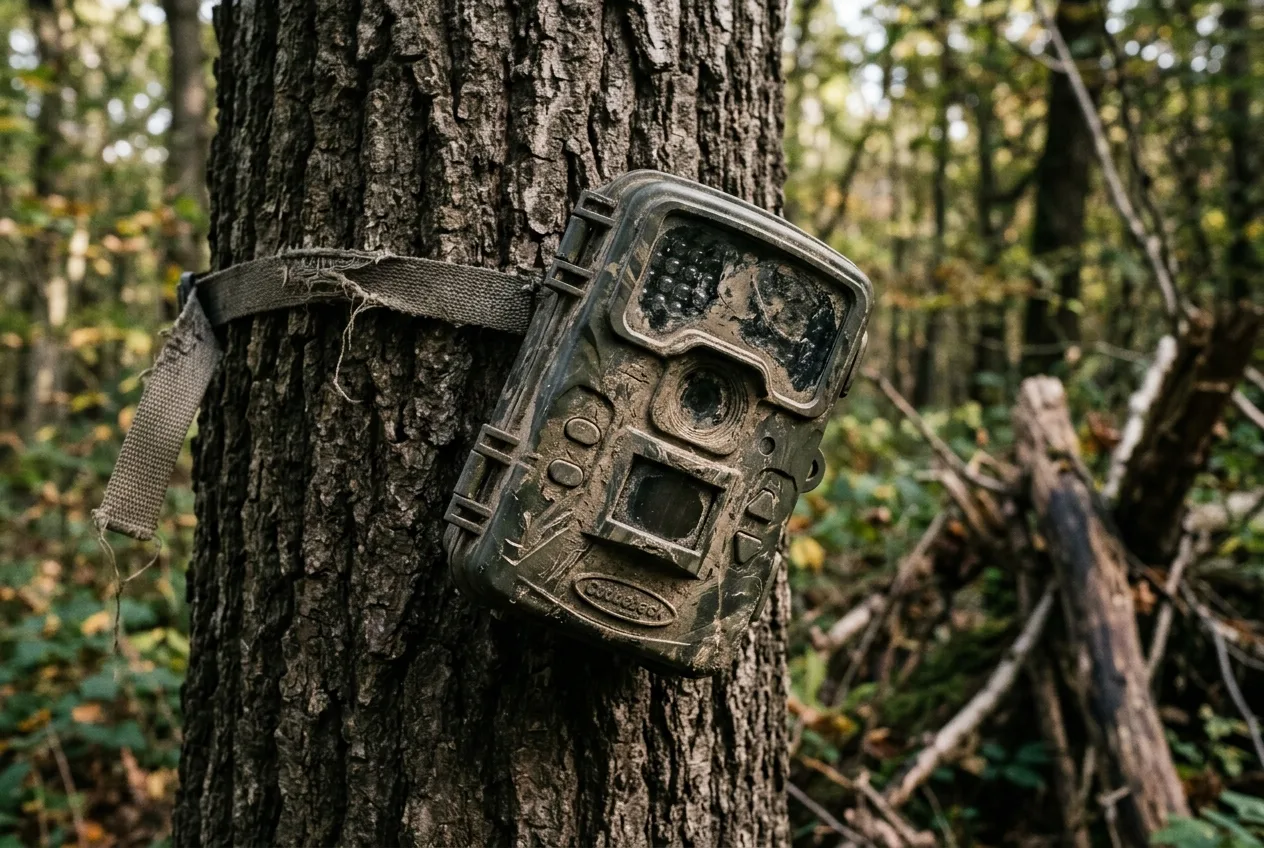
Set your expectations for the night shift. Multiple studies converge on the same picture: wild boar are predominantly nocturnal, with their heaviest movement around the edges of the day. A Belgian camera study found boar "predominantly nocturnal in all of the hunting management zones," with a bimodal pattern peaking "at sunrise … and just after sunset," activity staying high through the night and almost nothing in the middle of the day. By day the pigs held to the forest interior, away from people; at night they pushed out to the field edges to feed — which tells you where to aim a night camera. The Scottish biosecurity team simply ran their cameras "each night between 6pm and 6am," matching the window to the animal.
There's a behavioral reason hogs lean nocturnal, and it matters for hunters. An Oklahoma guide spells it out: "Hot summer temperatures make them nocturnal to avoid excessive heat," while in cooler months unmolested hogs are "active primarily in early morning and late evening". Two things will push them further into the dark: scarce food, which makes them "extend their active hours," and — the one we cause — hunting pressure, which can make hogs "more nocturnal" and shift their range. In other words, the more you pressure a sounder by hunting it, the more it becomes a nighttime, fast-moving target — which loops right back to why the trigger speed and the no-glow flash are the settings that matter. The pressure you apply is part of why the pigs are hard to photograph.
One timing tip for the trapper: hogs are "probably most susceptible to being trapped during winter or early spring because less food is available, making baiting more effective". That's the season to have your cameras out and your bait working.
By now you've probably noticed the real problem with a good pig setup: it works too well. A reliable bait site running no-glow flash and a fast trigger over a busy sounder will bury you in night photos — hundreds of near-identical dark frames of pigs you have to scroll through to find the head count and the timing that actually drive your decisions.
Frequently asked questions
What trigger speed do I need on a trail camera for hogs?
0.5 seconds or faster, and quicker is better — pig guidance specifically recommends "0.5 seconds or less," and a hog-trapping guide calls for "1/5 second (or faster)". Slow cameras fire after the fast-moving group has crossed the frame and miss pigs entirely. The exception is a feeder where pigs stop and root — there a slower trigger can still work.
Will the flash on my trail camera spook wild boar?
It can, especially white flash, which has cut capture rates of wary animals by as much as 50%. Use no-glow (black) infrared: even "no-glow" 940 nm light isn't truly invisible to pigs, but it's the least disturbing option, and it's the one to run when hogs are camera-shy. The flash matters far less at a large corral trap, where committed pigs have already accepted the setup.
How high should I mount a trail camera for pigs?
Mount around 80 cm to 1 m — roughly the pig's shoulder height — angled down from a bracket and off a wary hog's direct line of sight, with the bait set back so pigs aren't rooting right under the lens. Mounting low at the pig's body maximizes detection, while angling down from above keeps front pigs from blocking the rest of the group.
How far from the bait should the camera be?
As far as it will still reliably trigger — that pulls the whole group into the frame instead of giving you a close-up of one pig. Detection range varies by model, so do a walk-test to confirm the camera fires at the bait before you leave the site, and spread the bait out rather than dumping it in one pile.
Should I use photo burst or video for hogs?
Still photos in a burst of 3–5 per trigger. Stills are "much preferred over video" for pig monitoring because they save battery and memory, and a burst catches several animals in a moving group while a single photo catches only the lead pig. Keep the delay between triggers short so you photograph each pig in a single-file line.
When are wild boar most active on camera?
Mostly at night, with peaks around sunrise and sunset and little movement midday. Heat pushes them nocturnal in summer, and scarce food or hunting pressure pushes them even further into the dark. Aim night cameras at field edges and trails, where boar feed after dark, rather than deep cover where they bed by day.