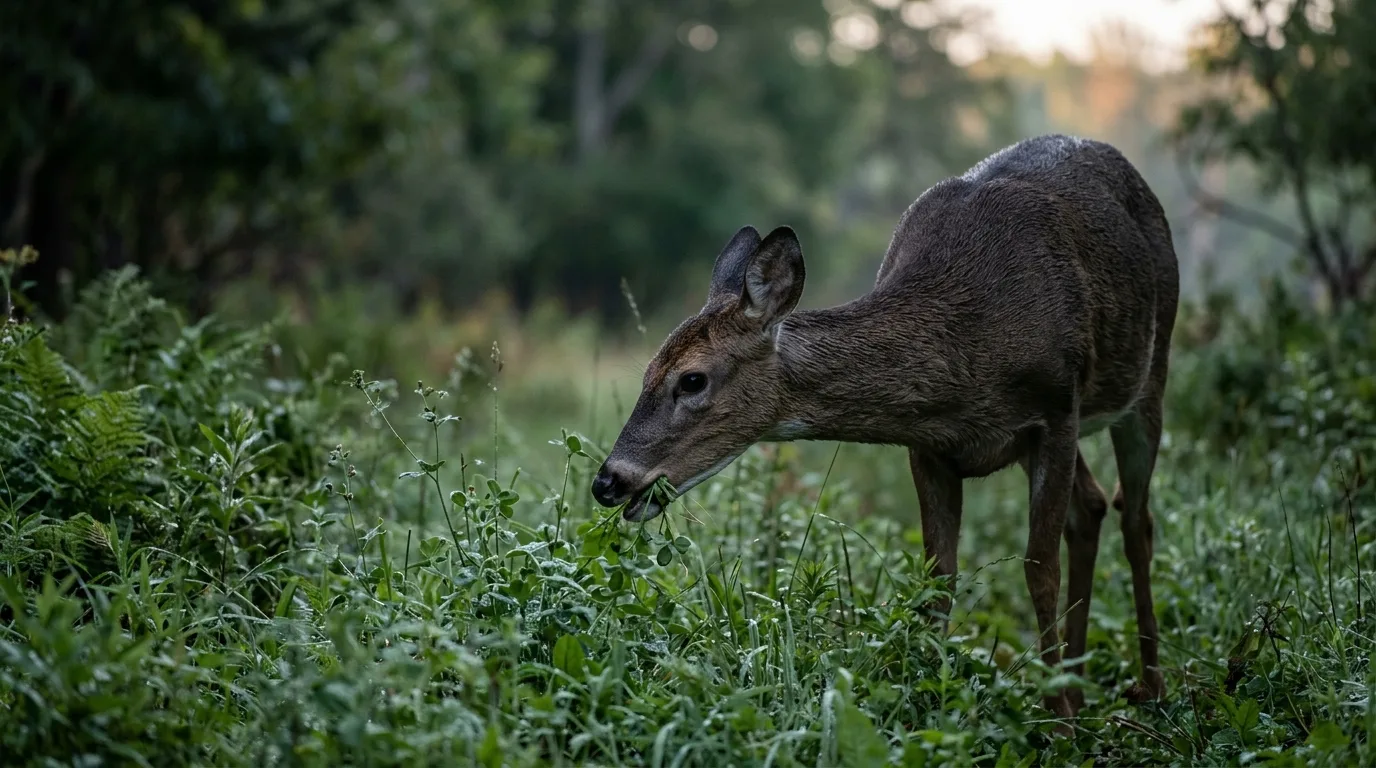
Here's the thing that trips up most people who ask what deer eat: there's no single answer, because the answer changes underneath you all season long. A deer that's nose-down in a clover field one week is standing under a white oak the next, then bedded in a cutover stripping bark off saplings a month after that. The food moves, and the deer move with it. If you want to find them — to hunt them, manage for them, or just put a camera where they actually are — the useful question isn't "what do deer eat," it's "what are they eating right now, and where is it?"
So let's answer both. Averaged across a year and across regions, a deer's diet is dominated by browse (the leaves, buds, and twig-ends of woody plants) at about 46%, followed by forbs (broad-leaved weeds and herbs) at 24%, mast (nuts and fruits) at 11%, and crops at 4%, with the rest made up of mushrooms, lichens, and odds and ends. That's the textbook split, and it's worth knowing. But an annual average is a little like the average depth of a river — technically true, useless for crossing. The real story is in how those proportions swing from green-up to deep winter, and that swing is what tells you where to be.
Why a deer eats like a deer
Before you can read what's on the menu, it helps to understand the kitchen. Deer are ruminants — like cattle, sheep, and goats, they have a four-chambered stomach, and the largest chamber, the rumen, is essentially a fermentation vat where microbes break down plant fiber into usable nutrients. The animal bites, barely chews, swallows, then later brings the cud back up to chew properly in a safe spot. Standard ruminant stuff. But here's where deer part ways with a cow.
A cow is a grazer, built with a big, complex gut to sit on coarse grass and digest it slowly and thoroughly. A whitetail is the opposite: a concentrate selector, with a smaller, simpler digestive tract that demands higher-quality, more easily digestible food. It selects "plants and plant parts rich in easily digestible and highly nutritious plant cell contents like starch, plant protein, fat, and oil". The Mississippi State Deer Lab puts the consequence bluntly: on overpopulated, depleted range, "white-tailed deer have starved to death with their stomachs full of low quality forages". A full belly of the wrong food isn't enough. They need the good stuff, and they're equipped to find it — a narrow snout and long tongue to pick out specific plant parts, and unusually active salivary glands whose enzymes neutralize tannins and let a deer eat a quantity of acorns "that would kill a cow".
A full belly of the wrong food won't keep a deer alive — it has to find the good stuff, and everything about how it's built points toward doing exactly that.
This is why deer are so selective. In one Oklahoma analysis, about a third of the plant species deer consumed made up roughly 93% of the actual diet. Another study logged bites from 137 different plant species, yet a handful of forage classes carried the load. They sample widely, then key in on what pays. Veterinary references sort ruminants into three groups — concentrated selectors (browsers), intermediate feeders, and grass-and-roughage eaters (grazers) — and the white-tailed deer, mule deer, and roe deer all land squarely in the browser camp. The classic framework here comes from the German researcher Reinhold Hofmann, who in 1989 divided ruminants along exactly this gradient based on the morphology of their guts and salivary glands.
That's not a trivia note — it's the master key to this whole article. Because deer are concentrate selectors, they're always chasing the highest-quality food currently available. As the seasons turn that food over, the deer turn with it.
Green-up: chasing the new growth
When the growing season returns, deer go for new growth first, and they go hard. Tender young shoots, fresh buds, and the swelling tips of woody plants are perennial favorites the moment they appear. The reason is nutrition: the younger the plant part, the higher its concentration of protein and minerals, and new spring growth of native vegetation runs high in protein and complex carbohydrates. After a winter on woody twigs, this is the payoff.
It's also a hungry, demanding time. Coming out of winter, does are in late pregnancy or early lactation and bucks are starting antler growth, so protein demand climbs for both sexes. Spring is, nutritionally, the best season of the deer's year, precisely because the landscape briefly overflows with high-protein food. They'll still clean up any acorns left in edible condition and pick at mushrooms, but the pull is toward what's green and new.
There's a regional wrinkle worth carrying. For mule deer on western ranges, grasses actually matter more in spring than at any other time of year — early, tender grass is briefly worth eating before it coarsens. And on European range, forbs are especially important for the smaller deer species in spring and early summer. The principle is identical everywhere; the specific plants just depend on what grows there.
Summer: forbs, browse, and the late-season grind
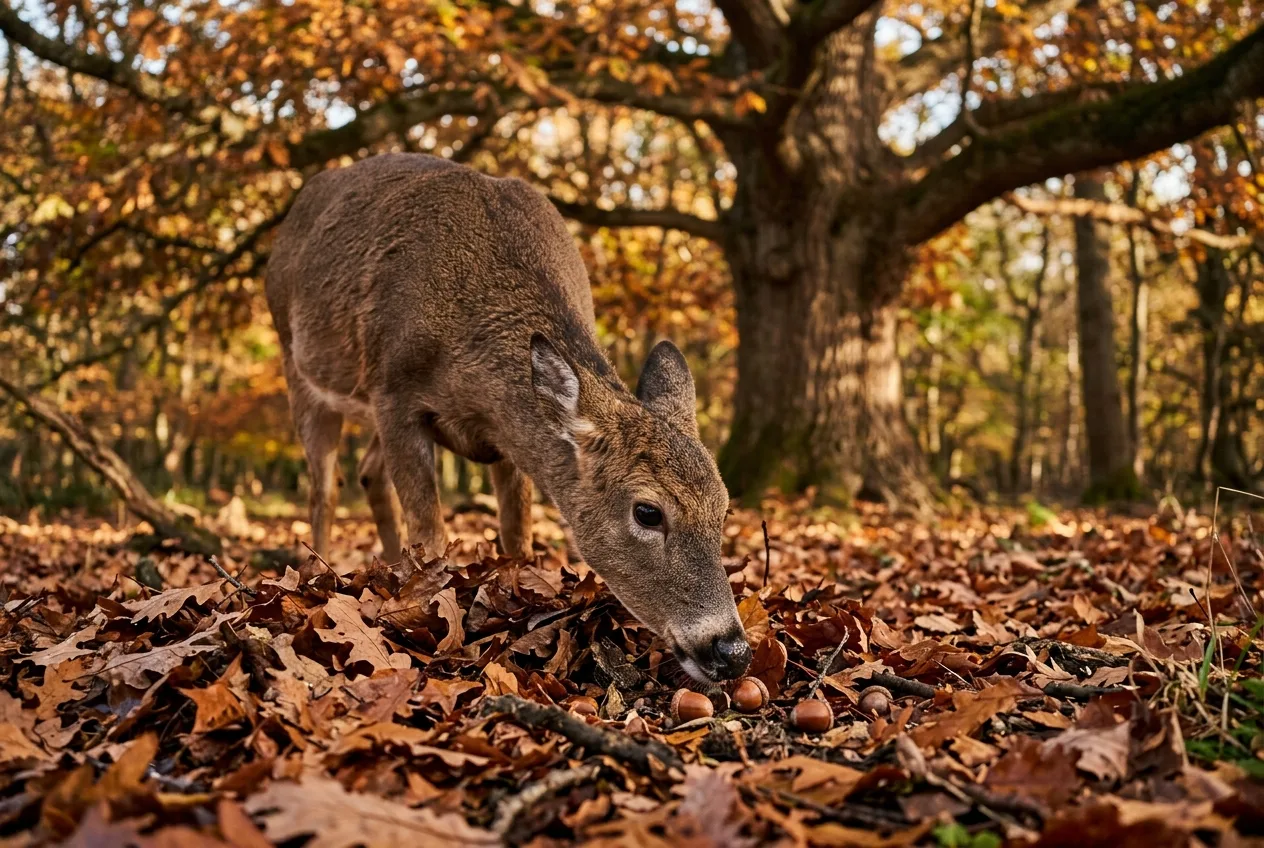
Through the heart of the growing season, deer lean on forbs and browse — the broad-leaved weeds and the leafy parts of woody plants. Forbs in particular are a preferred class: typically lower in fiber and higher in digestible protein than browse, and as a bonus they carry a lot of water, which matters in the heat. When a Texas study hit a wet spring and forbs exploded, they made up over 70% of the diet by dry weight. Deer reach for them whenever they can.
Where farmland is in the mix, crops join the rotation — soybeans are a summer favorite, and a wide range of agricultural plants get used readily because they're nutritious, palatable, and easy to digest. This is also when deer barely touch grass. Across study after study, grass sits at a low single-digit-to-mid-teens share of the diet, and even that is mostly the tender early stuff; one researcher found grass "was always 2 percent or less of the total diet at any point in time". Deer are not grazers, and summer is when that's most obvious.
But summer has a sting in its tail, and it's one a lot of people miss. As the season matures, plants pour their energy into seeds and structure: protein levels fall, lignin (indigestible woody fiber) rises, and a lot of that lush early forage turns coarse and far less digestible. In a Swedish study of moose browse, fiber climbed and crude protein dropped measurably between early-summer and late-summer samples. For whitetails in the Southeast, late summer is often "the greatest stress period" of the year — woody vegetation has gone high in lignin, acorns haven't started dropping yet, and does are still burning energy on lactation. The bridge across that gap is forbs, which is exactly why managers push for abundant forb cover heading into that window.
Late summer is the hungry gap: the green has gone tough, the acorns haven't dropped, and forbs are the bridge across it.
The autumn pivot: mast changes everything
If there's one moment that reorganizes deer behavior, it's the mast-fall. As the days shorten, deer flip into a fattening drive — they're "programmed to prepare for winter" and gorge on the temporary, energy-rich foods that suddenly appear, with some individuals putting on as much as 25–30% of their body weight in a couple of months. And right on cue, the woods deliver.
Mast comes in two kinds, and the distinction is worth getting straight because it shapes the whole season:
| Type | What it is | Nutrition | Examples | When it matters most |
|---|---|---|---|---|
| Soft mast | Fleshy, perishable fruit | High in sugars and vitamins — quick, easily absorbed energy | Apples, persimmons, pears, blackberries, blueberries, pawpaws | Late summer into early autumn; doesn't keep |
| Hard mast | Hard-shelled nuts | High in fats and carbohydrates — the most calories per gram, and a long shelf life | Acorns, beechnuts, hickory nuts, hazelnuts, walnuts | Autumn well into winter |
Soft mast tends to come first, and ripe fruit pulls deer in early — apples, pears, and berries get hit before the nuts really start. Then the hard mast drops, and the priority order changes. The numbers tell it cleanly: the Mississippi State Deer Lab found mast consumption climbs from about 11% of the diet in summer (mostly soft mast) to 28% in autumn (mostly hard mast). In that same window, browse and forbs — which supply over 80% of the diet in every other season — get displaced enough that autumn is the one season they don't dominate. In a Texas study, when mast came on it became "about half" of the diet, and the researcher described the change as someone flipping a switch.
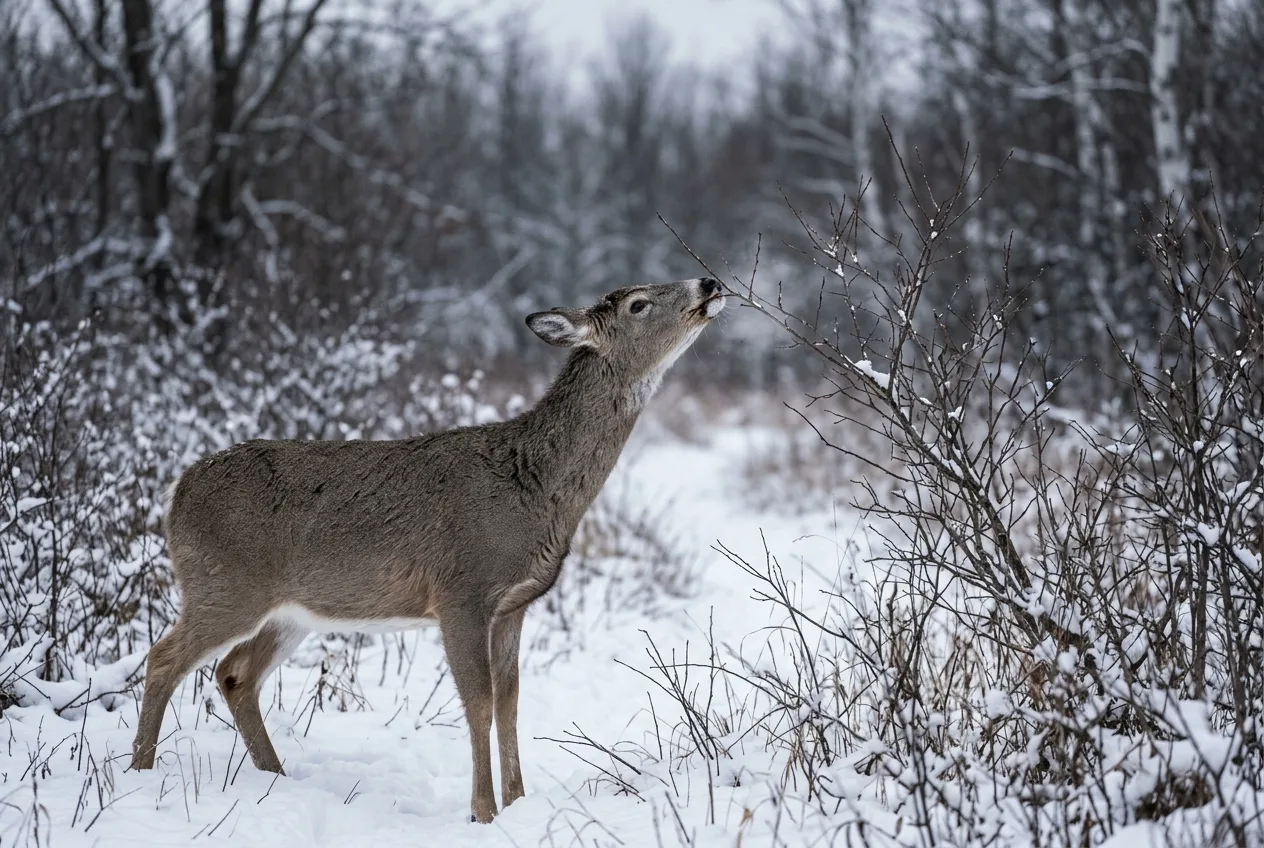
And among hard mast, one food rules: acorns. "Of all available food sources, acorns will be picked above all others," is how one state wildlife journal put it. Deer favor white-oak-group acorns over red-oak-group acorns because they carry fewer bitter tannins, though red-oak acorns have their own value — a longer shelf life that keeps them available deep into winter after the sweet ones are gone. Hard mast is calorie-dense, it stores, and it's there when the deer most need to fatten. For a hand-raised deer, hard mast can make up 50% of the autumn diet; rumen analyses of wild deer have found acorns at 76–90% of the autumn diet when they're available.
Acorns literally move the deer
This is the part that should change how you scout. Mast doesn't just get eaten — it relocates the herd. In a multi-year Virginia study, McShea and Schwede put radio-transmitters on female white-tailed deer and watched what they did when the acorns fell. The deer "increased their home range to incorporate acorn-producing areas during mast-fall". During peak fall, acorns made up about 50% of their foraging time, and they kept searching the oak stands long after the drop, picking acorns at an average rate of 0.75 per minute of searching — head down, neck stretched, swinging slowly through the leaf litter. Deer fecal-pellet counts in the oak stands tracked the acorns on the ground.
The kicker: in the one poor-acorn year of the study, the home-range expansion didn't happen at all — without the mast, there was nothing to pull the deer over. That's the whole mechanism in one comparison. When and where the mast hits, deer redraw their lives around it. When it fails, they don't.
Acorns don't just feed deer — they relocate them. When the mast fails, that pull vanishes, and so does your honey hole.
Which is also why autumn diets vary the most from place to place and year to year — the National Deer Association notes that fall preference "hinged heavily on mast presence," so a region with a bumper acorn crop and one with a total failure can look like different worlds. A bumper crop scatters deer across the woods (every oak is a restaurant, harder to hunt); a failure concentrates them on the few food sources left, including crops. Grain like corn becomes most attractive precisely "when hard mast failures occur" — it's the buffer when the acorns don't show.
Winter: down to the woody stuff
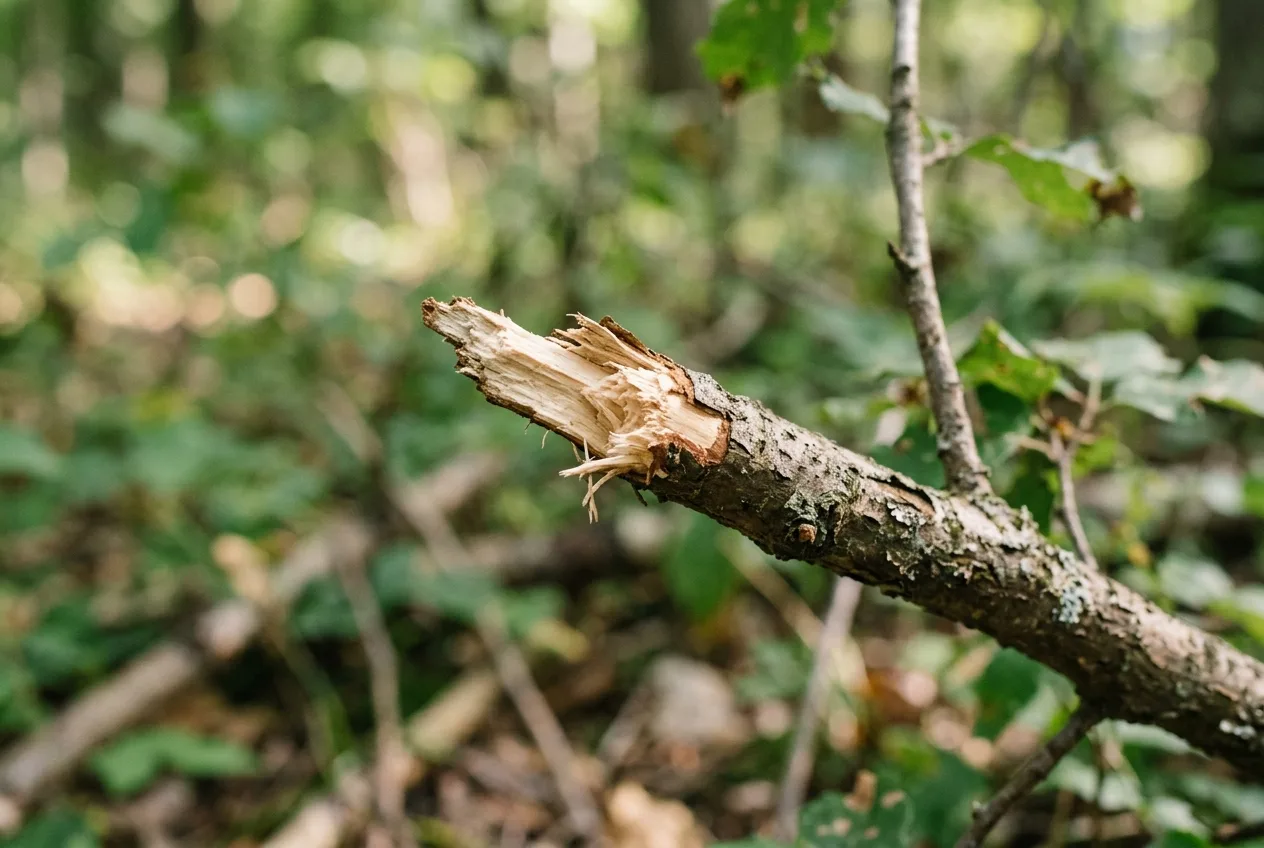
When the nuts and fruit are gone, the menu gets lean and deer fall back on what's left: woody browse — the buds, twigs, and bark of trees and shrubs. This is survival eating, not preference eating. Hard mast bridges part of the way in — acorns and other nuts keep feeding deer "well into the winter months" where they hold out, which is exactly why mast is considered a key winter survival food. But once that's exhausted, browse is the floor under the diet, "often the only winter food, north or south".
How much a herd leans on winter browse depends on where it lives, and the gradient is real: browse use follows a strong latitudinal pattern, with herds nearer the poles relying on it far more than herds in milder country. The further into hard winter a population sits, the more its survival rides on the quantity and quality of woody browse, and on whatever evergreen leaves and buds it can reach. On a depleted high-latitude range, deer get pushed onto progressively worse browse — a study of whitetails on an over-browsed island in Québec, Canada, found them forced onto white spruce, a low-quality conifer, for about 17% of the winter diet simply because the better browse like birch and balsam fir had been hammered down. Not because they wanted spruce, but because that's what associational shortage leaves you.
European browsers tell the same winter story from the other side of the world. In Germany's southern Black Forest, browsing pressure by roe deer climbs sharply from autumn into spring — researchers measured a roughly 45% average increase in browsing across plant species over the winter, with deer hammering favorites like bramble and mountain ash wherever they grew. The pinch point isn't midsummer; it's the long stretch of woody-browse dependence at the cold end of the year.
There's a subtler physiological layer underneath all this, too. Deer don't just face less food in winter — they want less. Red deer fed the exact same forage year-round still voluntarily ate far more in the growing season than in winter (89 versus 59 grams of dry matter per unit of metabolic body weight), an appetite rhythm baked into the animal independent of what's on offer. The food supply contracts and the appetite contracts with it; both point the same way.
"Deer" is a whole spectrum, not just whitetails
Almost everything above leans on white-tailed and mule deer, because that's where the deepest seasonal-diet research lives. But "deer" spans a family, and not every member eats the same way — so it's worth being honest about where the rules bend.
At the strict-browser end sit white-tailed deer and roe deer, Europe's small woodland deer; both are concentrate selectors that lean hard on browse and forbs and mostly snub grass. Moose are browsers too, and an extreme case — "a strict browser with a very low intake of monocot forage," essentially built to eat leaves and twigs.
Move toward the middle and the picture shifts. Red deer, fallow deer, and reindeer are classed as intermediate feeders — they mix grass and concentrate foods and are far more flexible. A Slovakian study of red deer in the Carpathians found a diet of about 29% grasses and 70% concentrate foods (browse, herbs, fruit), and notably the deer did not switch to grass in winter — they stayed on concentrate foods year-round, mostly because winter grass simply wasn't available. New Zealand's deer-farming research describes red deer as "a mixed feeder, or somewhere between a browser and a grazer," with a smaller mouth and bite than a sheep and a clear preference for higher-quality forage like clover and chicory over grass. Elk, the big member of the family, lean the most toward grazing — they "primarily graze on grasses and forbs but they also browse shrubs," eating around 20 pounds of vegetation a day and shifting elevation with the seasons to follow the green.
A large Swedish study that DNA-typed the droppings of four deer species at once (moose, roe, red, and fallow deer) shows how the gradient plays out in practice. All four still keyed on a few preferred foods out of more than 70 plant families available; shrubs like bilberry were eaten heavily year-round, browse from birch and willow dominated the growing season, and forbs were most important for the smaller deer in spring and summer — making up roughly 40% of the fallow deer's summer-and-autumn diet. Even the grass-tolerant species used grass sparingly, in the 5–20% range. The seasonal arc — green growth, then browse and forbs, then a mast and fattening phase, then a lean woody-browse winter — is recognizable across all of them. The exact plants on the plate are local.
One honest caveat from the European literature: for roe deer specifically, a continent-wide review concluded that diet composition is "more closely correlated to the habitat than to the season" — where a roe deer lives can matter more than the time of year. Season drives the diet, but it never overrides the ground you're standing on.
Season tells you what kind of food deer want; the habitat in front of you tells you whether it's there at all.
How to find the food — and put a camera on it
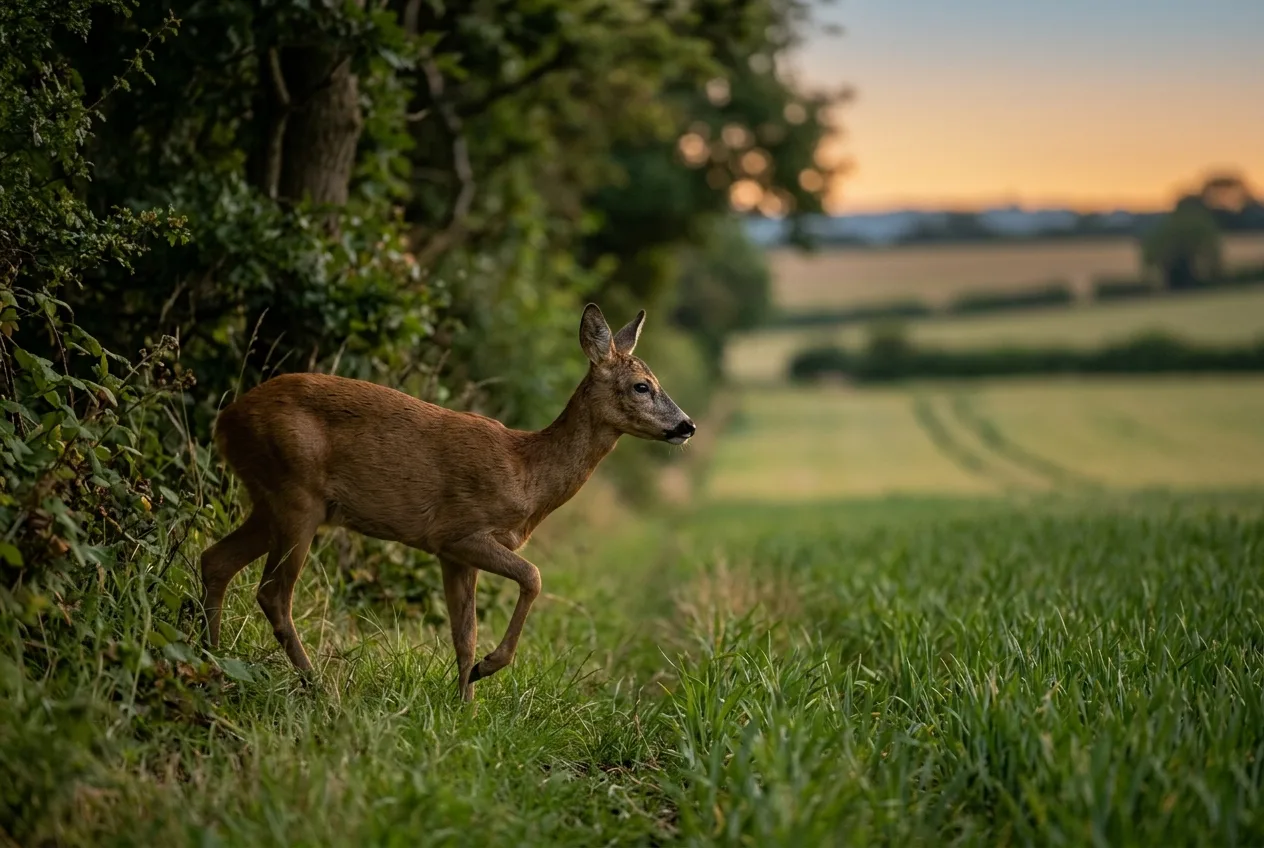
All of this is only useful if it tells you where to stand. It does. The single most important move is to stop thinking about deer food as a fixed thing and start tracking the current food source, because in the autumn especially it can "change in a flash" — summer forbs lignify, acorns start dropping, fruit falls, crops ripen, sometimes within the same week. The deer reshuffle constantly, and so should your cameras and stands.
Here's how to read it on the ground:
- Find the freshest sign, not just any sign. Because a deer's mouth can't take a nut or fruit in one clean bite, it leaves bits behind — and scavengers clean up leftovers fast. So partially eaten nuts or fruit mean deer fed there within the last day or two. Pair that with fresh tracks, fresh scat, and freshly nipped browse tips to pin down exactly where they're working now.
- Camera the food, with cover nearby. Set up within a few hundred yards of the most desirable energy food in the area — the hot mast tree, the standing corn, the apple flat — ideally with secure bedding cover close by. In the early season, a productive persimmon or apple is worth more than any food plot; once acorns start dropping, move to the oaks.
- **Know where the food grows, not just where it is today. Habitat structure tells you where forage concentrates. A young forest before the canopy closes can produce up to 1,000 pounds of deer forage per acre; a mature, closed-canopy forest puts out about 100 pounds or less**. Cutovers, burns, field edges, old fields, and recently thinned timber are where the browse and forbs pile up — and where the deer feed when there's no mast to chase.
- Match the camera to the season's food. At green-up and through summer, that's new growth, forb-rich openings, and crop edges. In autumn, it's soft mast first, then the acorns. In winter, it's the browse-heavy cover and any lingering hard mast. Move with the menu.
One practical note for anyone running cameras over a food source: the hot spots that draw deer draw everything else too — raccoons, opossums, turkeys, and squirrels all work the same mast and fruit. A camera on a dropping apple tree or a fresh scrape can rack up a pile of frames, most of them not the animal you care about.
The payoff for all this effort is a simple, durable skill. Bait and feeders can pull deer past a lens, but research shows bait sites don't necessarily attract every deer or make good hunting locations — learning to pattern deer by their natural, shifting food is what actually builds woodsmanship. Figure out what they want to eat, find it on your ground, and put yourself where the food is. The deer have already done the math; you're just reading their answer.
Frequently asked questions
What is a deer's favorite food?
When it's available, hard mast — acorns above all — outranks nearly everything; deer will reorganize their movements around a good acorn drop, and white-oak acorns are preferred over more tannic red-oak acorns. Outside the mast season, forbs (broad-leaved weeds) are the standout preferred class, being highly digestible and protein-rich.
Do deer eat grass?
Barely. Deer are concentrate selectors, not grazers — across studies grass is usually well under 15% of the annual diet and sometimes 2% or less, eaten mostly as tender new growth in late winter and early spring. Cereal grains like corn are the exception and get eaten readily.
What do deer eat in winter?
Mostly woody browse — the buds, twigs, and bark of trees and shrubs — once nuts and fruit run out, supplemented by any lingering hard mast and, in colder high-latitude range, evergreen leaves and buds. Reliance on browse rises the closer a herd lives to the poles.
How much does a deer eat in a day?
Through the growing season a deer needs to eat roughly 6–8% of its body weight daily in green forage and browse — about 6 to 8 pounds of green food per 100 pounds of body weight. For scale, a much larger elk eats around 20 pounds of vegetation a day.
Why do deer suddenly appear and disappear from a food source?
Because the food itself is changing. As one source ripens or gets used up and another comes on — fruit, then acorns, then crops, then browse — deer relocate to whatever's currently best, sometimes shifting their entire home range to reach a fresh mast crop. A spot that's dead this week can be the only game in town next week.
Do all deer species eat the same things?
No. Whitetails, mule deer, and roe deer are strict browsers focused on browse, forbs, and mast; red deer and fallow deer are intermediate feeders that take more grass; elk lean toward grazing. They follow the same seasonal logic, but the actual plants depend on the species and the place.